The Youth’s Instructor, Vol. LIII, No. 17

Korean Sketches

The Youth’s Instructor

April 25, 1905

Review and Herald Publishing Assn. · Washington, D. C. · April 25, 1905

Korean Sketches

Among the Country Folk
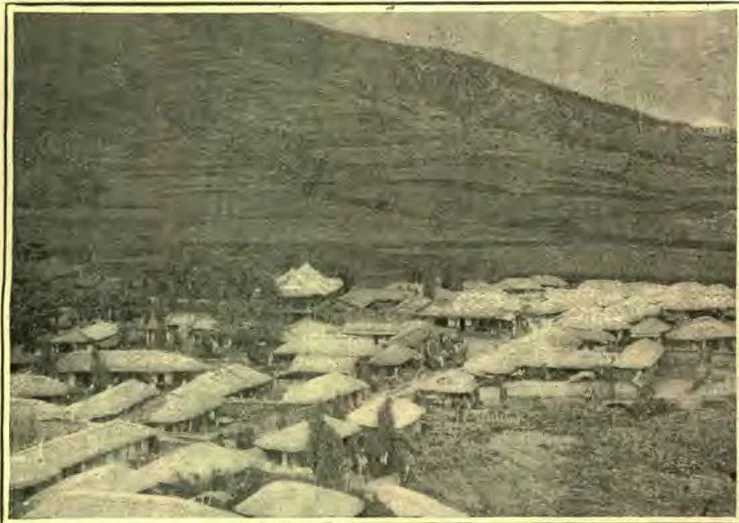
A TRIP through the country districts of Korea furnishes the traveler an opportunity to become acquainted with the people, and familiar with their manner of life. The most common mode of travel is on foot, and nearly all the so-called roads are mere paths through the fields. The dwellings of the people are grouped into small villages. As we near these, our approach is announced by the barking of numerous dogs, every household seeming to possess at least one noisy cur. Groups of children run out to watch the strangers, and the older people pause in their work while we pass.
We notice that there is no regular arrangement of the houses into streets, but narrow paths lead from house to house. In front of nearly every house is a cleared place where the grain is threshed. This threshing-floor lies just outside a small dooryard, usually enclosed by a fence or stone wall. These garden walls sometimes form three sides of a kind of shed which is roofed with thatch the same as the house. The side next the house is generally left open. This shed is used as a sort of storeroom; here also the family pig is often tied, and the donkey or pony stalled. Some part of this shed may even be enclosed to form a guest-room.
After a long tramp across country, we are glad to accept the hospitality offered us. We leave our shoes at the door with the slipper-like sandals worn by the natives, and find seats upon the mats which cover the floor. The Koreans sit with their feet crossed tailor fashion, and never with the feet folded under the body, as the Japanese do.
A KOREAN VILLAGE
A KOREAN VILLAGE
At meal-time the food is served on tiny tables about a foot high, and as large as a common tray. A generous bowl of rice and beans cooked together forms the principal dish. Dried fish, a kind of egg omelet generously salted, and a salad of coarse vegetables and red pepper, are common side dishes. The only form of bread I observed was griddle-cakes made of bean meal. The principal meals are eaten in the morning and at evening, only a light lunch being eaten at midday. The people eat heartily and hastily of this soft, poorly cooked food, and as a result indigestion and dyspepsia are very common.
At night the mats upon the floor form the beds, and smooth blocks of wood do service as pillows; but some families have quilted mattresses, and pillows of rice chaff. We thought ourselves fortunate to secure such a mattress, thick as an ordinary comforter. Then, spreading over this a woolen deck robe and a pair of blankets, we slept to dream of anything but woven-wire springs, hair mattresses, and feather pillows. Yet who could complain when the people freely provide the best they have to offer?
These country villages are without stores or shops of any description. All purchases must be made at the large cities and towns. In these same towns are the only post-offices; letters addressed to country places are delivered by private messengers in a very irregular and uncertain manner.
Because of their isolated condition and the inconvenience of travel, the country people live almost independently of the outside world. They eat the produce of their farms; cotton is grown, spun, and woven into the coarse fabrics which form their every-day garments; shoes are braided from straw, marsh grass, and a few strips of old cloth. A few kitchen and household utensils, and the material for their better clothes are the principal purchases made in town.
In the work of the farm all have a part; the women as well as the men and boys, may be seen working in the fields. The harvested crops have all to be carried over the narrow paths to the village. The men and boys carry heavy loads on their backs, the women place their burdens on their heads. The cattle are used as beasts of burden rather than as producers of milk and butter. Ponies and donkeys are also common. One may travel day after day and not see any sort of wheeled vehicle.
The village well or spring is a very busy place. Here the women do the family washing; vegetables and fish are brought here to be prepared for cooking. Water is carried in large earthen vessels upon the heads of the women in true Oriental style, and with an ease not unbecoming.
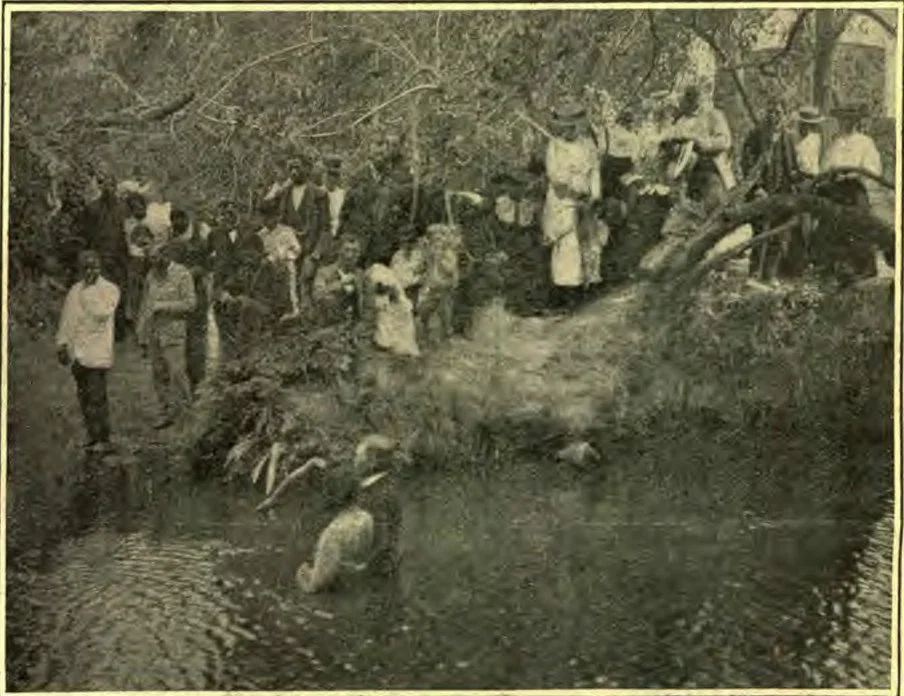
A SOUTH AFRICAN BAPTISMAL SCENE
A Korean village forms a picturesque part of the landscape; the thatched cottages do not obtrude themselves upon the eye as our modern dwellings do. But upon closer inspection, the beauty of the scene is marred by much disgusting filth. These people are greatly in need of instruction in the science and art of cleanliness. Here is a great field for missionary effort. The observance of a few simple sanitary rules would do much to improve the health and to increase the comfort and self-respect of these easy-going, unambitious villagers.
F. W. FIELD.

A Thousand Miles to Camp-Meeting

OUR party started from Cape Town for East London, South Africa, one Sunday evening about eight o’clock. The train was of the ordinary English type, consisting of carriages divided into small compartments. In each compartment are six berths, three on each side, as in a ship’s cabin. In the center is a table. These are much more convenient than the American carriages, as are nearly all the accommodations. The rate of travel, however, is exceedingly slow.
The first morning we awoke to see the broad stretches of the karoo all about us, with its dry, brown surface but slightly relieved by the boulder-strewn hills, or kopjes. These look like great sections of earth turned on edge, showing the strata of rock, which appear like great plowed furrows along their sides. There was no grass or timber, only stunted bushes and rocks.
We saw a few cattle by the side of the line, quite a number of sheep and goats, and some horses; but the land is so very dry and parched that one wonders how even these keep alive. This scarcity of stock was noticed all through the country, and is due to the late Boer War, and to the terrible rinderpest which killed live stock by the thousands only a few years before the war.
Along each side of the line can be seen the remains of old forts used during the war. They were built so the sentries could see from one to the other, and were surrounded by great entanglements of barbed wire. Between the forts were barbed-wire fences on each side of the railway, and at each bridge a permanent stone fort was erected. In many places also are long trenches on each side of the line, sometimes double rows of trenches. Even with all this guarding, the Boers many times broke through and blew up the line and the bridges. These relics, with the graves scattered along the way, first a solitary one, and then a whole graveyard, bear silent testimony of the terrible war which devastated this sunny land.
We passed several ostrich farms, where hundreds of these great birds roamed the vast expanse of seemingly barren land. One of the most interesting sights was a small animal very much like our Western prairie-dog. It is of a grayish-brown color, has a bushy tail like a squirrel, and lives about the same. It is called the “meerkat;” but more properly the suricate.
The camp-ground was reached on Wednesday morning. It was located on the main street, in a central part of the city. East London is a growing South African city, situated at the mouth of the Buffalo River, where there is an excellent harbor. It is a great wholesale center for a large inland district, and contains the largest number of wholesale stores in South Africa.
Our meetings were good, and the Spirit of God was manifested throughout the session. The one central theme was, Jesus is coming in this generation; we must get ready to meet him. When one can attend a meeting of this kind where are gathered workers from the missions, conference laborers, and many brethren and sisters who are holding up the banner of light in lonely and difficult places, one is bound to feel one’s own heart thrill with a love for this glorious truth, and a desire to bear the glad tidings to others. I only wish you might all have heard our dear brethren from the missions tell how the message was going to the native tribes of this dark land. Brother and Sister Sturdevant and Brother Sparrow from the Buluwayo Mission, Brother Chaney from Basutoland, Brother Armitage from Matabeleland, and Brethren Moco and Shone, who work for the Kafirs, were all there to report progress. It was evident that these brethren love the work. The statement made in a recent Testimony that “whole tribes will pick up the trailing banner of Prince Emmanuel, and carry it on to victory,” has put new life into our missionaries. We can see the beginning even now, and we know the work must quickly be finished.
A number of the Kafirs near East London have accepted the truth as the result of the labors of Brethren Shone and Moco; and by the intelligent testimonies they gave at the meetings, it was plain that they were well grounded in the faith.
Brother Moco has encountered many difficulties, and has met opposition and persecution in his work, as do also some of the converts. On several occasions he has been told to leave the location, and violence has been used to make sure his departure. One brother, who had been a minister, accepted the truth, and his former brethren did all they could to get him to give it up, finally telling him to leave. One morning he came to Brother Moco, all bruised and bleeding. Brother Moco said, “What is the matter; you are all covered with blood?” “O, those fellows caught me last night, and they gave me a jolly good hiding, I tell you.”
But still he stands a witness to the truth. As Brother Moco related this experience, I could see the face of this brother light up with joy, and I knew he esteemed it a privilege to suffer for Christ’s sake.
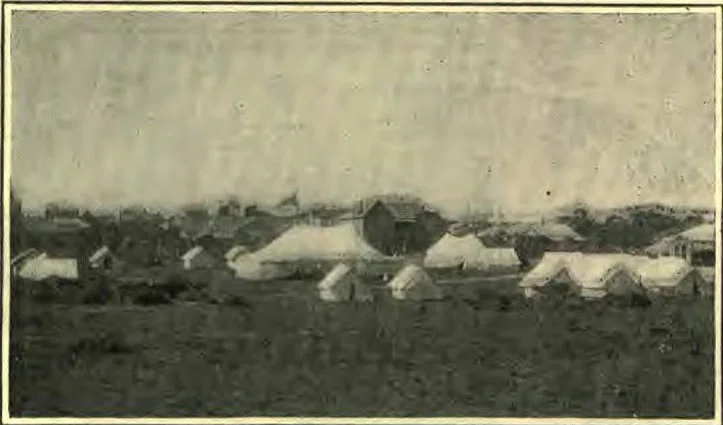
A baptismal service was held, at which several of these earnest souls were buried with their Lord. The illustration on first page shows Elder Tarr in the water baptizing a Kafir sister. Brother Moco can be seen on the extreme left, and just back of him Brother Armitage, standing with his hand on Brother Sturdevant’s shoulder. The picture below shows the camp-ground.
I am thankful to God that I have had an opportunity to attend an African camp-meeting; and I wish all our young people could hear and see what God is doing, especially for the native work in this country. They would be inspired to more earnest efforts in the accomplishment of our grand aim—“The Advent Message to All the World in This Generation.”
HARRY S. BECKNER.

What Prayer Cost Some Young Men

A PHOTOGRAPH on the wall of a friend's study attracted my attention. I asked who were the men whose pictured faces looked so earnestly at me. I can not forget the substance of his answer.
Some years ago thirty or forty Christian laymen agreed that we would each one make daily prayer for the conversion of the young men of our State, and for the speedy coming of the day when He whose right it is should rule King of kings and Lord of lords.
“We kept in touch with one another by means of letters to a secretary, from which he prepared a weekly bulletin sent to all.
“These bulletins were at first taken up with plans for our prayers and our Bible study. Soon they began to bear to us the joyful tidings of prayers answered in the conversion of individuals in different parts of the State. Later came word of revivals in many places. Then a bulletin told us that one comrade in our circle had given up his position, and had entered the ministry. Soon we learned that another had offered himself as a foreign missionary, and was on his way to China.
“Then we gathered at a forest camp for united prayer and conference. What wonderful days we spent there! And what prayers were made for the conversion of our young men and the spread of the kingdom! What earnestness and consecration were manifest on the part of every petitioner!
“Those prayers were speedily answered, though not as we had planned. They were answered in part, at least, as we might have expected when those first men offered themselves for the work of Christ at home or abroad as God willed.
“That picture at which you are looking was taken during the days of our conference in the forest. We can never again form a group before the camera. We are too widely separated for that. A—, who is seated there in the foreground, is now a missionary in Mexico; B—, at his right, is among the natives of West Africa; C— is preaching the gospel to the Navajos; D— is a home missionary in Oklahoma; E— is a minister in Kansas, preaching to the young men for whom he prayed years ago; F— is in Japan; G— is in South America.”
Other names and locations were mentioned, until I realized that something like half of the men who made up that company had gone out into the Master's vineyard as ordained or lay workers; and at the time of the conference most of them were engaged in what they thought was to be their life-work.
Is it strange that I replaced the photograph with a hand which trembled as I thought of those earnest men whose prayers for others had thrust them out to be used as God's instruments in bringing the answers to their own petitions? I had received a lesson in the cost of prayer.
Do we sometimes think it an easy matter to do the Master's bidding in praying that the Lord of the harvest send forth laborers into his harvest? Do we think we rid ourselves of responsibility in the premises when, once or twice each day, we say to God, “Thy kingdom come”? On the contrary, the Christian who pleads, “Thy kingdom come,” in the spirit desired by him who taught the petition, is thereby consecrating to God's service his whole life, to be used as he sees best in the spread of that kingdom. And the follower of Jesus who from the heart asks that laborers be sent forth to gather the harvest of souls must be willing to be himself thrust out—if God wants him.
All real prayer costs. Our Saviour's prayers cost him strong crying and tears and great drops of blood. They led him to Calvary and the tomb. Where do our prayers lead us? What do they cost us?—John T. Faris.

In the Region of Your Heart

If you're feelin' sort o' fretful, If you're feelin' sort o' blue, If you're apt to be forgetful Of the blessin's owned by you, Then it's time you went to doct'rin' For each little burn an' smart; Give yourself a close inspection In the region of your heart.
If you find that organ coated With a coverin' of hate, Then the pain can all be routed By a means not intricate; Take some love an' pity, mix 'em Thoroughly, with gentle art; For the blues, one dose'll fix 'em, 'An' 'twill regulate your heart.
If you're cross an' sharp an' "snappy," From the break o' morn till night, When you ought to be so happy, That's a sign your heart's not right. Take some blessed oil o' kindness, Aim it at your brother's heart,— This will stop your slothful blindness, An' a perfect cure impart.
There are many hearts affected In a manner sad to see,— Some o' them have been neglected To the very last degree; Rouse yourself an' go to workin', Weed out gloom, remove Hate's dart, Leave no festerin' wound a-lurkin' In the region of your heart.
— Benjamin Keech.

Christ's Love as the Source of True Transformation

It is the love, pity, and kindness of Jesus himself that will work the cures told about in the poem given above. Mere human love and kindness will not cause any permanent transformation.

Over and Over Again: Lessons in Life

“Over and over again, No matter which way I turn, I always find in the book of life Some lessons that I must learn; I must take my turn at the mill, I must grind out the golden grain, I must work at my task with a will, Over and over again.”

The Name at the Top

THE foreign mail had come in, and the missionary on furlough had a letter from one of his native helpers in China. He was showing to one of the home folk the thin sheets, traced with the neat and accurate characters in even columns. The onlooker noticed that some of these columns did not begin at the top of the page, but left a space above them, and asked what it meant.
“Sometimes it is the beginning of a paragraph,” was the reply, “but oftener it is a token of respect. The writer meant to put my name at the top. In this way they indicate reverence and regard. The Christians always write the name of Jesus at the top of a column. It must always be above whatever else is written.”
Is this not significant? Surely the “Name,” which is in itself “above every name,” should come first in everything, and be placed above all that we think or do. Would we not be more careful about what we write, would we not be more charitable and considerate in what we say, if we put our Lord’s name down first of all, and tried to do all things “in his name”?—Selected.

Jenny Lind’s Salute

FIFTY years ago, when Jenny Lind was singing in New York, the American frigate “St. Lawrence,” returning from a cruise abroad, came into the harbor. The young midshipman on the first night of their shore leave went to hear the famous singer.
The next day the boys, to express the emotions her wonderful voice had stirred in them, called on her in a body. They hardly expected that she would receive them, but she did; and she was so charmed by their youthfulness and ingenuousness that when they timorously asked her whether she would like to see their ship, she accepted the invitation. Then, growing bolder, they asked her to luncheon, and she accepted that invitation, too.
When, on the appointed day, she came on board with her companion, the captain saw her from his cabin, and recognized her.
There is nothing more strict than the courtesy observed in ship etiquette among officers of all ranks. Of the three messes—the captain’s table, the ward-room, and the steerage mess, where midshipmen eat—no officer, from captain down, would make himself one of a company at another mess, unless specially bidden.
In this case the captain rang the bell for the orderly.
“Tell the gentlemen of the steerage mess,” he said, “that the captain is going ashore, and that his cabin is at their disposal, if they care to use it.”
The luncheon, however, was eaten in the steerage; but, after the pleasant meal was over, the boys proudly invited their guest into the captain’s cabin, where they took their coffee.
“Ask her to sing something,” whispered the paymaster’s clerk.
“I’ll thresh you if you dare!” returned one of the midshipmen, under his breath.
The ward-room officers had guests, too. They brought up guitars, and sat on the poop-deck above, singing “The Suwannee River” and other popular songs.
“How pretty!” cried Jenny Lind, with enthusiasm, clapping.
When at last she was leaving, she paused on the steps between the carved sides of the gangway. Looking up at the floating stars and stripes, she said, “I wish to salute your flag.”
Uncovering her head and holding her hat in her hand, she began to sing “The Star-Spangled Banner.”
As she sang the first verse, every officer and every man came silently on deck. When she had sung the song to the end, deafening cheers rang out from the “St. Lawrence,” and were taken up by every ship near by, for all had been listening.
Steamers blew their whistles, and every man within reach of that thrilling voice knew that he had heard one of the world’s most inspiring songs sung as he would probably never hear it sung again.—Exchange.

Home Courtesies

CHARM of manner is made up usually of gracious observances of small courtesies. Heredity is unrelenting, and charm is a great birthright; but when these qualities are lacking, attention, effort, and above all things, desire, may overcome tremendous barriers. Though society may do without a good heart, it will not dispense with that appearance of it, which we call amiability of manner. This amiability may not always give that illusive something known as charm, but charm never exists when it is absent.
Simple flattery is not pleasing, but the actual making one do his best, and not alone thinking he is doing it, may be pleasing. Unselfishness is the root of all graciousness, as indeed it is the parent of most virtues, for charm loses its influence unless maintained by the superior qualities of mind and heart. A rude, unkind speech or act will make the most beautiful face appear ugly to one who looks below the surface. One of the greatest secrets of charm is charitableness and scrupulousness in imputing motives to those who interfere with our even way. Wit and eloquence fall flat when unkindly leveled at the weak and defenseless.
Originals are preferable to copies, and every one should dare to be himself. Individuality, when combined with graciousness, is a most potent weapon. Adjustability is the keynote of pleasing. Feel a sympathy with the aged, and you are prompted to say the thing that interests the aged. Feel sympathy with a child, and you have won that child. In a word, the secret of charm is in giving. Even extend your hand with the spontaneous suggestion of giving, and you have done much toward winning those you meet. Give something of your own nature, and do not discourage your friends by dropping a veil over your thoughts.
It has been said that the dining-room service and the dining-room manners and conversation of a family are the keynote to their home life. Be that as it may, we know that if the members of a household have refined and cultivated instincts by nature, or have been well-bred, their table manners are sure to indicate it. Any form of illness, suffering, or trouble should never be alluded to in conversation at the table. It matters not whether a calamity be great or small, public or private, the discussion of any manner of affliction could find no more inappropriate place. All differences in religion, politics, and individual opinion, as well as literary tastes, should be tabooed here, and harmonious subjects, with pleasant talk and laughter, take their place.
Children often need words of advice here as elsewhere, which may be given if there is no guest present. If this is not sufficient, it is often wise to excuse the child quietly from the table, and, in the privacy of one's room, to give the matter discussion, and correction, if necessary.
The habit of finding fault at the table with the food prepared for it, or the table service, indicates a lack of good training that should be overcome, no matter what age the fault-finder may have attained. Neither by look nor tone should such annoyance be shown, and a semblance of trying the food, rather than the ignoring of it entirely, is desirable.
Diverting incidents and amusing anecdotes should be stored away in the minds of different members of the family, to be told at the table. Every one should strive to cultivate table conversation. It is an art which, once learned, will stand one in good stead among strangers and in trying situations. Better than that, it is one of the best digesters of food known to the medical profession, and it is a rare thing to find dyspeptics where such conversation is practised.—Frank H. Sweet.

He Would Not Be Tempted

A CERTAIN boy, who had been taught the nature of strong drink, and who had promised ever to shun it, was sent to a school the master of which was not a teetotaler. One day the master, being in a friendly mood, offered the boy a glass of wine, which he declined. Wishing to see how far he could be tempted, he urged the boy to drink the wine, and finally promised him the gift of a watch if he would only drink. The boy declined, saying, “Please don’t tempt me; if I keep a teetotaler, I can some day buy a watch of my own; but if I drink and take your watch, I may later on have to pawn it to get bread.”—Temperance News.

The Difference

“THAT'S right, mother; don't you let any one else put you to bed. You just wait till I get home.”
The invalid smiled happily, as her daughter, who had just returned from her work, spoke thus blithely, and began the task of taking off the clothing from the poor, rheumatic limbs.
A little thing, you say. Maybe so, but there is still the truest heroism in it. No one but a working woman, tired in body and soul, can know what it means to shoulder an additional duty at the end of the day, and shoulder it unshrinkingly, nay, cheerily. Many there are who would do it from a sense of duty; but if there were no other feeling, the inmost attitude would inevitably be betrayed. Think you that in such a case there would come the joy and happiness to the recipient which the cheery, spontaneous service mentioned brought?—Selected.

Cure for the Blues

In a certain town a number of cures were established. There was a faith-cure, a hot-water cure, a cold-water cure, and a cure for the blues. Thinking that in these days of business depression and financial stringency, when more or less acute attacks of the blues are so prevalent as to be almost epidemic, a reliable remedy would be a delight, we give the one recommended at this cure. On his arrival at the cure for the blues, the patient was shown into a small office where sat a physician. After questioning the patient a little, he gave him a small box, charging a few cents for it, and charging him to keep the contents a close secret. In the box was a slip of paper with these words: “Let no day pass without doing something for some one.” This prescription carefully taken is guaranteed to cure the most chronic case. We hope if any one under whose eye this may chance to fall, is suffering from this melancholy disease, he will give it a trial.—Selected.

THE WEEKLY STUDY

Paul Leaves Corinth for Jerusalem

Opening Exercises.
Scripture for Study: Acts 20: 3-16.
Reference Study: “Sketches from the Life of Paul.”
Topics for Study:— Leaves Corinth. Plot discovered. Enter Macedonia. Companions in travel. Remains behind in Philippi. Reach Troas. Eutychus restored. Departs on foot for Assos. Leave Assos for Mitylene. Arrive at Samos. Reach Miletus.

Notes

Do not fail to trace on a map the route taken by the apostle in his journey to Jerusalem.
Paul remained at Corinth for three months. It is likely that he visited Athens, and the scattered believers in the other parts of Achaia. It was during his sojourn here probably that the epistles to the Galatians and the church at Rome were written.
Paul’s desire was to reach Jerusalem before Pentecost, but, a plot to take his life becoming known, he changed his route, and went by way of Macedonia.
From the use again of the pronoun “we” it seems that Paul is once more joined in his travels by Luke, who seems not to have been with Paul since his first visit to Philippi. Acts 16: 10-14.
Learn all you can of the history of the places mentioned in this lesson as being visited by Paul. Commenting concerning Paul’s journey on foot from Troas to Assos, Conybeare and Howson say: “And strength and peace were surely sought and obtained by the apostle from the Redeemer, as he pursued his lonely road that Sunday afternoon in spring, among the oak woods and the streams of Ida.” Paul evidently had no thought of observing the day as the Sabbath.
“Having completed his work at Corinth, he determined to sail directly for one of the ports on the coast of Palestine. All his arrangements had been made, when he was informed of a plot laid by the Jews to take his life. . . . Upon receiving warning of the plot, Paul decided to change his course, and go round by Macedonia, accompanied by a sufficient number of brethren to protect him. His plan to reach Jerusalem by the passover had to be given up, but he hoped to be there at Pentecost.”
“At Philippi Paul tarried to keep the passover. Only Luke remained with him, the other members of the company passing on to Troas to await him there. The Philippians were the most loving and true-hearted of the apostle’s converts, and he enjoyed a peaceful and happy visit with them during the eight days of the feast.”
“On a broad sill of a window whose shutters had been thrown open, sat a youth named Eutychus. In this perilous position he sank into a deep slumber, and at last fell from his seat into the court below. The discourse was interrupted. All was alarm and confusion. The youth was taken up dead, and many gathered about him with cries and mourning. But Paul, passing through the affrighted company, clasped him in his arms, and sent up an earnest prayer that God would restore the dead to life. The prayer was granted. Above the sound of mourning and lamentation the apostle’s voice was heard, saying, ‘Trouble not yourselves; for his life is in him.’ With rejoicing, yet in deep humility at this signal manifestation of God’s power and mercy, the believers again assembled in the upper chamber. They partook of the communion, and then Paul continued his discourse till the dawn of day.” G. B. T.

A Report Worth Reading

Until recently our young people in Pittsburg have done very little toward telling the people of this section about this great message that God has committed unto us for the world in this generation. We have been organized into a band for a year or more, but it seems, for the lack of something, we have made little progress; but by studying the Word of God, we found that there is only one way to make a success in the Christian life, and that is to make a complete surrender of all to Christ. A few months ago a number, if not all of our young people, determined to be more careful about the study of the Bible, also to have a season of secret prayer each day. This has proved to be the leaven of each life.
One of our young ladies said recently that since she had been making a daily study of God’s Word and had been holding secret communion with the Lord, she had become stronger, and she found more pleasure in Christian work, and was better able to do the work as Christ would have it done.
The psalmist says, “He that dwelleth in the secret place of the Most High shall abide under the shadow of the Almighty.” Since our reconsecration the Spirit of God has seemed to take possession of the workers, and all are doing good work. The young men and women who have never taken part in the public meetings, are taking up their work as it is assigned them, and are doing it as unto God.
We have put up two tract racks in one depot, and they are filled each week by one of the members, and sometimes twice a week. The people seem glad to get this good reading. All the members join in helping to get the money to buy the tracts. One month ago each member agreed to give twenty-five cents as a talent, and then to see how much he could make by doing some faithful work to multiply it. Our report of this talent on the second of April, showed an increase of twenty-seven dollars; and a number were not present who have good reports to make on the talent fund. Besides this we try to keep all our committees at work. The two tract racks put out from five to eight thousand pages of tracts each month, besides papers of different kinds.
We sent out one hundred eighty copies of the April Life Boat to ministers of different denominations, and have ordered five hundred copies of the “Open Letter,” which we expect to send to the ministers in this section.
The Lord has greatly blessed our work here, and it is our constant prayer that we may grow more and more into a perfect knowledge of Christ, and be able to have a part with him in this closing work.
REUBEN FINNELL, Chairman, RALPH ASHTON, Secretary.

The Soul’s Morning Bath

THE quiet hour has been called by some old writer—if I am not mistaken—“the soul’s morning bath.” There is much significance in this expression. It is not only the time when the soul, lifted up into the ocean of God’s presence, is washed clean from the stains of the past, but it is also a tonic, like a cold bath in the early morning, which refreshes, invigorates, and inspires for duty. Those who enjoy its refreshment never wish to get along without it. It seems as necessary to the beginning of the soul’s day as the ablutions are necessary for the body on arising from sleep, and, throughout all the hours of the day, the soul feels the stimulus and refreshment of its beginning.—Francis E. Clark.

The Reading Box's Story

I AM only a reading box. Kind friends nailed me to the side of a stump where four roads meet. They keep me supplied with papers and tracts that tell about the dear Saviour, who came into this world, suffered, and died that all might have eternal life. They teach that men should keep the day that Jesus kept while he was here on earth, and that this same Jesus is coming again soon to take his children home to himself.
I have a notice on my side which tells the passers-by that I have good literature to give them. A part of the time many strangers pass along the road, some in search of wild fruit, and some hunting for deer; others work in logging-camps and saw-mills. Some are pleasure-seekers; while others are bent on business. These people visit me quite often. Many call out of curiosity to see what I have. Sometimes they seem pleased with what they find, but others appear disappointed. Some show their appreciation by a second call.
One day a man came along, who, because the papers did not suit him, became very angry. He took hold of me and tore me apart. He left my back where it was, and put the rest of me on top of the stump. Then he destroyed all my papers. I felt sad about it; but my friends fastened me together, and gave me some new papers, and then I was happy.
The people seemed glad to see me again at my old post. They kept calling on me right along. I often wish that I could go to the homes of the people, and hear what they say after reading the good papers; but of course I can't leave my work. So I trust it all to the Lord, and am content to know only what I observe.
One day two tracts came back to the box with a queer story to tell. A man took them out, glanced through them hastily, and threw them away on the snow. A friend of mine saw them lying there, and took pity on them. He picked them up, carried them to his home, and thawed them out; for they had frozen almost stiff; then he brought them to me again. A few days later these same tracts were again taken out, and had a similar experience.
After having such rough treatment they began to be somewhat dilapidated. However, they came back to the box the third time.
It was now winter, and the snow began to drift, becoming so deep that I thought I should be covered up; but somehow I escaped that misfortune. The traveling was so bad that for a long time very few persons passed this way, and I began to fear that my usefulness was at an end.
But now the snow is nearly all gone, and the green grass and the birds have come again. And so the people are coming once more for papers.
Since my friends placed me here between one hundred and two hundred papers and tracts have been taken from me. I am told that there are only a few boxes like me. I wish there were a thousand. They would surely do much good.
JUDSON A. BAKER.
Continue reading: April Showers