1. By what striking parable does the Lord illustrate His gifts to His children, in Luke 19?
By the parable of the pounds given to every one of His servants.
2. By what parable in Matthew 25 does the Lord illustrate the same thing?
By the parable of the talents given to every one of His servants according to their ability.
3. For how long and what purpose were these talents given?
They were given by Christ WHEN He went away. They were given to be used to profit until He should come again. They were given to EVERY ONE according to his ability. They were given to every one to PROFIT therewith. And each one who received them was to RENDER ACCOUNT when Christ came.
4. What are these bestowals called elsewhere?
Now concerning SPIRITUAL GIFTS, brethren, I would not have you ignorant. 1 Cor. 12: 1.
5. What examples of gifts does the apostle there name?
For to one is given by the Spirit the word of wisdom; to another the word of knowledge by the same Spirit; to another faith by the same Spirit; to another the gifts of healing by the same Spirit; to another the working of miracles; to another prophecy; to another discerning of spirits; to another divers kinds of tongues; to another the interpretation of tongues. 1 Cor. 12: 8-10.
6. For what purpose are they given?
But the manifestation of the Spirit is given to every man to PROFIT withal. Verse 7.
7. To how many are they given?
But all these worketh that one and the self-same Spirit, dividing to EVERY MAN severally as He will. Verse 11.
8. What gifts does the apostle elsewhere name in the same class?
Wherefore He saith, When He ascended up on high, He led captivity captive, and gave gifts unto men. . . . And He gave some, apostles; and some, prophets; and some, evangelists; and some, pastors and teachers. Eph. 4: 8, 11.
9. For what purpose are they given?
For the perfecting of the saints, for the work of the ministry, for the edifying of the body of Christ. Verse 12.
10. For how long?
TILL we all come in the UNITY of the FAITH, and of the knowledge of the Son of God, UNTO A PERFECT MAN, unto the measure of the stature of the fulness of Christ. Verse 13.
11. What promise is given us concerning these gifts just before Christ shall come?
I thank my God always on your behalf, for the grace of God which is given you by Jesus Christ; that in everything ye are enriched by Him, in all utterance, and in all knowledge; even as the testimony of Christ was confirmed in you: SO THAT YE COME BEHIND IN NO GIFT; waiting for the coming of our Lord Jesus Christ. 1 Cor. 1: 4-7.
Christ's Coming
The next event in the great drama of the prophet is thus described:
"And I looked, and behold a white cloud, and upon the cloud One sat like unto the Son of Man, having on His head a golden crown, and in His hand a sharp sickle." Rev. 14: 14. It is Christ our Lord coming to reap earth's
What Presbyterians Declare
(From the Confession of Faith)
The Bible contains the whole counsel of God concerning all things necessary for His own glory, or man's salvation, faith, and life.
The moral law doth forever bind all, as well justified persons as others, to the obedience thereof; and that not only in regard to the matter contained in it, but also in respect of the authority of God, the Creator who gave it. Neither doth Christ in the Gospel any way dissolve, but much strengthen, this obligation.—Article 5.
Neither are the aforementioned uses of the law contrary to the grace of the Gospel, but do sweetly comply with it, the Spirit of Christ subduing and enabling the will of man to do that freely and cheerfully which the will of God, revealed in the law, requireth to be done.—Article 7.
Stewards of God’s Grace
AS EVERY MAN HATH RECEIVED THE GIFT, EVEN SO MINISTER THE SAME ONE TO ANOTHER, AS GOOD STEWARDS OF THE MANIFOLD GRACE OF GOD. 1 Peter 4: 10.
The Sabbath as Creator’s Sign
which constantly brings to them His power as Creator and as Re-creator, as Generator and Regenerator, as Sanctifier and Keeper of His children. The remnant church will know the Sabbath for what God designed it to be.
The Forks of the Road
By Clara Edna Rosencrans
By Clara Edna Rosencrans
"YES, just keep on the ridge for a mile or so. You'll see two or three dim trails that lead off into the woods; but keep to the main traveled road till you come to the place where it forks. Then go to the right hand, and it will take you straight to his house."
How often one hears this bit of information, as one travels through wooded, hilly stretches of country, where the main or county roads are intersected at every turn by dim, unworked trails leading off over the knolls, or "knobs" as they are called, winding in and out, till at last they bring one, without warning, to a quiet farmhouse nestled away in some green valley.
And as we often see beauty in the commonest objects, as man is strengthened by the most homely toil, so it seems to me that we who are traveling through a strange country, beset with hills of difficulty and valleys of temptation and sorrow, may get a lesson of courage and hope from this simple direction of our mountain friend, who knows the country for miles around, and could draw a map of it on the ground without omitting the tiniest cow-path.
He knows exactly what will happen if you turn to the left hand instead of the right, if you go up an incline instead of down a hill, and can tell you with unerring judgment how far it is across the mountain to Farmer Brown's. His knowledge is exact, and as a guide through these wild regions he can not be surpassed.
Now for the spiritual lesson. We have been sojourners here for over a half century, claiming to have a definite aim in view, claiming to be guides pointing others through this world, with its "knobs" of difficulty, its "hollows" of pain and sorrow,—to use another expression common in the Ozarks,—on to a better country, where the dwellers will be loyal servants of the King of Kings.
But can we point the inquirer with definiteness and certainty toward the road that will lead him Zionward? Have we used our ears and eyes to as good purpose as has our mountaineer? When we meet some earnest inquirer after truth, are we able to cite chapter and verse which gives us our warrant for faith in this Threefold Message?
These are solemn questions, questions which need earnest, prayerful thought, which must receive an answer, as we hope for eternal life.
The pioneers in this mountain region used to "blaze" out roads through newly opened tracts of timber. That is, the bark would be "scalped" from trees a hundred and fifty or two hundred feet apart, making a continuous line of these primitive sign-boards for perhaps several miles.
Even so it is with this "Highway of Holiness." All along the path that our feet press, are emblazoned the sign-posts of our mighty Guide.
Here at the beginning, as our feet first enter the way, we read, "This is the way, walk ye in it." Then a little farther on we see shining out this blessed assurance: "He that followeth Me shall not walk in darkness, but shall have the light of life."
Ah, over and over, as we fare homeward, we find these sign-boards, in one place warning us of danger to be avoided, or pointing the way to an inn, or quiet retreat, placed here by the kindly thought of our generous Sovereign; in another telling where crystal springs gush forth, where amid cooling shades we may bathe our weary feet and rest after the toilsome upward climb.
But by and by we will come to the forks of the road. It is on the top of the ridge, remember, that the road takes a sudden turn.
To the right hand it leads over the stony, uneven ground. Briers here and there line the narrow track and hinder our progress, and we wonder sometimes why these things should be there.
Then we remember that our Guide-book, which we carry along with us, has told us that by this road only can we gain the heavenly city; and our hearts grow strong again.
Far otherwise, however, is the track which leads to the left hand, the path of self-indulgence and worldly pleasure. Smooth and easy, a steady downward slope, it is here that we very often get out of the way. There are no briers to wound the feet, no stones to make the progress hard; and there are many companions to keep our minds occupied, and make us forget the holy, pure, unspotted life that is the atmosphere of the high "ridge road" leading to the right.
Ah, let us remember that the joy of this lower way is elusive and short-lived, that it leads downward to death, and that in the highway of spotless purity are pleasures forevermore.
And let us remember also that our Guide has been over every step of the way before us; and that if need be, holy angels will be sent to stay us, and lead us onward and upward, till at last we come to the city of eternal joy, the home of those who have been faithful, steadfast, and who have conquered.
There are two ways for travelers, only two ways.
One's a hill pathway of battle and praise.
The other leads downward; tho flow'ry it seem,
Its joy is a phantom, its love is a dream,
Its love is a dream, 'tis only a dream.
Mountain Grove, Missouri.
Obedience
By McK. Geere
By McK. Geere
CHARLES JOHNSON was a good citizen. He was honest, kind to all, free from bad habits. He injured none. He went to church very regularly. But that was where he became subject to much comment, and even criticism; for he went to church on Saturday, and kept that day sacred from all work. Also, out of respect for civil law on the subject, he did very little work on Sunday, and that in a very quiet way. He was not rich, and it was not likely he would ever be so; for he was honest and benevolent, and such do not seem to get rich.
One evening he was at the house of Joseph Jones on some small business errand. After it was transacted, as he sat talking to Jones, and the boys were sitting on the steps, Jones said to him: "Excuse me, Johnson; but for such a sensible man as you, I think you are foolish about one thing. You don't do anything Saturday but go to your church, and on Sunday you don't work either. Now as hard as times are, none of us can afford to lose two days out of each week."
"But you know, Brother Jones," answered Johnson, "the Scripture says, 'Remember the Sabbath day, to keep it holy;' and Saturday is the Sabbath. The people who have always kept the Sabbath day since they were a people, are the Jews; and you know Saturday is their Sabbath. I don't, of course, go to their church, for they have never accepted Christ, and I am a Christian."
"Yes, I know you are an Adventist, and I believe that the Jews are keeping the same day of the week for a Sabbath that they used to; but I think it was changed to Sunday after Christ came."
"Yes, it was; quite a long time after Christ came, it was changed. But it was by man, and not by God; and we must obey God rather than men."
"Well," said Jones, "I don't think it makes much difference anyway. God says to keep the Sabbath. If I keep one day in the week, I don't think it makes any difference what day. We obey if we keep a Sabbath."
Johnson still held to his position; but seeing that it was useless to try to convince a man against his will, he did not contend further. The Jones boys were listening carefully; and after Johnson left, one boy said to his father, "Johnson thinks Saturday is the only Sabbath, don't he?"
"Yes," said his father; "he is crazy about that. But he is a good man. His religion is all right for making good people. But one day is as good as another."
Soon after, on a Saturday, there was a high wind, and a tree in Jones's swamp pasture field was blown down, and fell across the fence, making a gap that cattle could get through to the road from that field. Jones noticed it in the evening, and said to Carl, his oldest son, "On Monday you take an ax and go and fix the gap where that tree fell across the fence in the swamp pasture."
"All right," said Carl.
On Monday Jones was very busy in various ways, and on Tuesday he took a horse and light carriage, and started on a business trip that would take two days. A few miles from home he stopped at the farm of Mr. Smith, who used to live near Jones's home. Of Smith he bought three young steers, on condition that Smith deliver them at Jones's home. "If you don't see the folks, you can just put them through the red gate, into the swamp pasture field."10
"All right," said Smith; and he started right away with the cattle.
After Jones was half a mile one way, and the cattle half a mile the other way, Jones thought of that gap where the tree fell, and stopped.
"O, well, I told Carl to fix it, and he is a good boy to mind, so of course it is done," and he went on, tho he knew he had been so busy he had not asked Carl if he had fixed the fence, or even noticed what Carl was doing Monday.
Late Wednesday evening, Jones returned home. "Did you notice how the new cattle were getting along in the swamp pasture?" he asked Carl.
"Didn't know there were any, didn't see them," said Carl.
"Then Smith must have put the bunch in when you were all away," said Jones. "Of course you fixed that gap in the fence?"
"Yes, I fixed it the last thing yesterday evening."
"But I said to fix it Monday."
"Well, Silverthornes offered me two dollars to help make hay Monday, and I knew there were no cattle in that field, and so I thought it was no difference which day it was fixed. You know you said one day was as good as another, the evening Johnson was here and you were talking about the Sabbath."
"Well, go and look if they are there."
They were not. Late as it was, two horses were brought out, and Jones and Carl started in search of those cattle. Late that night they found they had gone back to Smith's. As strays they had been chased by dogs. One had a badly bitten tail. Another had scratched a shoulder on a barbed wire fence. All three looked bad. Their chase had set them back a month on the time it would require to get them ready for the general market. And all because the order to fix the fence had been executed Tuesday instead of Monday. But Jones could not scold Carl much, for he thought: "The boy only did with my commands what I taught him we might just as well all do with God's commands. Am I better than God, that my commands must be obeyed literally, and His according to our convenience only? I will never criticize Johnson again for keeping the Sabbath on the exact day that the Lord appointed."
Saving Knowledge
By Delwin Rees Buckner
By Delwin Rees Buckner
O, TELL me if that man is truly wise
Who has been skilled in every useful art,
Yet lacks the secret of a happy heart;
Whose eyes have viewed the scenes that mortals
prize,
Yet never yearn for nightless heaven's skies;
Whose feet have left their prints in every mart
Of any size, but have not made a start
As yet upon the road to Paradise.
The hungry grave yawns ever at his feet,
And muffled bells are tolling in his ears.
O, is it wisdom in him to delay?
The pleasures of the world, tho seeming sweet,
Endure but only for a few fleet years,
And then comes death to bear them all away.
Cristobal, Canal Zone, Rep. de Panama.
Every Life a Surrendered Life
Every one lives a surrendered life. But not every one has surrendered to Christ; and those who have not have surrendered to the devil. For no one ever does his own unbiased, unmastered will; Christ and Satan are incessantly contending for the control of that will, and when Christ does not win, Satan does. It is like a rowboat in the center of a swiftly moving stream: it must either go with the stream or resist the stream all the time; there is no instant when it is free to do neither. It follows that either Christ or Satan is using us all the time to do his work. Just as Christ uses a life that is wholly surrendered to Him to give of Himself through that life to others, so the devil uses a life that yields to him to give of himself through that life to others. It is an awful thought. But we can not escape it. Satan enters one life through another. We bring Satan or Christ to our fellows all the time. And even we who are Christ's can so yield ourselves to Satan that Satan can use us in a death-dealing way. How he must rejoice in the opportunity to injure not only us but others when we fling open the doors of our life to him! With most Christians it is a fact that they are sometimes communicating Christ, sometimes Satan, to those near them. With a few, it is always and only Christ. Why not with all of us?—S. S. Times.
Was Jesus a Jew?
By C. L. Taylor
By C. L. Taylor
EVERY student of the Bible knows that Jesus Christ was "of the seed of David," that He was "the carpenter, the son of Mary, the brother of James, and Joses, and of Judah, and Simon." Indeed, almost every child knows that Jesus was a Jew.
But while Jesus was born a Jew, and found His genealogy among that people, yet never for one day did He live simply as a Jew. He lived as the Son of God. He was always found attending to His Father's business.
Jesus Christ was the Word "made flesh." He was "the Desire of all nations," the universal Man. As the seed of the woman, the second Adam, He came to fulfill the needs of the human race. In Him every nation under heaven was to find its great Center and Head.
Christ was given for all men and to all men. The seamless garment, the Jewish humanity, were but exteriors which hid from vulgar eyes the incarnate Truth which is "the power of God unto salvation to every one that believeth." In Him "there is neither Greek nor Jew, circumcision nor uncircumcision, barbarian, Scythian, bond nor free."
Yes, He was a Jew, and yet He was not. He was "the Citizen" of "the kingdom of heaven." Of Him it may be said that glory celestial found a hiding-place in human bosom. He was the personification of divine power. Through Him and in Him the life of God was translated downward, that by faith in Him the life of man might be translated upward. He was the connecting Link between fallen men and the throne of Deity.
Infinitely more than a Jew, therefore, was our Lord. And as men have gone into all the world to preach Him, so the blessed Scriptures reveal Him, they find Him to be the only One whose presence satisfies the cravings of the starving race. He alone is the unfailing and universal remedy. Truly "there is none other name under heaven given among men, whereby we must be saved."
As He was the universal Man, so His is the universal Gospel. His Word received in faith, His life again made incarnate, breaks down national barriers, race prejudices, social distinctions. His children no longer know one another as American, European, Eurasian, or African, as the case may be; no, they are "all one in Christ Jesus." They are simply "brethren," working together in love and unity, preparing to leave the "strange country" of earth for the country of whose glory they have had vision.
The converted Jew of to-day is no longer simply a Jew; the heathen is no longer simply a heathen; the German is no longer simply a German; the American is no longer simply an American. Men may so count them, and for a time they may continue to dwell where birth placed them; but they are only "pilgrims and strangers." Their true citizenship is in heaven, and the home land lies beyond. Each day they follow Jesus, drinking in more and more of His life; and one day they shall see the establishment of His universal kingdom, to which everything local, sectional, and national must give place.
Jerusalem
By J. O. Beard
By J. O. Beard
Tune, "America"
JERUSALEM, of thee,
Home for eternity,
Of thee I sing.
Home glorious and bright,
Home where can come no night,
Abode of life and light,
Home of my King.
Home now prepared for me,
Home where I long to be,
Thy name I love.
I love thy pearly gates,
Thy golden streets, where waits
The joy that ne'er abates,—
O home above!
I love thy jasper walls,
On which no shadow falls
Of sin's dark night.
Life's river flowing free,
Life's goodly fruitful tree—
These woo my heart to thee
From this world's blight.
In thee my Saviour dwells.
My heart with rapture swells
At that glad thought.
Yes, Jesus will be there;
And with Him free from care,
I'll dwell in home so fair,
Which He has bought.
Ye saints, shout loud your praise;
Your songs of triumph raise
In accents bold.
For such a home, O, sing!
Shout praises to our King;
To Him sweet tribute bring
A thousandfold.
Marshalltown, Iowa.
Love in Family Life
By Harriet Beecher Stowe
How MUCH more we might make of our family life, if our friendships, if every secret thought of love blossomed into a deed! . . . There are words and looks and little observances, thoughtfulnesses, watchful little attentions, which speak of love, which make it manifest, and there is scarcely a family that might not be richer in heart-wealth for more of them.—Harriet Beecher Stowe.
Millions for Minutes
By Editor
W
E have had the age of stone, the age of wood, the age of iron, the age of steel. This age is a combination of them all—and more. It combines the stone and iron, the steel and cement, the coal and oil, the steam and electricity. Everything is made to pay heavy tribute to man and his manufactures.
Above all it is an age of rush. The demon of hurry is everywhere manifest. The bacillus of rush, more virile and contagious than plague, bubonic or pneumonic, has infected the age, awakened sleeping nations, and is swinging the world into its rushing procession. Evil, malevolent, deadly, is the virus of rush; it gives no time for the eternities; its whole aim is to concentrate eternity into time, ages into years, days into minutes, hours into seconds. It is here, and here to stay, and as wise men we must reverse its spirit while we use its speed.
Upon no other departments of life is the unreasonable rush demand made as upon those of communication and transportation. Fast mails, and ever faster, telegraph, telephone, night and day letters by wire, demand more rapid transportation. Rivers must be spanned or tunneled, mountains must be bored, obstructions in the way, in the language of Holy Writ, “dissolved,” to permit, in the language of the Bible again, “the chariots” which “seem like the torches,” to “run like the lightning.” See Nahum 2:3-6. And railway companies must respond,—whether they believe in the mad rush or not, they must respond. And they are responding wonderfully.
No railroad in the world has met this demand like the New York Central, which we take as a type, the head of the type, of a marvelous combination of transportation facilities. Its consideration for a little while will, we believe, be of profit to our readers; for this article is no paid advertisement, both facts and photos were secured by the editor solely for our readers’ benefit.
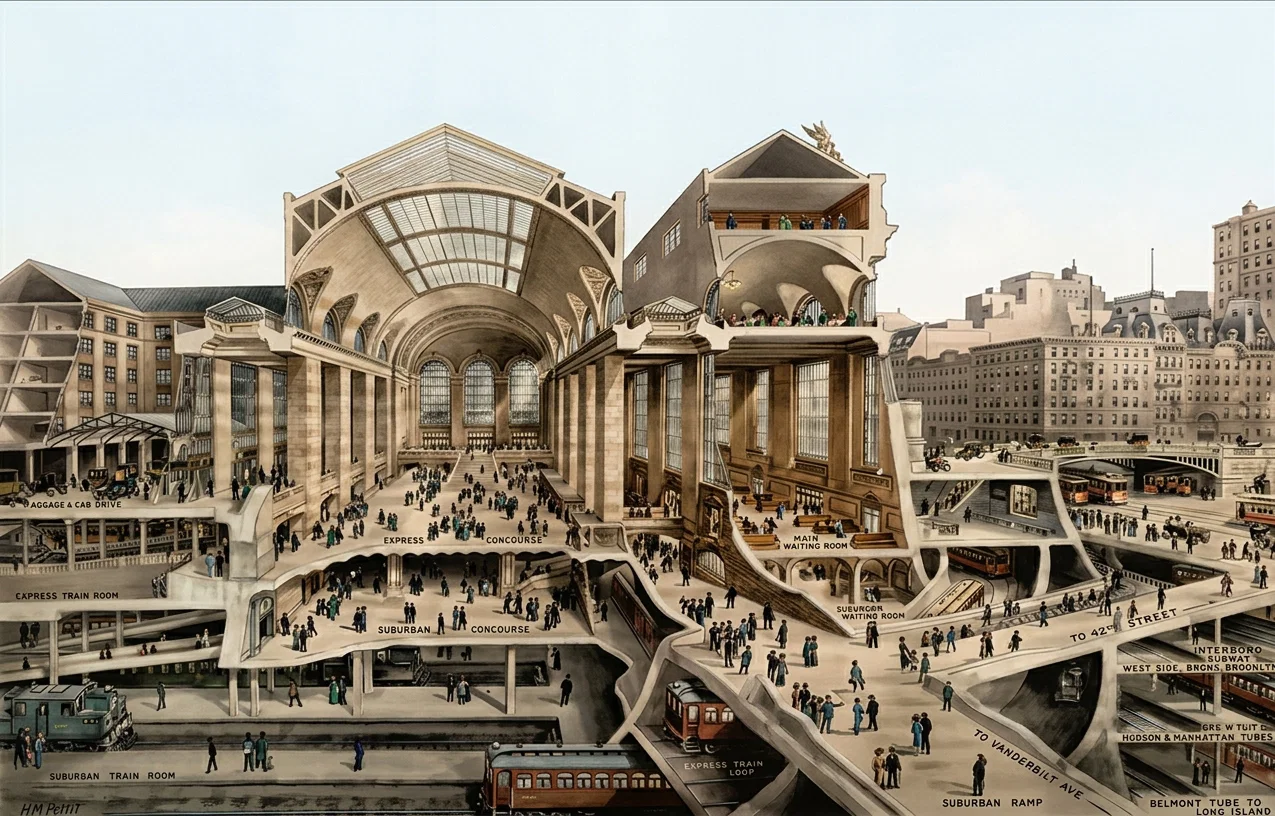
A sectional view of the Grand Central Terminal, showing the different levels, ramps, and subway connections. The main building above.
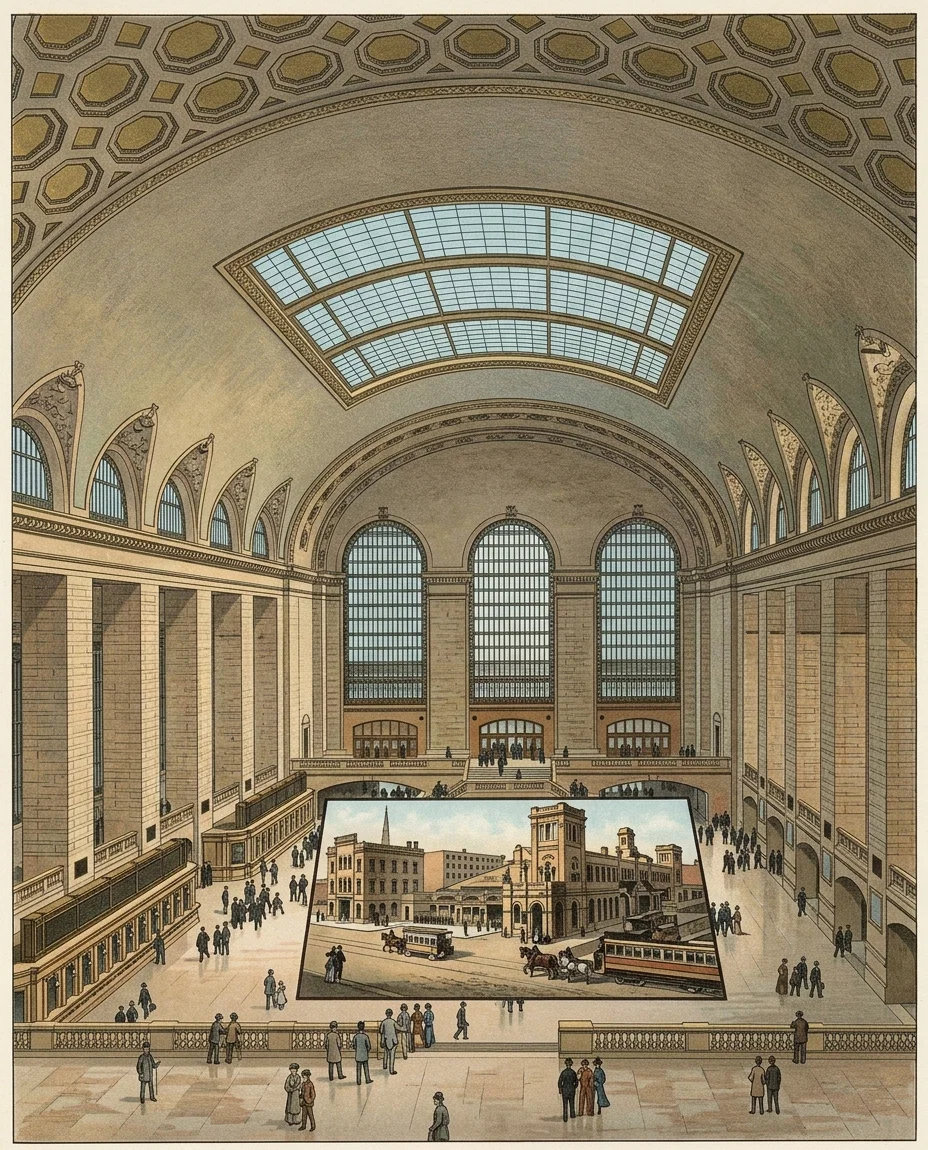
The reproductions of what is and what is to be, in the pictures upon this page, tell briefly but almost incomprehensibly the vast wealth that is expended to save time, to turn millions of dollars into minutes.
At the New York Grand Central Terminal 60,000 passengers and 400 trains arrive and leave daily. How to provide facilities so they may do this easily was a problem. It is settled in the building of the largest station in the world, more than twice as large in fact as any other yet planned. It is a stainless station; all passageways, galleries, concourses, are on gentle inclines or “ramps.” And all the machinery of this vast building, or collection of buildings—the signals, the tracks, the hundreds of trains—will not be seen from the street. All are below the street level. Prices in New York City real estate demand it, when the space for one car costs, exclusive of the station, $30,000.
There are four levels in this station. The gallery on 42d Street will be the upper level. Next below is what is called the concourse, from which level 42 tracks will handle the through trains, connecting also with the subway trains. On the12third level are the 25 tracks for suburban trains; and underneath this, subways for handling baggage.
The “ramp” idea came from the old Romans, the inclines built for their chariots. These inclines were tested personally by great railway specialists of every type of man, tall and short, fat and lean, loaded with hand baggage and free, and by women of all types, and the easiest gradients were adopted, the steepest 8 feet in 100, and some not more than 4 feet in 100.
Through these developments the new station can handle one hundred million people a year; it now handles twenty-five million. And all these passengers will alight from their trains and reach the street without mounting a single step; and 70,000 passengers an hour can be handled. There is no conflict, no meeting of human streams. Where steps are shown they need not be used, and in some cases elevators are in evidence.
In that new station are a lot of dressing-rooms at nominal rent, for women as for men, in which one may change his clothes; a rest room with medical attendance, and nurses if needed. Great trains are named as well as numbered to help the passenger to remember.
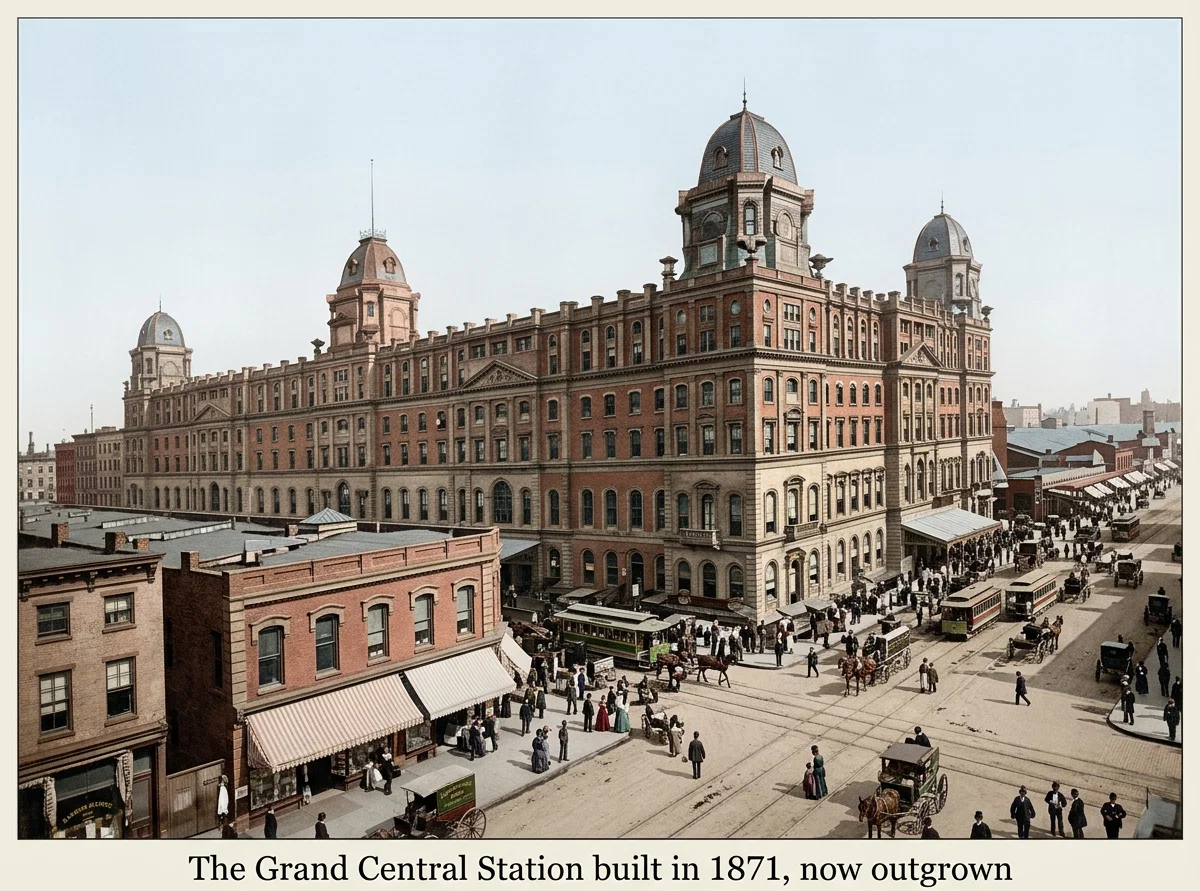
As compared with the old well-known station the following figures may be of interest: The area of the old terminal was 23 acres; the new, 70 acres; the car capacity of the old, 366; of the new, 1,149 cars. On the street level the station building proper is 600 x 300, and 105 feet high; below the street level it is 745 x 480 feet, 45 feet deep. 85,000 tons of steel will be used in its construction.
It will be a great and mighty gateway to a great and growing city, a wonderful help in this rushing age for men and women to rush safely; a wonderful example of what great capital and large thinking men can accomplish. Would that the same energy and foresight, under divine direction, might be used in the moral world!
Is It Catholicism, Politics, or Both?
By Editor
MR. ROOSEVELT seems to talk as tho he believed the Bible, and professedly he belongs to an evangelical church. He is convinced of “the admirable type of work done by the Y. M. C. A.,” a professedly evangelical organization, which in a general way at least stands for the Bible. Being an evangelical association, the Y. M. C. A. must of necessity debar those not considered evangelical, among whom are Roman Catholics. Mr. Roosevelt, at the request of the editors of the Monitor, a San Francisco Roman Catholic paper, has authorized the publication of a letter in which he says:
It seems to me both unwise and ungenerous to bar Catholics from admission to directorships on Y. M. C. A. boards. I did not know that such was the custom, but am now informed that it is. I feel that it is of the utmost importance to this country that our people who are straight and decent shall associate together as much as possible without regard to theological differences, and from my own knowledge of Y. M. C. A.’s I know that no Catholic is denied any privilege therein accorded to any Protestant, and that no man has any species of religion thrust upon him, but is simply given the opportunity to get it if he wishes.
Wherever a Catholic priest or layman is in hearty sympathy, as I know many Catholic priests and laymen are, with the purposes and work of the Y. M. C. A., I believe that they should be admitted to directorships and to every other position of influence just as freely as Protestants.
The Roman Catholic parallel society to the Y. M. C. A. is the Y. M. I., the Young Men’s Institute. Let Mr. Roosevelt plead with his Roman Catholic friends to admit Protestant clergymen to directorships in the Y. M. I. Would they do it? We doubt if these clergymen would be admitted to membership in any way, to say nothing of directorship.
This letter given out for Roman Catholic publication either shows that Mr. Roosevelt is more Catholic than Protestant, or he is doing it for political effect. Let the Young Men’s Christian Association still stand for evangelical Christianity. It loses that as soon as it adopts the advice of Colonel Roosevelt; for Roman Catholicism is not Protestant evangelical. Of course Roman Catholic priests would like to mold every Protestant organization under the sun after their own ideals. They are not permitting themselves or their own to be molded. They are much more consistent than Mr. Roosevelt. He would leave Roman Catholicism its own cardinal red; he would make Protestantism colorless.
—★—
Increasing Crime.
A magistrate of eight years’ experience in New York City says:
The more serious crimes, such as murders, shootings, stabbings, gang feuds, highway robberies, burglaries, assaults, and larcenies from the person, grow in number undetected and unpunished. The police force is demoralized and terrified. The men feel that they and not the criminals are the hunted, that (as many have told me) “if a man can keep out of trouble he is doing well,” and that the only safe and sure way to do is to “look the other way” when a crime is being committed.
The Grand Central Station built in 1871, now outgrown
An editorial in the National Prohibitionist (Chicago) remarks that New York is not alone; that in Chicago “there never was a time when crime was more rampant. Murders are committed by the hundred, and are punished, at best, by the half score. Crimes of violence against the lives and persons of citizens are perpetrated every day, and the police do not even arrest a suspect. Policemen shoot down unoffending citizens on the street and go scot-free. Never in the city’s history had the saloons less regard for the law. Never in the city’s history was the infamy of prostitution more open and defiant. Never in the city’s history was the gambler finding his prey more easily or the assistance of the public officials more surely. What is true in New York and Chicago is true, with momentary, passing variations, in every large city of the continent.”
The center is a picture of the first Grand Central Station, where Madison Square Garden now is. It could be placed in the express concourse of the new station.
And looking forward to this time the Word of God declares that “iniquity shall abound,” and that “evil men and seducers shall wax worse and worse.”
—★—
Earthquake at Mazatlan
A severe earthquake occurred in the vicinity of Mazatlan, Mexico, April 8. Many were injured and much damage done, but no lives were lost. The earthquake tolled the bells in the cathedral.
American Revenue Reform in Persia
Two young revenue officers who have been in the service of the United States Government in the Philippines, Frank S. Cairns and W. Morgan Shuster, have been selected by the Shah of Persia to save that empire from possible financial ruin. It is said the obsolete revenue system of Persia, one of the oldest in the world, will be abolished, and the American system adopted in its stead. And that could be improved, judged by its past.
A Needed Innovation.
The Sunday School Times prints the following prize illustration in its issue of April 1 which is timeable every day:
A GREATER INNOVATION.—Blessed are they that keep His testimonies (Golden Text). A good lady, belonging to another communion, once remonstrated with Dr. W. B. Robertson of Irvine. She said, “I hear you are introducing some dreadful innovations into your church service.” “Indeed,” he replied, “what innovations have we introduced?” “O,” she said, “I hear that you read the commandments at the communion.” “Is that all you heard of?” was the reply. “We have introduced a far greater innovation than that.” “What is it?” said the good lady in some alarm. “We try to keep them,” he replied.
Vulgarity in Intercollegiate Athletics
Dr. David Starr Jordan, president of Stanford University, has instructed the committee on athletics of that institution to abolish intercollegiate baseball and football, because of the coarse, vulgar epithets indulged in, flung back and forth from bleacher to diamond. He is convinced that this vulgarity witnessed in the games is not a spontaneous, cheap, and ordinary brand, but a premeditated, cut-and-dried type, which he has defined as "systematic muckerism." One of the faculty says, and he expresses the mind of many others: "I believe that if intercollegiate contests could be carried on with gentlemanly courtesy on both sides, they should be continued. But if the 'win at any cost' spirit is to prevail, then the games can not be stopped too soon." The order in which the students rank their college duties, he says, seems to be "athletics first, studies second."