The Youth’s Instructor, Vol. 38, No. 44.

BLESSED ARE THE MEEK

The Youth’s Instructor

Oct 29, 1890

S. D. A. Publishing Association · Battle Creek, Mich. · Oct 29, 1890

"BLESSED ARE THE MEEK."

O, BLESSED are the meek, who have that spirit That breathes from all things fair in earth and heaven! The sunshine pours again the blessing given In meekness on the fields. It asks no merit; No praise exalts it, and no censure pains, But like God's love it pours upon the plain.
The rose grows sweet, with meekness bending lowly, Blushes to find its praises spoken so, Yet breathes as sweet, with incense rare and holy, When 'neath our feet 'tis crushed and trodden low. So with the lily, lighting up with beauty, It calmly lives for God in stainless duty.
These are but types of our exalted Saviour, Forgetful of himself, he lived for others, And lived before us Heaven's high behavior, And poured his love as fragrance for his brothers. Tempted like them to grieve o'er life's sad woes, He only was the Lily and the Rose.
O, may our days be sweet as holy petals, Not odorless, but precious with love's bloom; Not dry and thorny and like noisome nettles, Malignant with sharp words and looks of gloom, But, like the sunshine and the lily holy, Bloom sweet for God and man in meekness lowly.
FANNIE BOLTON.

ROUND THE WORLD.—33.

THE PARSEES.

It is a proverb among travelers that when Arctic explorers discover the North Pole, they will find a Scotchman sitting on top, waving aloft the flag of his country. This adage has arisen from the peculiar propensity of that nation to be found always on the frontier of unsettled territories, battling with the savages, and establishing law and civilization. They are the bona fide pioneers of the British nation. To this adage an Anglo-Indian will invariably add another, “And also a Parsee’s shop.” One might properly designate the Parsees as a race of store-keepers. They do not seem to turn their attention very much to the practice of law, or to becoming physicians, but as a rule enter business as merchants, traders, etc. They are keen in business, but, taken together, are perhaps at the same time more honest than any other race on earth.
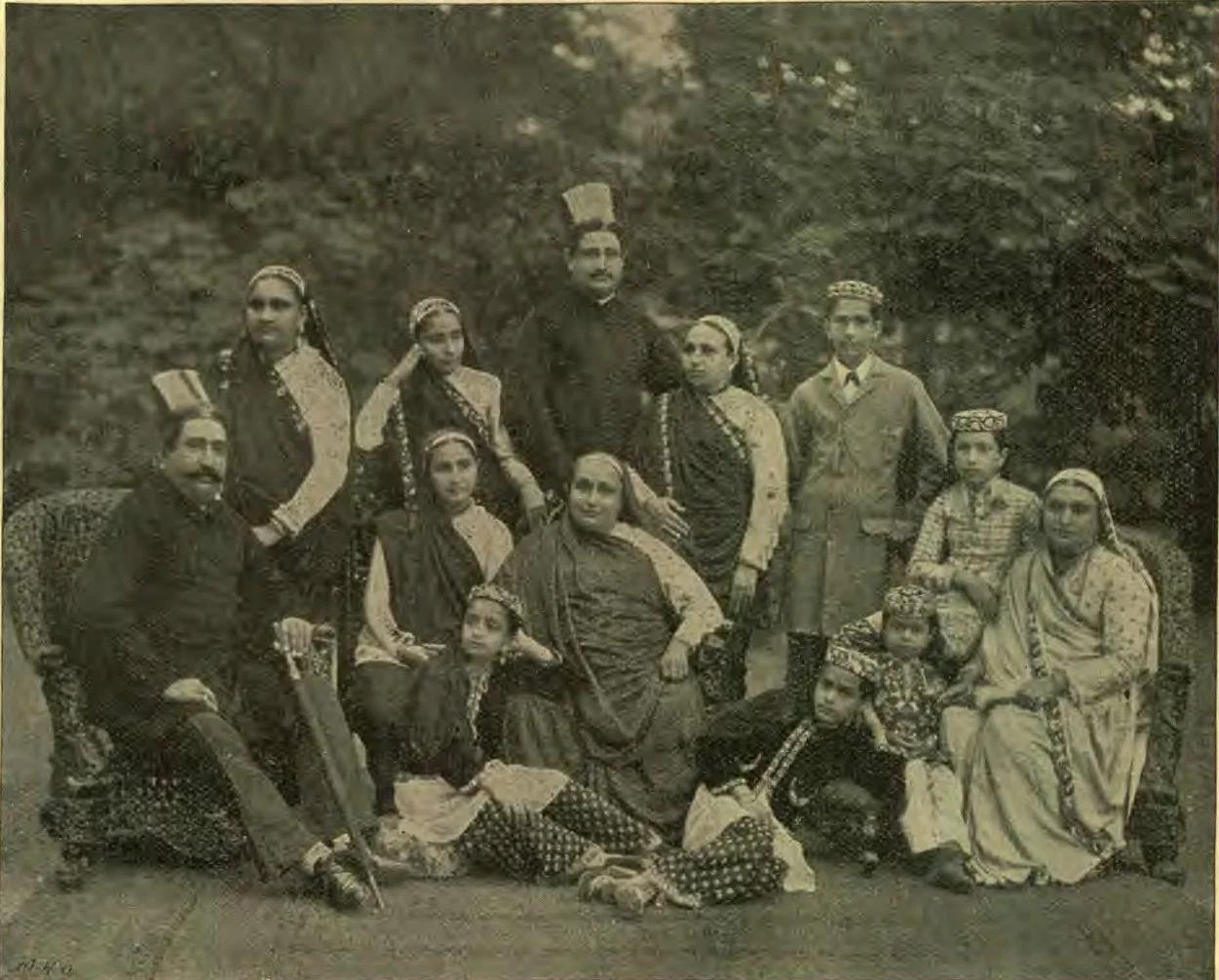
PARSEE GROUP.
PARSEE GROUP.
The native population in Bombay is numbered at between one and two million, and the British at about fifteen thousand, but the Parsees attract the most attention from the visitor. The more their history is studied, the more interesting they become.
Their former home was in Persia, and the founder of the religion which they profess was named Zoroaster, who lived contemporaneously with Confucius, the great Chinese philosopher. After the battle of Thermopylæ, the Persian Empire began to decline, till at last their armies suffered disastrous defeat at the battle of Arbela, in 331 B. C. After this the Mohammedans began to persecute the followers of Zoroaster, slaying them by the thousands. They were indeed given their choice as to whether they would turn Mohammedan or suffer death. Many relinquished their faith, but others preferred to sacrifice their lives rather than to deny the religion they held so dear.
They remained in their native land for a considerable time, but little by little it became evident to them that, in order to exist as a people, it would be necessary for them to go elsewhere. Accordingly, in the year 600 A. D., the remnant of the Parsee people, consisting of about 12,000 souls, men, women, and children, left their native land in small sailing ships for India. The voyage was stormy, and their ships badly foundered, so that six hundred were drowned en route during a gale which wrecked several of the fleet. The remainder finally landed at Sangar, on the western coast of India, and there made a treaty with the Hindoo king. The chief stipulations of this treaty were that,—
  1. They must assist him in time of war.
  2. That they were not to eat beef or pork.
  3. On occasions of marriage or death they were to give alms to the Brahmins.
  4. They were never to take part in any discussion concerning the Hindoo religion.
Shortly after this treaty was effected, four hundred of them were killed while fighting for the Hindoo monarch. This left only two hundred, of whom only ten were women. Tradition says that some of the men intermarried with the Hindoos, and so influenced their wives that they forsook the faith of their fathers, and became devout Parsees.
When a Parsee dies, it is one of the tenets of their creed that his body must remain exposed to the rays of the sun, without touching the soil, or he cannot go to heaven. The outcome of this belief is the “towers of silence,” which were represented in the cut accompanying the last article. At Bombay they are large circular buildings, situated on rising ground. One doorway about half-way up leads into them, and on a level with this inside is a stone floor sloping inwards toward a large hole in the center, from the bottom of which are pipes leading to the sea. On that part of the floor next the outer wall, the corpses of the men are laid, without any coffin, next below them those of the women, and nearest the center the little children. Little drains cut into the stone divide up the whole space into lots just large enough to contain one body. No sooner have the bearers left the towers than the vultures, who are ever to be seen sitting on the wall, come down and pick the flesh till nothing remains but the bones, which are washed down into the well in the center by the rains, and carried off to sea. Thus the tower is being continually rid of the dead, so that other bodies can be put in their places.
They believe in one God as the Creator and all-powerful being, but have no faith in Christ as the world’s Redeemer. Formerly there were twenty-one books setting forth the doctrines of their religion, but at present there is only one, as all the others were burned by the Arabs. No Europeans are permitted to enter their temples, where fire is kept ever burning on the altar. It is frequently stated that they are worshipers of the sun, moon, stars, and water, but this they deny. They say that the sun, moon, stars, sea, etc., are the greatest of God’s creative works, and that when they stand with their faces toward any of them, it is that their minds may be called away from the little things in their own lives to the magnitude of the power of God.
Many times in the evening I have watched them coming down to the sea-shore to pray. They come, men and women, and stand facing the mighty ocean, with their eyes upturned to the sky, praying frequently for half an hour at a time. But before commencing their adorations and supplications, a very curious ceremony is performed. Around the waist every Parsee has a cord, called the “Kusti.” This is made of pure white lamb’s wool, and is composed of seventy-two distinct strands, denoting seventy-two doctrines of religion, while the material and color signify the character of the people professing such a religion.
Their morality and uprightness in deal exceed that of the English-speaking races. Nearly all of them are wealthy. The national love existing between them is very strong, and they never allow one of their own name to come to want. They support a large number of hospitals, homes for the friendless, and other kindred institutions. As a rule, they are well educated, not only speaking their own language, but also English and Hindoo. They mix but little with Europeans except on business, and neither race knows much of the domestic life of the other. To become the theme of public comment or conversation they especially abhor, and it was with difficulty that I obtained the accompanying photograph, as they absolutely forbid the artists to sell their pictures to outsiders. They always marry among themselves, and consider it a disgrace to do otherwise.
Their dress, especially the hats of the men, is peculiar, as will be noticed in the cut. These have something the appearance of what is known in America as a plug hat, with the back sliced obliquely off. The legend is that many years ago one of their high priests was attacked, the would-be murderer making a vigorous blow at the skull. But as soon as the sword struck the hat worn by the priest, it glanced, and instead of cleaving the head, merely cut off the back of the hat.
The gospel of Christ has made little headway among the Parsees, who now number about 100,000 in India. They say that they do not see that the lives of those professing Christianity are as moral or as upright as those of their own people, and therefore they see no need of forsaking the doctrines of Zoroaster and accepting those of the Christian’s Bible. The basis of their reasoning is only too true. Those who profess the name of Christ, who fight, or profess to fight, beneath the blood-stained banner of Calvary, need to have their lives molded more closely after that of the Great Pattern, ere they can hope to convert such a people as the Parsees. This thought should stimulate all who really love their Savior to let their light shine that others may see their good works, and glorify their Father which is in heaven.
P. T. M.

“THEE NEEDS A LITTLE SWEETENING.”

“THEE needs a little sweetening. Vinegar never catches flies, Rachel,” said a dear, gentle lady to a beautiful young girl, who was, at thirteen, sour in disposition and sharp-tongued.
Rachel called herself a follower of Christ. She truly desired to do his bidding.
She denied herself pleasures that she might give to others, and read the Bible daily, yet there was something lacking.
The children attending the mission-school were not interested in any work of hers.
Young girls of her own age turned away from her. In the home circle no one sought her society, while freckled-faced sister Mollie, a merry, laughing girl, was in demand at all times.
To her good, far-seeing Aunty Love she confided her disappointment and desire to work for the Master.
“I—I—need sweetening, auntie,” said Rachel wonderingly, as they sat upon the river-bank in the shade of a monster elm upon a hot morning.
“I said it, Rachel,” replied Martha Love placidly.
“And you, too, auntie, believe in sweet words and deceits. I did think you would advise me to be true and speak truthfully. I don’t want to be sugary sweet, and gloss over things”—
“Stay, Rachel—thee can be kind, and yet follow Jesus. You are seldom kind. No! I must speak plainly, though I wound thee; it is for thy good. Jesus was always tender and kind, even when dealing with the wicked and those who despitefully used him. He taught us truth, yes, but that does not mean that we are to speak out the disagreeable things that come into our mind. When people went to him for comfort, no matter how much he suffered, he spoke to them kindly. Thee prides thyself upon thy frankness, and boasts of speaking out thy mind, and that thee harbors no deceit. Dear child, I have seen thy companions look as if they had received a blow after thee had said something particularly insulting.”
“Yes, insulting, Rachel.”
“Those who know thee best excuse thy speeches by saying, It is the child’s way; she means nothing by it. How is thee going to win souls to Christ if thee continues to drive away, with sharp words and unkind treatment, those whom thee would attract?”
“I think Christ’s smile must have been rarely sweet and his voice loving and soft when he pleaded, ‘Come, and be saved.’”
Unless thee tries now, before habit is firmly fixed upon thee for life, thy voice will grow more shrill and petulant. How can thee nurse the sick, and woo them back to health, if thee still clings to thy fretful manners?
“That we are all full of faults, and there are many wrongs in the world, all will admit; but Rachel, what of the beam in thine own eye?”
“There have been many earnest and devoted men and women, anxious to comfort the sick and distressed, and tell them of Jesus and his great love for the weak and suffering; but a sharp, commanding manner prevented their reaching the ‘real heart.’ The harvest will be ‘nothing but leaves,’ or a very few ‘sheaves.’”
“Pray over it, and for more love and charity. The more thee fills thy heart with these, the less thee will incline to say and do that which will provoke and wound. Leave all probing for the surgeon, and bear in mind the bruised in heart, weary and sick, or the distrustful and soured, need the balm of hope, oil of gladness, and tender compassion for their healing. Fill thy soul full of the sweetness of the love that Christ will give thee. The Lord’s handmaidens will receive full measure.”—The Well-Spring.

TWO OR THREE RULES.

You are old enough, dear, to think for yourself about your relations to other people, and to behave in such a manner that your friends will enjoy being with you. Half the annoyances which fret us in our homes are caused by the thoughtlessness of those who would be very pleasant companions if they would be mindful of two or three very easy and simple rules.
Let me mention some of the rules which are among the more important, and which are observed by well-bred people the world over. Politeness springs from kindness of heart, and polite ladies and gentlemen avoid rudeness for the reason that it wounds others, and is the cause of friction in every-day life. Nobody can afford to be in the least rude. Mark what I say—in the least. And so it is a good thing to know what is proper in society, and what, on the other hand, is boorish.
Except at the door of a room which is intended for the common use of the household, as, for instance, the door of the drawing-room or the family sitting-room or the dining-room, one should always knock. If papa is in his library, the well-bred little son or daughter will tap gently for admission, not rush in like a small whirlwind. If mamma is in her own room, even though the dear lady allows it to be regarded as a free-and-easy camping-ground for the whole family, it is right that you should knock, and await consent to come in before you enter. Sisters and brothers should observe this formality, and not take for granted their right to interrupt whatever the possessor of an apartment may be doing. Above all things, do not fly unannounced and uninvited into any one's room in a house where you happen to be a guest. The hostess may take no notice of your intrusion, but all the same she will reflect that your mother did not train you rightly, or you would not be a little social Goth or Vandal. Set this down as a rule which you intend to keep:—
“I will always knock at the doors of other people's rooms.”
Intimate friends sometimes fall into an unceremonious way of running into the private rooms of a house without special invitation. This is sometimes admissible, as, for instance, at my friend Jack Hillyer's. Jack has a charming apartment, in which he keeps collections of several kinds—his books and papers, his tools and fishing-rods, and the various treasures which an only son gathers around him, particularly when he has indulgent parents who gratify his tastes so far as they can. “The fellows,” as Jack calls his friends, know that they are welcome here at almost any hour, and that Jack likes to find them seated beside his big bay window or before his fire. It is understood that Frank, Hal, and Charley are to be sent to Jack's den whenever they ring the front-door bell.
But Jack's sister Helen has given no such permission to her girl friends, and she does not want them to come to her chamber until or unless she sends for them. She was prepared to be very fond of a certain new neighbor, until Lily put it quite out of the question by presenting herself at seven o'clock in the morning, work in hand, saying:—
“Why, haven't you had breakfast yet? Ours was over some time ago. Papa has to catch the train, you know. Never mind me; I'll sit here and make myself at home while you finish dressing.”
Never make yourself at home in such a fashion as this. Let another rule be:—
“I will always wait to be invited before going into the private sitting-room of a friend.”
There is another unwritten law which you are old enough to observe, and that is one which concerns other people's books. If you have borrowed a book, you are not at liberty to lend it again, nor to pass it from hand to hand among the neighbors. It was lent to you, and you should read and return it in as good order as you can. Two persons cannot comfortably and conveniently read the same book at the same time, so when the monthly magazines or papers come, the thing to do is to take turns. One should wait for another in this world, and so I come to my last bit of advice here, which I would have you write down, if you like it, in this way:—
“I will be very considerate about other people's books, and will always wait until my turn comes before reading a book which belongs to the family.”—Aunt Majorie Precept, in Harper's Young People.

A BIBLE PICTURE

For the INSTRUCTOR.

A BIBLE PICTURE.

At one time the children of Israel forsook the Lord, and began to serve Baalim and Ashtaroth and the gods of the heathen nations around them. Then the Lord left them to their enemies, and the Philistines and the Amorites came to make war upon them.
The Israelites were greatly distressed, and they cried unto the Lord, and confessed their sin in forsaking the one true God and serving idols. They put away the false gods, and prayed God for deliverance.
Then the Lord was grieved for the misery of his people; he heard their prayers, and freely forgave them, and raised up a great commander to deliver them from the enemy. When the Spirit of the Lord came upon this “mighty man of valor,” he went over Jordan to fight against the Amorites, and the Lord delivered them into his hand, and he smote them with a great slaughter, entirely subduing them, and capturing twenty of their cities.
And then the brave warrior returned home at the head of his victorious army. There were great rejoicings, and, according to the custom of those ancient times, a band of singing women came forth from the city to greet the triumphal procession with music and the dance. As this band of maidens approached nearer, the brave commander, who never quailed before the enemy, was suddenly overcome with terror. His cheeks were blanched; he rent his garments, and cries out in anguish, “Alas, . . . thou hast brought me very low!”
Who was this mighty warrior? Why did he rend his garments? and why were the shouts of victory so quickly changed to mourning? Who can find the chapter in the Bible that will tell the rest of the story?
MRS. A. W. HEALD.

A POTATO.

“I CAN’T afford it,” John Hale, the rich farmer, answered, when asked to give to missions.
Harry, his grandson, was grieved.
“But the poor heathen; is it not too bad that they cannot have churches and school-houses and books?”
“What do you know about the heathen? Would you wish me to give away my hard earnings? I tell you I cannot afford it.”
“If you do not feel able to give money, will you give a potato?”
“A potato!” ejaculated Mr. Hale, looking up from his paper.
“Yes, sir; and land enough to plant it in, and what it produces in four years?”
“O, yes,” setting his glasses on his calculating nose in a way that showed he was glad to escape from the lad’s persecution on such cheap terms.
Harry planted the potato, and it rewarded him the first year by producing thirteen; these the following season became a peck; the next season, seven and a half bushels; and when the fourth harvest came, the potatoes had increased to seventy bushels, and when sold, the amount realized was, with a glad heart, put into the treasury of the Lord. Even the aged farmer exclaimed,—
“Why, I did not feel that donation in the least! And, Harry, I’ve been thinking that if there were a little missionary like you in every house, and each one got a potato or something else as productive, for the cause, there would be quite a large sum gathered.”
Little reader, will you be that missionary at home?
—Gospel in All Lands.

Losing and Gaining God

He who hath lost God hath nothing more to lose; he hath lost all. But he that hath gained God hath nothing more to gain; he hath got all.—Swinnock.

The Sea-Star: A Curious Sea Animal

“Oh, see that pretty moss! It is like a star.”
It was clinging to a rock by the sea-shore. It was not moss, but an animal.
“It is a sea-star, Nellie, or a star-fish, as some call it. Take it in your hand. You will not be hurt.”
“Why, Uncle John! he is all legs. Where are his eyes and nose?”
“The sea-star has neither eyes, nose, nor ears, Nellie. In fact, he has no head at all. Those little feelers on what you call his legs are really all the legs and arms he has. His mouth and stomach are all the same.”
“Oh, how funny!”
“Yes, he is a curious animal. When he has finished one meal, some of those little arms sweep his stomach clean, and then he is ready for another.”
“And what does he have to eat?”
“Well, Miss Nellie, he is as fond of oysters as you are. Though he seems so feeble, the strongest shellfish cannot escape him. He sends a poisonous juice through the valves of the oyster, which makes him open his shell. Then the sea-star has a fine feast.”
“The wicked creature.”
“Yes, the oyster fishermen are no friends of the star-fish. But it makes a pretty ornament when dried. Do you want to take him home?”
“I am afraid of being poisoned.”
“I will tell you what to do. Place him in this little wooden box. I will bore some holes in it. Then put him down over an ant’s nest. They will prepare him nicely for you. His poison does not harm the ants. Perhaps there are ant doctors who cure them.”—Selected.
Continue reading: JOHNNY BURNS HIMSELF WITHOUT ANY FIRE