The Youth’s Instructor, Vol. 28, No. 51.

Philip and Effie, or the Golden Stars

The Youth’s Instructor

Dec 15, 1880

S. D. A. Publishing Association · Battle Creek, Mich. · Dec 15, 1880

Philip and Effie, or the Golden Stars.

Each evening mamma, Philip, and Effie read a chapter in the Bible together. On this evening of which we write, they were reading in the New Testament, where it tells about the wise men and their journey to see Jesus.
“I wish stars came into the sky now-a-days, and shone on purpose to point out the way to people,” said Philip; and “I wish we had one. If I could wake up in the night, and see a bright star shining into the room, and an angel or somebody would whisper that it was to show me where to go, wouldn’t it be nice?”
“Where to go to find Jesus?” asked mamma.
“Well, no, ma’am, not exactly; we know how to find him, of course, and we can’t walk right to his house and see him, as those men did; but I mean something that would show us just what is right to do, and where it is right to go, and all that.”
“I can get such a star for you,” said mamma; and then both the young people looked at her, and asked,—
“Why, how? What do you mean?”
“It is bedtime now,” said mamma; “but to-morrow morning I’ll agree to have a star ready for each of you.”
You may be sure that star was talked about on the way up-stairs.
Before Philip’s eyes were fairly open the next morning, he rubbed them hard to see plainer what was on the wall; then he raised up on one elbow; then he jumped out of bed and went nearer; a gilt paper star, quite large and perfect, pinned to the wall, and on it in clear letters these words: “Follow His steps.”
“Oh, ho!” said Philip. “That was what she meant. I never thought of stars made out of paper.”
“Did you get one?” said Effie, running to Philip’s room before she was fairly dressed, and displaying a star exactly like Philip’s.
“I didn’t think mother meant that kind,” he said.
“I didn’t, either. I didn’t know what she meant, but it’s true.”
“What is?”
“Why, about guiding us; don’t you see?”
“N-o,” said Philip, slowly. Well, yes, of course, on the whole it will; but I meant—well, now there are ten thousand things in school, you know, and out of it for that matter, that we don’t know just what to do about. Jesus never went to school, nor played ball, nor skated; or any way, if he did, we don’t know anything about it.”
“But we can guess just exactly how he would have acted.”
Philip made no answer to this, but turned away with a rather dissatisfied air. He was much too sensible a boy to have supposed that his mother could manage a real star in the sky for him, and he hardly knew what he expected; but still he was just a little disappointed in his paper star.
It wasn’t two hours after that, that they were together, he and Effie, on Tode Hill, with the new sled. Looking on with great longing eyes were Johnnie and Mate Jenkins in their patched clothes, and no sled at all. Effie was the first to notice them. “There!” she said, with a nudge to Philip; “There’s a chance this very minute.”
“A chance for what?” asked Philip, stopping on his way up the hill.
“Why, to follow the star; they never get a ride, and there they are looking at us, and there’s the sled.”
“There isn’t a thing in the Bible about sleds, and you can’t tell what He would have done.”
“O Philip Parker! you know you can tell.”
“How can I?”
“Why, He always did things that were kind and thoughtful, and not selfish.”
“Well, I don’t know as they want to ride down hill.”
“Yes; but, Philip, if you hadn’t any sled and never had a ride, and stood here watching them go down hill on a sled, what would you think about it?”
“Well,” said Philip again, after a minute’s thought; “stand out of the way, I’m going to ask ’em; but I don’t believe such little bits of things as that are following His steps at all.”
“He did little bits of things,” said Effie.
“What?”
“Oh, I don’t know; but I just know that anybody who went about doing good would keep finding little bits of things, and He wouldn’t walk by them and look for big ones. My verse, day before yesterday, was, ‘He went about doing good.’”
“You have the awfullest lot of verses,” said Philip, and then, “Hallo! you, Johnnie Jenkins, do you want to put Mate on behind and give her a ride down Tode Hill?”
Didn’t he! His eyes grew twice as large as before; and in a few minutes more, Philip and Effie stood by with complacent faces and watched the two glide down the hill.
“It isn’t much to do,” said Philip, with his hands in his pockets. “I wonder I never thought of it before; but it seems real queer to think that such a thing as riding down hill can be called ‘following His steps.’ I do suppose, though, if He was a little boy and was on Tode Hill, he would look out for other folks’ pleasure. It feels pleasant to do it, anyhow.”—Sel.

Giving Up for the Lord Brings Greater Blessing

We shall all find that when we try to do a little for the Lord, and give up something near to our hearts, that he will come and give us back a thousand times as much.

THE CLOSING YEAR.

Dropping, dropping, dropping, Slowly dropping away; Like the silent sands of the hour-glass Drops the old year, day by day.
Dropping, dropping, dropping, No sound of spoken word, But every day has a tale to tell, Which only God has heard.
Dropping, dropping, dropping, Swiftly dropping away; So go the years of the early life On their appointed way.
Dropping, dropping, dropping, Oh! joy to see them go, If they tell a tale in our Father's ear Of a holy life below. —Sel.

“LAND HO!”

On the morning of the eleventh day of our journey, breakfast being ended, we all go on deck at eight o’clock to see how the captain’s prediction comes out.
At ten minutes past eight o’clock we hear the cry, “Land ho!” and behold, over our left bow, the shores of Ireland! Not only are our captain’s calculations proved correct, but his point of compass does not vary one-half mile from where he expected to come out.
And what a feeling of relief we experience in seeing land once more! At ten o’clock, just as was predicted by the captain last night, we pass Cape Clear. Our noon observation shows a sail of two hundred and forty-six miles, making us now twenty-seven hundred and forty-seven miles from New York.
At three o’clock we sail into Cork Harbor, where a small tug-boat, called “Lord Bandon,” meets us to convey to the wharf a few passengers and some freight going to different parts of Ireland.
While stopping we make some inquiries, and find that this port, Queenstown, has a population of a little more than ten thousand souls. It is situated on the harbor of Cork, nine miles below the city of Cork, which has a population of about one hundred inhabitants, and is the capital of Cork County. The harbor of Cork is really the estuary of the river Lee, which passes from the mountains through the city of Cork, and is set down in the “National Encyclopedia” as “one of the finest harbors in the British Islands, as the largest sailing vessels can enter at any time of tide without ‘striking sail.’”
In Cork County there is an abundance of iron ore and coal, some lead, and the best copper mines in Ireland, the copper ore sometimes yielding sixty-five per cent of copper.
Before the time of King Henry II., 1172, Cork County was a separate kingdom of which the MacCarthys were the princes. The antiquities of the county are usually of a military character. There are many castles in the county, among them the castle of Kanturk built by MacDonough, which is a square 129 by 80 feet, and is 70 feet high; Lohort Castle, which is 83 feet high; and Liscaroll Castle, which is an oblong 240 by 120 feet. The walls of some of these castles are eighteen feet thick.
Our vessel has now completed its unloading, and is rapidly moving out of the harbor, soon to pass St. George’s Channel. The shades of night come on, and a breeze from the south-east is blowing a fog over the channel; but as we have land in sight at our left, and are out of the ocean, we feel comparatively secure. We are surprised, however, to learn from the captain that he considers this the most dangerous part of the voyage, as here are shoals, projecting rocks, and many vessels passing in various directions.
Being assured by the captain that by two o’clock to-morrow, if all is well, we shall be at the end of this sea voyage, we retire to our berths for one more night on shipboard. J. N. L.

I CAN AND I WILL.

How many boys there are who can, but never do, because they have no will power, or if they have, never use it! Before undertaking to perform any task, you must carefully consider whether you can do it, and once convinced that you are able to accomplish it, then say, “I will do it,” with a determination that you will never give up till it is done, and you will be successful. The difference between “Give up” and “I can’t,” and “I can and will” is just the difference between victory and defeat in all the great conflicts of life.
Boys, adopt for your motto, “I can and I will,” and victory will be yours in all life’s battles. “I can and I will” nerves the arms of the world’s heroes to-day, in whatever department of labor they are engaged. “I can and I will” has fought and won all the great battles of life and of the world.
I know of a boy who was preparing to enter the junior class of the New York University. He was studying trigonometry, and I gave him three examples for his next lesson. The following day he came into my room to demonstrate his problems. Two of them he understood, but the third—a very difficult one—he had not performed. I said to him,—
“Shall I help you?”
“No, sir! I can and will do it, if you will give me time.”
I said, “I will give you all the time you wish.”
The next day he came into my room to recite another lesson in the same study.
“Well, Simon, have you worked that example.”
“No, sir! but I can and will do it, if you will give me a little more time.”
“Certainly; you shall have all the time you desire.”
I always like those boys who are determined to do their own work, for they make our best scholars, and men, too. The third morning you should have seen Simon enter my room. I knew he had it, for his whole face told the story of his success. Yes, he had it, notwithstanding it had cost him many hours of the severest mental labor. Not only had he solved the problem, but what was of infinitely greater importance to him, he had begun to develop mathematical powers, which, under the inspiration of “I can and I will,” he has continued to cultivate, until to-day he is professor of mathematics in one of our largest colleges, and one of the ablest mathematicians in the country.
“My young friends, let your motto ever be, “I can and I will.”

Good Company Leaves a Lasting Blessing

CONTACT with the good never fails to impart good, and we carry away with us some of the blessing, as travelers’ garments retain the odor of the flowers and shrubs through which they have passed.

LIVE FOR TO-DAY.

LIVE for to-day! to-morrow is a dream, We may not see its bright fulfilling; But now while duty's earnest voices call, We will, with courage strong and willing, Live for to-day.
We'll bravely act our destined part in life; For whether cometh joy or sorrow, Full well we know, the bright to-day is ours,— To God alone belongs to-morrow. Live for to-day!

SOCIETIES FOR THE PREVENTION OF CRUELTY TO ANIMALS.

THESE societies have been established in several of the States, in Canada, in different parts of Europe, in Calcutta, etc., and they seem to be doing a good work. Who has not been pained to see, while passing along the street, the cruelty manifested by men to the dumb creatures under their care! And to put a stop to these hard-hearted, barbarous acts is indeed a work of humanity; and this is just what these societies are doing.
They have agents who are authorized to act for them in cases of distress among the brute creation. If animals are astray and suffering, and no owner can be found, it is the duty of the agents to relieve their sufferings. Also, animals, not astray, but suffering for food, are fed by the agents at the expense of the society. Agents have no right to kill an animal, whatever its condition, without the consent of its owner, but they may take possession of it by making an arrest.
Severe measures against the guilty are avoided whenever possible, and much is done by way of suggestions and warnings; but in all cases of aggravated and persistent cruelty, the prosecution of the guilty party always follows. As specimens of the work of these societies, we give the following:—
There was sold recently in Boston, at public auction, a horse which was the property of the United States government. He was believed to be about forty-eight years old, and had been at the Watertown arsenal for thirty-nine years. He sold for sixteen dollars; but the Massachusetts Society, thinking that he was too old and infirm to work longer, bought him of his new owner for twenty dollars, and shot him.
The agricultural fair held in Belchertown, Massachusetts, has usually been the scene of much lawlessness and gross abuse of horses on the part of those who have congregated there every year with these animals for the purpose of trading. So general were the complaints, the aid of the society was invoked, and they were able to put an end to these disgraceful scenes.
Two boys were found stoning a poor little kitten. The boys were reported to their parents, and told that if they indulged in such amusement again they would not go unpunished, and the kitten was taken to the home of the agent, where it was fed and its wounds dressed.
A monthly paper entitled Our Dumb Animals is published at Boston in the interests of these societies, setting forth their object, reporting their work, and giving well-authenticated anecdotes of the cunning, reason, and love manifested by the animal creation. V. A. M.

LESSONS FOR CHILDREN.

LESSON CIII.—RECAPITULATION.

Before reading this lesson, turn back and read lessons 101 and 102.
In the days of Eli there was a pious woman, Hannah by name, who was so grateful for the gift of a son, that she put him in the hands of the high priest, to be trained up in the service of God. Now Eli’s two sons, Hophni and Phinehas, were very wicked, but Samuel turned from their evil example, and gave his heart to the Lord. Even when he was a child, the Lord began to reveal important things to him, and he was soon known throughout the land as a prophet.
At Ebenezer, in a battle with the Philistines, the ark was taken, and Eli’s two sons were killed. When Eli heard of this, he fell backward and died. But the Lord so plagued the Philistines that they could not keep the ark, and so were obliged to return it. Samuel then persuaded the people to turn to the Lord and serve him only; and when the Philistines came up to attack the people, who had gathered for worship at Mizpeh, Samuel prayed to the Lord, and the Lord drove back the armies of the Philistines by means of a terrific thunder-storm. So it was, that so long as Samuel judged the people, the Lord defended them against their enemies. And so he will protect us, if we serve him with all the heart.
But, notwithstanding all these favors, the people became dissatisfied, and wanted a king, like the nations around them. This made Samuel very sad; but the Lord said unto him, “Hearken unto the voice of the people in all that they say unto thee; for they have not rejected thee, but they have rejected me, that I should not reign over them.” So the Lord told Samuel that the next day he should see the man that was to be king over Israel. Now Saul, the son of Kish, of the tribe of Benjamin, with one of his father’s servants, was at this very time searching the land to find some lost animals, and finally came to Samuel to ask him where they were. Samuel knew at once that Saul was the one whom the Lord had chosen. So, after keeping Saul over night, he anointed him king. When Saul was afterward presented to the people gathered at Mizpeh, they were much pleased, and shouted, “Long live the king!” But some would not honor Saul until he had shown his courage by delivering Jabesh Gilead from the Ammonites. Then they all proclaimed him king at Gilgal. It was here that Samuel, after reproving and instructing the people, confirmed his words by a miracle, causing it to thunder and rain at a time of year when such a thing was never known to happen.
After this, Jonathan, the son of Saul, provoked the Philistines to war; and Saul, when he had waited seven days for Samuel to come, became impatient, and offered sacrifices himself. Then the people nearly all deserted him; but Jonathan, with no one but his armor-bearer to help him, put all the army of the Philistines to flight. This was because the Lord was with Jonathan, and against his enemies.
For some years, Saul prevailed against his enemies on every side; but he finally became so proud and disobedient that the Lord forsook him, chose David, the son of Jesse the Bethlehemite, to be king, and sent Samuel the prophet to anoint him.
In a war that followed, the Philistines and the Israelites pitched on opposite sides of a narrow valley, and Goliath the giant walked every day back and forth in the valley, defying the Israelites to send a man to fight with him. After he had done so forty days, David, who had been sent down to the camp on an errand, went out against the giant with no weapon but a sling and some small stones, and slew him. This made David so famous that Saul became jealous of him, and tried in many ways to kill him; but the Lord protected him, and made Jonathan his dearest friend.

QUESTIONS.

  1. How many have read lessons 101 and 102, in connection with this one?
  2. Give the circumstances of Samuel’s early life.
  3. What wicked example did he have to resist?
  4. Tell how he received his first revelation from the Lord.
  5. Tell how the ark of God fell into the hands of the Philistines.
  6. What did they do with it?
  7. Why could they not keep it?
  8. After the death of Eli, what did Samuel persuade the people to do?
  9. Describe the attack and defeat of the Philistines, who came up against the people at Mizpeh.
  10. What kindness did the Lord show his people as long as Samuel judged them?
  11. Were the people contented in this state of peace and comfort?
  12. What did they desire?
  13. What did the Lord say to Samuel about this request?
  14. How did the Lord show who was to be king?
  15. How did the people receive Saul at Mizpeh?
  16. What did he have to do, before some were willing to honor him?
  17. Where was Saul proclaimed king?
  18. What did Samuel do on this occasion?
  19. How was Saul’s faith severely tested?
  20. By what rash act did he displease the Lord?
  21. Describe Jonathan’s attack on the Philistines.
  22. How was it that Jonathan could do such a wonderful thing?
  23. What success did Saul have for some years?
  24. Why did the Lord finally forsake him?
  25. Who was anointed to be king in Saul’s place?
  26. Describe the position of the armies, and the slaying of Goliath.
  27. What made Saul jealous of David?
  28. What course did he take?
  29. How did the Lord favor David?

NOTES ON THE LESSON.

Ebenezer, stone of help, the place where Samuel erected a monument, in grateful remembrance of the divine help, given in answer to prayer, in a great battle with the Philistines. The same place had before witnessed the defeat of Israel and the capture of the ark. 1 Sam. 4.—Bible Dictionary.
The Philistines were a warlike people that inhabited the fertile plain that lies along the Mediterranean Sea south of Mount Carmel.
Mizpeh.—The word Mizpeh means watch-tower, a lofty place, and was the name borne by several places. Every Mizpeh was a station of observation, commanding a wide view, from which friend or foe could be seen and signalized. The Mizpeh referred to in this lesson is supposed to be a peak situated about five miles north-west of Jerusalem, and rising six hundred feet above the plain of Gibeon.
Jabesh Gilead was a city situated on a mountain five or six miles east of the Jordan and twelve miles directly east of the southern part of the Gilboa range. It was about forty-four miles north and twenty-three miles east of Jerusalem, or about fifty-two miles from that place in a direct line. The mountain on which it stood was on the south side of a wady that opens into the Jordan valley about twenty-three miles south of the Sea of Galilee.
The Ammonites occupied the territory lying between Ar'-non and Jab'-bok, having the country of Moab on the south and south-west, and the tribes of Reuben and Gad on the west. Their capital city, Rab'-bah, or Rab'-bath-Am'-mon, was situated forty-five miles east of Jerusalem, and about ten miles farther north. It was a place of great natural strength, and Moses says, “The border of the children of Ammon was strong.” Num. 21:24. These people were the descendants of Ammon, the son of Lot.
Bethlehem means house of bread, and is the name applied to two places in the Holy Land. The most noted of these is situated six miles south of Jerusalem on a rocky ridge, which slopes gently toward the west, but breaks off rather abruptly on other sides, especially toward the east. Near the eastern brow of the hill stands a large, strong building called the Church of the Nativity. This church covers the cave where Christ is supposed to have been born. The sides of the hill on which the town is built are terraced and covered with fig-trees, olive groves, and vineyards. The valleys below were once so fertile that the place was called Ephrath, [ef'-rath], which means the fruitful.
The Valley of Elah is the place where David killed Goliath. The place where the battle must have been fought was about fourteen miles south-west of Jerusalem on the road to Gaza. Near Shochoh [sho'-ko], at a place where two wadys meet, the valley is about a mile wide. This little basin is flat and fertile, and through it winds a torrent bed, its banks fringed with acacia bushes, and its bottom covered with smooth round stones. The Philistines encamped on the south side of the valley and the Israelites on the north side. “The ridges on each side rise to the height of about five hundred feet, and have a uniform slope, so that the armies ranged along them could see the combat in the valley.”

Continuity in Study.

Mental effort to be profitable must have a continuous course. It is by a train of associated ideas that man rises to wisdom. Mere thought, without suitable order and sequence, is characteristic of a reason dethroned. The madman thinks; but his mental disorder appears in that his ideas have no orderly connection with each other, nor with facts.
The great law of connection and continuity should be respected by all teachers. Teachers of religion certainly cannot afford to disregard it. What they impart this week should have some direct relation with that which they imparted last week, and also with that which they expect to impart the next week. They must show the relation of truth with truth and of fact with fact.
The efforts of Sabbath-school teachers are too commonly put forth at random. They attend to whatever happens to strike them at the time. It is about the same as if an instructor in arithmetic should dwell upon the table of nines in multiplication to-day, leap to the rule of compound proportion to-morrow, fall back to subtraction the day following, take the next lesson in the notation of numbers, and the next in decimal fractions. This haphazard method would be folly in arithmetic; yet it is the very method pursued by many teachers of the Bible. Such chance procedure must be as irrational in dealing with the science of religion as with any other.—REV. C. N. POND, in S. S. World.

LITTLE EFFIE’S FAULT.

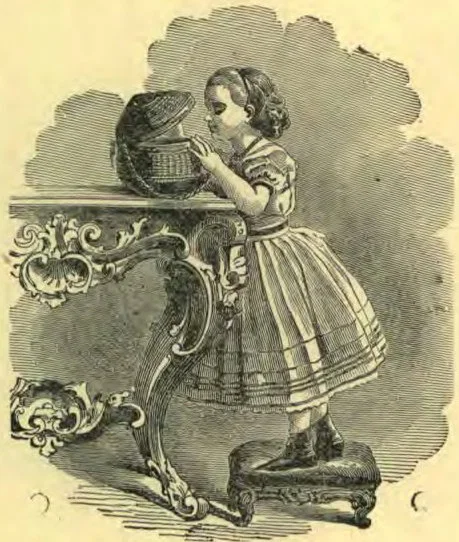
MRS. TEMPLE had been down town shopping, and coming into the room where her little daughter Effie was, she set her basket upon the table, telling Effie not to touch it, and then left the room to put away her bonnet and shawl. Effie kept wondering what was in the basket, and wishing that she might look in and see. Finally, she went softly toward the table, and standing on a stool, peeped in. Just then mamma came in, and when she saw what her little daughter was doing she was very much grieved. Calling Effie to her, and taking her upon her lap, she talked long and seriously to her about her fault of disobedience. “Little girls, Effie, should never meddle with anything that is not their own. Then, too, mamma had told you not to touch the basket. Didn’t my little daughter remember that God sees everything that she does?”
“You always talk about God, mamma, just as if he was a person,—a live person, I mean,—just as if he lived right in this house and took notice of everything we did.”
“Well, doesn’t he, my child? What did he say about noticing the fall of a sparrow, and counting the hairs of our heads? He is not only near, but he is very dear to me, Effie. I am always sorry to do anything that will grieve him.”
“O mamma, I am so sorry that I peeped into the basket. I did not think how naughty it was. I will try to obey you.”
Mamma’s kiss of forgiveness seemed to satisfy the little girl, and slipping down from her lap, she returned to her play.
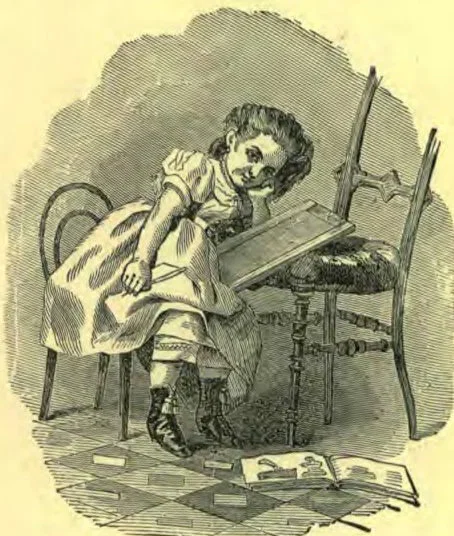
Soon after this Mrs. Temple saw Effie busy with her slate and pencil, her face wearing a very sober look. She said nothing, however, but waited till the little girl should come to her with whatever was troubling her.
By-and-by, the shadows cleared from off Effie’s face and she came dancing to her mother, holding up her slate, upon which she had printed with much labor, for she was but a little girl,—
I WILL BE GOOD AND DO WHAT MAMMA SAYS.—EFFIE.
Mamma read it, and then said, “That is a good resolve, Effie, and you have printed it quite well. And if you will really try to do what mamma tells you, I think that you will be much happier. We should always try to do everything just as if we could see God looking at us, and we ought to be so glad he loves us enough to watch over us.”
V. A. M.

THE ILLUSTRATED WEEKLY.

As we look over the editor's file of the INSTRUCTOR for 1880, and notice the illustrations, and the mechanical taste of the printer, we are led to exclaim, as we turn leaf after leaf, Beautiful INSTRUCTOR! This is the surface view, which pleases and instructs the eye.
We look again, and read, and compare the illustrations with historical descriptions, and are delighted. Turning backward, we see the rural home and snow-storm, the Esquimaux, in a sleigh without runners, riding after his reindeer, the beautiful peacock, baby elephant, and a hundred more pictures which invite us to wait and read. And as we get back to the first number for last January, we say, Good for 1880!
But what for 1881, which is so soon to begin? The Board of Trustees of the Publishing Association has just held a meeting, and decided that labor, care, and expense shall not be spared to make the INSTRUCTOR for 1881 what it should be, and that efforts should be made to double the subscription list. All who have taken the INSTRUCTOR for 1880 are expected to take it for 1881. All the friends of this precious little sheet are requested to work for the INSTRUCTOR in obtaining new subscribers. The beautiful picture, The Way of Life, will be mailed free, postage paid, to all new subscribers who actually pay 75 cents. This liberal offer extends only to the first of March, and is made to increase the circulation at the commencement of the year. We offer the Child's Poems also as a premium to those who may prefer it. Be in season for the first number for 1881.
JAMES WHITE, Pres't. S. D. A. Publishing Association.

THE MYSTERIES OF A LUMP OF COAL.

For years no one had ever supposed that a lump of coal, dug from its bed in the earth, possessed any other property than that of fuel. Chemical analysis, however, proved it to be largely made up of hydrogen, and that it would afford a gas which was combustible. In process of time, mechanical and chemical ingenuity devised a mode of manufacturing this gas, and of applying it to the lighting of buildings and cities. In doing this, other products of distillation were developed until, step by step, the following ingredients are extracted from it:—
An excellent oil to supply light-houses, equal to the best sperm oil, and at lower cost. Benzole, a light sort of ethereal fluid, which evaporates easily, and, combined with vapor or moist air, is used for the purpose of portable gas lamps, so called. Naphtha, a heavy fluid, useful to dissolve gutta-percha and India rubber. Asphaltum, which is a black, solid substance, used in making varnishes and covering roofs. Paraffine, a white crystalline substance resembling white wax, which can be made into beautiful wax candles. It is melted at a temperature of 110° F., and affords an excellent light.—Sel.

MABEL’S WISH.

Little Mabel was dressing her dollies one day, When dear mamma called her away from her play To try on a new dress she was making with care, For her little dollie with true, real hair, And a little pug nose, and two laughing blue eyes That twinkled and trembled like stars in the skies.
'Twas a gay little dress, with collar of blue, With lappets and pockets, and tiny cuffs, too. You surely would think she would run and obey Dear mamma, who had worked on her dress all the day; But she lingered, and pouted, and fretted instead, And said, with a toss of her bright golden head,
“I am tired of dresses; I wish we could do As the Bible folks did,—they were good people, too. In my Sabbath-school it tells about John; Where he lived, what he did, and what he had on. He never was troubled with clothing at all, But just wrapped himself up in a camel’s hair shawl.”
“Very well,” said mamma; “Mabel dear, you may try A life like good John’s, but be sure, by-and-by, When you want your good supper of milk and sweet bread, You must go to the woods and eat locusts instead; You may find, too, some honey by searching about, For wild bees and locusts are plenty, no doubt.
“You may take my fine shawl, but leave your new clothes For a poor little girl whom mamma well knows; And when the night comes, you must lay down your head With a stone for a pillow, and leaves for your bed; And when through the forest the darkness shall creep, No mother can watch you or rock you to sleep.”
Then quickly round mother’s neck white arms were pressed, And a head on her bosom was nestled at rest. “Dear mamma, forgive me; my dress I will try, For I never could leave you,—I surely should die! And I’m sure that the neighbors would think it was funny, If I lived in the woods and ate locusts and honey!”

You have reached the end of this edition.

The Youth’s Instructor · Dec 15, 1880