The American Sentinel, Vol. 8, No. 18.

Prophecy and the Progress of the Mystery of Iniquity
Earlier text: Prophecy and the Progress of the Mystery of Iniquity

Infallibility.

WHOEVER assumes to enforce his religion by law assumes the attribute of infallibility. A few considerations will make this apparent to all. 1. He assumes that he is right beyond mistake else he would not want his opinions so fixed that he himself could never change. The language of his feeling is, “I am right and I know and feel it in my inmost soul. Right must prevail and in order to prevail it must be in authority fixed beyond a chance of change, therefore I would have my righteous opinions established as fundamental law.”
2. He assumes that he is acting for God and because he is acting for God he is surely right. “God is right and I am right and mankind must bow to God’s authority in religion, therefore, my religion which is the religion of God must be incorporated into the law of the land for the government of all men. My religion which is the religion of God is the only religion that will save men therefore it is pure philanthropy on my part to have my religion enforced by law so that all may be saved even though it be by fire.”
3. His zealous convictions are proof that he is right beyond a doubt. “If I am not right why then this fervent zeal and piety? why this energy of desire to see this pure and holy religion which burns in my soul made triumphant? Surely by the holy fires of zeal burning within I am right and naught can turn me from my righteous and heaven-born purpose. I will have religion enforced by law, not my neighbors’ but mine which I am fully and deeply and surely persuaded is the holy religion of God. Ah, my soul, this must be true else whence these burning longings and this supreme anxiety of soul, this unutterable desire, this vehemence of purpose? Ah, my soul, thou art right and thou art God’s own commissioner and by the fires within, God’s will shall be established and his kingdom prevail among men.”
This is but a faint expression of the tropical logic that surges and swells in the soul of the religious legislationist. It was this silent assumption of infallibility which produced the religious laws and the consequent slaughter of souls to save them in the Dark Ages. The modern assumption of the infallibility of the Papal See has set the seal of righteousness—self-righteousness I mean—to every act in the history of that corrupt murderous power. And now in the face of all the history of the last sixteen centuries professed Protestants are assuming this same attribute in their effort to have their religious opinions made supreme in American law, over American consciences. The logic of this modern history will be the same as that of the mediæval. An infallible Protestant Church will be as cruel and intolerant as an infallible Papacy. Let modern Protestants no longer deny their ancestry. Let them own their mother—Rome—and draw near by this common bond and enter into close communion with her. This bond of union makes them blood relations. They can not fail to recognize their holy (?) mother, and she—why she has just discovered by this birth-mark, branded soul-deep, that they are her daughters and she graciously would receive them into sweet communion, pardoning all their waywardness if only they will coöperate with her in trying to dominate the civil power in America.
As this unholy alliance strengthens let American freemen lift their voices in no uncertain tones, and while they plead for the “liberty which is in Christ,” let them lift their voices in proclaiming the words dictated by the Spirit of God eighteen centuries ago: “If any man worship the beast and his image the same shall drink of the wine of the wrath of God which is poured out without mixture into the cup of his indignation.” G. D. BALLOU.
Grant’s Pass, Oregon.

Bishop Ireland and the Public Schools.

Of all the leading men of Catholic influence in this country, none are better known, or have greater regard shown for their plans or utterances than Bishop Ireland. His plan for the adjustment of the school question as between the parochial and State institutions has met with the favor of the Vatican and the hearty approval or indorsement of a large class of citizens in this country aside from those of his own faith. So placid is the apparent settlement of the intruding question that has rasped against the State heretofore, that people are thrown off their guard and imagine that sentinels are no longer needed to stand upon duty lest an enemy should gain an entrance to this stronghold of the republic. There are some, however, who view this matter with great concern, knowing that there is no policy that is openly pursued towards the State, but what carries with it, or behind it, that which is intended to subvert the institutions of a free Government, towards which there has always been a menace by this autocratic power.
Of the thousands who read the plans, publicly set forth by this celebrated prelate for securing State aid for religious uses, there are very few who can distinguish the principles involved in the solution of this question, because a goodly exterior hides the serpent’s tooth that is calculated, if once it strikes, to poison the whole circulation of the State. He says of his plans:—
The objections are of two different kinds—practical and speculative. I could discard the speculative ones by simply observing that they are deductions derived from imagination or from designs of these persons, and are excluded by the practical conditions with which I have surrounded my settlement with the directors of the school committee.
Now it is easy to see how speculative objections may be excluded by practical conditions, that might surround any plan of action. But speculative objections are unworthy of consideration in themes that pertain to vital interests. It is the practical things that are to be sought. As to the practical objection, he says:—
They say first that this settlement is only the beginning of a system which I intend to make, eventually, universal, and prove this alleging my speech at the Congress of public school teachers, the publication of a pamphlet by Dr. Boquillon, and a speech of Monsignor McGolick of Duluth.
After having stated that there was a practical objection to his plan and the proof that was urged in defense of that fact he proceeds to say that the practical objection is a “mere supposition.” Thus it has ever been that when practical things and objections are advanced against the incursions of the Church upon the State, the invariable reply is, it is mere supposition. If the objection is practical, why parley over the matter? Why not seek and maintain a true position?—one that will bear the scrutiny of men and the test of principle, instead of covering up the issue beneath the rubbish of mere supposition. Again he says:—
Whatever are my hopes for the future, the practical question of the moment is how to provide with a religious education, all those Catholic children to whom we can not give parochial schools, and it is proved by our statistics that they are sixty per cent. of our youth.
Since the prelate so artfully dodged the practical objection to his plan by the handy phrase of mere supposition, it is to be presumed that he would dodge the practical question in the same manner if pressed to the wall.
In the practical question of how to provide with a religious education this sixty per cent. of Catholic children, the whole issue is involved of obtaining the aid of the State to teach religion. Various have been the means by which Rome has sought to obtain an entering wedge that Catholic religion may be taught at the expense of the Government. The entering wedge has been secured; a few sturdy blows have been struck and others will surely and swiftly follow. For when once this bulwark of our Nation’s greatness has succumbed to the conniving of this invincible foe, the rest will speedily bend beneath its crushing power. But he further says:—
While we wait for the time far and uncertain when the Government shall endow our parochial schools. . . shall we permit that sixty per cent. of our children to remain without that instruction (religious education) and shall we entrust them unconditionally with the public schools.
Again, the practical question receives farther impetus by the statement that the plan adopted—
is an attempt by the episcopate to provide in a certain measure with a good Catholic education that sixty per cent. of our children who are now out of the parochial schools.
Thus the practical question assumes through the testimony of the instigator of the plan, not only the proposition of State aid for religious purposes, but for Catholic religious purposes and the worst feature of it all is that the plan is in process of execution. And so it is that while the State is constantly harassed by Protestant invasion upon its principles of liberty, there is the Catholic foe tearing at its vitals, and between the combination of these two elements the State, as a civil institution, will surely be slain.
C. A. WYMAN.

Religion by Law.

EVERY man should be left free to worship God according to the dictates of his own conscience, but by the way the churches and the preachers are exerting their influence with our law-makers, it seems that they want to force man to worship God according to the dictates of another's conscience, not his own. That is what is called religion by law, or forced religion. Religion should be voluntary, not forced. The churches and the preachers show a great weakness when they try to get the Government to enact religious laws to force their particular beliefs or tenets or doctrines upon the people. They show their utter inability to make converts by their preaching, but want the Government to help force people to be religious; but this can not be done.
When they get Sunday laws passed why do they not go a step further and have a law enacted compelling people to attend church, be baptized, celebrate the Lord's supper, read their Bibles, and pray so many times a day, and ask a blessing at the table?—all of which is just as reasonable as forcing people by civil law to keep any day holy. Every man has to give account of himself to God. If the churches would stick to the Bible, and not try to get the civil Government to help force people, they would prosper more, and do more good.
Men will not be forced in matters of religion, or anything else if they can avoid it. Man can not be made religious by law, and the sooner the churches find out this fact the better. It seems that history is repeating itself, for in the past when the Church attempted and even got the assistance of the State, then religious persecution began, and the bloodiest part of the world's history was then. It seems that such a time is fast approaching now. May God in his goodness and mercy open the eyes of those who are trying to enforce their views upon others by law.
A. F. BELO.

Pennsylvania Sunday Laws and the Press.

THE newspapers of the country are beginning to have an opinion on the subject of Sunday laws. Below are extracts showing the views of some prominent papers:—

The Law Needs an Overhauling.

A man has been arrested and fined in Pittsburg because he owned stock in a paper published on Sunday. An alderman having learned from observation that the fires in the Carnegie works are not entirely extinguished on Sunday, and that men are engaged to watch them, announces his intention to have warrants issued for the arrest of the stockholders in the company. As half the fine goes to the informer the Sunday law opens to a certain class of men a new field for enterprise. All who own shares in a railroad company which runs any trains on Sunday are liable to arrest and fine under the construction of the Sunday law. If some judge would extend the interpretation of the law so as to render all who hold annual passes over a railroad which runs trains on Sunday liable to arrest and fine, the entire legislature might be hauled into the Criminal Court and led to see, perhaps, that the old Sunday law of 1794 would be the better for a little overhauling.—Philadelphia Press.

Reciprocity That May Do Good.

The Law and Order Society of Pittsburg proposes to stop the publication not only of Sunday papers, but of Monday morning papers as well, because most of the labor on the latter is done Sundays. The newspapers, in retaliation, propose to have all the Sunday laws enforced, and if the undertaking is successful some of the law and order people will be hit in financially tender spots. That is a kind of reciprocity that they do not look upon with admiration.—Rochester Democrat.

Enforce the Law to the Letter.

The people of Pittsburg evidently do not propose to let the Sabbatarians have a monopoly of the business of enforcing the Blue Laws of Pennsylvania. If it is wrong to issue Sunday newspapers, it is also wrong to do any work on the Lord’s day, and so the authorities will see to it that the statutes that were enacted over a century ago to meet the stern Quaker sentiment of those times are enforced to the letter. That is the way to do away with them forever.—Boston Herald.
The agitation of this subject is not to cease with the Sunday closing, or opening, of the World’s Fair, but it will continue until every municipality, from the least to the greatest, shall have had its decisive contests over the question,—until every court shall have made its authoritative precedent; and until every individual citizen has taken his stand upon the question, either for or against.

A Methodist on Paganism in Pittsburg.

[The following from the Pittsburg Leader is interesting as an earnest expression of the views of one Methodist who very heartily disagrees with the legal enforcement of formal religion. This correspondent of the Leader is not the only one of his kind who understands the actual facts in these matters. Why should not more speak? They can not always hold their peace.]
Editor Leader: For some weeks past I have been watching the war that has been raging between the friends of common sense and human rights and the band of fanatics known as the Law and Order League, and I must say that in all my travel, both in this country and Europe, I have never met with a community so infested with narrow-minded bigots as Pittsburg and Allegheny.
One is carried back to the early part of the fourth century where the so-called Christian Church in Rome had lost its power and influence over the hearts and consciences of men, and in order to perpetuate itself was compelled to resort to civil authority. The Roman emperor was deluged with petitions from friends of the Christian (?) Sabbath demanding the closing of the theaters and circus on that day, because their churches were empty and the places of amusement were well patronized. The gospel, as preached by them, had lost its power; men had no use for an apostate church which paid so little attention to the plain teaching of the Scriptures, and a clergy who were overly anxious about their own support, determined that if they could not persuade men by the love of God they would whip them in by the scourge of civil law, and so they, like the law and order leagues of to-day, had a Sunday law passed.
History repeats itself, and away down here in the latter end of the nineteenth century, the century of progress and increase of knowledge, under a Government that pretends to offer an asylum to the oppressed of every nation, and guarantees freedom of religious thought and worship, we find ourselves burdened with a law that ought to be relegated to the oblivion of the Dark Ages, and which finds its only basis in the opinions of a few hypocrites who, despite all their religious cant, are afraid of the Bible and wrest it to their own destruction.
Upon what are Sunday laws based? Upon the Scriptures? No! a thousand times no!! notwithstanding the fact that Rev. R. H. Hood, in his paper on “Sabbath Reform,” read before the United Presbyterian ministers’ meeting, actually had the audacity to say that Jesus entered into the sanctuary and healed the sick on Sunday. Hear, oh, ye heavens! A minister of the gospel, an ambassador of Jesus Christ, defending an unscriptural, unrighteous, un-American institution by such a perversion of the inspired word of a holy God! Where is the passage in the Bible that states that Jesus Christ entered into the synagogue or healed on Sunday? Luke 6:1-16 mentions the fact that Jesus Christ entered the synagogue and taught and also healed a man on the Sabbath, but was it Rev. Mr. Hood’s Sunday? If so, why did the Pharisees condemn him for it? Were they as jealous for the sacredness of the pagan holiday of their heathen rulers as modern reformers are?
In all the Bible there is not a single word authorizing the observance of any other day than the one set apart by God as the memorial of creation and which he said should be a “perpetual sign between him and his people.” Nor is there a single instance of any other day being observed. The disciples were gathered together in an upper room, their common dwelling-place, with the doors closed for fear of the Jews on the evening of the day of the resurrection, not to celebrate that event, for it is evident from the reproof administered by their risen Lord that they did not believe he had risen. It is plainly evident that there is no scriptural basis for Sunday legislation.
The next argument used is that the American people have decided to adopt Sunday as the American Sabbath. When? How? The people can not do anything except through Congress, and that body is, by the Constitution, prohibited from making laws of a religious character. The people have never adopted Sunday as the national Sabbath.
Another argument used is that ordinary traffic on Sunday interferes with religious worship. Let us see. Does the regular business of the week interfere with the Wednesday night prayer-meetings or the daily meetings during a revival season? No such complaint has ever been made. Did anybody ever hear of a congregation of Hebrews or other Saturday keepers complaining that they were disturbed by the ordinary business that was carried on during their hours of worship? No! But it may be that the sneaking, narrow-minded bigots of “Sabbath” reform are made of a better grade than anybody else.
As a last resort we are told that a majority of the citizens of this country are in favor of Sunday laws. I most emphatically deny it. Of course if, according to that apostle of bigotry, “Rev.” Wilbur F. Crafts, editor of the Christian Statesman, the signatures of two Methodist bishops stand for 4,000,000 of Methodists, and Cardinal Gibbons’ indorsement pledges the signatures of 7,500,000 Roman Catholics, and 15,000,000 petitioners from Pennsylvania desire such legislation, is all true, then I will withdraw from the field of battle. But the writer is one of a good many Methodists who believe in the Bible and the Constitution of the United States, who decline to be represented by a bishop’s signature as supporting such unrighteous legislation.
I have no objection to a man believing and preaching any doctrine he chooses, but I most strenuously object to his forcing his theological views upon the community by means of the civil law, and having been born and reared in this country, the great-grandson of a man who laid down his life for its freedom in the Revolutionary War, I just as decidedly object to taking the advice of a “Sabbath” reformer to go to some desert island and in the name of His Satanic Majesty and for the sake of the “prince of darkness” set up a government of my own. We have a superfluity of Satan’s government under the rule of the “Sabbath” reformers.
Allegheny, Pa., April 21, 1893.

They Want to Pay Taxes.

THE following resolutions, recently adopted by the General Conference of Seventh-day Adventists, and re-adopted by the Litchfield church of that denomination speak for themselves:—
WHEREAS, in view of the separation which we believe should exist between the Church and State it is inconsistent for the Church to receive from the State pecuniary gifts, favors or exemptions, therefore,
Resolved, That we repudiate the doctrine that church or other ecclesiastical property should be exempt from taxation, and further,
Resolved, That we decidedly protest against such exemption, and favor the repeal of such legislation as grants such exemption.
—Litchfield Independent, Litchfield, Minn.

Some Deep Irony.

REV. REED STUART, of Detroit, Mich., lately expressed himself in the following language of deep irony in reference to the part which the religious element of this country has taken in securing the action of Congress to close the World's Fair on Sunday:—
We have shown that we have great influence. We have made Congress do an unconstitutional thing. We have succeeded in compelling our lawmakers to do for us what, if it were done for the Catholics, all of us would denounce, and some would take up arms to oppose; that is, deciding a religious question, and voting money for a national purpose with qualifications to fit the opinions of certain religious sects.
Some of our methods have not been of the highest the human mind could conceive. We have paid agents to lobby for us. We have indulged in some denunciation, which is never very just, even when a cause is just. We have mistaken the word Sunday for religion, and have permitted our zeal for the former to make us say some things which the latter would forbid.
Idolatry is the worship of that which is seen; of the thing rather than the principle; of the symbol rather than that which is symbolized. The institution is not a means but a finality. The temple is holier than the religion which built it. A rite or ordinance is esteemed of more value than the soul. Humanity is often sacrificed to a mere custom.
We say the Sabbath was not made for man—for humanity—but for some men and women; namely, for those who think as we do about it and will observe it as we do.
These paragraphs contain facts. It would be well if those who have succeeded in securing such undesirable and contradictory results, would give them some consideration. The arraignment of the course taken towards the World's Fair in Sunday closing as unconstitutional, unjust, and idolatrous is merited by the facts.

SMITH’S COMPREHENSIVE DICTIONARY OF THE BIBLE

WITH MANY IMPORTANT ADDITIONS AND IMPROVEMENTS.
Designed to be a complete guide in regard to the pronunciation and signification of Scriptural names;

THE SOLUTION OF DIFFICULTIES

respecting the interpretation, authority, and harmony of the Old and New Testaments; the history and description of Biblical customs, events, places, persons, animals, plants, minerals, and other things concerning which information is needed by an intelligent and thorough student of the Holy Scriptures, and of the books of the Apocrypha. Over 1,200 royal 8vo. pages. Cloth, $5.00; library, $6.00.
PACIFIC PRESS PUBLISHING COMPANY.
12th & Castro Streets, OAKLAND, CAL. 43 Bond Street, NEW YORK.

Abiding Sabbath And Lord’s Day.

BY ALONZO T. JONES.
A pointed review of the $500 and $1,000 prize essays in support of the Christian Sabbath, so called. Those desiring some $1,000 reasons for keeping the first day of the week, will find them here. 173 pages, 20 cents. Pacific Press, 43 Bond St., New York City.

GOOD LUCK. FISHERMAN'S OUTFIT

1 MOST PRACTICAL OUTFIT
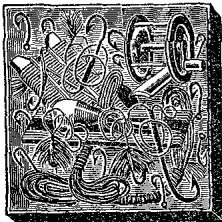
We can't begin to describe contents of our 1893 BONANZA for fishermen. Contains a patent HOLDFAST BRASS REEL; worth price of whole outfit; 1 LINEN TROUT LINE; 1 Linen BASS or SALMON LINE; 1 Long COTTON LINE on block; 1 FURNISHED LINE with BOB, SINKER & HOOK; 1 doz. Best Ass'd FISH HOOKS; A large assortment of FLIES for Trout, Bass & Salmon; 2 SNELL HOOKS & GUTS. All complete in neat Box; Every article is FIRST CLASS; No cheap Job Lots. The whole makes the CHEAPEST and MOST PRACTICAL OUTFIT ever sold at even double the price. Price post paid with large Catalogue of 1000 new and necessary articles. ONLY 50 CENTS. ROBT. H. INGERSOLL & BRO., 65 CORTLANDT ST., N.Y.

FOUND AT LAST!

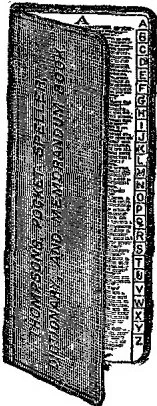
A Pocket Speller, Dictionary, and Memorandum Book Combined.
It gives the right orthography of all words (over 22,800) in common use, and in nearly every instance their definition. It also gives rules for the use of capitals and punctuation marks, abbreviations of names of States and Territories, letters of introduction and recommendation, definitions of commercial terms, forms of notes, due bills, receipts, letters of credit, orders for money, merchandise and goods stored, principal holidays, marriage anniversaries, combination of shades, and carefully selected laws of etiquette in social and business life, also a silicate slate for memoranda.
This Speller gives the most complete list of words in common use; it is a Speller, Dictionary, Handy Companion, and Memorandum Book combined; it is indexed; it prints all words pronounced alike but spelled differently, so they can be distinguished at a glance; it shows where the letter e at the end of a word is to be dropped when adding ed or ing; it gives a complete list of the most practical business forms; it gives the laws of etiquette in social and business life; these rules alone are worth the price of the Speller.
This Speller is bound in leather, is of convenient size to be carried in vest pocket, and its price brings it within the reach of all. American Russia leather, gilt edge, 50 cents. Sent post-paid to any address on receipt of price. Address Pacific Press Publishing Co., 43 Bond St., New York City.

The Grand Trunk Railway of Canada and the Chicago & Grand Trunk Railway

Form the GREAT THROUGH LINE to all Points in the West,
AND OFFER TO THE TRAVELING PUBLIC THE ADVANTAGE OF THROUGH TRAINS WITHOUT TRANSFER, AND A VIEW OF
THE ST. CLAIR TUNNEL,
“THE LINK THAT BINDS TWO GREAT NATIONS.”
It is the greatest submarine tunnel in the world, extending from Port Huron, Mich., under the St. Clair River to Sarnia, Ontario, and connecting the Grand Trunk Railway System of Canada with the Chicago & Grand Trunk Railway. It has just been completed at a cost of $2,700,000.
The tunnel proper is a continuous iron tube, nineteen feet and ten inches in diameter, and 6025 feet, or more than a mile, long. The length of the approaches, in addition to the tunnel proper, is 5803 feet, making all told a little over two miles.
Trains of the Grand Trunk and Chicago & Grand Trunk Railways are hauled through this tunnel by engines specially constructed for the purpose. They are said to be the largest engines in the world. The entire weight of the engine and tender rests upon ten drive-wheels. The weight of one of these monster engines in actual service is found to be approximately one hundred tons.
N. J. POWER, G. P. A. Grand Trunk Ry., MONTREAL, CANADA.
W. E. DAVIS, G. P. & T. A. C. & G. T. Ry., CHICAGO, ILL.

FRANK P. DWYER,

Eastern Passenger Agent, G. T. Ry., 271 BROADWAY, NEW YORK CITY.

THE BATTLE CREEK SANITARIUM

HEALTH FOODS.

For more than sixteen years the Battle Creek Sanitarium has maintained a Health Food Department, at first for the benefit of its patients and patrons, later, and for more than a dozen years, with increased facilities, to supply the general public. Within the last year More Than 150 Tons of the following named foods have been manufactured and sold:—
Oatmeal Biscuit, Rye Wafers, Medium Oatmeal Crackers, Fruit Crackers, Carbon Crackers, Plain Oatmeal Crackers, No. 1 Graham Crackers, Avenola, No. 2 Graham Crackers, Granola, Plain Graham Crackers (Dyspeptic), Wheat Granola, White Crackers, Whole Wheat Wafers, Gluten Food, No. 1, Gluten Wafers, Gluten Food, No. 2, Infants’ Food.

Granola, The Gem of Health Foods.

Our Granola, which has now been manufactured by us for nearly seventeen years, is unquestionably the finest health food ever devised, and is greatly superior to any of the numerous imitations to which its success has given rise.

TO THE PUBLIC:

This certifies that the Battle Creek Sanitarium Health Foods, manufactured by the Sanitarium under the name of the Sanitarium Food Company, are made under my direction and supervision, and that Granola and the other special foods manufactured by this company, are not made or sold by any other firm or person except their duly authorized agents. J. H. KELLOGG, M. D.
Our goods are shipped to every part of the world—to Australia, New Zealand, India, Persia, and other foreign countries, as well as to all parts of the United States; and in every instance they have demonstrated their wonderful keeping properties. The following are a few of the hundreds of testimonials received from persons who have for years made use of our foods.

MICHIGAN.

I have for three years used the “Health Foods” in my family, and can heartily recommend them, both for purity and health-giving properties. C. F. PORTER, D. D. S.

INDIANA.

Your “Health Foods” are the wonder of the nineteenth century. I have used Granola but a short time, but have already experienced relief from indigestion and acid, or flatulent dyspepsia. I also find the Zwiebach nourishing and toothsome. D. M. KAUFFMAN.
I have personally tested your excellent food known as Granola. It is highly pleasing to the taste, easy of digestion, and the most nutritive cereal production with which I am acquainted. DR. R. W. BULLA.

NEW YORK.

Your Granola is the best selling invalid food I have ever handled. I have already sold nearly two thousand pounds. A. J. BROUGHTON.

CONNECTICUT.

We have used your “Health Foods” in our family for three years and can not get along without them. Having been troubled with dyspepsia and chronic inflammation of the stomach, I found that your Granola, Avenola, Wheatena, and Gluten are the only foods that I can eat with safety. Wm. M. MERWIN.

OHIO.

Our baby is a testimonial to Sanitarium food. She is ten months old, weighs twenty-eight pounds, and is as ruddy and healthy a specimen as can be seen. She has actually gained flesh while cutting her last two teeth. Her flesh is firm and sound, and she is very strong.

MINNESOTA.

We have twins, and the little fellows are thriving nicely. The food agrees with them perfectly, and I have recommended it to many who are bringing up babies “by hand.” D. W. McCOURT.
We are constantly improving our foods, and adding to our list as the result of experimental researches conducted in the Sanitarium Laboratory of Hygiene and our Experimental Kitchen. For the latest descriptive circular and price list, address,
SANITARIUM HEALTH FOOD CO.,  BATTLE CREEK, MICH.

Sunday Laws and Liberty of Conscience in Tennessee and Maryland

The interview on another page which we republish from the Transcript, of Chestertown, Md., should not be omitted by any reader. It is full of interesting facts and opinions. Mr. Ringgold is never prosy, and especially is this true when he discusses Sunday laws and their relation to liberty of conscience.
The assumption by the courts of Tennessee and Maryland that a man must show that he has a religion before he can plead the constitutional guarantee of liberty of conscience is entirely unwarranted. The right to worship God, implies also the right not to worship. A man is not free to do that which he must do. The declaration of the Tennessee Bill of Rights that “no human authority can, in any case whatever, control or interfere with the rights of conscience,” is broad enough to cover with its mantle of protection the right of every man to absolute freedom in religious matters, and should be so construed by the courts. That it is not is ominous. It foreshadows even more serious assaults upon religious liberty than we have yet witnessed.
Likewise the language of Article 36, of the Maryland Bill of Rights, would seem to be sufficiently explicit to secure the rights of all, but that it does not is evidenced by the fact that a Seventh-day Adventist is in jail at Chestertown to-day for no other reason than practical dissent from his neighbors on the purely religious question as to which day of the week should be observed as the Christian Sabbath. The Bill of Rights declares that “all persons are equally entitled to protection in their religious liberty; wherefore no person ought, by any law, to be molested in his person or estate on account of his religious persuasion or profession, or for his religious practice, unless under color of religion any man shall disturb the good order, peace or safety of the State, or shall infringe the laws of morality, or injure others in their natural, civil, or religious rights.” But this is ignored, and a Seventh-day Adventist is imprisoned for husking corn on Sunday, a day which his religion teaches him should be devoted to secular pursuits in obedience to that part of the divine law which says: “Six days shalt thou labor and do all thy work.” That husking corn is immoral can not be maintained; that it interferes with others is too absurd to be even asserted; but that the law of Maryland forbids it on Sunday in deference to the religious prejudices of a portion of the citizens of that commonwealth, and that the courts stand ready to enforce the law notwithstanding the Bill of Rights, has been demonstrated, at least as to the inferior tribunals. What the court of last resort will do remains to be seen.

Adventists Continue Mission Work Despite Persecution

The systematic persecution of the Seventh-day Adventists in Tennessee, in Maryland, and elsewhere, and the organized effort throughout the country to establish and enforce the most strenuous legal discrimination against all seventh-day keepers, does not abate in the least the activity of the Seventh-day Adventists in good works, in the lines of educational and medical missionary labor which require large outlays of means and the time and strength of many self-sacrificing laborers. The Mt. Vernon Sanitarium building, Mt. Vernon, Ohio, where this denomination has conducted a medical institution, well and favorably known for some years, will be closed as a Sanitarium on May 1, and opened September 1, as an academy. It is understood that already about two hundred prospective students have applied for entrance next fall. All the medical appliances and furniture will be removed to 28 College Place, Chicago, where a new sanitarium is to be opened, in connection with a training school for medical missionaries. The medical missionary work of the Seventh-day Adventists is far more efficient and thorough than anything of the kind ever before attempted, and is being rapidly extended.

Enforcing Bad Laws Brings Injustice, Not Reform

VERY unfortunately General Grant once said that the best way to get rid of a bad law was to rigidly enforce it. It is a great mistake. The enforcement of a bad law means injustice to somebody, and injustice is never justifiable. The best way to get rid of a bad law is to repeal it; and as a general thing if those who are charged with the enforcement of such laws would speak out promptly and demand their repeal, legislatures would be quick to respond.

Sunday Work Prosecutions Threaten Asheville Sabbath Keepers

A PRIVATE letter, from a Seventh-day Adventist, in Asheville, N. C., says:—
The prospect is that one or two of our brethren may be indicted for Sunday work. The court will be in session next week, and we hear they will not say anything until near the time. One is a farmer, and has seven children; he was plowing in his field. He is a good man, and has been observing the Sabbath nearly a year.
What a strange inconsistency is here! This worthy farmer and father of a family who is conscientiously “observing the Sabbath” is to be put under arrest, and perhaps subjected to fine and imprisonment, upon the claim that he is failing to observe a Sabbath according to the statute made and provided.
The list of banner States of the American Sabbath Union is increasing. This is the roll of dishonor—Arkansas, Tennessee, Georgia, Maryland, and now North Carolina is about to swell the number. Although the attempted enforcement of religious law has become quite universal throughout the United States, in these States only has it yet attained to a definite religious persecution.

Battle Creek Sanitarium Health Foods.

THE managers of the Sanitarium Health Food Co. wish to announce to their old patrons and friends that their principal health foods are now manufactured and sold at the Rural Health Retreat, St. Helena, Cal. Several of our leading foods, including Granola, are also manufactured and sold at Union College, College View, Neb. Neither Granola nor any other of our health foods are manufactured by other parties than those mentioned above, except ourselves.
SANITARIUM HEALTH FOOD CO. BATTLE CREEK MICH.
Continue reading: Maryland Court Upholds Sunday Law Against Sabbath Keepers