THERE are many evidences that the spirit of religious liberty is waning. The imprisonment of Christian men for conscience’ sake in several states of the United States, and the endorsement of the laws that make such conditions possible by the leading religious combinations throughout the country, show the trend in this great American Government. Under the British flag the same tendency is quite noticeable. In 1676, in the reign of Charles II., a Sunday law was passed, which not only forbids “worldly labor,” but enjoins “repairing to the church,” and provides that “all persons shall on every Lord’s day apply themselves to the observation of the same, by exercising themselves thereon in the duties of piety and true religion, publicly and privately.” In 1858, however, Queen Victoria, in addressing her subjects in India, said:—
“Firmly relying ourselves on the truth of Christianity, and acknowledging with gratitude the solace of religion, we disclaim alike the right and the desire to impose our convictions on any of our subjects.”
This would indicate an appreciation of true religious liberty on the part of the sovereign herself, but all the old British Sunday laws remain on the statute books, and there is being manifested a disposition to resurrect these and enforce them, notwithstanding her majesty’s disclaimer of the right to impose convictions upon others. The inclination to bring up these old relics of an age of tyranny is particularly conspicuous in those parts of the British realm where the law of God regarding Sabbath observance is being made prominent and is securing attention.
The ancient doctrine that religious liberty is for those who have sufficient civil power to enforce their rights, is being extensively promulgated in popular religious circles, and is fast obtaining prominence in all of the “civilized” countries. This could not be if the true spirit of religious liberty were not on the wane. W. N. G.
GOOD WORDS FROM CALIFORNIA PAPERS.
“Eight honest, conscientious Seventh-day Adventists of Rhea County, Tenn., have been condemned to serve terms of from seventy-five to ninety days in the county jail at Dayton, Tenn., for the offense of doing common labor on Sunday—labor which disturbed no other person's private or public devotion. It has also been decided to work these honest men in the chain-gang.”
“It is hard to believe that in these days of liberality in sentiment and education such fanaticism can exist, or the laws under which the conviction was secured remain operative. The laws are plainly unconstitutional, and the punishment outrageous. In view of this fact, voters should pay particular attention to any endeavor on the part of any church or faction to reenact any similar law in this state. An attempt was made and a bill introduced in the last Legislature in this state to secure the adoption of a law almost identical to the one under which these conscientious men were punished.”—Ukiah Republican Press.
AN OUTRAGE.
“A report comes that eight honest, conscientious Seventh-day Adventists of Rhea County, Tenn., have been condemned to serve terms of from seventy-five to ninety days in the county jail at Dayton, Tenn., for the offense of doing common labor on Sunday—labor which disturbed no other person's private or public devotion. It has also been decided to work these honest men in the chain-gang.”
“This seems hardly possible in this year of grace. It reads more like the events of the Dark Ages, or the repulsive blue laws era of Connecticut, instead of this progressive era. Is Tennessee so far behind the age of progression as this? If so, the church, instead of sending missionaries to Asia, Africa, and the South Seas, had better send a few progressive, intelligent, sensible missionaries to Tennessee—they need them badly. We have looked for something better from the New South.”—Oakland Times.
SEVENTH-DAY ADVENTISTS.
“Under this heading the California Voice approves of the imprisonment of Seventh-day Adventists in Tennessee because they observe Saturday instead of Sunday as the Sabbath. The Voice closes its article with these words:—
“The laws of this country are not generally oppressive, and any sect that sets itself in opposition to them will get but little sympathy. Ninety-nine one-hundredths of the Christian people of America believe they are in the line of duty in keeping the first day of the week, and God has prospered them in doing so, and it is presumption, to say the least, for a few persons to set themselves against the learning and piety of the world, and claim that they have a right to go into a state and violate civil law simply because a misguided conscience prompts them to it.”
“The above is from the pen of our friend Dr. Stephen Bowers, and we are surprised to see a man generally so liberal, so illiberal toward the Adventists, who, so far as purity of life is concerned, compare favorably with any other sect. The editor of this paper is very far from being an Adventist, but we do believe that their imprisonment for conscience' sake is in direct conflict with the fundamental law of this republic, which guarantees to all men the right to worship God according to the dictates of their own consciences. It would seem that, according to the Voice's logic, minorities should be compelled to surrender their religious convictions at the demand of the majority. Such a doctrine enforced would prevent all reform. It would have suppressed Luther, and Knox, and Wesley, and Phillips, and Garrison, and Sumner. It was the effort to enforce this rule that drove the Pilgrims to this country, imprisoned and burned Quakers, and filled the past with cruelty, persecution, and blood.”
“When majorities arrogate to themselves the right to say to minorities, You have misguided consciences in religion, and if you don't worship God in the manner we prescribe, we will put a ball and chain about your ankles and shut you up in prison, then is the very foundation of religious liberty attacked, and the crowning glory of this republic threatened.”—Santa Paula Chronicle.
The Plutocracy.
That America’s tutelar deity is no longer the “Goddess of Liberty” is evident to the most casual observer. The principal god at whose shrine the people worship is Plutus, the god of wealth. This is well set forth in the following graphic statement from a New York paper, of July 4:— “The uncrowned king of America has returned from his trip across the sea. . . . President Cleveland is at times referred to by his enemies as a ‘czar,’ but the duration of his powers is fixed, and he is no true king. The real uncrowned king of America is one who is not dependent upon popular approval, the duration of whose powers is not fixed, who is obliged to account to no one for his movements, and who dictates not only to politicians but to railroad magnates, bankers, and trusts, and who by a nod of his head and a turn of his wrist decrees the rise or fall of values, the ebb or flow of prosperity. There is but one such man, and his name is J. Pierpont Morgan. To him the President appealed when this nation of seventy-five millions was floundering on the verge of bankruptcy. He heard the appeal, set his own price on his services, and extended the costly protection of his kingly arm. He went to England, and, lo! those who had been selling out American securities began to buy. He spake, and the gold ceased to leave the country. He returned, and when he set foot upon the western hemisphere, the planet tipped. The stock exchange almost ceased to do business until he was heard from in a public statement. The railroad presidents hastened to him in a body, prostrated themselves, and cried, ‘Help us or we perish.’ Trust magnates came and cried unto him, ‘Unless you reorganize us, we are lost.’ Nothing like this man’s apparent power has been seen since the republic was born. It is hardly an exaggeration to say that the nation’s prosperity depends as much upon what J. Pierpont Morgan says and does as upon the condition of the crops or the decrees of Congress. The fact may not be discreditable to him. Scanning his conspicuous record for the last few years, we do not see what there is to reproach him for. But, all the same, there is no more alarming symptom of industrial, economical, and financial disease than the tremendous powers that have become vested in this man. What system is this that concentrates in the hands of a single individual the power of life and death almost upon a nation’s industries? . . . It is time to do some thinking.”
The above is but one of many indications that we are nearing the end of the present order of things. “It is time to do some thinking;” but is it not better to think along the lines of the “more sure word of prophecy,” which God has given to be “a light that shineth in a dark place” to the coming of Christ?
A FITTING REBUKE.
The following letter appeared in a recent Voice (of New York). The editor gives it this suggestive heading, “The ‘Unspeakable Turk’ Gives Us a Vigorous Dose of Our Own Medicine.”
“VITOLIA, Turkey-in-Europe, June 3, in the year of your Lord 1895.
“Editor of Voice newspaper,—
“MY RESPECTED SIR: Please pardon your slave if I do not this letter translate precisely into your language, assisted by my lexicon.
“Many Christian newspapers, in America particularly, upbraid our race, and our most gracious ruler, the sultan, because on account of the what you call Armenian outrages, concerning Christians in our country.
“These severe censures are not equitable to my mind and to my patriotism. Let us look. You say our sultan treats the Armenians with cruelty, but how have your Christians treated the first owners of America? I mean the Red Indians named the aborigines. You have 400 years of persecutions which you celebrate with your Columbian Exposition.
“You have also one war of four years, where 1,000,000 Christians were, by their brother Christians, killed. What is one small village of rebels killed?
“Then you had some of African slavery, worse degraded and cruel than Moslem slavery, 4,000,000 slaves.
“Slave sellers are not benevolent and humane, very.
“Statistics from America say that one-half of the money for the support of the United States is taken from impost on intoxication drink, and 100,000 yearly die caused by this vice. Our sultan kills a small village of heretics, traitors. In your Koran, which I admire, there are such words like this: ‘Take the beam out of your eyes and quickly you are able to see clearly and take the mote out from your kinsman’s eyes.’
“Your obedient slave,
“HAMDI-NUZRET,”
He might have added to the other outrages of this “Christian nation” that at the present time there are Christians in jail, placed there by other Christians for doing just what Christ did.
From a Missionary Baptist on Sunday Laws
FROM A MISSIONARY BAPTIST.
“Booneville, Cooper Co., Mo., June 25, 1895.
“Editor Signs of the Times—Dear Sir: Through the courtesy of a friend your paper has been received and read by me. I am a Missionary Baptist by faith and practice, and have always contended for that liberty of conscience which is guaranteed by the organic law of the land,—the right to worship God according to the dictates of the individual conscience.
“The enactment of Sunday laws by the states is direct violation of the liberty guaranteed by the Constitution of the United States. The enforcement of such laws amounts to religious persecution, which is a disgrace to our intelligence. I hope that your effort may convince the people of their error.
“M. R. McDowell, Esq.”
And here is where all Baptists and professed Christians ought to stand.
Thou Alone Keepest Judgment
By Alice Cary
Thou alone
Keepest judgment for Thine own;
Only unto Thee is known
What to pity, what to blame,
How the fierce temptation came,
What is honor, what is shame.
—Alice Cary.
HOW TO KILL AN ENEMY.
“Children,” said a kind father to his little family, as he took his seat by the fireside, and gathered them around him for a pleasant talk, “which is the best way to kill an enemy?”
“Why, shoot him, to be sure,” said one.
“No, stab him,” said a second.
“No, starve him,” said a third.
“But I think,” said their father, “I can show you a better way than this. An enemy may be killed without taking from him his life, or shedding a single drop of his blood. Let me tell you a story to show how.
“There was a farmer once, who was a very cross, surly, disagreeable man. Everybody in the neighborhood knew him, and everybody disliked him. He was sure to make the most of whatever went wrong about him, and the poor offender always met with severe punishment. There was not a boy in all the neighborhood who didn’t feel uncomfortable as he passed his gate; and the poor dog that barked at his geese, or the neighbor’s rooster that crowed on his wall, was speedily visited either with the lash of his whip or the shot from his gun. The very cat knew his footsteps, and slunk away from him in terror. He was a complete pest, as much so to himself as to those about him. Every day brought him some fresh trouble, and found him in continual ‘hot water’; indeed, his life was made up of broils.
“After a time good Farmer Green came to live near him, and was soon told the character of his not overpleasant neighbor.
“‘Well,’ said he, if he ‘shows off’ on me, I’ll very soon kill him.’
“This remark of Farmer Green’s soon got afloat, and all sorts of things were said about it. He seemed the very last man to ‘kill’ any one, for his looks, and words, and actions all told of a loving heart which throbbed in his bosom and directed his life. Nobody could think for a moment of his becoming a murderer. Mr. Green’s intention at length came to the ears of the ill-natured farmer, and you may be sure he was not at all pleased about it. Everything he could do to tease, annoy, and even injure Mr. Green was done; but somehow the man who was to ‘kill’ this ugly-tempered farmer took it all in good part, and spoke as calmly and looked as kindly as ever.
“One day Mrs. Green sent to the wife of our surly friend a basket of nice plums; but her husband would not let her have them. He told the person who brought them, very gruffly, that ‘it was only done to get some of his pears in return, and he wasn’t going to give any of them away.’
“At another time Mr. Green’s team of oxen stuck fast in a bog, and when he asked his neighbor for a little help, he told him, in a rough way, that ‘he had enough to do to mind his own business,’ and refused to help him.
“‘Never mind,’ said Mr. Green to one standing by, ‘I’ll kill him very soon; see if I don’t.’
“Soon after this the team of the ill-natured man was in the same plight that his neighbor’s had been in. Mr. Green saw it. He ran for his oxen and chains, and set off to the bog. He spoke kindly, offered his help, and began to render it; but what did he receive in reply?—Why, a fierce look and an angry word—‘I don’t want your help! Take your oxen away!’
“‘No,’ said the other, ‘I must help you, for the night is coming on, and what is bad enough by day is ten times worse in the dark.’ Away pulled the oxen and men, and soon all was set right again.
“A strange feeling did that rough, cross man carry home with him that evening, something that he had never felt before. And a strange look did his wife give him as he said, ‘Peg, Farmer Green has killed me; he said he would, and he has done it.’
“Yes, the ‘enemy’ was ‘killed’ without the loss of a single life or one drop of blood. He went in the morning to confess his ingratitude to his kind neighbor and ask his forgiveness; and the very man who had been noted for nothing but his wickedness became the friend of all.”—Best Things.
IS TOBACCO-USING SIN?
“Drinking liquor is sin, but smoking is not.” A Christian worker made this assertion one day in conversation about narcotics and stimulants.
Some years ago Dr. Woods, a celebrated physician in the United States, said: “The active or poisonous principle of tobacco is one of the most virulent poisons known, and a drop of it in a state of concentrated solution is sufficient to destroy a dog, and birds perish as they approach a tub containing it.”
Wandering over to France and searching into records of wisdom, we find that M. Joly, in addressing the Academy of Science, gives this terrible warning: “The increase of lunacy keeps pace with the increase in the revenue of tobacco, and the immoderate use of the pipe produces a weakness of the brain and the spinal marrow, which causes madness.”
Coming home to Canada, we listen with marked attention to Mrs. Elizabeth Bradley, of England, as she gives her evidence before the Ontario Prison reform commissioners in Hamilton: “My own conviction is that the use of tobacco has a terribly demoralizing effect, far more so than is generally understood. Some young ladies were engaged in rescuing the daughters of professional men, and there came under their attention the daughter of a clergyman that was in connection with our work in London, England. There seemed here to be such a positive tendency to vice that we thought there was some other cause than the apparent temptation to which she was subjected. On inquiring we found that there had been great degeneracy in her ancestry. Her grandfather and father had been inveterate smokers. We set physicians to study this. My own conviction is that girls and boys who have come from a stock of this kind have a predilection to sensual vice. They are weak in that direction, and the result is a terrible increase in vice of this kind.”
I knew one woman who taught her children to despise smokers and sellers of tobacco. They, in turn, by God’s blessing, converted their father to her views. He began preaching to his class in Sabbath school, and one boy said laughingly to another, “Why, our minister smokes; papa has to order the very best brand of tobacco for him.”
The words were reported to the teacher, and he went to the minister and laid the matter before him. I am glad to say that that minister decided to give up the habit, although his wife was much opposed to his doing so. She said that his pipe soothed him so much and was such a comfort to her husband that she hated to see him give it up.
Can we still consider it no sin to smoke when we remember how selfish men and boys become who use tobacco, and also the extravagance it incurs, and, lastly, worst of all, ever remember that the use of one narcotic often leads to the use of others? “Tobacco prepares the way for alcohol, alcohol for opium.”
Mothers, watch your little boys; examine their mouths and see to it that on their way to and from school they are not learning to smoke by picking up the stumps of cigars that they find on the sidewalks. I know of children who are now smokers from this practice.—Woman’s Journal, Ottawa, Canada.
WHAT JIM FOUND IN HIS POCKET.
It was a great day for Jim Hagen when he went to be boy-of-all-work at the Mitchells’, for it was the first time in his life that Jim had ever slept in a clean bed, or had three square meals a day, or spent twelve hours without getting a cuff from somebody.
He was fast growing up into a wicked man, and seemed likely to end his days in the penitentiary, when God gave him a chance to do better.
Mr. Mitchell was crossing Fib’s Alley one day, hunting up some poor people he was trying to help, when he saw Jim fighting a boy bigger than himself to make him give a child back a nickel he had grabbed.
Mr. Mitchell went into the fight himself, drove off the bully, gave the sobbing child her nickel and another, and then turned his attention to Jim. For several days he inquired all around the neighborhood about Jim, and everything he heard drew him to the boy. Not that Jim was anybody’s good boy; he could not find that he was either honest or truthful, but he was brave and kind, and had a sort of dogged faithfulness to what was given him to do.
“The image of the Maker is not rubbed entirely out from that boy,” said Mr. Mitchell to his wife; “let’s give him a trial.”
But the first thing they did was to give him a bath, which Jim did not like any more than a young rooster would; then he was fitted out in some old garments of Carter’s, and felt himself a dude, in spite of the fact that the three garments had belonged to three different suits, and were somewhat ragged about the knees. He was promised better clothes if he behaved well enough to keep his place. The first time that he put his hand11down into the pocket of his new-old trousers he felt something round and hard at the bottom. He had never owned a quarter in his life, but he knew the feeling of it in a minute, and, having learned to be sly, he said nothing to the lady, who was turning him around to see if the clothes were respectable.
But the first minute he had to himself he tied that quarter up in an old dirty rag, and swung it by a string around his neck, under the new-fashioned shirt they had put on him.
“When they miss this here piece of money, and come axin’ me for it, I won’t know nothin’ ’tall about it,” said Jim to the self he had brought with him from Fib’s Alley. “Pockets don’t tell no tales.”
I have said that Jim was a brave boy; he had stood up against oaths and threats and blows and cold and fatigue, but there was one force that had never been tried on him, and that he did not know anything about, and that was loving-kindness. God and his servants were getting ready for that experiment now.
There were many things in the Mitchells’ house that surprised and delighted Jim, but the thing he had the most hankering after was a highly ornamental pistol, in one of the young gentlemen’s drawers. The pistol ought not to have been there, but some young men don’t cut their wisdom teeth very early, and there it was bright and tempting.
Jim took a look at it every day, and presently began to handle, and cock, and aim it, and at last it went off in his right hand, and shattered one of the fingers of his left.
Poor Jim! The finger had to be cut off; and now he had his first taste of anguish.
Mrs. Mitchell sat by his couch, not only during the dreadful operation, not only during the long days of pain and nervousness, but straight through the night, for fear he might sleep and tear the bandages from his poor hand.
When the first daylight came in the window, Jim awoke and saw her sweet face, pale with sleepless watching; a big lump seemed to rise in his throat, he fumbled at the neck of his shirt until he managed to tear out the quarter, wrapped in its dirty rag.
“If I had a-known how good you was to me, I never would a-took it,” he said, putting it in the lady’s hand and bursting into tears.
Mrs. Mitchell’s tears fell, too. “My boy,” she said, “if I tell you of One who loves you far better than I do, and who has done unspeakably more for you than I ever could, will you not feel that way about him, too—that you never will grieve him, because he is so good?”
And then she spoke to Jim of the Saviour who had died for him, and of the love that was now seeking him. And so, by this loving-kindness of hers, Jim learned to know the “Love divine, all love excelling.”—Morning Star.
IN LIFE—NOT DEATH.
By Sophie L. Schenck
BY SOPHIE L. SCHENCK.
SOMETIMES we think,
When hard words fall upon the waiting ear,
That were that friend now living, cold and dead,
How different the tones that we should hear,
How kind the things that would of him be said;
For most hearts shrink
From speaking harshly of the silent dead!
In life—not death,
Hearts need fond words to help them on their way,
Need tender thoughts and gentle sympathy,
Caresses, pleasant looks to cheer each passing day;
Then hoard them not until they useless be;
In life—not death,
Speak kindly. Living hearts need sympathy.
O do not wait
Till death shall press the weary eyelids down
To yield forbearance! Let it daily fall;
With it a golden calmness comes this life to crown;
Joy springs from charity. Friends, one and all,
Before too late
O'er faults and frailties let this mantle fall.
What worth can be
Love's gentlest glances, or its fondest tone,
The sweetest fancies loving lips can say,
When this form silent lies, cold and alone,
Beneath some grass-grown knoll not far away?
Ah, give to me
Love's prompt defenses while in life I stay!
—Christian Work.
PROTESTANTISM AND ROMANISM IN MADAGASCAR.
By George Cousins
BY REV. GEORGE COUSINS,
Secretary of the London Missionary Society.
To UNDERSTAND the present position of affairs in “the Great African Island,” as Madagascar is sometimes called, it is necessary to revert to a somewhat remote chapter of history. As far back as 1642 France made her first attempt to colonize the island. In that year the Société de l’Orient was formed for that express purpose, under the direct patronage of Cardinal de Richelieu, and, in spite of constant disaster, the work of colonization was persisted in for thirty years. It was then for many years abandoned, but by an order in council dated July 4, 1686, France asserted her claim to Madagascar as a part of her dominions. This claim was formally repeated from time to time, and in the eighteenth century frequent attempts at colonization were made and persisted in for upward of fifty years. War with Great Britain and the rise of the Hova power greatly modified the situation, but the island of St. Marie, on the east coast, and of Nosibé, on the northwest, remained permanently in French possession. Not only so, but failure to maintain their position on the mainland notwithstanding, France still regarded Madagascar as her own. Prior, however, to the signing of the Franco-Malagasy treaty, in December, 1885, her claims had never been recognized by the Hova power, but the cession, under that treaty, of Diego Suarez Bay as a French naval station, and the clause recognizing the government of the republic as the representative of Madagascar in all her foreign relations, did undoubtedly confer upon France special and peculiar rights.
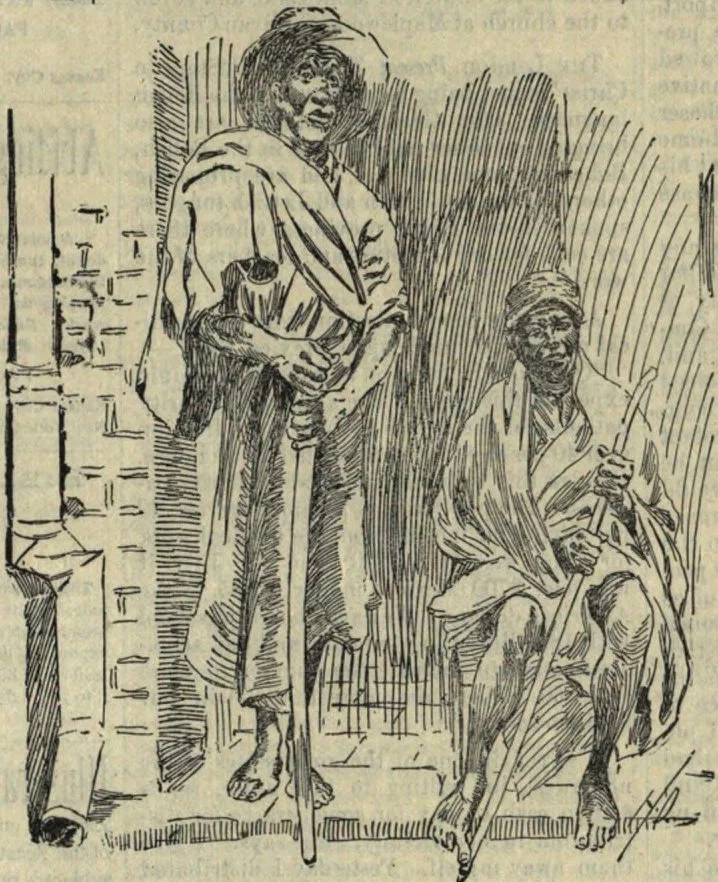
Paupers Who Were Once Princes of Madagascar.
Throughout this long connection with Madagascar, France has had valuable allies in the persons of Romanist missionaries; and long before the Protestants of Great Britain turned their attention to the island, Dominicans, Lazarists, and other religious orders of the Romish Church, had toiled and suffered and died in self-denying efforts among some of the coast tribes. They accomplished but little, it is true, and after twenty years abandoned their difficult task, leaving few traces behind them, but a few pages of a catechism. Their converts lapsed into heathenism, so that when, in 1818, the London Missionary Society commenced operations in the island, not a vestige of anything Christian was to be found, nor did any Roman Catholic missionaries follow them, or attempt to interfere with their work. The foundations of native Christian churches were laid by British Protestants, unchecked by any rivalry or opposition from others. Then came the break-up of the mission, and dark days of persecution, during which for a quarter of a century foreigners in general, and missionaries in particular, were kept out of the island.
A few succeeded in effecting an entrance one or two permanently to settle, others as passing visitors only. Conspicuous among the former was a Frenchman named Laborde, a man of considerable natural ability, who gradually acquired immense influence over the queen and her officers; while among the visitors were one or two Jesuit priests.
In 1861 Ranavalona I., the persecuting queen, died, and her son came to the throne, with the title Radama II. His accession secured liberty of worship to the native Christians, and brought foreigners back to Madagascar. To missionaries he at once granted full permission to prosecute their labors without let or hindrance. A few dependents of M. Laborde excepted, the entire native Christian community was at that time Protestant, and when the London Missionary Society resumed operations, its agents were welcomed by the Malagasy Christians as their recognized spiritual guides. But they were no longer the sole occupants of the field. Concurrent with their own arrival came a large staff of Roman Catholic missionaries—Jesuit Fathers, teaching Brothers of the Order of St. Joseph, and Sisters of Mercy—and from that day onward Protestant and Romanist teachers have worked side by side. Even during the Franco-Malagasy war, when the European staff (which was almost exclusively French by nationality and wholly so in political sympathy) was for the time expelled, native Catholic congregations still assembled for worship, and their liberty to do so was in no way interfered with by the Hova Government.
The Franco-Malagasy treaty materially affected the political situation, nor can it be denied that many feared that it would have a like influence upon the religious situation. When leaving Antananarivo, on the outbreak of hostilities, the priests boldly asserted that they would soon return as conquerors, and that, backed by the power of France, they would in future be able to carry everything before them. Much of this could, of course, be set down as idle vaporing; besides which our knowledge of the unique position, which, thanks to the years of persecution, the Bible holds in the estimation of the Malagasy people, was in itself enough to rob the language of much of its force. Still there did seem to be ground for grave concern, and the outlook was for the moment overcast.
More than eight years have gone by since the treaty was signed, and thus far none of the fears entertained have been realized.12Protestant missionaries continue their work on the same lines as before. In several districts they have greatly extended their operations; in all they have striven to consolidate and mature their organizations, and the proportion of the population that willingly follows their lead remains what it was before the treaty came into operation.—Missionary Review.
Salt Water Remedy for Colic and Faintness
“For the violent internal agony termed colic, take a teaspoonful of salt in a pint of water; drink it and go to bed. It is one of the speediest remedies known. The same will revive a person who seems almost dead from a heavy fall.”
The Strong Soul and the Tendency to Persevere
“The tendency to persevere, to persist in spite of hindrances, discouragements, and impossibilities—it is this that in all things distinguishes the strong soul from the weak.”
PRESENT TRUTH IN TURKEY.
By H. P. H.
The proclamation of the second advent of the Lord will be made to every nation before the great event takes place. While missionaries of this faith were sent out to every nation as fast as possible, the Turkish Empire received but little attention. But the Lord of the harvest did not forget this field. In the year 1888 a Greek who had migrated from Asia Minor to California, attended one of our camp meetings and received the truth. Although understanding English but imperfectly, he could comprehend enough to see that the message was of momentous import. He felt such a burden to impart these precious truths to his countrymen that he vowed upon the camp ground to return to his native land if the Lord would send him a purchaser for his small shoeshop. On returning home he found that the Lord had taken him at his word, for there was a man ready to purchase his business.
He soon sold out, and, without asking any missionary board to sustain him, started for Turkey. In returning to his native city, it was necessary for him to pass through Constantinople; here he remained a few days, and, thinking that everybody would be as rejoiced to hear the good news of the Lord’s soon coming as he himself was, he went to the Protestant churches to tell the people about it. But he was soon undeceived; that the Lord would soon come was not welcome news to them; so they prohibited the man’s coming into the churches. He therefore talked with the people outside; for this he was complained of as a disturber of the peace and imprisoned by the Turkish police. Thus his Christian brethren delivered him to the gentiles. Without inquiring into the justice or injustice of the complaint against him, the Turkish police kept him in custody as long as he had money; when they had from one pretext and another extorted his last dollar, they had no more use for him, and set him at liberty.
Being now without means to continue his journey, he was compelled to seek work in Constantinople to earn his living. Because he kept the Sabbath, his employer took advantage of him, paying him only about half wages. At the best, wages are here very low, yet with half wages our Greek was able to live and labor for the Master. His action under these circumstances is a fitting reproof to many in better circumstances who excuse themselves from doing anything for the Lord, on the ground that they have no time.
The faithful labors of this self-sacrificing man soon bore fruit, a number uniting with him. Among those that accepted the faith were some that soon devoted themselves to the work. From Constantinople as a center, the truth radiated out in all directions, penetrating as far into the interior as the river Euphrates.
At the present writing there are believers in present truth in Constantinople, several villages in Nicomedia (ancient Bithynia), Cappadocia, Cilicia, and Aleppo. Believers in all these provinces are unusually active in spreading the new-found faith; they see that it is the word of God indeed, and for that reason it creates in them such a lively hope and great joy.
It is a source of gratitude to see the truth going with such rapidity and power in these lands where the Gospel first triumphed over heathen darkness. This work was begun in the right spirit, humility and sacrifice, and so long as this characterizes the workers, it is bound to triumph. From the first, great obstacles have been met, but, in spite of all, the truth is constantly gaining victories and advancing, and doubtless when the Lord comes many will here be prepared to meet him.
H. P. H.
SEVENTH-DAY ADVENTIST ITEMS.
A small church was recently organized at Minnewaukon, North Dakota.
In connection with meetings recently held at Greenville, Ohio, twelve accepted the truths presented, and united with the church at Laura.
Recent reports of labor in New York show additions as follows: At Natural Bridge, Jefferson County, five have been added. In the vicinity of Nicholville, St. Lawrence County, eleven are reported. Thirteen have been added to the church at Monticello, and seven to the church at Maplewood, Sullivan County.
The London Present Truth says: “‘Steps to Christ’ is just being brought out in the Polish language. Our German brethren are also bringing out other publications in the Polish, Bohemian, and Livonian, and are preparing others for the Esthonian and Lettish tongues, spoken in the Baltic provinces, where there are calls for our literature and teachers of the word.”
A private communication from our medical mission in Guadalajara, Mexico, says:—
“Our work is going on as well as we could expect at this place. The average of charity patients for the month of July was a fraction over 40 per day that were treated in the house. Besides this we had some outside charity patients. The pay patients perhaps average 20 per day. Our income from the medical work for June was over $800, and for July it was over $700 Mexican money ($1.85 to the American dollar). We have a boarding school with 18 children in the house, and day scholars enough to increase the number to more than 50. There are more than 60 in our Sabbath school.”
A sister in one of the great states of the northwest, in writing to this office, sends $10 in cash to pay for some tracts for distribution in her vicinity. She says: “I give them away myself. Yesterday I distributed about $5.00 worth. These were mostly on the Sabbath. I am poor financially, and a widow, with two children to take care of, but yet I must help to spread this message; I give every cent I possibly can, and will, if the Lord helps me, get tracts to every family in this valley. This is a large valley, and it would take about a year to go all over it. There are a great many people here, not many of us to work, and but a short while to work.” This is the spirit of the Gospel.
A Colorado tent laborer reports a favorable turn of affairs in connection with a series of meetings. It should not be deemed a strange occurrence, however, inasmuch as earnest prayer had been offered in behalf of the accomplished result. Here is the report:—
“A Dunkard minister has been in attendance almost every evening. A question was placed in our question box, asking for further proof that the Sabbath is the seal of God, and Sunday the mark of the beast. Almost an entire evening was spent with the answer, at the conclusion of which this minister arose and said he would like the privilege on next Thursday evening of giving an answer for his hope. The privilege was granted him, and from that time on we prayed earnestly that God would lead him to preach the truth, rather than to oppose it, and our prayers were most abundantly answered. I never attended a meeting where the power of God was more manifest. Twice he told the people he couldnot follow the line he had intended, and that he must speak as the Spirit directed. His entire sermon was a most earnest appeal to accept the Gospel of God, unadulterated by men, and be ready to meet the soon-coming Saviour. He is an old resident here, but many said it was the best sermon they ever heard him preach. If God be for us, who can be against us. Praise his holy name.”
Wanted: A Housekeeper Position Advertisement
WANTED, a housekeeper. Address, G. C. Jenkins, 721 Second Street, Santa Rosa, Sonoma Co., Cal.
THE JUDGMENT
By John Nevins Andrews
By the late J. N. ANDREWS
The Events of the Judgment and their Order. Following are principal chapter headings: The Investigative Judgment, Examination of the Books, God the Father the Judge, Offices of Christ, Messages to the World, The Sanctuary in Heaven, The Crowning of Christ, The Executive Judgment, The Saints Sitting in Judgment. Bible Students’ Library No. 55. 136 pages. Paper covers. Price, 15 cents.