Art thou weary, near despairing,
Bowed at times with care and grief,
Conscious of thy weakness, sharing
Darksome doubts; while no relief,
Even from the Source of blessing,
Finds its way thy heart to cheer?
Go on, straight to Jesus pressing,
Helpless soul, thy strength is near!
In the work that lies before thee
Jesus takes the greatest part;
Keep on with the “Bible Lessons,”
Labor on with willing heart!
Mindful of the night approaching
Now, while it is called to-day,
On,—combat with doubts encroaching,
Push along thy Heavenward way!
Quench, with water from the fountain,
Restless, Christ-dishonoring fears;
Soon, though rising like a mountain,
They shall fall when faith appears;
Use thy talent for the Saviour,
Visit oft the Throne of Grace;
Watch! and see that thy behavior
Excels in the Christian race!
Yearn for souls,—on Christ depending,—
Zeal for him means life unending.
—S. S. Chronicle.
EUROPEAN CATHEDRALS.
CATHEDRAL AT STRASBOURG.
Another unfinished cathedral is that of Strasbourg, which still lacks completion in its south tower. This edifice stands upon the site of a church founded by Clovis about 510, and which was destroyed by lightning in 1007. The foundation of the present structure was laid by Bishop Werner of Hapsburg in 1015, and the interior was completed in 1275. The spire of the north tower was completed in 1439, but, as we have said before, the south tower remains unfinished to the present day. The construction of the edifice having been superintended by the ablest masters during four centuries, an opportunity is afforded to trace the rise and progress of Gothic architecture.
The façade is the richest part of the whole structure. Its magnificent rose window is forty-two feet in diameter, and its three portals, which are adorned with scenes from the history of Creation and Redemption, are regarded as being among the finest Gothic works in existence.
In 1793, several hundred of its statuettes were ruthlessly torn down and destroyed by the French revolutionists, and the beautiful spire only escaped the same fate from having been provided with a red republican cap, made of metal, as a protecting badge. The spire rises to the immense height of four hundred and sixty-five feet.
The church has been damaged many times by lightning, once by an earthquake, and when the city was besieged by the Prussians, it became a target for their guns, for the reason that the French maintained a post of observation on the elevated platform between the towers. Not only was the spire hit several times, but the organ was pierced by a shell, and the stained-glass windows were almost entirely ruined.
On the night of the 25th of August, 1870, the roof caught fire, and a great portion of it tumbled in. For several years past, workmen have been repairing the damage. Despite all its mishaps, the cathedral stands a stupendous monument of the grandeur of the human mind, both to plan and to execute.—Arthur’s Home Magazine.
THE LITTLE HARE.
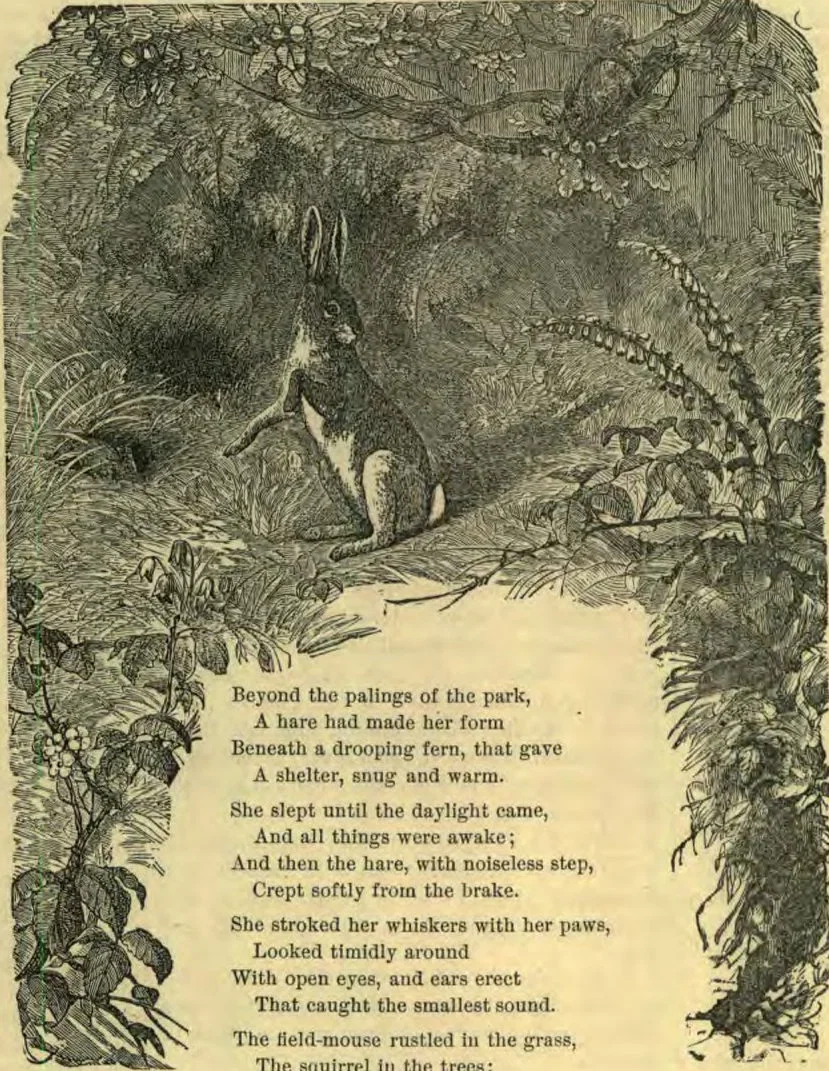
The hare is very much like the rabbit. It is a little larger, and is known by a black spot at the tip of its ears. It does not burrow in the ground as rabbits do, but makes its nest, or “form” as it is called, in the grass. It is very timid. In England rich men hunt it, for sport, with dogs and horses. It is hard to understand how grown-up men can take pleasure in hunting down a poor timid hare. It is cruel and senseless sport. We trust that no boy in the INSTRUCTOR family ever hurts an animal for pleasure or mere sport.
Here is a little poem about the hare which we take from the Canadian S. S. Advocate, and which we believe will please you if you read it carefully through:—
Beyond the palings of the park,
A hare had made her form
Beneath a drooping fern, that gave
A shelter, snug and warm.
She slept until the daylight came,
And all things were awake;
And then the hare, with noiseless step,
Crept softly from the brake.
She stroked her whiskers with her paws,
Looked timidly around
With open eyes, and ears erect
That caught the smallest sound.
The field-mouse rustled in the grass,
The squirrel in the trees;
But the little hare was not afraid
Of common sounds like these.
She frisked and gamboled with delight,
And cropped a leaf or two
Of clover and of tender grass,
That glistened in the dew.
What was it, then, that made her start,
And run away so fast?
She heard the distant sound of hounds,
She heard the huntsman's blast.
Hoy!—tally-ho!—hoy!—tally-ho!
The hounds are in full cry;
Ehew! ehew! in scarlet coats
The men are sweeping by.
So off she set with a spring and a bound,
Over the meadows and open ground,
Faster than hunter and faster than hound;
And on, and on, till she lost the sound,
And away went the little hare.
Beyond the palings of the park,
A hare had made her form
Beneath a drooping fern, that gave
A shelter, snug and warm.
She slept until the daylight came,
And all things were awake;
And then the hare, with noiseless step,
Crept softly from the brake.
She stroked her whiskers with her paws,
Looked timidly around
With open eyes, and ears erect
That caught the smallest sound.
The field-mouse rustled in the grass,
The squirrel in the trees;
Letter Budget
Sevastopol, Ind.
Dear Editors: I take the INSTRUCTOR, and think that it is very interesting. I am twelve years old. I have kept the Sabbath with my father and mother about four months. I feel very thankful to Brn. Sharpe and Lane for bringing the tent to our place. Pray for me that I may ever live a faithful Christian life.
Yours truly,
Charlie A. Dormire.
State Center, Iowa.
Dear Editors: I am thirteen years of age. My sister and I take the weekly INSTRUCTOR. We go to Sabbath-school every Sabbath. I have signed the teetotal pledge. My mother died when I was four years old, and my father died when I was nine. I am living with Sabbath-keepers. I hope all of the INSTRUCTOR family will try to follow Jesus. I am trying to follow him.
Anna Wellet.
West Hallock, Ill.
Dear Editors: I have been thinking some time of writing, but have not got at it till now. I am nearly thirteen. I have been taking the INSTRUCTOR only this year. We keep the Sabbath. I attend church and Sabbath-school. We have young people's prayer-meeting every Wednesday evening. I like to attend them very well. I am trying to be a Christian. Pray for me that I may have the pleasure of singing praise to God in “the land that is fairer than day.”
Stella Burdick.
Riceville, Iowa.
Dear Editors: I am twelve years old. My grandmother sends me the INSTRUCTOR, and I like it very much. I keep the Sabbath with my mother. There is no meeting or Sabbath-school near here. Pray for me that I may at last meet you all in Heaven.
Edith B. Gammon.
Marquette, Kan.
Dear Editors: We are two sisters aged ten and fourteen. We keep the Sabbath with father and mother. We take the INSTRUCTOR, and like to read it. We have no Sabbath-school to go to here. We are trying to live Christian lives. Pray for us.
Ida and Jessie Mitchell.
A Native African's Dog and the New Testament
A NATIVE African was greatly grieved because his dog swallowed some of the leaves of the New Testament. He had been a fine hunter, and his master feared, judging from the effect on those who read “The Book,” that it would tame and so spoil him.