The Youth’s Instructor, Vol. 28, No. 32.

WHICH IS THE PENITENT?

The Youth’s Instructor

Aug 4, 1880

S. D. A. Publishing Association · Battle Creek, Mich. · Aug 4, 1880

WHICH IS THE PENITENT?
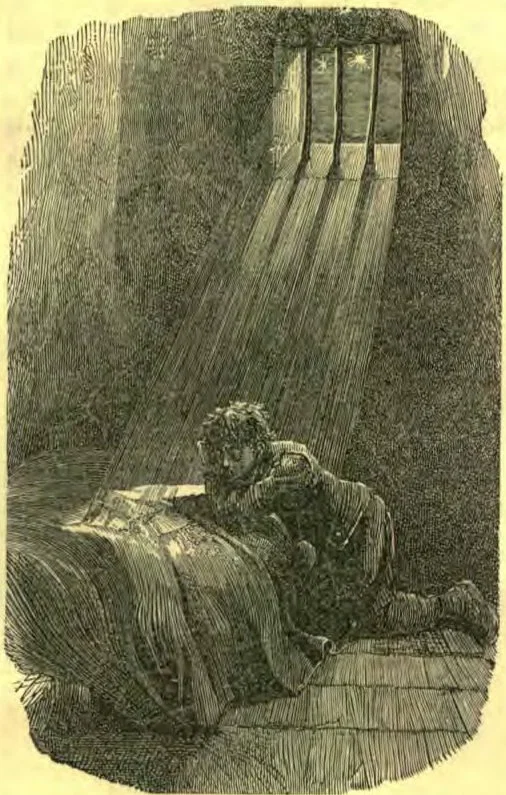
THIS boy is in prison, as you see. The moon and stars are pouring their soft, clear light upon his bed, beside which he is kneeling. His sad face shows that his heart is wretched.
Perhaps some of you are saying, “But how came he in prison? What has he done?”
The poor fellow has been stealing. He was caught in the act, and sent to jail. He does not like being in a cell alone. The wicked never like to be alone, because they are afraid of themselves and afraid of God.
This poor boy cannot sleep, so he has thrown himself by his bed, and if you will put your ear to the key-hole of his cell, you may hear what he is saying. Listen.
“This is a mean place for a fellow to be in. I don’t like it one bit. What a fool I was to let that policeman see me take that knife. My! but didn’t he grab me quick! Well, if I ever get out of this place, I’ll take care to keep a sharp eye on the police. They won’t catch me again, I guess.”
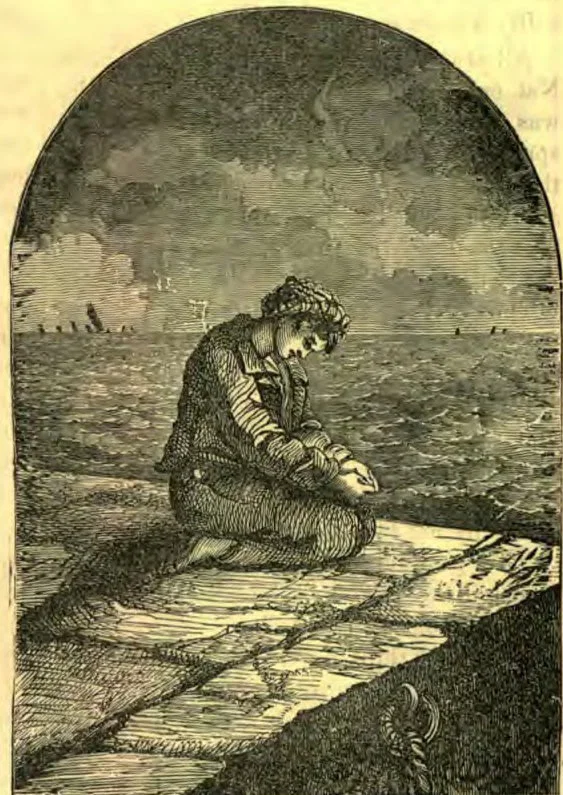
There, that will do. You need not listen any longer to that boy’s bad talk. Now just step out on to yonder dock. Softly! There is a boy kneeling there in the gray light of the early dawn. He too is poor, but his face is far more pleasant to look upon than that of the other boy. Listen to him as he offers his heart-felt prayer:
“O Lord, pity and forgive a poor sinful boy. I have been wicked. I have told lies. I have used bad words. I have often been angry. I have not loved thee nor thy Son, Jesus Christ. O Lord, I am sorry. I am very sorry. Please forgive me, for Jesus died for me, and I don’t want to sin against thee any more.”
I am sure that boy’s prayer will be heard. His face shows that the peace of God is filling his heart, and that he will rise from his knees a happier boy. How good God is to listen to his prayer!
Now I want you to read the words of these two boys over carefully, look at their faces, and then decide which of them is the penitent.
“The boy on the dock,” I think I hear you say. Yes; but why? You can’t exactly tell. Well, I will tell you. The boy in the cell is not sorry for his sin, but only that he was caught stealing, and is suffering for his sin. The boy on the dock is sorry for having sinned. The boy in the cell does not hate his sins, but only their effects; while the boy on the dock dislikes his sins and is resolved to overcome them. Do you understand? Yes? Very good.
Now, readers, keep this explanation in mind, and the next time you hear the minister or your teacher read God’s command to repent, remember that to repent is to be so sorry for having sinned as to be anxious to have God forgive you, and to help you not to sin any more.—T. F., in S. S. Advocate.

COMFORT FOR DULL BOYS.

Don't be discouraged. Slow growth is often sure growth. Some minds are like Norwegian pines. They are slow in growth, but they are striking their roots deep. Some of the greatest men have been dull boys. Dryden and Swift were dull as boys; so was Goldsmith, so was Sir Walter Scott. Napoleon, at school, had so much difficulty in learning his Latin, that the master said it would need a gimlet to get a word into his head. Douglas Jerrold was so backward in his boyhood, that at nine he was scarcely able to read. Isaac Barrow, one of the greatest divines the Church of England has ever produced, was so impenetrably stupid in his early years that his father more than once said that if God took away any of his children he hoped it would be Isaac, as he feared he would never be fit for anything in this world. Yet that boy was the genius of the family.—Sel.

SEED BY THE WAYSIDE.

IN TWO CHAPTERS.

CHAP. I.—HOW IT WAS SOWN.
You will expect to hear of spring-time and blue-birds and robins and long brown furrows waiting for the seed; but it was late in December. Outside, the world was white and sparkling; snow on the bare fields, snow on the roofs, snow lying in such heavy masses on the hemlock boughs that the saucy jays scolded noisily as they flirted their bright wings through it. Inside, the house was warm as the breath of summer; and in the library the carpet was flooded with sunshine that made it look like a bed of golden green moss. That is just what Daisy pretended it was, and she sat there with piles of papers strewn about her, stroking her gray kitten and singing softly a little song of her own.
All at once the door opened, and Uncle Nat came in. He walked slowly, for he was an invalid and quite lame. Daisy sprang up and wheeled the easy chair into the very sunniest spot, where he could look across the river at the White Mountains he loved so much.
“Setting your house in order?” he asked, looking at the piles of papers.
“Yes,” said Daisy, scowling a little; “mamma said I must arrange all my papers neatly before I went to grandma’s, and I’m so tired of the papers. Just see, Uncle Nat; the drawer is full, and all these besides. I mean to burn them up.”
“Why not take them with you?”
“To grandma’s?” asked Daisy, in astonishment. “There’ll be better fun there than reading old papers.”
“I wasn’t thinking of fun. Suppose you should take a large package of these papers and scatter them along as you go; give them to children at the stations where you stop; throw them out of the window near huts and cabins; be a sort of little seed-sower. Daisy, I suppose every one of these papers contains some good seed that might spring up in some heart if it had a chance. Now you can have a field five hundred miles long to sow it on. It will be very strange if some of it does not grow.”
“What a splendid plan!” Daisy danced about with excitement, and immediately decided to fill her school satchel with the very neatest and prettiest of her Sabbath-school papers. Uncle Nat helped her fold them into the smallest possible compass and tie them securely, and then Daisy could think and talk of nothing else. She had a world of pleasant fancies about the mission of the little papers, and the messages they would carry; and it seemed as if this new project had fairly driven all thoughts of the Christmas gathering and the long, delightful journey out of her mind.
Oddly enough, it chanced that the very morning they set out papa read at prayers how Christ sent his disciples out to teach, and the words that went deepest into Daisy’s heart were these,—
“And as ye go, preach.”
“You see,” said papa, “Christ did not tell them to wait until they got somewhere before they began, but to preach as they went along, every day and everywhere, and that is the way we must do.”
“That’s what I shall say to my little papers when I send them out,” whispered Daisy to Uncle Nat as she bade him good-by.
“And don’t forget to ask for a blessing on the seed sown,” said Uncle Nat.
Daisy answered with another kiss, and then the train moved slowly out and she was fairly started on her long journey.
Papa was soon buried in his paper; mamma was thinking anxiously of matters at home, and wondering if everything would move smoothly in her absence, and Daisy sat by the window impatient to begin her seed-sowing.
For half an hour the train made no stop, but at last they drew up at a large town where quite a crowd was gathered about the station. Daisy’s courage almost failed her, but at last she ventured to drop a paper into the basket of a boy who passed under her window with apples to sell.
To her great disappointment he took it out and threw it rudely away, but two little girls ran after it and carried it into a cabin near the track, where Daisy saw them showing it to their mother. After a few trials she quite lost her timidity, and the papers went fluttering out at every station until the satchel was nearly empty.
Now Daisy had a secret which she had not told any one but mamma. In the very bottom of the satchel was a neat little package carefully wrapped and tied up. Inside were two or three Sabbath-school papers, a beautiful card with the motto, “He careth for you,” and a lot of puzzle pictures with which Daisy had amused herself when she was quite a little girl and had the scarlet fever.
It was almost evening, and Daisy sat with her face pressed against the window looking down the deep gorges among which they were slowly creeping, and up at the great frowning rocks that almost overshadowed them. Presently the engine gave a long whistle that was echoed and re-echoed among the mountains.
“Now we are coming to the bridge,” said Daisy. “Please open the window, mamma.” The train moved more and more slowly, and at length almost stopped just as it came upon a long trestle-work built over a deep ravine. At the bottom of the ravine was a little brook, and beside it, half buried under a big hemlock-tree, a small brown house with a whitewashed fence around it.
“There’s the house, mamma,” said Daisy in great excitement; “it’s the very one where we saw the little girls swinging on a grape-vine last summer;” and leaning out at the window she tossed the little parcel into the ravine. Down, down it went, dropping not at all where Daisy wanted it to fall, but outside of the fence in the snow. Something followed after, fluttering more slowly and settling at last on a bush where it waved like a little rosy flag. In her eagerness Daisy had dropped her pretty silk handkerchief.
“Never mind, daughter,” said papa, “they will be sure to find that, even if they miss the papers.”
“I am afraid the house is deserted,” said mamma. “The snow does not seem to be broken around the fence.”
“Oh, no, mamma,” said Daisy. “Don’t you see that little path from the back door leading up the hillside? And I am almost sure I saw somebody at the window. Oh, I do hope they’ll find it.”
By this time they had crossed the trestlework, and the train rushed away as if to make up for lost time. Darker and darker fell the shadows, and Daisy soon fell asleep, to dream that her little messengers were sailing after the train and fluttering at the windows like a flock of white doves.

TRUTHFULNESS

A GENTLEMAN once asked a deaf and dumb boy the question, “What is truth?” The boy replied by taking a piece of chalk, and drawing a straight line. The man then wrote, “What is a lie?” The boy answered by drawing a crooked line.
Lies are always crooked. One lie opens the way for another, for often a dozen lies must be told to conceal one. Telling an untruth is like leaving the highway and going into a tangled forest; you know not how long it will take you to get back, or how much you will suffer from the thorns and briars in the wild-wood.
“A lie is an intention to deceive,” and may be told without speaking a word. A gentleman once asked a boy if a certain road led to the city. The boy nodded his head, and then laughed as the man took the wrong road. That boy lied with his head. Lies may be told with the fingers, and in many other ways.
Young people often amuse themselves by seeing who can tell the biggest lie. This is a bad habit, and leads one to vary from the truth at other times.
The only safe plan is to form the habit of always telling the truth. This will give a feeling of self-respect that will scorn whatever is low and mean. It will also give a purity to the character that will tend to elevate and ennoble the life.
A noble, upright man is he Who always speaks the truth;— This priceless habit seek to form In sunny days of youth.
A lie will stain the tablets white Of human souls with sin, And open wide the doors of hearts For woe to enter in.
Your word should be a sacred thing, And every promise made, Should be fulfilled with greatest care As debt that must be paid.
ELIZA H. MORTON.

BIBLE LESSONS FOR YOUTH.

LESSON CX.—THE SECOND TEMPLE REBUILT.

SOMETHING more than twenty years before the advent of our Lord, Herod began to be alarmed at the hostile feelings of the Jews, and sought to conciliate them by making public improvements. He built a theater and an amphitheater in Jerusalem, in order that the people might have suitable places for public amusements. Samaria, which had long been in ruins, he rebuilt, and gave it the name of Sebaste, from Sebastos, the Greek word for Augustus. He built a magnificent palace for himself on Mount Zion. On the Mediterranean, between Joppa and Carmel, he began to build a great sea-port, which afterward became a very important city. He named it Cæsarea, in honor of Cæsar.
Many violent complaints having been made against Herod, Augustus gave a decision in his favor; and to show his gratitude for this, Herod built, in honor of Augustus, a beautiful temple of white marble just at the foot of Mount Hermon, and close by the mouth of a cave from which issues one of the principal sources of the Jordan. The place, which had been called Paneas, was afterward known as Cæsarea Philippi.
The Jews were greatly displeased at this heathenish procedure; and to appease them, Herod undertook the most important work of his life. It had now been about five hundred years since the second temple had been built; and the ravages of time, together with the injuries received in war, had so impaired it that its renewal seemed not only desirable but necessary. The historian says, “The Jews were afraid that if Herod pulled down the existing temple before he built the new, something might occur to prevent the erection, and their city might be deprived of its highest glory. It was accordingly arranged that all the materials for the new temple should be prepared before the old building was demolished. A thousand wagons were employed in conveying stones and timber; ten thousand workmen in fitting the materials for building; and a thousand priests, skilled in architecture, in superintending the work.”
In about ten years the building was so far completed that the ordinary temple services could be performed in it; but for many years afterward a large body of men were employed upon the out-works. It was of this temple that the Jews said to Christ: “Forty and six years was this temple in building, and canst thou rear it up in three days?”
We have now come down to the very time of our Saviour’s birth, and it may be well to briefly reconsider the leading events of the four hundred years and more, intervening between the Old-Testament history and the New.
1. For more than 80 years the Jews remained under the nominal control of the Persians, who generally treated them kindly, and left them, in the main, to govern themselves, according to their own laws, and under the supervision of the high priest.
2. For the next 10 years they were under Alexander, who treated them with respect, and encouraged them to settle in Alexandria, and other newly founded cities throughout his empire.
3. Then for about 119 years they were under the Ptolemies, by whom they were, with some exceptions, honored, and promoted to offices of trust.
4. For the next 41 years the Macedonian kings of Syria were their masters. It was during this time that they suffered the terrible persecution inflicted by Antiochus Epiphanes.
5. For 100 years they were then independent under the Maccabees. For a part of this time they enjoyed peace and prosperity, but were finally torn by cruel dissensions.
6. For the last 63 years they were under the control of the Romans, who allowed them to be a prey to the selfishness and cruelty of local governors.

QUESTIONS.

1. What alarmed Herod, something more than twenty years before the advent of our Lord?
2. How did he try to conciliate the Jews?
3. How did he provide places of amusement for the people of Jerusalem?
4. What noted city did he rebuild?
5. What had been its condition for a long time?
6. What name did he give it?
7. How did he embellish Mount Zion?
8. What did he do for the commercial interests of the country?
9. Where did he build a beautiful temple of white marble?
10. What caused him to build this temple?
11. By what name was Paneas afterward known?
12. How were the Jews affected by this heathenish procedure of building a temple in honor of Cæsar, and for the worship of false gods?
13. How did Herod attempt to appease them?
14. How long had the second temple been built?
15. Why was it now necessary to renew it?
16. What did the Jews fear?
17. What precaution did they take?
18. How many wagons were constantly employed in bringing materials?
19. How many men were engaged in fitting the materials for the building?
20. How was the work superintended?
21. How soon was the building ready for services?
22. What may be said of the continuation of the work after this?
23. What did the Jews say to Christ about the time occupied in building this temple?
24. To what time are we now brought?
25. What will we now reconsider?
26. How long did the Jews remain under the nominal control of the Persians after the time of Malachi?
27. How did the Persians treat them?
28. How was the government administered?
29. How long were they under Alexander?
30. How did he treat them?
31. How long were they ruled by the Ptolemies?
32. How did they fare during this long period?
33. Which of the Ptolemies treated them cruelly?
34. What led to this cruelty?
35. How long were they ruled by the Syro-Macedonians?
36. What terrible persecution did they suffer during this period?
37. Give a brief description of it.
38. How were they freed from this terrible oppression?
39. What was their condition for the next one hundred years?
40. When did they come under the dominion of the Romans?
41. How did the Romans treat them?

LESSONS FOR CHILDREN.

LESSON LXXXIV.—REVIEW OF LESSONS LXXXI-LXXXIII.

1. NAME the kings of Judah from Rehoboam to Jotham.
2. Tell something about each one.
3. Give the name and character of Jotham’s successor.
4. What course did he pursue when the Lord reproved him?
5. How did he excuse such wickedness?
6. How did it turn out? 2 Chron. 28:23.
7. Who reigned next after Ahaz?
8. How did he reform the worship of the people? 2 Chron. 29.
9. Describe the passover which Hezekiah kept. Chap. 30.
10. How did he get so many people to come to the passover?
11. What kindness did he show them at the passover?
12. What did they all unite in destroying?
13. What calamity came upon the country in about the fourteenth year of Hezekiah’s reign?
14. What course did Hezekiah pursue?
15. Who united with him in asking help from the Lord? 2 Chron. 32:20.
16. What assurance did they receive? 2 Kings 19:20-34.
17. What course did the Assyrians pursue?
18. How were they destroyed?
19. Tell how Hezekiah’s life was lengthened.
20. Who was the next king after Hezekiah?
21. How long did he reign?
22. Describe the first part of his reign.
23. What caused him to repent?
24. Describe the latter part of his reign.
25. Who followed Manasseh upon the throne of Judah?
26. Relate his brief history.
27. Who then reigned?
28. What course did he pursue?
29. In what work did he show a remarkable zeal?
30. What prophecy did he fulfill?
31. How did he come to find a book of the law, written by Moses?
32. What did he learn from it?
33. Why did not the Lord bring evil upon the land in Josiah’s day?
34. How did Josiah meet his death?
35. Who succeeded him?
36. How was he dethroned, and who was put in his place?
37. What was the length and character of Jehoiakim’s reign?
38. What happened in the third year of his reign?
39. Who reigned next after him?
40. How long did he reign, and what then became of him?
41. How did the king of Babylon reduce the strength of Jerusalem at this time?
42. Whom did he make king?
43. Describe Zedekiah’s reign.
44. How long did it continue?
45. What then became of the king, the temple, the city, and the people? 2 Kings 25; 2 Chron. 36.
46. Why was this terrible punishment brought upon them?
Continue reading: AN ALPHABET