Your ShelfYour Projects

Review and Herald, Vol. 85, No. 37.

Singing by the Way

Review and Herald

Sep 10, 1908

Review and Herald Publishing Association · Takoma Park Station, Washington, D. C. · Sep 10, 1908

Singing by the Way

Ho, comrades, heavenward faring, Let’s sing, in cheerful strain, A song to lighten labor And soothe the heart of pain,— A song so full of gladness, So blithe with help and cheer, That weary wayside pilgrims Will gain new strength to hear.
Life holds for most, my comrades, More happiness than pain; God gives a week of sunshine For every day of rain. So, trusting in the wisdom Of his eternal plan, Let’s face the rain or sunshine, And do the best we can.
O let us sing, my comrades, Of blessings by the way,— Each cloud’s a silver lining, There’s blue beyond the gray! Ah, as we sing about it, The shadows break apart, And all the world’s in sunshine Because we’re light of heart!
— Eben E. Rexford, in Sunday School Times.

The New CHRIST IN SONG

For the Church Service, the Sabbath-School, the Missionary Volunteer Meeting
THE new edition of “Christ in Song” contains nearly one thousand choice hymns and gospel songs, besides a number of Scripture readings appropriate for opening services. This collection includes over three hundred new selections besides all the old favorites. The best productions of over five hundred authors and composers give to the possessor of “Christ in Song” the most complete collection of gospel songs published.

For the Church Service

Small companies sometimes desire to use the same book for both Sabbath-school and church service. “Christ in Song” will fully meet this need. To those acquainted with sacred music the names of Lowell Mason, W. B. Bradbury, Fannie Crosby, and Dr. W. H. Doane are very familiar. Each of these authors is well represented in this book. There are over thirty of Fannie Crosby’s best hymns, thirty by W. B. Bradbury, forty by Lowell Mason, and twenty-seven by Dr. Doane, beside many of the best compositions of such popular song-writers as Sankey, Sweney, Stebbins, and Kirkpatrick.

For the Sabbath-School

No better song-book could be published for the Sabbath-school than “Christ in Song.” There are spiritual, inspiring, and soul-winning songs for the children, the youth, and the older members. The use of this collection will make the exercises doubly interesting. Never before has a Sabbath-school had such a variety of songs from which to choose.

For the Missionary Volunteers

Every Missionary Volunteer society will welcome the new “Christ in Song;” for it contains the most stirring of gospel music. New life will be brought into the meetings by the use of such songs as “Higher Ground,” “More About Jesus,” “Face to Face,” “Saved by Grace,” and “Power in the Blood.” We believe the march-song entitled, “Who Will Volunteer?” is destined to become the rally song of the Missionary Volunteer societies, as it has a swing that is sure to make it popular.

PRICES

The complete book has 576 pages, 160 more than there were in the old edition; but even with the addition of all this new music, we are able to send the book, post-paid, at the following prices:— Flexible                                         $ .45 Cloth                                             .60 Half morocco                                 1.00

Selections from “Christ in Song”

The selections from the new edition of “Christ in Song” contains 128 pages of carefully selected songs for use in public meetings and all kinds of gospel services where a good but inexpensive song-book is desired in large quantities.
The first edition of this book contained only 96 pages, and did not give enough variety of music to be satisfactory. In this edition we have added 32 pages, making in all 128 pages. The old price is still retained—15 cents.

Evolution and Revelation

It may not be generally known to the readers of the REVIEW that there is a well-edited magazine devoted wholly to the maintenance of the old-time belief in the inspiration and the authority of the Holy Scriptures. We refer to the Bible Student and Teacher, a monthly magazine issued by the Education Committee of the Bible League of North America.
In the July number of this publication we find an article with the title, "The Theory of Evolution and False Theology," in which the doctrine of evolution is vigorously assailed, and the effect of this scientific hypothesis upon the essential doctrines of the gospel is plainly set forth. The introduction to this article includes this explanation of the real meaning of evolution:—
It may not have occurred to all that the theory of evolution and false theology are indissolubly linked together. But every scientist understands, as do also intelligent teachers of the Scriptures, that the theory of evolution is not simply a question of the origin of species, but, in its present-day application, proposes to account for everything material, from fire-mist to the perfected frame of the universe; everything animated, from the sterilized cell of lowest life to the Man of Nazareth; and everything moral, from the sensations of an amoeba to the sacred communion between God and man.
The writer declares that the theory of evolution is unscientific, and he supports this statement by the discussion of the following declarations:—
  1. It is a suggestion, not a science.
  2. The theory of evolution is unproved and unprovable.
  3. Its conclusions are without premises.
Again, the writer affirms that "the theory of evolution is unscriptural," fortifying this statement by showing that "the Word nowhere warrants it," and that "at many points evolution is anti-scriptural."
The writer shows the relation between the theory of evolution and false theology by elaborating these statements:—
  1. According to evolutionists God is a force, and those ministers who have accepted the evolutionary theory of the natural universe, have lost their personal Heavenly Father in consequence.
  2. Evolution makes Christ only a remarkable man.
  3. This theory makes sin essentially a virtue.
  4. The resurrection of Christ is even more offensive to evolutionists than regeneration.
  5. It makes the cross only a criminal mistake.
  6. To them redemption is a misleading term.
In conclusion, the writer quotes the following paragraph as a fitting summary of the results which have already attended the acceptance of the theory of evolution.
A pantheistic god, instead of a personal God. A human savior, instead of a divine Saviour. Infallible scholarship instead of an infallible Bible. Reformation instead of regeneration. Culture instead of conversion. The natural in all things, the supernatural in nothing.
In these days when so many who ought to be defenders of the truth are weakly yielding ground to the claims of a false science, it is refreshing to read so clear an analysis of the real meaning of evolution, and so vigorous a defense of the old-fashioned gospel.

Speaking With “Tongues”

WHEN the apostles on the day of Pentecost spoke with other tongues, the people of various nationalities who listened said: “We do hear them speak in our tongues the wonderful works of God.”
It was not merely an exhibition of something strange and wonderful. The most wonderful part of it all was the message of “the wonderful works of God.”
Neither did the apostles lay any stress whatever on the unusual manifestation of the gift of tongues. Their burden was not to publish their own gifts, but to publish the message that God had given them. That was the one burden,—to declare the wonderful works of God and the truth for that time. The method was but incidental. The thing itself is the preaching of the gospel.
Nor do we read in the New Testament that, as the apostles went out in their work, they were able to speak without effort any language. Paul and his associates who had the fluent use of the Greek tongue were commissioned to the lands where Greek was current. And so, very likely, was it with others. However that may be, the essential thing was the preaching of the message given them.
The craving for the strange and the unusual, to the neglect of the common and practical, has led to a fanatical movement in our time, aiming at securing the gift of other tongues. Those who have made this the end to be sought have advertised much. But after all the years of excitement and talk, no one seems to be able to cite any practical use which the movement has been. The genuine gifts of the Spirit are always for service. The strange or wonderful in the manifestation of the gift is but to call attention—not to the gift, but to the message. On the other hand the spurious and false gifts are ever attracting attention to the peculiar and unusual in the manifestation itself.
In mission fields we have seen no results whatever from this movement that has risen in this country and caused so much stir among lovers of the eccentric. A missionary in China, S. C. Todd, has been looking up the experiences of some who have ventured into mission fields on the strength of this movement. He writes to the Baptist Argus:—
I have been asked about a certain Mr. McIntosh. Notwithstanding his statements that he expected to preach at once to the people, he has been wholly unable to do so. He must not only have an interpreter in preaching, but also in the simplest affairs of every-day life. From the day of his arrival in China until now, neither he nor his wife has been able to speak a single sentence in Chinese. I do not speak from rumor, but from personal knowledge, and the personal admission of failure by Mr. McIntosh himself.
As to Japan. While there I met a party of about a dozen missionaries who had come out from the State of Washington, on the Pacific Coast. I visited them in their home and attended one of their services. They, too, expected to speak at once to the people, but on reaching Japan they were powerless to do so. They admitted to me their inability, and I saw it with my own eyes.
As to India. You remember that Rev. A. G. Garr and wife went there, also expecting to speak to the people in this supernatural way. But did they? They have left India and are now in Hongkong. I have attended two of their services. Mr. Garr, in reply to a personal question of mine as to whether either he or his wife had been able to talk in the native language of India, said that they had been unable to do so.
Again, two ladies came on from the Japan party to Hongkong because they felt they had the gift of the “Hongkong dialect.” I have seen them, inquired of their power to talk in Chinese, and they, too, were unable to speak.
It is by no means unthinkable that God should enable men to speak to-day with other tongues; but it will be when it is to his glory and when the message itself will have the attention of those that hear, rather than the messenger or his peculiar gift. And the Lord does not work miracles to save his children a little study and hard work.
In apostolic days the gift of tongues was evidently sought after by those who were not using the speech they had to any very good purpose; and the apostle Paul said: “I had rather speak five words with my understanding, that by my voice I might teach others also, than ten thousand words in an unknown tongue. Brethren, be not children in understanding.”
Even spiritual gifts may be perverted and abused, and the way prepared for the spurious and fanatical. For a time one of our workers abroad, a native of the field in which he labored, was considerably agitated over this movement in America and the idea of speaking with tongues. He had one or two languages that he could use, and the people to whom he can speak in those languages are in dense darkness. But he had little success in presenting the message in the languages he knew, while his attention was diverted and his labors weakened, by this fanatical movement. The greatest gift of all is the gift of teaching sinners the way of life, so that they come to the obedience of the truth. If one can not do that in one language, of what benefit would a dozen languages be?
The Lord will work in unusual ways, just as he may see that it will redound to his glory; but through it all the most wonderful thing will be the message that is borne in these last days to prepare men for the judgment. W. A. S.

Editorial

Love to God is more than a sentiment or a passion; it is a principle of action. When this love rules in the heart the conduct will not be controlled by the feelings but will be in harmony with the revealed will of God. “He that loveth another hath fulfilled the law. . . . Love worketh no ill to his neighbor; therefore love is the fulfilling of the law.” “Thou shalt love the Lord thy God with all thy heart, and with all thy soul, and with all thy mind. This is the first great commandment. And the second is like unto it, Thou shalt love thy neighbor as thyself.”
“Love divine, all love excelling, Joy of heaven, to earth come down! Fix in us thy humble dwelling; All thy faithful mercies crown,”

Purpose and Prophecy

INSPIRATION has plainly designated a power which was to bear sway for a time over all the earth. That power the Revelator calls “the beast,” and concerning it he says: “And the whole earth wondered after the beast; and they worshiped the dragon, because he gave his authority unto the beast.” Rev. 13: 3, 4. That power is also represented as one which man is powerless to oppose. The question is asked, “Who is like unto the beast? and who is able to make war with him?” Above all human power, and unlike any other power, these are two of the chief characteristics of the organization referred to.
There can be no question as to the identity of that power; for its characteristics are too prominent to admit of uncertainty. It was to make war with the saints and prevail against them—a statement which could not be made truthfully as to paganism; for in spite of the persecutions under pagan emperors, Christianity continued to increase. Christians were sawn asunder, torn to pieces, thrown to the wild beasts of the arena to make a Roman holiday, burned alive as torches to light up the Roman theater, slain by the thousands by the soldiers of the realm; but paganism never prevailed over the Christians. In fact, Constantine, on coming to the throne, found them so numerous and so staunch that he thought it wiser to enlist their support than to continue the war against them. But following paganism there did come a power that made war against the Christians and prevailed. Paganism persecuted; the papacy fondled, flattered—and persecuted, and that till the objects of her wrath were either dead or hid away in the fastnesses of the mountains.
That power took every title of divinity and applied them to its chief official; set its head above the law of Jehovah; and even assaulted heaven itself in its blasphemous assumption of the right of opening and shutting heaven, forgiving sins, and releasing from punishment beyond the grave for a monetary consideration.
The time of the rule of that power is also prophetically foretold, and the prophecy already fulfilled—another incontrovertible means of identifying it.
The prophecy further declares that this power shall again bear sway as in days of old; but that consummation is brought about through the agency of another power, designated by the same prophetic writer as “another beast.” That other “beast” itself is not an image of the first mentioned power; but it says to “them that dwell on the earth, that they should make an image to the beast who hath the stroke of the sword and lived.” Rev. 13: 14. That other “beast,” however, has power to “give breath to it, even to the image of the beast.” The second power, the other “beast,” thus becomes the prime mover, the invigorator, the inspirer, of the image that is set up, which all men throughout the world are commanded to worship under pain of death.
What power is that other “beast,” or power, which the prophet brings to view? Is there any movement in any nation which bids fair to give strong assistance to the fulfilment of the purposes of the papal power? That power which fulfils the specifications of that other “beast” has been designated in these columns many times, and we shall not treat that phase of the question here specifically. The papacy is looking to the United States as her child of promise, from whom she expects much. What Constantine accomplished by flattery of the early church, Pius X is seeking to accomplish by flattery of America. American archbishops and bishops are always received at the Vatican “with marked distinction.” On August 3, while Archbishop Farley, of New York, was visiting the pope, the latter said to him: “It is marvelous what you Americans can do. You make miracles. Indeed, the centennial was a most remarkable religious event. That is the result of a church breathing free air and enjoying real liberty, and not being restricted within the bounds of certain concordats.” It will not be out of place to remark, in passing, that it is strange that the papacy clings so tenaciously to her concordats, when the church is so much freer and makes so much greater progress without them. But flattery has its purposes, and the papacy leaves no agency untried that will help it to achieve its ends. One of its principal objects just now is to bring America under its control—to use America in achieving its purposes. Its chief purpose is to bring the whole world under its domination. America is to be its tool to help to bring it about,—so reads the prophecy,—and so is shaping Rome’s purpose.
Has Rome hopes of bringing that about? Let us see. On August 8, “Father” A. P. Doyle, the rector of the Apostolic Mission House at the Catholic University in Washington, D. C., was graciously received by the pope. It is reported that the rector succeeded in stirring up the usually calm waters of the Vatican with his enthusiastic prophecies concerning the triumphs of the Catholic Church in America. Father Doyle has in charge that department of the Catholic work in America whose object is the winning of Protestants to Catholicism. That work is represented as having been wonderfully successful. The press report of the rector’s visit to the Vatican says:—
With the optimism of all prophets and proselytizers, he predicts that, through the work of the Mission House, in a few years the Roman Catholics in the United States will be four times as many as they are now, reaching the figures of sixty to seventy-five millions, so that America will be practically a Catholic country.
Father Doyle has submitted his plans of organization to the pope, Cardinal Merry del Val, and to other members of the sacred college, and has succeeded in impressing all with the enthusiasm he has for the success of the enterprise. According to his calculations, if he were to receive the support needed, in ten years from now two hundred million more English-speaking people will have joined the Roman Catholic Church.
Mgr. Merry del Val, in speaking of Father Doyle, said that he has followed with keenest interest the growth of the work since its beginning ten years ago, and that he seemed to have a comprehensive knowledge of the wonderful results secured by arousing among the priesthood an all-consuming zeal for convert-making by sending trained missionaries to address non-Catholics and by instituting centers of missionary energy.
The secretary of state thinks that the time is particularly ripe for an aggressive propaganda among the English-speaking peoples. The cardinal continued: “The way mission work has been carried on in the United States shows that it has been inspired with the ripest wisdom. There undoubtedly is on the part of non-Catholics a desire to know what the Catholic Church teaches. Non-Catholics are looking to the Catholic Church as one which speaks with authority.”
The same kind of work which Father Doyle is directing in America, and which has proved so successful and satisfactory here, is beginning to be organized in England along the same lines. It is not without significance that such a work as this should have been instituted in America. It seems not to have been a plan originated in Rome, but was initiated here by American Catholics, and later received the indorsement of the Vatican officials. The fact that English Catholics are to follow the lead of America is also significant; for was not that other “beast” to make “the earth and them that dwell therein to worship the first beast, whose death-stroke was healed”? Purpose and prophecy have met, and Rome’s purpose will fulfil the prophecy. She is not working for the special purpose of fulfilling that, or any, prophecy; but she can not accomplish her purpose without showing in her acts the complete fulfilment of those prophetic words.
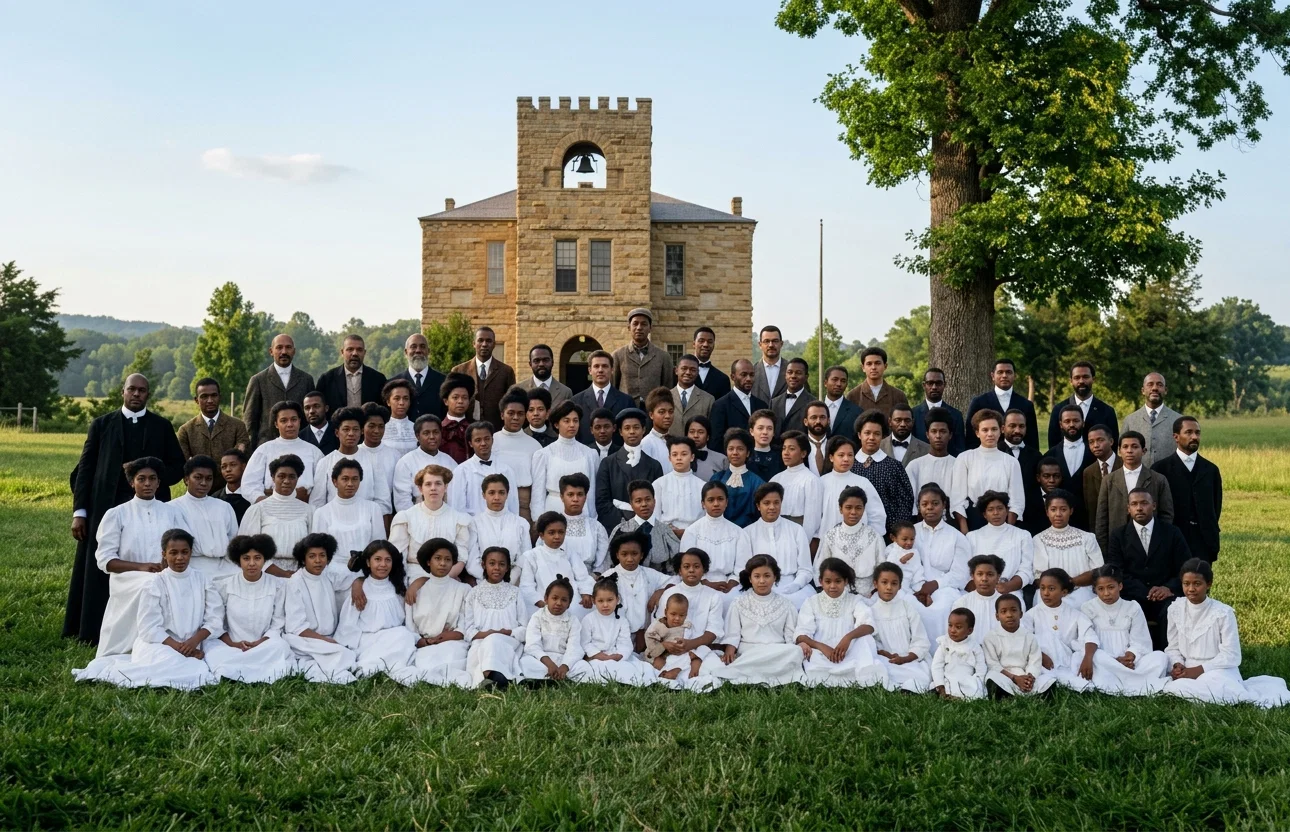
STUDENTS AND MISSION SCHOOL-TEACHERS AT THE OAKWOOD SCHOOL, HUNTSVILLE, ALA.
The purpose of the Apostolic Mission House is also the purpose of the American Federation of Catholic Societies. The one is to make America Catholic through individual accessions to the Roman Church, the other to make America Catholic through political influence. They are working along different lines but to the same purpose, and both by their success are securing the benedictions of the Vatican. At the same time American Protestants are being lulled to sleep by pastors who have forgotten for what Protestantism stands, and are extolling the wonderful progress of the Church of Rome. “Eternal vigilance is the price of liberty;” but America has ceased to be vigilant. “America all Catholic” is the purpose of Rome; and she will achieve her purpose for aught that the great religious bodies of America are doing to prevent it. America is destined to lead the world in a great procession to the feet of that so-called successor of St. Peter. America, through the wonderful influence which she wields, will give life to that “image of the beast” whose work fills up the cup of this world’s iniquity. The prophecy and the purpose are working out together.
C. M. S.

Our Near-By Mission Field

While being in perfect sympathy with the effort to carry the third angel's message to every land, and believing it to be the thing for us to do, yet I fear that in our zeal, we are liable to overlook a very needy people living right at our doors; namely, the colored people of the Southern States. The colored people constitute one tenth of the population of the United States, and the citizens of the United States are more indebted to this people than to any other. Our responsibility for their general condition of ignorance is greater than for any other people; and if preference should be given to any of the population, it should be given to them.
The establishment of small mission schools has proved to be the most potent agency for reaching this people with the truth. The results obtained from the efforts put forth in this direction have been quite satisfactory. But instead of the number of mission schools which we now have, there should be hundreds of similar schools in operation among this people. Urgent appeals are constantly coming in to those having charge of the work among this people for the establishment of other schools, and the whole South could soon be ablaze with these little lights, had we the necessary number of properly trained teachers, and the means to support them.
The Southern Missionary Society, whose efforts have been entirely along this line, have done a good work so far as their resources in teachers and means would permit. The Oakwood Industrial School for the training of colored teachers has done the best it could to train the necessary teachers; but they, like the Southern Missionary Society, have been handicapped for lack of means and appliances thoroughly to prosecute the work.
We also need means to erect a small sanitarium upon the grounds of the Oakwood School, where the sick may be treated, and the students given a practical course in rational treatments, so that they may go out not only as mission teachers but as medical missionaries as well. We need means to establish a small sanitarium and treatment-rooms in the city of Nashville. No argument will be needed to convince our people of the North of this need other than to state that we have no sanitarium for the colored people, and but one treatment-room, in all the South.
It was my privilege to spend ten days in July at the Oakwood School, attending the institute that was held for the better education and training of mission-school teachers. As I listened to the reports given by these teachers of the progress made by the students in their mission schools, and how both children and grown people had accepted and were rejoicing in the message, I wish that I might be able to say something that would interest our people in general in behalf of the work for the colored people in the South. These teachers are all bright, intelligent people, and love the truth as dearly as any one; and they are very anxious to receive all the help they can from the hands of the white teachers, so that they can continue to do better work, and exercise a greater influence over the people in the community in which they labor.
While appreciating what has been done for this people in the past, the time has certainly come when we should redouble our efforts. Instead of a meager collection we ought to receive thousands of dollars throughout the field for immediate use among this people. The colored people of the South are coming more and more to appreciate what has been done and is being done for them, and they are still anxious that the white people shall take the lead in the training of their young people to become workers; but soon it will be impossible for them to do this. So in behalf of the colored people of the South, I appeal to the brethren of the North to make earnest efforts to help the Oakwood School to act its part now while the way is still open.
I trust that while reading this appeal, the Spirit of God may impress upon each heart the needs of this people and the obligation that we owe to them, and that each will be constrained to contribute liberally toward this work, on the first Sabbath in October. G. A. IRWIN.

Note and Comment

A New Trust

AND now we have a “theological trust,” according to the testimony of a leading German representative of conservative theology, who makes the charge in these words:—
In recent years the representatives of the advanced type of theology have virtually formed a trust, which might be called a “General Mutual Self-Laudation Insurance Company,” having as its purpose the promotion of those who write liberal books, and who teach advanced theology, and ignoring and “killing by silence” the claims of conservative theologians to public recognition and appointment, no matter how excellent their scholarship may be.
This appears to be about the only trust in which liberal theologians permit themselves or any one else to indulge. In their creed, trust in the Scriptures and trust in Christ are unknown quantities.

The Church's Weakness

Many are asking why it is that great evils are so rampant, and why so few are reached and converted by the gospel. One of our exchanges deals thus with this subject:—
Well, what is the answer? There are scores of answers given, all of which probably have some measure of truth in them. “Church-members are too worldly;” “there is too little prayer;” “too many divisions among religious bodies;” “too much unbelief;” “too little pastoral work;” “ministry is weak and uninteresting.” All these reasons, and many more equally good, are offered to explain the lack of scope and power in the church of to-day. The cause of weakness is almost always found in the faults or failures or mistakes of somebody else than our own selves. The desired change and improvement will not come until we all turn about, and discover that the real trouble lies in our own selves—and not with the other fellow. The seat of the whole difficulty is a lack of the spirit of self-sacrifice in the individual men and women who make up the church.
This diagnosis of the case is not so flattering to professed Christians, but who can deny the truthfulness of the charge? The remedy is in a renewed personal consecration to service.

The Critic Confuted

In the twelfth verse of the second psalm occurs this expression: “Kiss the son, lest he be angry.” The word there translated son is the Hebrew word bar. The word generally used for son at the time when this psalm was written was ben. From this circumstance the Higher Critics have made the assertion that this psalm must have been written at a much later date than that commonly attributed to it. On the same kind of evidence many a learned criticism of the Bible itself has been made. Now there has come to light an ancient Aramaic inscription which throws light upon the use of that word. The discovery of this inscription near Haran was made known to the world by M. Pognon, the French consul at Aleppo, Asia Minor. Concerning the matter Dr. Driver says:—
The date of the inscription must be about 800 B. C. Consequently it is the oldest Aramaic inscription at present known, and only about fifty years later than the inscription of Mesha on the Moabite stone.
In this inscription the word bar is used for son, and the inscription contains within itself evidence which shows that it was written within two hundred years of the reign of David.
Thus falls to earth another learned criticism, illustrating the sheer worthlessness of the whole system of Bible study evolved by the Higher Critic.

Mortal Mind and Real Money

THE inconsistency of Christian Science teachings was strikingly illustrated recently at New York, when Solomon Raisler, who had had his foot treated by a Christian Science healer and lost it, sued the healer for twenty-five thousand dollars. The jury awarded him six thousand dollars' damages. Concerning the suit and the verdict, an exchange well remarks:—
It seems strange that Mr. Raisler should miss a thing so essentially material as a right foot, when Eddyism declares that matter is non-existent and the product of mortal mind. It also seems equally queer that he sought a partial compensation for the loss of something that did not exist by trying to acquire another substance as grossly material as filthy lucre. Another peculiar thing is that Mr. Benjamin, the healer, should be compelled to produce that which is non-existent, to the extent of six thousand dollars, to satisfy the demands of a fellow disciple. We are sorely perplexed as to how this non-existent product of mortal mind was passed from one man to the other.

Freethinkers and Intolerance

It is one of the boasts of infidelity that the world is indebted to it for the freedom of mind and of practise in religious things which are enjoyed at the present time. The facts in the case and the evidence furnished by those making such a claim, both contradict the assertion. For instance, at a recent congress of freethinkers held in Paris, resolutions were passed instructing the members of their party in the legislature to propose a law forbidding parents to have their children baptized or confirmed. The members of their party were made to take oath never to participate in a religious act of any kind. Such an act has no relation to freedom of conscience. It is a kind of slavery acquiesced in “for a consideration,” and instead of encouraging liberty, debases the character of those who permit themselves to be a party to it. An infidel, in conversation with the editor of a religious journal, advocated the idea that parents had no right to talk to their children of religious things, and declared that every one who dared to do so ought to be shot. How different is the principle of true religious liberty enunciated by Jesus: “If any man hear my words, and believe not, I judge him not.” That is true religious liberty, and so far as such liberty is enjoyed in any country, it is the product of true Christianity. To it the freethinker can not legitimately lay claim; for the spirit and the inspiration of it are foreign to the instincts of the human heart.

If I Can Live

If I can live To make some pale face brighter, and to give A second luster to some tear-dimmed eye, Or e'en impart One throb of comfort to an aching heart, Or cheer some wayworn soul in passing by;
If I can lend A strong hand to the fallen, or defend The right against a single envious strain,
My life, though bare, Perhaps, of much that seemeth dear and fair To us on earth, will not have been in vain.
The purest joy, Most near to heaven, far from earth's alloy, Is bidding clouds give way to sun and shine;
And 'twill be well If on that day of days the angels tell Of me: “She did her best for one of thine.”
— Helen Hunt Jackson.
Continue reading: Medical Missionary Work Among the Colored People in the South