Your ShelfYour Projects

Signs of the Times, Vol. 21, No. 9.

Man's Way or God's Way: Which?

Signs of the Times

Feb 28, 1895

Pacific Press Publishing Company · Oakland, California · Feb 28, 1895

Man's Way or God's Way: Which?

Editorial
Man’s Way or God’s Way—Which?—Perhaps the better title of these notes would be, “Satan’s Way or God’s Way—which?” for every way of man’s which is contrary to the way of God originated with Satan. Man was originally created in God’s image—“in righteousness and true holiness.” He was made “upright,” and was declared by his Creator to be “very good.” But Satan came in, perverted God’s way, presented the perverted way to man as a better way, and led man to believe that this perverted way was the better way, and that it originated in his (man’s) own wisdom.
Wisdom in Man.—In this way Satan has led man to seek for wisdom and knowledge in himself or in his own attainments. Lucifer sought his own glory. His motive was exaltation of self. His language was, “I will exalt my throne above the stars of God,” “I will be like the Most High.” Isa. 14: 13, 14. But this meant the dethronement of God, for only one could be Most High, and Lucifer was determined to be that one. Man in yielding to the suggestions of the enemy, in receiving them into the heart, partook of the same spirit, and is seeking his own exaltation at the price of others’ degradation. God’s message to Lucifer, showing the result of self-exaltation, was, “Thine heart was lifted up because of thy beauty, thou hast corrupted thy wisdom by reason of thy brightness,” and, therefore, because of his perversion of truth and righteousness, he is become a terror, and shall perish, and “never shalt thou be any more.” See Eze. 28:12–20. In the same way as man has exalted himself, he has corrupted his wisdom, has degraded himself, has proved a curse instead of a blessing; and his self-exaltation ends in his utter destruction.
Man’s Motto.—Man’s motto in seeking wisdom and knowledge has ever indicated his selfish spirit, the mind of Satan, the god of this world. It was inscribed over the old heathen Delphic temple, “Know thyself,” and has been repeated as a wise saying by the worldly wise men in church and state all down the ages. Says Pope, in his “Essay on Man”:—
“Know thyself; presume not God to scan; The proper study of mankind is man.”
But it is the old heathen lie, the basis of which is Satan’s deception. Man has sought to know himself; he has sought wisdom in himself; he has studied himself, and to what has it all amounted? How much wiser is unaided man than in the beginning? How much good has his study done toward elevating the race? What new wisdom has he given to the world? What gospel of healing have his knowledge and wisdom evolved?
The Sad Result.—The sad result of it is that man’s source of wisdom has brought him no good, has given no new wisdom to the world. On the other hand, it has brought only sin and misery and degradation and death upon all mankind. The apostle expresses it all in the following scripture:—
“Because that, when they [man] knew God, they glorified him not as God, neither were thankful; but became vain in their imaginations, and their foolish heart was darkened. Professing themselves to be wise, they became fools, and changed the glory of the uncorruptible God into an image made like to corruptible man, and to birds, and fourfooted beasts, and creeping things. Wherefore God also gave them up to uncleanness, through the lusts of their own hearts, to dishonor their own bodies between themselves; who changed the truth of God into a lie, and worshiped and served the creature more than the Creator, who is blessed forever.” Rom. 1: 21–25.
This is not all. The same apostle tells us in the following verses of the chapter somewhat of the depths of the wickedness and darkness to which mankind have been led simply and solely because they chose Satan’s way instead of God’s way, and sought wisdom in themselves, and glory for themselves, instead of wisdom from God and God’s glory. Almost every object in nature has been worshiped, by the direction of man’s wisdom. Every crime in the catalogue of crimes, and every transgression of God’s law, have been justified by the wisdom which man finds in himself.
The Chiefest Idolatry.—The chiefest idolatry which has cursed the world has been that of sun worship. Says Dr. S. W. Chambers: “The universality of this form of idolatry is something remarkable. It seems to have prevailed everywhere.” And it has. Egypt, Persia, China, Babylon, Phoenicia, Greece, Rome, the barbarous and savage tribes of both eastern and western continents, worshiped in some form or other the luminary of day. It placed its indelible stamp upon the apostasy of the Jewish people. It had a prominent part in the apostasy of the early church, which resulted in the Papacy. It lives to-day, not clothed in the gross wickedness of the early ages, but no less seductive in blinding minds, leading men to turn their backs upon God’s truth. It is man’s way and wisdom instead of God’s.
The Worst Idolatry.—This idolatry was the worst because it resulted in turning men from the true God more absolutely and effectually than any other form of worship. The sign, the seal, the token, between God and his people is the Sabbath. It points out God as the Creator and hence the Re-creator, not only of the heavens and earth, but of man. But sun worship has succeeded in putting in the place of the Sabbath the Sunday, the day named after the sun, because dedicated to its worship. It has in this way shut away from millions in heathen lands and in apostate “Christian” lands a knowledge of the living God, who made all things and gave his Sabbath as his memorial. True, Sunday has been called the Sabbath by many honest souls, but that does not make it the Sabbath. God has not so called it, and he has not required it at the hand of any man to presume to speak or do when he has not commanded. Not only is the sun worship guilty of all this, but it is guilty of benumbing and paralyzing man’s moral faculties as no other idolatry has. It is a nature worship which has connected with it essentially the sexual idea in some form or other. Hence there has arisen from it the most unbounded and abominable licentiousness which the world has ever seen. And there is nothing more benumbing to the consciences of men than this.
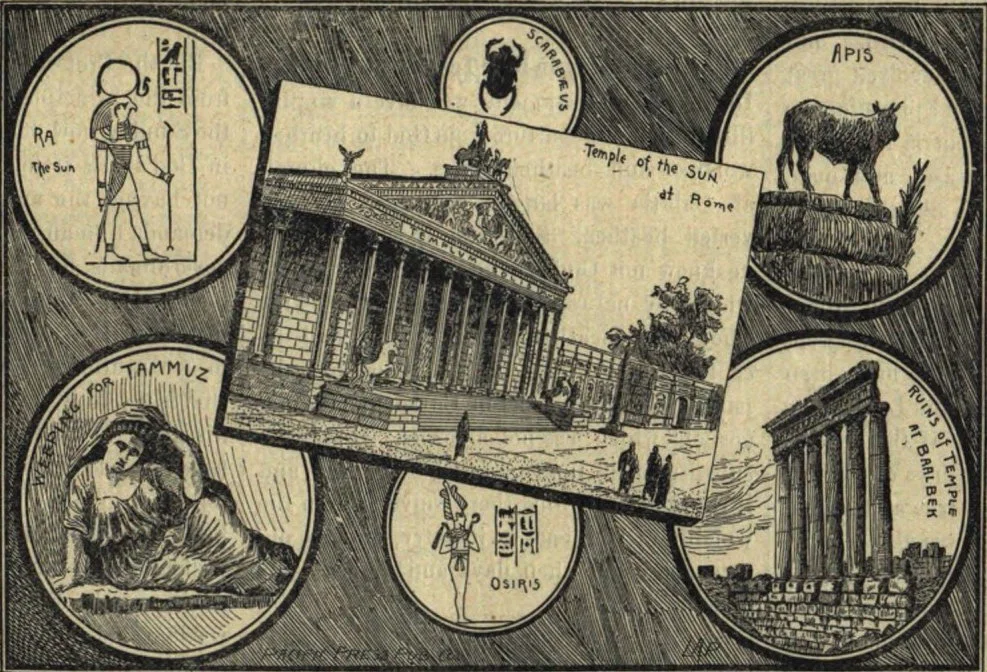
Our combination illustration will give the reader something of an idea of sun worship. In the center we have a cut of the temple of the sun erected at Rome. Magnificent temples were erected in other places. Baalbec, in Syria, and Heliopolis, in Egypt, were cities of the sun. At Baalbec was one of the most magnificent and costly buildings erected to the sun which the earth ever saw. Ra, Apis, Osiris, and others were Egyptian sun gods. Tammuz was another name of the sun, for which the women of Israel wept. See Ezekiel 8. Other figures will explain themselves. All this idolatry, let it be observed, came because man sought knowledge and wisdom in himself. He has evolved great schemes, wondrous ideas, grand plans for the regeneration of man, but man is no better; rather, the wickedness increases, and man, being in honor of himself, is like the beasts that perish.
Reformations.—There have been times when God’s message and power have swept away the darkness, and hearts have been brought out into the light of the Lord Jesus Christ. It was so in the time of the Exodus from Egypt; it was so in the days of Samuel and Haggai, and especially true at the first advent of our Lord. There was also a reviving in the days of Martin Luther, and another in the time of Wesley. But soon after all these reformations and wondrous manifestations of God’s power, man has chosen his own way, his own wisdom, and has departed from God. He has sought to supplement God’s plan by his own schemes, and has brought cumbersome weakness instead of strength. He has substituted his own ways for God’s ways, and idolatry has come in, and God has been dishonored.
Early Introduction of Error.—We have an illustration of this departing from God in the substitution of man’s way for God’s way shortly after Israel left Egypt. The incident also shows how rapidly error spreads, and how little time it takes to utterly depart from God. Before the thunders of Sinai had hardly ceased their reverberations, during the forty days which followed the speaking of that Decalogue by the living God, Israel had turned their back upon him and had turned to the Egyptian sun god Apis. The record of this is found in Ex. 32: 1–6. In the absence of Moses the fickle people demanded visible gods to go before them. Aaron made a representation of the god Apis, and proclaimed, “These be thy gods, O Israel, which brought thee up out of the land of Egypt.” With this same transgression of God’s command to not observe heathen times and gods. Lev. 19: 26. In his blindness Aaron said, “To-morrow is a feast to Jehovah.” It was, in all probability, the substitution of the sun-god festival for the appointed day of Jehovah. Thus the people “corrupted themselves.” This same licentious sun worship in various forms became the greatest curse of Israel in later days. Baal worship was sun worship, and was ever emphatically condemned of God. See Numbers 25; Ezekiel, chapters 8 and 20; 2 Kings 21: 1–6, and many other scriptures. It was demonstrated throughout the history of Israel that the worst of all idolatry was sun worship, and that this always meant violation of the Lord’s own day, and the observance of the days and times of heathenism, chief among which was “the wild solar holiday of all heathen times,” the present Sunday. That special idolatry became so interwoven and inbred in the very life of the nations of earth that almost every departure from God meant going back to sun worship.
Early Apostasy in New Testament Times.—In the New Testament we have a similar illustration of departure from God to heathen worship and heathen times. The church at Galatia was largely composed of converted heathen. Said the apostle, “When ye knew not God, ye did service unto them which by nature are no gods.” Gal. 4: 8. They were heathen idolaters who had accepted Christ. But the Galatians had departed from the Gospel of Christ to “another gospel,” which was not a gospel. It was the substitution of man’s way for God’s way, and it resulted in turning these converts from the worship of God back to idolatry, and the observance of heathen days and times. The apostle says:—
“Howbeit then, when ye knew not God, ye did service unto them which by nature are no gods. But now, after that ye have known God, or rather are known of God, how turn ye again to the weak and beggarly elements, whereunto ye desire again to be in bondage? Ye observe days, and months, and times, and years. I am afraid of you, lest I have bestowed upon you labor in vain.” Gal. 4: 8–11.
Now, as the worship of the sun was the chief and most popular worship of the world in some form or other, and as the chief day of idolatrous worship was the Sunday, the first day of the week, it is most probable that among the days and times observed by the Galatians was that of Sunday. Already had the mystery of iniquity begun to work. Christ in the heart by faith hindered its full development (2 Thess. 2: 3–8), till the hearts of the majority composing the church had chosen their own way instead of God’s way in Christ. No wonder that the apostle exclaimed, as he saw the Christian church turning back to the old heathen festivals, “Ye observe days, and months, and times, and years. I am afraid of you.”
The Result.—The result of this early departure in the Christian church is seen in the terrible darkness of the days of the papal supremacy, in the setting aside of the Sabbath of the Lord, and the enthronement of the man of sin in the place of Christ. It is the perversion of the worship of God as truly as Baal worship was the perversion of the worship of God in ancient times. It is true that men have called and do call Sunday the “Lord’s day,” the “sabbath,” the “Christian sabbath,” etc., but God does not so call it. Jeroboam called the golden calves he set up at Dan and Bethel the representatives of Jehovah, who brought Israel out of Egypt (1 Kings 12: 28–33), and Aaron said that the feast to the sun god Apis was a feast to Jehovah. The Jews also mixed the worship of Baal with the worship of God till the rites and customs and penances of idol worship were offered to God, and supposed to be acceptable to him. Compare Jer. 41: 4, 5 with 1 Kings 18: 26–28; Lev. 21: 5, and others. The Reformation barely touched the subject of the day of the Lord’s Sabbath, though it was based upon principles which, if followed, would have led to obedience to all the commandments of God, the fourth among the rest.
But the Protestant churches have departed from the principles of the Reformation, and the Sunday now demands by right the place in God’s law it has so long usurped. But, not having the authority of God’s word, it demands human might, the might of human governments, for its promotion and enforcement. It is the acceptance of man’s ways instead of God’s ways. This has already led to persecution; it will lead to still more. God is not in it, nor can he be without giving his glory to another. Would that the professed people of God would listen to his voice, repeated so many times: “O that my people had hearkened unto me, and Israel had walked in my ways!” The question is between man’s ways and God’s ways, man’s wisdom and God’s wisdom. The crucible of testing is God’s eternal word. What is not in harmony with that word will be rooted up and destroyed. What is authorized by that word will stand forever.

AT OUR GENERAL CONFERENCE.

We left Oakland on the evening of February 6 to attend the General Conference of Seventh-day Adventists at Battle Creek, Mich., in company with Elders M. H. Brown and J. E. Graham, and Brother C. H. Jones, president of the Pacific Press Publishing Co., Mrs. C. H. Jones, and others. Having a special car, others desiring to go East joined our company. We journeyed by that deservedly popular route, the Atlantic and Pacific Railway, or, as it is more generally termed, the Santa Fe. It furnishes not only through tourist cars of the most comfortable and latest pattern from Oakland to Chicago without change, but its officers and employees are uniformly kind, courteous, and obliging. It passes through an almost snowless region of country till we reach Colorado or Kansas, and this renders it more favorable at this season of the year. We were not delayed for a moment on the whole trip by reason of storm.
The day we started was one of the regular weekly excursion days of the road, but we were in nowise crowded or inconvenienced thereby. In fact, it was for this reason made more pleasant, as we had the company of Mr. Thomas Moses, the excursion agent, who makes it his pleasure to attend to the wants of the patrons of the road and to enhance their enjoyment. His address is either 332 Washington Street, Boston, or 129 N. Spring Street, Los Angeles. We believe that those of our readers who contemplate going East or West along the line of the great Santa Fe would do well to communicate with Mr. Moses or some of the agents of the Santa Fe Company. This we say unsolicited, for, personally, we can get the same terms of other roads—barring sometimes the courtesy and kindness—that we do from the Santa Fe.
Our trip was uneventful; however, three things may be of interest: (1) One of our company left Oakland with ticket, berth, and baggage checks in the pocket of a friend who remained. This caused some uneasiness, perplexity, and anxiety for a time, especially as the peremptory word of the Southern Pacific conductor was that he would have to go back and get it, and come on a later train. Nevertheless, there was a better way, of which the conductor afterward became convinced. Fare was paid to Mohave, where the Santa Fe train struck its own tracks, receipts were taken, circumstances were telegraphed to the railway authorities at different points, other tickets were obtained, and our brother came through all right, and will collect the extra amount over price of ticket from the railway company in due time. The incident showed the advantage of modern inventions to correct mistakes and help the unfortunate, especially when operated by obliging hearts and willing hands. (2) At Barstow we met an overland train which had been held up by robbers near a small station in Kansas. The train was delayed for an hour and a half, the combination lock of the express safe was broken off, but, as no explosives were possessed by the robbers, the safe was not opened. The outlaws then went through the passenger day coaches, and obtained about two hundred dollars. Those in the sleepers were not disturbed. There were put on our train guns and dogs, probably for the purpose of hunting the robbers. There has been a remarkable increase of this class of crimes of late, and the protection of passengers and treasure has become a serious problem with railway companies. These crimes are among the increasing evidences of the soon-coming harvest of the world. (3) The whole journey was exceptionally quiet and comfortable. Newspapers in different towns through which we passed told of severe storms, fearful cold, and terrible suffering elsewhere, but we enjoyed the blessing of calm, moderate weather, and comfortable conditions in all our journey.
We reached Chicago Sunday night at 10 o’clock, too late to connect with the train to Battle Creek, and therefore stayed in our car overnight, with the willing permission of the Santa Fe Company, and came on to Battle Creek the next morning, arriving here at 4 P.M., where we were warmly greeted by dear relatives, beloved brethren and co-laborers, and good, sharp, bracing, tonic weather. Our thin-blooded people from warmer climates, such as our beautiful California and the sunny South produces, feel the severe cold, although to a certain extent enjoying it. The hardier weather helps in forming a stronger character, just as other difficulties which a kind Providence permits to meet us always prove to be helps to him who meets these difficulties in the grace and strength of Christ.
We find here already a large number of our brethren and sisters from all parts of the great harvest field. Here are representatives from Turkey, Germany, Switzerland, England, and other parts of Europe, Central and South America, West Indies and Polynesia, Australia, and South Africa. From various lands, speaking various languages, raised amid various environments, educated with various national prejudices, yet here they come together as one brotherhood, as they truly are, blood relatives through our Lord Jesus Christ. It is the life of Christ alone that thus unites men, that thus abolishes all earthly distinctions and differences in the great agreements of truth and the perfect union of Christ.
The first meeting in the day is held at 9:30 A.M., a prayer meeting. Earnest prayer is offered for divine guidance and unction. Following this meeting is a class in Biblical instruction, the lessons at present being by Elder J. H. Durland on the book of Colossians. There is manifest a genuine interest in this study, which is not only made expository, but intensely and presently practical. This has been followed by interesting talks on health topics by Dr. J. H. Kellogg. In the afternoon at 2:30, is a council meeting, at which the different branches and phases of the work of God are presented and considered. Other meetings relating to the sale of our publications, our educational work, and various phases of the message, have been held. The evening is divided into two services, of one hour each, thus far mostly occupied by Elders A. T. Jones and W. W. Prescott. The subject of the study conducted by the former is the “Third Angel’s Message,” and of the latter, “The Divine-Human Family.” These lessons are of great interest, and the meetings are largely attended.
It is impossible in the space to which we have limited this article, to give any adequate idea of the work or of the conference. Our mind has gone back, only a few years, to the first General Conference we attended in this place, and we have been led mentally to exclaim, “What hath God wrought!” At that time we had but two publishing houses, here and at Oakland. Now the one at Oakland is much larger than was the one then here, and the one here has indeed grown apace. Publishing houses have since been established at Bâle, Switzerland; Christiana, Norway; London, Eng.; Melbourne, Australia, and in New York. Besides the work done in these houses there is much printing done outside. Periodicals or other publications have been printed in English, German, French, Danish, Swedish, Italian, Russian, Roumanian, Armenian, Welsh, Spanish, Portuguese, and the languages of the Finns, Tahitians, Hawaiians, Japanese, Chinese, and others. At our first conference we believe these publications were in but two languages, English and French.
The message is onward. Its triumph was never so nigh, its messengers never of so good courage. Christ is leading on to certain victory, as he has given certain victory in the past. There is every reason for encouragement; there is no reason for discouragement. And yet with the psalmist would we devoutly say, “Not unto us, O Lord, not unto us, but unto thy name, give glory, for thy mercy, and for thy truth’s sake.”

Question Corner

[From time to time we will reply under this head, if deemed advisable, to such candid inquiries as may be sent us. Correspondents wishing a reply to their questions must give their full name and address, not for publication unless they wish, but as an evidence of good faith on their part, and to give us opportunity to reply by letter if deemed best. It is always well to inclose stamp. Let the questions be short and pointed, and such as may be answered in limited space. The questions will be numbered continuously.]

No. 189. A Matter of Confession.

SHOULD a person who had stolen from another and who desires to make it right, go and confess to the one that he has wronged while it is not yet within his power to restore that which he has taken, or should he wait until such time as he can restore the amount taken before confessing? It occurs to me that if the confession were accompanied by substantial evidence that the repentance was genuine, it would have a better effect upon the one who was wronged. Can a person allow his name to go on the church book while such a state of affairs as I have described exists?
The above is one of those questions of conscience which it is many times impossible for a third party to decide. They are matters which come between the soul and God and the person wronged. In all such cases it is better to give the Lord the benefit of all doubts. If it were possible soon to obtain the means of making right that which was wrongfully taken, it might be proper to wait; but it strikes us that the matter of procrastination, or putting off the confession, is a scheme of Satan in order to take it from the mind entirely. The idea of making it right is not simply to gain the good will of the individual that is wronged; that is secondary. The real question is, What is right? And knowing what is right, the only duty is to do the right thing without any question as regards expediency or policy. It is always best to do that which is right. If the Spirit of Christ were in the confession, it would manifest itself to the one to whom the confession is made. As regards membership in the church, it seems to us that the matter must necessarily be made right before one has a right to church membership. If the person wronged accepts the confession, and the individual who has done him wrong is doing his part in restoring that which he has taken, we do not know why church membership should be delayed. In all these matters those involved should seek God earnestly, and the question should always be, not what is best policy, but what is right. When policy is that which moves us, the Lord leaves us to ourselves to work it out. When we do that which is right, we have the God of right on our side.

WHO ARE THE SANCTIFIED?

BY MRS. E. G. WHITE.
“God hath from the beginning chosen you to salvation through sanctification of the Spirit and belief of the truth.”
Sanctification is not a happy flight of feeling, not the work of an instant, but the work of a lifetime. If any one claims that the Lord has sanctified him, and made him holy, the proof of his claim to the blessing will be seen in the fruits of meekness, patience, long-suffering, truthfulness, and love. If the blessing that those who claim to be sanctified have received, leads them to rely upon some particular emotion, and they declare there is no need of searching the Scriptures that they may know God’s revealed will, then the supposed blessing is a counterfeit, for it leads its possessors to place value on their own unsanctified emotions and fancies, and to close their ears to the voice of God in his word. Why need those who claim they have had special manifestations of the Spirit, and the witness that their sins are all forgiven, conclude that they can lay the Bible aside, and from henceforth walk alone? When we ask those who claim to have been instantaneously sanctified, if they are searching the Scriptures as Jesus told them to do, to see if there is not additional truth for them to accept, they answer, “God makes known his will to us directly in special signs and revelations, and we can afford to lay the Bible aside.”
There are thousands who are being deceived by trusting to some special emotion, and discarding the word of God. They are not building upon the only safe and sure foundation,—the word of God. A religion that is addressed to intelligent creatures will produce reasonable evidences of its genuineness, for there will be marked results in heart and character. The grace of Christ will be made manifest in their daily conduct. We may safely ask those who profess to be sanctified, Do the fruits of the Spirit appear in your life? Do you manifest the meekness and lowliness of Christ, and reveal the fact that you are learning daily in the school of Christ, shaping your life after the pattern of his unselfish life? The best evidence that any of us can have of our connection with the God of heaven is that we keep his commandments. The best proof of faith in Christ is distrust of self and dependence upon God. The only reliable proof of our abiding in Christ is to reflect his image. Just so far as we do this we give evidence that we are sanctified through the truth, for the truth is exemplified in our daily life.
There are thousands, yes, millions, who are making a mistake in their religious life. They make religion a thing independent of their life, of their thoughts and words, and daily actions. Their religion is a delusion of the senses. Their ideas and principles presented as sanctification are deceitful workings. Some speak of hearing voices and of seeing sights of a supernatural character; but there is no sign in their daily course of action that the Spirit of God has wrought a change in the natural heart, for they are carnal, at enmity with God’s law, and neither love God nor obey his commandments.
Nervous excitement in religious matters is no evidence that the Spirit of God is working upon the heart. We read of frenzied contortions of the body, of shrieking and screaming in the work of Satan upon the minds and bodies of men; but the word of God affords us no example of any such manifestations in connection with those upon whom he pours out his Spirit. It is clear that distempered fancies, wild outbursts, and contorted bodily exercises are the workings of the enemy. Yet many think that the disorder of the mind, which is intensified by the power of Satan, is a warrant that God is causing these deceived souls to act in so uncomely a manner. The whole spirit and tone of the Bible condemns men in acting without reason or intelligence. When the Spirit of God moves upon the heart, it causes the faithful, obedient child of God to act in a manner that will commend religion to the good judgment of sensible-minded men and women. The Spirit of God illuminates the mind with the word of God, and does not come as a substitute for that word. The Holy Spirit ever directs the believer to the word, and presents its passages to the mind, to reprove, correct, counsel, and comfort. It never leads its possessor to act in an unbecoming way, or to manifest extravagant and uncalled-for developments that bear not the least resemblance to that which is heavenly, and lower the standard of what is pure and undefiled religion in the minds of men.
There was nothing of this character found in the life or teachings of Jesus. All that is of heaven is pure, peaceable, refined, and ennobling, free from everything that is extravagant or fanatical in thought, word, or action. The religion of Christ bears the heavenly credentials, and when the heart has been impressed with the divine image, the soul is in harmony with all God’s commandments. But the sanctification that leads its possessors to refuse to study the Scriptures, and persuades them to believe they know it all, and that there is no advanced truth for them to accept, is of a spurious order. They are yet carnal, for it is the carnal mind that is “enmity against God; for it is not subject to the law of God, neither indeed can be.” They are deluded by the adversary of God and man. They have illusions, and a bewitching power is upon them as they cry out: “I am saved, I am saved. I cannot sin.” We only can distinguish the true from the false by the manifestation of the graces of the Spirit, which Christ has promised to implant in the heart.
Many who claim to be sanctified, who are yet breaking the commandments of God, and filled with enmity against God, are boldly presumptuous, and, while disobeying the words of Christ, yet dare to appropriate the promises given to the loyal and obedient. They have no right to one of the promises of God, because they do not fulfill the conditions upon which the promises are to be fulfilled. They will talk of faith and holiness when their foundation is built up of rotten timbers, and they are depending on their own self-righteousness. But their presumptuous assurance is not faith. They do not know what constitutes faith.
While there are many who lay claim to the promises of God while they are not fulfilling their conditions, there is another class who are humble and conscientious, but fainthearted, and they overlook the precious promises of God that are for their appropriation. They are continually in fear that Jesus does not love them. They walk in fear and trembling, and the hand of faith seems too feeble to reach up and grasp and hold the promises of God. They continually look to themselves to find an assurance that they are good enough to become the children of God. But to look to self is to look in the wrong direction. The parable of the Pharisee and the publican has forcible lessons for both these classes. The Pharisee is full of self-sufficiency, and rests in carnal security that he is “saved, while the publican has a deep sense of his unworthiness, and stands afar off. He does not feel worthy to draw nigh to God, but smites upon his breast in self-condemnation, and will not so much as lift up his eyes unto heaven to meet the eyes of the heart-searching God. His cry is one of soul agony, “God be merciful to me a sinner.” Yet this was the one that Jesus himself declares went down to his house justified. But the Pharisee had no such divine favor. The publican looked away from himself, for he could see nothing there in which to trust for salvation. He felt the need of a physician, and his humble prayer was heard, while the prayer of the boasting Pharisee was an offense to God.
The promises contained in the seven beatitudes are not to be fulfilled to the one who feels self-sufficient, who turns from the Scriptures of revealed truth to a false theory, crying: “I am saved, I am saved. I cannot sin.” The precious promises of the beatitudes are for those who feel their poverty of spirit, to the true mourners, to the meek, to the peace-makers, to the pure in heart, to those who hunger and thirst after righteousness. It is the weary and the heavy laden that Christ invites to come unto him, and to them his promise is sure, “Ye shall find rest unto your souls.” But the rest comes in wearing Christ’s yoke, in bearing Christ’s burden.

“IN WATCHINGS OFT.”

BY S. M. HAYNES.
STAND still, O evening star, stand still, And watch with me the weary night; My soul is dark, O wait until God’s peace shall bring the morning light!
Long ’neath the midnight, cold and bowed, My soul in waiting waits for Him; My griefs cry, unrepressed, aloud, “O come, thou pity’s synonym.
“Here at Thy cross’ foot I lie; My hope hangs by those driven nails; And here, unsaved, my soul must die, Unless for me this death avail.”
O lifted cross, O cruel tree, O piercing nails that must not break. O dying One, look down and see A sinner dying for sin’s sake!
O ruined soul, O lost, vile heart, Look up, look up, and comfort take! See, through this vail which falls apart, A Saviour dies for mercy’s sake!
Rise, Morning Star, arise and shine; Go no more down, for now the Sun— The Sun of Righteousness—divine, Makes in my soul eternal noon!
Continue reading: THE SCEPTER OF RIGHTEOUSNESS