It is very easy to lose courage and give up the fight in this world of sorrow, distress, and disappointment, and it is undoubtedly the easiest way to do, but, after all, you and I cannot afford to do this. “Fear not, I am with thee,” should be sounding day and night in our ears. If we are assailed by temptation on every side, if the world seems to be going against us, if there is almost every reason to be discouraged, we must still look up and hear God’s voice saying, “I will never leave thee nor forsake thee.”
A young woman who had been trying to live a right life for some time said: “I must give up and go back; I have no friends; everything is against me; I cannot find work; temptation to go back to my old life is very strong and overpowering.” To such a one God would say: Never give up; “my grace is sufficient for thee.” I “will with the temptation also make a way of escape, that ye may be able to bear it.”
Never give up, means to seek first the kingdom of God and his righteousness, and all things will be added. Man, woman, and child, assailed on every hand by the tempter, hindered and tried in every way, keep your eye fixed upon God, and never give up.—Selected.
THEIR HEART'S WISH.
By V. V.
BY V. V.
“He is greatest who serves the most.”
The hall was crowded from platform to farthest window ledge, and the large audience had listened patiently to all the graduates, waiting for the valedictorian.
“Because, you know,” whispered Mrs. Bernard to her pretty niece, Alice Edgeworth, “he is considered exceedingly promising—not only brilliant, but thorough; not only smart, but very good. And what do you suppose he intends to be? You would never guess. He is so smart he might be a first-class lawyer, and work his way up anywhere, but he will not study law. He has no taste for medicine, so he will not be a physician. People made sure then that he would be a minister, and become a celebrated preacher, but no, he says he shall be a teacher—not to occupy a chair in some big university, but a public schoolteacher, because, he says, there is no nobler work than the training of future citizens, and it ought to be done by thoroughly educated, Christian people. He says he intends to work in missions—city missions—all his spare time. I heard all this from his roommate, who visits at Mrs. Conrad's. Isn't it—O, there he is!”
The crash of the orchestra ceased, and Alice Edgeworth saw Ernest Monroe advance, with firm, graceful step and noble presence, to the front of the platform, and begin with the words, “He is greatest who serves the most.”
Alice never could tell how the valedictorian looked to her that day. Over and over those words repeated themselves to her, as the speaker went on, eloquently expanding his theme of service to mankind, showing how Christ, the only Son of the Ruler of the universe, became the Servant of all, and taught his followers the principle, which the greatest and wisest of earth have always lived out.
Inspired by his sympathetic audience, he in turn inspired many of them to nobler lives, and those who were too indolent to put into practice “living for others,” could never quite forget the influence of that hour.
As for Alice Edgeworth, she went home in a sort of exalted state, fired with a determination to live for others—just how, she had not determined.
That evening, at the president's reception, Alice was introduced to Ernest Monroe. There was a mutual liking established at once. This is not a love story, so I need not go into details, but say that a year from the next fall found Ernest and Alice Monroe in a home of their own, in which there dwelt refinement, culture, true love, and unity of thought and purpose. Ernest was principal of the city high schools, and carried into his work all the ideas he had given to his college roommate.
His spare time and much energy were given to city mission work, where too few workers are found. Alice assisted him as much as her home duties would allow, and their friends called them “a couple of fanatics” for giving themselves so completely to those “low-down folks, who haven't a spark of gratitude.”
Too often they discovered for themselves that gratitude was an unknown emotion among many for whom very much was done.
“But,” as Ernest remarked, “we do not work for appreciation; we work as Christ did, for love of souls.”
Years passed, and only the record kept above could show what was done by this pair of workers, who had a practical belief in their motto, “He is greatest who serves the most.” Of course Alice was often hindered in outside work by home cares, for four little ones came to live with them.
Ernest had a good salary as principal, and they had a comfortable, pleasant home, with all the necessaries of life well supplied. But they saved nothing, for they not only spent themselves, but their means, in relieving and saving their suffering fellow-beings.
Ernest and Alice Monroe had many tastes in common, but one amounted almost to a passion. They both had an intense love of nature in all her phases, and regretted that their work kept them so constantly in the city. The brief vacations they allowed themselves were always spent in some beautiful country wood, where they laid up pictures in “memory's hall” to last until next time.
They often talked of a country home in which to bring up the children. Ernest had, when a boy, lived several years with an uncle on a farm, and, although he had worked hard, retained pleasant memories of the place, and often said, “If I only had a farm like Uncle Edward's, I should really enjoy it, and it would be so delightful to bring up the children in pure country air and associations.”
Alice, whose childhood had been passed on a farm, and who knew of the hard work which is necessary in such a life, thought the pleasures of country life would outweigh the toil, and she agreed with her husband. But, thinking of their work, she said, “Could we give up our work for others, merely to enjoy our own lives?”
“O, as to that,” replied Ernest, “we can always find people to help everywhere! But no need to worry; we have no farm, you know.”
But the unexpected often happens, and it came to pass that one evening in midwinter Ernest received a telegram, which read, “Edward Monroe dying; come.”
“Uncle Edward!” exclaimed Ernest and Alice together.
No more was said, but quick work got Ernest ready for the first train. He was gone but a few days, and returned without warning one bright afternoon. Alice could not help noticing on her husband's face an expression of mingled sorrow and pleasure. They sat down, and Ernest gave an account of his uncle's sickness and death.
“And so he was still living when you arrived?” said Alice.
“Yes, and he called to me at once in his weak voice to kneel down. I did so, and he said: ‘Your Cousin Rupert is dead, you know, and I have no one but you that I care about, so I've left the farm to you. There isn't much beside. The will is in my desk over there.’”
“Well!”
Alice's eyes shone while she waited for the rest.
“That is all. He died a very short time afterwards. The funeral took place the day before yesterday. I left the place in care of the old housekeeper, and came home at once. So you see, Alice, we have a farm.”
“What shall we do with it?” asked Alice mischievously.
“Live on it, of course,” replied her husband. “I shall resign my position at the end of the quarter, in February, and we will get out there in time to put in crops.”
“Tell me about it,” said Alice. “How did Uncle Edward happen to leave it to you? Had he no nearer relatives? And what kind of a place is it?”
“Well, Rupert and I were his favorites. Rupert died. Uncle Edward had become offended with Aunt Marjory and her husband, but, as they are rich, they don't need the farm. As to the place, well, there are eighty acres of good soil, about ten acres in grove, a nice meadow, and some good grain land, a fine garden, and a beautiful orchard. A brook runs through the meadow. The house is an ordinary-sized stone building, comfortably furnished. There is a good barn, a wagon, a spring buggy, farming machinery, two teams of horses, two good Jersey cows, and ever so many chickens.”
“It seems too good to be true,” cried Alice, clasping her hands. “But, Ernest, how can we leave our work, our mission rooms, and all those who are starting out in Christian life?”
“We'll set some of them to work, and interest some responsible people to overlook things,” replied her husband.
“Well, but what becomes of our vow to work for others? Shall we have a chance there?”
“Certainly, there are people everywhere, you know, and we can have prayer meetings in the neighborhood, and Sunday schools at the schoolhouse. They look like respectable people out there.”
“That's it,” interrupted Alice. “They are respectable. They have all they need to make them comfortable, and, although many are not Christians, most of them know the way. O, I know there's plenty to do among respectable sinners, but some way I feel as if the need is greater in the depths of ignorance and vice in the cities!”
“Meanwhile, the farm,” suggested Ernest with a smile, “and our children?”
“Yes, O yes,” said Alice, “just for ourselves there couldn't be anything more delightful!”
Days and weeks passed, and their plans were matured and carried out. The first of March found them settled on their farm, ready to begin work. Mr. Monroe, as his neighbors called him, found among them a warm welcome, and good advice in regard to his new calling. It was not a thickly-settled neighborhood—that is, most of the farms were of good size, and the houses generally situated near the middle of the place. The Monroes discovered that several families were Catholics, one or two were Baptists, two or more were Methodists, and several were good, moral people who cared little for religion.
The schoolhouse was a mile from their farm, and after six days of hard and unusual10toil, they did not feel able to walk there and back, and they fell into the farmers' habit of considering the work horses too tired to harness up on Sunday. So, after a few trials, the Sunday school was given up. They tried the neighborhood prayer meeting, but, after two or three times, no one came but themselves and one old lady. So they concluded to have family Sunday school and prayer meeting.
At first their delight in the country air and springtime scenery was unbounded, but, as the season advanced and work crowded, they forgot to admire the glories of the rising and setting sun, the sparkling dew on the tender green grass, and the blush and fragrance of the climbing roses. The world was just as beautiful, but they were too tired to notice it.
As money was scarce, Alice dispensed with any help, except that of her two playful little girls, while Ernest hired help now and then, when more than one pair of hands were necessary. Alice thoroughly enjoyed the ample house room, the abundance of milk, fresh eggs, and sweet butter, but the rooms must be taken care of, the milk must be strained, skimmed, and churned, and the hens and chickens must be attended to, and eggs gathered—all this besides the cooking, washing, ironing, and mending.
To be sure, in the winter Ernest's work was less, and he had time to read to his wife; but Alice's work remained the same, except that she declared she would not cook so much.
Take it all in all, despite the hard work, they thought the pure air, the beauties of nature, and the possession of an “own home,” amply repaid them. But they were not satisfied. Some people might have been. Indeed, some of their friends called them something worse than fanatics.
“You see,” said Alice, as they talked it over one night, “we might be perfectly contented if we cared only for ourselves.”
“I know,” sighed her husband. “We have tried honestly, but with the time we have we cannot seem to influence our neighbors for the better. To be sure, we do not know how the Lord may bless our words, as we have dropped them here and there, but I see clearly that here we benefit only ourselves, and our aim was to serve others. Farm life is beautiful for those who do not yearn to spend their time and influence for others. I wish I knew what to do. I do not wish to sell this place. Even if I go back to the city and mission work, I should want the children here vacations.”
Alice sat thoughtfully for a moment, and then said:—
“I know. You remember Mrs. Howe, with her two boys, whom we got interested at the mission? Sewing is killing her. Let her come here and keep house, and have the use of the cows and poultry. Her boys can do the chores, and make a good garden, and help the neighbors,—hire out, you know. You can turn the grain land into meadow, and come out here summers and do the haying. You can sell what the animals do not need. We can sell some fruit, and let Mrs. Howe do up some for us and herself. We can come here every vacation and attend to things, and—and Ernest—why couldn't we make it a sort of refuge for sick and worn-out poor creatures?”
Ernest grasped his wife's hand, exclaiming heartily: “What a woman to plan! If it can be carried out, it suits me.”
After other talks Mr. Ernest Monroe, one day in early spring, went to the city, and almost the first man he saw was the superintendent of the city schools.
“Why, Mr. Monroe!” he cried with genuine pleasure in voice and manner, “how are you? When did you arrive? I am sorry you ever had that farm left you, for we have been bothered to get the right man ever since you left. And now we must find a new one for next year; our present principal is discouraged, and has just resigned, to take effect in June.”
“Well, now,” exclaimed Ernest, “this is a coincidence, or I prefer to call it a leading. I have decided to return to the city, and would like my old position next fall if I am wanted.”
“You are just the man,” said the superintendent. “Where is your family?”
“On the farm at present. They will remain there until next fall.”
“Tired of farming?” exclaimed the superintendent, looking keenly at the slender, earnest man.
“Tired of farming,” repeated Ernest Monroe, “O, no, not at all, I assure you! There could be no more lovely life for any one who can be content to think only of himself and his own advancement. My wife and I found that it took all our time, strength, and energy, and most of our thoughts, to do the work required to run the farm, and we had no time nor strength for helping others, which we had determined should be our aim in life. Farmers are necessary, but there are plenty of men who can give themselves heart and soul to the farm, which is what must be done in any work to make it a success. I couldn't do it. And my wife is always yearning for the poor women who used to come to get her help and advice. It's no use; we must get back to our own work.”
“And your farm?” queried his friend.
“It is to be called ‘Rest Haven,’ and poor, tired folks are to go there. That is Alice's plan.”
The superintendent grasped Mr. Monroe's hand, exclaiming, “You are the man we want; your old school and mission need you.”
And so the years pass in earnest, self-sacrificing work among the children and the city's poor. The Monroe children are growing up interested in their parents' work. The family pass all their vacations on the farm, where many tired mothers and wretched invalids are rested and made well. And Alice sometimes says to her husband:—
“Isn't it strange, Ernest, that our heavenly Father gave us our heart's dearest wish to prove to us that it would not satisfy us?”
“Ah, yes,” replies Ernest, “the Lord is gracious, but if it is his will, our legacy shall bless many, and maybe prove our resting place when we are too old to work!”
THE BURDEN.
TO EVERY one on earth
God gives a burden to be carried down
The road that lies between the cross and crown;
No lot is wholly free;
He giveth one to thee.
Some carry it aloft,
Open and visible to any eyes,
And all may see its form and weight and size;
Some hide it in their breast,
And deem it there unguessed.
Thy burden is God’s gift,
And it will make thee brave and calm and strong;
Yet, lest it press too heavily and long,
He says, “Cast it on me,
And it shall easy be.”
And those who heed his voice,
And seek to give it back in trustful prayer,
Have quiet hearts, that never can despair,
And hope lights up the way
Upon the darkest day.
Take thou thy burden thus
Into thy hands and lay it at His feet,
And, whether it be sorrow or defeat,
Or pain or sin or care,
Leave it calmly there.
—Selected.
MOROCCO
The sultan of Morocco rules over a region about four times the size of New England. The population is variously estimated from 3,000,000 to 8,000,000, and the variety of estimates in this matter indicates the lack of accurate information in regard to the whole empire. In Regions Beyond for November there are extended extracts from a volume by Dr. Robert Kerr, entitled “Pioneering in Morocco: A Record of Several Years’ Medical Work in Palace and the Hut.” It is a sad account given of the ignorance and superstition and cruelty prevailing. The people are generally Moslems of the Sunnite sect, though there are a large number of Jews. Dr. Kerr gives descriptions of two Mohammedan sects with which he came in contact, illustrating the wild and desperate fanaticism of the people. The first of these sects is termed Aissau-i-as, or Sheep-eaters, of whom he tells the following incident:—
“My attention was attracted one August day by hideous howling going on outside. A dozen or more men with long hair hanging down their backs, their heads shaven, save a large tuft at the back (which is usually kept plaited, but had been frizzed out for this occasion, giving them a look of savage Indians), were leaping and howling, contorting their bodies, and nodding their heads, until they were in a frenzy, throwing their hands backward and forward against the door, like madmen trying to climb the wall; then, becoming frantic, they tried to burst open the door. I asked what all this meant, never having seen or heard of the Aissau-i-as before. I was told to keep quiet and I should soon see.
“Presently the door was opened from within, and a sheep thrown to them, and, while alive, they tore it to pieces with their hands and teeth like a pack of infuriated wolves, being more like escaped lunatics than anything else. Their chief, or moukuddam, had a stick about two and a half feet long and about an inch and a half in diameter, which he used freely over their heads to keep them from eating each other. Hundreds of Moors witnessed the scene with rapturous delight.”
The other sect of Mohammedans that Dr. Kerr describes is called the Hamaja. A procession of followers of this sect is thus described:—
“About 2 P.M. some thirty of this chosen11band went to the east gate of the city, and began cutting their heads with hatchets and beating them with heavy weights. The procession then moved slowly through the principal streets, accompanied by the music of native drums, and with banners flying, until they reached the mission house, where they formed into a ring of over one hundred and fifty. Here they jumped, danced, and yelled, nodding their heads backwards and forwards, calling ‘Allah! Allah!’ while others rolled in the dust. It was most revolting to see the one embracing the other, and drinking the blood which flowed from his friend’s head. Several became so faint that they had to be carried into the saint’s house close by. On former occasions, I was informed, a few died from the effects of their wounds.”
WHEN THEY WERE NEW.
PINS made, 1450.
Needles used, 1545.
First cast iron, 1544.
Matches made, 1829.
First newspaper, 1494.
Coal used as fuel, 1834.
First gold coin, B.C. 206.
Lead pencils used in 1594.
First steam railroad, 1830.
Window glass used in 694.
Kerosene introduced, 1826.
First postage stamps, 1840.
Electric light invented, 1874.
First insurance, marine, 533.
First American express, 1821.
First wheeled carriages, 1659.
First illuminating gas in 1792.
Musical notes introduced, 1338.
Iron found in America in 1815.
Bible translated into Saxon, 637.
Gunpowder used by Chinese, 80.
Old Testament finished, B.C. 430.
Bible translated into Gothic, 872.
Photographs first produced, 1802.
Paper made by Chinese, B.C. 220.
Bible translated into English, 1524.
Tobacco introduced into England, 1583.
—Selected.
TEACH ALL NATIONS.
By Isaac Watts
“Go, PREACH my Gospel,” saith the Lord;
“Bid the whole world my grace receive;
He shall be saved who trusts my word,
And they condemned who disbelieve.
“I’ll make your great commission known,
And ye shall prove my Gospel true
By all the works that I have done,
By all the wonders ye shall do.
“Teach all the nations my commands;
I’m with you till the world shall end;
All power is vested in my hands;
I can destroy and I defend.”
He spake, and light shone round his head;
On a bright cloud to heaven he rode;
They to the farthest nations spread
The grace of their ascended Lord.
—Isaac Watts.
JAPANESE WORSHIP.
The Japanese are supposed to have come from Korea. They found in the new country inhabitants who were hunters and fishermen. The conquerors were a superior race, and were agriculturists and warriors, armed with iron weapons. They divided the land among themselves, and made the aborigines their serfs. Ancestor worship was the religion of the invaders, and out of their fashion of deifying their relatives and heroes arose Shintoism. The ruler, the mikado, said to be descended from one who sprang from the sun, became the head of the nation.
There are no idols in the Shinto temples. Shintoism consists of the worship of ancestors and the powers of nature, the sun especially. The only objects in the temples are a small mirror, emblematic of light, and some strips of white paper. Pilgrimages to various places form a feature of this religion.
Buddhism was introduced in the sixth century from Korea, and became the national religion.
On each side of the entrance to the Buddhist temple in Tokio stands a hideous idol. To the iron grating inclosing one of these figures are hung many straw shoes belonging to the coolies who have sore feet and have placed them there as offerings and inducements to the gods to cure their feet. In the main apartment of the temple is a shrine where men, women, and children pay their devotions. They toss a small piece of money into a box five or six feet long, place their hands on their heads, repeat a few words in a low voice, and then give place to others. Not far from the shrine is a wooden image, much worn by rubbing. A person with a sore hand rubs a hand of the image; one with weak eyes rubs the eyes, etc., in hopes that the afflicted member will thus be healed. The image of Buddha at Kemarma, thirteen miles from Yokohama, is made of bronze, and is forty-four feet in height. It was cast and erected about six hundred years ago. In front of the idol are vases and a bronze brazier where incense is burned, day by day, for the pilgrims, who are constantly coming, dressed in white garments, with broad hats, and little bells fastened to their girdles or staves.—The Occident.
Christian Progress in Singapore: Bishop Galloway's Report
BISHOP GALLOWAY, of the M. E. Church South, who has just returned from a visit to the Orient, says of Christian progress in Singapore:—
“In Singapore there is an English church with over one hundred members, self-supporting, a Chinese church with about two hundred members, a Malay church with about forty members, and a Tamil church. There is an Anglo-Chinese school with 475 pupils, in splendid buildings erected by the community, with very little foreign aid. There is a Boys’ Orphanage, a Girls’ Boarding School, a Tamil School, about thirty day schools, and the Soldiers’ and Sailors’ Home, a mission press, and Methodist book room. Last year there were more than one hundred accessions to the Chinese church. The Orphanage, Tamil School, and Soldiers’ Home are all supported locally.”
Foreign Missions and Sociology in China.
By Arthur H. Smith
BY REV. ARTHUR H. SMITH.
It is one of the claims of Christianity that it is a religion which is profitable for the life that now is. The civilization of Christian lands is in many respects so much superior to that of non-Christian lands that it is very natural for missionaries to cast about for ways in which they may inject some of the forces of the higher civilization into the lower. Something of this sort is the legitimate outcome of the introduction of Christianity anywhere, as the history of missions in all ages and in all lands abundantly shows. It is the purpose of the present paper to give, from a single, limited field in the northern portion of the Chinese Empire, a few illustrations of the difficulty of introducing new sociological conditions among ancient races with a hoary civilization.
A CHINESE HOSTELRY.
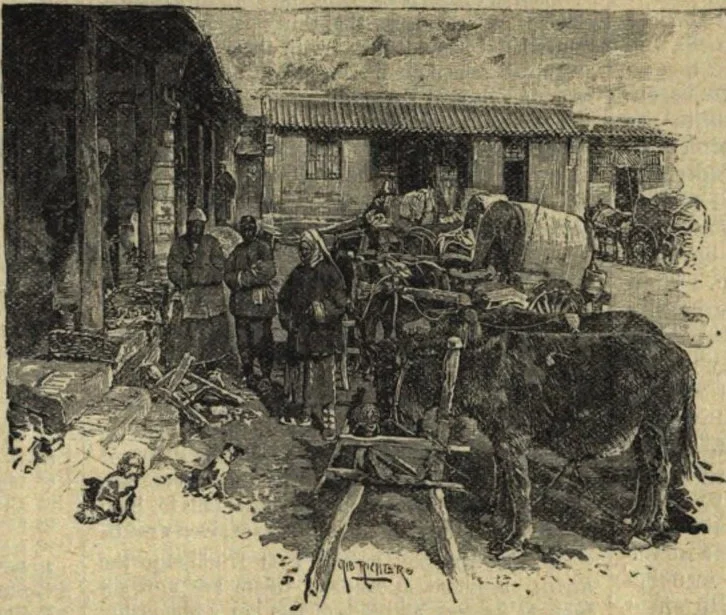
Nothing is more essential to the well-being of a community than good roads, facilitating communication. In Northern China the travel is largely by carts, and yet the public highways are never repaired, and are so far from justifying their name that it is a proverb that an old road becomes a river, which in the summer rains is literally the case. Much of the waste and misery resulting is preventable, yet it cannot be prevented. When we try to influence a farmer to repair the road over against his own house, he refuses, on the ground that the track is no more his to use than it is that of others. He has no time to waste on such work—that is to say, he is unwilling to confer a benefit on others, even though he reaps a greater one himself. But there is a deeper reason still. The repair of roads requires earth, and, in a land where every available square foot is necessary for tillage, who is to furnish the earth?—Nobody. And therefore it never is furnished.
Every missionary is able to perceive that, despite the industry of the Chinese, they are laboring under great disadvantages, owing to the lack of good tools; but he can seldom introduce better tools into actual use, either because they are far too expensive for the narrow means of a single farmer, or because, while they might be used for several families, jealousy and selfishness would prevent the experiment from becoming a success. One of the clumsiest of the Chinese machines is the set of rollers by which cotton is very slowly and imperfectly seeded, but a foreign machine cannot be introduced to take the place of the other, for the reasons already given, as we have had opportunity to observe.
The same has been found to be the case with grains. Yet tobacco, maize, the peanut, a variety of beet, cabbage, and the potato, have all been introduced into Northern China during the present dynasty, and all of them are well acclimated. Yet every such innovation has to fight for its existence for a long time, and there are probably few plants that can spring at once into favor, as the poppy has done—a type of the persistence of evil and its universal adaptations.
Conservatism and suspicion are in all oriental countries twin sisters, which resent any interference with what already exists. It is due to these traits that one is so often struck with the fact that contrivances for saving labor, which have long been in use in one region, are altogether unknown in other regions not far distant. An instance of this sort is to be found in a district in the province of Chihli, where the common form of water wheel is fitted with buckets drawn up by a rope coiled on a windlass turned by a donkey. The machinery is rude, the buckets ill made and leaky, and the waste of power very great, but, on the whole, this is much more economical than drawing water by hand. Yet in a belt of country along the Grand Canal, only about two days' journey from the district where water wheels are used, these devices are wholly unknown, and the only method of irrigation is either from wells with a windlass worked by men, or by two men tossing water from wicker baskets from the river into a pool above, and from thence to the field to be irrigated, thus using the labor of four men, and spilling about half the water in transit. Within a few years, however, the water wheel, in a very imperfect form, has made its appearance on the banks of the canal, introduced by two men relatively more enterprising than their neighbors. The reason given for not having bought a machine sooner was poverty—the compendious explanation of so many of the ills of China.—Missionary Review.
Penang: Island City at the Straits of Malacca
PENANG.—The city of Penang is situated on a small island at the upper end of the Straits of Malacca, formerly called the Prince of Wales Island, but now known by the name of the city. The island was ceded to the English Government by a native prince in 1785 for an income of $6,000 a year. The island is only 2 miles from the mainland, and is 12 miles long and 9 miles wide, with an area of 107 square miles. “In both Singapore and Penang the Chinese already constitute a large majority of the population, and are beyond comparison the richest and most prosperous part of the general community. In both cities the second and even third generations of Malasia-born Chinese are found, and in both cities these are the leading people of the community.”—Gospel in All Lands.
How Sad 'Twould Be: A Poem by John Boyle O'Reilly
By John Boyle O’Reilly
How sad ’twould be to see a master’s hand
Strike glorious notes upon a voiceless lute;
But, O, what pain when, at God’s own command,
A heart string thrills with kindness, but is mute!
—John Boyle O’Reilly.
AN UNTIRING PURPOSE.
The Lord requires his servants to be energetic. It is not pleasing to him to see them listless and indolent. They profess to have the evidence that God has especially selected them to teach the people the way to life; yet frequently their conversation is not profitable, and they show that they have not the burden of the work upon them. Their own souls are not energized by the mighty truths which they present to others. Some preach these truths, of such weighty importance, in so listless a manner that they cannot affect the people. “Whatsoever thy hand findeth to do, do it with thy might.” Men whom God has called must be trained to put forth effort, to work earnestly and with untiring zeal for him, to pull souls out of the fire. When ministers feel the power of the truth in their souls, thrilling their own being, then will they possess power to affect hearts, and show that they firmly believe the truths they preach to others. They should keep before the mind the worth of souls, and the matchless depths of a Saviour’s love. This will awaken the soul, so that with David they may say, “My heart was hot within me; while I was musing, the fire burned.”
Paul exhorted Timothy: “Let no man despise thy youth; but be thou an example of the believers, in word, in conversation, in charity, in spirit, in faith, in purity. Till I come, give attendance to reading, to exhortation, to doctrine.” “Meditate upon these things; give thyself wholly to them; that thy profiting may appear to all. Take heed unto thyself, and unto the doctrine; continue in them; for in doing this thou shalt both save thyself and them that hear thee.” What a weight of importance is here attached to the Christian life of the minister of God! What a necessity for his faithful study of the word, that he himself may be sanctified by the truth, and may be qualified to teach others!—Testimony for the Church No. 19.
It is the law of health that there must always be aspiration and progress. If we attempt to remain stationary, to be satisfied with what has already been achieved, decay inevitably begins. There is a kind of uncomplaining contentment which is a duty; but it is equally necessary that we be unsatisfied with the present, so long as the future opens the path to further progress. Paul said, “I have learned, in whatsoever state I am, therewith to be content.” But he also said, “Forgetting those things which are behind, and reaching forth unto those things which are before, I press toward the mark.” We despair of the person who has no ambition to change his present condition in any way for the better. One of the things which our missionaries have to do is to awaken in the breasts of the too-contented people an aspiration for something better than they have known. There is no greater example of a perfectly self-satisfied people than China, and her lack of ambition to advance has been her destruction.—Advance.
ADDRESSES OF CANVASSING AGENTS.
F. L. Mead, general agent, Battle Creek, Mich.
S. Sherrig, 18 Werder St., Chicago, Ill.
Charles Michaels, Echo Pub. Co., N. Fitzroy, Victoria, Australia.
B. B. Newman, cor. High Holborn and Berry Sts., Kingston, Jamaica.
N. Z. Town, 451 Holloway Road, London, N., England.
F. W. Spies, Grindelburg, 15a, Hamburg, Germany.
Emil Lind, Smalandsgatan 15, Stockholm, Sweden.
T. Wittle, 76 Pyrmont Bridge Road, Glebe, Sydney, Australia.
Wm. Crothers, Banks Terrace, Wellington, New Zealand.
R. B. Craig, Casilla del Correo 481, Buenos Ayres, Rep. Argentina, S. A.
W. H. Thurston, No. 1, Travessado Moreira, Rua do Livramento, Sand, Rio de Janeiro, Brazil, S. A.
DISTRICT NO. 1.
F. L. Downs, North Deering, Maine.
F. S. Porter, Northfield, Vermont.
S. F. Reeder, Newark, West Virginia.
J. R. Calkins, 317 W. Bloomfield St., Rome, N. Y.
Morris Lukens, Box 644, Williamsport, Pa.
C. A. Watkins, 501 N. 25th St., Richmond, Va.
H. C. Wilcox, S. Lancaster, Mass.
C. L. Taylor, 97 Plymouth Grove, Montreal, P. Q., Canada.
F. W. Morse, 20 Melbourne Ave., Toronto, Ont., Canada.
DISTRICT NO. 2.
E. C. Haskell, 755 S. Perry St., Montgomery, Alabama.
W. L. Killen, Raleigh, N. C.
C. F. Dart, Jewella, La.
L. E. Johnson, 159 Laurel St., Columbia, S. C.
C. N. Perrin, Meridian, Miss.
W. P. Burrow, Memphis, Tenn.
A. F. Harrison, Graysville, Tenn.
DISTRICT NO. 3.
C. A. Pedicord, Cochocton Ave., Mt. Vernon, Ohio.
I. S. Lloyd, 122 Ruckle St., Indianapolis, Indiana.
G. A. Wheeler, Plano, Ill.
A. J. Olsen, Ovid, Mich.
DISTRICT NO. 4.
J. J. Devereaux, 1505 E St., Lincoln, Neb.
S. A. Hill, Adel, Iowa.
Frank Gravelle, Bridgewater, S. Dakota.
C. M. Everest, Box 989, Minneapolis, Minn.
S. D. Hartwell, Milton Junction, Wis.
DISTRICT NO. 5.
James Hackett, 2010 E. 23d St., Kansas City, Mo.
S. C. Osborne, 821 W. 5th St., Topeka, Kansas.
L. C. Somerville, Springdale, Ark.
E. R. Palmer, 318 4th St., Oklahoma City, Okla.
W. W. Eastman, Keene, Texas.
DISTRICT NO. 6.
J. R. Glass, 1059 Castro St., Oakland, Cal.
W. C. Ward, 727 E. Taylor St., Portland, Or.
W. S. Holbrook, College Place, Wash.
E. P. Boggs, Butte, Mont.
“SHE HATH DONE WHAT SHE COULD.”
By Mary Felton
Do your work, and do it well;
Do not stop to think or tell
That the work is small or low.
Do your duty as you go.
Hear your Lord and Master say,
“Go and glean for me to-day;
Gather up the golden grain;
Bring it safe to me again.”
Let the reapers far before
Take the finest grain—there’s more
Scattered o’er the ground. There’ll be
Work enough for you and me.
Then, one day, when you shall stand
With your sheaf at his right hand,
Your Master will pronounce it good,
And say, “She hath done what she could.”