Pacific Press Publishing Company · New York · Apr 16, 1896
WORMS AND THE WARTBURG.
Worms and the Wartburg Castle were both scenes of important events in the history of the Reformation.
At Worms assembled the Diet to which the place owes its fame, for it was there that Luther put to confusion the representatives of both Church and State; while, in Wartburg Castle the reformer subsequently found temporary asylum from his enemies.
“A real reformation,” says D’Aubigne, “prepared during many ages, is the work of the Spirit of God. Before the appointed hour, the greatest geniuses and even the most faithful of God’s servants cannot produce it; but when the reforming time is come, when it is God’s pleasure to renovate the affairs of the world, . . . then if men are silent, the very stones will cry out.”
All was ready when Luther came upon the stage of action. “God who prepares his work through ages, accomplishes it by the weakest instruments when his time is come.” The reformer was only a poor monk, but “he came in the fullness of time,” writes Professor Harnack, “when the rule of the Roman Church, which had hitherto educated the peoples, had become a tyranny, when States and nations were beginning to throw off an ecclesiastical yoke and independently to organize themselves in accordance with their own laws.”
“He came in the fullness of time—when laymen were no longer satisfied with priest and sacrament, but were seeking God himself, and were feeling the personal responsibility of their own souls.”
The Reformation was not the work, however, of Luther and his co-laborers; they were only instruments in God’s hands. In the life of the true reformer we see only the reflected glory of the Creator working out his eternal purpose.
“Luther was great only in the rediscovered knowledge of God in the gospels.” He himself said: “I put forward God’s word; . . . this was all I did. And yet while I was asleep . . . the word that I had preached overthrew popery, so that neither prince nor emperor has done it so much harm. And yet I did nothing: the word alone did all.”
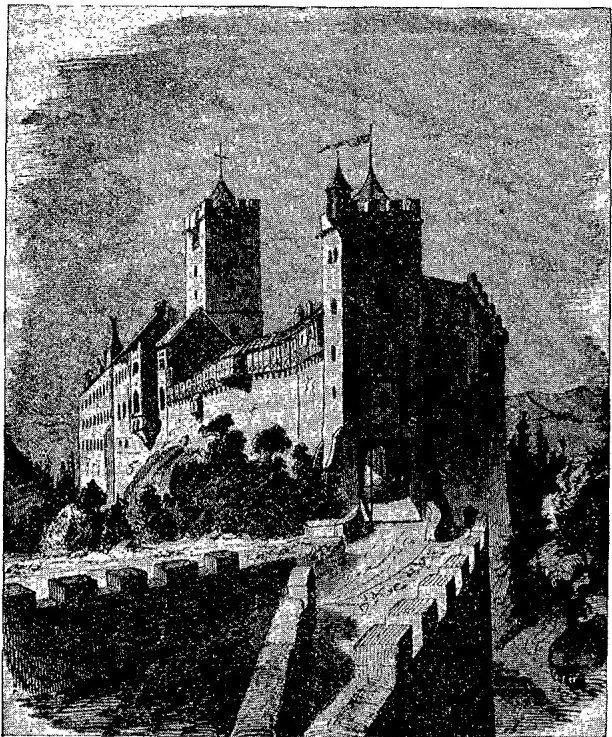
Wartburg Castle.
“The Reformation was accomplished,” says the historian, “in the name of a spiritual principle.” It “rejected all worldly elements.” And only so long as this was true did it continue to be reformation. “Every revolution,” says D’Aubigne, “should be accomplished in the mind before it is carried out externally.”
It was so with Luther; the Reformation began in his own heart. Seeking freedom from the bondage of sin and finding it not in external ordinances, but only in the promise of God: “Believe on the Lord Jesus Christ and thou shalt be saved,” Luther began to minister to others the comfort wherewith he himself had been comforted. It was with no ambitious purpose that Luther assailed the doctrines of the Papacy; he desired only to give to his fellowmen the gospel which priestcraft had taken from them. His purpose was not the destruction of the Papacy, but the salvation of souls.
Realizing that individual responsibility to God necessarily meant freedom to obey, Luther denied the right alike of Church and State to trammel his conscience. And this denial was fraught with far-reaching consequences to both civil and ecclesiastical systems.
“An obscure individual, bearing in his hand the word of Life, had stood firm before the mighty ones of the world, and they had shaken before him. He had wielded this arm of the word of God, first against Tetzel and his numerous army; and those greedy merchants, after a brief struggle, had fled away: he next employed it against the Roman legate at Augsburg; and the legate in amazement had allowed the prey to escape him: somewhat later with its aid he contended against the champions of learning in the halls of Leipsic; and the astonished theologians had beheld their syllogistic weapons shivered in their hands; and, lastly, with this single arm, he had opposed the Pope, when the latter, disturbed in his slumbers, had risen on his throne to blast the unfortunate monk with his thunders; and this same word had paralyzed all the power of this head of Christendom. A final struggle remained to be undergone. The word was destined to triumph over the emperor of the West, over the kings and princes of the earth; and then, victorious over all the powers of the world, to uprise in the Church, and reign as the very word of God.”
The ordeal was severe, but the reformer stood, not in the strength of men, but in the power of God. To one who asked him, “How can you hope to succeed?” Luther answered, “I trust in God Almighty, whose word and commandment I have before me.” The forces of a mighty empire were arrayed against him, but he faltered not, and when in the presence of the assembled Diet, he was required to give a direct answer to the demand of the Emperor that he retract his writings, the reformer said:—
**I cannot submit my faith either to the Pope or to the Councils, because it is as clear as the day that they have frequently erred and contradicted each other. Unless, therefore, I am convinced by the testimony of Scripture, or by the clearest reasoning; unless I am persuaded by means of the passages I have quoted, and unless they thus122render my conscience bound by the word of God, I cannot and I will not retract, for it is unsafe for a Christian to speak against his conscience. Here I stand, I can do no other; may God help me. Amen.**
Never before had the old city of Worms been stirred by such words. The most important declaration of independence since that of the apostles: “We ought to obey God rather than men,” had been given to the world. The Protest of the Princes at Spires five years later was simply the response of German manhood to the reformer’s declaration of the individual’s duty to God and of his consequent right to pay his highest allegiance to him only.
Rome was baffled! She had demanded unqualified submission only to hear her authority boldly challenged. The power of conscience was declared to be above the civil magistrate, and the word of God above the visible church.
“The sword of the Spirit which is the word of God” had been unsheathed against an apostate church, and though she might take the life of the warrior who thus wielded it, she could not destroy the weapon which had power in itself to continue the warfare; nor could she again fetter the human mind enlightened with divine wisdom. The word of God once locked in dead languages and chained to convent walls was now to be unfettered that it might accomplish in other minds and hearts the revolution it had wrought in Luther’s bosom. “Not by might, nor by power, but by my Spirit, saith the Lord of hosts.”
“He is a freeman, whom the truth makes free,
And all are slaves beside. There’s not a chain,
That hellish foes, confederate for his harm,
Can wind around him, but he casts it off
With as much ease as Sampson his green withes.”
The Wartburg
From Worms Luther went to the Wartburg, not indeed by his own volition, but nevertheless providentially. May 25, 1521, he was placed under the ban of the empire. But his safe conduct protected him. The next day he left Worms as though to return to Wittenburg. On his journey he was seized by his friends and was carried to the Wartburg, a castle near Eisenach, where he remained until March of the following year.
But the Reformer was not idle in his retirement. “Luther’s residence at the Wartburg,” remarks Dr. Schaff, “marks the second period of his reformatory activity.” For a time his enemies thought him dead, but they were soon undeceived. It was in the Wartburg that Luther translated the New Testament into German, which more than anything else contributed to make the Reformation permanent. Here too he wrote those tracts which so stirred Germany, and which were like barbed arrows in the sides of the Papacy. It is because of the work done within its walls for soul-liberty that the Wartburg is to-day a household word, while many more pretentious and in their day more noted castles are forgotten.
The eternal years of God belong to truth, and he who would make an everlasting name must identify himself with the incarnate “Word which liveth and abideth for ever,” for He is the embodiment of truth.
“With our own strength we naught can do,
Destruction yawns on every side:
He fights for us, our champion true,
Elect of God to be our guide.
What is his name? The anointed One,
The God of armies he;
Of earth and heaven the Lord alone—
With him, on field of battle won,
Abideth victory.”
THE PAPACY AND INTERNATIONAL ARBITRATION.
THREE leading representatives of the Papacy in three separate countries of Christendom—Cardinals Gibbons, Vaughan, and Logue, have put forth to the world a plea for the establishment of an international court of arbitration, which shall be a permanent body for the decision of international controversies. This plea comes as the result of a conference on the subject between the said cardinals, and is worded thus:—
We the undersigned cardinals, representatives of the Prince of Peace and of the Catholic Church in our respective countries, invite all who hear our voice to coöperate in the formation of a public opinion which shall demand the establishment of a permanent tribunal of arbitration, as a rational substitute among the English speaking races for a resort to the bloody arbitrament of war.
We are well aware that such a project is beset with practical difficulties. We believe that they will not prove to be insuperable if the desire to overcome them be genuine and general. Such a court existed for centuries, when the nations of Christendom were united in one faith. And have we not seen nations appeal to that same court for its judgment in our own day?
The establishment of a permanent tribunal, composed, may be, of trusted representatives of each sovereign nation, with power to nominate judges and umpires according to the common acceptance of general principles defining and limiting the jurisdiction and subject matter of such a tribunal, would create new guarantees for peace that could not fail to influence the whole of Christendom.
We do not hesitate on our part to lift up our united voice and proclaim to all who are accustomed to hearken to our counsels that it is a sign of a divine influence at work in their midst when “nation shall not lift up sword against nation, neither shall they be exercised any more in war” (Isa. 2:4), for it was written of a future time. “Come ye and behold the work of the Lord, what wonders he hath done upon the earth, making wars to cease even unto the end of the earth.” Ps. 46:8, 9.
Others may base their appeal upon motives which touch your worldly interests, your prosperity, your world-wide influence and authority in the affairs of men. The Catholic Church recognizes the legitimate force of such motives in the natural order, and blesses whatever tends to the real progress and elevation of the race. But our main ground of appeal rests upon the well-known character and will of the Prince of Peace, the living Founder, the divine Head of Christendom. It was he who declared that love for the brotherhood was a second commandment like unto the first. It was he who announced to the people the praise and reward of those who seek after peace and pursue it. “Blessed,” said he, “are the peacemakers, for they shall be called the children of God.” Matt. 5:9.
We therefore earnestly invite all to unite with us in pressing their convictions and desires upon their respective governments by means of petitions and such other measures as are constitutional.
JAMES CARDINAL GIBBONS,
Archbishop of Baltimore.
MICHAEL CARDINAL LOGUE,
Archbishop of Armagh,Primate of all Ireland.
HERBERT CARDINAL VAUGHAN,
Archbishop of Westminster.
It is not at all strange that the Papacy should thus make its voice heard in the matter of international arbitration. It would be difficult to find a matter widely affecting or concerned with public interests in which the Papacy is not “in evidence.” As the appeal states, such a court of arbitration once existed, in days of which the Papacy has fond remembrance. That court was a conclave of papal prelates, with the Pope at its head. And so far as existence is concerned, it is sitting yet; but since the Reformation it has found its occupation gone. The three cardinals, Gibbons, Vaughan, and Logue, would doubtless be willing to see this long-lost function of the Papacy revived.
But when we look at the history of the centuries during which the Papacy was international arbitrator, we are by no means assured of its utility as a preserver of the peace. We find that international wars and factional quarrels abounded on every hand, which drenched Europe in blood; and this notwithstanding the fact cited in this appeal that “the nations of Christendom were united in one faith.” Their “faith” was not of a kind which made them peaceable. And indeed, there is strong reason to believe that so far from acting as a peacemaker among the nations, the Papacy, through her instruments the Jesuits, stirred up international strife whenever it was deemed that her interests would be promoted thereby.
Doubtless this papal court is as willing as ever to act as international arbitrator. Nothing would do more to elevate the Papacy to her lost position of worldly preëminence. And there is much that favors the scheme. As stated in the appeal, the establishment of a permanent court of international arbitration is a project “beset with practical difficulties,” and these difficulties might be found so great that it would be deemed better to accept the services of this court already established, which has officiated in the proposed capacity in times past, and whose offices in this line are sought by some of the nations today.
There can, of course, be nothing more desirable than that wars should cease unto the ends of the earth; but unfortunately, there is very little real indication that the “Christian” nations of the world will be willing from principle to submit their differences to any court of arbitration. The spectacle of the strong nations tyrannizing over and absorbing the weak, the “Christian” powers failing to take123measures to stop Turkish butcheries in Armenia because of their jealousy and distrust of each other, and all striving to the utmost to equip themselves with armies and materials for war, does not indicate that they are willing to accept simple justice in any case where aggrandizement seems to be within their power.
The apostle James tells us that wars and fightings come from the evil lusts of men which rule in their hearts. James 4:1. And so long as these lusts reign in the human heart, so long will the fountain of war and strife continue to flow. The only power that can put an end to war is the power of the Prince of Peace, which power is exercised in the individual heart through faith. The one in whose heart dwells the Prince of Peace will “follow peace with all men,” but this peace will be found only so far as faith is found. Elsewhere there will be “wars and fightings,” and the usual manifestations of the “fruits of the flesh.”
But the time is near to which the words of the prophet apply: “Come, behold the works of the Lord, what desolations he hath made in the earth. He maketh wars to cease unto the ends of the earth; he breaketh the bow and cutteth the spear in sunder; he burneth the chariot in the fire.” Ps. 46:8, 9. Of this it need only be said that it is not the work of man, but of God. Then indeed will wars cease unto the ends of the earth; not because of a millennium, nor because men will have abjured war, but because God’s judgments will have visited the earth, leaving “desolations” in their track. Then will God be exalted in the earth, and all men will know that he is God, because the fact will have been visibly demonstrated before their eyes. But the only saving knowledge of God is that which is to be obtained now, through faith.
“REASONABLE LIBERTY OF CONSCIENCE.”
The confusing and misleading use commonly made of the phrase “liberty of conscience” in the forum of public address, is illustrated by the following from the New York World of April 9:—
The simple fact is that the Sunday laws of this State are infringements upon the just and reasonable liberty of the citizen, and as such they ought to be repealed. In recognition of this proper demand the Republicans at the last election promised German and other voters in this city that they would so modify these laws as to permit a reasonable liberty of conscience. Instead of doing so they have enacted an excise law which further and most intolerably restricts liberty of personal conduct.
Liberty of conscience is something which does not enter into the turbid strife of saloon politics. It has nothing in common with the “liberty” which some men desire, to drink freely of intoxicating liquors. No person ever conscientiously desired full freedom to indulge his appetite for intoxicants. His conscience, if not too benumbed by dissipation, told him to refrain from such indulgence. To invoke the name of conscience in behalf of perverted appetite, is the merest sham. The sacred rights of conscience do not keep company with Bacchus and his troop.
It is commonly considered that the use of intoxicating liquors as a beverage ought to be guarded by “reasonable” restrictions; but this has nothing to with liberty of conscience. “Reasonable” liberty of this kind is nothing short of perfect liberty, such as God himself has given to all men. No man or organization of men has any business to restrict human freedom in this respect. We protest against any use of the phrase which tends to associate and connect liberty of conscience in men’s minds with that which is properly subject to the restrictions of human legislation.
THE RELIGIOUS AMENDMENT.
For the present the proposed religious amendment is dead, but the National Reformers will not let the matter rest. Another Congress will see it revived and urged with a persistancy worthy of a better cause, hence it is still a live question for discussion. Concerning it the Protestant American says:—
“But what harm can come of such an amendment? says some reader. In the first place there are thousands of “the people of the United States” who do not make such acknowledgment, and the adoption of such amendment would only pave the way to compel them by civil amendment to at least act as though they did, which would only be to make hypocrites of such as would in all other respects be considered good citizens.
“This amendment would not make the nation any more Christian, because Christianity is a thing of the heart and life of the individual, and the adoption must be an individual act, and anything short of this is not Christianity at all, but an empty mockery. Therefore, every Christian should protest against the adoption of such an amendment.
“More than this, the adoption of this proposed amendment would be to make so-called Christianity the national religion, and the “revealed will of Jesus Christ”—the Bible—the creed of the nation. And this would not be the word of God, that “revealed will,” to each individual to be studied, interpreted and accepted by the individual guided by the Holy Spirit, but as interpreted by the Government, by a tribunal appointed by the nation. Thus again, as in days gone by, would the word of God be put into the hands of crafty, designing men, a priesthood of corruption, intolerance and bigotry, and its interpretation be found in the decrees of national councils with all the power of the nation back of these decrees to enforce them, which would be persecution for conscience’ sake. And so again, no Christian should be found upon the side of such an amendment; and we are sure that when the matter is seen in its true light they will oppose it.
“It is further evident from the foregoing that the proposed amendment would be a union of Church and State. This being so, every truly loyal, patriotic person will be henceforth, now and ever, opposed to any such amendment, as being un-American, un-Christian and therefore utterly inconsistent and out of harmony with the principles upon which this government was founded.”
STRANGE “CHRISTIAN” ENTERPRISE IN INDIA.
THE working of any movement to promote Christianity among men by the power of political or social combinations, human precepts and traditions, or any means other than the divine means which God himself provides and controls, is being illustrated in a movement to secure a better observance of Sunday as the “Christian sabbath,” in India. The following account of the undertaking is furnished by the St. Louis Christian Advocate:—
There has recently been formed in India a “Lord’s Day Union,” the purpose of which is to secure a better observance of the Christian sabbath. As originally constituted, the union was composed, not only of Europeans resident in India, but also of Christian natives, who, seeing about them a constant violation of the Christian sabbath, by Hindoos and Mohammedans, determined to do what they could in order to secure more respect for the sabbath as an institution. With this end in view they went to work disseminating Christian literature, showing the propriety of rest on one day in seven, and also designed to impress upon the minds of the public the sanctity of the day and the good results that would follow from its observance after a Christian fashion.
The result was, in one respect, quite unexpected. The Lord’s Day Union succeeded well among the Christians, for it is said a marked improvement in the observance of Sunday has been noted in those parts of India where it has been laboring. Stores and workshops have been closed, the peasant farmers have been induced to cease from their ordinary vocations, and among many classes the beneficial results of the labors of the union have been quite marked.
A sabbath in England is the perfection of a Christian day of rest, and the English in India, while diverging in no small degree from the religion of their island home, have nevertheless retained a considerable measure of respect for the sabbath, and have been shamed into a still closer observance by the example of the Christian natives. The consequence is that in the Christian quarters of many Indian cities the Sunday is said to resemble that of an English country town.
But the union is now contending with a very strange problem. It seems that Hindoos and Mohammedans, noticing the benefits to be gained from a careful observance of the Christian sabbath, have joined the Lord’s Day Union in such numbers as to threaten to become a preponderant element. This was what the union never contemplated. When it was formed it was not expected that its influence would extend much beyond the Christian element of the population, nor that its membership would comprise those of another faith; but the Hindoos and Mohammedans perceived the advantage gained by the Christians from a day of rest in every week, and strangely enough, desire admission for the purpose of still further forwarding the work of sabbath observance.
The situation is probably unique in the history of mission and Christian work. The Hindoos and Mohammedans having once been admitted, are increasing in numbers, so that the society is in danger of being outnumbered by a non-Christian, if not anti-Christian element. It is certainly a very strange situation and one that demands the closest consideration from all concerned.
That the means employed in this undertaking are merely human, is evident from the fact that God has never provided any means for securing the observance of Sunday, since his Sabbath is not the first day but the seventh day, and at the time of making the Sabbath, he constituted Sunday one of the six working days. It is also evident from the fact that God does not work through “Lord’s day unions” or other organizations aiming to secure religious observances by human legislation. He works by the power of his divine word, applied to the hearts of individuals by his Spirit.
This influx of pagans into the ranks of the promoters of this enterprise is not an unheard-of proceeding. There have been many like it on similar occasions in the past. Early in the “Christian era” pagans flocked in large numbers into the church, retaining the essence of their paganism; which paganism, blending with the outward forms of Christianity, and adding to these many of its own ceremonies, became the religion of the Papacy. The pagans did not join the Church because they had become converted, but because they saw in church connection a prospect of worldly advantage. And it is precisely so with the pagans of this time. In these movements for the exaltation of religious institutions by human “law,” there is nothing that tends to convert a person from sin to Christ, since the power of God is not in them. Therefore they will become popular just as soon as they can present strong enough inducements to the unconverted masses to persuade them that an espousal of the cause on their part will be good policy.
When the politicians see that our cause is going to succeed, said a leading representative of the National Reform party, they will tumble over each other in their haste to secure front rank among its adherents. To which we reply, Very likely; but any cause which fights its battles with the carnal weapons of worldly organizations, which attains what the world recognizes as success, and thereby attracts to itself the multitudes who place policy above principle, is not a Christian cause, and has no value from a Christian standpoint. Christianity was never popular in this world, and never will be. Let the spirit of pure Christianity actuate a movement, and there will be no danger to it from an inrush of unsanctified men.
PUBLIC MONEY FOR SECTARIAN USES.
By Editor
The New York Methodist ministers’ conference in session in New York City, April 6, passed the following resolutions touching the appropriation of money by the United States Government for sectarian schools. Incidentally, says the New York Sun, the members of the conference displayed some feeling against the Catholic Church, the only church that has asked for an appropriation this year:—
WHEREAS, We learn that the House of Representatives has, by a large majority, refused to grant further appropriations to certain sectarian schools, which for years have been supported at an annual expense to the Treasury of the United States of $200,000, and
WHEREAS, The bill as it passed the House of Representatives is soon to be acted upon by the Senate; therefore, be it
Resolved, That the New York Conference of 300 ministers of the gospel representing 150,000 members and adherents, and as fellow-heirs of Methodist doctrine and history representing 10,000,000 of communicants and adherents in this Republic, most heartily approve the action of the House of Representatives, and we earnestly request the Senate to promptly pass the bill and the President to sign it, so that this great wrong committed against the taxpayers of this country and124against the very spirit of the national Constitution may cease forever.
There is more reason for this display of feeling against the Catholic Church than might appear on the surface. A few years ago the Methodist Church was “in the swim” with the Catholic and other churches, seeking to get all the money they could from the Government in aid of their denominational schools and charitable institutions. But the Catholic Church distanced them all in the race, and was leaving them behind so rapidly as to make it evident that the only means of checking her career would be by repudiating the principle of governmental appropriations for sectarian institutions, thus influencing the Government to withhold all such appropriations, from the Catholic Church as well as from others.
We trust that the Methodist Church recognizes the evil principle of Church-and-State union in such appropriations, and that the Government will likewise recognize it, and on that basis bring them to an end.
CHURCH AND STATE IN UTAH.
Action taken at the semi-annual conference of the Mormon Church, in Salt Lake City, Utah, April 6, outlines that church’s position in the matter of Mormon affiliation with the State government. It is in the form of a manifesto, which declares that all political office-holding on the part of officers of the church must be subject to the church’s direction and approval. Considering that seventy per cent. of the Mormon people hold office in the church, it is apparent that this action will very widely affect, if it does not shape entirely, the character of the State.
The position of the Mormon Church, says the Sun of April 8, “as defined, is that a man having accepted the honors and obligations of ecclesiastical office in the church, cannot of his own volition make these honors subordinate or even coördinate with new ones of an entirely different character, and that he is bound to obtain the consent of the priesthood before assuming any other such responsibilities.” In harmony with this decision, “apostle” Moses Thatcher, who accepted the nomination for United States senator without consulting the “First Presidency,” was deposed from his church office during the conference.
There can be no doubt, in the light of this manifesto, that the State government of Utah will be a Mormon government as long as the Mormon Church is able to make it so. From her view of the nature of church office-holding as compared with State office-holding, it could not be otherwise. If that view were the proper one, the church would not have deemed it necessary to issue this manifesto. There is in the exercise of the functions of civil office nothing necessarily antagonistic to religion. The obligations of the one demand the exercise of honesty and integrity, virtues which are certainly not out of harmony with the spirit of the other. The person who conducts himself with honesty and uprightness before his fellowmen, should not be debarred from the privilege of church connection simply because he occupies a position of public trust.
Considered in connection with the facts of the situation in Utah—the predominance of the Mormon element in numbers, and their known readiness to hold political office—this manifesto can mean nothing else than that the Mormon Church aims to control political action within the State. The power that selects the office-holders in a State, is master of the whole situation. That the Mormon Church should aim to be master of the situation in Utah is in harmony with her history, and with the principles upon which she is established.