The Youth’s Instructor, Vol. LIII, No. II

On the Street

The Youth’s Instructor

March 14, 1905

Review and Herald Publishing Assn. · Washington, D. C. · March 14, 1905

On the Street
THE streets and thoroughfares of earth are but her great show-windows, revealing in a multitude of phases the conditions of human life to be found in the homes of the people. Here are displayed wealth and penury, thrift and indolence, hunger and gluttony, thirst and drunkenness, health and disease, happiness and misery, peace and contention. Here infancy, childhood, youth, manhood, and old age make up the motley throng, including the grave, the gay, the generous, the selfish, the cultured, the unrefined, the educated, the ignorant,—all passing to and fro, some with decided step, indicating a definite aim in life; others whose listless attitude bespeaks an aimless existence. The majority in the throng are treading the downward way which leads to destruction, even many youth and children bearing the impress of crime upon their young faces. The ever-varying scenes in this great panorama are enacted but once; yet “history repeats itself,” and the similarity in many respects is maintained from day to day, from year to year.
Mingled promiscuously in the vast, moving throng, are philanthropic souls, who have consideration for the woes of humanity, and are ready to improve the opportunities that come to them for adding to the happiness of others. Blessed thought! there are, amid the moral and spiritual darkness of the world, a few who shine as lights; who are in the world, but not of the world; whose characters are above reproach, untarnished by the polluting touch of sin’s foul breath.
The great desert waste of waters has its flowers, but they are so hidden by the ever-restless waves that the casual observer has little or no conception of their infinite variety and marvelous beauty. So with the flowers of the sea of humanity. One stands upon a crowded thoroughfare of a great city, and looks upon the surging sea of human beings; and although the flowers are there, they are so hidden by the waves that only occasionally does their beauty become apparent.
Upon the street as elsewhere there is a great dividing line which separates humanity into two very uneven classes. On one side are the multitudes arrayed in garbs of selfishness; on the other are the loyal few, who wear the spotless robes of righteousness. And every soul who treads this mundane sphere, belongs to the one class or the other; for there is no middle ground. “Nevertheless the foundation of God standeth sure, having this seal, The Lord knoweth them that are his.”
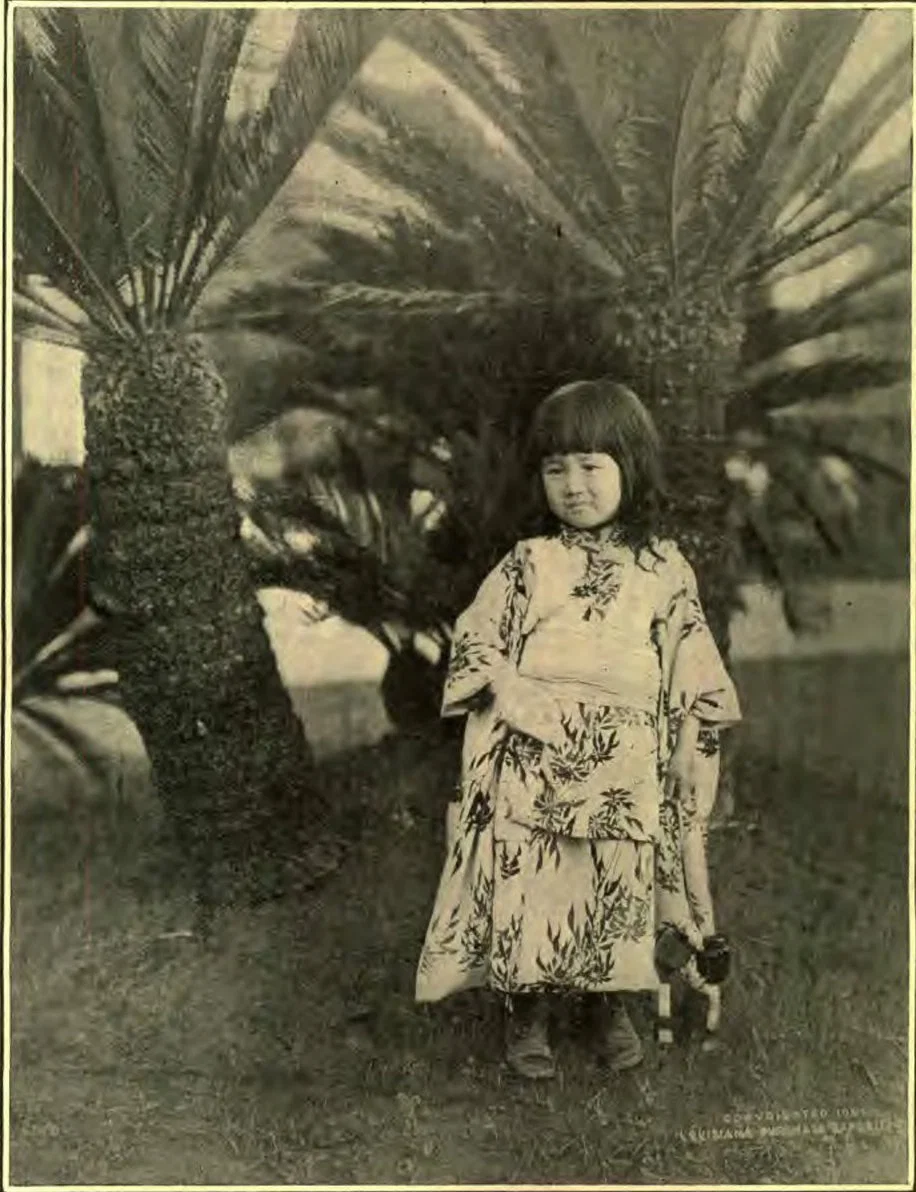
A LITTLE JAPANESE VISITOR TO THE WORLD'S FAIR
One’s appearance and deportment upon the street have much to do with his influence in the world about him. Therefore always wear modest apparel. Keep the shoulders back, the chest high. Cultivate an elastic step, and maintain a pleasing gait, free from everything that savors of affectation or immodesty. In greeting ladies or gentlemen upon the street, boys should not neglect to lift the hat, and every child should learn to speak politely. It is not good manners to point the finger on the street, or turn around to gaze at some one whom you have just passed, and who may be gaping at you at the same time. Such greetings after having started in opposite directions, are by no means pleasant. Never patronize the low grade restaurant, where there is no food to be found that is fit for either the body or the soul. Shun the saloon as you would shun the most deadly of poisons. Upon entering a store, modestly await your turn to be waited upon. Do not incur the displeasure of clerks by requesting them to show you numerous pieces of goods, just to satisfy a morbid curiosity, when you have no thought of making a purchase.
Little acts reveal the character. Who has not seen the narrow-minded individual performing the dog-in-the-manger act while traveling? Not content with occupying one seat in a railway coach, she enjoys having two double seats turned together, and with the aid of various personal effects, succeeds in keeping three extra seats, while a portion of the coach may be crowded. Then there is the sight, very familiar in some localities, of ungentlemanly men and boys occupying seats in street-cars, while ladies and the aged are obliged to stand. Boys, and girls too, should be prompt in yielding their seats to aged persons. They should cultivate reverence for gray hairs. There is no more beautiful mission in all this world than that of ministering to the comfort and happiness of those whose locks are white with the snows of years, whose weary feet are slowly nearing the end of life’s journey. It matters not what may be their outward apparel, always treat them with becoming courtesy.
If you have occasion to spend a half-hour upon a street-car, do not take with you yellow-back literature to help while away the time. It is not a good recommendation; and one should be just as much ashamed to be seen in the company of bad books as in the company of bad boys and girls. Degrading literature unfits the soul for fulfilling successfully the grand mission of life. Think too much of your example and influence in the world, to allow yourself to countenance such evil associations. It is not good manners to look over another’s shoulder while he is reading or writing. Your location in a car may make this easily possible, but one should live above infringing upon the personal rights of others in any direction.
Never indulge in flirtations. “A good name is rather to be chosen than great riches, and loving favor rather than silver and gold.” So avoid everything that would give occasion for remarks against your good name.
The street is not the proper place to form new acquaintances. One never knows with whom he may come in contact, so it is better not to accept of any advances; yet one need not be rude in showing resentment. There is a quiet, modest way in which an individual may attend to his own business, and thus impress others that he is not of the rude sort. Many a well-meaning person has been mercilessly swindled by confidence men, simply because he listened to the oily tongue of some rogue who called him by name, pretending to be an old-time acquaintance, but whom he really never had seen before. How many an unsuspecting, innocent girl has been lured to ruin by exchanging compliments with some stranger who took pains to play the agreeable for a time during her temporary absence from the home nest. Satan is seeking to claim every soul as his victim, and he cares not by what means one’s destruction is accomplished. He may come to you “transformed into an angel of light,” but be not deceived. Preserve the proper dignity under all circumstances, and strangers will understand that you are not to be trifled with.
Boys and girls should esteem personal dignity too highly to remain indefinitely upon street corners, indulging in loud, boisterous laughing, and rude, uncultured conversation. They should have more consideration for the feelings of others than to do so. It is not commendable to be of that number of whom it is said, “They are always on the streets.” Persons tire of seeing the same faces every time they go shopping. And it is a terrible mistake to squander upon the streets precious time that might be used in accomplishing some good purpose. Children who start out in life by taking a thorough course in street education, are almost certain of failure in the end; for it is seldom that they change their evil course. The low, vulgar whistle which announces the convening of the night school on the streets, should never be responded to by any boy or girl who cares anything for a good moral character. “Blessed are the pure in heart; for they shall see God.”
Children who remain upon the streets in the daytime when they have no business there, are learning lessons in elementary sin. And children who frequent the streets at night, receive the more advanced instruction, whose post-graduate course is taken behind prison walls. The child who has learned to enjoy the society of street companions more than he enjoys the society of the members of his own family circle, is truly an object of pity. Boys and girls whose names are upon the church roll, put themselves in the way of temptation; and it is little wonder that they fall. Instead, they should cherish such a sense of their obligations to a loving Heavenly Father that they would pray earnestly, “Lead us not into temptation, but deliver us from evil.” And they should help answer that prayer by shunning the very “appearance of evil.” The atmosphere of the streets is contaminated with the poison of immorality from sunset to sunrise, and children and youth who choose such perilous surroundings, are not following the footprints of Him who trod the triumphal pathway from earth to heaven; but, instead, they are following the slimy trail of the serpent, only to lose their good character, their good name, their good influence,—all that fits the soul for doing a grand work for others. If the boys and girls would spend their precious evening hours at home, in the company of helpful books, or in useful employment, the mercury in the moral thermometer would begin to rise, instead of remaining so near the zero mark as it is at present. The lessons of life that are of lasting benefit are not learned in the saloon, the theater, or the gambling hall. The music of life that thrills the inmost soul, is never sung by the jeering midnight rabble.
On the rock-bound shores of the “Sundown Sea,” near the Golden Gate, at San Francisco, stands the famous Cliff House, so familiar to thousands traveling to and fro. The great waves beat madly against its solid foundation, but it moves not; for it is “founded upon a rock.” It is the precious privilege of every individual to build upon the rock Christ Jesus, secure from the lashing fury of the destructive waves of sin.
The child or youth who thinks it commendable to make his exit through a window in order to join his street companions, while his fond parents believe he has retired for the night, is sadly lacking in the foundation principles upon which noble manhood and womanhood are reared. Such escapades are always led by Satan, and bring only misery and wretchedness in the end. Such children dishonor their parents in taking a course which may yet bring down their “gray hairs with sorrow to the grave.”
There are children who seem to think that their parents do not know nearly so much as they do; and when they are kindly advised to keep out of the way of temptation, they pass by that advice as scarcely worthy of consideration. But there will come a time when such children will think differently. And happy will it be for those who realize their mistake in time to work a reformation.
Children and youth do not always realize how much they need just such advice as Christian parents are able to give. It is commendable always to stop and weigh the evidence on both sides of a question, and then be willing to yield a wrong opinion without further controversy. That Florida native who stoutly maintained that the earth is flat because he had been “clear to Georgia, and it was flat all the way,” had a very small idea of the proportions of this comparatively little world on which we dwell. That boy or girl who argues that the path of life is one continuous smooth promenade, because he or she has traveled clear to the sixteenth mile-stone, and it has been smooth all the way, little realizes the hills of difficulty and the vales of perplexity that are sure to be encountered a little farther on.
The beautiful words of the thirty-second psalm are full of comfort for every soul who desires to tread the gold-paved streets of the New Jerusalem. How many will commit this short text to memory? It matters not how many mistakes you have made, “Blessed is he whose transgression is forgiven, whose sin is covered.” If you are in doubt as to just what to do, cling to the precious promise, “I will instruct thee and teach thee in the way which thou shalt go: I will guide thee with mine eye.” Mrs. M. A. Loper.

“Some One That Doesn’t Have to Be Shown”

An officer of our Mission Board came into the large assembly tent at a summer school about two years ago, and, seating himself in the rear, near the writer, looked over about two hundred students there gathered, and said, “Miss —, I am looking for some one to go to South Africa — some one who doesn’t have to be shown.”
How those words were impressed upon my memory! How much meaning there is in them! Some one who doesn’t have to be shown what and how and when and where,—some one who doesn’t have to be shown the better way,—some one who knows how to speak a word in season “to him that is weary,”—some one so sensitive to the needs of humanity about him that the impulse to supply that need comes with the sensing of it,—some one who sees his place and fills it, who finds his work and does it,—some one so in touch with the Infinite that he makes God’s purpose for that time and place his own, and fulfils the divine mission.
O for the men and women who do not need to be shown! God is looking for such to do the hard things, to bear the heavy responsibilities; and such it must be, too, who do, and do well, whatsoever their “hand findeth to do.” They are needed who have not to be shown where, who know where, as the bird knows where when she wings her flight through the pathless sky, and settles with unerring certainty upon her nest, hidden away in the forest,—they who know when, as the wild fowl knows when to seek warmer latitudes,—they who know how, as the beaver knows how to prepare his home,—they who know what, even as the startled deer knows, when he bounds away into the safe retreats of the wooded solitudes.
“Go to the ant, thou sluggard; consider her ways, and be wise.” Clumsy indeed would be man’s work in teaching these tiny creatures. Vain would be man’s attempts to instruct the bees how to work.
And all these need no man to teach; for are they not “taught of God”? Man alone, of all God’s creatures, is forever getting out of his place; forever making it necessary for him to be shown; forever going heedlessly into things when a moment’s prayerful forethought would save mistakes and regrets. “And all thy children shall be taught of the Lord; and great shall be the peace of thy children.”
O for the peace and harmony that would come with a united effort by those who have been indeed taught of God! What could not be accomplished if all the energy bound up in our great army of young people were consecrated to do a work as God would direct—not as man could twist and turn and mar it? What could not be done if every young man and every young woman, through prayer and much earnest study of God’s Word, had been so taught that with the child Jesus they could say: “Wist ye not that I must be about my Father’s business?” and then with that same Child’s assurance of divine guidance, go about that business intelligently.
God is looking for some one who doesn’t have to be shown when to move, and where to go, and how to get there,—some one who recognizes the Lord’s voice amid a thousand calls, and responds promptly, “Here am I; send me.” Too many of us have to be “wound up” occasionally, and even have our “hands set,” like an eight-day clock.
God is looking for workers whose eyes have been anointed with heavenly eyesalve, whose perceptions are made keen by divine insight, whose work is made efficient by God-given wisdom and skill.
“Wisdom is the principal thing; therefore get wisdom; and with all thy getting get understanding.” MARY C. COOK.

A Voice Upon the Wind

“THERE is a voice upon the wind,— A voice that comes from far,— A voice from where the distant groves And perfumed breezes are. ’Tis not the song of triumph, nor The scream of heathen rage; But ’tis a cry for gospel light— The echo of the age.”

“Drop a Prayer in, Too”

“Was that your penny on the table, Susie?” asked grandma as the children came in from Sunday-school. “I saw it after you were gone, and I was afraid you had forgotten it.”
“O, no, grandma. Mine went into the box all safely.”
“Did you drop anything in with it?” asked grandma.
“Why, no,” said Susie. “I had nothing else to put in.”
“Do you care what becomes of it?”
“Why, yes. I want it to do good somewhere.”
“Well, then, every Sunday when you drop your penny in, why don’t you drop a prayer in, too? If every penny the school sends away carried a prayer with it, what a great amount of good would be done!”
“I’m going to remember,” replied Susie, “and not let my penny go alone again.”—Little Worker.

What the President Does

AMONG all the people in our busy country, where men drive away at business as they do nowhere else in the world, there is no one more involved in great and important matters than the president of the United States.
He represents all the people of all the States in our dealings with foreign nations. If any one of our many millions of people has a complaint to make against a foreign nation, for any cause, he must look to the president to secure for him his rights.
The heads of nations, kings or emperors or presidents, or the officials immediately representing them, are constantly in communication with one another about the rights of their people. We can readily understand this when we remember how many citizens of any civilized country are engaged in trading or in traveling abroad for profit or pleasure.
A conscientious chief magistrate is always anxious to preserve pacific relations with other countries. War is sometimes unavoidable, but the sufferings and the evils it brings are horrible, and the greatest care must be taken to avoid whatever may tend to the destruction of peaceful relations with other countries.
National pride is easily offended, and so difficult and delicate are the president’s duties growing out of our foreign affairs, that it has always been a rule that the president of the United States may keep secret, even from Congress, his correspondence with foreign powers if he thinks the public interests require it. It is even true that often when the public knows nothing of what is being done through the State Department the issue of peace or war rests in the discretion of the president.
Congress alone has the power to declare war, but the American people are very combative, and so patriotic that, whenever diplomacy has got us into a quarrel with a foreign nation, public sentiment may be counted on to be with our country, right or wrong. Congress is always apt to be responsive to public opinion, which is easily excited, and so it is plain that whether our country shall continue to enjoy the inestimable blessings of peace quite frequently depends upon the will of the president.
To aid him in looking after foreign affairs the country has ambassadors, ministers, and diplomatic agents, all appointed by him, and confirmed by the Senate. With them he corresponds through the Secretary of State, who is his especial adviser in these matters and his first Cabinet officer.
The Secretary of the Treasury is in charge of the finances of the country, collects taxes, keeps the moneys, and defrays the expenses of the government. He is appointed by the president, who controls, subject to the laws, the financial policy of the government.
All the principal officers of the government, executive and judicial, are appointed by the president, and then confirmed by the Senate. The judges of the United States courts are so appointed, and the marshals and attorneys of these courts are under the control of the president aided by the attorney-general.
The president is responsible for the mail service by land and sea, through the postmaster-general and the postmasters, who preside over the important offices in the United States, all of whom are appointed directly by the president.
The president is commander-in-chief of the army, and through the Secretary of War he orders troops wherever in the United States they are needed. He is also commander-in-chief of the navy, which is to defend the country in time of war, and aid its diplomacy in time of peace; and in this he has a secretary.
The president must look after the affairs of the Indian tribes, the sale of public lands, the granting of patents to inventors, and the payment of pensions to soldiers; and he has under him, in direct charge of these matters, a secretary of the interior.
The president must look after the inspection of meats that are sent to foreign countries for sale; the collection of scientific information for farmers, and the operations of the Weather Bureau; and a secretary of agriculture is in immediate charge of these affairs.
The Secretary of Commerce and Labor has charge of lighthouses, steamboat inspection, surveys, immigration, the census, manufactures, and corporations.
These nine officials, the Secretary of State, the Secretary of the Treasury, the Secretary of War, the Attorney-General, the Postmaster-General, the Secretary of the Navy, the Secretary of the Interior, the Secretary of Agriculture, and the Secretary of Commerce and Labor, constitute the president’s cabinet, and they meet the president usually twice a week, to advise with him about affairs of state.
Most of the business of the president with the several departments is transacted by direct consultation with these heads of departments, but matters of the greatest import are reserved for the cabinet meetings.
The rank of the cabinet officers accords in great degree to the chronological order in which the several departments were successively established by law, and they have seats at the cabinet table according to that rank, the Secretary of State, as first, being on the right of the president, the Secretary of the Treasury next to the president on his left.
After all are seated, the president lays before them any matter upon which he wishes the opinion of the cabinet, when every member is free to give his views without any especial regard to rank or precedence. Usually, the member of the cabinet whose department is more immediately concerned expresses himself first.
It is not the custom to take formal votes, as the president is not in any sense to be bound by the will of the cabinet. He takes the opinions of such as choose to express themselves, and when he wishes, he asks for the views of each member in turn. What he shall do in any case depends upon his own conclusions after he has heard such advice as may be given. Should there arise between a president and a member of his cabinet differences on questions serious enough to warrant such a course, the cabinet officer tenders his resignation.
If the president has nothing himself to lay before the cabinet, he begins by asking the Secretary of State what he has to lay before the meeting. When the Secretary of State is through with his business, or if he has nothing, the president turns to the Secretary of the Treasury, then to the Secretary of War, and so on in order until the list is completed, or until the time comes for adjournment.
The stated cabinet meetings begin at eleven o’clock in the forenoon, and usually last two or three hours. No one is present except the president and cabinet officers, and no record of the proceedings is kept, as everything is strictly confidential.
The president’s business day usually begins after he has had his breakfast, and has read the morning papers. He lives with his family in the White House, from which he goes about ten o’clock, through a private hallway, to the new executive office.
This office can be approached only through the cabinet room or the private secretary’s office. Adjoining these two rooms is a large reception hall reached directly by the main entrance. It is here that for a long time to come all visitors to see the president will await their turn to pass through the secretary’s office to the chief executive.
Ordinarily no previous understanding is necessary to enable public officials to obtain an interview. During at least three days in the week such persons, and especially Senators and Representatives in Congress, are admitted from twelve to one o’clock in the day, through the office of the private secretary. Many of these calls relate to applications for office; others to measures pending in Congress, petitions for pardons, sentences of court martial, complaints against revenue officers, or any other of the thousand matters that touch upon the powers of the chief executive.
Some presidents enjoy informal calls, even from strangers. It is said that President Jackson once received a bluff sea-captain early in the morning, when the president was still in his loose dressing-gown and slippers, enjoying his long pipe.
Fortunate, indeed, would the president be if, after having spent two hours of his time in these interviews, he were permitted to sit down to the work upon his desk, consisting, during the sessions of Congress, of bills to be approved or vetoed, as well as of business coming up from the departments.
But it is usually the case that Senators and members do not all go away to the sessions of Congress beginning at noon. Some have merely arranged for more protracted interviews, when they can talk more fully over their matters.
Possibly, however, twelve is the hour set for the president to hear some delegation from a distance, with its spokesman at its head to speak about political, economic, religious, or social questions. These delegations are usually heard in the president’s office—he standing to listen to the address, and then replying.
If the engagement be to receive a foreign minister, newly accredited to our country, more formality is observed. The president goes into the Blue Room, and there the new minister, attired in his court costume, glittering with stars and gold lace, and attended by one or more of his suite, is introduced by the Secretary of State, and makes his address. The president replies, and then there is a cordial shaking of hands.
The hour for luncheon is usually between one and two, and even after that time interviews do not always cease. It frequently happens that from morning until night the president is not allowed to give any attention to the routine business of his office. It is probably true that, for many months in the year, more of his office work is transacted after a seven o’clock dinner than during the daytime.
This is an outline sketch of one of the three days of the week when the president is said to receive callers; the other three are the two cabinet days and the day usually reserved to himself for business; but it is not to be understood that even on these days no others except the members of the cabinet have access to his office. Important business is considered as justifying calls at any time, and there are very few days upon which some visits are not made. Those who come from foreign countries are astonished at the ease with which the chief magistrate of this great country can be approached.
Now consider for a moment the laws the president approves, the bills he vetoes, the messages he writes, and the many thousands of pages of business papers he goes over and decides upon. The amount of labor performed by a conscientious chief magistrate who desires to know what he is doing, and judge for himself of the merits of the matters upon which he decides, is really stupendous. The hour of midnight frequently finds the president hard at work.
The president and his wife are the official heads of society at the national capital. They give a number of state dinners, one to the members of the cabinet and their wives, one or more to the diplomatic corps, and one to the justices of the Supreme Court. Some of the members of the House of Representatives and of the Senate, and others, more or less prominent, are also invited.—Hon. Hilary A. Herbert, in Youth’s Companion.

Books for Young People

THE BIBLE: Old Testament, New Testament.
GENERAL HISTORIES: D’Aubigne’s History of the Reformation; school text-books are among the best books of history.
SCIENCE BOOKS: Books on minerals, plants, animals, the stars, and physical geography.
MISSIONARY BOOKS FOR STUDY OF FIELDS:—
India and Christian Opportunity.
Knights of the Labarum (missionary biographies).
Dawn on the Hills of T’ang (China).
Africa Waiting.
Japan.
Missions in South America.
INTERESTING MISSIONARY BOOKS:—
Islands:—
Life of J. G. Paton ............... $1.50
John Williams .................... .75
John Chalmers .................... .75
Bishop Patteson .................. .75
Africa:—
Robert Moffat .................... $.75
David Livingston ................. .75
India:—
In the Tiger Jungle .............. $1.00
Village Work in India ............ 1.00
Across India at the Dawn of the Twentieth Century ............ 1.50
Life of William Carey ............ .75
Life of Alexander Duff ........... .75
Burma:—
Life of Judson ................... $1.50
Soo Thah, a Tale of the Karens .... 1.00
Canadian N. W.:—
On the Indian Trail .............. 1.00
DENOMINATIONAL BOOKS:—
Great Controversy ................ $2.25
Desire of Ages: Worker’s Edition, $1.50;
Regular .......................... 3.50
Patriarchs and Prophets .......... 2.25
The Story of Daniel, by S. N. H. ........ 1.00
Thoughts on Daniel and the Revelation .. 2.25
Spirit of Prophecy, Vols. I, II, III, IV.*
Christ’s Object Lessons .......... 1.25
Mount of Blessing ................ .75
Our Paradise Home ................ .25
Heralds of the Morning ........... 1.50
Education ........................ 1.25
Scriptural Foundations of Science.*
Life Sketches of Elder and Mrs. James White ........ 1.25
Life of Elder Joseph Bates ....... .35
Life of William Miller.*
Life Sketches of Paul.*
Making Home Happy ................ .25
Story of Joseph .................. .25 and .50
How a Little Girl Went to Africa ...... 1.00
CHARACTER BUILDING:—
The Christian Gentleman, Banks ........ $ .75
Light on Life’s Duties, Meyer .......... .60
Week Day Religion, J. R. Miller ........ .60
Making the Most of Life, J. R. Miller ... .60
Silent Times, J. R. Miller ............. .60
Strength and Beauty, J. R. Miller ....... .60
The Hidden Life, J. R. Miller .......... .60
Individual Work for Individuals, Trumbull .35
The Lover’s Love, W. P. Pearce .......... .75
Those books marked with a star are out of print; but many families have them, and they are worth reading, so are included in the list. Any book in the list may be ordered of the Review and Herald.

THE WEEKLY STUDY

Paul’s Trials and Victories at Ephesus

OPENING EXERCISES.
SCRIPTURE FOR STUDY: Acts 19: 23-41.
REFERENCE STUDY: “Sketches from the Life of Paul,” pages 140-149.
TOPICS FOR STUDY:— Great commotion. Reason. Influence of the apostles’ labors. Pagan temple. Diana. Paul’s companions mobbed. Speech of the town clerk. Assembly dismissed.

Notes

“The scale on which the temple of Diana was erected was magnificently extensive. It was 425 feet in length and 220 in breadth, and the columns were sixty feet high. The number of columns was 127, each of them the gift of a king; and thirty-six of them were enriched with ornament and color. The folding doors were of cypress wood. . . . The value and fame of the temple were enhanced by its being the treasury, in which a large portion of the wealth of western Asia was stored up.”—Conybeare and Howson.
“The Ephesian goddess [Diana] was represented by a rude idol, which was said to have fallen from heaven. . . . In the representation which is familiar to us . . . the goddess appears as a standing idol, in shape partly human. . . . The lower part is merely an upright block, without distinction of legs or feet, covered with symbols and figures of animals; the arms from below the elbows are extended on each side, and the hands are supported by props; the head is surmounted either by a lofty ornament or by a mural crown, and something like a heavy veil hangs on each side of the face down to the shoulders.”—Bible Dictionary.
“Portable statues were modeled after the great image of Diana, and were widely circulated in the countries along the shores of the Mediterranean. Models of the temple which enshrined the idol were also eagerly sought.”
“A report of the speech of Demetrius was circulated. The uproar was terrific. The whole city seemed in commotion.”
“The words of Demetrius reveal the real cause of the tumult at Ephesus. . . . ‘This our craft is in danger.’ The income of pagan priests and artizans was at stake; and for this reason they instituted the most bitter opposition to the apostle, and refused to receive or investigate the new religion, which would have made them wise unto salvation.”
“Moreover ye see and hear, that not alone at Ephesus, but almost throughout all Asia, this Paul hath persuaded and turned away much people, saying that they be no gods, which are made with hands.” These words touching the work of Paul, from an enemy of the gospel, reveal to us the extent to which the gospel was spreading, and the influence it was having on the heathen world. Read Rom. 10: 17, 18; Col. 1: 23.
G. B. T.

Report from Killbuck, Ohio

A YOUNG People's Society consisting of thirteen members was organized at this place about four months ago. From October to January we sold, gave away, and loaned nine thousand five hundred pages of papers, tracts, and pamphlets. We have visited the sick and written missionary letters.
Our church is in the country, two miles from the nearest town; so our attendance is chiefly from the country. A large number of young persons not of our faith attend nearly every meeting. The Lord has wonderfully blessed us in all our efforts to move forward, and for this we praise his holy name. As we are just starting in this work, and know but little about it, we would be glad to hear from any one who has had more experience in the young people's work. We are glad the coming of Jesus is so near, and we ought to lay hold with a mighty hand on the work he gives us to do in these last hours.
V. S. WHISLER, President.
Continue reading: The Children's Missionary Society in Rarotonga