Your ShelfYour Projects

Review and Herald, Vol. 87, No. 23.

Roosevelt and the Vatican

Review and Herald

Jun 9, 1910

Review and Herald Publishing Association · Takoma Park Station, Washington, D. C. · Jun 9, 1910

Roosevelt and the Vatican
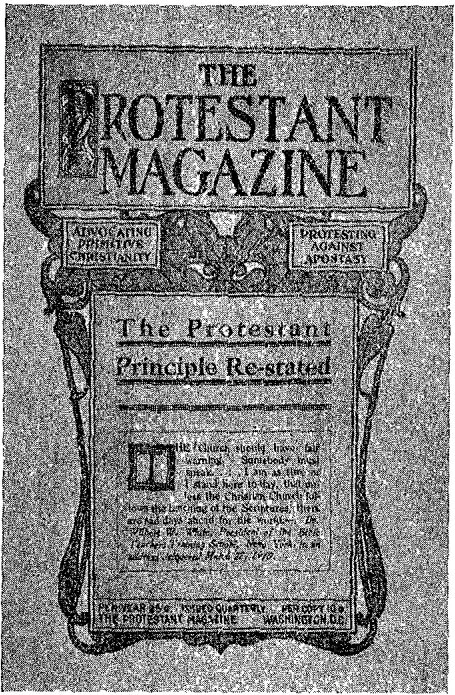
No incident in years has so stirred both the secular and the religious press throughout the world as the recent episode at Rome, when former President Roosevelt was denied an audience with the Pope, except upon conditions which Mr. Roosevelt felt he could not accept without compromising his personal freedom. The threatening aspect of present-day Roman intolerance was plainly betrayed.
In making this Vatican affair the leading feature of its second issue for 1910, the PROTESTANT MAGAZINE avoids personalities, but deals in a dignified yet forcible manner with the underlying principles of Catholic intolerance which are involved. For this feature alone, the PROTESTANT MAGAZINE should be in the hands of every true Protestant in the land.

ENGLAND'S NEW KING AND THE PROTESTANT OATH
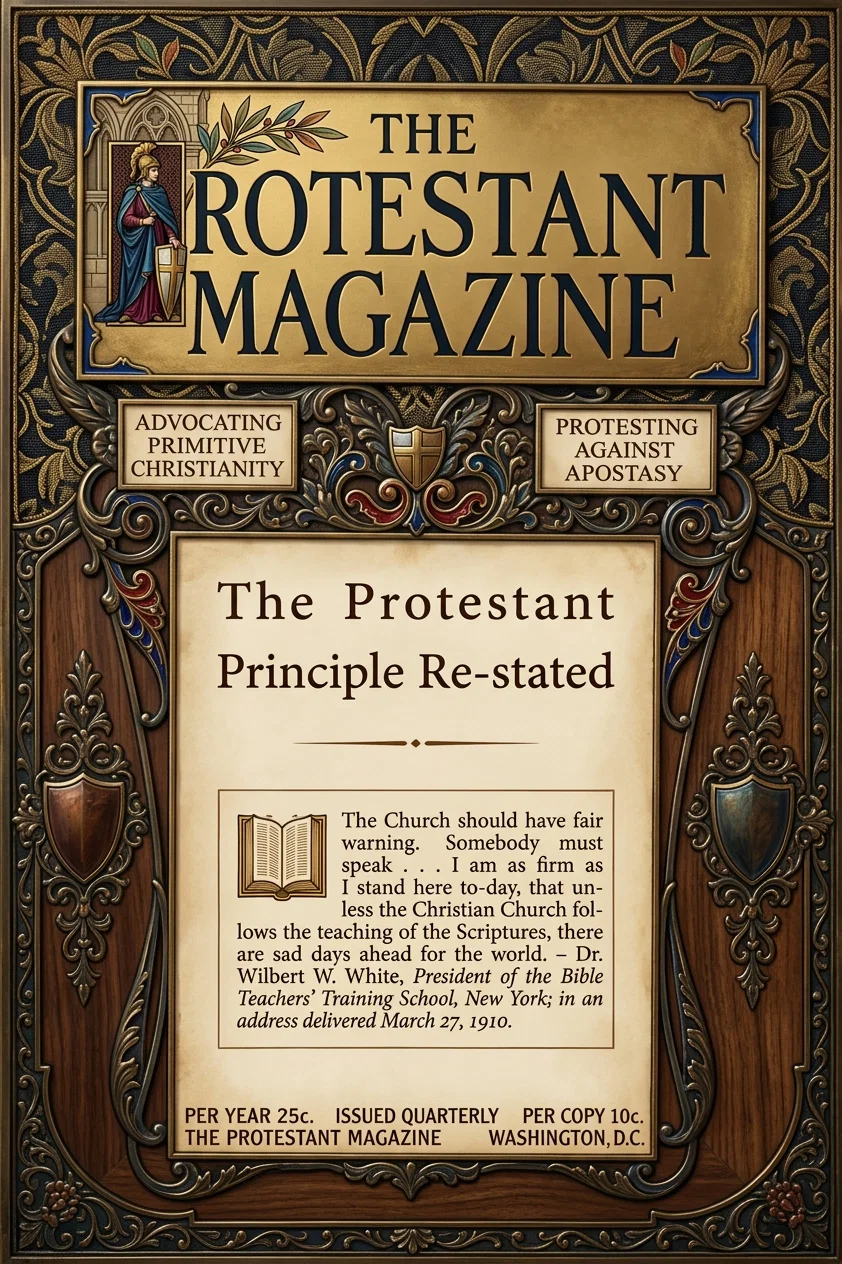
Coming on top of the Vatican incident, the religious controversy which arises in England with reference to the taking of the King's Oath, by the new king, George V, is of unusual significance. The light thrown upon the situation by this number of the PROTESTANT MAGAZINE will be appreciated by all readers.

OUR MISSION SCHOOLS IN FAR-AWAY LANDS

The May-June number of CHRISTIAN EDUCATION is a strong missions number, bearing interesting messages from a number of distant mission fields, written by those who are in direct charge of important phases of the educational work. There are articles from Rome, South Africa, Japan, Korea, China, and other foreign lands. All the departments in this issue are especially helpful, showing evidence of painstaking care on the part of the editors. This number of CHRISTIAN EDUCATION is deserving of a large circulation.

EARN A SCHOLARSHIP

There is no better way for a young man or a young woman to lay the proper foundation for a successful, useful life than by taking a thorough course in one of our Christian schools or colleges. These schools are not open to the rich or well-to-do alone. Any one who will, may readily earn his way. The best way to earn a scholarship is by selling such publications as those described above, together with LIFE AND HEALTH and the Temperance INSTRUCTOR. Many are also earning scholarships by selling our subscription books. Publications and books are supplied by the State tract societies, and inexperienced workers are trained to the point of success by field missionary secretaries.
Write to your Tract Society or to us
Review and Herald Publishing Assn., Washington, D. C.

Christ Our Helper

MRS. E. G. WHITE
THE only begotten Son of God came to this world to redeem the fallen race. He has given us evidence of his great power. He will enable those who receive him to build up characters free from all the tendencies that Satan reveals. We can resist the enemy and all his forces. The battle will be won, the victory gained, by him who chooses Christ as his leader, determined to do right because it is right.
Our divine Lord is equal to any emergency. With him nothing is impossible. He has shown his great love for us by living a life of self-denial and sacrifice, and by dying a death of agony. Come to Christ just as you are, weak, helpless, and ready to die. Cast yourself wholly on his mercy. There is no difficulty within or without that can not be surmounted in his strength. Some have stormy tempers; but he who calmed the stormy Sea of Galilee will say to the troubled heart, “Peace, be still.” There is no nature so rebellious that Christ can not subdue it, no temper so stormy that he can not quell it, if the heart is surrendered to his keeping.
He who commits his soul to Jesus need not despond. We have an all-powerful Saviour. Looking to Jesus, the author and finisher of your faith, you can say, “God is our refuge and strength, a very present help in trouble. Therefore will we not fear, though the earth be removed, and though the mountains be carried into the midst of the sea; though the waters thereof roar and be troubled, though the mountains shake with the swelling thereof.”
Do not think that the Christian life is free from temptation. Temptations will come to every Christian. Both the Christian and the one who does not accept Christ as his leader will have trials. The difference is that the latter is serving a tyrant, doing his mean drudgery, while the Christian is serving the One who died to give him eternal life. Do not look upon trial as something strange, but as the means by which we are to be purified and strengthened. “Count it all joy when ye fall into divers temptations,” James admonishes, “knowing this, that the trying of your faith worketh patience.”
In the future life we shall understand things that here greatly perplex us. We shall realize how strong a helper we had, and how angels of God were commissioned to guard us as we followed the counsel of the Word of God.
To all who receive him, Christ will give power to become the sons of God. He is a present help in every time of need. Let us be ashamed of our wavering faith. Those who are overcome have only themselves to blame for their failure to resist the enemy. All who choose can come to Christ and find the help they need.
There stands among you the mighty Counselor of the ages, inviting you to place your confidence in him. Shall we turn away from him to uncertain human beings, who are as wholly dependent on God as we ourselves are? Have we fallen so far below our privileges? Have we not been guilty of expecting so little that we have not asked for what God is longing to give?
“I will mention the loving-kindnesses of the Lord, and the praises of the Lord, according to all that the Lord hath bestowed on us, and the great goodness toward the house of Israel, which he hath bestowed on them according to his mercies, and according to the multitude of his loving-kindnesses. For he said, Surely they are my people, children that will not lie: so he was their Saviour. In all their affliction he was afflicted, and the angel of his presence saved them: in his love and in his pity he redeemed them; and he bare them, and carried them all the days of old.”
Let us have more confidence in our Redeemer. Turn not from the waters of Lebanon to seek refreshment at broken cisterns, which can hold no water. Have faith in God. Trustful dependence on Jesus makes victory not only possible, but certain. Though multitudes are pressing on in the wrong way, though the outlook be ever so discouraging, yet we may have full assurance in our Leader; for “I am God,” he declares, “and there is none else.” He is infinite in power, and able to save all who come to him. There is no other in whom we can safely trust.

A More Effective Ministry

A. T. ROBINSON
“He that winneth souls is wise.” Prov. 11:30.
The demand of the hour is for specialists in every department of life. He who attempts several lines of effort is sure to excel in nothing, and more than likely to make a failure of everything. The work of the gospel ministry is no exception to this rule. He who thinks he can drift into that sacred and holy work, after failing in almost everything else undertaken, places a woefully low estimate upon that high calling.
The only way a man can reasonably hope to make a success of any worldly profession is by throwing every energy of his being into it. No lawyer, banker, merchant, or other professional man ever attained success, influence, or wealth, except by making his chosen work the one dominating idea of his life. Every man who has reached any degree of greatness in his life-work has started out by placing before himself a difficult task, a high ideal to be reached. “This one thing I do,” has been the motto of every truly successful life.
That which made the apostle Paul great in his profession — that made his testimony an authority on the work of the gospel ministry — was the fact that he set his mark high, and made it the one effort of his life to reach it. Here is his life motto, a good one for every minister of the gospel: “This one thing I do, forgetting those things which are behind, and reaching forth unto those things which are before, I press toward the mark for the prize of the high calling of God in Christ Jesus.”
“Study to show thyself approved unto God, a workman that needeth not to be ashamed, rightly dividing the Word of truth.” “Give attendance to reading, to exhortation, to doctrine. . . . Meditate upon these things; give thyself wholly to them; that thy profiting may appear unto all.” These are among the admonitions of the great apostle to every man who dares assume the solemn responsibility of the gospel ministry.
My brother in the ministry, I invite you to critically review your work for the past year. Have you kept the “mark for the prize of the high calling” everbefore your eyes? Have you worked for definite results? I will venture what I believe would be the answer that many preachers would give to their own hearts in this matter: “Well, I went where the conference committee asked me to go; I thought I would try it. If souls were converted to the truth, well and good; but if not, of course I could not help that. It is the Lord who must give the increase; and if he does not see fit to give any increase, of course I am not responsible. The Lord says that if a man does not provide for his own house, he is worse than an infidel; but I drew my salary each month, and this enabled me to provide for my family: so I did not have anything to worry about. Of course I must live, and my family must live. The Lord says that a man who plants a vineyard has the right to eat of the fruit of the vineyard, and that ‘the husbandman that laboreth must be first partaker of the fruits.’” True, brother, but the Lord’s plan for the support of his ministers is based on the supposition that there will be fruit as the result of their labor. How many preachers would go out in the work during the coming season if some definite arrangement was made by which their salaries would be dependent upon actual returns from their labors?
Sometimes I wish we had some way of applying Gideon’s army test to ourselves. Gideon had raised a little army of thirty-two thousand men, to go out against the Midianites, who were “as grasshoppers for multitude; for both they and their camels were without number.” But the Lord, looking at Gideon’s army, saw a feeling of pride and self-sufficiency in their hearts. “And the Lord said unto Gideon, The people that are with thee are too many for me to give the Midianites into their hands, lest Israel vaunt themselves against me, saying, ‘Mine own hand hath saved me.’” A proclamation was made in the camp: “Whosoever is fearful and afraid, let him return, and depart early from mount Gilead.” Many were glad to avail themselves of this permission. “And there returned of the people twenty and two thousand; and there remained ten thousand.” “The people are yet too many,” said the Lord, and another test was given. When the number was reduced to three hundred men, each one of whom was so true to God and to the task before him that he would not take his eyes off the enemy, even while quenching his thirst, God said, “By the three hundred men that lapped will I save you.”
I would like to see every worker in the employ of the Nebraska Conference, including the conference president, settle it in his heart — in some way get his soul fired with the conviction from God — that he is going out to win souls for the Master; and that unless he can go from this workers’ meeting with a fixed and unconquerable determination to see definite results from his labors during the coming season, he will turn his attention to some other occupation. Better, a hundred times over, make a success of some honorable worldly calling, than to be dabbling in other things while engaged in the work of the ministry. The gospel minister must “endure hardness, as a good soldier of Jesus Christ,” remembering that “no man that warreth entangleth himself with the affairs of this life; that he may please him who hath chosen him to be a soldier.”
I would rather see two thirds of this company of workers decide at this meeting to turn their attention to some worldly occupation, and ten of our number go out from this meeting with their souls fired with a zeal for God which would consume their very being if they could not see results of their labors, than to see what I fear we shall see,—what we have seen year after year,—this company, after spending ten days here, at conference expense, go out into the field, and at the close of the season come up to our camp-meeting and report one or two churches, made up mostly of old Sabbath-keepers, added to the conference.
Among those who labored in the earlier days of this message, we have some noble examples, worthy of our emulation. I knew a young minister in the earlier days who was counseled by the conference not to pitch his tent in a certain locality, but who insisted that he felt a burden to go to that place. The committee finally consented, but told him that they were impressed that he would not meet with success. The tent was pitched, and meetings began with a small interest, which gradually grew less, until at the close of the first week, there was almost no attendance, in spite of everything that could be done to interest the people. What was to be done? — Only one thing seemed left,—to confess his mistake in not following the counsel of the committee, take down the tent, and go to another place. But that would mean to disregard his conviction of what he had felt the Lord was calling him to do. A whole night was spent in pleading with God for victory. Something like the spirit that led John Knox to plead, ‘Give me Scotland, or I die,’ took possession of the heart of the young man and his associate; and that God who proves his people at the waters of Meribah, and answers in ‘the secret place of thunder,’ gave them the assurance of victory. The next day they went out as usual, and invited the people to come to the meeting. Somehow they felt sure the people would come; and they did come, and an interest was aroused. The Spirit of God set its seal to the word spoken, and a good church was raised up.
O that the Lord will baptize his servants with the baptism of the Holy Spirit, and give us a victory at this workers’ meeting, the results of which shall be seen and felt by us in all the days of service that are to come!
Hastings, Neb.

Relation of Our Sanitariums to the Third Angel’s Message

D. H. KRESS, M. D.
The sanitarium idea is the outgrowth of the health principles which have been associated with the proclamation of the third angel’s message from its beginning. In 1821 Joseph Bates, then a sea captain, witnessing the evils resulting from strong drink, gave up the use of alcoholic liquors. Wine and cider were then regarded as household necessities by the majority because of their supposedly strengthening properties. In fact, about that time a Quaker in England who applied for a policy in a life-insurance company was rejected when it was ascertained that he was a total abstainer, although he was considered a good risk in other respects. Later the company consented to take the risk, provided an extra payment of ten per cent was made for his policy. It is now established that the total abstainer lives longer, and has fewer days off on account of illness during each year, than the moderate user of these milder alcoholic drinks; and total abstainers are considered much better risks by all insurance companies.
That which it has taken years for science to establish, Captain Joseph Bates advocated in his day. He abandoned allalcoholic drinks about the year 1823. This was not the end of reforms with him. A few years later tobacco was given up for the same reason that alcoholic beverages were abandoned; and, still later, in 1832, he gave up the use of tea and coffee. In 1843 flesh foods were added to the list of undesirables; and from that date to the time of his death, which occurred thirty years later, Captain Bates remained an abstainer from flesh food.
Science to-day upholds every one of the steps in reform taken by Captain Bates. So strong is the feeling against alcohol, even by medical men, that it is seldom prescribed as a remedial agency. Its supposedly beneficial effects are known to be due to its paralyzing influence. Alcohol renders the patient unconscious of his real condition, just as it makes a man exposed to cold unconscious of the fact that he is cold, and perhaps in serious danger. Thus the science of the Bible now stands vindicated — “wine is a mocker, strong drink is raging: and whosoever is deceived thereby is not wise.”
The search-light of science is now being turned on tobacco, tea, and coffee. These, too, are narcotics, and lessen the feeling of fatigue, sorrow, and business or home perplexities, by deadening the sense of consciousness. Flesh foods have concealed within their fibers subtle poisons which exert a similar influence. No man can afford to be made unconscious of his real condition, either physical or moral; he can not, therefore, afford to introduce into his body, poisons which benumb the only medium through which God, by his Spirit, can communicate with man, and convict of sin and of righteousness; for such an act may result in the loss of the soul.
After the bitter disappointment of 1844, many forsook the advent doctrine altogether, giving no further thought to it. But not so Captain Bates. God had prepared this man, unconsciously to himself, to start a still greater reform. His mind was directed to the latter part of Revelation 10, “Thou must prophesy again before many peoples and nations and tongues and kings;” to the temple of God in heaven, as mentioned in Rev. 11:1, 2; and to the ark and its contents — the ten commandments. Light came into his mind especially upon the fourth commandment, which was then ignored; and this light he at once proceeded to communicate to the world.
This great health and temperance reformer was the man whom God selected to call attention to the Sabbath reform, as connected with the heralding of the second coming of Christ. Captain Bates was the first Seventh-day Adventist. So, in the providence of God, our sanitariums have been established to give special prominence to, and to teach, these reforms, and thus prepare minds (as God prepared the mind of Joseph Bates) for the reception of the Sabbath truth and other truths connected with the proclamation of the second coming of Christ.
A little over forty years ago, at Battle Creek, Mich., our first sanitarium was established. It was an unpretentious beginning. Our facilities for doing sanitarium work were very meager. We had no physicians, no nurses. The ministers of the gospel were the chief advocates of these reforms. Articles on health were written by them; and, in fact, they are responsible for the impetus given to this great reform movement, which has resulted in the establishment of over eighty sanitariums, with an investment of more than three million dollars. At present two thousand workers are engaged in sanitarium work, and we have more than one hundred physicians. In these institutions a thousand earnest young people are in training as medical missionaries for foreign and home fields. Foreign missionary work can not be carried on without missionaries, and missionaries can not be developed without schools of training. To the medical missionary, doors will open which remain forever closed to the ordinary missionary. In our sanitariums, young men and women have an opportunity to receive a training for this double ministry, at little or no expense to themselves. Twenty-five thousand persons pass through our sanitariums as patients or guests each year, remaining, on an average, five weeks each. The good accomplished by their stay, the far-reaching effect of their being brought under these influences even for this brief time, the books of heaven alone will reveal.
But there is another side to the picture. Many of our sanitariums have their usefulness crippled because of their burden of debt. The managers find it impossible to keep up the service, equipment, and repairs of the institutions, because of lack of means. Unfavorable impressions may thus be made of those who should in every respect be models of neatness and order. Our sanitariums also desire to do much more for a class that have none to help them, especially for our own sick poor; but here again the burden of debt prevents.
The plan of relief proposed — that each member of our denomination sell two copies of “Ministry of Healing” and five copies of Life and Health each year for three years — will, if carried out, do much to place our sanitariums in a position to do the work which at present they are unable to perform. The plan itself does not call for an impossible effort on the part of any one (to sell two books and five magazines a year is not a great task); but if it is faithfully carried out, it will mean much to our sanitariums, enabling them to reduce their indebtedness one half in three years.
The world needs the truths found in “Ministry of Healing;” and few who read it will be led astray by Christian Science, the Emmanuel Movement, the hypnotic-suggestion theory, or other false mind-cures, which are at present deceiving multitudes: our people need the experience they will gain in this work: and our sanitariums greatly need the help that can come to them in this way.
Takoma Park, D. C.

The Beauty of Forgiveness

HUMANITY is never so beautiful as when praying for forgiveness, or else forgiving another.—Richter.

The Awakening

L. D. SANTEE
“For the Lord himself shall descend from heaven with a shout, with the voice of the Archangel, and with the trump of God: and the dead in Christ shall rise first.” 1 Thess. 4:16.
A SOUND from Jehovah’s trumpet Wakes the dead who are lying low, And swift to unnumbered mounds of earth Will the guardian angels go. At the Master’s call the saints shall rise; They have slept through seasons long; But now they’re caught to the radiant skies To join the eternal song.
Room for the white-robed column, Where the pavements are of gold! Room for the tried and faithful ones In the tender Shepherd’s fold! Room for the weary pilgrim band, In the heavenly courts above,— For the hands that did the Master’s will, And the hearts that beat with love
Room for the resurrected ones, From the woes of earth set free! In the city bright, where is no night, Will they keep their jubilee. A sound from Jehovah’s trumpet Has broken their slumber deep; Their joy is long with the white-robed throng, From the peace of a dreamless sleep.
At a sound from Jehovah’s trumpet Will the sea give up its dead, And up through the wondrous pearly gates, Will the soldiers of Jesus tread, They awake to their home eternal, Where no foot of sin has trod, By a sound from Jehovah’s trumpet, And the voice of the Son of God.
Moline, Ill.

J. N. LOUGHBOROUGH

The Two Thrones—No. 2

J. N. LOUGHBOROUGH

THAT there was to be a limit to the rule of Christ as a priest upon his Father's throne, is made definite by the prediction made by David concerning it: “Sit thou at my right hand, until I make thine enemies thy footstool.” Ps. 110: 1, 2. This language would surely lead us to conclude that when his enemies should be made his footstool, his position as priest at his Father's right hand would cease. This is intimated also in the statement in Rev. 3:21 that the time would then come when his throne and kingdom would be established, and his people be associated with him as joint rulers in that kingdom.
While Christ is seated upon his Father's throne is the time when grace is manifest in behalf of penitent sinners. Of this we read as follows: “For we have not an high priest which can not be touched with the feeling of our infirmities; but was in all points tempted like as we are, yet without sin. Let us therefore come boldly unto the throne of grace, that we may obtain mercy, and find grace to help in time of need.” Heb. 4:15, 16. That priestly service of Christ in our behalf is confined to his work in the sanctuary above. That service which was shadowed forth in each year's service of the earthly sanctuary was first a service for all those who humbly confessed their sins on the head of the beast whose blood was conveyed into the sanctuary, and then blotted out in the closing work of the year, on the day of atonement.
The “mystery of God”—the gospel work—is “finished” under the sounding of the seventh angel, when he begins to sound. Rev. 11:7. When that angel sounds, the apartment of the temple in heaven is opened which contains “the ark of God's testament.” Rev. 11:19. That service, as set forth in the typical sanctuary, was when the high priest blotted out the sins of Israel, no longer bearing them, but placing them upon the head of the scapegoat [a type of Satan], who, when Christ blots out the confessed sins of his people, and puts them upon his head, bears them into a land uninhabited.
Of the termination of the priestly work of Christ upon his Father's throne, we read definitely in Paul's letter to the Corinthians, in the following words: “For as in Adam all die, even so in Christ shall all be made alive. But every man in his own order: Christ the first-fruits; afterward they that are Christ's at his coming. Then cometh the end, when he shall have delivered up the kingdom to God, even the Father; when he shall have put down all rule and allauthority and power. For he must reign, till he hath put all enemies under his feet. The last enemy that shall be destroyed is death. For he hath put all things under his feet. But when he saith all things are put under him, it is manifest that he is excepted, which did put all things under him. And when all things shall be subdued unto him, then shall the Son also himself be subject unto him that put all things under him, that God may be all in all.” 1 Cor. 15: 22-28.
Some have attempted to apply this language to Christ's own throne and his kingdom, saying that the delivering up of the kingdom means that he simply submits it to his Father for his inspection, to see if it is in harmony with the Father's mind. Such reasoners make Christ the one who puts all enemies under his own feet. Surely such construction makes only confusion in the language used; for in the end it would make Christ become subject to himself.
The language is a clear fulfilment of the Father's prediction, “Sit thou at my right hand [as a priest], until I make thine enemies thy footstool.” Ps. 110: 1. It clearly sets forth the time when Christ yields up that priestly position on the Father's throne. We will quote the scripture again, inserting the names meant by “him” and “he:”—
“Then [at the resurrection of the righteous, at Christ's second coming] cometh the end, when he [Christ] shall have delivered up the kingdom [the kingdom of grace, his position on his Father's throne], to God, even the Father; when he [the Father] shall have put down all rule and all authority and power. For he [Christ] must reign [on his Father's throne] till he [God] hath put all enemies under his [Christ's] feet. The last enemy that shall be destroyed is death. For he [God] hath put all things under his [Christ's] feet. But when he [God] saith all things are put under him [Christ], it is manifest that he [God] is excepted, which did put all things under him [Christ]. And when all things shall be subdued unto him [Christ], then shall the Son also himself be subject unto him [God] that put all things under him, that God may be all in all.”
That Christ's work as a priest ceases when he leaves his position on his Father's throne, is further made clear from Paul's statement respecting his work as a sin-bearer. Writing to the Hebrews, he compares the work of Christ with that performed in the temple service. And that service he calls “a shadow of good things to come, and not the very image.” Heb. 10: 1. In order that the service of the high priest on the day of atonement should be the very image, the priest himself must have shed his own blood, died, been raised from the dead, and offered his own blood. Instead, he died in symbol, as represented in the death of the victim, over which he had confessed the sins of Israel. Of this service Paul says: “And as it is appointed unto men once to die [in figure, by the slaying of the goat], but after this the judgment [the typical judgment, on the day of atonement, in the cleansing of the sanctuary]: so Christ was once offered to bear the sins of many [he ‘bare our sins in his own body on the tree.’ 1 Peter 2: 24]; and unto them that look for him shall he appear the second time without sin unto salvation.”
This language clearly states that when Christ comes the second time, he is no longer a sin-bearer. That work for sinners is then done. The confessed sins of his people are blotted from the books of record in heaven, and laid on the head of the scapegoat. The sinners are to meet the penalty of their own sins. Having done his work for sinners while ruling as a priest upon his Father's throne, he comes “without sin;” that is, his work for those in sin is done. Strange is the theory now taught by some,—that when he comes again, there will be a better chance for sinners than ever before!
Lodi, Cal.

Boldness

J. S. WASHBURN
HE who fears God will have no fear of demons or men, of wild beasts, of tempests, of fire, or of flood. The fear of the Lord is not only the beginning of wisdom, but it is the beginning of boldness and true courage. “There is forgiveness with thee, that thou mayest be feared.” Ps. 130: 4.
The ground of forgiveness is the ground of boldness. All have sinned. No man can be bold on the ground that he is better than another. Sin brings torment and fear, a certain fearful looking for of judgment; but when we fear God as he would have us fear him, and confess our sins, we are forgiven; and then, while we fear God, we no longer fear the judgment.
A man whose conscience is clear, and who knows that God is a present help in every time of need, need have no fear. “God is our refuge and strength, a very present help in trouble. Therefore will not we fear, though the earth be removed, and though the mountains be carried into the midst of the sea.”
Courage, boldness, to-day and in the day of Judgment, are given to God’s people, not because of our goodness, but because of his righteousness, his faithfulness. When we have committed all to him, we cease to fear any earthly or satanic power.
The boldest, bravest man who ever lived was Jesus. He faced the combined power of all the fallen angels and of evil men. He met temptation, suffering, mockery, scorn, yea, even death. “Because,” he could say, as we may also say, “he is at my right hand, I shall not be moved.” “He hath said, I will never leave thee, nor forsake thee. So that we may boldly say, The Lord is my helper, and I will not fear what man shall do unto me.”
A Christian is not timid. He is not a coward. Weak girls and children were true to Christ, meeting a fearful death in the arena by wild beasts. They endured torture. They stood fastened to the stake while the tide slowly rose about them, and did not quail nor yield. Because the Lord is with us, we may boldly stand, endure, fight the good fight of faith.
Men who have accomplished anything in this world have been men of bravery. Look at Elijah, who faced Ahab and the prophets of Baal, yea, all Israel, saying, “As the Lord God of Israel liveth, before whom I stand.” Look at the boldness and intrepid courage of the apostle Paul. Hear the ringing words of Martin Luther:—
“And though this world, with devils filled, Should threaten to undo us, We will not fear, for God hath willed His truth should triumph through us.”
Brother, sister, let us lift up our heads. Let us look the world, the danger, yea, all that would cause us to tremble, boldly in the face. Let us cast fears and discouragement to the winds. He who is unconquerable is our friend. He is with us all the days; he will never forsake us. Even in the day of danger and of death he gives perfect assurance.
Facing death, the Christian sings his triumph. He has come boldly to the throne of grace. He has found grace to help in time of need. He has known the experience that perfect love casteth out fear. He has sinned, but O, the blood of Jesus Christ has cleansed from all sin! He has thus, and thus only, a clear record and title to a throne and a kingdom. His love has been made perfect, and he thus has “boldness in the day of judgment.” Even in that awful day when before the face of the Judge heaven and earth flee, he stands purified, cleansed, complete, fearless. Glorious experience! Dear reader, may this be yours now and in the great and terrible day of the Lord just before us.
“Bold shall I stand in that great day, For who aught to my charge shall lay, While, through His blood, absolved I am From sin’s tremendous curse and stain?”
Nashville, Tenn.

Making the Day Blessed

“WHEN you rise in the morning, say that you will make the day blessed to a fellow creature. It is easily done. A left-off garment to the man who needs it, a kind word to the sorrowful, an encouraging expression to the dejected,—trifles in themselves as light as air,—will do it at least for the twenty-four hours. If you are young, depend upon it that it will tell upon you when you are old; and if you are old, rest assured that it will send you gently and happily down the stream of time to eternity. By the most simple arithmetical sum, look at the result. If you send one person away happy through the day, that will be three hundred sixty-five in the course of a year.”
Continue reading: Shall We Tell Fairy Stories to the Children?