The Youth’s Instructor, Vol. 30, No. 46.

THE VOLCANO OF MAUNA LOA

The Youth’s Instructor

Nov 15, 1882

S. D. A. Publishing Association · Battle Creek, Mich. · Nov 15, 1882

THE VOLCANO OF MAUNA LOA.
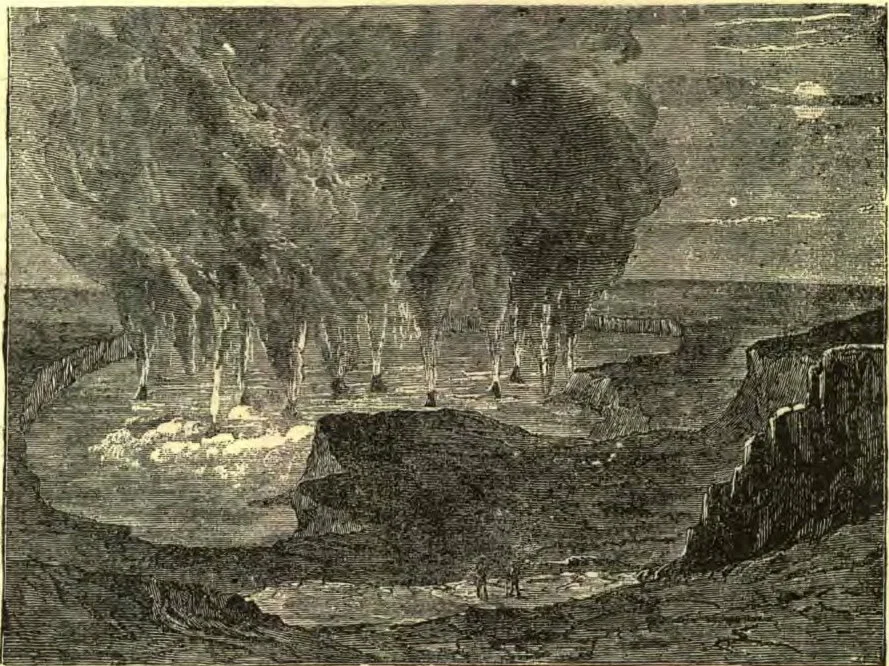
In the middle of the Pacific Ocean is a group of islands known as the Sandwich, or Hawaiian, Islands. No doubt nearly all of the readers of the INSTRUCTOR have learned about them in their geography lessons at school; but perhaps you never knew anything particularly interesting about them, except that the natives were mostly idolaters and cannibals until the missionaries went there and taught them a better and happier way of living. There are twelve of these islands in all, but only eight of them are inhabited, and on these about 80,000 people live, in all. The capital, Honolulu, is situated on the island of Oahu; but Hawaii is by far the largest as well as the most interesting of the group. The central part of Hawaii forms an elevated plateau from 3,000 to 4,000 feet high, which is almost entirely covered by thick forests, roamed over by herds of wild cattle. Above the plateau rise four volcanic peaks, the loftiest being nearly 14,000 feet high. At some time these have all been active volcanoes, but Mauna Loa, rising over 13,000 feet, is the only one which still remains so. This is one of the most wonderful volcanoes in the world, and has a number of craters from which the burning lava pours forth in the time of an eruption. The central one is about 8,000 feet in diameter, and the walls rise perpendicularly from 600 to 800 feet. The bottom, or floor, of this pit is covered with hardened lava when the volcano is quiet.
Through the cracks, or fissures, of this floor constantly issue steam and sulphurous vapor; and at intervals are chimney-like openings called cones, from the top of which, every few minutes, the burning, seething lava bursts up and rises in a fiery column, sometimes to the height of several hundred feet. The picture will give you some idea of how it all looks, only you must imagine the columns of lava red as fire.
People like to stand on the brink of this crater and look down into the pit and watch the play of these fiery jets, and some travelers are bold enough to go down into the bed of the crater and walk about on the lava floor among the cones. Of course this is a dangerous thing to do, for no one knows at what moment an eruption may take place, throwing the whole burning mass up to the top, and pouring it down the mountain-side in burning rivers of lava. Sometimes the volcano is quiet for years, and then with scarcely a warning it sends forth its fiery flood to deluge forests, fields, and villages.
About sixteen miles from this terminal crater of Mauna Loa (Moknaweowes) is another called Kilauea, which is said to be the largest active crater in the world. This crater basin is oval-shaped, and at one end is a lake of liquid fire, now foaming, surging, and leaping, like the waves of the ocean when stirred by some mighty storm; and “the roar is more terrible than loud sea-surfs beating against bold bluffs.” Again, all is quiet, and the surface of the lake looks black and dismal; but in a few moments fiery jets begin to be thrown upward, and soon the whole is again a roaring, tumbling mass of liquid flame.
One of the most violent eruptions of Mauna Loa took place in the year 1868; and some description of that terrible destruction may give a better appreciation of the fearful power of a volcano than could any other words:—
“On March 27 of that year, a series of earthquakes began, and became more startling from day to day, until their succession was so rapid that the island quivered like the lid of a boiling pot nearly all the time between the heavier shocks. The trembling was like that of a ship struck by a heavy wave. Then the terminal crater of Mauna Loa sent up columns of smoke, steam, and red light; and it was shortly seen that the southern slope of its dome had been rent, and that four separate rivers of molten stone were pouring out of as many rents, and were flowing down the mountain sides in diverging lines.”
Suddenly the rivers were arrested, and the mountain dome appeared against the still, blue sky without an indication of fire, steam, or smoke. The town of Hilo, near the coast, was much agitated by the sudden lull. No one was deceived into security, for it was certain that the strangely pent-up fires must make themselves felt.
“The earthquakes became nearly continuous, until scarcely an appreciable interval occurred between them. Late in the afternoon of a lovely day (April 2) the climax came. The crust of the earth rose and sank like the sea in a storm. Rocks were rent, mountains fell, buildings and their contents were shattered, trees swayed like reeds, animals were scared and ran about demented; men thought the Judgment day had come. The earth opened in thousands of places, the roads in Hilo cracked open, horses and their riders and people on foot were thrown violently to the ground; ‘it seemed’ said an eye-witness, ‘as if the rocky ribs of the mountains and the granite walls and pillars of the earth were breaking up.’ In Kau, south of Hilo, they counted 300 shocks on this direful day; and the earth swayed to and fro, north and south, then east and west, then round and round, up and down, in every direction, while the trees thrashed as if torn by a strong rushing wind. “An avalanche of red earth, at first supposed to be lava, burst from the mountain-side, throwing rocks high into the air, swallowing up houses, trees, men, and animals. It traveled three miles in as many minutes, burying a hamlet, with thirty-one inhabitants and 500 head of cattle. The people of the valleys fled to the mountains, which themselves were splitting in all directions, and collecting on an elevated spot, with the earth reeling under them, they spent the night of April 2 in prayer and singing. Looking towards the shore, they saw it sink, and at the same moment a wave, whose height was estimated at from forty to sixty feet, hurled itself upon the coast, and receded five times, destroying whole villages and even strong stone houses with a touch, and engulfing forever forty-six people who had lingered too near the shore.”
“Still the earthquakes continued, and still the volcano gave no sign. The nerves of many people gave way in these fearful days. Some tried to get away to Honolulu, others kept horses saddled on which to fly, they knew not whither. The hourly question was, ‘What of the volcano?’ People put their ears to the quivering ground, and heard, or thought they heard, the surgings of the imprisoned lava sea rending its way among the ribs of the earth.”
“Five days after the first outburst of April 2, the ground south of Hilo opened with a crash and roar, which at once answered all questions concerning the volcano. The molten river, after traveling underground for twenty miles, had emerged through a fissure two miles in length with tremendous force and volume. It was in a pleasant pastoral region, supposed to be at rest forever, at the top of a grass-covered plateau sprinkled with native and foreign houses, and rich in herds of cattle. Four huge fountains boiled up with terrible fury, throwing crimson lava and rocks weighing many tons to a height of from 500 to 1,000 feet. ‘From these great fountains to the sea flowed a rapid stream of red lava, rolling, rushing, and tumbling, like a swollen river, bearing along in its current large rocks that made the lava foam as it dashed down the precipice and through the valley into the sea. It was nothing else than a river of fire from 200 to 800 feet wide and twenty feet deep, with a speed varying from ten to twenty-five miles an hour!’”
In some of these eruptions of Mauna Loa, such vast quantities of lava have found their way to the sea as to form huge promontories, and even fill up whole bays.
With such a mass of molten fire pent up in the bosom of the earth, how easily could the fires of the last day be kindled, when “the mountains shall quake at Him, and the hills melt, and the earth is burned at his presence, yea, the world and all that dwell therein.” E. B. G.

THE CORN AND LILIES.

Said the corn to the lilies, “Press not near my feet; You are only idlers, Neither corn nor wheat, Does one earn a living Just by being sweet?”
Naught answered the lilies, Neither yea nor nay, Only they grew sweeter All the livelong day, And at last the Teacher Chanced to come that way.
While his tired disciples Rested at his feet, And the proud corn rustled, Bidding them to eat, “Children,” said the Teacher, “The life is more than meat.
“Consider the lilies, How beautiful they grow! Never king had such glory, Yet no toil they know.” Oh, happy were the lilies That He loved them so.
—Sunday Afternoon.

THEY WENT AND TOLD JESUS.

ACROSS the bleak prairie the winter wind came, The roofs of the settlement nearing; It whistled and roared from the smithy's low door To the barn at the end of the clearing; It rattled the door of the minister's house, At the window it whimpered and worried, Then fought with the poor little column of smoke That away from the rough chimney hurried.
Away from the hearth and a sorrowful group, To the glow of its low embers creeping— A father grown gray, a mother work-worn, In the cradle a baby was sleeping; While pitiful Jack, with a cheek thin and white, Dried a boot, with the snow-water sodden, That told its own tale of its frost-bitten foot And the wearisome way it had trodden.
From the care-tended coat on the minister's back To the wee baby's sock mended lying, Grim Poverty spoke in her forcible way, As the pastor, with sorrowful sighing, His purse counted over against his account, Finding lack for the hearth and the table,— No money to shoe little Jack yet awhile, E'en the wolf at the door not a fable.
There was bitter temptation to faithless distrust, There was fierce human bitterness growing, As Paul Allan glanced at his wife, So thin in the fitful light showing— Poor Annie! the fair, happy darling at home, The bride whom he vowed at the altar To shelter and love— Well, God knoweth best How a good man may waver and falter.
With a slow, quiet step, Annie came to his side, As she whispered a word brave and cheery: “You know, dearest Paul, when the friends of our Lord, With the toils of their mission grew weary, They went and told Jesus. Shall not you and I So tell him? The firelight was paling, So, close by the cradle, they told Jesus all, And anew heard his promise unfailing
A glow of warmth and light and cheer— A rich man's house at evening— A rich man's dreaming busy dreams And golden tissues weaving.
A dancing sprite of summers few Exhausting childish pleasures From out a hidden nook had brought A host of by-gone treasures.
Just in the glimmer of the grate She held a picture higher; “Tell me, papa, of Uncle Paul, Who saved you from the fire.
“I know he lives away 'way out West,” And preaches to the people; But then you said the little church Had neither bell nor steeple.
“So I'm afraid he must be poor. Is Uncle Paul your brother? And did you say, ‘Our Father,’ once At night, to one dear mother?”
Out from the world of stocks and gold The rich man's soul came peeping, And glanced adown the whirling years, Life's later scenes o'erleaping.
“God help me, Paul, I did forget.” The words were softly spoken, When through the rust which riches bring— The childish voice had broken.
Good, loving words, and magic lines That turned to gold when wanted, Sped o'er the railway westward bound, By love and memory haunted.
Was it a ray of stupid chance That dim, old picture showing— So prompting help for yonder home, Where prairie winds were blowing?
O Jesus! could we tell thee all, And trust thy promise better,
But feel thy hand a helping one And not a clasping fetter. Content to hold that scar-marked hand For guidance still forever, The roughest winds of surly care Should shake our dwelling never.
—Ethel Lynn.

SCENES IN THE LIFE OF CHRIST.

LESSON 95.—JESUS TELLS HIS DISCIPLES OF THINGS TO COME.

It had been a long, weary day,—the last that Jesus was to spend in the temple. On the day before, he had driven from the temple those who polluted it by their unholy traffic. None had been able to resist the authority and power which he manifested on that occasion. And the next morning, when Jesus returned to the temple, the chief priests, the scribes, and the elders, at once came to him, and asked by what authority he did such things. By a single question, Jesus put them all to silence. Then he went on to give them parables, setting forth the wicked course that they had pursued, and showing what terrible punishment was to come upon them. The Jewish rulers understood the meaning of these parables, and were so angry that they would gladly have killed him, but they dared not lay hands on him because a great multitude of the people believed him to be a true prophet.
Then the Pharisees laid a cunning plan to entrap Jesus by asking him hard questions. When the Pharisees failed, the Sadducees tried the same, but with no better success. After this, the Pharisees brought forward a lawyer to ask questions for them; but the lawyer was so well pleased with the answers of our Lord that he very nearly became his disciple. When they all had completely failed, Jesus asked the Pharisees some questions; but the record says that “no man was able to answer him a word, neither durst any man from that day forth ask him any more questions.” Then Jesus turned to the people, and warned them against the pride and hypocrisy of their leaders. He told them to keep carefully the law of Moses, which the scribes taught; but not to follow their example; for they were very far from living out what they taught.
After this, he taught them how God estimates the value of our gifts, showing that the poor widow had, in the sight of Heaven, gave more than all the rich men who had cast into the treasury. Some of the Greeks then sought an interview with Jesus, who spoke to them and to his disciples of his coming death, and of the good results that would follow from the sacrifice he was about to make. While the Saviour was talking to them, a voice was heard from heaven in answer to his words, thus bearing witness that he was the Messiah.
By this very brief outline we see that our Lord must have spent nearly every moment of this important day in very earnest talking. It seems hardly possible that he should have given so much instruction in a single day. And now, as Jesus was about to leave the temple, and go over the Mount of Olives to Bethany, where he stayed every night, the disciples spoke to him of the temple, how it was adorned with precious stones and beautiful devices, saying, “Master, see what manner of stones and buildings are here.” Then Jesus said, “As for these things which ye behold, the days will come in which there shall not be left one stone upon another that shall not be thrown down.” On leaving the temple, Jesus and his disciples went out through one of the gates of the city, and going down into the Valley of Jehoshaphat, crossed the brook Kidron, and slowly made their way up the Mount of Olives. When they had reached the top of the mountain, they sat down and looked back upon Jerusalem. The whole city lay below them. Mount Moriah, with the splendid buildings of the temple on its crest, must have been a beautiful sight. As they looked upon it, they were reminded of the words that Jesus had spoken concerning these buildings. Then some of the disciples said to him, “Tell us when shall these things be? and what shall be the sign of thy coming, and of the end of the world?
“And Jesus answered and said unto them, Take heed that no man deceive you. For many shall come in my name, saying, I am Christ, and shall deceive many. And ye shall hear of wars and rumors of wars: see that ye be not troubled; for all these things must come to pass, but the end is not yet. For nation shall rise against nation, and kingdom against kingdom: and there shall be famines, and pestilences, and earthquakes, in divers places. All these are the beginning of sorrows. Then shall they deliver you up to be afflicted, and shall kill you; and ye shall be hated of all nations for my name’s sake. And then shall many be offended, and shall betray one another, and shall hate one another. And many false prophets shall rise, and shall deceive many. And because iniquity shall abound, the love of many shall wax cold. But he that shall endure unto the end, the same shall be saved. And this gospel of the kingdom shall be preached in all the world for a witness unto all nations; and then shall the end come.”

QUESTIONS.

  1. On what day of the week did the things happen that we have been learning about in our last lessons?
  2. For what was this day remarkable?
  3. What had Jesus done on the day before?
  4. What may be said of the power and authority which he manifested on this occasion?
  5. Who came to him as he returned to the temple the next morning?
  6. What did they ask him?
  7. How did Jesus put them to silence?
  8. What did he then go on to give them?
  9. What did these parables set forth?
  10. How did the Jewish rulers show that they understood the meaning of these parables?
  11. How would they have been glad to vent their spite?
  12. Why did they not do so?
  13. What did the Pharisees then do?
  14. When the Pharisees failed in this, who next tried the same thing?
  15. How did they succeed?
  16. What further effort did the Pharisees then make?
  17. What was the result of this effort?
  18. When they had all completely failed, what did Jesus do?
  19. What does the sacred record say of the effect of these things?
  20. How did Jesus then improve the opportunity to instruct the people?
  21. What did he tell them to observe?
  22. Why were they not to follow the example of their teachers?
  23. What lesson did he afterward teach them from the example of those who dropped their offerings into the treasury?
  24. Who sought an interview with him at this time?
  25. Of what did he speak to them?
  26. By what miracle were the people unmistakably shown that Jesus was the Messiah?
  27. What does this very brief outline enable us to see?
  28. Of what did the disciples speak to Jesus as they were leaving the temple to go over to Bethany?
  29. What did they say? Mark 13:1.
  30. What reply did Jesus make? Luke 21:6.
  31. Where did they first go, on leaving the temple?
  32. When they reached the top of the mountain, and looked back, what sight was presented to them?
  33. What did this view bring to the minds of the disciples?
  34. What question did they ask Jesus?
  35. What admonition did he first give them? Matt. 24:4, 5.
  36. Of what did he say they should hear?
  37. Why were they not to be troubled by these rumors?
  38. What did he say would take place among the nations of the world? Verse 7.
  39. How were these things to be regarded? Verse 8.
  40. What persecution would the people of God have to suffer?
  41. What wicked course did he say many professed Christians would take? Verse 10.
  42. How would many be led astray?
  43. What effect would be produced by the iniquity that would abound?
  44. What promise was made to those who should endure to the end?
  45. When did he say the end would come? Verse 14.

A DROP OF OIL.

THE sewing-machine went hard. Brother Will came and looked over Amy’s shoulder and knit his brow, as was his custom when in a puzzle. At last, turning back the machine, he glanced over the works, and said,—
“Do you oil it here, Amy?”
“Why, no, I never thought of that.”
A drop of oil was supplied, and in another minute the slender needle was flying through the work like a fairy. It was now easy to turn the wheel. That drop of oil on a dry spot in the machinery made all right.
There are many other places where a drop of oil works just as great wonders. For cold mornings, when tempers are apt to get frosted as well as toes and finger-tips, there is no magic like a few sweet, cheery words. So when one is angry, and ready to do or say rash things, just give him a “soft answer,” and you will see how it can cheer and brighten the way for yourself and all about you.
—Young Reaper.

Respect Yourself and Command Respect

ALWAYS respect yourself, and you will command respect.

FLOWERS AND FAITH.

A GARDENER met in the street one of the children of a family he had heard were in trouble. Calling the little one, he put into his hand a bunch of flowers, saying, “Take them to your mother, and tell her to have faith in God.” The child did so, when all the blessedness of this text filled the mother’s soul: “If God so clothe the grass of the field, which to-day is, and to-morrow is cast into the oven, shall he not much more clothe you, O ye of little faith?” Have we but one talent,—nay, have we but half a talent,—let us use it. Are we ever so weak and poor in our own eyes, let us do what we can.—Selected.

NEW-TESTAMENT HISTORY.

LESSON 109.—THE DESCENT FROM THE CROSS.

WHEN Jesus bowed his head and died, the veil of the temple was rent in two from top to bottom; “And the earth did quake, and the rocks rent; and the graves were opened.” The veil of the temple was rent to show that the most holy place of the earthly sanctuary was no longer sacred. The ministry was to be transferred to the most holy place in heaven. See Hebrews 8. “The most holy place, that had been sacredly entered by human feet only once a year, was revealed to the common gaze. God had ever before protected his temple in a most wonderful manner, but now its sacred mysteries were exposed to curious eyes. No longer would the presence of God overshadow the earthly mercy-seat. . . . The Saviour was henceforth to officiate as Priest and Advocate in the Heaven of heavens. From henceforth the blood of beasts offered for sin was valueless; for the Lamb of God had died for the sins of the world.” Spirit of Prophecy.
“Now when the centurion, and they that were with him, watching Jesus, saw the earthquake, and those things that were done, they feared greatly, saying, ‘Truly, this was the Son of God.’” “And all the people that came together to that sight, beholding the things which were done, smote their breasts and returned. And all his acquaintance, and the women that followed him from Galilee, stood afar off, beholding these things.”
“The Jews, therefore, because it was the preparation, that the bodies should not remain upon the cross on the Sabbath-day (for that Sabbath-day was an high day), besought Pilate that their legs might be broken, and that they might be taken away. Then came the soldiers and brake the legs of the first, and of the other which was crucified with him. But when they came to Jesus, and saw that he was dead already, they brake not his legs; but one of the soldiers, with a spear pierced his side, and forthwith came there out blood and water. And he that saw it, bare record, and his record is true, and he knoweth that he saith true, that ye might believe. For these things were done that the scripture might be fulfilled, A bone of him shall not be broken. And again, another scripture saith, They shall look on him whom they pierced.”
Among the Jewish counsellors was a man known as Joseph of Arimathæa. This man, being acquainted with the prophecies, had been looking for the coming of the Messiah, and was really a believer in Jesus, though he had kept it a secret, for fear of the Jews. He held an honorable position in the Jewish council, but it appears from the narrative that neither he nor Nicodemus took any part in the deliberations when Jesus was condemned. It is highly probable that they were not called on that occasion, because of their favorable attitude toward Jesus, as their sentiments were better known than they supposed.
Before the Sabbath drew on, Joseph went to Pilate, and begged the body of Jesus. When Pilate heard this request, he wondered that Jesus was so soon dead; so he called the centurion, and inquired of him. Having thus assured himself, Pilate granted Joseph’s request, and the body of our Lord was taken down from the cross, wrapped in a linen cloth, and placed in a new tomb that Joseph had hewed out in the rock. Then they rolled a great stone against the door, or opening, of the sepulchre, and departed.
“And the women, also, who came with him from Galilee, followed after, and beheld the sepulchre, and how his body was laid. And they returned, and prepared spices and ointments; and rested the Sabbath-day, according to the commandment.”
“Now the next day, that followed the day of the preparation, the chief priests and Pharisees came together unto Pilate, saying, Sir, we remember that that deceiver said, while he was yet alive, After three days I will rise again. Command, therefore, that the sepulchre be made sure until the third day, lest his disciples come by night and steal him away, and say unto the people, He is risen from the dead; so the last error shall be worse than the first. Pilate said unto them, Ye have a watch; go your way, make it as sure as ye can. So they went and made the sepulchre sure, sealing the stone, and setting a watch.”

QUESTIONS.

  1. As Jesus bowed his head and died, what took place in the temple? Matt. 27:51.
  2. What phenomena in nature occurred at the same time?
  3. What did the rending of the veil indicate?
  4. What change was now to take place in the ministration of the sanctuary?
  5. What care had God up to this time manifested for the holy places of the sanctuary?
  6. In what capacity was the Saviour now to officiate?
  7. What was to be valueless from this time forward?
  8. How were the centurion and his soldiers affected by the phenomena that attended the death of our Lord? Matt. 27:54.
  9. What did they say?
  10. What tokens of consternation were given by the people who had assembled near the cross? Luke 23:48.
  11. Who were among those that stood afar off and beheld these things?
  12. How did the Jews wish Pilate to hasten the death of Jesus and the men who were crucified with him? John 19:31.
  13. What caused them to make this request?
  14. To what extent was their wish gratified?
  15. Why were not the legs of Jesus broken?
  16. What was done to him by one of the soldiers?
  17. What scriptures were fulfilled by these circumstances?
  18. Who was Joseph of Arimathæa?
  19. How had this man been led to look for the coming of the Messiah at this time?
  20. What was his position with respect to Jesus?
  21. How did he stand among the members of the Sanhedrin?
  22. Does he appear to have taken any part in the deliberations of that assembly at the time when Jesus was condemned?
  23. What seems highly probable with reference to this?
  24. What petition did Joseph present to Pilate before the Sabbath came on?
  25. How was Pilate astonished by this petition?
  26. How did he assure himself of the fact that Jesus was really dead?
  27. When Joseph had obtained permission, what was done with the body of Jesus?
  28. Having laid the body in a rock-hewn tomb, how did they secure it against intruders?
  29. Who followed after, and noticed closely all that was done to Jesus?
  30. What did they afterward do?
  31. Where do we find the commandment that enjoins the observance of the Sabbath-day?
  32. How does it read?
  33. With what request did the chief priests and the Pharisees come to Pilate? Matt. 27:62-64.
  34. In speaking of Jesus, what name did they apply to him?
  35. What saying of his did they remember?
  36. Why did they want the sepulchre guarded?
  37. How did Pilate answer their request?
  38. Having obtained this authority, what did they proceed to do?

PAPER
THERE is still found growing, along the River Nile, in Egypt, a plant which is extremely interesting to us, as we get from it our name of paper. It is a reed, or bulrush. Perhaps Moses was laid in a wicker-boat made of these rushes, for the Egyptians used them for almost everything. The Greeks and Latins called it papyrus, which in their languages means a reed, or rush.
Papyrus was the first substance generally used for writing purposes. But, before this was introduced, the ancients were accustomed to engrave with sharp-edged tools, upon stones, metal, and waxen tablets. These last answered the purpose of memorandum books; and, by the way, books in olden times were called bibles, because they were written upon papyrus.
Now, papyrus was used for a hundred different things, just as the bamboo in Eastern countries still supplies a thousand wants of the inhabitants. The Egyptians made use of the pith as food, for one thing, and the roots for fuel, furniture, chains, etc.; but of the stalks they made wickerwork baskets, boats, boxes, sails for boats, clothes, rugs, or mats, sandals, and even torches and candles. In your great-grandfather’s days, a light was made of a reed, or rush, and called a rush-light.
In preparing this reed-paper, or papyrus, the best rushes were selected, and split into pieces of the proper thinness, then fastened together, pressed, and smoothed, so that it could be easily written upon with a pen similar to our own.
This was the only paper our ancestors had, until about two hundred years before Christ, when a new sort of paper was made out of the skins of animals, and called parchment, or vellum. Parchment was so named because it first came from Pergamus, an ancient town in the East, now in Turkey in Asia. Vellum was a nicer variety of parchment, and only made of calf, goat, and lamb skin. Now, what is very curious, it was so called because it was first made of calf skin. Our word veal comes from the same Latin word that vellum does. So words are not so dry and stupid after all.
We use parchment now for diplomas, which are given in colleges, and by corporations and societies; for drum-heads, tambourines, battledores, and sometimes for covering books. But leather is generally used now for the latter purpose, as we do not care for white-covered books, so to speak. Parchment keeps a long time; and it was a great invention, as, by means of it, the writings of the ancients have been preserved to us. Papyrus after a time, decays; but parchment, if taken proper care of, will last for hundreds and hundreds of years, as has been found.
Real paper, the paper like what I am writing to you upon, and the newspaper and books you see and read every day of your lives, came into use about eight or nine hundred years ago. The Chinese have also used paper, but we did not know it until a little while ago. They shut themselves up between four high walls for so many hundreds of years that we hardly knew there were any such people as they in existence, till they began to come over to this country, and our government made treaties with them. But they are still very shy of strangers, and what we try to learn of them is pretty hard work.
Now, how is paper made? It is made of many different substances. Cotton rags are chiefly used for this purpose, silk and linen come next, then straw, wool, hemp, woods of various kinds, reeds, grass, bamboo, and a hundred other materials.
Paper was once made by hand; but now machinery is employed, and a very quick process paper-making has become.
It would take too long to tell you everything about how paper is made, so I shall only give you the principal steps in the process; and when you get an opportunity to visit a paper-mill, you will learn more in five minutes than all the information books can give you.
First the rags are sorted, cleansed by washing and chemicals, bleached, and reduced to a very fine pulp. Then, this pulp is mixed with glue, called sizing and an earthy matter called kaoline. It is then spread out into sheets, marked, and aired, pressed, and the best goes through a process called cream-laid. It used to take three weeks to prepare paper for the market; now, the labor is not only lightened by machinery, but lessened.
Besides for writing, printing, and newspapers, paper is worked up into a hundred articles of ornament and usefulness,—stands, pails, bowls, knicknacks of all kinds. These are colored and polished, and are often very beautiful. We call such articles papier mâché, a French word, meaning, simply speaking, mashed paper, and the word well expresses the process through which rags and other substances go before they are turned out as paper, pails, and tables.—F. C. C.

SOME THINGS ABOUT DOGS.

HERE are a great many different kinds of dogs in the world, and some of them live in every country; but wherever these animals are found, they are almost always friends to man. The dog will do anything in his power for his master, and seems to show almost a human affection for those who are kind to him. Many a time a faithful dog has been known to lay himself down upon a dead master's grave, and refusing to take food, there grieve himself to death.
The Newfoundland dog is the most noble looking dog of all. In his native home he is taught to draw wood and water and to work as steadily all day as a horse. He seems to take great delight in water, and is a good swimmer. He often saves people from drowning. A story is told of one very strong dog who, if he saw men in swimming even, would rush into the water and drag them out in spite of themselves. Some dogs are trained to go out upon mountains and moors and bring in people who have been buried or blinded and lost in the snow. In fact, dogs are taught to do many things which no other animals can do. They lead the blind, drive cattle to and from pasture, gather and herd sheep, carry notes and baskets, and make themselves useful in many other ways. Of course all dogs are not so clever, and some are lazy and good for nothing but to bark at the moon.
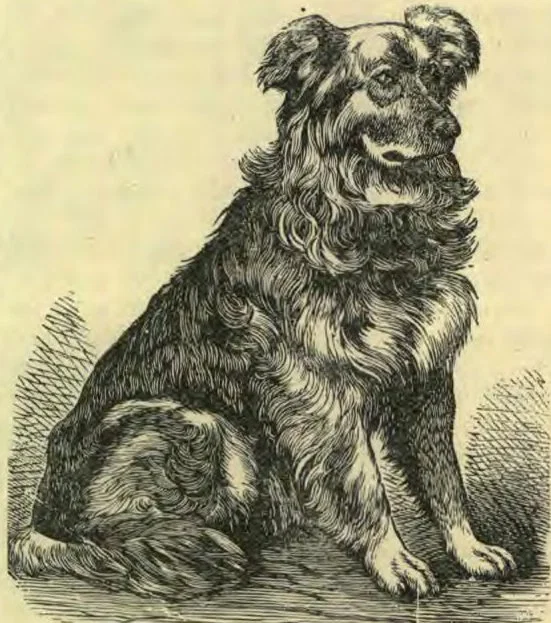
The picture on this page is copied from the photograph of a real dog. His name is Jack Willard. His master has taught him quite a number of tricks. He has learned to go to the meat-market alone and buy his own dinner. Many persons, knowing this, give Jack money; and so sometimes he gets more dinners than are good for him, and is made sick. So his master told the man who keeps the market to give Jack but one dinner a day. At first the dog did not like it at all because he could not get meat for his money every time he went. Now how do you think he saved his money! He dug a hole out by the ice-house and buried it there. His master saw him do it, and so would give him no money to buy his dinner next day. Finally Jack went and dug up his money and bought his dinner. He has often been watched since then, and always carries his extra money to the same spot, and never forgets that he has money in his bank. Jack still lives, and goes to market every day, besides doing many errands for his master.
Many children might take lessons from the dogs, and so learn to be quick and faithful in doing the errands on which they are sent. A. L. S.

BE GENTLE.

ONE of the noblest men who ever lived was a man who was not ashamed to be gentle and tender. This was President Lincoln. When he was at the head of our country, there were troublous times; war was taking many men away from their homes and leaving many lonely women and children behind. President Lincoln found many ways to show his gentleness, and it is said of him that no one ever asked of him in vain for kindness, where the good of the country did not compel him to refuse.
But do you suppose this great and good man, became so great and good after he became a man? It is the little things of every day which children think and do which make up the character of the grown men. And in nothing is this truer than in the matter of gentle and kindly behavior. We cannot think of the childhood of Christ, our great example, as being other than gentle in every word and way. No rough or unkind manner could ever have been his, and we have only to “follow his footsteps,” in this, as in everything else.

THE WASTED PIN.

A LITTLE girl picked up a pin, which she threw into the fire. Half an hour after, a lady’s carriage came to take her to ride. She was all ready, only she wanted a pin,—only one pin, to pin her shawl. She raced here and there for it and searched the carpet, and tried everywhere to find a pin, until the lady got tired of waiting and drove away; and so she lost her ride in the park by simply wasting a pin.
The proverb says, “Waste not, want not”; and Jesus said, “Let nothing be lost.”

You have reached the end of this edition.

The Youth’s Instructor · Nov 15, 1882