SEVERAL notices have come to us of an article in the Saturday Evening Post of February 12 by Ex-governor Joseph W. Folk, of Missouri, entitled "The Limitations of Reform." This article has been spoken of as a splendid religious liberty article; but those who have thus designated it, it seems to us, have not read closely. He does say: "The right to worship God according to the dictates of one's own conscience, was fought for for years, and finally established in this country. We can not compel men by law to worship in any particular place, or any particular way, or to worship at all. We may go to church on Sunday and think that others should do likewise, but we can not compel others to do so, nor can others prohibit us." And that, of course, is good. We hear that from some of the strongest National Reformers.
THE GUGGENHEIMS, FATHER AND SONS
We recently listened to a sermon by a minister who contended that he believed in religious liberty, and he gave utterance to just such sentiments as this; but the religious liberty in which he believed was religious liberty for those who agreed with him. Mr. Folk does not say that he does not believe in Sunday laws, but he expresses it in this form: "As to whether a thing should be prohibited on Sunday, is from the standpoint of government a question of public morals and good government, not of religion." "The law can not compel such observance on religious grounds."
The danger line in Mr. Folk's argument lies in the admission that a thing may be prohibited on Sunday as "a question of public morals and good government, not of religion"—an utterly impossible thing. If a thing should be prohibited on Sunday because it is against public morals, it should be prohibited on every day of the week for the same reason. The same just principle which would prohibit it on Sunday, would prohibit it on Monday also. Just as soon as a discrimination is made between the two days, it is done simply and solely from a religious view-point. The Senate of the United States endeavored to escape that in the Johnston Sunday bill a short time ago. The bill was a religious bill. Religious marks stood out all over it. Every clause nearly spoke of religion. But the gentlemen of the Senate felt that it would not be right to legislate a religious measure into law, and therefore they began amending the bill, and thought that they had amended all the religion out of it; but when the measure passed the Senate, all their efforts had failed, for it prohibited "secular" labor on Sunday, and secular is the opposite of religious. The very fact of the prohibition of secular work, indicated that the law was designed as a religious measure.
Further, when this religious measure has been formulated into law and placed upon the statute-books, as this argument of Mr. Folk indicates that it may be, he declares, "No man has the right to insist that a law written in the statutes ought not to be enforced." Therefore persecution. That raises, too, another principle. Andrew Jackson thought that the men who enforced laws had a conscience in the matter as well as the men who made the laws, or the judge who declared what the law was, and he plainly said so in the case of the proposed United States bank. His conscience as executive was as sacred as was the conscience of John Marshall as judge.
Of course, it is true, as Mr. Folk intimates, that the law ought to be considered before it is placed on the statute-books; but nine tenths of all the Sunday laws that were ever placed on statute-books have not been considered. They have been passed because it has been supposed that good men were behind them. But when on the statute-books, they have always been weapons in the hands of bigots for the oppression of conscientious men and women, much more often than they have ever touched enemies to the commonwealth.
Mr. Folk, too, seems deceived by the play of words in an old fallacy, and thus repeats it:
"The limitation for the making of laws should be that where the right of one man begins, the right of another man ends."
That may be true as regards real estate, but not as regards principles. Certain rights are God-given, as expressed in the Declaration of Independence, and these rights can never justly be sold or bartered, taken by law or violence or trampled upon. They are equal and parallel; they begin with one man when they do the other, and they end in the same way. Nor does it belong to civil government to limit or differentiate in these rights. The only object of civil government is to conserve these rights, or as the next sentence in Mr. Folk's article declares: "The laws should go no further than to protect each man in his rights." But then governments will never legislate in behalf of institutions, but of men.
If Mr. Folk and other good men like him could11see that the whole aim and object behind every Sunday law that is in existence or has ever been advocated is religious, he would not be willing to concede even seemingly that certain things legal and proper on other days could be prohibited on Sunday on the ground of public morals. Morality is not a question of a day in civil law. It inheres in the act, in the deed, apart from the day on which it is done. The question of the day with God is another matter; but that judgment rests with Him, not with men.
THE OUTLOOK
By Editor
Watchman, what of the night?
Predatory Wealth—I
THE constant revelations in various quarters of our country do not indicate by any means that the millennium of honesty is at hand. There has just closed the suit of the Government against the oil trust before the Supreme Court of the United States. In his closing speech, Frank B. Kellogg, the counsel for the Government, declared that if the oil trust was sustained, great danger menaced the Government. He said:
"Let them combine, and let them use their money as they please, and I believe that this company and others like it will control the industrial affairs of this country before ten years have gone by; yes, before five years have passed; and if you remove the fear of the law, they will combine; they will control the country. We talk of the greatness of our country. What makes it great? Is it the trusts and their money?—No, it is the individual; thousands of individuals, each striving for himself and for his own progress, with the star of hope before him to lead him on. Take away that hope, give the corporations control, and you will have Socialism, and then anarchy and worse."
The next day the attorney-general of the United States, Wickersham, made his plea. His final word was, "It seems to me that if ever there was or could be a combination in restraint of trade, a combination for all time with a monopoly in perpetuity, it is before your honors now."
Mr. Wickersham besought the court "to root up this gigantic monopoly that threatens the very life of the nation, and to tear from it the fruits of its fraud."
Right upon this comes the report of the tobacco trust which is endeavoring to control not simply tobacco, but chemicals as well. It too is being prosecuted by the United States Government as an illegal combination in restraint of trade; but its net earnings for 1909 were given as $30,448,384 as compared with $28,700,000 the year before. After eliminating interest, etc., there remains over $20,000,000, or more than fifty per cent of dividend on the $40,000,000 of common stock outstanding.
It is such trusts as these, piling up their immense wealth, which are doing their part to the unsettling of stable conditions and arousing enmity in the hearts of men. Some of them stop at no schemes that will add to their profit. They purchase congressmen, legislators, councilmen. Take for instance conditions in our large cities. This has been demonstrated over and over again, until the nation is sick of it. Note the corruption in city councils which have been purchased by great monopolies. We have before us Pittsburg, at the present time, where threescore of councilmen have been indicted as guilty of receiving bribes. And the same charges are made, open and emphatic, in regard to cities without number throughout the entire United States. These evils are not confined to the New World. They are manifest in the Old World as well. Witness the same condition of Paris at the present time, and the revelations concerning the robbery of the government and of various classes in the misappropriation of funds from the confiscation of church property under the law. It would have been a mighty blessing indeed if the flood could have washed out that iniquity, but it takes a different cleansing than Seine water to do it.
The remedy for these things might be found in laws for the individual, not for trusts or institutions or combinations, but for the benefit of the individual man, faithfully administered. Such laws would prohibit all of these combinations in restraint of trade, and would necessarily make much more difficult the piling up of the great fortunes by which men are bought and sold. The selfishness of man's nature is always to combine and increase and gather for himself, and from this there is no political remedy which can save. The only remedy is in the Gospel of Jesus Christ; and that same Gospel in sure prediction tells us that the remedy for the world's ills lies in the second coming of Christ, of which the great heaping up and misuse of wealth are evidences of the near approach. James 5:1-8.
Halley's Comet
INTEREST in Halley's comet still continues, and it may be of help to our readers to state a few facts concerning it. There has been a great deal said of an alarming nature which has no particular basis in science. Some have thought that the cyanogen gas connected with the comet's tail would mingle with the gases of this earth and so poison the people. This has been suggested by some scientists. It has been stated as a fact by sensational newspaper writers. Another astronomer suggests that it may not be any connection which the comet may have with the earth that will cause us trouble, but that the comet may act as a projectile fired into the sun or near the sun, and so cause tremendous explosions in the sun itself, and the earth be affected thereby; and suggests that the peculiar meteorical or weather conditions through which we have been passing the last few months may have been caused by this; that there are many other forms of energy sent out by the sun besides light and heat, such as magnetism, electricity, etc., that may be affected by the comet. This of course is also pure speculation.
Prof. W. W. Campbell, the director of Lick Observatory, writes much more calmly and judicially. He declares, in a recent article, that "the tail of the comet, 14,000,000 miles from the nucleus, or head, is so extremely attenuated that there is not the slightest chance of deleterious effects upon terrestrial life. This aspect of the question may be dismissed without further thought. Statements to the contrary must be attributed to the ignorance of their authors or to purposes difficult to fathom."
Professor Mitchell declares that if a cubic mile of the comet's tail were compressed into a beaker, it would be difficult for scientists to find a trace of cyanogen gas.
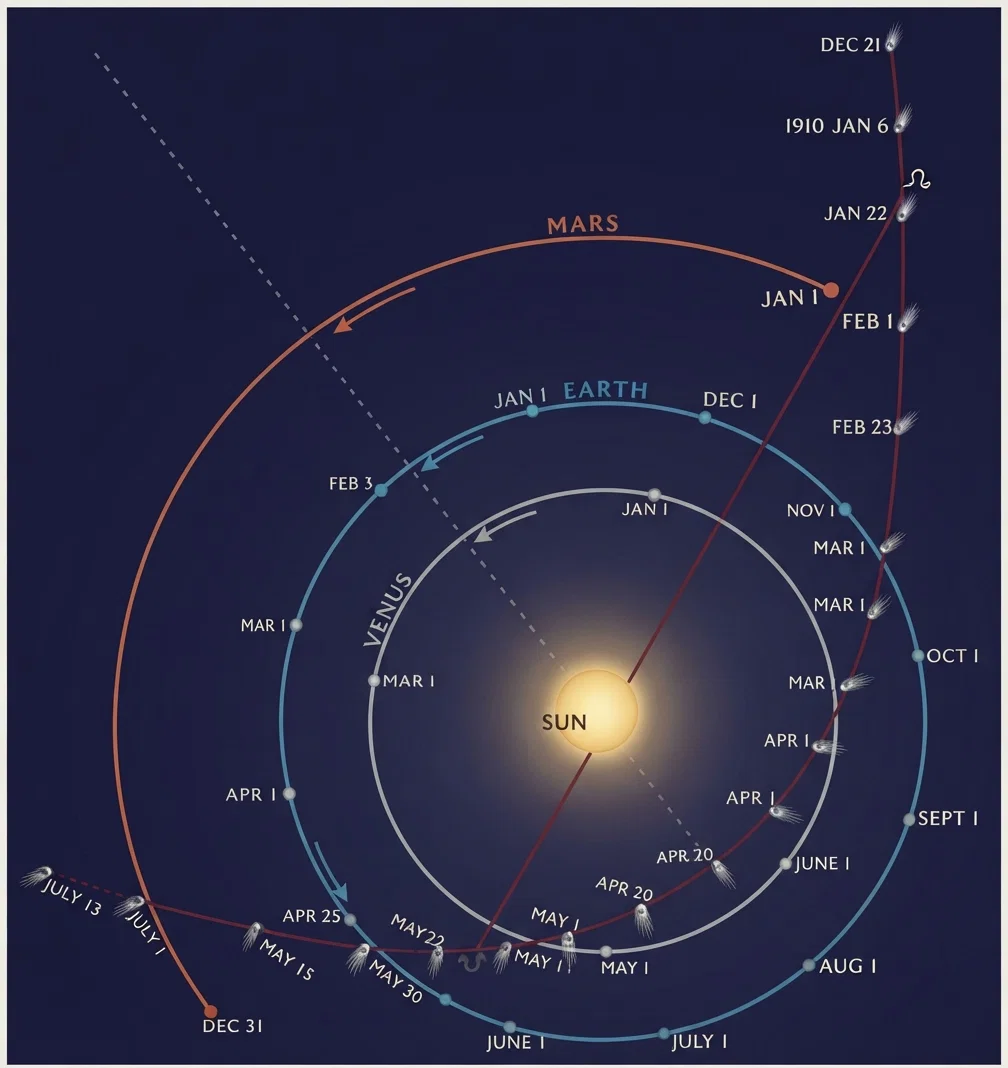
When the comet was first discovered, in September, it was 300,000,000 miles from the sun. It is very much nearer now. March 31 it was 158,000,000 miles away from the earth; April 16 it will be 124,000,000 miles; April 24, 69,000,000; May 10, 41,000,000; May 20, 14,500,000, its nearest approach; May 30, 41,000,000. When first discovered, it was not even visible to the most powerful telescopes, but the camera caught it. It has been almost visible to the naked eye.
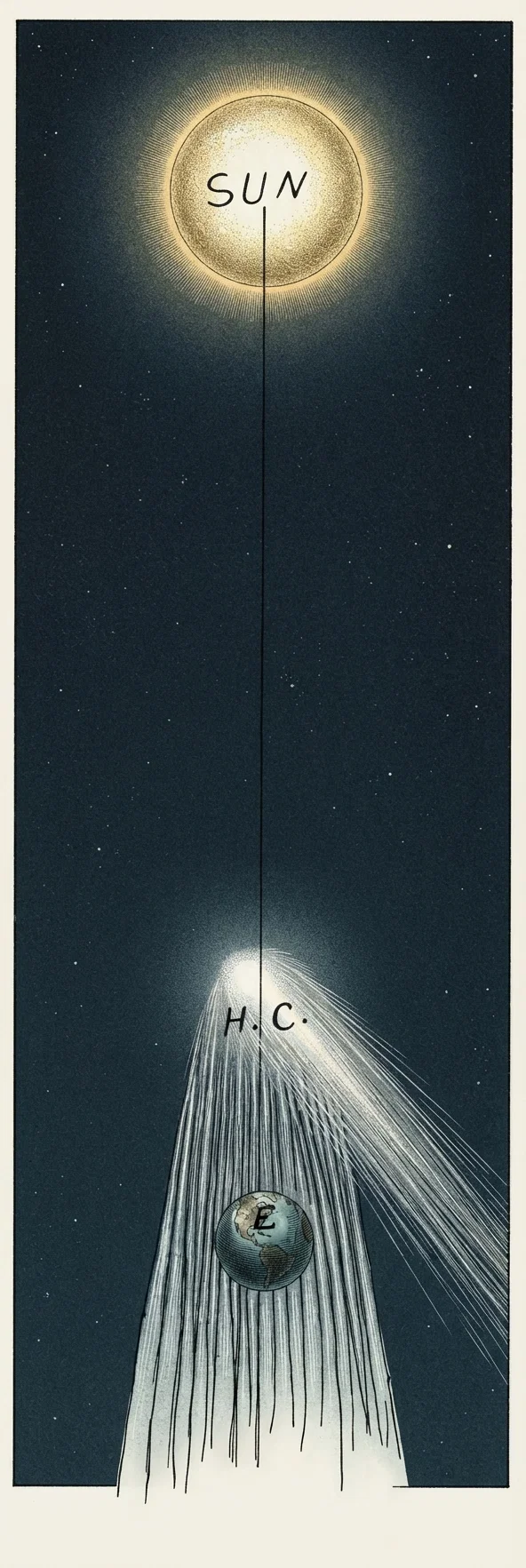
The comet is at this writing, April 3, so close to the sun that it is not visible. It will come directly between the earth and the sun at 6:22 P. M., Pacific standard time, on the evening of May 18, and will pass out of this space at 7:00 o'clock and 22 minutes, or one hour later. But this probably will not be seen here, as the sun is too low on the horizon at the time. Stations far west of California will be in a much better position to observe the passing of the comet across the sun's disk. On April 8 the comet will arise an hour and four minutes before sunrise. Professor Campbell says that while it is never safe to predict how bright a comet is going to be, it is expected that the head and perhaps a little of the tail will be visible to the naked eye about that date. It will be six or eight degrees north of directly east. On April 18 it will be 54,000,000 miles from the sun — the nearest point to that body. Still it will be farther from the earth than the sun is; but on May 18, when it passes directly between the earth and the sun, it will be 76,000,000 miles from the sun and about 14,000,000 from the earth. "Late in April and early in May the comet should be fairly seen in the low eastern sky at the break of dawn." After May 18 the comet will again be an evening object, and because of its nearness to earth, Professor Campbell declares, should be conspicuous; but he continues, "The brightness of a comet can not be safely predicted." They vary greatly in brightness. Sometimes a periodic comet is very bright at one return, and very disappointing at the next. The tail has been predicted by some to be many million miles in length, extending, at the time when it is nearest to the earth, some 60,000,000 miles beyond the earth, the earth passing through it 14,000,000 miles from the comet; but he declares that it is not certain that the tail will be as long as the distance from the comet to the earth. Here are some of the times that it may be seen:
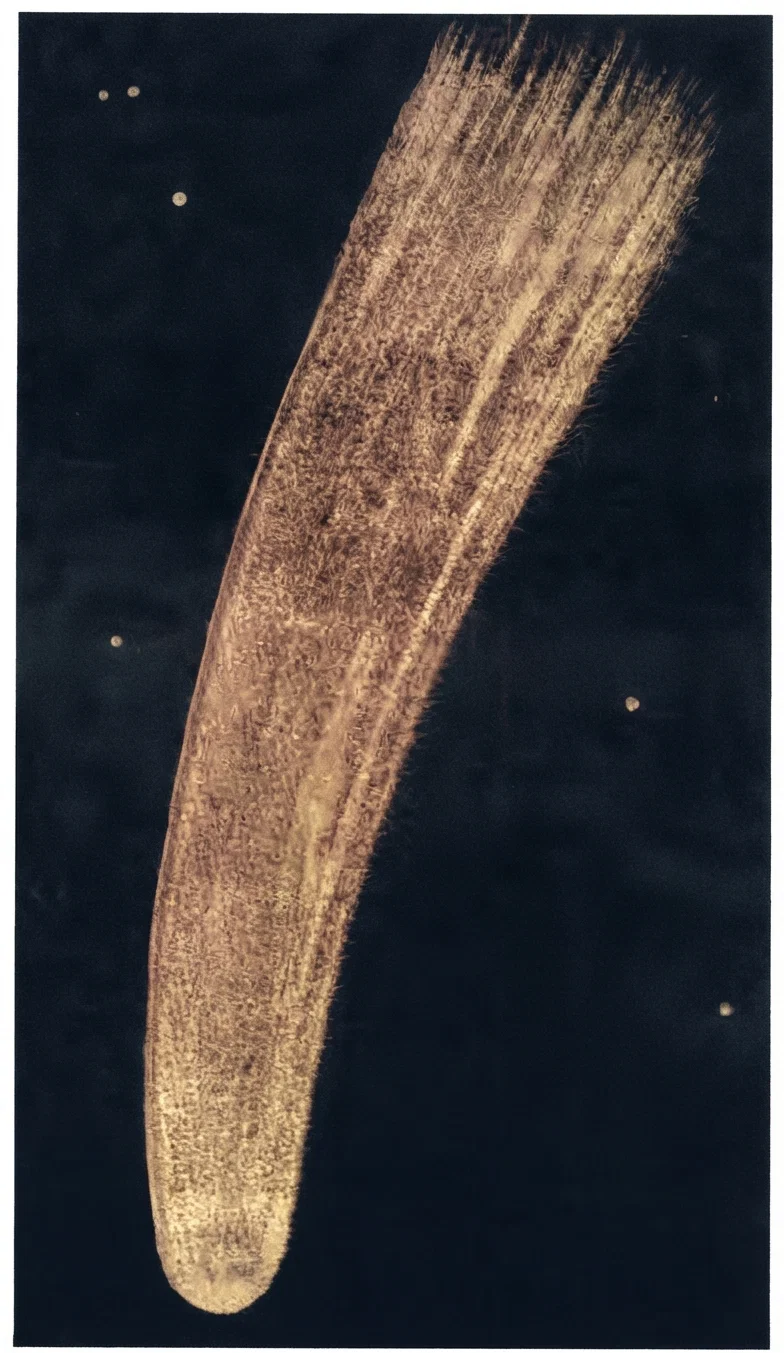
A sketch of Halley's Comet as it appeared in 1835, made by the Danish astronomer F. G. W. Struve. Doubtless somewhat exaggerated.
April 8, it rises one hour and four minutes before sunrise;
April 24, one hour and fifty-nine minutes before sunrise;
May 10, two hours and twenty-three minutes before sunrise.
May 20 it sets one hour and 17 minutes after sunset, gradually increasing up to May 30, setting four hours and sixteen minutes after sunset.
The path of Halley's Comet in its present visit through the solar system, from "Review of Reviews."
It will be a great question, however, whether people are not much disappointed in its brightness as compared with the comet of 1861 or 1882.
Marginal References for the Revised Version
Immediately after the English Revised Version was complete, a committee set to work to draw up full marginal references to the Revised Version. The report of this committee, it is said, for the New Testament, will issue from the University presses very shortly in the new edition of the Revised Version. This work has been done by Professor Moulton, Dr. A. W. Greenup, and Dr. J. H. Moulton, son of the professor, who died some time ago. Bible students will certainly welcome the work.
A Blessing
By Editor
A Blessing.—If the report from New York, March 24, regarding Dr. Simon Flexner's remedy for spinal meningitis, is true, there is indeed cause for rejoicing. Dr. Flexner is of the Rockefeller Institute, and has, after working for years, developed an antitoxin which has reduced the mortality of the dread disease from 80 per cent to 16.5 per cent. The number of cases in the test was 123.
The Westerner
"The Westerner" for March is an Alaska number, showing the progress already made in that great territory, and setting forth somewhat of its resources and possibilities. It is published at Earlington, Washington.
Increasing War Expenditures
Regarding the new battle-ships which it is proposed that the nation shall build, there seems prospect that much opposition will be met in Congress. Chairman Tawney of the House Committee on Appropriations is against the eighteen million dollar battle-ships. He finds that 71 per cent of the expenditure of the Government outside of the Post-office Department is military. Three years ago the war expenditures of the Government were 65 per cent of the total. The proportion of public money spent on war, increases constantly. The late Mr. Allison, chairman of the corresponding committee in the Senate at that time said that since 1883 the yearly cost of pensions has risen by thirty million dollars, of the army by fifty-one million, of the navy by eighty-four million. The naval appropriation for 1910 is more than double the naval expenditure in the year of the Spanish war; ten times as great as in 1886, and five times as great as in 1896, says an Eastern exchange. Every thirty-two thousand ton battle-ship renders almost obsolete the sixteen thousand ton. But all this war expense and awful burden increase notwithstanding the call for peace, and both the peace cry and the war expense are the fulfilment of the prophecy of God's Word.
Shiloh: the Man of Sorrows
By Mrs. L. D. Avery-Stuttle
Copyright, 1910, Pacific Press Publishing Association
By Mrs. L. D. Avery-Stuttle
Chapter VII. The Death of Herod
HARDLY a month has passed away since occurred the horrible massacre of the innocent babes of Bethlehem. Herod the king, weakened by age, dissipation, and disease, is about to die. He lies upon his luxurious couch in the chamber of death in his palace at Jericho, a bloated, festering mass of corruption.
Even in his sleep, the figures and faces of his murdered victims disturb his uneasy slumbers; but he only seeks by fresh atrocities to cover the memories of the past.
Suddenly turning his face from the wall, and toward his attendants, he calls hoarsely:
"Send me Salome, my sister, and her husband Alexis."
"Thou seest me, my sister," he began, when he found himself alone with his guests. "Surely I shall die in a very little while, so great are my pains. But I am an old man, and should be ready to die. But the certainty that mine own nation careth not—"
"Speak not of death, O king," interrupted Alexis. "Surely the baths of Callirrhoe must yet be of benefit to thee. Thou art scarce threescore and ten years old; why speakest thou of death? Verily thou needest fear no rivals; Antipater is safely lodged, and—"
"Yes," agreed the king, speaking with difficulty, "yes, Alexis; but all the virtue of the baths of Callirrhoe is not for me; neither can the physicians do aught for me. Verily my complaint is horrible, and Jehovah hath set His mark upon me. Truly, mine Alexis, I fear no rival but death. I have had no difficulty in ridding from my path the young Babe lately born in Bethlehem of Judea, whom the princes of the East were pleased to call King of the Jews. Surely these princes thought to do me great despite. But now hath the young King perished,—so saith Varro the centurion,—with all the babes of Bethlehem and the coasts round about. But I would speak, before I die, of mine ungrateful nation."
"Verily, O king, thou hast loaded them with benefits," declared Alexis, unwilling in any manner to offend his royal brother, not being unmindful of the punishment which he well knew would follow a contrary course.
"Verily," puffed the vainglorious king, "I have rebuilt and adorned the temple of Jehovah, until it is a structure, this day, which the kings of the earth must envy. By the strength of my might have I done this; but hear me: that which renders my death most bitter is the certain knowledge that there are none to bemoan me."
Then for a little time the monster gave himself up to cries and lamentations. "Promise me, O my Salome, swear to me, O mine Alexis, that ye will carry out my dying wish. Why should I, King Herod, rest in a tearless grave—I who have made glorious the temple of God?" And again the aged monarch bedewed his pillow with the tears of a monster.
"What wilt thou, O Herod, that we do for thee?" asked Salome, placing her hand upon the bloated face; "what wilt thou?"
"Thou knowest that I sent letters to all the principal Jews in my province that they should hasten into my presence on pain of death. These men are now shut up in the Hippodrome, and they are great men in Israel, and at their death there will be deep lamentation. Now tho I be king, yet I forget not that I am of humble birth; and tho I have beautified the temple, and lavished many gifts thereon, yet shall I not be mourned by Israel. Therefore, when I shall die, which I am assured by my increasing pains will be very soon, cause ye my soldiers to fall upon those men and slay them. Then shall there be great mourning upon the occasion of my death, and my funeral shall be such as becometh my pomp and position."
Salome and Alexis had scarcely given their word to accomplish this deed of horror, and left the room, when the attendants ushered a man into the royal chamber. He was in great excitement, and his words were almost unintelligible. That Herod was well acquainted with this man, was very evident, and he turned himself upon his bed, and regarded him steadfastly, as he inquired: "Thou art come from the prison of my son, even Antipater. What knowest thou? Speak."
"Thy son, O king, already believeth that thou art dead, and he desireth even now to take thy kingdom without any further ado. Moreover he offereth me many presents if I will open the doors of his prison this hour, that he may take the throne. And so, O king, have I hasted to bring thee word."
With a howl of rage, like that of a wild animal, Herod raised himself upon his elbow.
"Call me Varro, the centurion!" he bellowed. An attendant made haste to do the royal bidding. Meanwhile the rage of the king was horrible. With loud cries, he beat his white head, and tore at the straggling gray locks with his stiffened and bloated fingers.
"Ha, Varro," he cried, "thou didst make short work of the enemies of Herod at Bethlehem, and I wot the would-be usurper of my throne hath perished at thy hand. And now, O Varro, up! take thou thy sword and slay me Antipater mine own son; for, behold, he reckoneth on the kingdom, even now."
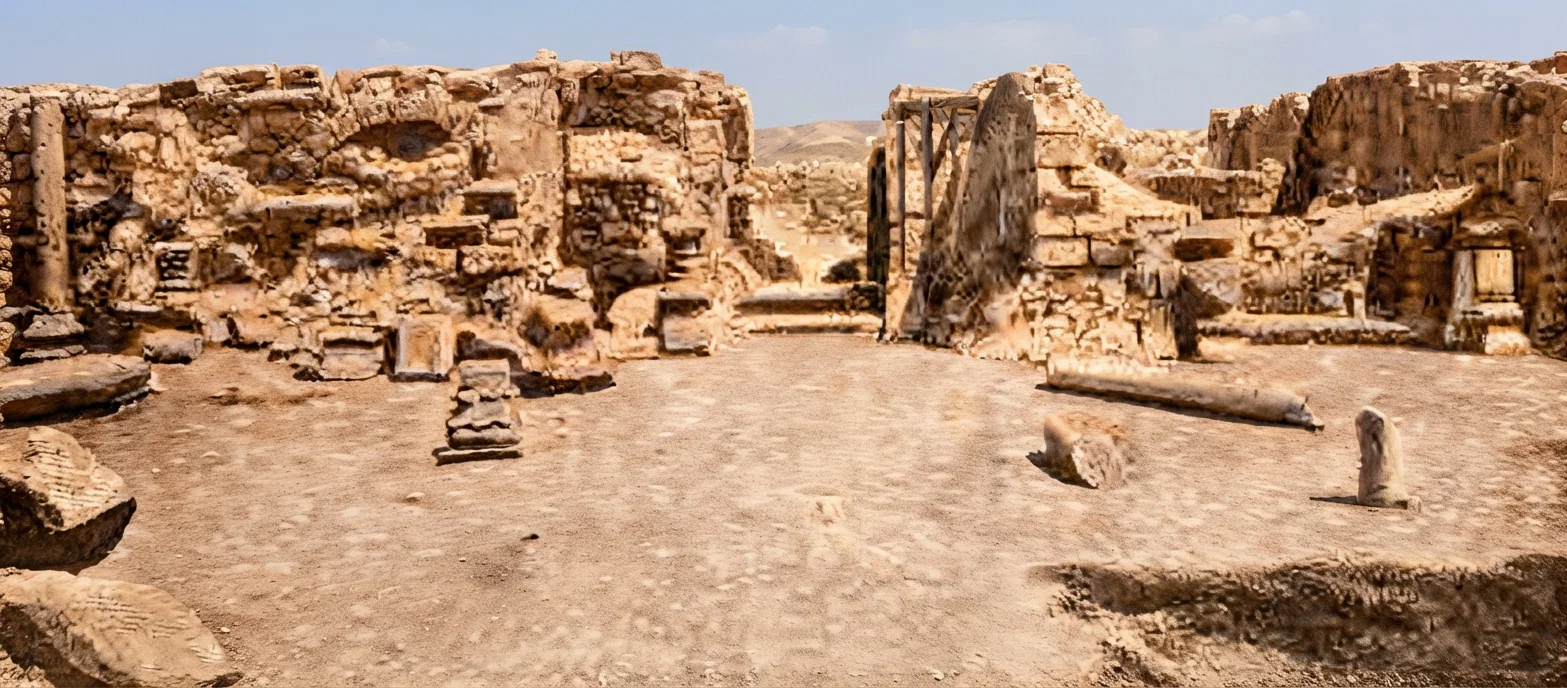
Ruins of Herod's Palace, near Jericho, unearthed by German archeologists. Here Herod the Great held some of his bestial feasts. The ruins indicate that it was a structure of great magnificence.
With a nod of satisfaction that he had been entrusted by the king with still another horrible commission, the centurion departed on his bloody errand.
Five short days had rolled away. Herod the Great, the bloody king, was no more, and his son Archelaus had been appointed to the kingdom. Flattered by the great honor which had been conferred upon him, and influenced by a love for display more than by any respect which he felt for his father, Archelaus determined that the funeral should be one of royal magnificence.
But before the arrangements for the funeral began, even the same hour in which the breath left the decaying body of the old king, there was a meeting between Alexis and Salome in a little room far removed from the chamber of death. "What sayest thou, Alexis, my husband? thou rememberest the command which the king my brother gave unto us."
"Yes; and there are now many of the best and wisest men among the Jews imprisoned in the hippodrome, that their cruel and unjust death may cause mourning on the occasion of thy brother's funeral."
"But who shall release us from the vow which is upon us?" protested the woman.
"Did not Solomon, the wise king, say: 'Enter not into the path of the wicked, and go not in the way of evil men. For they eat the bread of wickedness, and drink the wine of violence'?"
"Behold, now, we will call Marcus the centurion. Surely he delighteth in deeds of mercy, and he shall open the doors of the hippodrome to these men."
Wending its way slowly toward Herodium from Jericho, comes a brilliant retinue. It is the funeral procession of Herod the Great. Burnished helmets and swords and glittering armory gleam in the April sunshine. All along the route bloom the many colored wild blossoms of spring, while the lark and the nightingale among the trees and the hedges of cactus, vie with each other in singing sweet songs.
The bier upon which rests the royal casket, is surrounded by the relatives of the king; while the centurions, with their soldiers, armed and equipped as for war, march after them in gorgeous array. Behind them are hundreds of the household servants of the king.
The royal retinue moves slowly, coming only about eight furlongs each day,—a journey of about twenty-five miles.
Let us step nearer, that we may view the royal personage stretched upon the bier. Above the rugged brow shines a diadem of great value; and still above it, a crown of gold; and as if to defy death, the king of terrors, a shining scepter has been placed in the rigid fingers. A purple covering is draped across the golden bier, which bier is ornamented and bedecked with costly gems of every kind; and thus, in mock power, and amid all the shining pageantry of earth, is buried the vainglorious monarch.
There lack no emblems of sorrow in that vast pageant; but not one real mourner follows to his last resting-place Herod, called the Great.
Cover the loathsome and festering body with the gaudy trappings of royalty,—but hasten to hide it from the sight of men. But for him, the women at Bethlehem would not be childless, nor the Shiloh of Jacob driven into exile. But for him!—
But why blot the page or drag into the unpitying light of day an account of crimes and horrors so great that even the dimming hand of the centuries can not cover them? Only so far as it affects the interests of our narrative shall we pry with curious eyes into the sickening record which the historian has made. And so we repeat sadly, "Ashes to ashes, dust to dust." Let the dead rest. But when that fast hastening day shall dawn when the murderer and his victim stand side by side to listen to the awfully truthful record of the angel scribe, what disclosures will be made!
(To be continued)
"What Shall Be the Sign of the End of the World?"
By Editor
Was a perfectly natural question—a question that any of us would be glad to put to the Master had we the opportunity. But we have the opportunity of listening to His answer and of studying the history connected with the fulfilment of His words. This is the object of a 94-page booklet entitled
Matthew Twenty-Four
Here are some of the chapter heads:
NATIONAL CALAMITIES
FALSE PROPHETS
INIQUITY ABOUNDS
THE END OF THE AGE
THE GREAT TRIBULATION
THE DAYS OF TRIBULATION SHORTENED
LO, HERE, AND LO, THERE
THE ADVENT WILL BE LITERAL
SIGNS OF THE LORD'S COMING
THEIR FULFILMENT
PARABLE OF THE FIG TREE
THE GENERATION SHALL NOT PASS
NOAH'S TIME AND OURS
OBJECT OF MATTHEW 24
OUR DUTY TO WATCH
THE FAITHFUL AND WISE SERVANT
THE FAITHFUL REWARDED AT HIS COMING
This is an intensely interesting document, and one that is appealing to a constantly increasing class of students of the times in which we live. Price, post-paid, only 10 cents.
Other Choice Books
In sending for the above-mentioned pamphlet, you may wish to include in your request copies of some of the following:
Christ Our Advocate
A comprehensive study of the sanctuary question. 112 pages, price 10c.
The Lord's Day
A study of the Sabbath question in the light of the dispensations. 125 pages, price 10c.
The Sure Word of Prophecy
A verse-by-verse study of the book of Daniel. 96 pages, price 10c.
The Saints' Inheritance
A beautiful study on the home of the saved. 88 pages, price 10c.
Christian Science
A consideration of this "science" in the light of reason and revelation. 50 pages, price 10c.
The Spirit World and a Future Life
Is there a supernatural power being manifested by certain mediums, or is it all fraud? If it is genuine, what is its source? 96 pages, price 10c.
Order through your tract society, or
### PACIFIC PRESS PUBLISHING ASSN.
### Mountain View, Cal.
61 N. Park St.
Portland, Ore.
1109 East 12th St.
Kansas City, Mo.
Box 666, Regina, Sask., Canada.
THE HOUSE WE LIVE IN
By Vesta J. Farnsworth
OR THE MAKING OF THE HUMAN BODY
By VESTA J. FARNSWORTH
THIS is a book for home reading and it is a great help to mothers in teaching their children how to care for themselves physically. The structure of the human body is set forth in a most interesting and instructive manner, and all its wonders, uses, functions, etc., are told in a most attractive way.
The style of the book is conversational—a mother talking with her children. It makes a splendid birthday gift.
Two hundred and eighteen pages, nearly 150 illustrations, attractive cloth cover.
Price, post-paid, $1.00.
Pacific Press Publishing Assn.
Mountain View, California
Portland, Ore. Regina, Sask., Can. Kansas City, Mo.
Uncle Ben's Cobblestones
Familiar Talks with Boys and Girls About Common Things
UNCLE BEN has such a pleasing way of telling about the origin and use of common, every-day articles, that he holds the interest of the reader from the start in his talks about air, water, sunshine, fire, smoke, glass, coal, salt, paper, matches, etc.
He tells about more than one hundred different things in all, and intersperses with many happy thoughts that bring good cheer to young and old.
Two hundred and twenty-one pages, nicely bound. Price, post-paid, $1.00.
Pacific Press Publishing Assn.
Mountain View, California
Portland, Ore. Regina, Sask., Can. Kansas City, Mo.
Love So Divine
By Delwin Rees Buckner
THE blind man, born in blindness, longs to see
The plumage of the birds he often hears;
The brook, whose purling waters greet his ears;
The restless sea that roars incessantly;
The golden fruit so pleasing to his taste;
The flowers of spring whose perfume he can smell
In level valley, meadow-land, or dell.
The sightless life seems O, so void and waste.
But blindness far more pitiable still,
Is that of sin, which blindfolds willing eyes
So that they fail to see the Master Mind
Of that One Infinite, whose presence fills
The universe,—revealed in land and skies,—
Whose yearning love embraces all mankind.