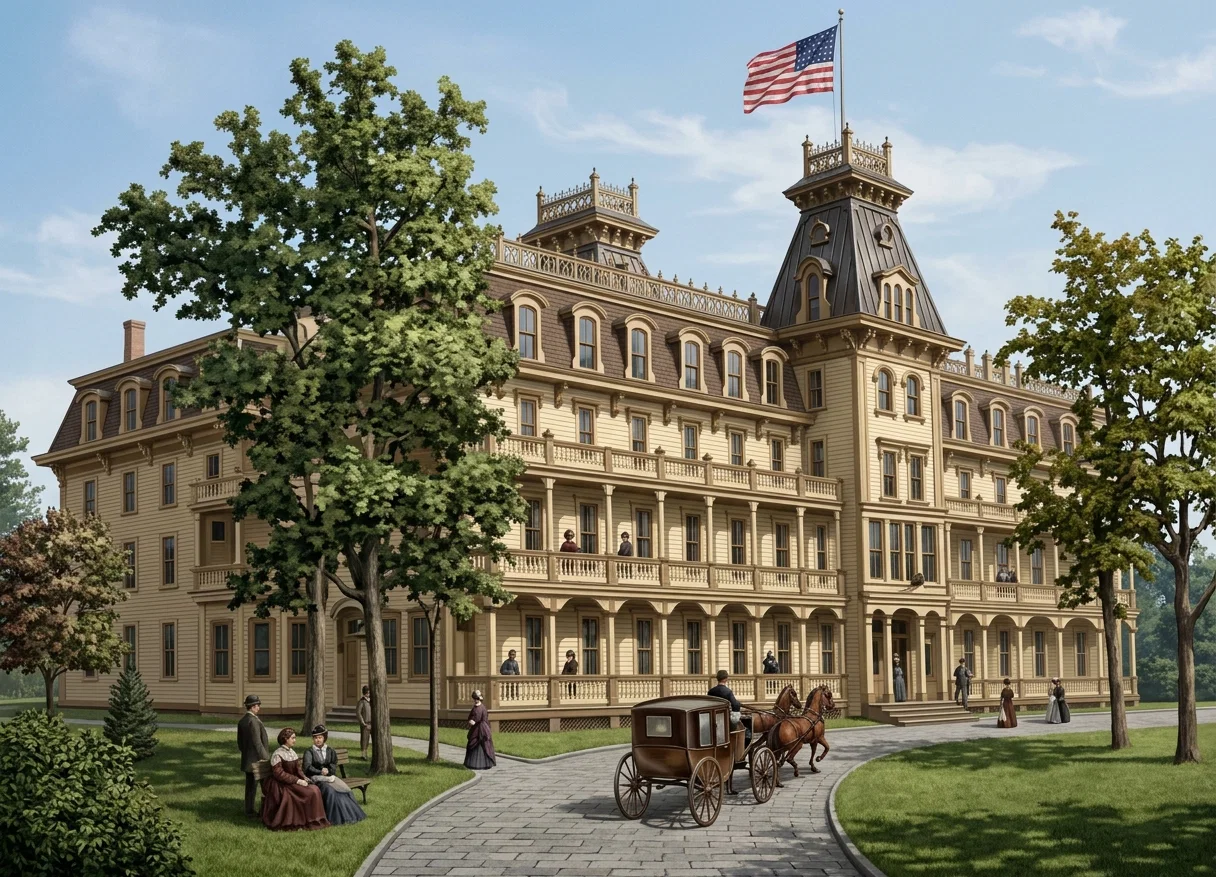
It was a pleasant change from the monotony of car-life, and I was mentally computing the length of the rails by the area of land over which we had to come—safely so far; and I admit that I breathed easier—when a thump and a sudden cry brought me to my feet. Hacks disgorged their living freight, drivers vociferated, omnibuses tilted against the pavement with porters on the alert for every thing they could lay hands to, and through it all stood the hotel, full and running over with light and warmth and generous cheer. I was the last to leave the coach, and before I had time to mount the steps I caught a glimpse of two well-to-do looking gentleman shaking hands with each other in the most cordial manner.
"Glad to see you, Burt."
"How are you, Hal?" with a warmth that showed no chill to the friendship formed in early boyhood.
It was this friendly greeting that led me to follow them with more interest, perhaps, than ordinarily given to strangers; and later, when taking my ease in a delightful, cosey chair that overlooked the veranda, I heard the remark, "Come, Hal, let's take a drink for old times," I felt the sense of pain, a quick wonderment cut short by the reply of the younger and graver looking man.
"In this you must excuse me, Burt; I never drink."
"Not drink!" with an almost incredulous smile. "I did not know that coming West changed one's habit in that respect."
The face of his friend betrayed emotion, but emotion controlled by a strong will. He did not speak for an instant, and when he did his voice was full of touching tenderness.
"You knew me for a drinking man Burt; it is but your due that I should tell you why I gave it up."
There was no reply, but the bent head and eager gaze was full of interest. The ruddy glow of the western sky fell across the face of the speaker and revealed lines of thought deeply graven on the broad forehead. The voice held the quality that strikes the ear of the listener as not only agreeable but thoroughly honest—such voices are too rare, and it struck me, as this man spoke, that he was exceptionally gifted in this respect—firm, manly, and still cordial, as though he would have the world know; and this was why I listened.
"You know," he remarked, turning his eyes to the face of his friend, while the light played in the meshes of brown hair, "when I came West it was to settle my brother's business, and, if the way opened, as I felt perhaps it would, to take up his work just where he laid it down. As a manufacturer he was singularly successful. From a small establishment and a mere handful of men he had spread himself until his factories could be counted by blocks and his men by hundreds. His widow, a delicate woman, had from the first pined for her eastern home. The activities of the new life did not harmonize with her tastes, and, when her husband died, health failed and it was manifest she must go back. The children were girls; and after placing them in school where their mother could visit them frequently and have the oversight, it was an open path and I resolved to do my best.
"As to the work I must say that I had little or no experience, but a certain aptitude in that direction, and with this, and the determination as closely as possible to follow the plan my brother had marked for himself, I was confident of success.
"Absorbed with business, I knew little of the men, save through the manager. That they were paid regularly was the extent of my care; for the rest Morton knew. Of but one thing did I take a second thought, this was the proposition for a saloon on 'our own premises.' Morton said, 'It does not pay to have the men go to town for their grog. It has a bad tendency and unhinges them for the next day; they won't work, and they are turbulent and hard to manage.'
"'They must have it?' I asked, without any real idea that I had anything to do in the matter.
"'Of course they will have it,' with that kind of seeming superiority not unusual in one of inferior mental calibre. 'Who ever heard of a gang of men who didn't have their whisky?'
"Sometimes when I went home I met my wife coming from the cottages, looking very pale and pitiful.
"'That's the way,' I said; as she told me the story. 'Every week I see that they are paid, and paid well; but they must complain. It is chronic with them.'
"'But, Harry, it is something more than this, so many of the men drink; and it is growing upon them. The very thing of being paid gives them money to spend in the saloon; the wives and children get very little of it.'
"'Well, what can I do?' I rejoined, inwardly chafing that my wife must exhibit such interest in a matter that did so little belong to her. 'They work all right during hours; outside of this I have no right to go.'
"'But, Harry, when I see them so distressed, and when I listen to what the mothers say of the children being afraid and "running away when the father comes home,"' I keep thinking of what is said about being our brother's keeper.'
"'That is like you for a good woman as you are and always wanting to help somebody. I will speak to Morton about it,' was the reply.
"My wife did not make answer. Morton, I knew, was a man distasteful to her; but he was a close manager and I could not do without him.
"After this I gave little or no thought to the subject, sometimes meeting my wife followed by a haggard woman or half-starved child, wondering a little that there should be such a look of destitution and wretchedness. Of course they were improvident—nothing more or less.
"One night I returned to find my wife gone. On the step a woman confronted me. I remembered her as a rarely pretty girl when I first came there. She married a workman, I knew; but this was years ago. On the night in question the sorrow in her face and in her eyes was dashed with a sense of wrong. The expression of her wan, white lips awed me, and suddenly there came a consciousness that I was in part chargeable with her sufferings. The skeleton of a babe was in her arms.
"'Your wife is not at home,' she said; 'perhaps I can speak to you,' looking up without any tears.
"'What can I do for you, my good woman?' I asked, not ashamed to show the interest I felt.
"'Do!' emphasizing the word so that each letter stung like an adder. 'Do! Do as you have been doing: pay my husband every week and let him spend it in the saloon. Your saloon! Ha! ha! pretty well!—paying out money with one hand and taking it back with the other.' The laugh was hysterical, but the look was defiant.
"'It had never before struck me in this way: the saloon was mine—of course the money came back to me.
"'What would you have me do?' I stammered, lifting the babe from her arms, while its blue skeleton fingers clutched at the watch-seal that glittered in the sunshine.
"'Do! Can it be that you ask me?' in the same incisive manner.
"'Why not?' thinking only to appease her.
"'Shut the door of your saloon. Put whisky aside. Say to them that they cannot have it,' while her cheeks flamed up and her eyes had the look of a wild beast at bay.
"'They will go into town in that case,' I answered.
"'Forbid it.'
"'But, my good woman—'
"'There is no other way' she cut me short.
"'Many a time I have seen my husband on his knees praying for this very thing.'
"'That I would forbid him whisky?' I hastened to ask.
"'Yes.'
"'I hire him to work, I pay him for it. I cannot say to him what he shall do with his money,' was my reply.
"'Then the Bible is a lie and God no better than man,' came fiercely.
"I was shocked at the woman's infidelity. Of course the Bible was true and God was to be adored. Somehow I had never considered it in this light; but I knew it now.
"'Listen to what it says,' drawing a small Bible from her pocket. 'Your wife gave it to me one day to comfort me. Cain would never have asked the question, "Am I my brother's keeper?" If he had not felt to combat a truth the assertion of which had been made to him; neither would the answer have sounded down to him: "The voice of thy brother's blood crieth unto me from the ground."'
"When she again spoke it was with a pause between the words.
"'I have read it all. I couldn't be satisfied without seeing for myself. John used to be a good man, and there are times now, when the whisky is out of him. Many a time he's asked for the law to be made strong enough to keep him from ever touching the dreadful stuff. You see he would stop, if he could, but he can't—appetite is too much for him. But God's promises don't seem made for us, or he has forgotten or don't care; there's no use asking.'
"The situation was beginning to be dreadful. If only my wife would come in and I could slip away! For diversion I set the babe on its mother's knee. Instantly her arms closed around it. 'No use asking,' came wearily.
"What did the woman mean? A moment before she was speaking of the Bible. She had read it all, she said. Was it this? No use in asking God to help her? Instantly all that I had in my boyhood learned in the Bible came back to me. It was like a great illumined gallery through which I had walked in my youth. God's denunciations against strong drink, and my own part in the soul-destroying traffic, came home to me with a force I could not master. The question asked in the primeval ages of the world was written in letters of living fire: 'Am I my brother's keeper?' And will God call me to account?
"The woman stood up in a half-dazed fashion.
"'I thought she'd be here. It comforts me always to see her,' letting her eyes wander over the porch and along the hall. 'You won't mind, sir, that I've spoken so freely? John says you have done the right by him all along.'
"'What is it, Harry? What news have you received?'
"'You shall decide whether it is good or bad,' I answered, and briefly I related what my reader already knows. 'And now Morton must be told to close the saloon. Not a drop of liquor will I ever taste. Not a drop of liquor will be used on my premises, and I will employ only those who with me are willing to keep and maintain this pledge.'
"'God be praised, Harry! I knew the time would come. My husband is not a man to do wrong wilfully.'
"'Your husband has done wrong thoughtlessly, and now he will rectify it, and his wife will help him,' I answered, trying to smile.
"'Always, Harry, always!' came quickly."
The sunshine on the dome opposite was gone. Once more there was a shaking of the hands, guests came and went, and through it all another voice keyed to the same measure:
"If railroad corporations and managers and government officials would employ only temperance men, what a reduction there would be in crime, poverty, and wretchedness, what an increase of peace, prosperity, and Godliness!"—National Temperance Advocate.
The Home Circle.
By A. L. E.
YOU MIGHT HAVE SAID NO!
'Tis true that temptations assail you,
In every conceivable shape;
But Providence never will fail you,—
There's always a way of escape;
You scarcely once thought of refusing,
When friends urge you deeper to go,
Say now, was it not your own choosing?
Ah, yes, for you might have said no.
The wine-cup so smilingly brought you,
Your eager lips hastened to press,
In vain has experience taught you
The danger of e'en one caress.
How soon are your promises broken,
How soon are you plunged into woe;
Just one word—the wrong one was spoken,
'Twas yes, when you should have said no.
Ah me, but the ruin is fearful,
By thousands and thousands they fall,
And hearts once so happy and cheerful,
Are tasting the wormwood and gall.
Be sure that your chain will grow stronger,
The farther in evil you go,
Don't yield your consent any longer,
There's time enough yet to say no.
—A. L. E.
The Thrush and the Quarry Blasts
On the edge of a slate quarry a thrush had made her nest. It was so close to danger that when the rock was blasted a peice of the falling slate came almost into the nest. At the ringing of a bell the bird saw the men run. She left her nest too, and after the explosion she returned. This the thrush continued to do whenever a blast was fired. The men rang the bell to hoax the bird, but she only peeped over the nest, and, as the men did not run, settled down again.
ITEMS OF NEWS.
—It is proposed to tunnel the St. Lawrence river at Montreal.
—Gen. Burnside has been re-elected U. S. Senator in Rhode Island.
—It is reported that entire herds of sheep have died of starvation in Modoc Co., Cal.
—A freshet on the Upper Mississippi has caused great loss of property, especially in logs and lumber
—B. F. Crary, D. D., was elected by the M. E. General Conference editor of the California Christian Advocate.
—A Philadelphia schooner was fired into by the Spanish man-of-war Mincio, fifteen miles from shore off Guanatamata.
—The Quakers of England have 85 mission schools in Madagascar, with 2,860 pupils. They have also missions in Syria and India.
—Arkell, Tufts, & Co., shipping and commission merchants of New York and London, failed June 9; liabilities supposed to be $500,000.
—The melting snows have produced as great floods in California as the heavy rains of April. Considerable damage has been done in some places.
—Buddhism is stronger in Siam than in any other country. It is the established religion, and is maintained at an annual expense of $25,000,000.
—The colored people of Raleigh, N. C., own over $200,000 worth of real estate, besides a great deal of other kinds of property, and throughout the State they are doing well.
—The difficulty over the question of the public schools, for some time growing between the Pope and Belgium, has resulted in the suppression of the Belgian legation at Rome.
—In the second day's meeting of the National Greenback Convention "the confusion was so great that several Sergeants-at-Arms were appointed with Denis Kearney at their head."
—There is remarkable unanimity of feeling among Republicans over the nomination of Gen. Garfield. The Democrats concede that Garfield is an honorable man, and the ticket a strong one.
—During the last eleven months the national debt has been reduced about $75,000,000. An excellent showing. The financial management of the present administration has been complete.
—One thousand feet of snow sheds, 250 feet of wood-sheds and 250 cords of wood at Coldstream, three miles west of Truckee, were burned on the 7th. The fire is thought to have caught from engine sparks.
—Charles A. Hill, a lawyer, formerly a resident of California, and a prominent Greenback speaker, was arrested in St. Louis with a complete counterfeiter's outfit and appliances for "raising" his greenbacks.
—One man in Santa Clara, Cal., reports that he will lose $500 in strawberries, because he cannot get enough Chinose to pick them. Others also lose in the same way. The "unemployed" still cry "The Chinese must go."
—A very heavy storm visited South-eastern Minnesota on the morning of June 10. The wind blew hard, and the water fell in a flood, inundating the village of Stockton. Business was suspended in a large section about Winona.
—Speaking of short sermons, the Baptist Weekly says: "The consciences of many professors of religion would not be altogether at ease in any entire neglect of public worship; but the briefer the period they spend in the sanctuary the better they are pleased."
—Gladstone proposes to replace the malt tax by a tax on beer, to increase the income tax two-pence for the half year, and to re-adjust and increase the rates for licenses for the sale of liquors. He estimates that the changes will produce a surplus of $381,000.
—Now it is said that Tucson, Arizona, is the oldest settled city in the United States. For the benefit of those who have struggled hopelessly with the Roman alphabet, we will add, that c is silent in this name, and the accent is on the second syllable, pronounced Tooson.
—The Captain of a bark is just arrived in New York who encountered a great number of icebergs. He says he believes an arm of icebergs is stretching across the path of the ocean steamships directly off the Newfoundland Banks. Fifty icebergs were passed in latitude 45 degrees, longitude 50 degrees.
—Another fire has occurred in the Pennsylvania oil regions. Lightning struck a 20,000-barrel iron tank of oil on a hill above Titusville. The fire reached other tanks, and finally the city. The buildings burned were the poorer class, on the outskirts of the city. The loss on the stills, refineries, &c., of the Acme Oil Works is estimated at half a million. No estimate of the total loss is yet made.
—The steamers Stonington and Narragansett collided in Long Island Sound, near the Connecticut river, on the night of June 11. The night was dark and foggy; the Stonington cut into the Narragansett, which took fire and soon sank. The scene was appalling; the accounts of the sufferings and loss of women and children is heart rending. The number lost is not known; the officers express a hope that it is not over twenty-five or thirty.
—A terrible tornado passed through Pottowattamie Co., Iowa, the evening of June 9. The track of the storm was about half a mile in width, and swept everything before it, demolishing farm houses, barns and other buildings, and carrying some of them bodily for hundreds of feet, and then dashing them to the ground in pieces. There were from fifteen to twenty persons killed outright, and many wounded, while others cannot be found.
—A meeting of the San Francisco Produce Exchange was held June 11 to consider the subject of the deterioration of California wheat. When first introduced in England it commanded a premium of two shillings per quarter; now it is at a discount of two shillings per quarter. It is estimated that the loss, on this difference, on the entire quantity exported amounts to $3,000,000. The reason assigned is the slovenly way of securing the crop, especially of storing the "headings" on the ground, and mixing the soil with the grain in threshing.
—The Northern Christian Advocate feels humiliated, and gives as a reason that "the whole great Methodist Episcopal Church in America, numbering almost 2,000,000 of members, after nearly a round hundred years of toil and giving, boasts of assets to the amount of only $63,000,000, in personal and real estate, devoted to church work." It regards this as a very poor showing, when a single man in New York has amassed a fortune of $75,000,000 in his lifetime. His son to-day could buy up the whole Methodist Episcopal Church and have an independent fortune left.
—The Examiner and Chronicle, Baptist paper of New York, is caustic in its strictures on certain Baptists in California. It says: "The character and conduct of the murdered man have nothing to do with the guilt of young Kalloch's crime, and are not to be taken into the account in determining what his punishment is to be under civil or ecclesiastical law. But Dr. Kalloch seems to have no such ideas as these, and it may be that his knowledge of San Francisco and the churches with which he is affiliated justifies the expectations attributed to him. But it may be well for him and them to know that the Baptist denomination cannot be too soon relieved of the deep humiliation of having a predetermined and cold-blooded murderer among its accredited ministers."
BATTLE CREEK SANITARIUM.
By John Harvey Kellogg
Institution Founded 1866......4000 Patients Successfully Treated.
THIS INSTITUTION, for completeness of appointment, and extent of facilities, is unrivalled in this country. Its splendid arrangements for HEATING AND VENTILATION, together with special appliances for regulating the humidity of the atmosphere, makes this institution UNEQUALED AS A WINTER RESORT FOR CHRONIC INVALIDS.
Even persons suffering with pulmonary difficulties do much better here than in Florida.
All known useful remedies for disease are employed, including Turkish, Russian, Vapor, Electro-Thermal, Electro-Vapor, all kinds of Water Baths, Sun Baths, Swedish Movements, Electricity, etc., etc.
Terms very reasonable, J. H. KELLOGG, M. D., Medical Superintendent.
Address for Circulars:—SANITARIUM, Battle Creek, Mich.
GOOD HEALTH
By Editor
THIS POPULAR JOURNAL enters upon its fifteenth volume with the most flattering prospects not only of a continuance of the prosperity which has attended it in the past, but also of a great increase of patronage, although it already enjoys
THE LARGEST CIRCULATION OF ANY HEALTH JOURNAL IN AMERICA.
The interest of the journal for 1880 will be greatly increased by a series of practical articles from the well-known pens of
ELDER AND MRS. WHITE,
Whose contributions in the past have done so much to increase the popularity and the usefulness of the journal.
A SPLENDID PREMIUM BOOK
Is offered to new subscribers. Address, for specimen copy:—
GOOD HEALTH PUBLISHING CO.,
Battle Creek, Mich.
Or:—SIGNS OF THE TIMES,
Oakland, Cal.
RURAL HEALTH RETREAT.
THIS INSTITUTION is located about two and a half miles from St. Helena, Napa County, California, at the
CRYSTAL SPRINGS.
The water is clear, pure and cool. The facilities for heating water, and bathing, are unsurpassed. The situation is both pleasant and healthy, it being about 300 feet above the valley. The scenery is unsurpassed for beauty, including a view of valley and mountain. The building is spacious, and the table accommodations are first-class.
The institution is just opened.
The medical department is under direction of E. J. Waggoner, M. D., who has had experience in practice in the Medical and Surgical Sanitarium at Battle Creek, Mich.
Those who seek medical treatment under favorable and health-giving conditions, and those who seek a pleasant resort from the heat and business of the city, cannot fail to be pleased at the Retreat.