Your ShelfYour Projects

Signs of the Times, Vol. 32, No. 27.

LOVE SUFFERS LONG

Signs of the Times

Jul 11, 1906

Pacific Press Publishing Company · Mountain View, California · Jul 11, 1906

LOVE SUFFERS LONG.

BY FLORA E. YERGIN.
Love suffers long. No pow’r of earth can quench The working of that living, burning flame That shines beyond the region where its worth Is known and seen and sung by angel tongue, To where they know Him not who bears its name.
Love suffers long. The slowly passing years Find Love’s clear waters still more clear and sweet; And many hearts have gazed with hopes and fears At that cool fountain—once they passed with sneers, And found again—where love and longing meet.
Love suffers long; nor waits until the hand Is lifted up in sorrow or despair; A mighty arm from Canaan’s glory-land Now reaches down to Egypt’s desert sand, To gently lead His wand’ring children there.
Love suffers long! until the fevered lips Have tasted of Love’s living, cooling cup; Until sin’s prison-bars are opened wide; Till starving wand’rers find Love’s bleeding side, Love lives and longs! and can not give them up.
Love suffers long. And what should mortal care For aught of else, that withers all to-day? Love lives,—in cooling streams and pastures fair; In gentle breeze, and angel voices where They follow even while Love leads the way.
Love suffers long? a year?—aye, tens of years! Long as the sons of earth shall need of love; Long as the ages where Hate laughs and jeers; Long as the heavy heart shall sigh in tears Shall the Eternal bear—who reigns above!
O weary soul, leave now with Him thy prayer, And go rejoicing in its answer true; Ah, self-sufficient, careless one, beware! He hates the sin that leads thee to despair,— But listen to His pleading love for you. Onoway, Mich.

New Publications

Signs of the End

Near the close of the Civil War, Abraham Lincoln said, “I see in the near future a crisis approaching that unnerves me, and causes me to tremble for the safety of my country. As a result of the war, corporations have been enthroned, and an era of corruption in high places will follow, and the money power of the country will endeavor to prolong its reign by working upon the prejudices of the people until the wealth is concentrated in the hands of a few, and this Republic is destroyed. I feel at this moment more anxiety for the safety of my country than ever before, even in the midst of war.”
This crisis is upon us. Read its significance in “Signs of the End.”
Bible Students Library No. 194. Price $0.80 a 100.

The Bible or Tradition

A review of Dr. Torry's booklet entitled “Ought Christians to Keep the Sabbath.” The reviewer's purpose is to point out the contradictions with which the book abounds. For example:
“Each of the Ten Commandments is an expression of an eternal principle, and the eternal principle stands under the new dispensation as well as the old.”
“The one thing we have now settled is that the law written and engraved on stones, including the Sabbath law, has been done away.”
Bible Students Library No. 193. Six full-page illustrations. Price $1.60 a 100.

Sunday in a Nutshell

In these strenuous times you object to long drawn-out arguments, and appreciate those which are short and pointed. “Sunday in a Nutshell” is of this latter kind. Its sixteen pages are bristling with facts, references, and quotations, showing just how Sunday entered the Christian Church and how it came to be regarded as a sacred institution. The character of the quotations are such as will interest all denominations and classes.
Apples of Gold Library No. 88. Price $0.80 a 100.

Great Popular Evils

The Ethics of the Theater, The Card Table and the Dance, by Rev. E. E. Knapp, Pastor First Baptist Church, Fairport, N. Y., together with “The Question of Skating Rinks” by Milton C. Wilcox, editor of the SIGNS OF THE TIMES. A setting forth of the evil of these forms of amusement such as will cause even their devotees to pause and consider. Every young man and woman in the land should have a copy.
Apples of Gold Library No. 89. Price $0.80 a 100.

The Earthquake: Its Lessons

A message of comfort and cheer to the sorrowing and discouraged. Written by one who was in the midst of the shaken region, and who has carefully observed its effect upon the country and people; it presents these lessons in a manner that invites close consideration.
Here are some of its sub-headings:
Different Points of View
The Ministry of Affliction
The True Comforter
A Touching Incident
The Causes of Earthquakes
A Foretaste of the End
The Solidity of Eternal Things
Bruised to Heal
Lessons in Human Kindness
The Earthquake’s Meaning to Us
Another Great Earthquake
Perfect Trust
This publication is issued as Bible Students Library No. 196.
Price $0.80 a 100.

The Great Earthquake

The whole world is, and will continue to be, interested in the terrible California Earthquake of April 18, 1906. In the United States particularly every family will want a series of views upon which they can depend as being accurate. Such a series, nearly fifty in all, is found in “The Great Earthquake” booklet. One leading feature of this series is, they cover not only San Francisco, but Healdsburg, Santa Rosa, Stanford University, Mountain View, San Jose, and Agnews Asylum where more than 100 people were killed.
Liberal discount to agents. Price $0.25 each.

Adventist Publishing House Addresses by Region

The PACIFIC PRESS PUBLISHING CO., Mountain View, California Kansas City, Mo., 1109 E. 12th St. Portland, Oregon, 285 Salmon St.
REVIEW AND HERALD PUBLISHING CO., Takoma Park Station, Washington, D. C. Battle Creek, Michigan
SOUTHERN PUBLISHING ASSOCIATION, 24th Avenue North, Nashville, Tennessee Fort Worth, Texas

Terms of Subscription.

Per Year, post-paid . . . . . . . . . . . . . . . . . . . . . . . . . . $1.50
Six Months, 75 cts. Three Months, 40 cts.
To Foreign Countries, per year, $1.75.

SPECIAL TERMS.

1. One new yearly subscription and one renewal, or two new yearly subscriptions, sent at one time, $2.50.
2. Two new yearly subscriptions and one renewal, or three new yearly subscriptions, sent at one time, $3.25.
3. Three new yearly subscriptions and one renewal, or four new yearly subscriptions, sent at one time, $4.00.
Sample copies sent on application.

TO OUR PATRONS.

Please be careful to write all names of persons and places plainly.
Send money by Post-office Money Order, Express Order, or Bank Draft on New York, Chicago, or San Francisco.
Orders and Drafts should be made payable to the Pacific Press Publishing Co.
Paper money or silver should be sent in a registered letter.
Registered mail is safe. Unregistered mail is at the risk of the sender.
The address label on your paper will indicate the time to which your subscription is paid. In case of non-receipt of papers, or any other irregularity, please notify us immediately.
When subscriptions expire, no more papers are sent to the party except by special arrangement.
You are requested to watch the date on your label, and renew early, and save the loss of papers. We can not always furnish missing numbers.
When requesting change of address, be sure to give both old and new addresses.
Important.—If you order SIGNS, Our Little Friend, books, etc., at the same time, use a separate sheet of paper for each. If this request is complied with, it will materially assist in the prompt and accurate despatch of the business.
When writing to the editor, be sure to use a separate sheet of paper.

Reader Praises the Paper and Hopes for Wider Circulation

A sister in renewing says: “We think the paper is getting better all the time, and would like to see it in every home.”

Aged Sister in Missouri Values the Paper

Another, and aged, sister in Missouri writes: “I would not miss a single copy if I could help it. I give out the papers and try to interest all I can in the truth.”

Reader Praises the Papers for Perilous Times

From New York an interested reader writes: “I don't want to miss any of the papers, for they are just what we all need in these perilous times. I should miss them very much.”

Colporteur Selling Signs of the Times in Texas

A brother who sells 150 copies a week in Texas writes: “Many are so interested in the SIGNS OF THE TIMES they have the five cents ready for me at the door. I wish I could handle ten hundred instead of one hundred SIGNS.”

A Sister's Success Selling Papers in San Francisco

A sister in San Francisco says: “I sold forty papers yesterday forenoon in two hours.”

Free Catalog Available by Postal Card Request

Our catalog for 1906 is free. Send us a postal card requesting one.

"AND AFTER THE EARTHQUAKE A FIRE."

THE above expression from the Scriptures has been twice placed in connection with a fire scene in previous numbers of this paper. There are those who have inquired as to its meaning or application. In reply to these and others, we would say that the text was so used as illustrative of the often close connection of these agencies of destruction, and to teach a lesson. The lesson is of vastly more importance than the mere aptness of the illustration.
THE passage is found in 1 Kings, chapter 19. The previous chapter reveals the utter discomfiture of the false prophets who were nourished by the corrupt queen Jezebel, and of the slaying of those prophets who had brought such a curse upon Israel. Then Elijah, the prophet of God, prays for rain upon the drouth-smitten land, and it comes in abundance. Ahab, the king, drives from Carmel to Jezreel in his chariot, but Elijah, the messenger of the Most High, the hardy mountain-dweller, runs ahead of the chariot for twenty-five miles, enters the city before the king, and lies down wearily by the city gate, discouraged at the spiritual apathy of Israel.
FROM his unrefreshing slumbers a messenger from the cruel Jezebel arouses him with this message: “So let the gods do to me, and more also, if I make not thy life as one of them [the false prophets] by to-morrow about this time.” Wearied, worn, and discouraged, fear took possession of the fearless prophet who had fearlessly faced the most dreaded dangers. He arose and fled for his life. Reaching the southern border of Judah, he leaves his servant, and presses on into the wilderness to die. At the end of a weary day's journey, he casts himself down under a scraggy broom tree of the desert, and moans in his utter discouragement: “It is enough now, O Jehovah, take away my life; for I am not better than my fathers,” and in sheer exhaustion he falls asleep.
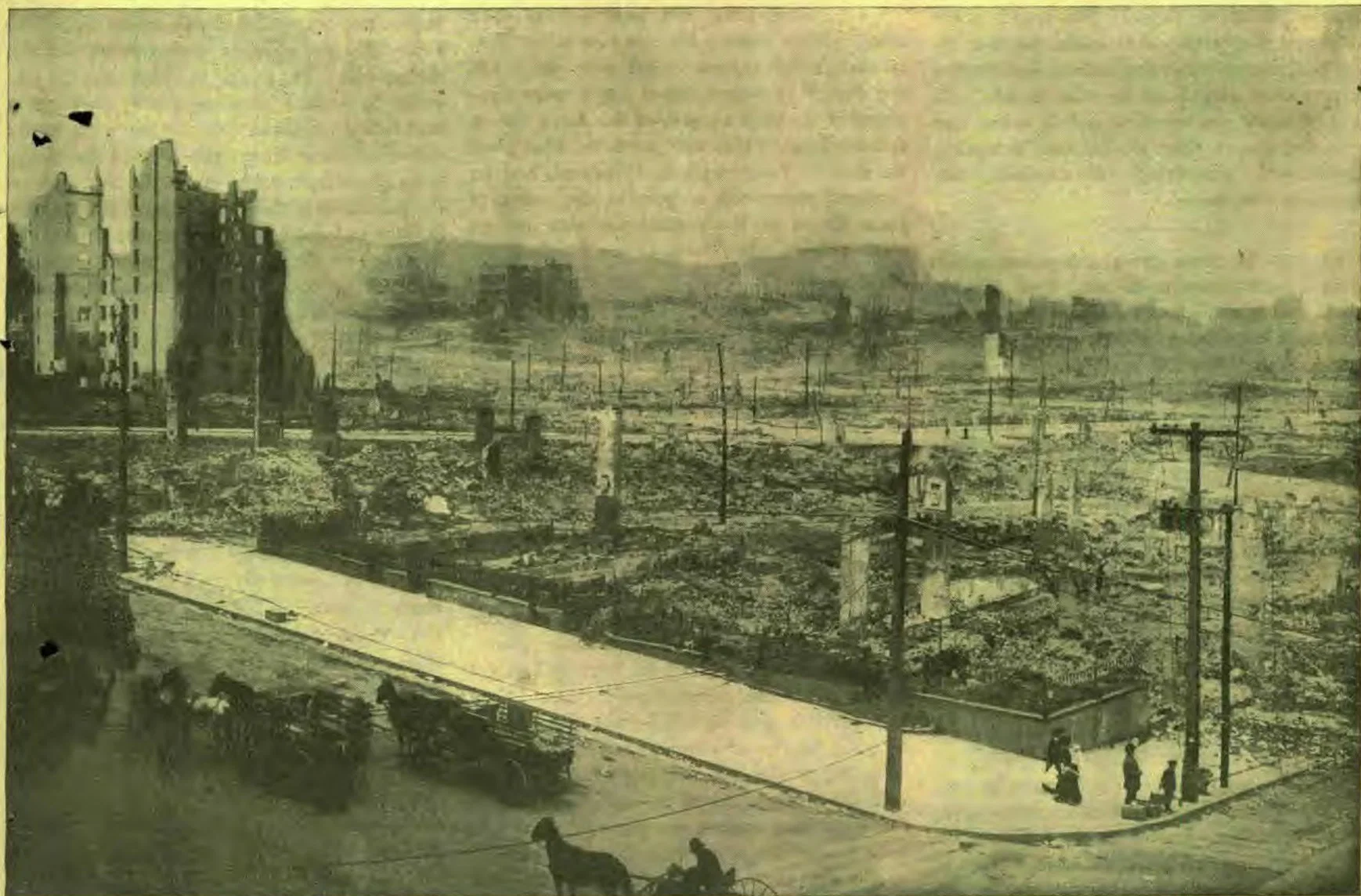
After the Fire in San Francisco. Looking northward toward the Fairmont Hotel. This was the appearance of square miles after the awful burning.
GOD pities him, sends His messenger, and twice in that night he is aroused to eat and drink of the food prepared by the angel; and in the strength of that food he presses on for forty days and nights unto Horeb the Mount of God. And the story continues:
“And he came thither unto a cave, and lodged there; and, behold, the word of Jehovah came to him, and He said unto him, What doest thou here, Elijah? And he said, I have been very jealous for Jehovah, the God of hosts; for the children of Israel have forsaken Thy covenant, thrown down Thine altars, and slain Thy prophets with the sword; and I, even I only, am left; and they seek my life, to take it away. And He said, Go forth, and stand upon the mount before Jehovah. And, behold, Jehovah passed by, and a great and strong wind rent the mountains, and brake in pieces the rocks before Jehovah; but Jehovah was not in the wind; and after the wind an earthquake; but Jehovah was not in the earthquake; and after the earthquake a fire; but Jehovah was not in the fire; and after the fire a still small voice. And it was so, when Elijah heard it, that he wrapped his face in his mantle, and went out, and stood in the entrance of the cave. And, behold, there came a voice unto him, and said, What doest thou here, Elijah? And he said, I have been very jealous for Jehovah, the God of hosts; for the children of Israel have forsaken Thy covenant, thrown down Thine altars, and slain Thy prophets with the sword; and I, even I only, am left, and they seek my life, to take it away. And Jehovah said unto him, Go, return on thy way.”
THE text and context clearly indicate that Elijah expected his zeal to accomplish Israel's reformation. He had been very zealous, he had wrought mighty things; but now, discouraged, all his work seems a thing of naught, and he stands alone. Then God gave him the lesson. A mighty wind rends the mountains and breaks the rocks, a mighty trembling follows which shakes the very earth; and then a devouring fire sweeps over the ruins; yet God is not in wind or earthquake or fire. He uses them. Before they came “Jehovah passed by.” But the prophet seemed not to know it. He shrunk back into the mountain cave, afraid.
YET Jehovah uses even these great destructive agencies. They come in consequence of sin, as the results of perverted law. God permits them, that man may learn how evil sin is, how destructive is its power, what an enemy to mankind it is. God would have man learn his own helplessness and nothingness; how pitifully weak he is before these great perverted forces of nature. He has grown him great crops; the wind, the storm, the tempest, the tornado, destroys them. He erects noble buildings; the earthquake shakes the foundation and the buildings are broken, and the fire sweeps over and licks up what is left. All earthly hopes are wrecked and in ashes, and upon the dreary ruins sits helpless humanity, discouraged, despairing, disconsolate, desperate, or determined.
TO ALL in these great calamities, which come in consequence of sin, God speaks. Again and again in that awful morning at San Francisco, conscience called men to judgment, conscience condemned them for their deeds, conscience aroused within them impulses to do better, and nobly many acted on those impulses; not alone in San Francisco the great heart of humanity was touched. It is ever so. In the great forest fires of Wisconsin and Michigan a few years ago, wild and savage beasts herded with the most timid, peaceful, and harmless. In the waters of a lake could be found bear and deer and dog and wolf and sheep and man. The fear of a great power had suppressed for a time the savagery born of sin, and peace reigned. The tornado, the earthquake, the fire, frighten and subdue for the time the sin-born savage in man, and good impulses rise to the surface and bear sway till the fear is gone, the love of self asserts its rule, and the impulse issues in death. Men—even the unregenerate—sorrow as the impulses die and the spirit of fellowship vanishes. Even so are they sorrowing to-day in the city by the Golden Gate.
AT such times as these comes ever the voice of God to every soul the sanctuary of which is not barred and bolted against righteousness. By some almost forgotten sermon, by some word of Scripture learned when a boy, by every and any means which can be used, God speaks to the soul, and bids it, “Come unto Me.” He offers forgiveness and cleansing, fellowship and counsel, comfort and strength; healing for every hurt, balm for every bruise; riches of grace and glory which tornado nor earthquake nor fire can destroy, a character which is priceless beyond all rubies, eternally young and expansive in the everlasting, unshakable, sinless kingdom of God.
TO HIS servants Jehovah would teach this lesson: “It is not by might, nor by power, but by My Spirit, saith Jehovah of hosts.” It is not the big things in which we pride ourselves that accomplish God's work; it is the uplifting, penetrating power of a life hid with Christ in God. We may not reach Israel by thunder tones or mighty displays of eloquence or force; we may reach them by prayer through the power of the Spirit. We may feel we are all alone; but God still has His own faithful ones who have not, and will not, compromise faith or righteousness on the altars of lust or greed. The still, small voice of God is more than all the might of mere power. The weakness of God is stronger than men. O soul, hide in Him.

THE LAW BEFORE MOSES.

It is passing strange that men who profess to love and serve God should be so anxious to evade His law, which is the expression of His divine will. Ps. 40:7, 8; Eccl. 12:13. In order to escape obedience, they persistently maintain that there was no law until it was delivered from Mount Sinai. But the Scriptures give ample testimony to the fact that all the principles of the Ten Commandments were in force and recognized before the formal deliverance on Sinai. We will briefly note the evidence as touching the several commandments in order:
1. “And God said unto Jacob, Arise, go up to Bethel, and dwell there; and make there an altar unto God, that appeared unto thee when thou fleddest from the face of Esau thy brother. Then Jacob said unto his household, and to all that were with him, Put away the strange gods that are among you, and be clean.” Gen. 35:1, 2. Why put away the “strange gods” if they were not forbidden? “Sin is not imputed when there is no law.” Rom. 5:13.
2. These “strange gods” were images (Gen. 31:19), and Jacob hid them from his people. Why?—Because Jacob had been taught the law of God. Abraham had obeyed it (Gen. 26:5), and had so taught his household (Gen. 18:17–19).
3. Among the sins for which the Canaanites were destroyed was their profaning the name of God. Lev. 18:3, 21, 27. If that was sin, there was law against it.
4. The Sabbath was established at Creation. Gen. 2:2, 3. Moses reminded the Israelites of the sanctity of the Sabbath day, and renewed its observance, one month before they came to Sinai. Ex. 16:1, 4, 5, 22–26. The Lord said this was a test, “that I may prove them, whether they will walk in My law, or no.” And it is a test for all ages.
5. A curse rested on Ham, son of Noah, because he dishonored his father. Gen. 9:20–25.
6. A curse was visited upon Cain because he killed his brother Abel. Gen. 4:8–12. Satan was a murderer from the beginning” (John 8:44); therefore, if murder was a sin from the beginning, the law forbidding murder must have existed, as “where no law is, there is no transgression.” Rom. 4:15.
7. Adultery was sin in Abraham’s time (Gen. 20:1–9); and would have brought dire punishment upon Abimelech, tho committed unwittingly. It was sin in Joseph’s time also, Gen. 39:7–9. The “sin” of Sodom and Gomorrah was “very grievous” (Gen. 18:20), and Peter ascribes to them “unlawful deeds” (2 Peter 2:8), while Jude specifies the sin of fornication (Jude 7).
8. God punished theft in Abraham’s day (Genesis 14), and it was deemed a heinous offense in the time of Jacob (Gen. 30:33; 31:26, 27) and of Joseph (Genesis 44).
9. False witnessing was a sin when Potiphar’s wife brought a false charge against Joseph. Gen. 39:7, 12–18. Christ charges Satan with being the father of lying. John 8:44. If that was sin, the law forbidding lying must have been in force when Satan told his first lie.
10. If Eve had not coveted the forbidden fruit, she would not have partaken of it. If Abimelech had not coveted Abraham’s wife, he would not have taken her for himself. If Jacob had not coveted Esau’s birthright and blessing, he would not have taken the unrighteous course he did to secure them. As covetousness is idolatry (Eph. 5:5) it was included in the acts of those who transgressed the first and second commandments.
Inasmuch as God is perfect (Matt. 5:48), and the law is perfect (Ps. 19:7); inasmuch as God is holy (Rev. 4:8), and the law is holy (Rom. 7:12); inasmuch as Christ is the truth (John 14:6) and the law is the truth (Ps. 119:142); and inasmuch as, under the everlasting covenant, the law is placed in the hearts of God’s people (Heb. 8:8–13), it follows that the principles of the law are suitable to the divine administration in all ages, under all circumstances. G.

THERE IS POWER IN HIS NAME.

THE name “Jesus” means “Saviour.” “Thou shalt call His name Jesus; for He shall save His people from their sins.” Matt. 1:21. He was also called Emmanuel, which means “God with us.” On the day of Pentecost, when many were convicted of sin by the power of the Holy Spirit, and cried out, “Men and brethren, what shall we do?” Peter replied, “Repent, and be baptized, every one of you in the name of Jesus Christ for the remission of sins, and ye shall receive the Holy Ghost.” Acts 2:37, 38.
Shortly afterward Peter and John were called before the council and questioned concerning the healing of a certain man who had been lame from his birth. Then Peter declared that “by the name of Jesus Christ of Nazareth” the man had been made whole. And to this testimony he added the further declaration that “neither is there salvation in any other; for there is none other name under heaven given among men, whereby we must be saved.” Acts 4:7–12.
Dr. Banks tells of an early missionary to Africa who, for over two years, was at a loss for some expression by which to make known the idea of a Saviour. At last he heard a native tell some others how his master had saved him from being killed by a lion. After listening to the adventure, he asked the man what he would call the one who had saved him from death, when, to his great joy, he found the long-desired and powerful word. At once he told the man about Jesus his Saviour in a way to make it clear to him; and the poor native, having caught the full meaning of the message, was surprised to learn what the missionary had been trying all that time to tell the people.
In telling of his joy because of the discovery and its result, the missionary said: “I spent four years in Africa. For fourteen months I never saw bread; for months I have lived on African beans and sour milk; I have eaten everything from ants to rhinoceri; thirty times I had fever; I have been attacked by native bands, three times I have been attacked by lions, and four times by rhinoceri; but I would go through it all again for the ineffable joy of that moment when I heard the word Saviour, and saw the light of that man’s face at the message it conveyed to him!”
The wonderful power of the name of Jesus, a power sufficient even to forgive sin, is available to every one who will believe in Him and implicitly trust Him. His assurance is: “Whatsoever ye shall ask in My name, that will I do, that the Father may be glorified in the Son. If ye shall ask anything in My name, I will do it.” John 14:13, 14. The only conditions are that we shall ask believing, (Mark 11:22–24), and in a spirit of obedience (1 John 3:21, 24). It is into this name that the true believer is baptized, thus becoming a recognized member of the heavenly family, with all its privileges and blessings and promises. See Gal. 3:26–29.
“Take the name of Jesus with you, Child of sorrow and of wo; It will joy and comfort give you, Take it, then, where’er you go.”

The Greater Dangers; The Greater Enemies.

San Jose was “hit hard” by the earthquake, but she was a long way from being killed. She was hardly stunned, as her noble call for thousands of San Francisco refugees demonstrated. Mountain View was “hit hard”; so was Palo Alto, Redwood, San Mateo, San Francisco, and Santa Rosa first of all. And yet to-day we would as soon settle and build in Santa Rosa or San Jose as any other city in the world of equal advantage elsewise. We do not believe there is worse danger in these cities than there is in any two cities of equal size in the East. The worst foe of San Jose is not the earthquake or the man who tells of it, it is the saloon and the rum-sodden politics which surround it. The earthquakes and cyclones are incident to the ageing of the earth in consequence of the sin-perverted laws in her physical being, and go where we will we can not escape regions of disaster. Therefore as we have said from the beginning we do not consider California any more perilous than any other state or locality and in many respects the Golden State is generally to be preferred to many other sections of the world. The worst foe of any city is its unrighteousness. “By the blessing of the upright the city is exalted; but it is overthrown by the mouth of the wicked.” Prov. II: II.

EARTHQUAKE AND FIRE SPECIAL.

“Signs of the Times” Souvenir Edition.
THIS is our third and last and best edition on the great misfortune which befell the Pacific Coast. It is of much more than ordinary interest; it is the best thing yet gotten out. Let us tell you a few things it contains:

I. In Art and Illustrations.

1. A fire picture of the burning of the city in colors.
2. Two two-page panoramic views—one of the great fire and the other of the ruins, in colors.
3. A portrait of the governor of California, Hon. Geo. C. Pardee.
4. A whole page (seven views) of Stanford University buildings before and after the great temblor.
5. A whole page (six views) of refugee scenes, camps, etc.
6. A page on areas covered by earthquake and fire, including a relief map of San Francisco, with burned district in red.
7. A fine page-view of fire and ruins, looking up California Street.
8. Twenty-four other illustrations of graphic earthquake scenes, seismographic records, ruins of noted places, such as San Francisco City Hall, Palace and Fairmont hotels, eruption near Healdsburg, safe-opening scene, etc., etc., etc., with interesting stories of each. A total of forty-seven illustrations. The six seismographic records alone, including tracings taken in California, New York, and Austria, are worth the price of the paper, as are several of the other illustrations.

II. The Articles.

1. “California: Her Condition and Resources,” contributed to this paper by Governor Geo. C. Pardee.
2. An article on Why This Issue.
3. “The Earthquake.”
4. “The Queen City of the West in Sackcloth and Ashes.”
5. “Oakland, Berkeley, and Alameda.” By A. J. S. Bourdeau.
6. “Stanford University.” By President David Starr Jordan.
7. “How San Jose Fared.” By C. M. Snow.
8. “Mountain View’s Experience.” By W. N. Glenn.
9. “What Do These Things Mean?” By J. O. Corliss.
10. “Santa Rosa’s Sad Story.” Mostly from the pen of Mr. Geo. E. Peery.
11. “Some Direct Causes of the Earthquake.” From “Patriarchs and Prophets.”
12. “A Mighty Ruin—Sure Trust.” By C. M. Snow.
13. “Divine Law—Normal and Abnormal.” By the Editor.
14. “The Eruption in Alexander Valley.” By Prof. L. A. Reed.
15. “Some Graphic Descriptions.” A few extracts from Hewitt’s and Hopper’s articles on the earthquake and fire.
16. An official list of contributions to the Relief Funds up to June 16.
17. Some Disasters of the present year.
18. Increase of Earthquakes, a list of the most destructive.
19. Destructive Fires in the United States.
20. Fire Losses in the United States from 1875 to 1905.
This paper is an issue which you will wish to keep. Twenty-four pages; price 10 cents; in lots of 5 to 500, SIX cents each; 500 and upward, FIVE cents each. Mailed direct from this office to lists of names furnished in lots of five or more, six cents each. Orders are coming in splendidly. News agents are doing well in selling it. It will be a good seller till autumn. Address, SIGNS OF THE TIMES, Mountain View, Cal.
Continue reading: CONTAINED IN THIS NUMBER