The Home.—Influence and Responsibility of Parents, MRS. L. D. AVERY-STUTTLE—In the Home Laundry, M. H.—Mothers and Children 10, 11
Literary Notices. 11
Missions.—Railroads in Africa, A. C. SELMON, M. D.—Letter from Portugal, C. E. RENTFRO 12, 13
Outlook.—Morality Personal, Not Legislated, F. M. WILCOX—As It Should Be Everywhere—The Testimony of Presidents—Religion and the Constitution—Boston Methodists—The Seed Is the Word—Sunday Enforcement 14, 15
Publishers 2
Temblor: The Spanish Word for Earthquake
“Temblor.”—The word “temblor” is a Spanish word meaning earthquake. It is commonly used throughout the Pacific Coast region. Some of our Eastern exchanges get it “trembler,” “tremblor,” and elsewise; but the proper Spanish word is “temblor.”
Redeeming Power in Christ Only.
In speaking of the Shaw-White murder a daily paper says: ‘That this murder will have a great and redeeming effect on the morals of this great city was to-day’s positive development in the most sensational homicide which New York has known since the Fisk-Stokes case.’
Be not deceived. There is no redeeming power in crime or violence or brutality or war or sin or revelation of corruption of any kind or sort. Persons may be horrified, shocked, awakened; but there will be no true, lasting reform unless men sink out of self and into Christ Jesus. Redeeming power is creative power; and creative power comes to this world through Christ Jesus alone. As long as men hope for reform in the revelation of the need of reform they will be disappointed.
Another Earthquake Strikes Southern Wales and Bristol
Another earthquake has strayed from the “belt” in which, according to “science,” such phenomena logically belong. This one found its way as far north as the British Isles. A press despatch says that violent shocks were felt throughout southern Wales in the forenoon of June 27. “Houses rocked and many of the cheaper were damaged. Hundreds of chimneys fell, occupants of dwellings were thrown to the ground, and people fled from their houses, shrieking in panic with visions of the San Francisco disturbance before them. There were many narrow escapes from falling chimneys and copings, there were no casualties, as far as known.” Earthquake shocks were also felt at Bristol, Ilfracombe, and elsewhere. They were accompanied by loud rumblings. The shocks were felt with particular severity in the collieries, where the men tell of terrific experiences. While underground they were thrown about in all directions like ninepins, and they all left the pits as speedily as possible.”
The Transitory Nature of Earthly Accomplishment
The transitory nature of mere earthly accomplishment is well illustrated in the recent death of George K. Fitch, who spent fifty-seven years in the work of building up the great city of San Francisco, and lived just long enough to see its most valuable improvements wiped out. He came to San Francisco in 1849 as a journeyman printer. It was a time when the best artisans of all trades came to California from every state in the Union. He made an enviable reputation as part owner of the Bulletin and the Call. Being a newspaper man of the old school, which was characterized for integrity of purpose and independence rather than the pursuit of political influence, he achieved a goodly share of that influence as a natural result of the confidence of the public. It is noticeable that the great fire covered the territory that was improved under the supervision and by the effort of the pioneers, and their labors in this line went down and out while many of them were yet alive. The new San Francisco will be built by other hands. And it is a fitting symbol of all the merely temporal works of man. Why not build for eternity?
Nine Shot.
A report having been published in an Indiana paper to the effect that a woman had been shot by a soldier in San Francisco because she insisted on building a fire in the park; the editor of Messiah’s Advocate called the attention of General Greeley to the matter. That officer replied that there was no truth in the story, adding the following statement: “But nine people were shot during the earthquake and fire period. Of these, two were by the National Guard, two by citizens, the Denicke case which was a complication between marines and a citizen, and the sixth by a police officer, of a looter. As to the death of the three others, nothing is known definitely, but they were not in the localities covered by the regular army. They were all men; no woman was shot, and no man was shot in the park.”
Building in San Francisco Slowed by Strikes and Insurance
Building in San Francisco, while being very much retarded by the dilatory action of the insurance companies, must suffer also from other causes. Among these is the strike of union seamen, and the usual attempts to prevent others from taking their places. A conflict took place on the 16 ult., between strikers and a non-union crew in which one union man was killed and three wounded. The strikers were attempting to board the vessel from a launch.
A Cloudburst Near Golconda, Nevada
A cloudburst, the second within a month, occurred June 27, in the mountains near Golconda, Nev. Altho the waters had spread so as to lose much of their force before reaching the railroad, the track was covered with three feet of debris for a quarter of a mile, delaying all trains until it could be cleared away.
RELIGION AND THE CONSTITUTION.
The Boston Globe of April 16 contains the following regarding the freedom of conscience in religious matters under the United States Constitution:
Keeping the Sabbath day is one of the free exercises of religion. Thus the United States Constitution does not prohibit the Christian keeping Sunday as the Sabbath; nor does it forbid the Jew keeping Saturday as such; nor does it stop the Greek observing Monday as a day of rest; nor does it interfere with the Mohammedans keeping Friday as their holy day. Thus, under the Constitution any person has any right to pursue his business on any day; practically there is no legal Sabbath day for all the United States according to this Constitution, because the Constitution wisely declined to make any religious laws interfering with any one; thus the United States, according to its Constitution, is without any religion, and without any religious laws, for the Constitution is . . . non-sectarian.
Undoubtedly the laws enforcing the observance of Sunday are all interferences with personal religious freedom of others who do not agree with these laws. The clause in the Massachusetts Sunday laws freeing a seventh-day person from the Sunday-law obligation is a piece of hypocritical interference, as the clause has no business, nor has the whole Sunday law any business, to be in the statutes of one commonwealth or of the United States.
Under this situation there can be no amendment to allow any religious laws to be in force in any states, so all that can be done is to leave these observations of all religious matters to the conscience of the people of the United States, which was the intention of the framers of the Constitution.
THE SEED IS THE WORD.
The ninetieth annual meeting of the American Bible Society, which was held on May 10, in the Bible House, New York City, presents some interesting features. The debt which was reported a year ago has been paid, and the new year opens with a balance of $27,477 in the treasury. The total cash receipts of the year were $842,488. The total issues of the year amount to 2,236,755, about two-fifths of these volumes being issued in New York, and three-fifths from the mission presses in China, Japan, Siam, Syria, and Turkey. The figures are by far the largest in the society’s history of ninety years. The circulation of the Bible in foreign countries during the past year shows that China has received over 500,000 copies, and Japan half as many. More than 100,000 copies have gone to the Philippines, which before the American occupation were absolutely closed to the free circulation of the Scriptures. In Latin America more than 130,000 Bibles and parts of Bibles have been distributed in the past year. The work of the American Bible Society is supported by contributions from nearly all the American Protestant churches, including our own. Its production of cheap and uniform editions of the Scriptures is one of the most efficient factors in home missionary work, and it deserves the hearty support of all the churches.—Christian Advocate.
Catholic Church Compromise on Sunday Baseball
THAT Sunday laws are principally designed to cut off all pretext for not attending church, and everything that tends to a rivalry of church patronage, is frequently manifest in compromises with such rivalry. Such compromises are most frequently met in the action of Roman Catholic churches. It is said that an arrangement has been made between Priest Waring, of Dyersville, Iowa, and the management of the local baseball team, whereby the Sunday afternoon church services are to be held a half hour earlier and the ball game a half hour later than formerly, so that those who desire to attend both can have the opportunity. The Sunday holiday as a church institution originated in the Roman Church, and it is but logical to expect that authority to set the pace for its observance. It is said that Priest Waring “realizes that Sunday baseball has come to stay,” and evidently it is all right with him if it does not interfere with attendance at his church. This is an old-time principle of that church.
COMPROMISING WITH THE SALOONS.
By G.
We are informed that a compromise between the mayor and saloon-keepers of Rochester, Minn., has been concluded. The saloon-keepers “agree and promise as honorable men to close at eleven o’clock Saturday night, and keep closed until five o’clock Monday morning” on condition that licenses be granted them for another year, and the mayor evidently enters into the agreement, as he says that he will see that the pledge is carried out. A local paper is quoted as saying that “it is one of the encouraging signs of the times that saloon-keepers themselves are uniting to close their places of business in compliance with law.”
That “encouraging sign of the times” has some queer features. It implies that the saloon-keepers see a danger of losing their licenses altogether, and by offering to limit their trade to six days in the week they win a decided victory. They not only retain their privilege on an equality with ordinary business enterprises, but gain the good-will of many professed temperance people because of the decision to do business in a law-abiding manner. It is no specially good “sign of the times” that men prefer to sell intoxicating drinks only six days in the week rather than to close out. It is no specially good sign to find officials, who have the power to close nests of crime all the time, compromising with dens of infamy on terms offered by the proprietors of such places. It is not a specially good sign of the times to see municipal officers willing to put the crime-breeding saloon business on a basis of legitimacy on condition that its conductors observe Sunday. It is not a good sign of the times to see municipal officials compromising with crime in any sense.
G.
WORSE AND WORSE.
It has been telegraphed all over the world that “a clergyman of the Church of England” denies that Christ ever rose from the dead, while another “clergyman,” of the same denomination, has opened a saloon for the sale of intoxicating liquor! The unbeliever proclaims that he is “high churchman wears vestments, and lights candles,” and yet denies that the resurrection of the body of the Lord is an article of faith. He even dared to say that in a “careful exploration in Palestine to-day we might come across the sacred tomb and discover within it the precious body of our Lord, or the dim remains of it.” He declares that only “the spirit of Christ rose and ascended into heaven.” Thus it goes until one is sickened with the silly statements of men who seem to be bereft of their senses. “When the Son of Man cometh, shall He find faith on the earth?”—Watchword and Truth.
SUNDAY ENFORCEMENT.
IT is reported from Elmira, N. Y., that the Civic Federation, composed of professed ministers of the Gospel, recently served notice on the mayor and police board that unless Sunday baseball games are stopped, efforts will be made to have them removed from office. But the Spirit says, “No man that warreth [as a soldier of Christ] entangleth himself with the affairs of this world.” 2 Tim. 2:4. Threatening or prosecuting municipal officials is in no sense the work of Christ. Neither He nor His apostles ever engaged in such work.
Canton Clergy Demand Sunday Closing Enforcement
EIGHTEEN clergymen who recently called upon the mayor of Canton, Ohio, with a demand for the enforcement of the Sunday-closing law, received a promise that he would do all he could to secure an “orderly Sabbath.” But he took occasion to censure one of the delegation for turning his church into a hotel on Sunday while demanding that other places be closed. It seems that clergymen and churches (that is, Sunday observers) are deemed to be exempt from the penalties of such laws.
Persecution and Its Escalating Penalties
It is incumbent on the authors of persecution, previously to reflect whether they are determined to support it in the last extreme. They excite the flame which they strive to extinguish, and it soon becomes necessary to chastise the contumacy, as well as the crime, of the offender. The fine which he is unable or unwilling to discharge, exposes his person to the severities of the law, and his contempt of lighter penalties suggests the use of propriety of capital punishment.—Gibbon, in “Decline and Fall of the Roman Empire,” chap. 37, par. 23.
Greenwich Clergy Turn Against Sunday Golf
HAVING accomplished the suppression of baseball-playing on Sunday, the clergymen of Greenwich, Conn., have announced their purpose to attack Sunday golf also. Some of the wealthy golf-players joined in the crusade against Sunday baseball, but continued their own golf games.
Massachusetts Senate Committee Proposes Review of Sunday Laws
The Committee on Ways and Means of the Massachusetts Senate has recommended that a special recess committee be appointed to consider and revise the laws relative to the observance of Sunday, —the committee to consist of two members of the upper house and three of the lower.
Council Bluffs Mayor Moves Against Sunday Funerals
At the request of the carriage drivers' union, the mayor of Council Bluffs, Iowa, is said to be moving toward the suppression of Sunday funerals. The mayor has given his own opinion that the ministers of the city should refrain from conducting funerals on that day, and that they do such work in disregard of the Sabbath commandment. Query: (1) What has a secular official to do with enforcing the observance of a religious institution? (2) How does Sunday work do violence to the Sabbath commandment? “The seventh day is the Sabbath of the Lord thy God.”
Louisville Strict Sunday Enforcement Under Mayor's Proclamation
PURSUANT to the proclamation issued by Mayor Barth of Louisville, Ky., on May 22, after conference with Governor Beckham, there was strict Sunday enforcement in that city and the county on Sunday, May 27. “Every place except hotels, drug-stores, and railroad and street-car lines, was closed.”
Strict Sunday Enforcement Closes Businesses in Kokomo
A PRESS despatch says that strict Sunday enforcement against all business prevailed at Kokomo, Ind., on Sunday, May 13. Signs were posted in nearly all the retail stores, warning their customers that no sales would be made on Sunday. Even drug-stores and fruit stands were closed, so that it was impossible to purchase even a glass of soda water or other harmless refreshments during the day. The J. G. Leach Ice Company suspended business for the first time since the plant was built, and no deliveries of ice were made in any part of the city.
East Side Merchants Fined for Sunday Store Opening
The New York Post notes that seventeen East Side merchants were recently fined five dollars each for violating the Sunday law. The magistrate declared that he had been trying for years to break up the practise of keeping stores open in this locality, but had not been able to succeed. The defendants were mostly Jews.
Falling Chinese Immigration After the San Francisco Earthquake
A noticeable effect of San Francisco's disaster is the falling off in Chinese immigration. In June of last year, 450 were admitted at that port; for the same month of this year there were less than fifty. Very extravagant reports were circulated in China about the earthquake, giving the impression that it was far more extensive and ruinous than it really was, many believing that the whole country was devastated. This report was confirmed by the large number of Chinese that returned to the Orient immediately after the destruction of their occupations and apparent prospects. However, a reaction is expected in course of time.
Court Rules Trust Debts Uncollectible in St. Louis
The latest blow at the “trusts” is a decision in the Circuit Court at St. Louis, that a debt for goods bought of a “trust” concern can not be collected by law. A man bought a bill of goods from the Cahill-Swift Manufacturing Company, and afterward refused to pay. He was sued, and his attorney argued that a trust corporation, being an illegal party, could not lawfully collect any bills for its wares. Judge Ryan sustained the defense, and dismissed the case. If such a decision holds good, the monopoly builders will have to try some other scheme than combining corporations in restraint of trade.
Cyclone Damages Oklahoma and Indian Territories
A destructive cyclone passed over portions of Oklahoma and Indian Territories June 24. Houses were demolished, live stock killed, and crops (especially corn) badly damaged. A man named Graham was killed by lightning near Roosevelt, O. T., and a Mrs. Tobin was killed at Perry. In Lawton the damage was especially heavy. One family left their house just in time to see it sucked up by the whirlwind and turned over and over. At Snyder, also, the loss is reported to have been very heavy.
Italian Laborers' Strike at Tacoma, Washington
A peculiar strike at Tacoma, Wash., is mentioned in a press despatch of June 25. About two hundred Italian laborers for the Tacoma Railway and Power Company, who were on strike for a raise of wages, marched to a point where some Americans were at work and ordered them to quit also. Fifteen of the men obeyed. Each Italian carried a red rose in his hand or teeth, or wore it in his hat or coat. People are wondering what is the significance of the red rose.
Free Tool Bureau Aids Mechanics After San Francisco Fire
A thoughtful charity is that of the “Los Angeles Times Free Tool Bureau” in San Francisco. Its work is to distribute free tools to deserving mechanics who lost their all in the great fire. This is a most practical help in time of need.
MORALITY PERSONAL, NOT LEGISLATED.
By F. M. Wilcox
[From the Denver, Colo., Camera.]
I READ with interest what you said in your issue of Wednesday evening under the caption, “Want Blue Laws,” referring to the efforts of the Boulder Ministerial Association to secure a city ordinance prohibiting the giving of entertainments on Sunday.
I heartily approve of the principle of your dissent from this effort. Every student of history knows the evils which have inevitably resulted from all religious legislation, even tho undertaken in many instances, no doubt, with the best of motives. The persecution of the Quakers, the banishment of Roger Williams, the burning of witches,—all this and many other misguided movements, have resulted from the notion that it was right for some to dictate to others what they should believe and practise in religious matters. And the first step in such procedures created the necessity for every subsequent act of intolerance.
All amusements that are uncivil, that tend to the degradation of the community, should be prohibited on all days. An amusement that is proper to be given on Monday or Tuesday, is as entirely proper to be given on Saturday or Sunday, in so far as the civil authorities have to deal with the question.
It is certainly the privilege of the minister of the Gospel to warn his flock and the public generally, against desecration of the Sabbath day, but here his duty ceases. It is manifestly wrong for him to attempt to force upon his hearers his notion of things.
The state has to do with civil matters only. By enactment of appropriate legislation, it should regulate the civil relationship existing between the citizens of the state. If a man is uncivil, if his course of conduct is such that it invades the rights of his fellows, if his life is a menace to the civil peace of the community, then it is for the state to exercise its authority in compelling the offender to lead a civil life, whether his incivility is manifested on Sunday, Saturday, or any other day of the week; but no more so if it be manifested on Sunday or Saturday than if it be manifested on Monday or Thursday.
That legislation which seeks to improve the moral tone of the community by prohibiting evils on a certain day, is religious legislation, aimed not against the evils primarily, but designed to afford protection to the day. It is as wrong for a man to steal on Wednesday as it is for him to steal on Sunday. Proper prohibition will prohibit theft on both days and on every day. If it is wrong to sell whisky and operate a saloon on Sunday, it is equally wrong to sell whisky and operate a saloon on any and every other day of the week, therefore Sunday prohibition is but an effort to throw certain barriers around a day. Prohibition which is directed against the liquor traffic, pure and simple, will seek to prohibit it every day and all the time.
While the province of the state pertains alone to civil matters, the church has its field of operations in the province of moral questions. The state deals with those questions affecting the civil actions of men, the church makes appeal to the conscience. Says Christ, “Render therefore unto Caesar the things which are Caesar’s; and unto God the things that are God’s.”
There is seen to-day a sad tendency for the church to enter the realm of politics, and to compel men to do by civil or legal enactment, what they can not be induced to do by moral suasion. It is the right of the Christian to vote, to hold office, and as a citizen to throw his whole influence in favor of good government. It is right for the minister of the Gospel to exercise his prerogatives as a citizen of his country. But let him keep politics out of his pulpit. As well might the ward politician be found occupying the pulpit, as the minister be found, in his ministerial capacity, doing the work of the politician. When the church as a church enters the realm of politics, when it seeks to accomplish by civil enactment what it can not do with its divinely appointed help—the Holy Spirit—it misses its high and holy calling, and misinterprets its mission in the world.
It is for every citizen to determine before his Maker how he shall spend every day of his life, without any manner of interference from his fellows, so long as he conducts himself as a law-abiding citizen. And so far as his fellows are concerned, it is perfectly proper for him to do on one day what is proper for him to do on any other day.
That which is not uncivil on one day, can not be uncivil on any other day. Every man, so far as the interference of his fellows is concerned, has a God-given, natural right to keep every day as a holy day, or to keep no day at all. And so far as such interference is concerned, every man has a natural right to worship a pagan deity, the one true God, or not to worship anything. God will sometime call this man to account, but the state or his fellowmen have not this right. They may seek to persuade him, but with that their mission must end. When in the worship of his deity the pagan becomes uncivil, then the state can step in and compel his observance of civil laws. When the professed Christian, in following a perverted sense of right, becomes uncivil, then, likewise, the state has a right to compel civility. But let it be remembered in all this that that which is not uncivil on one day is not uncivil on any other day.
The language of the Gospel is to entreat, to beseech, to implore. If men by moral suasion can not be made religious, they can not be brought to God by forcible measures. One compelled to pray is made a hypocrite, and in God’s sight a hypocrite is worse than an open sinner.
I heartily approve of every effort to improve the moral tone of any community when such effort is put forth in Christ’s lines. If I believed that any one day was holy, I should deem it my duty zealously to labor to induce my fellows to observe that day in a proper spirit, but failing there, I could not ask the city counsel to compel men to do on one day what the council should not compel them to do on every day.
We need always proper legislation to correct evils in the community, but let the legislation be so broad that it will not favor any cult or church or creed or day, but will be aimed against the evil on whatever day that evil may be exercised.
F. M. WILCOX.
AS IT SHOULD BE EVERYWHERE.
In speaking of his trip to the Orient last year, Mr. John G. Woolley says:
When we reached Japan a great surprise awaited us. I never saw such eagerness to hear and absorb whatever information and facts we had to give them. The war was just over when we arrived there, and thousands of the Jap soldiers were returning from Manchurian battle-fields; but strange as it may seem, there was little or no drinking among them, and for the most part it was as abstentious a crowd as a delegation of ministers in this country en route to some church conference. Our first point in Japan was Nagasaki, a mission colony, where we had a strenuous ten days of it, with two enthusiastic rallies every day. The Japanese young people are most appreciative and sympathetic, and they would listen to what I had to say without any regard as to what time it was when I began or when I might stop. Occasionally they would keep me at it for two, three, four, and even five hours at a time, and were ready for another meeting of the same sort at the first possible moment thereafter.
At Tokyo and Yokohama we had many large and enthusiastic rallies, at which hundreds of university young men were conspicuous by their interest and attention. The whole trend of Japanese thought seems to be in the direction of Western ideas and Western customs. Everywhere the warmest friendship was professed for America and Americans. If there is one thing that stands out above others on this trip, it is that we have the best people in the world in this great fight wherever it is being carried on. Nothing could match their hospitality wherever we went, and especially was this noticeable in our final meetings in Japan. At our last meeting in Tokyo we were presented with a silk American flag with the Japanese flag fastened indissolubly to it, and this token represented the feeling of our friends throughout our journeying. Best of all to me was the evidence that the Christian people are leading in this great reform. The liquor men are coming to treat the church as synonymous with its temperate enemies, and a head-on collision is rapidly approaching.
THE TESTIMONY OF PRESIDENTS.
HERE is a copy of a remarkable document, said to have been drafted in 1834 by Edward Cornelius Delevan, founder of the New York State Temperance Society. To this document the author personally secured the signatures of twelve presidents of the United States. Following are the testimony and the names of the presidential signers:
Being satisfied from observation and experience, as well as from medical testimony, that ardent spirits as a drink is not only needless, but hurtful, and that the entire disuse of it would tend to promote the health, the virtue, and the happiness of the community, we hereby express our conviction that should the citizens of the United States, and especially the young men, discontinue entirely the use of it, they would not only promote their own personal benefit, but the good of our country and of the world.
Zachary Taylor. Andrew Jackson.
Millard Fillmore. James Madison.
Franklin Pierce. John Quincy Adams.
James Buchanan. Martin Van Buren.
Abraham Lincoln. John Tyler.
Andrew Johnson. James K. Polk.
It will be noticed that this is not a pledge, but a testimony, and coming from men whose opportunities for observation extended to all classes of men, it bears unusual weight and is entitled to serious consideration.
Schaff on Religious Freedom and the First Amendment
Schaff, in commenting on the first amendment to the Constitution, says: “This is much more than freedom of religious opinions; for this exists everywhere, even under the most despotic governments, and is beyond the reach of law, which deals only with overt actions. Freedom of exercise includes public worship, acts of discipline, and every legitimate manifestation of religion.”
Sure Seal
Home canning of vegetables, meat and fruit made easy and certain by The Economy Jar
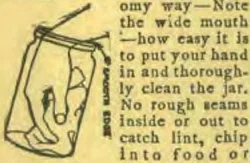
To give you an idea how easy it is to can fruits, soups, vegetables, meats, etc., in the Economy way—Note the wide mouth—how easy it is to put your hand in and thoroughly clean the jar. No rough edges inside of jar to break off, chip into food or scratch you.
After pouring the fruit in hot and wiping rim of jar, place the gold-lacquered cap (acid-proof). No screwing, twisting or prying. Just press the cap on gently. No bruises, burns, cuts or sprains when you use the Economy. Put clamp on top to hold cap in position while contents are cooling. The cooling forms a vacuum and holds cap on firmly. Jar is then absolutely air-tight. Next day remove clamp, which lifts off lightly. If the food was cooked enough cap is held tight by vacuum, and contents cannot spoil, as no air can leak in. If cap loosens, contents were not cooked enough to sterilize, and can be heated again and saved.
The Economy automatically informs you if contents are in proper condition to put away. When ready to use, puncture cap with can opener and pry off lightly. No sprained wrists, no unscrewing, no hands gashed by broken glass. No glass particles in food, no smelly tops; contents are as fresh and sweet as the day you put them up. CAPS 20c doz.
No separate rubber rings required. The Economy is the jar you will use with comfort and satisfaction year after year. There is absolutely no jar that looks like, works like, seals like, keeps like, or opens like the Economy. Using some other jar cannot give you any notion of what the Economy really is and what it really will do. Try the Economy for yourself. Ask your dealer for it. Send his name and state if he sells the Economy Jar, and we will send you free a book of recipes. Write direct to main office.
BEST FOR COMFORT, WEAR AND ECONOMY
FOR EVERY PURPOSE, FOR MAN AND YOUTH
Guaranteed to Outwear Three
of the Ordinary Kind
BULL DOG SUSPENDERS
Not a Harness—Do Not Twist or Tangle—Cannot Grow Stiff, Bind, Catch or Bag—Will Not Soil Linen. Are the Standard of True Suspender Economy
Contain more and better rubber and greater elasticity than any other suspender; have non-rusting, silver nickel metal parts and imported, unbreakable Bull Dog Leather Ends, insuring ease and action, longer wear, and better and more uniform trouser support. They give absolute satisfaction that cannot be had in any other make of suspenders.
In light weight lisles or heavy weight twills for man or youth (extra lengths at no extra cost). If they don't prove the Best 50 Cent investment you ever made you can have your money back by asking for it.
If your dealer won't supply you, we will, postpaid. There is no substitute for the Bull Dog
HEWES & POTTER
Largest Suspender and Belt Makers in the World
Dept. 232 87 LINCOLN ST., BOSTON, MASS.
Valuable Booklet, “CORRECT DRESS & SUSPENDER STYLES,” free on request.