The Youth’s Instructor, Vol. 37, No. 46.

ARCTIC EXPLORATIONS

The Youth’s Instructor

Nov 13, 1889

S. D. A. Publishing Association · Battle Creek, Mich. · Nov 13, 1889

ARCTIC EXPLORATIONS.
Were I to ask our geography students, What is the earth's axis? or, What are the poles of the earth? I am sure that a great chorus of voices would answer correctly at once. You would also tell me that the portion of the earth's surface for a certain distance from the poles is called the Polar Region; the one at the north being limited by the Arctic Circle, is called also the Arctic Region, and the one at the south, by the Antarctic Circle, is called the Antarctic Region.
These circles, on the map, give the limit of the polar regions, yet owing to certain local causes, some points within the Arctic Circle are milder by several degrees than other points considerably farther south than this boundary line.
Although the Arctic zone is so cold that the waters are solid ice a great part of the year, for the last three or four centuries many attempts have been made by brave seamen and men of science to explore it; not by all, we trust, simply for the gratification of curiosity, but many go in order that the world may have the full benefit of any knowledge or advantage they may gain. If you will compare a map of to-day with one of one or two hundred years ago, you will form some idea of the success that has attended their efforts at discovery.
One motive which induced Europeans to risk their lives in the perilous voyages consequent upon the exploration of the frozen seas of the North, was to discover a more direct passage to India, which was in their minds a land of unimaginable riches. First they thought to find a northeast passage,—by the coast of Norway, thence eastward through the Polar Sea along the coast of Asia.
In the 16th century well-manned vessels were sent upon such an expedition; and although the original object was not gained, it opened the way to commercial relations with Russia, and an experience was gained which proved beneficial in succeeding Arctic voyages.
Fifty years later, Englishmen had their attention directed to a northwest passage. If you have access to a map of the northern hemisphere, you will notice that there are three openings into the Arctic Sea, two of them from the Atlantic,—one between Greenland and Norway, one through Davis Strait and Baffin's Bay; the third is from the Pacific Ocean through Behring's Strait. The northwest passage, they hoped to find, would lead them west from England through the Atlantic, northwest through Davis Strait and Baffin's Bay, west through the Polar Sea, thence south through Behring's Strait into the Pacific Ocean, when they would have made the voyage to India in much less time than by the old route.
The main object with too large a class has been to try to reach the pole, or to discover an open polar sea, which in their imagination exists somewhere beyond any discovery which has yet been made. Many brave men have sacrificed their lives in these enterprises, and probably as many more in search of their lost countrymen.
One vessel forced a passage from the Pacific Ocean through Behring's Strait, the Arctic Ocean, and on even to the Atlantic Ocean; but the voyage was almost as hazardous as would be a ride through the rapids of Niagara River. Of what advantage to commerce is a northwest passage through such perilous seas?
All efforts of search within the Antarctic Circle have proved so unfruitful that but little is known of it. No one has been able but once to penetrate those vast ice-fields beyond the 78th degree of latitude; and south of about 65 degrees not so much as a moss or a lichen has been seen. One has written of this region, “There are no hunters there, like the Eskimos, to chase the seal or walrus; no herdsmen, like the Lapps, to follow the reindeer to the ocean's edge, and not a single land quadruped exists beyond 56 degrees,—all is one dreary, uninhabitable waste.”
I haven't space to give you the causes of this difference in temperature between the northern and southern zones, but your school and library books will instruct you what they are. A number of books have been written upon the subject of Arctic exploration, in which are given some thrilling incidents of the hardships and sufferings endured by explorers. Most of these you will find not only entertaining, but instructive in a knowledge of the Arctic region.
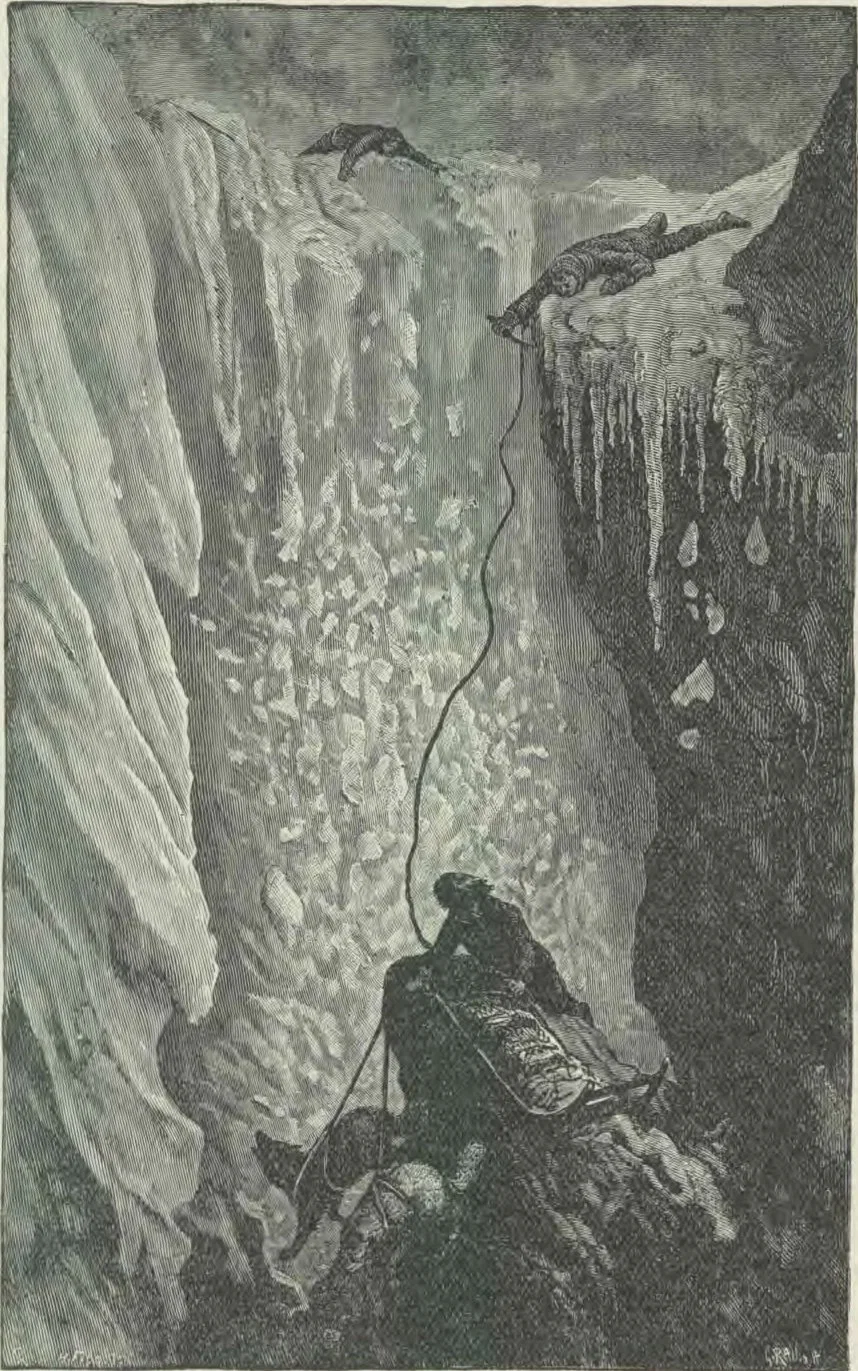
The cut accompanying this article represents a scene which transpired on an island some two degrees north of Nova Zembla. The party shown in the picture belonged to an Austro-Hungarian expedition, which set out on June 13, 1872, for a two and a half years' voyage of discovery among the icebergs of Nova Zembla. Among the crew, which numbered twenty-four, were Germans, Italians, and Hungarians.
Their vessel made good time through the North Sea, along the coast of Norway, until they reached the icebergs of Nova Zembla, when, as they advanced northward, it was greatly retarded in its progress by the continual crowding of ice-floes against it. In the meantime, too, they noticed that the channel through which they were guiding their ship was all the time narrowing up; and by the time they had reached the north of Nova Zembla, about the 20th of August, they were entirely shut in. But it was among these icebergs that they saw some of the beautiful and wonderful sights so common in this region, occasioned by the reflection of the sun's rays upon the fog and ice-glaciers.
Their vessel gradually drifted northward with the ice that imprisoned them, whither they knew not. The sea beyond and around them was grinding, and at times projecting great masses of ice, leaving chasms that threatened to engulf them, while the ice was, at times, pressing so hard against the ship that it seemed that it must collapse. The party packed their sledges, got their boats, clothing, and everything ready to leave the ship at a moment's notice, should it be necessary.
The vessel was drifted to about eighty degrees north latitude, when, although they had given up all hope of making any discoveries, they were joyfully surprised at the sight of land,—land discovered for the first time. In honor of their emperor they at once named it Franz-Josef's land.
The party spent the following fall and winter in making sledge journeys over this newly-found territory, and it was while making one of these trips that the accident occurred that is shown in the picture. As told by another, the story is as follows:—
“The party, after a brief halt, were just setting out again (in the fissures of what is known as Middendorf Glacier), when the snow gave way beneath the sledge-runners, and driver, dogs, and vehicle were precipitated into some unknown depth below. Payer [one of the commanders of the vessel] first heard the confused shouting of the man, mingled with the barking and howling of the dogs from the bottom of the crevasse below. ‘All this,’ says he, ‘was the impression of a moment, when I felt myself dragged backward by the rope. Staggering back, and seeing the dark abyss beneath me, I could not doubt that I should be precipitated into it the next instant. A wonderful providence arrested the fall of the sledge; at about thirty feet it struck just between the sides of the crevasse, just as I was being dragged to the abyss by its weight. The sledge having jammed itself in, I lay on my stomach close to the awful brink, the rope which attached me to the sledge tightly strained, and cutting deeply into the snow.’
“By incredible tact and perseverance, Payer at last freed himself from the sledge, and set about recovering the store of lost provisions, the manuscripts, which could never be replaced, and above all, about the rescue of the fallen comrade who was the ‘pride and gem of the party.’ Being the only one of the party accustomed to glaciers, Payer was of necessity almost alone in his exertions. Rushing back to the tent where most of the men had remained, he hurriedly explained what had happened, and all hastened to the scene of disaster. They found their poor comrade nearly dead from the cold, but sufficiently conscious to be pulled to the top of the ice-cliff over which he had fallen. The dogs were found uninjured, and quietly sleeping near him, but celebrated their release by joyful demonstrations.”
Satisfied that Franz-Josef's land could never be made available to mankind, and having become wearied with waiting two long years for their vessel to become released from the ice, the Austro-Hungarian party unitedly agreed, on the 20th of May, 1874, to abandon their ship, the Tegetthoff, and turn their faces homeward. It was not without feelings of regret that they parted with the ship, which had afforded them a home so long, and with some of their goods which they had to leave to share the fate of the ship. Pictures of relatives and friends they left hanging upon the frozen walls. Boats, sledges, and everything they could make available they took with them. They could not make room for their dogs, and rather than leave them to starve, they thought it an act of mercy to kill them.
I cannot tell of all they endured on their homeward route; but in time they were taken on a vessel, and all arrived home safely. M. J. C.

LITTLE BY LITTLE.

STEP by step the Alpine climber Presses upward, sure and slow, Till his feet are firmly planted In the realms of endless snow.
Blow on blow the sculptor fashions Roughness into symmetry. Till the dark rock gleams with brightness In its new-born majesty.
Touch by touch the picture groweth Into beauty, life, and light, Till a wondrous revelation Bursts upon the raptured sight.
Stroke by stroke the clock aye ringeth Welcomes to eternity, Adding warning unto warning, To the heart in me and thee.
Word by word the book is written, With its tale of woe or weal, Till the throbbing thoughts like music Through the trembling spirit steal.
Wave on wave the wild tide creepeth Farther on and up the shore, Till the stranded boats are floating Free and buoyant as of yore.
Such is life in all its phases, Little things make up the great; Therefore scorn them not, but make them Stepping-stones to heaven's gate.
—London Freeman.

ONE OF THE “FIZZLE FAMILY.”

There was once a very smart boy whom, to begin with, we will call Little Fizzle. He was one of those wide-awake boys who poke their noses into almost everything they see, and think they know half as much again as all the rest of the world. He went to school very young, and his mother wanted him to learn to read and write well before he did anything else; but he preferred to study “geog’gry,” grammar, and “’rithmetic” besides. As he was so very bright, he soon learned to write very badly spelled words, and could tell in quite incorrect language what verbs and adverbs were. He was likely to say Michigan was “bounded” by Connecticut, while other boys of his age, it may be, never heard of either place; for, young as he was, you see Little Fizzle had come to a point where he must choose between two ways. He could half learn a little about a great many things, or he could well learn all about a few things. He made up his mind he would do the first; and that is the way he went on and grew into a big Fizzle.
When he wanted to read, he never took one nice story and read it every word, but he skimmed over the easy parts of a dozen, and jumbled them all together in his mind. As soon as he opened a tool-box, he almost made a cart, and began a fine table, and finished a remarkably pretty rocking-chair which tipped over instead of rocking. But then it was “so stupid” to spend time and trouble in making only one thing and making it perfect!
As he grew older, people liked him because he could talk about all things under the sun, and was really very entertaining if they did not want to get any genuine information. He was not worth a last year’s almanac to anybody who was after facts.
He thought, when he grew up, he would be a lawyer, but he began by studying medicine. By and by he knew more about physic than a lawyer needed to know, and not half enough about medicine for a doctor. After awhile he began to wonder what ailed him that he failed in everything he tried. He grew poorer, and poorer, while men who had been boys with him—boys who had worked like drudges over a few things—these, grown up, became great men, rich men, famous doctors, lawyers, and ministers, while he was a little Fizzle grown into a big Fizzle. Then folks began to sneer and snub him. At twenty he had thought himself a genius; at forty he used to hang around a blacksmith’s shop and wish he had learned to shoe horses. At sixty he had given up all hopes of being a lawyer, a doctor, or an artist, or a blacksmith, and he kept his soul and body together by cleaning out feather-beds.
Now, if anybody wants to become such another big Fizzle, let him half learn everything he begins.—S. S. Evangelist.

“SAUCE FOR THE GANDER.”

“HERE, fag! go and pick up my ball.”
“I am not your fag, and I won't pick up your ball,” angrily answered Charlton Maclin, to whom these haughty words had been addressed.
“You won't, eh? But it's my business to make you,” roared Elmo Dixon, pouncing roughly upon the younger boy. “There! you'll pick up your cap, I suppose, and your books” (knocking these articles to the ground); “and if I knock you over, perhaps you'll condescend to pick yourself up, though I wouldn't if I were you; you're not worth picking up.”
“Oh, Elmo!” cried a gentle voice behind him, “what makes you do so?”
Elmo quickly took off his hat to the girl who had just turned into the street from Mr. Douglas Reid's handsome grounds. You would have been surprised to see how well behaved he could be when he chose:—
“Oh, don't be disturbed, Sybil; I'm only fooling with this youngster.”
“But it is such disagreeable fooling!” remonstrated the girl. “Do let go Charlton's ear! How would you like any body to fool with you in that way, Elmo?”
“Oh, what's sauce for the goose isn't sauce for the gander, you know,” answered the big boy lightly; but he left off teasing his companion, and little Sybil, gratified at having effected her kind purpose, hastened to entertain him with an account of the company at her father's house the evening before.
While they were talking gayly, a gentleman passed them, and spoke pleasantly to both. “Well, I say,” exclaimed Elmo, “that's Cousin Frank—lives at our house, you know. Wonder how long he has been walking behind us?”
“I saw him when I first came out of our gate,” answered Sybil, and went on with her chatter, not observing that she had lost her companion's attention.
“Here, Elmo, you milksop!” said Cousin Frank that evening, as the boy entered the sitting-room, “take these shoes upstairs, and bring me down my slippers; be quick now, or I'll throw them at you.”
Elmo's face reddened violently; he was devoted to Cousin Frank, and would have done anything for him cheerfully, but to be spoken to in such a rude way was an insult. He did not stir from the room. “You won't do it, won't you?” shouted his cousin; and seizing the tongs, he poked Elmo not very gently in the ribs.
While this scuffle was going on, Mr. Dixon entered the room. “See here!” he called out in a loud voice, “go and get me a glass of water, Elmo, and don't lose any time about it, sir, or I'll pitch it over you.”
Elmo looked at his dignified, courteous father in amazement. “What in the world is the matter, mother?” he asked as the lady entered the room.
“I was just going to ask that question myself,” she answered, looking anxiously from one to the other.
“Oh, it's nothing, Cousin Mary,” said Mr. Frank, with a twinkle in his eye; “we are only fooling. We want to show Elmo how the goose's sauce suits the gander.”
In a flash there came back to Elmo the little scene which Sybil had stepped out upon in the morning. “You thought your father and I had turned rowdies, Elmo, didn't you?” asked the gentleman gravely. “Well, now, my boy, you know just what I thought of you this morning.”
“But, Cousin Frank, boys are different from grown men.”
“Yes, they can run faster and jump higher and eat more candy, may be; but, my dear boy, they have no more business to play the ruffian in their little world of school and home than men have on a wider field. Now, I just ask you as a favor, next time you feel like being rude and disagreeable, to think how it would become your father.”
“Father?” exclaimed Elmo.
“Certainly; your father has no more call to obey the Golden Rule than your father's son.”
Elmo said, “Pshaw!” as if he did not agree with this opinion; nevertheless, the small boys at Mr. Morrow's school began to have an easier time, without knowing that they owed it to Cousin Frank and the Golden Rule.—Sabbath-school Visitor.

TRY, TRY AGAIN.

“Mamma, I never can do this seam right. It puckers all up every stitch I take!” said Florence Darley impatiently, as she looked across the room at her mother.
“Bring it to me, dear. I thought you would have no more trouble with it after I started it for you the last time.”
“One side wants to go faster than the other, or something,” said Florence, “just because I am in a hurry.”
“Isn't your mind more on Belle and Lottie, playing out there by the gate, than it is on this little bit of sewing you have on hand?” asked her mamma pleasantly.
“Yes, it is,” answered the little girl, with a pout. “They are waiting for me to go over to the old hickory tree to see if there are any nuts on the ground. I think Rose might do this apron on the machine. What is the use of sewing with a needle, when she could do it quicker and better on the machine? I have had to rip it out twice already. I can never do it right!” and two big tears trickled slowly down over the plump cheeks.
“Try, try again, Florie. You will not need to take out your stitches if you will only calm yourself, and take a little pains. There, I have fixed it for you so you can finish it in ten minutes, and the girls will wait for you,” said Mrs. Darley. “And the ‘use’ of doing it with your own needle is that you cannot always carry a sewing machine around with you wherever you go, to mend the tears and rips you may make, and you would be in a pitiable state if you did not know how to sew by hand.”
“Do you remember the story we were reading a few days ago of the young teacher who always mended her clothes by pinning them? And of her doing it once too often, when she pinned a rip in her pocket, and lost her month's wages through the hole after the pins had slipped out? If you learn to use a needle now, and to form habits of neatness and order, you will never have her experience.”
“Yes, mamma, I remember,” said Florence, brushing away her tears, and looking up brightly. “I hope I shall never be like her. See,”—holding up the apron,—“it is finished, and I'm glad I didn't give up trying to do it right. Now I'm off to the tree, to see how many nuts the frost has brought down.” When Florence came back with her basket filled with nuts, she met at the gate her mamma, who was just returning from the store. She gave Florence a pretty book of child's poems, bound in blue and gold.
Soon Florence came running to Mrs. Darley, with her face all aglow, saying, “O mamma, see what I have found on the first page of my new book!”
“‘If at first you don't succeed, Try, try again. 'Tis a lesson you should heed, Try, try again. “‘All that other folks can do, Why with patience may not you? Only keep this rule in view, Try, try again.’”
“Isn't it funny that that is just what we were talking about this morning?”
Her mamma did not seem so very surprised, but stooping to kiss Florence, she said, “I hope you will remember, dear, to make that your rule always, in every good work. ‘Practice makes perfect’ in everything.”
MRS. L. E. ORTON.

The Talent of Success

THE talent of success is nothing more than doing what you can do well, without a thought of fame.— H. W. Longfellow.

PLAIN TALK FROM JOHNNIE.

THERE are men that are ever so kind and good, And yet not ever so clean; Most all of them say they'd quit if they could— Quit chewing tobacco, I mean. But they'd never be wishing so much to get out, If only they'd never got in; And that's what I've made up my mind about,— I'll quit before I begin.
There's Crissy, my dear little sister so bright, So rosy and sweet and glad, That every one's bound to hug her at sight, And often it seems too bad; For she turns away whenever she can From the chewers—poor little Criss! I'll try to be that sort of a man That a baby'd be willing to kiss.
Our good old bossy-cow chews all day; She's got in the habit, I 'spect. But she does it in such a nice, clean way That no one could ever object. And then I'd like to remark just now,— And you may deny if you can,— That some things look very well for a cow That look very bad for a man.
Though some of the boys may tease and laugh, 'T will be all the same to me. I'm sure tobacco is worse than chaff, So I'll have my choice, you see. I'll give as good as they send in jokes, And do what I said I'd do; For, unless I change to a cow or an ox, I never, NEVER will chew!
—Companion.

BENNIE'S BAD HABIT.

BENNIE is a mischievous boy. He makes the family a great deal of trouble. He always wants to see how things look on the inside. He wants to see what makes them stay as they are, or what makes them go, and why they will not go just as well if fixed some other way. When he was a very little boy, he went to a show. His mamma bought him a pretty red balloon tied to a string. She gave the string to Bennie to hold. He wanted to know what made the balloon stay up in the air. He poked a hole in it with a stick, but he did not find out, and he spoiled his balloon. That is the way most of his experiments turn out.
One time Santa Claus brought his sister a wax doll. It had eyes that opened and shut. It had real hair. It cried out loud when it was pressed on its stomach. Bennie admired the doll. He wanted to know at once what made its eyes fly open. He wondered how it could cry. So he broke a hole in its head, and cut open its body. But he could not mend the doll again. All Bennie's toys suffered in the same way.
The tall clock in the kitchen was also a great temptation to Bennie. He very much wanted to take off the face and see the wheels go round. One day all the folks were gone. Bennie climbed up into a chair, with a screw-driver in his hand, and took the face off. Something fell down, and all the little wheels stopped. Bennie put the face back. He could not start the clock again, and grandpa had to send off for a man to come and fix it.
Bennie has another fault. He thinks he can do everything he sees any one else do. He is really a kind-hearted boy, and wants to help. But he does not like to wait to ask. He wants to do the big things.
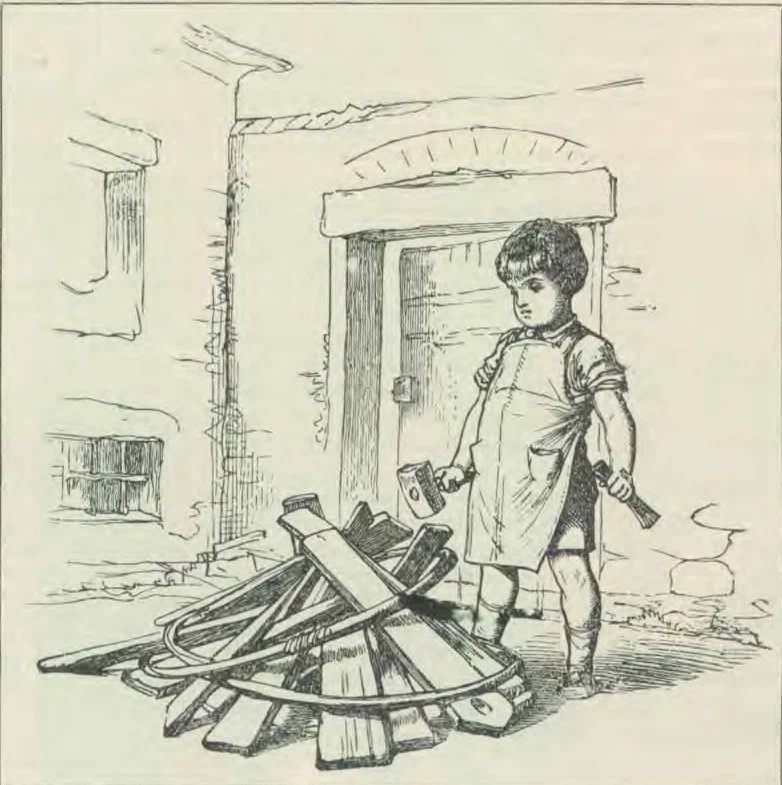
One washing day he heard grandma say the hoops on the tub were too loose. Bennie was sure he could fix it. He took a mallet, and tried to tighten them. He pounded too hard, and the hoops flew off. Then the tub fell to pieces. Grandma had to go to a neighbor's and borrow another one. Bennie's helping was often only hindering.
Did you ever see a little boy like Bennie? I suppose he will never learn very much unless he does try to find out all the “whys” about things. Curiosity is the name of that quality that prompts Bennie to pry into things. It it is a good quality to have, but Bennie must learn to control it. He must think very hard, and find out whether the things he wants to pry into are things he has a right to meddle with. Do you not think he would save himself and other people a great deal of trouble if he should first stop to ask about things? W. E. L.

KNOCKING

“I GUESS God won’t hear such a very, very little girl like me.”
That was what Dorothy said when her grandmother told her to kneel down and say her prayers before she went to bed.
Dorothy had never been taught to say her prayers. Does that seem very strange to you, my little ones? I hope so. I should be glad to think that there is no little boy or girl who will read this who will not think it strange; yet until Dorothy came to live with her grandmother, no one had ever taught her to say her prayers.
And that first night, when her grandmother bade her kneel down beside her bed and pray, the little girl opened her blue eyes wide, and said, “But I guess God won’t hear such a very, very little girl as me.”
The blue eyes were very sleepy eyes, and grandmother did not think it best to talk that night; so she only took the little hands in hers, and knelt down with Dorothy, and taught her to repeat after her, for the first time, the words I hope you all say every day: “Our Father.”
Next day Dorothy followed grandmother happily about the house, helping in her small way; and she was very proud when grandmother gave her a basket into which she had packed a loaf of white bread and a pat of fresh butter, and bade her run across the road with it to a cottage where a poor old woman lived, who was often helped in this way by her neighbors.
Grandmother watched the little girl from the window, and saw her run across the road and up the walk to the cottage door.
There was an old-fashioned knocker on the door, and Dorothy reached up, trying to touch it. But it was far above her head, and although she stood on tiptoe, and stretched her little arm to its full length, she could not reach it.
She tried again and again, but at last, when she found that there was no use in this, she doubled up her little hand, and rapped smartly on the door with her own knuckles. In a moment the door was opened, and Dorothy and her basket passed in out of grandmother’s sight.
That evening, when bedtime came again, grandmother took the little girl on her lap, and said, “You had a good deal of trouble in getting into Mrs. Pratt’s this morning?”
“I couldn’t reach the knocker; I tried and tried,” said Dorothy. “Did you see me, grandmother?”
“Yes, I saw you, and I wondered why you didn’t come away when you couldn’t reach the knocker.”
“Why, I could knock myself,” said Dorothy. “Didn’t you see me knock with my own knuckles?”
“Yes; but I don’t see why you thought Mrs. Pratt could hear you knock with such very, very little knuckles.”
Dorothy laughed, and doubled up her fist, and looked at her soft knuckles. “She did hear,” she said, “they could knock loud enough for that.”
“Even if you couldn’t knock with the grown-up people’s knocker? It seems to me you are wiser than you were last night. Don’t you remember, when grandmamma told you to say your prayers, you thought God would not hear such a very little girl’s voice? But you were not afraid that Mrs. Pratt could not hear such a very little girl’s knock.”
“Oh, but,” said Dorothy, “that’s different.”
Grandmother took up her Bible, and turned over its leaves. “Listen to what our Lord Jesus says about knocking,” she said. “Ask, and it shall be given you; seek, and ye shall find; knock, and it shall be opened unto you. For every one that asketh receiveth; and he that seeketh findeth; and to him that knocketh it shall be opened.”
“It does not say, ‘Knock, grown people, and it shall be opened unto you,’ or ‘Knock, little people, with the grown people’s knocker.’ Every one is to knock—very little girls and all; and it is with prayer we knock. God will hear even the faint little tap that my Dorothy’s voice gives at his door. His ears are, oh, so quick; and he is glad when he hears the little ones come knocking and asking him to open to them. He gives his Holy Spirit to teach them how to pray, and he will put right wishes in their hearts and right words on their lips, so that they need never be afraid to come to him.”
“Every day, then, my little girl must knock, and God will hear, and will give her what she asks if it is best for her.”—Young Christian Soldier.

GENERAL GARIBALDI AND THE LOST LAMB.

GARIBALDI was a great soldier. He felt that his country was oppressed and downtrodden, and he determined to fight for its liberties.
One day when he was passing through a country, he met a shepherd who had lost a lamb. Like the shepherd Jesus tells us of in the parable of the Lost Sheep, this man was much distressed about his lost lamb. Although General Garibaldi had a great work before him, he at once ordered his soldiers to help the shepherd in his search. After a long time they came back saying that they could not find the lamb. That night the General was missed by his men. They searched for him in many places, and at last found him lying in a shed on a heap of straw. And what do you think was beside him? It was the little lamb, which he had found after a long, hard search, and there both the great General and the tender, snowy lamb were fast asleep. He had traveled about so long that he was very weary.
Do you not think he was like the great and good Shepherd who “gathers the lambs in his arms, and carries them in his bosom”? Indeed, it was just because he had the spirit of Jesus that he was such a friend of the poor and needy and the oppressed. He must have had great pity for the lost lamb, or he would not have missed his night’s rest, and gone out into the darkness and traveled over the hills until he found it. But how much greater love must Jesus have had when he gave up the rest which he might always have enjoyed in heaven, when he came down into this dark world and spent a life of sorrow in it, and at last suffered those terrible things of which we read in the Bible!
How great the love of Jesus is for you now! Nothing can give him so much joy as to let him come into your heart and save you from your sins. Will you be so ungrateful to him and so unkind to yourself as to keep him standing longer on the outside? He is saying, “If any man hear my voice and open the door, I will come in and sup with him, and he with me.”

AFRAID TO TRUST HIM?

ARE YOU afraid to trust Him, Seeming so far away? Wherefore, then, not keep closer— Close as he says we may? —Anna Warner.

A TOUCH-ME-NOT.

She did touch it at first, though, but put it down again. She won't touch it again, though, because something wouldn't let her. This was what she told her grandmother about it: “A Satan-thought came to me, and said, ‘Take it; it's only an apple.’ But I said, ‘I can't take what is not mine.’ Then the Satan-thought came again, and said, ‘Just touch it, and see how soft and ripe it is.’ Then I said, ‘I won't even touch it again; I'm a touch-me-not,’ and so I am.”
Continue reading: LETTER TO THE HEBREWS