The Youth’s Instructor, Vol. 30, No. 43.

LEGEND OF THE WHITE CANOE

The Youth’s Instructor

Oct 25, 1882

S. D. A. Publishing Association · Battle Creek, Mich. · Oct 25, 1882

LEGEND OF THE WHITE CANOE

Written for the Instructor.

LEGEND OF THE WHITE CANOE.

In the days, now gone forever, When the forest paths had never Echoed to the white man's tread; Where Niagara's swift waters, Seek for rest, but never find it, Falling on their stony bed— Tall and dark, and very silent, Donning plumes, and wearing war-paint, Dwelt the red men in their wigwams.
This a custom of the warriors— Once a year they all assembled At the Falls for sacrifice. Not without the flock a firstling, As the Scriptures speak of yore, Not the turtle-dove and pigeon, Grains and fruits and nothing more. But canoe of snowy whiteness, Filled with autumn fruit and flowers, Rowed by fairest Indian maiden, That abode in sylvan bowers.
It was not considered penance, By the women or the warriors, Kith and kin of any tribe. Parents thought it to be honor, As they clasped their blooming daughter, If the lot had fallen on her— Though the arrow pierced, they smiled. Smiled at heart in secret triumph— Theirs the fairest of the fair— Ne'er betrays the stoic features, Pain or pleasure reigning there.
It has come—the day of offering; And have gathered from the forest, All its dusky denizens— 'Tis not strange the lot fell on her— Fawn-like in her maiden beauty, Daughter of the chief of Seneca.
Hostile hand his wife had smitten, And in all the forest wild, Naught could cause a thrill of pleasure, But his star-like, darling child. Not a wave came o'er his features, Not less proud his lofty bearing, As the festive day wore on.
There are spirits high as heaven, That by nature cannot bow— Harp that's tuned to highest tension, Broken strings or wail must know. Grace may come, for God hath given Strength to every wayward child; And the storm-cloud, thunder-riven, Sunglit on the vale hath smiled.
When the evening stars were glimmering, Through the misty clouds of spray, From the margin of the river, Shot a white canoe away. Deftly, calmly, steered the maiden, Her light bark adown the stream, While the forest aisles re-echoed, Hideous yell, and frantic scream.
Suddenly there swept another White canoe along the wave— With one look of love, together, Child and sire go to one grave.
Riseth the moon serenely, Over the dashing stream; Resteth the sleepers sweetly, Forgotten life's troubled dream. Gone are the forests they traversed, And vanished the forms they knew— Such is the pale-face's legend, Of Niagara's White Canoe.
MARY MARTIN.

THE OLD SHEPHERD.

It was twilight.
“Shadows from the fitful firelight Danced upon the parlor wall.”
Soon, though, the evening lamps were lighted. There was every reason why all should be bright and merry, unless—well, there was a circle round the moon, and not one star was to be seen within the circle,—a sign, according to the kitchen authorities, that there would be rain the next day,—the very day of all the year when the young people of the house were to go on a chestnut-hunt. Every preparation had been made. And now if, after all, it should rain! Amy and Wallace sighed at the thought; but Sue and Rufus refused to entertain it for a moment.
“Nothing quite so bad could happen,” they said. “If it does, we will never plan any fun again—no, not as long as we live!”
“Don’t cross the bridge till you come to it,”—which means, of course, ‘Do not borrow trouble,’ said wise Uncle Ben.
“Neither would I believe in all the weather-signs that I chanced to hear,” added Stanley, a tall brother.
But the mother said, “I must introduce you to my Shepherd of Salisbury Plain.”
Ann, who had just come in from the kitchen, gave a quick, bright look, which did not escape the keen eyes of Master Harry.
“Who is the shepherd, mother?” he asked. “Does Ann know him?”
Mrs. Rowland smiled, and answered, “I dare say that Ann knows much about Salisbury Plain.”
“Indeed, ma’am, I do,” said Ann, with a beaming face, lingering a moment, while Mrs. Rowland told of the beautiful plain in England, near Ann’s childhood home.
“But, mother, who was the shepherd?” asked Sue.
“He was introduced to me long ago, when I was a little girl. I had expected a delightful time, with a party of friends, on the river; but the rain came and spoiled everything, as I declared with tears and pouts and frowns. Even now I can fancy the touch of my mother’s hand on my head, as she said, ‘Come, little daughter, I want to show you something.’ I followed her to her room, and stood by while she opened a curious little cabinet. I admired that cabinet, and was always especially delighted when my mother would unlock it, and give me a peep at the treasures inside. She opened a drawer that I had not noticed before. She took out a book with a little green cover, and showed me the title-page, and the picture of a man with a shepherd’s crook. ‘Oh!’ I cried. ‘I suppose that he is David, keeping his father’s sheep; or perhaps he is Moses, in Midian; or—who knows?—he might be one of the shepherds who heard the heavenly music the night that Jesus was born.’ ‘Read, and find out about him, and come by-and-by and tell me how you like him,’ said my mother. I took the little green book, inclined to look upon it as a treasure, if for no other reason, because it had been in the cabinet so long. I sat down in my little rocking-chair on one side of the great open fire-place, forgetting all about the rain in my anxiety to make acquaintance with the man in the picture.”
“Was he really Moses, or David, or one of the shepherds of Bethlehem?” asked Amy.
“No; he was a man who lived about fifty years ago, on Salisbury Plain.”
“Near Ann’s home?”
“Yes. I dare say that Ann would like to tell you about that plain some day,—how the turf grows over it; though I believe that lately the land has been portioned off into farms.”
“But, mother, what is there to tell about the shepherd?”
“An English lady, Hannah More, considered some things about him so remarkable that she wrote the little book, and called it ‘The Shepherd of Salisbury Plain.’”
“Tell us what you read about him, that day, in your little rocking-chair by the great fire-place. I wish that we had an old-fashioned chimney-place where we could have a blazing log-fire!” exclaimed Sue. “Then a rainy day would not seem half so stupid.”
Mrs. Rowland smiled, and said, “I see that you need very much to know about my shepherd. First, I found that he wore a coat so covered with patches that no one, not even a boy with eyes as bright as Harry’s, could tell which was coat and which was patch. His stockings, too, were darned with many-colored worsteds; and his shirt, though pure white, was coarse as the sails of a ship, and covered with darns and patches.”
“The poor fellow must have been ashamed of his clothes,” said Wallace.
“No; he was not in the least ashamed,” said Mrs. Rowland. “He was delighted to have people see them, and admire the busy, careful wife who had put such neat work on them.”
“What more about him, mother?”
“A gentleman, traveling over the plain, met him, and asked what kind of weather he thought it would be next day. ‘It will be such weather as pleases me,’ said the shepherd. ‘How can you be sure?’ asked the gentleman. ‘Because,’ answered the shepherd, ‘it will be such weather as pleases God; and whatever pleases him pleases me.’ The gentleman had never heard any one talk in that way. He resolved to ask a few more questions, to see if the shepherd were really such a man as this speech would make him appear. He found out that he lived across the plain, in a hovel, with one room above, one below, and scarcely a chimney; that his wife was sick nearly all the time, and that they had eight children. ‘Poor man, what a hard life you must have!’ thought the gentleman. But when he said as much, the good shepherd looked at him with surprise, and spoke as though there were not a man in the world happier than he. ‘True,’ he said, ‘I am often in the wet and cold, and I have no time to be lazy; but it is well to be busy. Besides, the troubles of my lot are not nearly so many, nor so great, as my Master suffered. When I am lonely,’ he added, ‘I can think over the Bible words that I have learned. I can look up, too, toward the stars, and thank God for his wonderful works.’ As to his wife and children, he did not seem able to praise them enough. They were always good and kind and busy, he said. The boys, who were very little, were still able to earn a penny by keeping the birds away from the farmer’s corn, or by picking up stones. ‘Anything is better than idleness, sir,’ he said. ‘If they did not get a penny for it, I should have them do it just the same, for the sake of giving them early habits of labor.’ The little girls, who were not able to do hard work, would wander over the hills, and pick up little pieces of wool that the sheep had rubbed off their backs, and carry it home. The mother would card the wool, the girls would spin it, and the little boys would knit it into stockings at night, or while they were watching the neighbors’ cows.”
“What a way to get stockings!” exclaimed Sue. “I wonder how they managed about shoes.”
“In some ingenious way, no doubt. Indeed, the shepherd told the gentleman so many wonderful things that he resolved to visit the family, and judge of matters for himself. He was not disappointed. The more he saw of them the more he admired their cheerful, thankful spirit, and the more ashamed he felt of himself for worrying over what he called vexations and disappointments. It is a long story,” continued Mrs. Rowland. “If it should rain to-morrow, we might have a good time reading it.”
If it should rain! They hoped that it would not. But, somehow, when they thought of the shepherd, with his sick wife and eight children, how they lived in a leaky cottage, and had to work so hard for shoes and stockings and dry bread, and yet were all the while so happy and thankful,—when they thought of this, they were ashamed to worry about the weather.
Mrs. Rowland did not make any personal application of the story which she had told. She left that to the keen heads and ready hearts of the children. But she saw that during the rest of the evening there was less of restlessness regarding the coming day, and a greater disposition to take contentedly whatever weather might come. Even Harry seemed to think more of the cheery Shepherd of Salisbury Plain than he did of to-morrow’s projected chestnut expedition, while thoughtful Sue was evidently lost in a brown study. It was not till late in the evening that she came half shyly to her mother’s side.
“Mother,” she said, “do you know that I cannot help thinking of those lines that I recited in school last week:—”
‘Some murmur when their sky is clear And wholly bright to view, If one small speck of dark appear In their great heaven of blue. ‘And some with thankful love are filled If but one streak of light, One ray of God’s good mercy, gild The darkness of their night. ‘In palaces are hearts that ask, In discontent and pride, Why life is such a dreary task, And all good things denied. ‘And hearts in poorest huts admire How love has in their aid (Love that never seems to tire) Such rich provision made.’ —S. S. Times.

THE CATERPILLAR AND THE BUTTERFLY.

A CATERPILLAR was one day warming herself in the bright rays of the sun. The sky was very blue above her head. The tree upon which she had always lived was covered with soft, tender, green leaves, upon which she could feed at any time; and she felt very happy.
“Who in all the world is so fortunate as I!” thought she. “Here is my home. I am surrounded by the beautiful sunlight, and can breathe the clear, dry air: my food is all about me; and if an enemy approach, I can flee to the protecting shade of one of these leaves, and lo! I am hidden from view.”
At that moment, a large butterfly alighted on a bush beneath the tree. The caterpillar gazed with wonder on the gorgeous wings of the stranger, and thus saluted him:—
“Good morrow, fair sir. Didst thou come from the golden land of the sunbeams?”
But the butterfly looked with scorn upon the worm, and bade her hide her unshapely form from the sight of day, as she did but mar the beauty of all around.
Then the caterpillar hid her head in sorrow, and began to mourn; and she wept till the setting of the sun. And, behold, when the night came, she had spun a shroud, in which she folded herself, and she was hidden from the gaze of all. Then the caterpillar was content.
It so happened one day that the master of the garden passed that way with his little daughter; and she, looking up, beheld the enshrouded caterpillar, but knew not what it was.
Pointing it out to her father, she asked that it might be taken from the tree.
“Not so,” replied the master; “for within the covering you there see is that which will one day be a beautiful butterfly.”
Then the caterpillar, upon hearing these words, was filled with wonder and great joy. And she hasted to find the sunlight, that she might see for herself the beauty of which the master had spoken.
It so chanced one day that she was enabled to throw aside the covering that was enfolded about her, and to step forth into the beautiful light of day.
Then, her heart being full of joy, so much so that she could not restrain herself, she sprang upward, and found herself floating in the air. On either hand, her outspread wings sparkled in the sunlight; and she knew that the master's words were true.
Soon it chanced that she grew weary, and alighted on a low bush near by, where also came the same butterfly which had scorned her not many days before. And the butterfly bowed low at her feet, offering homage to her in her new dress.
“Thou art surely the queen of the butterflies,” said he; “and as such I yield myself to thy service.”
“Not so, friend,” replied she: “'tis but my dress thou dost serve. When I was but a homely worm, thou didst reject me and my greeting: how canst thou care for me now?”
Then the butterfly was struck speechless, and hung his head in shame, while she whom he had scorned in her humility now soared in her beauty far away, until she was lost to his view.—Mrs. Sarah E. Eastman.

YOUR HISTORY.

It is said of Peter the Great, Emperor of Russia, that once, when out in a sailing-boat, he became so angry at some offense given by one of the men, that he seized him and was about to throw him overboard. The man had but time to say, “You may drown me, but your history will tell of it.” Struck by the force of this fact, the emperor relaxed his hold and desisted from his terrible purpose.
Boys and girls, do you know that the acts and words of every day will make up something of your history? Once in a while, some act will be performed that will mark a special point in your life. It may be an act of blessing, it may be some dreadful, dark deed. In either case, it will loom up out of the past, and will determine in great part the character you shall form and the reputation you shall bear for life. As the colors and figures that are woven into a fabric determine its character, so the acts, the words, the thoughts, that are woven into your every-day life will determine with unfailing accuracy what your life shall be.—Children’s Friend.

SOWING THE SEED.

Out in the garden of life, God bids us sow the seed,— Each in the place he has given, By word or deed.
Within the Master's vineyard There's work for great and small,— Sowing the seeds of heavenly truth, Where he may call.
Over the fields of sin, He guides the faithful hand, To scatter abroad the golden grain For the joyous harvest land.

“IT WILL LIGHT YOU HOME.”

Going two miles into a neighborhood where very few could read, to spend an evening in reading to a company who were assembled to listen, and about to return by a narrow path through the woods, where paths diverged, I was provided with a torch of light wood, or “pitch pine.” I objected; it was too small, weighing not over a half pound. “It will light you home,” answered my host. I said, “The wind may blow it out.” He said, “It will light you home.” “But if it should rain?” I again objected. “It will light you home,” he insisted. Contrary to my fears, it gave abundant light to my path all the way home, furnishing an apt illustration, I often think, to the way in which doubting hearts may be led safely along the “narrow way.” If they would take the Bible as their guide, it would be a lamp to their feet, leading to the heavenly home. One man had five objections to the Bible. If he would take it as a lamp to his feet, it would “light him home.” Another told me he had two faults to find with the Bible. I answered him in the words of my good friend who furnished the torch, “It will light you home.”

Improve the Odd Moments

IMPROVE the odd moments. It is surprising how much may be done by using a few moments at a time. There are many kinds of light labor, and many subjects of study, which may be followed successfully by taking a few moments at a time. Let our young friends try the experiment.

SCENES IN THE LIFE OF CHRIST.

LESSON 92.—JESUS QUESTIONS THE PHARISEES.

The Pharisees had made two unsuccessful attempts to entangle Jesus in his talk, but now while they were gathered together he asked them a question, saying, “What say ye of Christ? whose son is he?” And they say unto him, “The son of David.” Jesus then questioned them still farther. Referring to the 110th Psalm, he said, “How then doth David in spirit call him Lord, saying, The Lord said unto my Lord, Sit thou at my right hand till I make thine enemies thy footstool? If David then called him Lord, how is he his son?” These questions were too hard for the Pharisees, and they were greatly perplexed in not being able to answer them. The Scripture record says, “And no man was able to answer him a word, neither durst any man from that time forth ask him any more questions.” The common people, however, heard him gladly; and our Lord, turning to them, said, “Beware of the scribes and the Pharisees; for although they teach the law that the Lord gave Moses, they do not obey that law in their lives; and while you should be careful to obey the words of the law which they read to you, you must not do according to their works; ‘for they say and do not:’” He taught them in substance as follows: “These proud teachers care more for the good opinion of men than they do for the approval of God. They love to walk in long robes, to be honorably saluted in public places, to have the highest seats in the synagogue, and the chief rooms at feasts; but they are unkind and exacting toward the widows and the fatherless, and as a pretense to cover this wickedness, they make long prayers in places where they will be seen and heard of men.” Jesus plainly taught that these men would be held more guilty in the sight of God than they would have been if they had not made such great pretensions to piety.
Outside of the temple building there were inclosed places called courts. These were separated from one another by low walls of stone. One of these was called the court of the women. In this court was the treasury of the temple, where the people dropped in money to be used in buying incense and such other things as were needed in the services of the temple. As Jesus sat over against the treasury, he watched the people as they dropped their offerings into the large trumpet-shaped openings that led into the treasury. Many rich people cast in much. After a time there came along a poor widow, who cast in the smallest coin that was known among the Jews. This coin was valued at two mites, or about one-third of a cent. When Jesus noticed this, he called his disciples to him, and said, “Verily I say unto you, That this poor widow hath cast more in than they all which have cast into the treasury; for all they did cast in of their abundance; but she of her want did cast in all that she had, even all her living.”

QUESTIONS.

  1. What attempts had the Pharisees made to entangle Jesus in his talk?
  2. How did they succeed in these attempts?
  3. What question did Jesus now ask them? Matt. 22:42.
  4. How did they reply?
  5. To what Psalm did Jesus refer in his next question?
  6. What words did he quote?
  7. What question did Jesus then ask them?
  8. How did the Pharisees receive this question?
  9. What does the Scripture record say about the effect of this talk?
  10. What interest was manifested by the common people? Mark 12:37.
  11. As Jesus turned to them, what caution did he give them?
  12. What did he say about the teaching of the scribes and Pharisees? Matt. 23:2, 3.
  13. What did he say about their lives?
  14. What did he tell the people to be careful to do?
  15. What did he say they must not do?
  16. Why was it not safe to follow the example of the scribes and Pharisees?
  1. For what did these proud teachers care most?
  2. How did they like to appear when they went out to walk?
  3. What attention did they like to receive?
  4. What did they want to have when they went into the synagogue to worship?
  5. How did they like to be honored at feasts?
  6. Of what cruel and dishonest actions were they guilty?
  7. By what pretense did they try to make the people think they were very holy?
  8. What did Jesus plainly teach in regard to these men?
  9. What name was given to the inclosed places about the temple building?
  10. How were they separated from one another?
  11. What was that one called where the treasury of the temple was situated?
  12. How was this treasury supplied?
  13. What use was made of this money?
  14. What did Jesus do as he sat over against the treasury?
  15. What did he notice as he was thus watching?
  16. How much did the poor widow cast in?
  17. When Jesus had called his disciples to him what lesson did he teach them from this circumstance? Mark 12:43, 44.

NEW-TESTAMENT HISTORY.

Lesson 106.—Review.

1. WHERE did Jesus go with his disciples on the night of the Passover?
2. What had already taken place during that evening?
3. After entering the garden, for what purpose did Jesus withdraw himself from his disciples?
4. What ones did he take with him?
5. Repeat his agonizing prayer.
6. Relate the circumstances attending it.
7. After the struggle was over, and Jesus returned to the disciples the last time, what did he say to them?
8. Describe the betrayal of our Lord.
9. What took place in the garden after the mob came out to take him?
10. To whom did they first take him?
11. Where was he next sent?
12. Describe the temptation, the denial, and the repentance of Peter.
13. What words of Jesus were fulfilled by Peter’s denial?
14. Relate the circumstances that called out these words.
15. When Jesus was brought before the high priest, what altercation took place between them?
16. What ill-treatment did this bring upon him?
17. When the high priest found that he was foiled in this attempt, how did he next try to condemn Jesus?
18. How was he defeated in this attempt?
19. How did he then find an accusation against the Saviour?
20. What decision was made by the council?
21. What insulting treatment did our Lord then suffer?
22. What measures did the Sanhedrim then take for the purpose of securing from the Roman governor legal authority for putting Jesus to death?
23. Describe the repentance and confession of Judas. Matt. 27:3, 4.
24. What rebuff did he receive from the chief priests and elders?
25. To what desperate act did his bitter remorse then lead him?
26. What scripture was fulfilled by the subsequent action of the chief priests with reference to the money that Judas left with them?
27. When Pilate had come out of the Judgment Hall, how did he try to shun the responsibility of condemning Jesus? John 18:29-31.
28. Why did the Jews object to this proposal?
29. What vehement accusations did they then bring against Jesus? Luke 23:2.
30. Relate the conversation that took place between Pilate and Jesus in the Judgment Hall. John 18:33-38.
31. What took place when Pilate brought Jesus forth to the Jews? Mark 15:3-5.
32. What did Pilate declare before all the people? Luke 23:4.
33. What course did Pilate pursue as soon as he had an intimation that Jesus was from Galilee? Luke 23:6, 7.
34. What treatment did Jesus receive at the hand of Herod?
35. When Jesus was again returned to Pilate, what proclamation did Pilate make before the chief priests and rulers?
36. Tell how the Jews preferred a robber and a murderer above Jesus.
37. How were the people induced to make such a noise?
38. How did the people reply when Pilate asked what he should do with Jesus?
39. Against what remonstrances did they violently repeat this demand? Luke 23:22, 23.
40. What did Pilate then do? Matt. 27:24.
41. How did the people answer this protest?
42. How were their clamors then appeased? Mark 15:15.

WHAT TO STUDY.

Self.—As a teacher of the young, his own heart should be right before God. He is sent as a messenger to dying souls, and, therefore, demands a Christian qualification. Piety, purity of motives, consistency in private life should receive from the Sabbath-school teacher the most serious and careful attention. He should so study that, by the help of divine grace, he may be able to conform his life to that of the Great Teacher, and to adapt himself, his plans of work, and his method of teaching, to the field he assumes to cultivate. Such are best fitted to teach the way to Christ; and, indeed, how can any teacher successfully lead the young to Christ, who has not himself earnestly sought and found him?
Self is the most difficult of all objects of study, and least understood. Nevertheless, if the teacher would be wise, he must give earnest heed to the admonition of the ancients, “Know thyself.”
The Scholars.—They are like so many books laid before the teacher for his careful investigation, each possessing its own peculiarity. They constitute the material upon which he is to operate. They are placed before him that he may lead them to the feet of Jesus Christ. Before he can accomplish much, he must know something of the material he is to deal with. The many gateways to the hearts of these precious ones must be well understood before possession can be taken, and without possession of these hearts, no great influence can be exerted upon their minds.
He who would fashion living, immortal minds for the glory of the Master, must prayerfully study the nature of those minds, and the laws to which they are subject. He will have a variety of characters to deal with, each requiring particular treatment. Hence each demands special study. Some will be moved by argument and reason, some by emotional forces, some by earnestness, some by tenderness, and some by an appeal to their higher nature. The teacher should endeavor to understand these various classes, and know how benevolence can be developed, how studious habits can be secured, and how love and obedience and other graces can be fostered.
The Bible.—This is the great text-book of the Sabbath-school teacher, and must be his constant class-book and his chief subject of study. He should become familiar with all its parts, and to this end the Bible must be his most intimate companion. Its genuineness, its inspiration, and its interpretation, if carefully studied, render it in the hands of an intelligent teacher a formidable weapon. As to its contents, the details are to be applied to the several wants that arise. Its history will aid to the understanding of prophecy; its types will unfold doctrines; its biographies will illustrate experience; while its chronology, its geography, the manners and customs of the people mentioned, and the figurative language with which it abounds, throw open a vast field for study unsurpassed for beauty and attractiveness. Indeed, all its parts afford appropriate and important subjects, worthy of the most thorough investigation. The Bible to the Christian teacher is truly the book of books, a storehouse of that which is to be his life and comfort, and that with which he is to render himself useful in his Master’s service.

GATHERING CHESTNUTS.

Very early one morning in late October Bert and his little brother Herman woke up, and running to the window, peered out into the gray dawn.
“Yes, there was a hard frost,” said Bert, “and the nuts will drop off real easy.”
“Oh, I’m so glad,” said his brother, “maybe papa will let us go to-day.”
All the fall the boys had been laying plans to go nutting with their father, and they had been waiting for a hard frost to come and open the chestnut burrs.
They dressed and ran down stairs to ask their father to go that very day.
“Oh, please do go father,” they begged. Father said he was very sorry to disappoint his little boys, but that he must go away to-day on business. The boys were just getting ready to make some wry faces that looked a little like crying, when their father said, “It is such a good morning to gather nuts that I don’t know but if neighbor Robinson’s boy, Henry, wants to go along with you, and mother will put you up a luncheon, you may go without me when the dew has dried off. Only you must be sure to start home in time to get here before it is dark.”
Mother was glad to put them up a luncheon, and the boys ran over to neighbor Robinson’s to see Henry. He promised to go, and by ten o’clock Henry, Bert, and Herman, with their little sister Minnie, went trudging down the country road to the woods. The air was clear and the sun shone bright. Little squirrels and chipmunks ran across the road, or sitting on their haunches, peered curiously in the children’s happy faces.
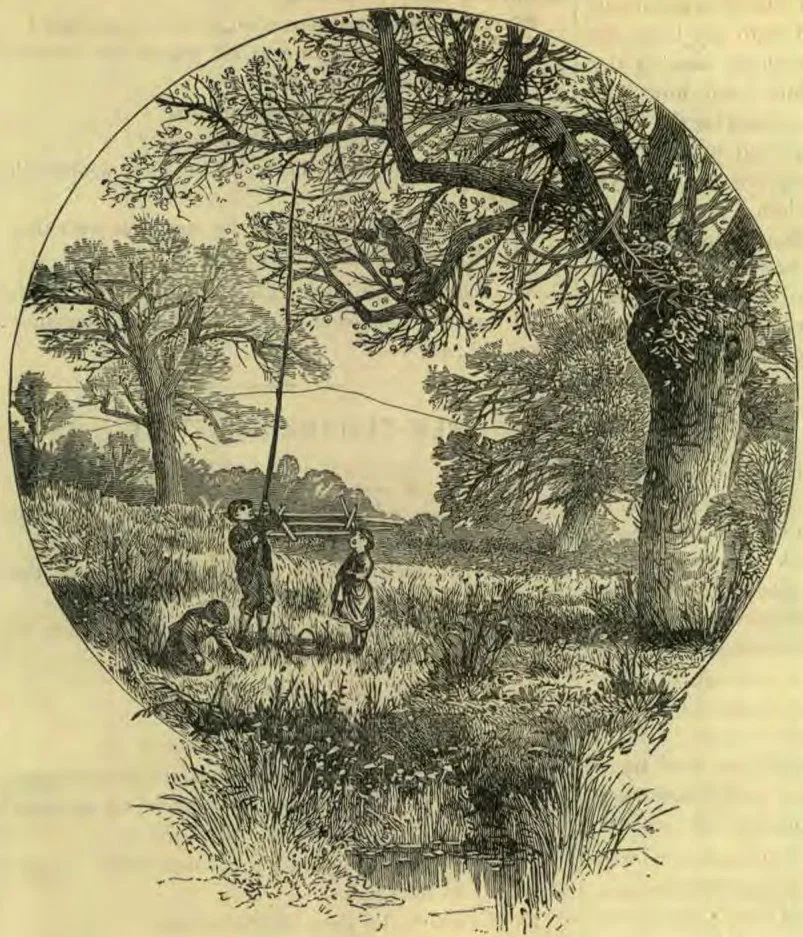
When they got to the woods, they found the chestnut burrs cracked open and the nuts all ready to fall. Henry climbed the tree and shook them down, while Bert got a pole to help him.
Minnie held her little apron for Henry to drop nuts into, and Herman picked up what fell to the ground.
They found that they were not the only ones who were out nutting that bright autumn day; for little red squirrels with their bushy tails cocked over their backs were scampering up and down, in and out, among the trees, very busy laying up stores of nuts for the coming winter.
Pretty soon they heard a shout from Herman who had strayed away from them. On going where he was, they found him with one hand in a hole in a gnarled old tree, and on drawing it out, he showed them a little bit of a squirrel that he had found.
“Let’s take it home,” said Minnie.
Bert wanted to do so, too, but his brother said, “Just think how sorry the squirrel’s mother will be when she comes home and finds her baby stolen.”
Minnie thought squirrels didn’t have any feelings, but Henry said he guessed they would better put it back.
So after leaving the little thing safe and warm, they picked up their bag of nuts, Henry and Bert carrying the bag, Herman the basket, and little Minnie her apron full, and went home.
In the evening, Herman drew on his slate a picture of the woods and flowers and the little brook, with Bert poking the nuts off with his long pole, just like the one on this page.
Mamma thinks he will make quite an artist sometime. Don’t you think so, too?
W. E. L.

MINDING GRANDMA.

A LITTLE girl once said that she wished she could be good and not mind grandma. It was easy to sing hymns and to say prayers, but it was hard work to mind grandma. From this we see that the things which the Lord requires us to do are not always easy to be done, but sometimes try our patience and cross our will. It is often easier to sing hymns than it is to obey the Lord’s commands.
We may in our hymns and our prayers acknowledge Jesus as our Saviour and our Lord, but he has said, “Why call ye me Lord, Lord, and do not the things which I say?” If we do the things which he says, we shall be blessed in our deeds; but if our service is only lip service, it will have neither blessing nor reward. The son who said, “I go, and went not,” did not have the approval of his father, nor shall we, if we say and do not. We must—
“Learn to watch as well as pray, And learn to do as well as say.”
—Little Christian.

Using Talents Faithfully: A Teacher's Counsel to Youth

“My young friends,” said a wise teacher to his pupils, “if God gives you talents, remember not to bury them in a napkin. But if he gives you only a napkin, don’t think so to flourish it that it will seem to be full of talents.”

Thoughtful Independence and Regard for Others

No trait of character is rarer, none more admirable, than thoughtful independence of the opinions of others, combined with a sensitive regard to the feelings of others.
Continue reading: Greatness Measured by a Low Standard