The Youth’s Instructor, Vol. 28, No. 14.

BUTTER-MAKING IN THE EAST

The Youth’s Instructor

Mar 31, 1880

S. D. A. Publishing Association · Battle Creek, Mich. · Mar 31, 1880

BUTTER-MAKING IN THE EAST.

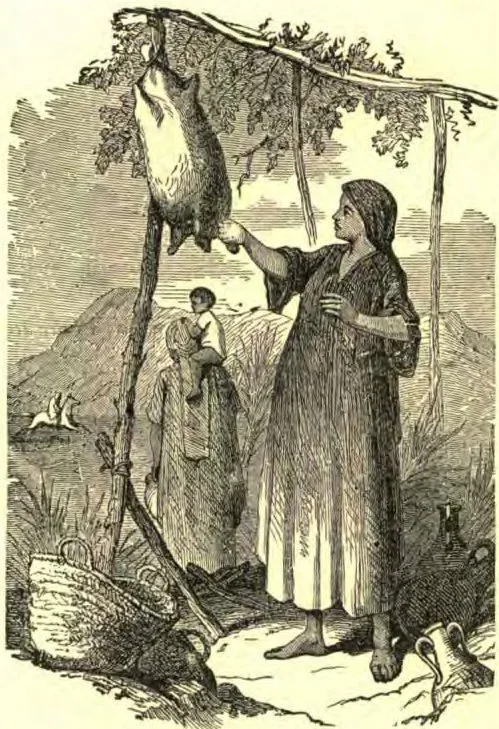
BUTTER was doubtless much in use among the ancient Jews, and, from the information that can be obtained, it is thought that it was prepared in the same manner as at this day among the Arabs and Syrians, who use a kind of boiled butter called gee. The milk is put into a large copper pan over a slow fire, and a little sour milk, or a portion of the dried entrails of a lamb, is thrown into it. The milk then separates, and is put into a goat-skin bag, which is tied to a pole, as seen in the picture, and constantly moved backward and forward for two hours; or, sometimes, the bag is placed upon the ground and trodden upon. Job referred to this manner of churning when he said, “I washed my steps with butter.” The buttery substance having coagulated, the water is pressed out, and the butter is put into another skin. After the lapse of two days, the butter is placed over the fire and allowed to boil for some time, during which it is carefully skimmed; when so prepared it will keep in a hot climate.
Butter is chiefly used among the Arabs and Syrians to impart softness to burgul, or bruised wheat, the common diet of the country. The Greeks and Romans used butter as a medicine and for external application—not as an article of food.

HOW SUNDAY-SCHOOLS BEGAN.

IN 1780, Robert Raikes, proprietor and printer of the Gloucester Journal—a gentleman of no great celebrity at that time—went into the suburbs of his city, among the poorest and lowest of the people, to hire a gardener. While conversing with the gardener’s wife, he was pained by the noise, degradation, and idleness of the crowd of boys who were constantly interrupting them.
On inquiry he found they were much worse on Sundays. They were then released from their employment, and spent the day in profanity and riot, playing all manner of rude games. He took the idea of doing something to prevent such profanation. The word “try” was so impressed on his mind as to lead to immediate action.
Having found four persons who were accustomed to teach children reading, he engaged to pay them each one shilling for receiving and instructing such children as he should send to them every Sunday.
The children were to stay from ten A. M., to twelve, noon, to return again at one P. M., and after reading a lesson, to be conducted to church. After church they were to repeat the catechism until half-past five, and then to be dismissed. Such was the commencement of the Sunday-school work.
After three years Mr. Raikes wrote to a gentleman in Lancashire: “It is now three years since we began, and I wish you were here to make inquiry into the effect. A woman who lives in a lane where I had fixed a school told me some time ago that the place was quite a Heaven on Sundays, compared with what it used to be. The numbers who have learned to read and say their catechism are so great that I am astonished at it. Sunday afternoons the teachers take their scholars to church—a place into which neither they nor their ancestors ever entered with a view to the glory of God. But what is more extraordinary, within this month these little ragamuffins have, in great numbers, taken into their heads to frequent the early morning prayers, which are held every morning at the cathedral at seven o’clock. I believe there were near fifty this morning. They assemble at the house of one of the teachers, and walk before her to church, two and two, in as much order as a company of soldiers.”
About 1785, William Fox, Esq., formerly a merchant in London, feeling deeply interested in the education of the poor, and believing that this new system afforded the means of promoting the object, obtained the co-operation of several individuals who were like-minded, and, after a correspondence with Mr. Raikes on the subject, succeeded in forming, on the 7th of September, 1785, the “Society for the Establishment and Support of Sunday-schools throughout the Kingdom of Great Britain.” Sunday-schools began to increase under the direction of various clergymen, but the great hindrance to their prosperity was the expense of hiring teachers.
In 1784 the teachers were paid one shilling and sixpence for their services every Sunday, but by degrees gratuitous teachers arose, so that in 1794 only six out of thirty were hired.
A short time after the death of Mr. Raikes, Sunday-schools in Gloucester ceased. But in the providence of God, about the year 1810, six young men, feeling the necessity and value of such institutions, banded themselves together, and resolved, trusting in God, to revive the work there. They applied to their minister for help, but he refused, saying the children would make too much noise; the trustees refused, saying the children would soil the place; members of the church refused, saying, “they would find no children, no teachers, and no money to pay expenses.”
But these young men were not to be discouraged. Accordingly, they met around a post at the corner of a lane, and, taking each other by the hand, solemnly resolved that Sunday-schools should be established in the city of Gloucester. Accordingly, they entered into a subscription among themselves, and although all the money they could raise was fifteen shillings, with that they set to work and formed the first school, with unpaid teachers, in that locality.—Our Bible Teacher.

Dickens on Devoting Oneself Wholeheartedly to Work

“WHATEVER I have tried to do in my life,” says Charles Dickens, “I have tried with all my heart to do well. What I have devoted myself to, I have devoted myself to completely. Never to put my hand to any thing on which I could not throw my whole self, and never to affect depreciation of my work, whatever it was, I find now to have been golden rules.”

MARCH

Mud under foot, fogs over head, Rain, drizzle, gloom, and mist; Winter and spring are reconciled, Have met again and kissed. Uncertain, fickle, fierce, and false— A monster in his rage, A hampered lion fain to break The boundary of his cage.
Parent of winds and frantic storms, Patron of sulky nights, When all the sky is bloody red With ghostly Northern Lights— Repenting, now and then, to show Suns like the suns of June— And soft, cerulean, placid skies Above a placid moon.
White snows, forgetful of the time, Drifting adown the hills— And spanning ice bridging across Emancipated rills; Touches of fiercest polar cold, Blasts from the Boreal shores— Sweeping with wild demoniac rage, The dreary waste of moors.
Crushing with brutal hands the flowers That yearn to spring to bloom, Dooming all vegetating things Unto a common tomb; Nipping with frosty breath the life Of sprout, and bud, and leaf— But little care we for his power, The time of his reign is brief! —Sel.

J. N. L

FROM SEA TO SEA.—NO. 24.

COMPLETING our visit in Southern New York, we return to Buffalo to resume our eastward journey. We congratulate ourselves upon the facilities of travel to-day as compared with former times. Fifty years ago this trip to the Atlantic, some five hundred miles, was by stage-coaches to Albany or Troy, and from thence in vessels down the Hudson River to New York. Then, the journey required five or ten days of constant riding and shaking about in the coach, with little chance for rest. Sometimes all the male passengers were required to get out and help pry the stage-coach out of mud-holes. The passengers termed it, “Getting a ride by working your passage.”
When the Erie Canal was constructed, it was considered a great improvement on the stage-coach; and although it is still of great value as a means of conveying freight, for passengers it has had to give way to the New York Central Railway, with its four lines of track side by side across the entire State. On this road, with a running speed of forty to fifty miles per hour, persons can take a sleeping-coach at night in Buffalo, and wake up the next morning in New York City. While thus musing, we have come seventy-five miles on our way. Looking out of the window, we see the city of Rochester spread out before us. It is situated on the Genesee River, at the Upper Genesee Falls, about ten miles from the mouth of the river. We will stop over one train to look about a little before resuming our journey. The Genesee Falls are nearly three hundred feet broad, and the leap of the waters is about seventy-five feet. About one mile down the river is another fall of fifty feet, called the “Lower Falls of Genesee.” These falls furnish excellent water-power for mills and machine-shops. They were, in fact, the cause of so great a city being built at this point.
There stands, on the west side of the upper fall, a cotton factory. Some time since, one of the spinners, Sam Patch, being weary of life, thought to end his days by jumping off the rocks over these falls. He was a drunken, worthless fellow; but, strange to tell, instead of taking his life he came out unharmed. He gained so much notoriety by this performance that he tried it again, at a set time, before thousands of spectators. Maintaining an erect posture, he went straight down into the water and came to the surface much as a stick would pop out of the water on being thrown in endwise. He gained so much fame from this second feat, that he tried it a third time with a greatly increased concourse of people. He now erected a scaffold, higher than the falls, so as to make his leap about one hundred feet. Flushed with former success, he indulged quite freely in drink. In this drunken condition, he jumped, but instead of maintaining his erect position as before, he struck flat upon the water, killing him instantly; and so ended the days of this fool-hardy man. It was some time after that his body was found and interred.

J. N. L

SCHOOL LIFE.

COMMENCING our school-days in childhood, learning the little things that childhood’s mind can grasp, seems like a small beginning; yet here the foundation principles are laid,—upon which the future education is built. As the mind is first inclined, in that direction it will probably continue. Then how important is the starting—starting right.
Free from care, with a joyous and light heart, the happy school-days of childhood pass. Then, broadening and lengthening out into manhood and womanhood, come youthful days with their perplexities and greater temptations, yet for all, joyous and happy days. If the foundation principles have been laid with care, and a love of study and self-improvement instilled into the mind, temptations will be surmounted, the pitfalls made for unwary feet will be passed, and the youthful life will bud and blossom into the perfect one of manhood and womanhood; for education ennobles, elevates, and exalts the character.
An educated person can never become an object of neglect. He must always remain an object of distinction among his acquaintances. When young, he can please by his mind; and when declining into the shade of years, he can still, from the superiority of his character, make himself a pleasant companion. He grows old gracefully.
This world is a school-room, and each one of us, from infancy through life, is a pupil, always learning something that will tend either for good or evil. We are all fast gliding down the current of life. We are on our passage to eternity. If we make a success of life, by gaining a heavenly home, our felicity will bear no inconsiderable proportion to our present attainments in knowledge.
Permit me to say, then, dear young friends, Defer not the cultivation of your minds; improve every moment; that you may lay up a store of enjoyment and comfort to which you can repair when all abroad is unpleasant and uninviting; and more than this, that in the world to come, you may be capable of higher enjoyment, and like a distinguished star be crowned with superior splendor. V. A. M.

THE COURTESIES OF LIFE.

Wm. Wirt’s letter to his daughter, on the “small, sweet courtesies of life,” contains a passage from which a deal of happiness might be learned:—
“I want to tell you a secret. The way to make yourself pleasing to others, is to show them that you care for them. The whole world is like the miller at Mansfield, ‘who cared for nobody—no, not he—because nobody cared for him.’ And the whole world would serve you so, if you gave the same cause. Let every one, therefore, see that you do care for them, by showing them what Sterne so happily calls the small courtesies, in which there is no parade, whose voice is too still to tease, and which manifest themselves by tender and affectionate looks and little kind acts of attention, giving others the preference in every little enjoyment at the table, in the field, walking, sitting, or standing.”

OBEDIENCE

OBEDIENCE is like the gem Prized most in kingly diadem, And shines with pure and radiant light, Like stars that crown the brow of night, And is the groundwork and the frame On which to build a noble name; And though the name may not be known Beyond the circle of the home, Yet its pure influence here on earth, Will far excel the diamond’s worth, And like sweet incense it will rise And reach to worlds beyond the skies. —Anna Linden.

LESSONS FOR CHILDREN.

LESSON LXVI.—NABOTH'S VINEYARD.

“And it came to pass after these things, that Naboth the Jezreelite had a vineyard, which was in Jezreel, hard by the palace of Ahab, king of Samaria. And Ahab spake unto Naboth, saying, Give me thy vineyard, that I may have it for a garden of herbs, because it is near unto my house; and I will give thee for it a better vineyard than it; or if it seem good to thee, I will give thee the worth of it in money. And Naboth said to Ahab, The Lord forbid it me, that I should give the inheritance of my fathers unto thee. And Ahab came into his house heavy and displeased because of the word which Naboth the Jezreelite had spoken to him: for he had said, I will not give thee the inheritance of my fathers.”
“And he laid him down upon his bed, and turned away his face, and would eat no bread. But Jezebel his wife came to him, and said unto him, Why is thy spirit so sad, that thou eatest no bread?”
When Ahab told his wife the reason, she said unto him, “Dost thou now govern the kingdom of Israel? arise, and eat bread, and let thine heart be merry: I will give thee the vineyard of Naboth the Jezreelite.” So she wrote letters in Ahab’s name, and sealed them with his seal, and sent the letters unto the elders and to the nobles that were in his city, dwelling with Naboth.
“And she wrote in the letters, saying, Proclaim a fast, and set Naboth on high among the people; and set two men, sons of Belial, before him, to bear witness against him, saying, Thou didst blaspheme God and the king. And then carry him out, and stone him, that he may die.”
Then the men to whom Jezebel sent letters did as she had commanded them. And the men of Belial witnessed against him, saying, “Naboth did blaspheme God and the king. Then they carried him forth out of the city, and stoned him with stones that he died.”
When Jezebel heard that Naboth was dead, she told Ahab, and he arose, and went down to the vineyard to take possession of it.
Then the Lord commanded Elijah the Tishbite to go to Ahab and say unto him, “Thus saith the Lord, In the place where dogs licked the blood of Naboth shall dogs lick thy blood, even thine; . . . I will make thine house like the house of Jeroboam, the son of Nebat, and like the house of Baasha, the son of Ahijah. . . . And of Jezebel also spake the Lord, saying, The dogs shall eat Jezebel by the wall of Jezreel.”
And it came to pass that when Ahab heard these things he fasted, and lay in sackcloth; and when the Lord saw how he humbled himself, he said, “I will not bring the evil in his days, but in his son’s days will I bring the evil upon his house.”

QUESTIONS.

  1. What request did king Ahab make of Naboth?
  2. Why was the king so anxious to possess this vineyard?
  3. In what part of the country was it situated?
  4. What did Ahab offer to give Naboth for his vineyard?
  5. What reply did Naboth make?
  6. How did this make Ahab feel?
  7. What did he do?
  8. Who came to him as he lay upon the bed?
  9. What did Jezebel say to him?
  10. What reply did she make when Ahab told her why he felt so sad?
  11. What did she then do?
  12. To whom did she send the letters?
  13. What did these letters order the men to do?
  14. How were the letters signed and sealed?
  15. What did the men to whom Jezebel sent letters do?
  16. What did these men of Belial witness against Naboth?
  17. What course was then taken with him?
  18. When Jezebel heard that Naboth was dead, what did she do?
  19. What did Ahab do?
  20. Whom did the Lord send to Ahab at this time?
  21. What did the Lord say would happen to Ahab?
  22. What did he say about Ahab’s family?
  23. What did he say would finally become of Jezebel?
  24. When Ahab heard these things what did he do?
  25. What kindness did the Lord show unto Ahab when he saw how he humbled himself?

BIBLE LESSONS FOR YOUTH.

LESSON XII.—FIRST YEARS OF THE CAPTIVITY.

1. At what different times were captives taken from Jerusalem to Babylon?
2. How long had Daniel been in Babylon when Jerusalem was destroyed by Nebuchadnezzar’s army?
3. How was he treated there?
4. What position had he long held when Nebuzaradan brought the last company of captives from Jerusalem?
5. Describe the company of captives to whom Daniel belonged. Dan. 1:3, 4.
6. For what purpose were they taken to Babylon?
7. What advantages did they enjoy?
8. By whom were they instructed?
9. What provision was made for their sustenance?
10. How did Daniel and some others choose to subsist?
11. How did the Lord especially bless the faithful ones? Verse 17.
12. What qualifications did they manifest, when, at the end of three years, they were brought before the king? Verse 20.
13. Was Nebuchadnezzar really a king when Daniel was taken captive?
14. How did he come to bear that title?
15. Where was he when his father died?
16. What unusual experience did he have in the second year after he became sole monarch? Dan. 2:1.
17. How was he perplexed in regard to this dream? Verses 2–13.
18. By whom was it finally told and interpreted? Verses 14–25.
19. Did Daniel claim to do this by his own wisdom? Verses 27, 28.
20. What was given to Nebuchadnezzar in the interpretation of this dream?
21. How was the king affected by this revelation? Verses 46–48.
22. What honors were conferred upon Daniel?
23. What kind providence seems manifest in the promotion of Daniel?
24. How were the Hebrew captives probably regarded?
25. To what severe test were the captive princes soon put? Dan. 3:1–6.
26. Who were called to the dedication of the image? Verse 2.
27. What was to be done to those who would not worship the image? Verse 6.
28. Who steadfastly refused to yield homage to this false god?
29. How do we account for the omission of Daniel’s name?
30. What was done with the men who would not worship the image? Verses 19–23.
31. How did God then manifest his power to save those who trusted in him? Verses 24–27.
32. What decree did the king make?
33. Why was this a favorable opportunity for spreading a knowledge of the true God?

SYNOPSIS.

When Jerusalem and the temple were destroyed by the army of Nebuchadnezzar, and the last company of captives were carried away, Daniel had been in Babylon more than eighteen years. From the first, he had been treated kindly, and had now long held a position of great honor,—the highest, perhaps, next to the king. From Daniel 1:3–5 it will be seen that he was one of a company of young men chosen on account of their superior intelligence, that they might be educated in Babylon for the king’s court. They had all the advantages that could be afforded them by the most powerful monarch on earth, and were instructed by the most profound scholars of the age. The king appointed them a daily portion from his own table, but as many of the articles of food thus furnished were forbidden by the God of the Hebrews, Daniel and some of his companions chose rather to subsist upon pulse and water. To these faithful ones, God gave knowledge and skill in all learning and wisdom, and when at the end of three years they were brought before the king, he found that in all matters of wisdom and understanding they greatly surpassed the ablest magicians and astrologers of his realm.
At the time when Daniel was taken captive, Nebuchadnezzar was not really a king, although his father had given him that title, and placed him at the head of the armies of Babylon. When his father died, Nebuchadnezzar was in the west, probably in Egypt, whither he had carried his conquests after subduing Jehoiakim. On hearing the news of his father’s death, he hastened to Babylon to claim the kingdom.
In the second year of his independent reign, he had a remarkable dream, which, although it made a deep impression upon his mind, he could not recall. Of all the wise men of the kingdom, none but Daniel could tell the dream; and he expressly informed the king that the God of Heaven had revealed it to him. The interpretation of the dream gave Nebuchadnezzar an outline of the future history of the world, and of the final establishment of the kingdom of God, which should stand forever. The king was so affected by this revelation that he bestowed the highest honors upon Daniel, and gave glory to the God of Heaven. The youthful prophet was made ruler over the whole province of Babylon, as well as chief of the governors of all the wise men. Thus the Lord prepared the way for his people to be kindly treated; and it is probable that they were regarded more as colonists than as slaves.
But the time soon arrived when the faith of the captive princes was put to a severe test. Nebuchadnezzar made an immense image of gold, and set it up in the plain of Dura, commanding all men to worship it. All the princes, governors, and other chief men, from the remotest parts of the empire, were called together; and the image was dedicated with great pomp. Since Daniel is not mentioned, we conclude that he must have been absent at that time. But Shadrach, Meshach, and Abed-nego, who at Daniel’s request had been set over the affairs of the province of Babylon, steadfastly refused to worship the image, and as a consequence, were cast into a burning fiery furnace, heated so hot as to destroy the men who threw them in. When Nebuchadnezzar saw them walking about in the midst of the furnace, unharmed, and accompanied by another, glorious as the Son of God, he called them forth; and all the princes and governors saw that the fire had had no effect upon these men. Then the king made a decree that no one should speak anything against the God of the Hebrews, under pain of death.
So the Lord not only delivered his servants, but spread a knowledge of his name throughout the vast realm of Nebuchadnezzar.

Blanks Sent to Michigan School Secretaries

Blanks have been sent during the last week to the Secretaries of all the schools in Michigan. Let all those who do not receive them by the first of April, report immediately to the State Secretary, and they will be again supplied.

GOD'S LIFE-BOOK.

Willie was a bright, lively boy six years of age. His mother was reading to him one Sabbath afternoon about the Lamb’s book of life which St. John tells us of in the Revelation. Mamma told him that the Lamb is Jesus Christ, and that he keeps the names of all who give their hearts to him, so that on the Judgment-day, when the books are opened, not one of those who love Jesus will find his name forgotten.
“Mamma,” said Willie, “how do people get their names put in the life-book?”
“By asking Jesus to write them there,” was the reply. Then mamma said, “Willie, is your name in the Lamb’s book of life?”
Willie’s eyes grew very earnest as he said, “No, mamma; but ’t will be to-night.”
Willie was sometimes a thoughtless little boy, and his mother feared he would soon forget his Sabbath lesson; but at night, when he knelt with his little brothers by the bedside, the first words of Willie’s prayer were, “O Jesus, won’t you please to put my name into your life-book?”
Do you not think Jesus loved to hear this prayer? And “when the dead, small and great, stand before God, and the books are opened,” shall we not be sure to find Willie’s name? I hope he tries every day to live as a child should whose name Jesus is keeping with such tender love.
Dear children, if your names are not written in the book of life, remember that the Bible says that “whosoever was not found written in the book of life was cast into the lake of fire.”
Go now, like Willie, and ask the Saviour to make you his children. We know he is gathering child-names for the precious book, for he says, “Suffer little children, and forbid them not, to come unto me; for of such is the kingdom of Heaven.”—Young Reaper.

TOM

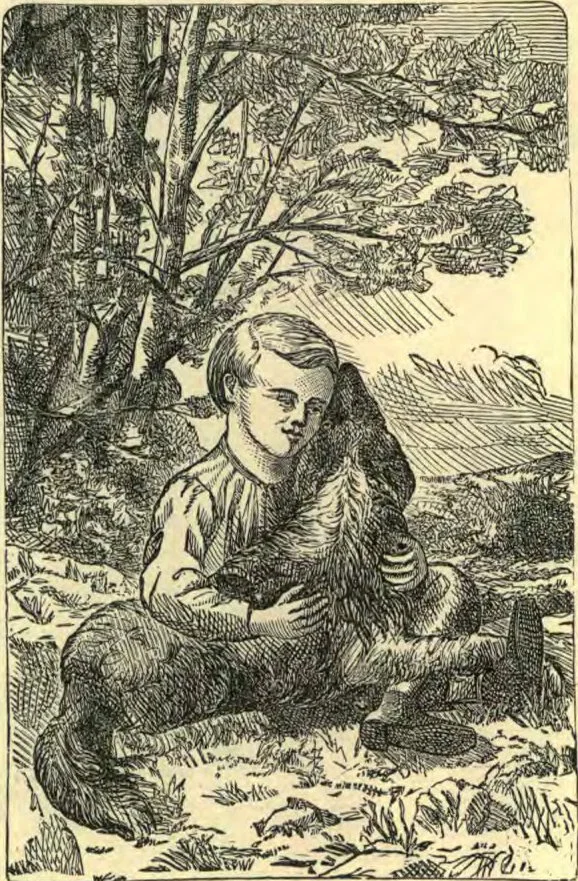
YES, Tom’s the best fellow that ever you knew. Just listen to this: When the old mill took fire, and the flooring fell through, And I with it, helpless, there, full in view, What do you think my eyes saw through the fire, That crept along, crept along higher and higher, But Robin, my baby boy, laughing to see The shining! He must have come there for me; Toddled along from the cottage without Any one missing him. Then with a shout— Oh! how I shouted, “For Heaven’s sake, men, Save little Robin!” Again and again They tried, but the fire held them back like a wall. I could hear them go at it, and at it, and call, “Never mind, baby, sit still like a man, We’re coming to get you as fast as we can.” They could not see him, but I could; he sat Still on a beam, his little straw hat Carefully placed at his side, and his eyes Stared at the flames with a baby’s surprise, Calm and unconscious, as nearer it crept. The roar of the fire up above must have kept The sound of the mother’s voice shrieking his name From reaching the child. But I heard it. It came Again and again—O God, what a cry! The axes went faster, I saw the sparks fly Where the men worked like tigers, nor minded the heat That scorched them—when, when suddenly there at their feet The great wall leaned in—they saw him—then, crash, Down came the wall! The men made a dash— Jumped to get out of the way—and I thought “All’s up with poor little Robin,” and brought Slowly the arm that was least hurt to hide The sight of the child there, when swift at my side, Some one rushed by, and went through the flame Straight as a dart—caught the child, and then came Back with him—choking and crying, but—saved! Saved safe and sound.
Oh! you’d admire To see Robin now:—he is eight years old, And to me is worth his weight in gold; Tom it was saved him. Now isn’t it true, Tom’s the best fellow that ever you knew! There’s Robin now—see, he’s strong as a log— And there comes Tom too—yes, Tom is our dog. —Christian Child.

Bible Lessons for Little Ones

BIBLE LESSONS FOR LITTLE ONES.—This is No. 2, of the “Progressive Series of Sabbath-School Lessons,” and covers the period from Egypt to Canaan. It contains fifty-two lessons, and is a nice little book of 120 pages. Price in paper covers, 15 cts. Flexible “ 20 “

How Sunday-Schools Began: Raikes Centenary Memorial

Our readers will find, on the first page of this issue, a readable article on “How Sunday-Schools Began.” It is now one hundred years since Robert Raikes opened the first Sunday-school, and a memorial service in his honor is to take place in England next June, under the patronage of the Queen. The exercises will be held in Westminster Abbey, in St. Paul’s Cathedral, and at Lambert Palace. Special arrangements are being made with steamship lines to carry passengers from this country.

HOW TO SEE A SEED GROW.

MANY little folks wonder how a seed grows. Some boys and girls have taken up the seed after planting it in the ground and thereby prevented it from taking root.
We may, however, see the roots shooting out from the hyacinths and other bulbs that we grow in glasses in our windows. And in this way we may see other seeds sprout and root.
A gentleman, to gratify his little sons, took a glass tumbler, round which he tied a bit of common lace, allowing the lace to hang or drop down in the center of the glass. He then put enough water in the glass to cover the lower part of the lace, and in this hollow he dropped two sweet peas. The little boys were told to look at them every day, and they would learn what was going on under-ground with similar seeds.
One morning the boys hurried from the breakfast-room to look at the glass with the peas in the south window. They found that while they were fast asleep the little brown skins had burst, and a tiny white sprout was seen on the side of each pea. The little sprouts soon grew long enough to reach through the holes in the lace, and on the top of the peas two little green leaves were seen.
In time the boys saw the white, thread-like roots reach almost to the bottom of the glass, while the green leaves grew large and gave way to a stalk or stem.
In this way most seeds may be seen to grow.

Wooden Paper

It is an interesting sight to see the great logs of poplar wood go through the powerful machine at the Connecticut river pulp-mill at Holyoke, Mass. The wood, as it is brought to the mill, is about the size of cord wood used for fuel, and in this shape the machine takes it and gnaws it up very fine. So rapidly does this process go on that the machine eats about seven and a half cords of wood a day, and this makes between three and four tons of pulp. After coming from the machine, the pulp is put into vats and reduced by the action of chemicals. It is used for the manufacture of news and book paper.

LETTER BUDGET.

FRANKTON, IND.
DEAR EDITORS: I am ten years old. I have three sisters and one brother. My brother has gone to Battle Creek. I love to go to Sabbath-school, and I love to get the INSTRUCTOR very much. I have been keeping the Sabbath ever since Elds. Covert and Rees brought the truth to Frankton. This is the first letter I have written to the INSTRUCTOR. JOSEPH A. MOORE.
If this is the first time you have written for the INSTRUCTOR, Joseph, we hope that it will not be the last.

You have reached the end of this edition.

The Youth’s Instructor · Mar 31, 1880