O LITTLE children of the streets!
My heart goes out in love to you,—
The different faces that one meets,
The different forms that pass in view!
O little lass with locks of gold!
O little lad with eyes of blue!
The streets some precious treasures hold,—
My heart goes out in love to you.
O little child of city ways!
May you be ever good and true;
And may the gently beaming rays
Of heavenly sunlight guide you through
The mists that rise above your head,
Obscuring all that's good from view.
Through all the different paths
you're led,
May you be ever good and true.
BENJAMIN B. KEECH.
What to Read
By Mrs. M. A. Loper
Literature is so cheap that every one can have access to the printed page; but it is all-important that the choice of reading-matter be such as will tend to develop the mind in the right direction. The influence of books can not be overestimated either for good or for ill. It is an old saying that an individual is known by the company he keeps. And it is no less true that one is known by the collection of books to be found in his library.
He who best fulfils his mission, however humble it may be, never makes a failure of life; for he constantly seeks to have all his efforts tend to one great purpose, in obedience to the divine command, “Whatsoever ye do, do all to the glory of God.” This rule he finds sufficiently practical to determine even the books that he should read.
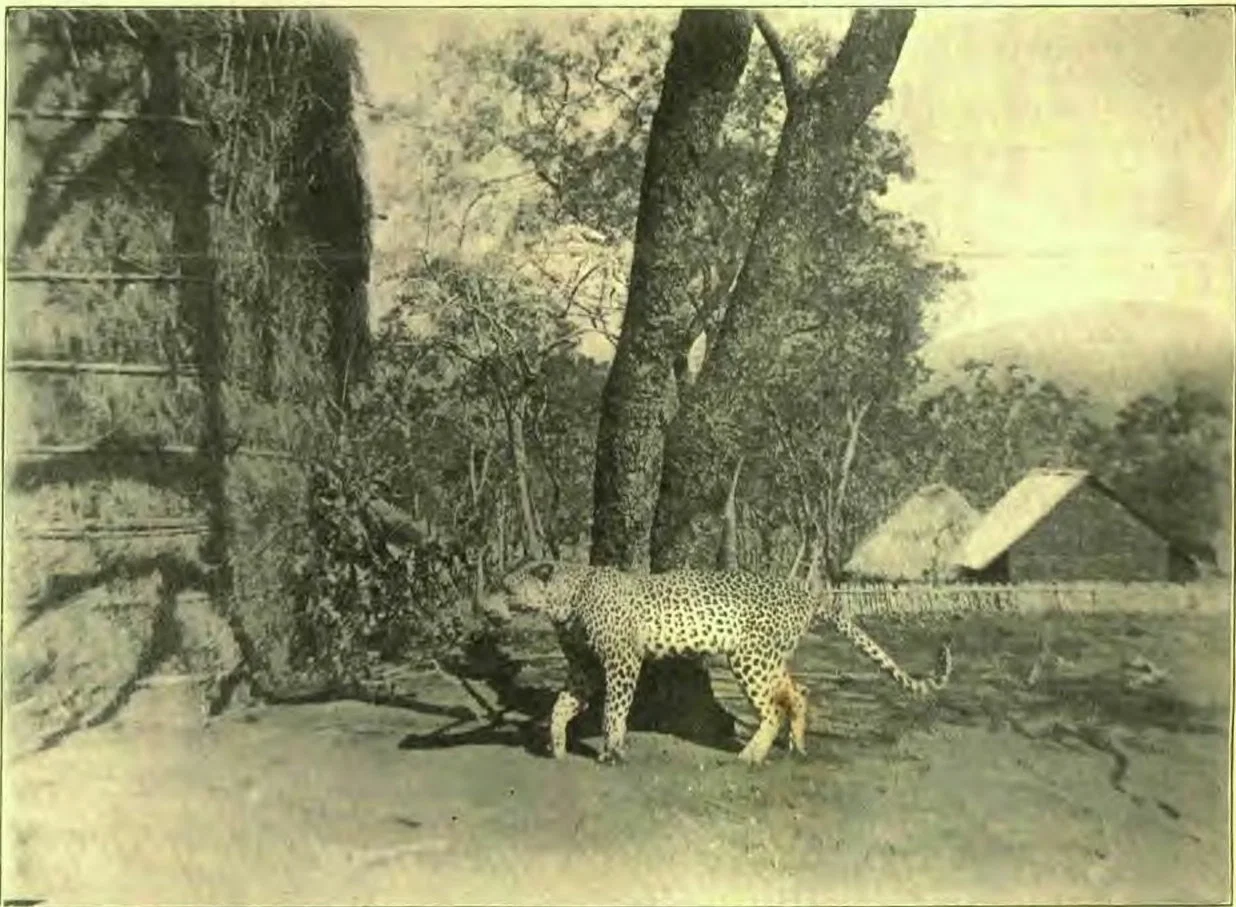
This leopard was caught on the mission farm in Central Africa. Brother J. N. Watson tells how he was caught: “He had killed one of our goats, and we had seen leopard tracks several times around the yard. I had a large trap made of young trees set in the ground about eighteen inches, and roofed with heavy trees. The inside of the trap is divided into three apartments: one partition incloses a goat, and the other has a doorway through which the leopard must pass to reach his supposed prey. In this doorway is a spring connected with a heavy log, which drops in the outer doorway when the spring is touched by the animal. We captured him about ten o'clock on a very dark night. When I went to investigate, his fierce growls gave us some idea what it would mean to be at his mercy in the woods.”
Minds, like palates, differ in regard to taste; but if one pampers the natural inclinations, mental dyspepsia is often the result. If a relish for wholesome food is lacking, it is best to cultivate an appetite for it. Many become so addicted to the use of pickles, catsup, hot tomales, etc., that they can not relish a meal without the accompaniment of pepper in some form. So there are those who have no relish for a book that is of a nature to give mental strength and vigor. They crave something exciting, something that will feed the imagination; and mental degeneration and decay are the result.
If the companionship of health-giving books is not enjoyable, be courageous in your efforts to discipline the mind to love only that which is good, remembering that by beholding we become changed. No life is what it might be that does not devote some time to good reading. No one can successfully fight the battle of life to-day who does not acquaint himself to some extent with the tactics of those whose names are enrolled as victors in the conflict. But to make out a certain list of books as best suited to the needs of every individual, would be as impracticable as to select certain articles of food with the view to supplying a diet suited to the wants of every case. The divine command is, “Eat ye that which is good,” in harmony with which we may well say, Read ye that which is good.
Some one has suggested a rule which it is safe for every one to follow; and that is, to read that which will benefit the reader most in whatever may be his life-work. Every legitimate line of work has its own literary field,—a field rich in knowledge for him who will search therein,—and how many precious gems of truth may be collected in one brief lifetime! But do not forget that “much reading is a weariness of the flesh” (Eccl. 12:12), nor that there is a limit to one’s capabilities in this direction.
The lover of sea-shells thoroughly enjoys his search for them until he finds himself growing weary, and his task becoming irksome; but while still raking among the sands, where the fascinating little treasures are so numerous, he is almost overwhelmed with the thought of how many there are, and that he can not hope ever to gather more than a very few in comparison, however much he may feel that he would enjoy taking the whole beach home with him. So it is with good books. One can not hope ever to read but a small portion of them, and he should be contented with his lot; knowing that a little knowledge, well applied, is better than much learning gained at the expense of health, and it may be of life itself.
Some books, like frivolous fashions, are soon out of date, while others are always in demand. As it is very unwise to try to ape all the fashions to be found in the social world, so it is folly to try to keep up with all the new literature which comes and goes in one’s lifetime.
Never buy a book simply because it is cheap, and never judge of the contents of a book by the beauty of its exterior. If you can secure a book suited to your needs, which is both cheap in price and pleasing in appearance, well. But no one can ever tell whether the books you have read were bound in morocco or paper, or whether the edges were gilded or even marbled. They may judge, however, as to the contents—whether they have tended to refine, elevate, strengthen, and ennoble the mind, or to crush out noble aspirations, and to lead the thoughts in an evil channel.
The cultured mind is capable of inestimable good if consecrated to the service of God. He who was learned in all the wisdom of the Egyptians became the leader of Israel through the wilderness. He who sat at the feet of Gamaliel became a teacher of truths to the Gentiles. But no one has time for anything that will not prove of service to him in building into his character-building gold, silver, and precious stones.
“Study to show thyself approved unto God.” This should be the motive of every student; and, following this injunction, one will not spend precious time in seeking to satisfy his curiosity by investigating that which he knows to be evil and only evil. He will not follow the winding maze2of error, in order to know by experience where it leads; for one who adopts this rule is likely never to retrace his steps.
A sweet satisfaction follows communion with good writers,—a satisfaction not to be found in useless amusements. Beresford once said: “How I pity those who have no love of reading, of study, or of the fine arts. I have passed my youth in amusements and the most brilliant society; but I can assert with perfect truth that I have never tasted pleasures so true as those I have found in the study of books, in writing, or in music. The days that succeed brilliant entertainments are always melancholy, but those which follow days of study are always delicious. We have gained something; we have acquired some new knowledge; and we recall them not only without regret, but with consummate satisfaction.”
In the list of precious stones the diamond ever stands at the head. So in the long list of printed volumes the Bible deservedly has the first place. No life can be successful without it. It is the only book that defies all the vicissitudes of time. Flames can not destroy it; evil can not subdue it; Satan can not annihilate it. In spite of the accumulated darkness of error and superstition through all the ages, it shines forth to-day in all its brilliancy, the light of the world. It illuminates the winding pathway from the cradle to the grave. It comforts the bereaved. It consoles the sorrowing. It condemns sin. It saves the sinner. It is food to him who hungers after righteousness. It is drink to him who thirsts for living water. Read it; heed it; love it; live it; and it will guide you in all the varied experiences through which you may be called to pass, and will finally be to you a passport from the verge of this brief life to the threshold of that which is infinite in duration. Mrs. M. A. Loper.
The Message of the Mistletoe
By Minnie Rosilla Stevens
A SPRAY of mistletoe had been tossed upon the study table, among books and papers. My eyes chanced to fall upon it, as I dreamed in the lamplight. A few thick stems, some dull-gray leaves, and several clusters of translucent berries,—which to my fancy resembled the manna of the wilderness,—clinging together like baby hailstones,—that was all: yet as I studied the pearly things in their green setting, I discovered that the spray of mistletoe held for me a new interest; for I found that it was murmuring to me in the language of wood and hillside, that universal tongue so few appreciate.
It mentioned scenes long past, where solemn priests, pagan rites, superstition, weirdness, and mystery appeared; but it did not linger there. It spoke of mirth, laughter, and frolic, with merry eyes and lips, smiling amid luxury. It hummed the songs of the breezes in the elm boughs, of running water among stones, and of the redbird, brilliant as his own coat, or the morning sky into which he sang.
It spoke briefly of fieldland, woodland, and meadowland, beneath sunlight, moonlight, starlight, and twilight; how the green things flourish, how the birds build and sing, how the wild birds live and die, how the hills rejoice, and the trees make merry. It hinted that it had suffered from ruthless hands, from loneliness and exile. But the mistletoe’s white berries wasted little time in fruitless complaints.
Instead, it whispered most earnestly of its mission. It told of beginning life amid the boughs of an elm tree in a happy valley, where, permeated by a wonderful power endowing it with strength and beauty, it was prepared to go forth to the world as a witness to the power which formed it.
“Look not at me, but at the Power that created me,” it said. “Admire not my beauty, but the beauty of my Creator. My loveliness is not my own, but merely an expression of the loveliness of another. The life within my fragile shape comes from the great Creator of all, and whatever admiration I may excite belongs by right to the source whence my beauty springs. My life, like all life, is given for a purpose,—as is yours, earnest listener,—and is given only in trust. Endowed with the Maker’s own life, with his loveliness, with his grace, with his authority, I have been sent to testify of his love and power. This testimony I have borne as best I could throughout my humble life.
“And now let me whisper what every passing breeze and verdant branch and running stream is saying, too: All life flows from the same fountain, and has one uniform purpose, that of praise to the Creator, and service to mankind. Have you been faithful to your trust?”
I sighed and raised my head. The mistletoe berries gleamed pure in the lamplight. Outside the stars shone, witnessing to the power of God; the church bells chimed, witnessing to his love; children sang, witnessing to his mercy; while my own heart,—beating with his life,—testified, like the leaves of the mistletoe, to his love and power. And then, with the chiming of the bells, there came to me a sudden sense of the significance of the numberless phases of existence all around; and, gazing long into the starlight, I wondered if, like the mistletoe, I had been faithful to my trust.
MINNIE ROSILLA STEVENS.
Unanswered Prayers—No. 1
By Arthur Fox
THERE are many thousands of letters every year that are never answered, because they fail to reach those to whom they are directed.
Some of these never reach their destination because the postage is not paid; others because they are directed to the wrong office; still others never find the proper place because they are addressed illegibly; and others yet because the matter inclosed is not of a kind permitted to be sent by mail. All such letters are examined at different post-offices, and are finally sent to the dead-letter office.
Something like this happens to many prayers. They are never answered, because they do not fulfil the conditions of prayer. “Ye ask, and receive not, because ye ask amiss.”
It is certainly an interesting and important matter for us to consider—this failure of prayers to meet the desired answer. We may be sure that one reason there are so many unanswered prayers is because they are mere formal petitions. We have direct assurance that God can not answer such petitions. Many prayers are like artificial flowers; they may deceive those who look on at a distance; but when more closely observed, are found to have no life nor fragrance. God declares that he is a father to us, and that we are his children. What, then, can be more painful or repulsive to him than cold, formal, insincere prayers from us?
“Prayer is the soul’s sincere desire,
Uttered or unexpressed;
The motion of a hidden fire
That trembles in the breast.”
Some prayers are unanswered because our hearts are not right toward our fellow men. We are holding, perhaps, hatred or revengeful feelings toward some one; therefore, for our own good, God can not grant our requests. Christ states the true condition of the heart for prayer in that wonderful petition he taught his disciples. “Forgive us our trespasses as we forgive them that trespass against us.” It is impossible for God to hear our prayers for forgiveness while we refuse to forgive those who have trespassed against us.
Many shut themselves out from the fellowship of Christ and the forgiveness of their sins because they do not meet that condition. John Wesley, at one time, was making a voyage to America in the same ship which carried General Oglethorpe, the governor of Georgia. Hearing an unusual noise in the cabin of the governor, Mr. Wesley stepped in to inquire the cause. Oglethorpe, who had the greatest respect and reverence for Wesley, excused himself for being angry and using violent language, by saying that he had met with a provocation too great for man to bear.
He then related some failure in duty on the part of his valet, who was standing trembling with fear at the anger of his master. After stating his fault, Governor Oglethorpe said: “But I will be revenged on him. I have ordered him tied, and carried to the man-of-war which sails with us. The rascal should have taken care how he used me so, for I never forgive.”
“Then I hope, sir,” said Wesley, “you never sin.” The governor was abashed at the reproof; but acknowledged its justice by saying, as he handed his keys to his servant, “There, take my keys, and behave better in the future.”
It is not an uncommon thing to find persons practically prayerless because they are treasuring wrath in their hearts against some one. And many who have been Christians lose their communion with their Saviour, and all the happiness of their Christian experience, because they are unforgiving toward their fellow men.
The fact that we are forgiving in spirit toward others is very good evidence that we are living in a state of mind and heart that is pleasing to God. Forgiveness on our part is an argument of God’s forgiveness toward us. If a seal is pressed against a piece of wax, it will leave an impression, or mark like itself, in the wax, which, as long as it lasts, will testify to the existence of the seal that made the imprint. So one’s readiness to forgive others is a witness to God’s forgiveness that has been exercised toward him.
What folly for any one to risk the loss of his soul by harboring revengeful feelings against some one who is battling with the same temptations, trials, and weaknesses with which he has to contend.
ARTHUR FOX.
Time, Forgive Me!
By Eben E. Rexford
TIME'S a thief! I trusted him
When he came to me with smiles.
I had heard that he was grim,
Stern, and full of artful wiles;
But he seemed so frank, so kind,
And so merry-hearted he,
That I wholly changed my mind.
Ah, what gay companions we!
Time's a thief! He stole away,
Quite before I was aware,
Gold of youth, and left the gray
Of life's autumn in my hair;
Stole the roses from my face—
Ah, youth's roses, fair to see—
Robbed my steps of agile grace,
Fooled me so, and cheated me!
Time's a thief, I say. But stay—
After all he was a friend.
He has stolen much away—
Has he not made some amend?
He has helped me up life's steeps,
He has given me home, and lit
On its hearth a fire that keeps
All cold weather out of it.
Time, forgive me what I said!
What you took from me was dear.
What you gave me in its stead
Grows more precious every year.
Roses fade, as fade they must—
For the vanished things a sigh—
But, O Time, I will be just,
Greatly in your debt am I!
— Eben E. Rexford, in Woman's Work.
The Present Moment Is All We Have
By A. B. C.
“On the clock of time there is but one word — Now.” The present moment is all we have — is not this a call for the most careful living, the most earnest effort to “do all to the glory of God”? To put a thing off to some future time is to put it off to a time that may never be—for us. “Now is the accepted time; now is the day.” A. B. C.
The Schoolmaster's Secret
RODNEY TRISCOE came in, placed two well-thumbed school-books on the rickety pine table, hung up his hat, exchanging it for another older and uglier one always worn at home, and turned a troubled face to the old lady who sat calmly knitting a gray stocking before the one window of the little room.
“There's a new teacher in school to-day. It's just a week, but we've another teacher. This one is a lady.”
Grandma Triscoe knit off all the stitches on the needle. There was much surprise in the faded blue eyes which she lifted to her grandson's face.
“Mr. Pembroke's been took with fever,” the boy said, answering his grandmother's look. “The doctor says it'll be more'n two months 'fore he's able to do anything. So they went and hired another teacher.”
“Too bad!” said the old lady, beginning to knit off another needle. “And he out here without any o' his folks, either.”
Rodney looked very slowly around the little room which served as kitchen, dining-room, and living-room. Beyond was the still smaller one where grandma and tiny Beulah slept each night. Rodney himself crept up a nearly perpendicular ladder to the loft above.
He went over to the door now and surveyed the old lady's sleeping nest, then returned and stood silent before his grandmother's chair.
She looked up from her work long enough to smile into his round, healthy, young face. Its troubled look was not lost upon her.
“What is it, dear?” she inquired, very gently.
“Say, gramma, we're dreadful poor, ain't we?”
His grandmother nodded.
“But Mr. Pembroke, he is awful poor, too. An' he has no money to pay his board, an' no folks, neither, an' Mis' Comin says he has to leave right away. She says that she can't board him for nothing, an' he told her he'd pay her when he got well, too. An' she just says she won't keep him.”
The boy's tones expressed considerable indignation.
Mrs. Triscoe was a very thin, tall old lady, as erect as when she was twenty. She stood up now, carefully placing her knitting-work on the shelf above her head, and laid a firm hand on the boy's shoulder.
“Well, I guess we are not so poor that any sick man need go without a home,” she said. “You go watch at the door, and when you see Farmer Bond go by, ask him to step inside. It's just about time for him to be a-takin' in his butter and eggs.”
She then applied herself to making some changes in the small sleeping-room, removing the little girl's crib to the outer room, and putting fresh, snowy linen on the bed which she was surrendering cheerfully to one in greater need than herself.
“Well, now here I be, Mis' Triscoe.” The loud, hearty bass of Farmer Bond's voice rolled in from the doorway, and his cheery old face was good to see.
Grandmother Triscoe made her little, prim, old-fashioned bow.
“Thank ye for coming, Mr. Bond. I just wanted to ask if you'd be good enough to stop at Mis' Comin's on the way back, and bring out a sick young man in your wagon? Rodney'll go with ye and help, and here's two comforts to make his ride easy.”
The farmer opened his eyes.
“Who is the young man?” he inquired.
“It's the new school-teacher,” answered Mrs. Triscoe.
“Where's his folks?”
“Well, I hear he has no folks. I'm going to be folks to him as well as I can for a spell,” she told him.
Two hours later, the sick young man, hot with fever and wrapped in one of Mrs. Triscoe's gayest comfortables, staggered into the house, supported by the stalwart farmer and Rodney, who soon had him resting in grandma's high, old-fashioned bed.
Before leaving, Mr. Bond made a trip to his wagon, returning with a sack of flour, a small jar of butter, and a basket of fresh eggs which he had not tried to dispose of in the town.
“I reckon if you kin give up the only bed you got to sleep in fer a stranger, I kin afford to help this much,” he said, placing the butter and eggs on the pine table beside Rodney's school-books.
Now this donation was a new thing, and the farmer ordinarily would not have dared to make it, for Mrs. Triscoe's pride was a thing to be respected; but “circumstances alter cases,” and the old lady thanked him with real graciousness.
That evening, little Beulah groped noiselessly to the bed, and laid a cool hand on the young man's hot forehead.
“I know your head hurts,” she said, “'cause it's so hot. Once I had fever, too, an' I was awful, terrible sick, an' gramma she just cured me. An' you needn't be one bit scared, not the littlest, teeniest bit, fer gramma'll cure you. Gramma just knows lots. An' she'll get the doctor fer you, too.”
Thus the child prattled, passing her active fingers, meanwhile, over the sick man's features, for poor Beulah lived in a world of perpetual night. No ray of light had penetrated that darkness since her second year, when a spell of illness had left her sightless. This, and not poverty, was the sorrow of grandma's life. But Mrs. Triscoe was a brave woman. No one ever heard a complaint from her lips, and she tried in all ways to make her old eyes do duty for the eager, bright-minded child. Grandma never could forget the happiness of the hour years ago when the life of her little granddaughter was spared, and Beulah was a dear, joyous creature, not, as yet, realizing the full extent of her very great loss.
During the weeks that followed the day on which Mr. Pembroke was brought to the little cottage, Grandma Triscoe devoted her energies to the care of her patient, being relieved from her almost constant attendance at the bedside by Rodney after his return from school each afternoon. There were dark hours when the sick man's life hung by a mere thread, days when hope died in the heart of the boy who grew to love the stranger more and more during those long weeks of suffering; but grandma never lost hope. “He is in God's hands,” she would say daily, and little Beulah never failed to add: “An' in yours, too, gramma.”
But there came a day when the wasting fever left Mr. Pembroke, and the light of reason struggled slowly back to the eyes looking unnaturally large now in the thin, colorless face. And three glad hearts rejoiced and gave thanks in the little cottage that night.
Strength returned but slowly to the sick man at first, but after a time he was able to sit out in the yard under grandma's one big apple-tree, and drink in the soft-breathed summer wind that whispered of near-by meadows where the new-mown hay lay green and fragrant, and brooksides where the waving flowers nodded to one another across the rippling waters; and then it was that new life seemed to infuse itself into his veins.
He began thinking with something akin to alarm of the deep inroads his rapidly increasing appetite must be making upon poor Mrs. Triscoe's scantily provisioned larder. But never was he allowed to feel for an instant, what was in reality the case, that his benefactress was practising the most rigid self-denial in order that he, the stranger, should not want. And his eyes never tired of looking upon the sweet, serene face that wore habitually the calm restfulness that ideal old age always wears.
And while Mr. Pembroke talked to little Beulah, and told her wonderful stories, he tried to think of ways in which he could repay in some small measure the great kindness that had been lavished upon him.
“Rodney,” he said, quite suddenly, one evening when he was testing his newly recovered strength by walking a short distance with his young friend, “I wonder if you could keep a secret. I mean keep it from everybody, even your grandmother. Of course, ordinarily I would not ask this, but there are reasons why she must not be told.”
Rodney gave the promise very readily.
Mr. Pembroke flung himself down on a grassy hillock by the roadside, and his companion followed his example. The man's eyes were fixed intently on the eyes of the boy.
“You are young yet, Rodney,” he said at length, “and I do not suppose you know just how it feels to want some one thing with all the strength of which your soul is capable. I am thinking of little Beulah. I have looked and looked at those lovely sightless eyes of hers until the desire that she shall some time see is above every other wish. I want to have all done for her that is in the power of man to do. In that way alone shall I feel that I am trying to repay yourself and your grandmother for your great kindness to me. Of course, I do not mean the money debt to your grandmother. I hope to pay that as soon as I am able to work. It shall be the first work I take in hand—and I shall do it gladly. But money of itself could never pay her one tenth of her tender care of me. Now I wrote several days ago to a college mate of mine who is one of the physicians in the most celebrated institute for the treatment of diseases of the eye and ear in the United States. He has promised to have Beulah's eyes examined by a4great specialist. From what I have been able to tell him, he holds out hope that an operation may restore her sight. I shall soon leave with a surveying party for the rest of the summer, and I hope to earn enough to come back and take your little sister to the institute, and her grandmother, too, of course. But Beulah's eyes must be examined before your grandmother is told there is hope of her seeing. At her age, to raise her hopes only to disappoint would be too cruel. Science is doing things more truly wonderful every day.”
Grandma Triscoe scarcely knew the strong, active young man with the red-brown hue of health upon his face who walked into her little cottage one morning in November. The surveying expedition had proved even more profitable than he had hoped.
A few days after, Mrs. Triscoe and little Beulah took their first trip to the great city near, in care of the young schoolmaster. This he had brought about by his pleading that as they had cared for him, it was but right they should let him care for them to the measure of a little outing before he settled down to his fall work. But not even then, save to Rodney, was the school-teacher's secret known.
“I will get the verdict of the physician first, before I tell her, but we will hope for the best, Rod,” he had said to the boy the night before the trip was entered upon.
It was a week later, just as Grandma Triscoe was packing her little hair trunk for its return trip, that Mr. Pembroke came into her room, leading Beulah. A soft, tender light was on the child's face, and the gentleman's voice was husky as he told where they had been, and also that it was the belief of the physician that Beulah's sight could be restored. But Mrs. Triscoe was too old a woman to build securely on so slight a thread. Fervently she thanked the young man for his interest, but quietly shaking her head, she said, brokenly: “It is kind of you to think of it, but I must not let my old heart dwell on it for long.”
Grandma Triscoe returned to her home alone, and little Beulah was left in the hands of the physician, while her kind tutor remained as her guardian.
It was a glorious December morning, clear and crisp. The sun was shining through the window of the little cottage, resting lovingly on the old gray cat curled by grandma's knitting ball. The door opened quickly, and Beulah ran with a glad cry into her grandmother's arms.
“Oh, gramma, I can see! I see you now! And that is Buddy. And I can see Mr. Pembroke and every one. But I have waited to see you most of all. You, gramma, you!”
Mrs. Triscoe turned with streaming eyes to Mr. Pembroke, whose own eyes were wet. But no words came to her quivering lips. He understood her thought, but shook his head very gently. Then he took one of the brown, toil-worn old hands in both his own and bent over it as if she were a queen, saying, in low, clear tones: “I was a stranger, and ye took me in!”
— Young People's Weekly.
MAY GILMAN COLE
By May Gilman Cole
Only
Only a thorn down beneath the green leaves,
Hidden among roses rare,—
Only a thorn, yet it wounded the hand
That smoothed the clusters so fair.
Only a word that all carelessly fell
From the lips of a friend to our heart,—
Only a word, but within the breast
Still rankles a painful smart.
Only a meek, blue-eyed floweret,
That bloomed at the wanderer’s feet;
But it cheered the eye of a passer-by,
And made one life more sweet.
Only a kindly, earnest smile,
That illumined a stranger’s face;
But it scattered and broke a deadly doubt,
And strengthened a new-born grace.
MAY GILMAN COLE
Make Your Opportunities
Some boys and young men are fond of saying what great things they would do if they had such opportunities as some others have. Nonsense! “This country,” says some one, “is another name for opportunity.” Mr. Garfield once said, “That which is at the bottom of the sea to-day may float on the summit of the highest waves to-morrow,” and his life was a splendid illustration of the statement. Boys, make your opportunity, as Lincoln made his in a log cabin in the wilderness. Make it as Henry Wilson made his, during his evenings on a farm, when he read one thousand volumes, while the other boys of the neighborhood wasted their evenings. Make it as the shepherd boy, Ferguson, made his, when he calculated the distance of the stars, with a handful of beads on a string. Make it as George Washington made his when he mastered the rules of mathematics with a bit of chalk on the side of coal wagons in the mines. Make it as Douglas made his, when he learned to read from scraps of paper and posters. Make it as Napoleon made his, in a hundred important situations. Make it as the deaf, dumb, and blind Helen Keller is making hers. Make it as every man must, who would accomplish anything worth the effort. Nothing can be accomplished without labor. Get at it! — Children’s Friend.
A Garden Fair
By Benjamin B. Keech
A CHILD'S pure heart is like a garden, where
Seed, scattered lightly, take a ready hold,
And grow and flourish in the pliant mold,
Bringing a lavish harvest, sweet and fair,
Or bitter in its weedy rue and tare.
Ah, sower in this garden, bright and fair!
Sort well the seed that carelessly you hold;
Drop but the fairest in the ready mold,
And 'tend them well. Pluck out the weedy tare;
And cherish all the pure, white blossoms there.
BENJAMIN B. KEECH.
Report of the Young People's Society at South Lancaster, Massachusetts
By Howard M. Lee
THE New Year has found our Society growing in numbers, and in interest in the third angel's message. At this time we feel to consecrate our moments and energies to preparing for the portion of this great work that God has committed to us. We aim to prepare for our future mission by faithfully improving the present. Three thoughts we aim to keep in mind: “Withhold not good from them to whom it is due, when it is in the power of thine hand to do it.” “Whatsoever thy hand findeth to do, do it with thy might.” “Now is the day.” Surely these admonitions should impel us to greater earnestness and activity in doing our heaven-appointed work.
Our meetings usually have been held Sabbath afternoon; but for the past few weeks we have been meeting at a quarter of seven on Sabbath morning. These early meetings have been the most interesting, and, apparently, the most profitable. At this hour of the day we are fresh in mind and body, and can give all our strength to the subject in hand. The lessons in the INSTRUCTOR on the life of Luther and other Reformers, have been an inspiration to us. One can not well afford to miss these lessons. If we pass through the perilous times before us, we must have firm characters like the Reformers,—characters founded upon the Word of God.
We have used our papers as the basis of our missionary work. The young people have sold a large number of the special Signs. Some of the young women have been successful in selling the papers upon the streets of cities. Each week a club of Signs and Sentinels is sent out by the Society. Quite a quantity of clothing has been gathered, and is being made ready to send to the South, or where most needed. Two large barrels of clothing and provisions were recently shipped to a worthy family in Rhode Island.
We expect soon to begin the work of distributing tracts. We hope by this means to scatter the seeds of truth broadcast, yet wisely, throughout some of the large cities. May the blessing of God rest upon the work of all our Young People's Societies during nineteen hundred four.
HOWARD M. LEE, President.
The Landing of the Pilgrim Fathers in New England
By Felicia Hemans
THE breaking waves dashed high
On a stern and rock-bound coast,
And the woods against a stormy sky
Their giant branches tossed;
And the heavy night hung dark
The hills and waters o’er,
When a band of exiles moored their bark
On the wild New England shore.
Not as the conqueror comes,
They, the true-hearted, came;
Not with the roll of the stirring drums,
And the trumpet that sings of fame;
Not as the flying come,
In silence and in fear;—
They shook the depths of the desert gloom
With their hymns of lofty cheer.
Amid the storm they sang,
And the stars heard and the sea;
And the sounding aisles of the dim woods rang
To the anthem of the free!
The ocean eagle soared
From his nest by the white wave’s foam;
And the rocking pines of the forest roared—
This was their welcome home!
There were men with hoary hair
Amid that pilgrim band;—
Why had they come to wither there,
Away from their childhood’s land?
There was a woman’s fearless eye,
Lit by her deep love’s truth;
There was manhood’s brow, serenely high,
And the fiery heart of youth.
What sought they thus afar?—
Bright jewels of the mine?
The wealth of seas, the spoils of war?—
They sought a faith’s pure shrine!
Ay, call it holy ground,
The soil where first they trod;
They have left unstained what there they found—
Freedom to worship God.
— Mrs. Felicia Hemans.
THE WEEKLY STUDY
By E. R. P.
The Pilgrim Fathers
Scripture Study:—
Matt. 22: 15-22; Rom. 14: 22, first sentence. Make this a ten- or fifteen-minute study of the principles of religious liberty.
Parallel Reading:—
“Great Controversy,” Chapter XVI.
Outline of Parallel Reading
1. The source of persecution in England.
2. Who were the Puritans? Tell the story of their flight to Holland, and later to America.
3. Read the parting words of John Robinson, their pastor.
4. The Puritans suffered great hardships that they might enjoy religious rights; but they themselves established persecution. Tell the story of Roger Williams.
5. Relate the incident in which these words were spoken, “Yes, from those who hire him.”
6. Tell how various errors which have endangered, and at times have taken away, the liberties of the people, stole their way into the early history of the United States.
To the Leader
Seven persons may be appointed to present this lesson. The first should give the Bible study; and one of the above divisions of the reading lesson may be given to each of the other six persons. These topics should be written on slips of paper, and given to the ones selected, at least one week before they are to present the topics.
Arrange also for a suitable person to read or recite “The Landing of the Pilgrim Fathers,” by Mrs. Hemans. Or if you have the music, the words may be sung as a solo. E. R. P.
Shutting the Heart Against One's Fellows
“He who shuts his heart on his fellows can not open it to his God.”