The Youth’s Instructor, Vol. LIII, No. 12

Korean Sketches

The Youth’s Instructor

March 21, 1905

Review and Herald Publishing Assn. · Washington, D. C. · March 21, 1905

Korean Sketches

The Country
KOREA is a peninsula projecting from the eastern coast of Asia, just west of Japan. Seoul, the capital, somewhat south of the center, is in latitude thirty-seven degrees and thirty-six minutes north, about the same as that of Richmond, Va.; and the longitude is one hundred and twenty-seven degrees east from Greenwich. Korea extends through rather more than eight and a half degrees of latitude, or about six hundred miles. The area is about eighty-two thousand square miles, nearly equal to that of Great Britain, and a little more than twice that of Ohio.
The climate is more continental than that of Japan, being dryer, and showing greater extremes of heat and cold. Even in the central part the winters are quite severe. But the September days of our brief stay in the country were most delightful, as calm and bright as an American Indian summer.
The surface of the country is mountainous. The higher ranges are nearer the eastern coast, and range from five to six thousand feet in height. Toward the west the slope to the sea is less abrupt, giving room for considerable stretches of lowlands. The coasts, especially on the south and west, are strewn with innumerable islands. Many of these are of considerable size, and are inhabited by small communities of fisher folk. From the passing ship small patches of cultivated ground are occasionally seen; but generally these islands are broken and barren, the steep, rocky hills and mountains supporting a sparse growth of stunted pines. We saw very little timber in the parts we visited; but away to the north, along the Yalu River, there are extensive forests of pine and other conifers.
Korea is distinctively an agricultural country. The principal crops observed were rice, beans, millet, buckwheat, and cotton. Fruits of all kinds seem to be scarce, and to form a very small part of the people's diet. The rice fields and more level uplands are very fertile; but the more hilly land is of red clay or a slaty formation, and quite sterile. Back from the Tadong River, near Chinampho, are thousands of acres of waste land, unavailable for cultivation because daily covered by the tides. These lands could be reclaimed with profit; but the people lack enterprise, and the government is loath to grant concessions to foreigners. So the lands lie waste.
The country is also believed to be rich in minerals. Gold, iron, copper, and coal are known to exist. Mining concessions have been granted by the government to companies from various countries; but some of these ventures have not proved successful, the ore not existing in sufficient quantities to be worked to advantage by Western methods. The most successful is a gold-mine worked by an American company. The total value of the gold exported during 1902 was more than two and one half million dollars.
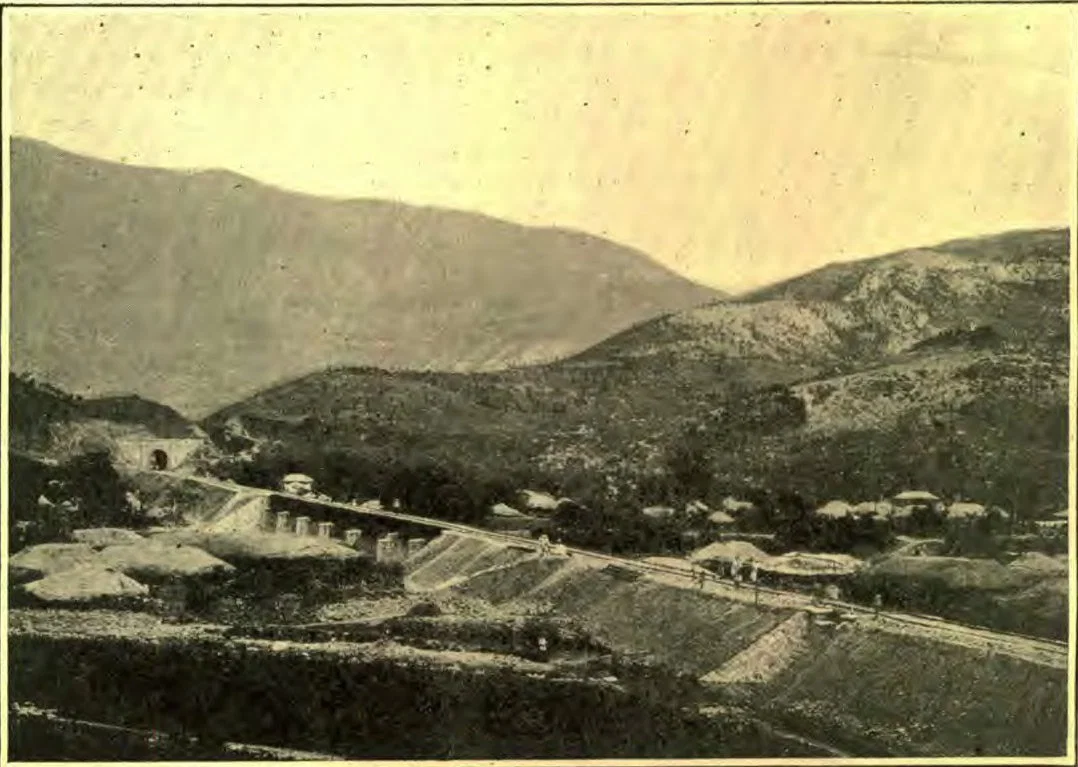
A TYPICAL KOREAN LANDSCAPE — ON THE LINE OF THE SEOUL-TUSAN RAILWAY
The government of Korea is a hereditary monarchy, and the present dynasty has occupied the throne since A. D. 1392. Until 1895 the king of Korea was a vassal of China; but by the treaty signed at the close of the recent war between China and Japan, Korea was acknowledged to be an independent power.
The government is still weak and corrupt; yet the country has opened its doors to foreign influences, and under the counsel of foreign advisers, many reforms have been introduced. However, the opinion seems to prevail among neighboring powers, that the government is incompetent to guide the destinies of the nation. The future control of Korea is one of the important questions to be settled by the present war between Russia and Japan.
The attitude of the Korean government and people toward foreigners is very friendly. Foreigners may reside in the country without annoying restrictions, and there are no laws to interfere with the preaching of the gospel. This is cause for gratitude, and is an indication that the Lord is opening the way for all nations to hear the everlasting gospel. F. W. FIELD.

Travel from Finland to Russia by Rail

From Finland to Russia

We left Helsingfors Thursday night. Our tickets to St. Petersburg, including the right to the third-class sleeper—which means you are assured a plain board bench to lie down on—cost five and one-half rubles. A ruble is about fifty cents. In our apartment were sleeping places for eight persons—on either side the aisle, two below and two above. There were double windows, and the ventilators were two round metal wheels, having in them six or eight small holes. The wheel is about six inches in diameter. You can imagine the amount of air a ventilating apparatus of that sort will admit; and, often the ventilator is shut.
In the morning we arose about seven o’clock. I think I was up earlier. Of course one sleeps, or attempts to sleep, with his clothes on. I had my steamer rug, my winter overcoat, and my rain-mantle. Brother Conradi had practically the same, only his blanket was twice as thick as mine. We each had a small pillow. In the morning I noticed we were in a land of rather light soil, often rocky, sometimes swampy, and there were now and then patches of timber, pine and birch seeming to predominate. There are many lakes in Finland, so that it is sometimes known as the land of a thousand seas. We passed some of these very pretty lakes. The prevailing style of houses is the low log-cabin-like cottage, in the country and smaller places; while in the city of Wiborg, the last large city passed before crossing the border, are the same building materials in use as in Helsingfors—stone, brick, cement, and wood.
In passing the customs, three officers assisted; one looked through our things, one watched him do it, and the other observed the passenger. As we had some forbidden literature in different parts of our clothes and in our overcoats hanging on the wall, of course we were anxious to pass the border without molestation. Now the officer came first to Elder Conradi’s luggage, and when he began to feel around the overcoat, and put his hands on the precious package, it really took grit to look unconcerned. I did not look at Brother Conradi then. The man passed on to my luggage. I also had such a package in my coat. He had his hands on this package, too, but passed on. After they were gone, I looked at Brother Conradi’s face; it was as white as the face of a dead man. He said, “I tell you that was a pretty close call.” You may be sure we were thankful that the forbidden books were not discovered, for that would mean their confiscation, and a close search of our clothing; and we would have lost all the Russian pamphlets and papers, which were the objects of our tenderest care. It is really true that “want makes the worth,” and so these things are at a high premium in this land. I can better imagine now what will be our feelings when the Word of God becomes again a forbidden book. How glad we will be if, in the time of prosperity, we have stored the mind with its sacred truths.
The same is true of hearing the Word. As I write, in the adjoining room they are assembled for worship. We had a meeting Friday evening. Forty persons were in attendance. There were two meetings yesterday, and between twenty-five and forty persons were present. Some of these are dressed in Russian uniform; some of them are very nice, cultured people. I am astonished at the class who dare come to these unlawful gatherings. Education, refinement, intelligence, are all represented. One of the men in uniform is a pensioned government officer. Formerly he was an army official, then chief of police, and now he is honorably retired. He is especially interested in the books of Revelation and Daniel; indeed, he has written an exposition of these prophecies himself, to be printed. He has been refused permission to publish it in Russian, and may fail to secure it in German. The man is a Lutheran. Another man with the Russian uniform is a high government official. There are some Russians, one Bohemian, and many Germans in the church here. It is surprising to see the ease with which these folk speak so many languages. It is no rare thing for a man to use four or five of them. The services here are in German, and translated into Russian. Our church in St. Petersburg numbers about thirty. The people come in one by one to attend the services, and they go out in the same manner, to avoid attracting attention. We do not throw the double windows wide open to admit the air, and thus let out the sound of the speaker’s voice so it may be heard in the court below. The air we breathe is not the free and pure air of heaven; but we do feel that God meets with us; and that it is a privilege to be here. There are in the congregation those who really hunger for the truth. Every one present is an outlaw, because he has no legal right to be here. At any time a policeman could come and look up the meeting, and send us to prison. We learn that about a year ago there was a detective in attendance at the meeting here right along for several weeks. As the leader of the company was away from the city, and those who came met in an informal way, and were very much guarded, no evil resulted, so far as we now know. But this will be enough to show you that the work in Russia needs the constant prayers of our people.
There are many interesting things about this people and city. The Russians are a kind, accommodating people; they treat you nicely, only they do not want anything to break down the established order in church and state. It is the people who attempt to introduce new ideas into these two realms of thought that get into trouble in Russia. Of course he who would preach the genuine gospel is regarded as a public enemy, and subject to the most severe penalties.
But from a few hours spent in the streets Sunday afternoon, I am convinced that there is great need of the gospel here. I never saw so many drunken men in so short a time in any other of the European cities. I was astonished. I saw one very religious man quite intoxicated, and yet he had enough religion to take off his hat and repeatedly cross his breast as he passed by a shrine. Sunday is not observed here as in sections of America or England; there is much more traffic, and trade is carried on not only in the stores, but also in the markets. Near where I am stopping is a market-place. There are a number of old red frame buildings, with broken-in floors and surrounded by poorly-kept sidewalks, where persons were offering for sale apples, cabbage, turnips, a red berry somewhat resembling cranberries, huckleberries, watermelons, and grapes, and plums. I could not ask the vendors what price they wanted for their wares; but things to eat are usually high-priced, and rent is exorbitant. Guy Dail.

The Blind Hymn Writer, Fanny Crosby

THE twenty-sixth of March is to be observed by the Methodist churches throughout the country as Fanny Crosby’s day. Other denominations also will join in this public demonstration of appreciation of Miss Crosby’s service to the world. On the twenty-fourth of March she will be eighty-five years old. She is still in full possession of all her faculties, and in excellent health.
Fanny Crosby has given to the Christian world many of its best hymns, more than five thousand in all. Rescue the Perishing; Blessed Saviour; Pass Me Not, O Gentle Saviour; Safe in the Arms of Jesus; My Saviour First of All; Near the Cross; Saviour More Than Life to Me; All the Way My Saviour Leads Me; More Like Jesus; Redeemed; Some Sweet Day By and By; and Stand Like the Brave, are among her best-prized hymns. She has written under more than a hundred assumed names. Her best work, however, has been done under her maiden name; so she is usually spoken of as Miss Crosby, though in 1858 she was married to Alexander Van Alstyne, a blind musician. Miss Crosby believes that she was called by the Lord to the work of Christian hymn writing, and she also feels that because of her blindness, she has enjoyed peculiarly rich spiritual blessings. So appreciative is she of this close communion with the Lord, that she expresses sincere thankfulness that she was early deprived of her sight. She says: “I verily believe it was God’s intention that I should live my days in physical darkness, so as to be better prepared to sing his praises, and incite others to do so. I could not have written thousands of hymns—many of which, if you will pardon me for saying it, are sung all over the world—if I had been hindered by the distractions of seeing all the interesting and beautiful objects that would have been presented to my notice.” This expression of sweet submission to God’s will that she might more effectually serve the world is akin to that remarkable but sincere statement of the apostle Paul: “I take pleasure in infirmities, in reproaches, in necessities, in persecutions, in distresses for Christ’s sake.”
Her blindness, earnest service to the world, her unexceptionally sunny disposition, and her happy resignation to the will of God,—these all must enlist interest in the life story of the blind poet.

Her Childhood

Fanny Crosby was born in Putnam County, New York. She was the first baby of John and Mercy Crosby. She had good eyes at birth; but when six weeks old, she suffered from slight inflammation of the eyes. The attending physician, it is claimed, prescribed treatment that wholly destroyed the sight. At the age of five years the services of the very best physician of New York City were secured, but without avail. Though left without any hope of ever seeing, she did not grow morose and gloomy. She managed, even when a very little girl, to get much fun and happiness out of her dark world. She says in her autobiography:—
“One of my principal amusements was to sit with hands clasped, or engaged in some piece of work with needles, and listen to the many voices of nature. The laughing and sighing of the wind, the sobbing of the storm, the rippling of water, the ‘rain on the roof,’ the artillery of the thunder—all impressed me more than I can tell. I lived many lives with my imagination. Sometimes I was a sailor, standing at the masthead, and looking out into the storm; sometimes a general, leading armies to battle; then a clergyman, addressing large audiences and pleading with them to come to Christ; then the leader of a gigantic choir of voices, singing praises to God. My ambition was boundless; my desires were intense to live for some great purpose in the world, and to make for myself a name that should endure; but in what way was it to be done?
“A poor little blind girl, without influential friends, could have as many ambitions as any one; but how was she to achieve them? What was there for her? The great world that could see was rushing past me day by day, and sweeping on toward the goal of its necessities and desires; while I was left stranded by the wayside. ‘Oh, you can’t do this, because you are blind, you know; you can never go there, because it would not be worth while: you could not see anything if you did, you know,’—these and other things were often said to me, in reply to my many and eager questionings.
“Often, when such circumstances as this made me blue and depressed, I would creep off alone, kneel down, and ask God if, though blind, I was not one of his children; if in all his great world he had not some little place for me; and it often seemed that I could hear him say, ‘Do not be discouraged, little girl: you shall some day be happy and useful, even in your blindness.’ And so it was that gradually I began to lose my regret and sorrow at having been robbed of sight. Little by little God’s promises and consolations came throbbing into my mind. Not only the scriptures, but the hymns that I heard sung Sabbath after Sabbath, made deep impressions upon me. I began to wonder who made those hymns; and whether I myself could ever make one that people would sing.”
Miss Crosby says that the greatest good fortune that attended her when a little girl was that she was taught the Bible. When ten years old she could recite without a mistake the first four books of both the Old and New Testaments. She also learned many beautiful poems. These created a desire to write stanzas herself; so when eight years old, she produced her first lines, which reveal her optimistic spirit even at this early age:—
“Oh, what a happy child I am, Although I can not see! I am resolved that in this world Contented I will be. “How many blessings I enjoy That other people don’t! So weep or sigh because I’m blind, I can not, nor I won’t.”

Thirst for Knowledge

Miss Crosby’s description of her early desire for an education is both pathetic and interesting. She says: “There was one terrible hunger that afflicted me during all these years; and that was for knowledge,—knowledge, knowledge! I felt that there were a million things that I ought to know, and had no means of learning. If I ever lamented that I was blind, it was through these opening days of girlhood—and that for only one cause: the fact that it debarred me from reading for myself. The amount of literature in raised letters for the blind was very limited in those days, and I had been so accustomed to knitting that my fingers were not adapted to learning how to read by such means, even if alphabets for the blind had been common.
“So, night after night, I have gone to bed drearily, weeping because I could not drink of the waters of knowledge that I knew were surging all around me. I felt at times like a sailor on a great lake of fresh, crystal water, heated and thirsty, but bound hand and foot, so that he could not get to the blessed relief.
“‘Dear God, please give me light!’ was my prayer, day by day. I did not mean physical light, but mental. I always arose from my knees feeling that sooner or later those prayers would be answered. God has always had a way of granting my petitions to him.”
(Continued next Week)
FIG. I
FIG. I

A Handy Basket

Model No. 4

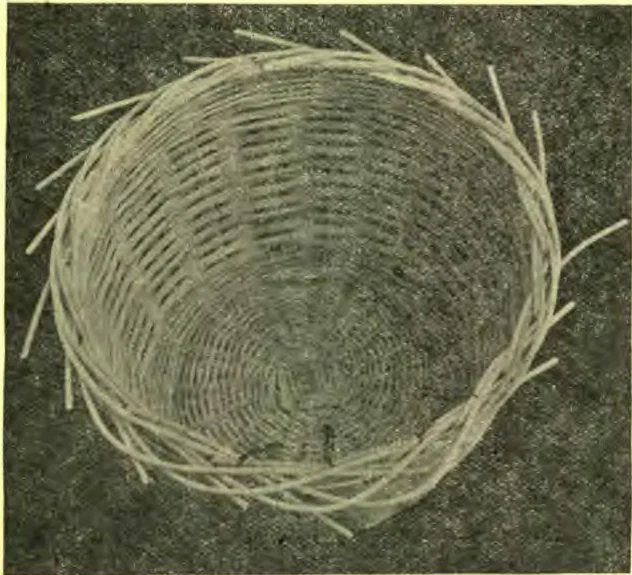
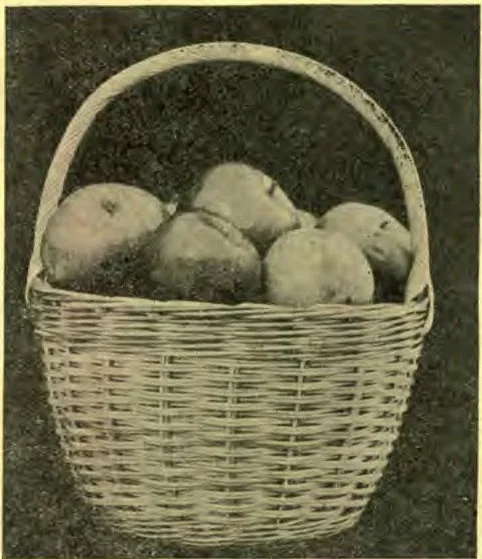
MATERIAL, reeds Nos. 3, 4, 5, and 9. Diameter of base, six inches; top, nine inches; height, six inches. Base is exactly the same as model No. 2. Thirty-eight stakes of No. 4 reed, each twenty-two inches long. Insert one each side of each spoke and use double, as in Model No. 3. Stakes may be bent up sharply from base or rounded as preferred. Rope twist and four rows of triple twist of No. 3 reed form the upset. Four inches of double weaving forms the sides; double weaving is spliced the same as single weaving. Five rows of waling twist complete the weaving. The border of this basket is the same as the braid on the bottom of Model No. 3. When the waling is finished, cut the right stake of each pair close to basket, and follow exactly the directions given for the braid. Tie thread around each of the first four stakes as suggested. Fig. 1 of this article shows how the last four stakes are threaded in to complete the border. When finished, tighten each stake, and cut close.
FIG. 2
FIG. 2
FIG. 3
FIG. 3
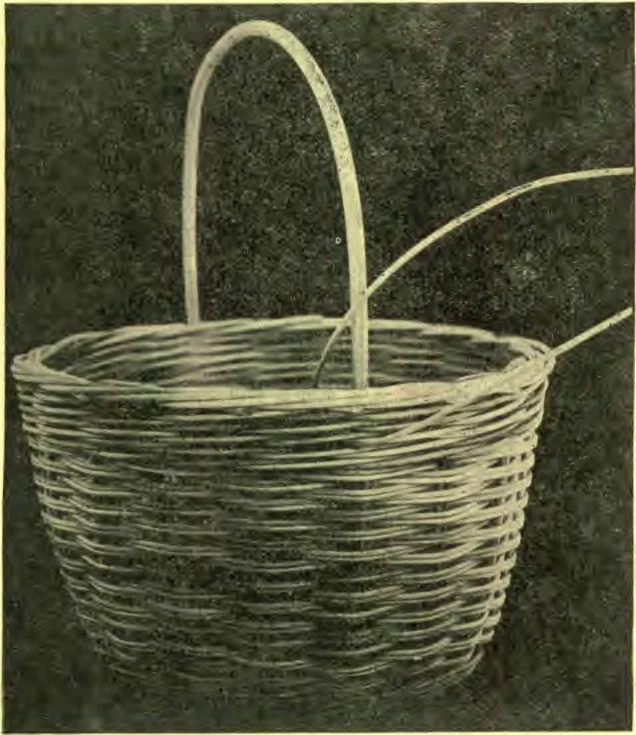
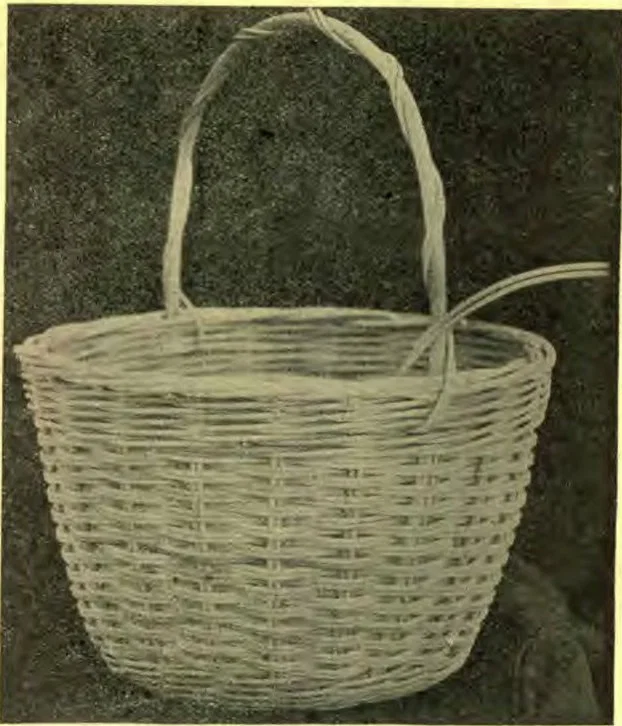
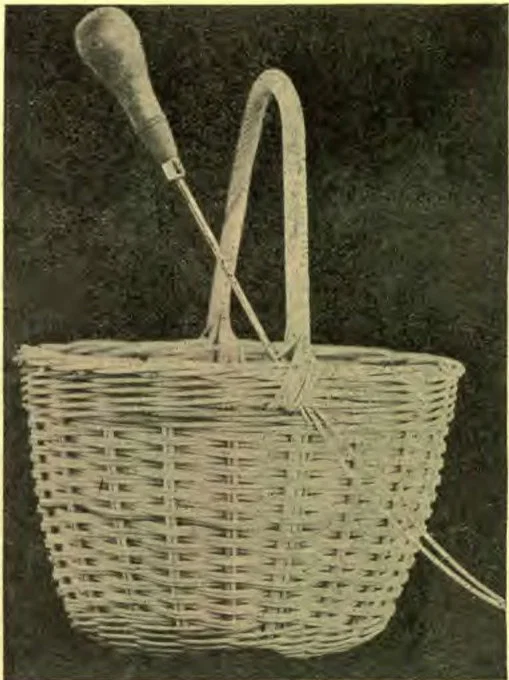
For the handle use a piece of No. 9 reed thirty inches long. Soak until sufficiently pliable to make the desired bend over the basket. Slant each end on the inside of handle only. Begin the slant six inches from the end, and graduate to the thinness of paper at the end. Insert one end at the left of any stake, pushing it down through border, waling, siding, and upsetting. Use the awl if necessary, but if properly slanted there will be no difficulty. Insert the other end at the left of the opposite stake. Shape the handle as desired. Select a long No. 3 reed, and soak well. Slip one end between the third and fourth rows of waling at left of one end of handle, and pull through to about the center. Fig. 2. Draw the reeds together quite near the top of basket and over the handle, then, keeping them close together, bring them on around, and push them through under the handle, and bring back over the top. Repeat five times, spacing so that the fifth time brings the winding to the opposite side of basket. Slip the ends between the third and fourth rows of waling at left of handle, and bring them up just as at the starting-point. Fig. 3. Turn and wind back again just as the first time, keeping the second row close to the first. Continue until the spaces are filled, carrying only one reed across the last time if there is not room for two. If the winding reed is not long enough to finish, secure the ends by passing them down through the waling, and start another piece. The exact method of doing this can not well be told. It is only necessary to make it firm and neat. When the handle is closely covered, the winding reeds should be passed down through the waling and cut close. Fig. 4. For service this basket should have two coats of varnish or shellac.
FIG. 4
FIG. 4
AN ACCEPTABLE GIFT
AN ACCEPTABLE GIFT
MRS. E. M. F. LONG.

Autoplasty: Early Grafting of Severed Body Parts

Autoplasty

MANY years ago, the rajahs of India pursued the barbaric custom of punishing crime by cutting off the nose, lips, or ears of the unfortunate and helpless culprits. Horrible as it may seem, one of the most remarkable additions to the medical science of the world is attributable to this heathenish and brutal practise.
It was serious enough for some poor native who had committed some minor offense, or who had in all probability incurred the displeasure and enmity of those above him, to part company with his nose or lips; but to go about among his fellows, bearing on his countenance the brand of a criminal in the shape of terrible scars, was the greatest punishment of all. So it came to pass one day that a victim, after losing his nose, gained possession of it again, and, carrying it home, placed it back upon the bleeding wound in its former position, and bound it tightly in place. The experiment proved a success, as the wound healed as any other might, and only a scar remained to show that the punishment had been inflicted.
This practise was carried on for some time with continued success before the rulers became aware of it. After that, when a nose or ear was removed, it was cast in the fire, thus removing from the mutilated victim his only hope of escaping lifelong disfigurement. But here the science of surgery, though in its infancy at that time, stepped in and took a part.
The surgeons of the country had noted the successful experiment of grafting a disjoined member back in its former place, and the fact that the natural part adhered after it had been cut off, suggested the idea that a portion of skin removed from some other part of the body and applied immediately to the mutilated part might heal, and act as a natural and acceptable substitute for the missing member of the body.
Willing to try anything that seemed likely to better their appearance after undergoing punishment, victim after victim readily submitted to the treatment proposed by the surgeons. Immediately after a nose had been removed by the executioner, the surgeon went to work, cutting a triangular portion of flesh from the forehead, leaving it still attached to the face by a small strip over the root of the nose which had been cut off.
The skin adhered to the wound, and although the operation left a scar upon the forehead, the deformity of the subject was greatly lessened. At last, as such things will, the fame of this remarkable operation, with the uniform success attending it, spread beyond the confines of India, and reached the ears of the surgeons and scientific men of Europe. Investigation proved the truth of the rumor, and the new method was adopted in other countries where the nose, eyelids, or any other portion of the face had been injured by accident or disease.
This new science was known as autoplasty, or skin-grafting. Celsus, a scientific writer, speaks of both nasal and labial autoplasty. In the fifteenth century the art was practised extensively and successfully by the Branca family of surgeons in Calabria, who may rightly claim the honor of having introduced the practise, since followed, of taking portions of skin from the arm or other part of body to replace deformity in the face, instead of turning over a piece of skin from the immediate neighborhood of the part repaired, thus leaving a scar almost as hideous as the deformity.
In the following century Lanfranc, an Italian surgeon, practised nasal autoplasty in Paris with notable success. The celebrated surgeon, Gaspard Tagliacozzo, also practised the art in Italy, writing a book which threw extensive light on this new addition to the realm of science.
Strange to say, the art was practised but little in the beginning of the nineteenth century, and was almost abandoned until it was revived by the noted English surgeon, Carpue.
Several new methods were introduced, of which three have been permanently adopted as the most practicable and successful. These methods are the Indian, French, and Italian, and one or the other is preferred according to the exact part involved by the operation. The Indian method, as already described, consists in turning over a contiguous portion of skin to repair deformity; the Italian, to take the desired piece of flesh from the arm or some distant part of the patient's body; the French, to loosen skin on either side of the injury, in order to detach it from the part beneath and draw it tightly together across the wound until it entirely covers the lost part, the borders being united with suture pins and ligatures.
By the practise of this method, discovered in far-off India hundreds of years ago, many remarkable operations have been performed, restoring disfigured patients to something like their original appearance.—Hilton R. Greer, in Children's Visitor.

The Sabbath

1. When was the Sabbath made?

“And on the seventh day God ended his work which he had made; and he rested on the seventh day from all his work which he had made. And God blessed the seventh day, and sanctified it: because that in it he had rested from all his work which God created and made.” Gen. 2: 2, 3.

2. For whom was the Sabbath made?

“And he said unto them, The Sabbath was made for man, and not man for the Sabbath.” Mark 2: 27.

3. Who is the Lord of the Sabbath?

“Therefore the Son of man is Lord also of the Sabbath.” Mark 2: 28.

4. How does the Lord command man to keep the Sabbath?

“Remember the Sabbath day, to keep it holy. Six days shalt thou labor, and do all thy work.” Ex. 20: 8, 9.

5. Which day does the Lord say is the Sabbath?

“But the seventh day is the Sabbath of the Lord thy God: in it thou shalt not do any work, thou, nor thy son, nor thy daughter, thy manservant, nor thy maidservant, nor thy cattle, nor thy stranger that is within thy gates.” Ex. 20: 10.

6. Why does the Lord specify the seventh day as the Sabbath?

“For in six days the Lord made heaven and earth, the sea, and all that in them is, and rested the seventh day: wherefore the Lord blessed the Sabbath day, and hallowed it.” Ex. 20: 11.
EMMA S. NEWCOMER.

Paul Writes to the Corinthians

OPENING EXERCISES.

SCRIPTURE FOR PERSONAL STUDY: Acts 20: 18-32.
SCRIPTURE FOR STUDY: 1 Corinthians; chapter 1.
REFERENCE STUDY: “Sketches from the Life of Paul,” pages 149-172.
TOPICS FOR STUDY:—
  • To whom sent.
  • For Corinthian church.
  • Salutation.
  • Prayer.
  • Condition of the church.
  • Paul’s mission.
  • Gospel defined.
  • Who chosen.
  • What Christ is made unto us.

Notes

These lessons are not a study of the epistles of Paul. Reference is made to them simply that we may note the time, place, and circumstances under which some of them were written. The first chapter of this epistle gives an insight into some of the reasons why Paul wrote the Corinthian brethren. We suggest, however, that during the week the entire epistle be read. Two chapters daily and four on the Sabbath will complete the task in a week. Read it prayerfully.
Paul’s first epistle to the Corinthians was written near the close of his three years’ stay at Ephesus, probably in the spring of A. D. 57, near Pentecost.
Conybeare and Howson argues that during his sojourn at Ephesus, Paul paid a brief visit to Corinth which is not recorded by Luke in the Acts. A close study of 2 Cor. 12: 14; 13: 1; 12: 21; 2: 1 seems to indicate that this is so. It is by no means unreasonable that, during the three years he spent in Ephesus, with the easy means of communication between the two cities, he should have visited the brethren in Corinth.
From 1 Cor. 5: 9 it appears that Paul had previously written a letter to the Corinthian church which is not preserved to us. Note also the expression “his letters (plural) are weighty,” in 2 Cor. 10: 10.
A letter informing Paul of the sad condition of the Corinthian church was sent to Paul by members of the household of Chloe. Paul hearing of their condition, however, by no means molded the instruction given by the Holy Spirit.
“With a heart throbbing with anguish, and eyes blinded with tears, he sought counsel from God, and made his plans. . . . In the present state of the church, they were not prepared to profit by his labors. He sent Titus to Corinth to inform them of his change of plans, and to do what he could to correct the existing evils. Then, summoning all the courage of his nature, and keeping his soul stayed upon God, stifling all feelings of indignation at the ingratitude which he had received, and throwing his whole soul into the work, he dictated to the faithful Sosthenes one of the richest, most instructive, and most powerful of all his letters,—the first extant epistle to the Corinthians.”
“Though Paul was an inspired apostle, the Lord did not reveal to him at all times just the condition of his people. Those who were interested in the prosperity of the church, and saw evils creeping in, presented the matter before him, and from the light which he had previously received, he was prepared to judge of the developments. Because the Lord had not given him a new revelation for that special time, those who were really seeking light did not cast aside his message as only a common letter.”
“Paul endeavored to impress upon the minds of his Corinthian brethren the importance of firm self-control, strict temperance, and unflagging zeal in the service of Christ.”
“The apostle thus sought, in the most decided manner, to correct the false and dangerous ideas and practises which were prevailing in the Corinthian church.”
“The servants of God who bear the burden of his work for this time, share the same experience of labor, conflict, and anxious care that fell to the lot of the great apostle.” G. B. T.
Continue reading: “Charity suffereth long, and is kind.” I Cor. 13: 4