The Youth’s Instructor, Vol. 32, No. 34.

THE LAND OF BASHAN

The Youth’s Instructor

Aug 20, 1884

S. D. A. Publishing Association · Battle Creek, Mich. · Aug 20, 1884

THE LAND OF BASHAN.
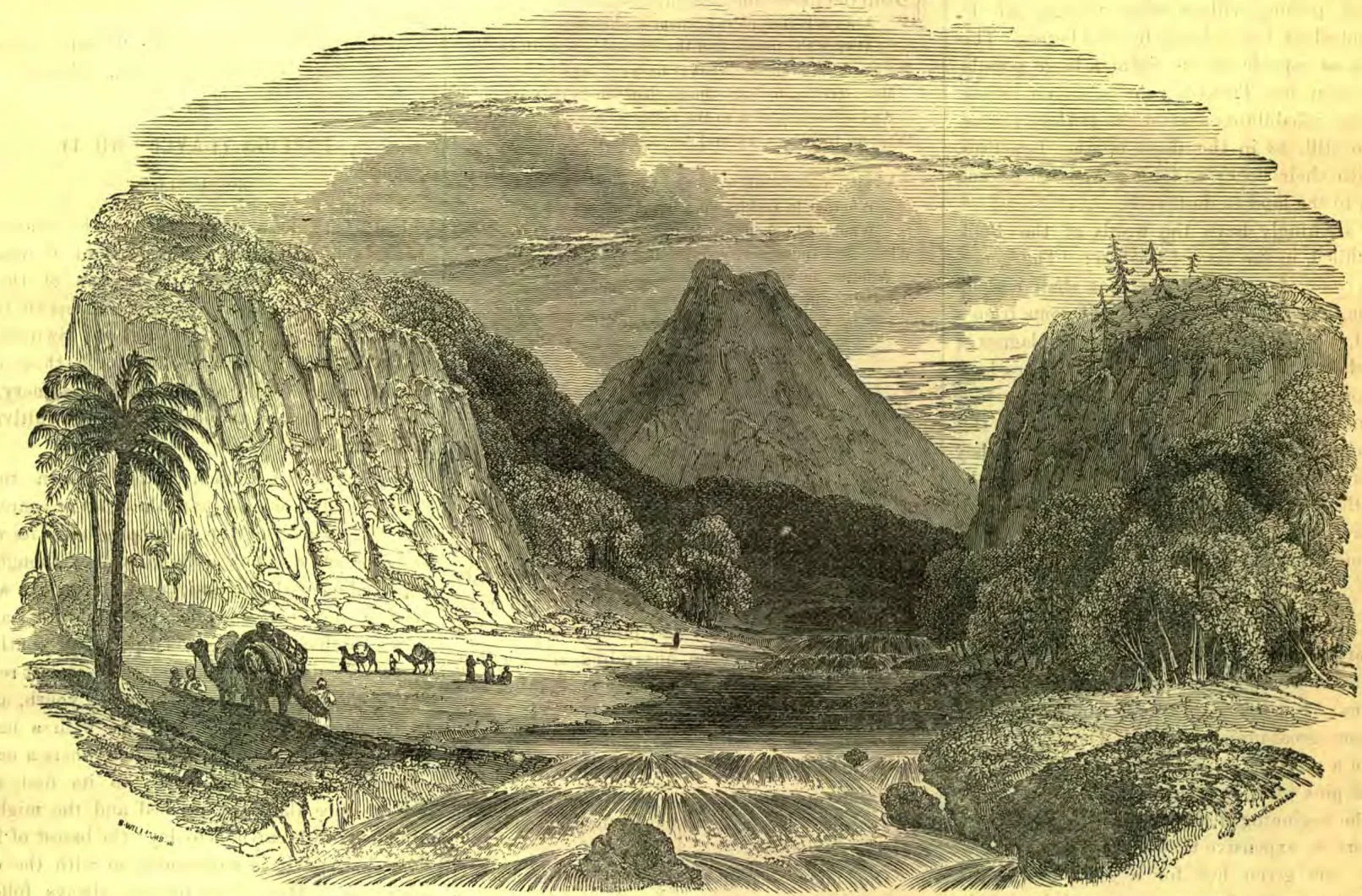
TURNING to the third chapter of Deuteronomy, we read in the record of Moses, “So the Lord delivered into our hands Og also, king of Bashan, and all his people. . . . And the rest of Gilead, and all Bashan, being the kingdom of Og, gave I unto the half tribe of Manasseh; all the region of Argob, with all Bashan, which is called the land of giants.”
This land of Bashan lay on the east of the Jordan, and was among the earliest conquests of the Israelites. It extended south from the snow-capped ridge of Hermon to the River Jabbok, and it stretched away to the eastward till it lost itself in the sands of the desert. From the west, it appears like a long range of mountains rising abruptly from the deep valley of the Jordan. But on approaching it from the east, we find it an elevated table-land, from two thousand to five thousand feet in height.
The Bashan of the time of Moses was afterward divided into four Roman provinces,—Gaulonitis, Auranitis, Batanaea, and Trachonitis. Gaulonitis lay to the west, bordering on Galilee and the Jordan; Batanaea lay on the extreme east, hemmed in by the desert; Trachonitis lay between these to the north; and Auranitis, to the south.
Gaulonitis and Auranitis are beautiful, level plains, dotted here and there with rounded hills. The soil is black and loamy, covered with rich green grass or waving grain, and is wonderfully productive. Strips of oak forests, survivors of those famous “oaks of Bashan,” greet the traveler’s eye, and the plain is gay with the profusion of bright wild flowers.
Batanaea, however, is of an entirely different character . It is a most picturesque mountain region, a mountain range some forty or fifty miles long, and running from north to south, occupying the section. The soil here, also, is extremely fertile, and the mountains are covered with evergreen oaks. The mountains and oaks, and the flocks and herds of Bashan, are often spoken of by the sacred writers. Says the psalmist, “A mountain of God is the mount of Bashan; a mount of peaks is the mount of Bashan.” These mountainsides afford excellent pasturage for cattle.
But perhaps the most interesting and wonderful portion of the land is the Trachonitis, or rough country, the Argob of the Israelites; el-Lejah, or asylum, the Arabs call it, since it furnishes a safe retreat for all outlaws and persecuted persons. It is oval in shape, some twenty-two miles long and fourteen wide, and stands twenty or thirty feet above the surrounding plain. Speaking of this wonderful region, a writer says: “It is wholly composed of black basalt rock, which appears to have issued in past ages from innumerable pores in the earth in a liquid state, and to have flowed out on every side until the plain was almost covered. . . . It has a wavy surface, broken by deep fissures and yawning gulfs with jagged edges. The rock is filled with little pits and protuberances like air-bubbles. It is as hard as flint, and emits, when struck, a sharp, metallic sound. The border is everywhere as clearly defined as the line of a rocky coast, which, indeed, it very much resembles, with its inlets, bays, and promontories.”
Speaking of the conquest of Bashan, Moses says in the Sacred Record: “We took all his cities at that time, there was not a city that we took not from them, three-score cities, all the region of Argob, the kingdom of Og in Bashan. All these cities were fenced with high walls, gates, and bars; besides unwalled towns a great many.” Were this statement not from the Inspired Word, we would deem it incredible that so small a section of country could contain so many towns; yet says Dr. Porter, “On the spot, with my own eyes, I have seen that it is literally true.”
The cities on the west side of the Jordan, with but few exceptions, have scarce one stone left upon another. On the eastern side of the valley this is entirely different. Here stands city after city, hundreds of years old, the houses as perfect as if finished only yesterday, but uninhabited and silent as a city of the dead. Travelers now walk the quiet streets; they open, unbidden, the doors of the houses, and sleep unmolested in the long deserted halls. These stone houses are on a massive scale, with stone doors, stone window-shutters, and low, stone roofs, as if built for the race of giants who first inhabited the land, and at a time when the strength of the buildings was the chief consideration. Says Dr. Porter, in describing these houses: “The walls are sound, the roofs unbroken, the doors and even the window-shutters in their place.” “The houses of Bashan are not ordinary houses. Their walls are from five to eight feet thick, built of large squared blocks of basalt; the roofs are formed of slabs of the same material, hewn like planks, and reaching from wall to wall; the very doors and window-shutters are of stone, hung upon pivots projecting above and below.”
One would think that a land so richly productive as Bashan, with these old, gigantic houses in a state of such perfect preservation, would be inhabited and well cultivated. Yet we are told by those who have been there that one may ride for miles, passing village after village, all deserted and silent, inhabited only by wild beasts. This region is as capable of sustaining a large population as ever, but Turkish rule offers no protection to any inhabitants against the lawless Bedouins, who still, as in the days of the Israelites, come with their flocks and tents and herds, and enter in to the land to destroy it.
Very strikingly have the words of the Book been fulfilled, in the case of Bashan: “The generation to come of your children that shall rise up after you, and the stranger that shall come from a far land, shall say, when they see the plagues of this land, and the sicknesses which the Lord hath laid upon it, wherefore hath the Lord done thus unto this land! what meaneth the heat of this great anger! Then men shall say, Because they have forsaken the covenant of the Lord God of their fathers; for they went and served other gods and worshiped them, gods whom they knew not, and whom he had not given them.” W. E. L.

“NOT WORTH A PIN.”

We are accustomed to look upon pins as valueless; and the saying, “Not worth a pin,” is common among us. But this expression would not have suited our great-grandmothers. They knew the worth of a pin.
Metal pins were first used by English ladies about the beginning of the sixteenth century; and they were so expensive that a lady was very glad to have one given her for a New-Year’s gift. This is why a sum of money was settled upon ladies at their marriage for the toilet, and called “pin-money.”
Fifty years ago, it took twenty people to make a pin—one to draw out the wire, another to straighten it, a third to cut it, a fourth to point it, and a fifth to grind the top, and so on.
The pins of to-day are made by machinery; consequently they are cheaper than ever. The value of a pin is as nearly nothing now as anything can be. A noisy, rattling, snappy little machine turns out between two and three hundred pins every minute, so quickly that it is impossible to count them as they fall.
First, the end of the wire is seized by this devouring little monster, drawn off the reel, and straightened as it travels on to be cut; then a pin’s length is pushed in, and held fast by a kind of nipper, while an iron something snaps down with a rap, and leaves the pin’s length with a neat little head; then away it slides off an incline into a tray, where its straight shank slips through a small slit, which allows it to hang by the head, in company with many others.
As they dangle here, their blunt ends are sharpened by a revolving steel roller which bristles over with vicious, file-like teeth. As each pin is pointed, it is pushed on and out of the way by others that want attending to. After this, they have to be whitened and brightened, in order to be what we describe “clean as a new pin.”
They are laid in a large copper vessel filled with alternate layers of pure-grain tin and pins; then they are covered with water, and sprinkled with cream of tartar, and slowly heated. The acid acting on the tin produces solution of tin, the property of which is to give them that pretty new look we know so well. After this, they are washed, dried, and shaken about in a bag filled with bran, to brighten them.
Who invented all this? Well, that I can not tell you; the process grew and was improved upon by different people. Think of all this when you use the expression idly, “Not worth a pin.”—Harper’s Young People.

TWO SIDES.

“You did!”
“I didn't.”
“You're real mean.”
The children out in the kitchen were quarreling. Mrs. Brown was entertaining a caller in the parlor, when she heard the angry voices. The caller had just been telling her about another lady who had said things not true, and behaved in an unchristian way. It was very plain that the caller and Miss Lewis had been quarreling, though they had been too polite to contradict each other like the children.
Mrs. Brown could not prevent her neighbors disputing, but she did mean to keep peace in her own family.
Edwin and George burst into the room without noticing the caller.
“O mamma,” began Edwin, “George has broken my top, and lost my knife, and he won't lend me—”
“But Edwin tore my new kite, and I want to play sliced animals, only he won't,” cried George.
“Hush, children! not another word. Edwin, you may sit in that corner, with your face to the wall; George, in this; and each write five good things about the other before you stir from your seats;” and mamma handed each of the boys a sheet of paper and a pencil. They felt very much ashamed when they saw Miss Clara. Mamma did not often punish them before people. They wondered why she should do so now. She had her own reasons.
Miss Clara soon went away. Then mamma went out, shutting the door, and the boys were left alone.
George never did like to write. He always got Eddie to help on the grammar exercise at school. Now he folded his paper and bit his pencil; but the words would not come. He peeped around at Eddie. Eddie was writing away as fast as he could. By and by, he spoke, very timidly it is true, “Couldn't you tell me something to write, Ed?”
“What, something good about myself! You are funny!” Then both boys laughed. “Perhaps it will help you to hear what I've written,” and Eddie read his paper.
“Whew!” whistled George, “I hardly know myself; but I can say you've got your paper done first, for one thing; and that you're going to wait for me to finish mine, for another; and that you helped me in my exercise, for another,” and then the “good things” came so thick and fast to George's mind he could not write half of them.
When the boys carried the papers to mamma, it was with arms thrown about each other in a very loving fashion. Indeed, you could not have thought, to see them, that they had ever quarrelled. Next time, I hope they will stop to think of the “good things” before they begin to dispute.
The boys were surprised that evening to see Miss Clara come in again. Two calls in one day! But she walked right up to the boys' mamma, and said, “I've been doing what you told the boys to do, and my mind has changed about Miss Lewis. I'd no idea how many good qualities she had till I tried to count them.”
And Mrs. Brown said softly, “Charity not only suffereth long, but is kind.”—S. S. Advocate.

ROUMANIA

FOREIGN TRAVEL.—NO. 14.

ROUMANIA

Roumania is a country so little known to Americans that possibly some account of what we saw there may interest the readers of the INSTRUCTOR. The usual route of European travel lies in England, Scotland, France, Switzerland, Italy, Germany, Holland, etc.; for in these countries are found the most beautiful scenery, the largest wealth, and the highest stage of cultivation and refinement.
Roumania was much better known to the Greeks and Romans than these other countries; but “westward the star of empire takes its way,” and Roumania is now little known or thought of. Our contact with the nations of the orient awakened a sad train of reflections. With nations as with individuals, there is a period of youth and vigor, and a season of old age. We cannot restore old people to the vigor and bloom of youth, and it is almost equally hard to do so with a nation. There is not an example in history where a nation, once fallen, ever rose again to its first state. Egypt, once the most learned and the mightiest kingdom of the earth, is to-day “the basest of kingdoms.” And it is measurably so with the other kingdoms. Had these nations always followed the path of righteousness and virtue, they need not have become so enfeebled.
But the tendency of modern nations is in the same direction as those that have preceded them. History so repeats itself! And should God grant them time to run their course, we would doubtless see the same sad results as in the ancient nations. There is only this hope for the world, that God will bring about a better state of things by the salvation of the good at the second coming of Christ. Then will be a perfect government, and peace will reign to the ends of the earth.
But we must proceed with our description of Roumania. It is the same country that was anciently called Dacia, an important province of the old Roman Empire. Its inhabitants are descendants of those so long under the Roman Empire in that province. The language bears a strong resemblance to the modern Italian, and both have their foundation in the ancient Latin. But both have become mixed with the language of the other tribes who have occupied the country, or have had intercourse with the people. There are some 10,000,000 people who speak the Roumanian tongue. Only four or five millions of them, however, live in Roumania.
For centuries this country has been under the control of the Turkish Empire, and has paid tribute to it. When the Turks conquered Constantinople, several hundred years ago, their armies poured through Eastern Europe, and conquered the countries bordering on the Black Sea, portions of Hungary, and nearly captured Vienna, the capital of Austria. From that time till within a few years, when the Russian army drove the Turks out, Roumania has had to pay tribute. But the Roumanians, Bulgarians, and other nations inhabiting these countries, were always restive under the rule of the Turks.
The Roumanian religion is Greek Catholic, which, in its forms and ceremonies, much resembles the Roman Catholic. The Greek Catholics, however, do not acknowledge the authority of the pope. There are many Roman Catholics, too, in the country; but the Protestant churches have few adherents. Russia holds the same religious faith as Roumania, and on this account a strong sympathy exists between them. Sympathy in religious matters is the strongest tie which binds peoples together, unless it be self-interest. Both of these influences unite the peoples of Eastern Europe to Russia. Russia greatly desires to obtain Constantinople for her capital, and these nations are equally anxious to obtain the assistance of Russia against their great enemy, the Turk, who has so long oppressed them. Roumania now has a king; and although a small territory, with about 5,000,000 inhabitants, she is training her soldiers, as are also the larger powers of Europe.
Roumania lies between Russia and Bulgaria, and borders upon the Black Sea on the east. The River Danube, a stream almost as large as our Mississippi, traverses the whole southern extent of this country.
The appearance of the land reminded me of many parts of the great West. The country is not so thickly settled as are many portions of Europe. Here and there were many fine groves of trees. Fruits of various kinds, such as apples, pears, cherries, and grapes abound. We saw many fields of corn, quite an uncommon sight in most of the countries of Europe. The country was quite level in some places; portions of it looked much like Nebraska, and there were rivers as yellow as the Missouri. There were droves of cattle and flocks of sheep, with young boys and girls tending them, as in some portions of the West; and there were yokes of oxen plowing. Indeed, one could almost fancy that he was on the broad western prairies, if it were not for the odd-looking houses and people.
The turbans on their heads and the sandals on their feet gave the people a decidedly oriental appearance. The costumes of many were indescribable, so far as being able to give any clear idea of them to any one who had not seen them, is concerned. Although it was April, and quite cool, some had on pants of thin, white cotton cloth. Their feet were dressed in something which looked like Indian moccasins, and their limbs were wrapped around, up to their knees, with what appeared to be old cloths. There were various efforts at adornment, even among the poorest, some indulging in brass jewelry, and a cheap kind of embroidery, and vests of high colors. They look very strange indeed to a Western man. Many were about as wretched-looking people as I had anywhere met, with the exception of those in Naples. Only about half the people can read or write. But then, when in Italy, a very intelligent man told me that only twenty-five per cent of the Italians could read or write. He said the statistics of the country showed this. We cannot realize the ignorance, squalor, and degradation of the mass of people in these countries near the orient.
We saw many gypsies in Roumania. Many of them were darker skinned than the American Indians, and they were a hard looking set. Everywhere in the cities, dogs were yelping, fighting, howling, and barking,—miserable curs, quite unlike the well-trained dogs of our country. They are the scavengers of the streets. The city houses are, as a general thing, small and poor, and not remarkably clean. Fleas and vermin are plentiful.
The churches are built in oriental style, with large, round cupolas and minarets. The buildings did not look inviting. We were there at the time they celebrate the Passover. The week before, we had seen it celebrated at Rome. Years ago, the Greek and Roman churches separated in the time of celebrating this feast. In the State churches of Europe, the people make great account of these feast days, much more so than they do of Sunday. On Sunday, they have pleasure parties, military parties, horse-racing, shooting matches, etc. We saw very little evidence of its being kept as a sacred day anywhere outside of America and Great Britain. The other religious holidays and feast-days are days of pleasure. But we will be obliged to postpone our description of the Passover until another time.
UNCLE IDE.

Purposeless Life: Vanity Without Faith in Love

PURPOSELESS—life is so wayward and purposeless! Always before us the object is shifting; Always the means and the method are drifting. We rue what is done; what is undone, deplore. More striving for high things than things that are holy; And so we go down to the valley so lowly, Wherein there is work and device nevermore. Vanity, vanity—all would be vanity, Whether in seeking or getting our pleasures, Whether in spending or hoarding our treasures, Whether in indolence, whether in strife, Whether in feasting, and whether in fasting, But for our faith in the Love everlasting— But for the life that is better than life. —Alice Cary.

IMPORTANT BIBLE SUBJECTS.

LESSON 8.—THE RESURRECTION.

[NOTE TO THE STUDENT.—Do not consider the lesson learned until you can give at least the substance of every text, with the correct reference for each. The references in black letters indicate those texts that should be committed to memory. A little diligent application each day will enable you to do this.]
“Then said he also to him that bade him, When thou makest a dinner or a supper, call not thy friends, nor thy brethren, neither thy kinsmen, nor thy rich neighbors; lest they also bid thee again, and a recompense be made thee. But when thou makest a feast, call the poor, the maimed, the lame, the blind; and thou shalt be blessed; for they cannot recompense thee: for thou shalt be recompensed at the resurrection of the just.” Luke 14: 12–14.
“As for me, I will behold thy face in righteousness; I shall be satisfied, when I awake in thy likeness.” Ps. 17: 15.
“Beloved, now are we the sons of God, and it doth not yet appear what we shall be; but we know that, when he shall appear, we shall be like him; for we shall see him as he is.” 1 John 3: 2.
“But this I confess unto thee, that after the way which they call heresy, so worship I the God of my fathers, believing all things which are written in the law and in the prophets: and have hope toward God, which they themselves also allow, that there shall be a resurrection of the dead, both of the just and unjust.” Acts 24: 14, 15.

QUESTIONS.

  1. How should we live in this world? Titus 2: 11, 12.
  2. For what are we to be looking? Verse 13.
  3. What is the blessed hope?
  4. Why is the coming of the Lord called a blessed hope? John 14: 3.
  1. By what means are the followers of Christ taken to be with him? 1 Thess. 4: 16, 17.
  2. Are we to hope for an immediate reward for our good deeds? Luke 14: 12.
  3. When are we to expect our recompense? Verses 13, 14.
  4. When does the resurrection of the dead take place? Give proof.
  5. What did Christ promise those who believe on him? John 6: 40.
  6. When did the prophet David say that he would be satisfied? Ps. 17: 15.
  7. And when will the saints be in the likeness of Christ? 1 John 3: 2.
  8. For what was Paul persecuted by the Jews? Acts 26: 6, 7.
  9. On another occasion, how did he define his hope? Acts 23: 6.
  10. Then what fact do we learn from Acts 26: 6, 7?
  11. What sustained Abraham when he was commanded to offer up Isaac? Heb. 11: 17–19.
  12. What comforted Job in his affliction? Job 19: 25–27.
  13. What did the prophet Isaiah say of the resurrection? Isa. 26: 19.
  14. At what time did he locate it? Verse 21.
  15. Will any but the righteous have a resurrection? Acts 24: 14, 15.
  16. To what are the righteous raised? John 5: 28, 29.
  17. What kind of a resurrection do the wicked have? Ib.

NOTES.

THE appearing of our Lord in glory may well be termed a “blessed hope,” since he comes to take his people to himself. It is, indeed, the Christian’s only hope; for whatever of life and joy he may expect, depends upon that.
On 1 Thess. 4: 15–17, we quote the following from Dr. Barnes: “We have in the passage before us an interesting view of the order in which these great events will occur. There will be (1.) The descent of the Judge with the attending hosts of heaven; (2.) The raising up of the righteous dead; (3.) The change which the living will undergo (comp. 1 Cor. 15: 52); (4.) The ascent to meet the Lord in the air; and (5.) The return with him to glory. What place in this series of wonders will be assigned for the resurrection of the wicked, is not mentioned here. The object of the apostle did not lead him to advert to that, since his purpose was to comfort afflicted Christians by the assurance that their pious friends would rise again, and would suffer no disadvantage by the fact that they had died before the coming of the Redeemer.”
For the hope of the promise.—This does not appear to mean the hope of the Messiah, as some have imagined, but the hope of the resurrection of the dead, to which the apostle referred in chap. 23: 6.
It was the resurrection of all men from the dead which Paul’s words signified; and this the Jews had been taught to hope for in many passages in the Old Testament.—Dr. Clarke, on Acts 26: 6.

What One Sin Will Do.

There is but one crack in the lantern, and the wind has found it out, and blown out the candle. How great a mischief one unguarded point in our character may cause us? One spark blew up the magazine, and shook the world for miles around. One leak sank the ship, and drowned all on board. One wound may kill the body—one sin destroy the soul.
It matters little how carefully the rest of the lantern is protected, the one point which is damaged is quite sufficient to admit the wind; and so it matters little how zealous a man may be in a thousand things, if he tolerates one darling sin; Satan will find out the flaw, and destroy all his hopes. The strength of a chain is to be measured, not by its strongest but by its weakest link; for if the weakest snaps, what is the use of the rest? Satan is a very close observer, and knows exactly where our weak points are. We have need of very much watchfulness, and we have great cause to bless our merciful Lord, who prayed for us that our faith fail not. Either our pride, our sloth, our ignorance, our anger, or our lust, will prove our ruin unless grace interposes; any one of our senses may admit the foe, yea, our very virtues and graces may be gates of entrance to our enemies.—Spurgeon.

IN THE HAYFIELD

Written for the Instructor.

IN THE HAYFIELD.

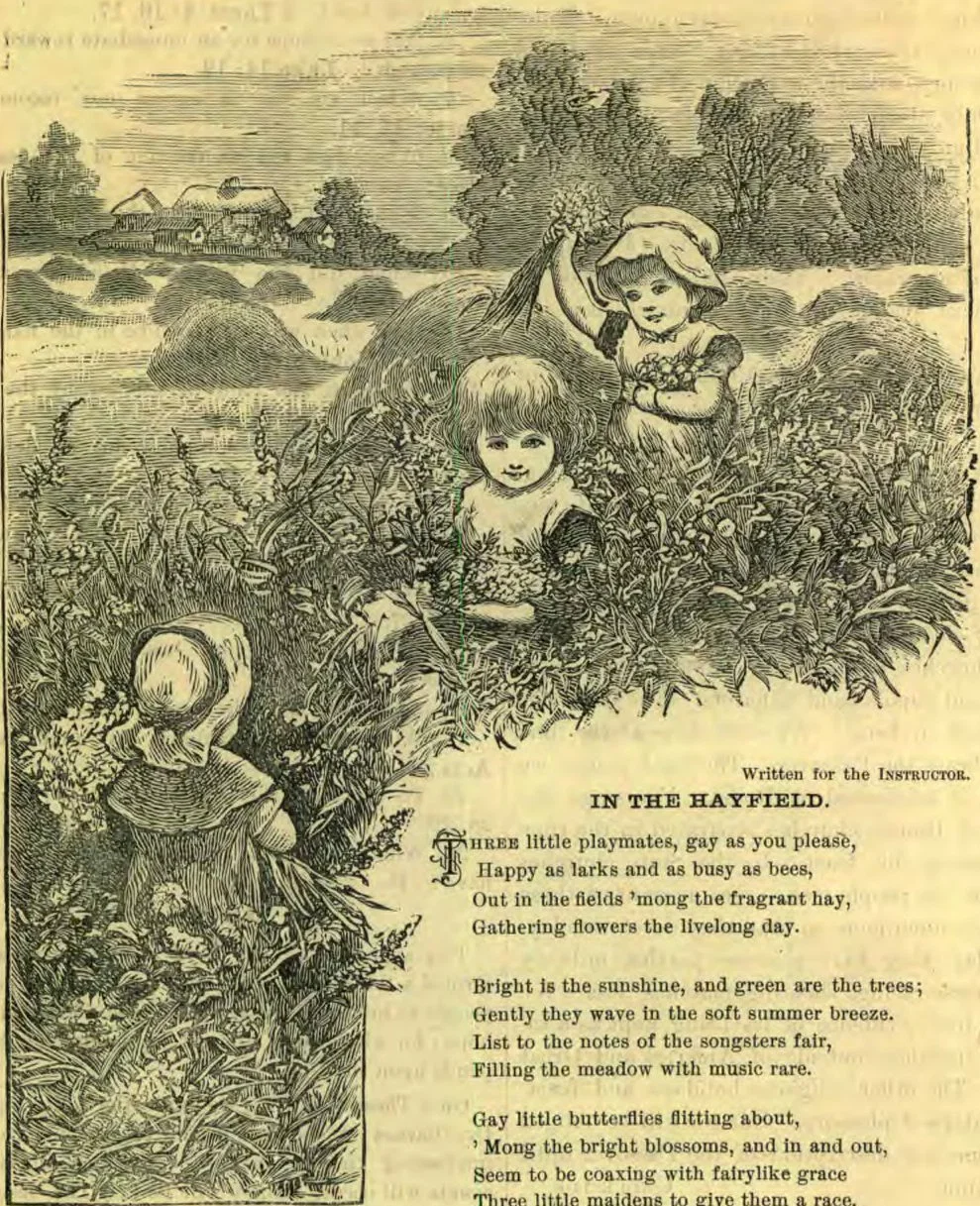
THREE little playmates, gay as you please, Happy as larks and as busy as bees, Out in the fields ’mong the fragrant hay, Gathering flowers the livelong day.
Bright is the sunshine, and green are the trees; Gently they wave in the soft summer breeze. List to the notes of the songsters fair, Filling the meadow with music rare.
Gay little butterflies flitting about, ’Mong the bright blossoms, and in and out, Seem to be coaxing with fairylike grace Three little maidens to give them a race.
Filling their laps with the blossoms rare, Blushing wild roses and violets fair. See, little Jane has a lovely bouquet! “Take that to mamma,” cries dear little May.
“Look, sister Fannie, look quickly—do see! Isn’t it lovely as lovely can be? Mamma says God made the sweet flowers grow, And I guess that’s the reason we all love them so.”
MRS. L. D. A. STUTTLE.

CLEANLINESS

Cleanliness and cleanly you may think are two pretty hard words for little readers to understand. Ask your parents how to speak them correctly. Cleanliness is from the word cleanly, and cleanly is from the word clean, and you all know what that word means. Mamma tells her little boys and girls to wash themselves clean, and how their fair faces shine when free from dirt! She tells the little girls to wash the dishes clean, and oh! how they shine too.
We talk about a person's habits of cleanliness, and we mean he is clean and neat in his ways. He is cleanly in person if he keeps his body clean by bathing it often, and putting on clean clothes at proper times. If one speaks of an uncleanly person, he means just the opposite,—that he does not have cleanly habits.
Almost all of the readers of the INSTRUCTOR are children—we like to have said—of health reformers; we meant, ought to be, then they would know all about cleanliness. They would be cleanly in their persons, in their dress, and in their homes. Everybody can and should be cleanly.
Some diseases, like cholera, diphtheria, and a few others, always appear first in uncleanly places. You hear your parents talking about the cholera in Europe, and that it may visit this country by another year. You begin to fear and dread it. But you should rather begin to practice cleanliness in all your ways. We hope your parents take the Good Health. We don't see how any one can keep house properly without it; for it teaches how to be cleanly, and how to eat and live so as to escape these dreaded diseases.
But we want most to talk with you about the uncleanly habit of neglecting the teeth. It is quite common to see persons, and some of them call themselves reformers, who appear very correct in their habits until they speak or laugh, and expose their unclean teeth. One would not think of taking filth into the mouth; and yet when the teeth are not properly brushed, the worst kind of filth collects on them, which injures the health, and greatly disfigures one's looks; and aside from this, it will soon eat through the enamel on the teeth, causing them to ache, and finally to fall out.
“Oh, well! false teeth are cheap now,” a lady once said when advised to take care of her teeth. Who would not rather have his own sound teeth than to suffer the pain of having them pulled out and others fitted? False teeth, when well prepared, must be a great blessing to those who have lost their teeth; but any one who has them would gladly exchange them for his own natural teeth.
We want the INSTRUCTOR family to be thoroughly clean, with clean mouths and sweet breath. Save a little from your pin-money, and buy a good tooth-brush; not to lay up out of sight, but to use faithfully several times every day. How many will do this? We would like to hear the response.
When you go away from home, too, be sure to take your tooth-brush with you; and don't let anything prevent your using it. If anything must be neglected, rather let it be your outer garments than your teeth. We could tell you something more about the teeth, which would help you to remember the use of the brush; but it would make this article too long.
Finally, dear children, it is a part of the Christian religion to “cleanse ourselves from all filthiness of the flesh and spirit, perfecting holiness in the fear of God,” that we may be fit “temples of the Holy Ghost.” M. J. C.

Letter Budget.

ROBBIE DULLAM writes from Genesee Co., Mich. He says: “Nearly every week I read letters in the INSTRUCTOR from little boys and girls in some of the States; and, although we are strangers, it is good to hear from those who keep the true Sabbath. I go to Sabbath-school, and learn my lessons in Book No. 2. I have never been to day school. My brother and I study at home. I am trying to be a good boy, and hope to meet you all in heaven.”
ELLA MAY MINIER writes from Noble Co., Ind. She says: “I am a little girl six years old, with blue eyes and dark, curly hair. I have a little brother three years old. He has blue eyes and curly hair too. His name is Earnest Harvey. I do not go to school; mamma teaches me at home. I love to read the INSTRUCTOR and the Bible. Mamma tells me the hard words. I send my INSTRUCTOR to a little girl. We have a nice, large Sabbath-school here. My Aunt Emma is secretary. She says she is acquainted with Mrs. Chapman, and she will take Earnie and me to see her when she goes to Battle Creek again. I send much love to the INSTRUCTOR family, and a good share to the editors.”
PEARLIE PERKINS, of Mendicino Co., Cal., says: “I have been keeping the Sabbath with mamma and my brother Roy, who is nine years old, almost two years. Sabbath-school was held at our home a long time. There are sixteen grown persons and nine children, when all are present at the school. I study Bible Lessons No. 1, and Roy studies No. 2. Every week he reads the INSTRUCTOR through, and likes it much. We recite verses out of the Bible every Sabbath, and save our money for the contribution box; for mamma says we give so little for all that God gives to us. I am only six years old, so I had mamma write this for me. When I can write, you shall hear from me again.”
OCTAVIA BANTA, of Sutter Co., Cal., writes: “This is my first letter to the INSTRUCTOR. I go to Sabbath-school, and like my teacher much. I do not go to Sunday-school; I have too much work to do on that day. I study in Lesson Book No. 2. I have two sisters and one brother, all younger than myself. We have been Sabbath-keepers more than a year. I am twelve years old. My parents think they will send my sister and me to the Healdsburg College. I would like to go. There are only three families of Sabbath-keepers in our neighborhood. The trustees refuse to let us have the school-house for Sabbath-school, so we hold it around at our homes.”

You have reached the end of this edition.

The Youth’s Instructor · Aug 20, 1884