THERE was to be a missionary meeting over at the Corners, and Millie and Bennie were in a state of great expectancy; for no matter how simple the event, anything which served to break up in the least the quiet monotony of country life, was eagerly welcomed.
“Just think, Bennie Bradshaw,” explained Millie, “just think, the preacher’s lived for months and months where there wasn’t anybody at all but just poor black people who never even heard of Jesus, ’way off in Africa.”
Never to have heard of Jesus, seemed to Bennie the sum total of wretchedness; and he counted the days till the meeting, when he could hear all about it.
The much-talked-of evening came at last, but as it had rained all day, and the skies still looked threatening, mama decided that Bennie must stay at home with grandma.
“Never mind, Bennie, I’ll tell you all about it just the minute you wake up in the morning,” declared Millie, as she wiped a bright tear from the little boy’s cheek, and then stepped briskly down the steps under papa’s umbrella.
The next morning Bennie was awake bright and early.
“O brother!” began Millie, “the minister showed us ever so many things that the poor heathen use in their own country. They rattle a queer-looking bell when anybody is sick: I should think it would make the sick man’s head ache worse than ever.”
“What do they do so for?” asked Bennie, with wide open eyes.
“O, because they think that will cure the disease. Then the minister showed us some funny-looking clothes which are worn by those strange people. But, O Bennie! he said that one morning a poor black woman came to him to see if he could cure her. She was very sick and wretched, but she did not forget to bring along her god with her; and what do you suppose it was, Bennie? just guess.”
Bennie’s eyes were very big and round by this time. “I’m sure I don’t know; maybe it was a great big wooden doll, like the pictures in papa’s book; or maybe it was a brass man or a little iron man, or —”
“No, Bennie Bradshaw, it was a horrid old cat’s skull! and to think it was the only god the poor woman knew anything about!”
“O Millie! did she say her prayers to a dead cat’s head the same as we pray to the Lord in heaven?”
“Yes, and she had been asking this skull to make her well, for many years. The missionary said the sick woman had paid a large sum of money for it.”
“What became of the poor woman? Did she get well? Did the missionary cure her? O why didn’t some one tell her about Jesus?”
“The minister said he could not cure her, but he did tell her all about the dear Christ, who loves everybody; so that finally when she died, she gave her cat-skull god to the kind teacher, because she had learned to pray to the true God.”
At the breakfast table that morning, Bennie asked many more questions about the poor heathen, and his wise little head began studying up means of earning money to send more missionaries to those far-away countries where the people do not know about God and heaven; for Bennie was a very practical little boy, and his mama had explained that much money was needed to send missionaries in the great ships across the waters. All day long he thought about it. Sister Millie had a whole dollar, which she had cheerfully given; for Millie was a generous little girl,—but poor Bennie! what could he do? He was too small to be trusted to run to the village for mama.
“See here, Bennie,” said grandma, “why not be a farmer? Papa is, and why not you? then you could earn a nice lot of money for the missions.”
“Why, gran’ma! I’m too little! I couldn’t plow; I’m not so big as papa, even when I climb up in a high chair.”
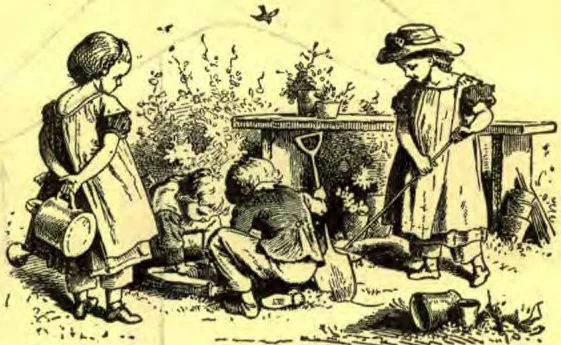
“Never mind, dear, you just ask papa if you can’t have that nice little plat of ground back of the chicken park. I’ll give you some seeds, and you can keep the ground soft with the little hoe and rake Millie used to play with.”
“O can I? can I, Millie?”
“Yes, brother, and I’ll help you all I can, though I expect to be pretty busy with my missionary chickens.”
“You can get a good price for early spring dainties—radishes and lettuce and spinach—at the village,” volunteered grandpa; “and though I’m not as much of a farmer as I used to be, I think I can help you keep the weeds down.”
“O I know I shall earn lots of money if my grandpa helps me,” declared Bennie, delightedly.
“Maybe,” said grandpa, “but you and I must not forget that Paul may plant, and Apollos may water, but God giveth the increase.”
“Which means,” added mama, “that you must ask God to give you success.”
“Yes,” said Bennie, seriously, “I will try not to forget.”
It is needless to say that papa very gladly gave the needed plat of ground to his little son, and that, with grandpa’s help in planting and keeping the weeds down, that little garden blossomed like the rose,—of course it was a very little garden,—but plenty large enough for so small a gardener. But nobody’s vegetables seemed to grow like Bennie’s,—and such a price as people paid him! Of course papa helped him in the marketing. But when the last one was sold, Bennie had quite a sum for helping to keep a teacher in those dark heathen lands, where neither the little boys and girls nor the men and women know anything about the good Lord who gave his precious life for the perishing.
MRS. L. D. AVERY-STUTTLE.
Harry's Missionary Potato
By Mrs. B. McPherson
“I CAN’T afford it,” said John Hale, the rich farmer, when asked to give to the cause of missions. Harry, his wide-awake grandson, was grieved.
“But the poor heathen,” he replied; “is it not too bad that they can not have churches and schoolhouses and books?”
“What do you know about the heathen?” exclaimed the old man, testily. “Do you wish me to give away my hard earnings? I tell you I can not afford it.”
But Harry was well posted in missionary intelligence, and day after day puzzled his curly head with plans for extracting money for the noble cause from his unwilling relative. At last, seizing an opportunity when his grandfather was in good humor over the election news, he said:—
“Grandfather, if you do not feel able to give money to the missionary board, will you give a potato?”
“A potato?” ejaculated Mr. Hale, looking up from his paper.
“Yes, sir; and land enough to plant it in, and what it produces for four years,” said Harry.
“Oh, yes!” replied the unsuspecting grandfather, setting his glasses on his calculating nose in a way that showed he was glad to escape from the lad’s persecution on such cheap terms.
Harry planted the potato, and it rewarded him the first year by producing nine; these, the following season, became a peck; the next, seven bushels and a half; and when the fourth harvest6came, lo! the potato had increased to seventy bushels; and when sold, the amount realized was put with a glad heart into the treasury of the Lord.
Even the aged farmer exclaimed:—
“Why, I did not feel that donation in the least! And, Harry, I’ve been thinking that if there were a little missionary like you in every house, and each one got a potato, or something else as productive, for the cause, there would be quite a large sum gathered.”—Mrs. B. McPherson.
Raising Corn for Missions
ONCE a wee little girl, with two round, dimpled cheeks,
And with eyes like a dove’s, soft and fair,
Held her kerchief at once for the kernels of corn,
Which her teacher placed in it with care.
Then the kind lady said, and in tones full of love,
“Plant this corn for the Lord, whom you know,
Then water it, tend it, and shield it from harm,
And the Lord will himself make it grow.”
Then the wee little girl with her treasure went home,
And quite snug ’neath her pillow ’twas laid;
The next morn, ere the sun had sipped up all the dew,
Her neat little garden was made;
And at night she thus prayed, as she knelt by her bed,
“Bless dear papa, and mama, and Joe.
Please, God, bless my corn; and just where it is sown
Please don’t let the mocking-birds know.”
So with watching and praying and tenderest care,
The young blade soon appeared through the sod,
And erelong as it grew, and the wind through it blew,
To the wee little girl it did nod.
Then, in time, there appeared silken tassels on high,
And bright plumes such as warriors wear;
And the bright golden corn in its cradle so soft,
The wee little girl watched with care.
But when it was ripe, and then garnered and sold,
The wee little girl danced with joy,
As ten bright silver dimes lay right in her hand,
And naught could such pleasure destroy.
Now, dear children, go thou and do likewise,
and see
If the half of her joy I have told;
Plant your corn for the Lord, scatter broadcast
the truth;
He’ll reward you a full hundredfold.
— Selected.
The Mystery of the Toy Boomerang
By Edison Driver
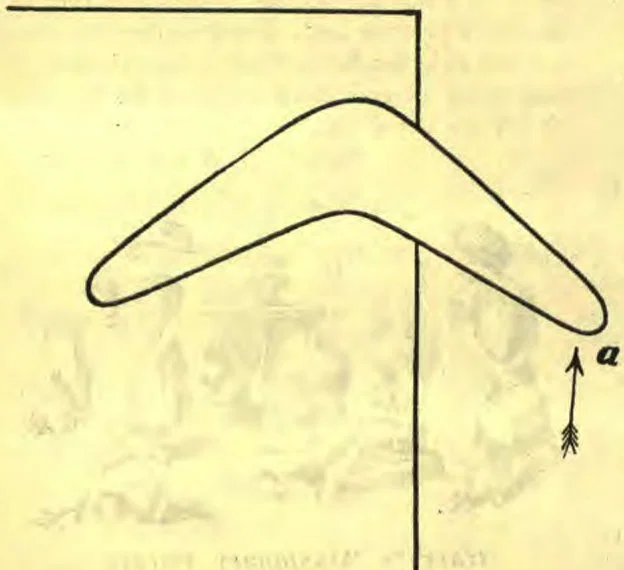
If you will take a piece of cardboard as thick as a visiting card, and cut from it a tiny boomerang of about the shape I show you in the picture, you will have the foundation of considerable amusement as well as instruction. With heavier or lighter cardboard than I have used, you may need to vary the size or shape a little in order to get the best possible results, and I would not try to use heavy cardboard at all.
However, having cut out the little contrivance, lay it, as I have done, on a book, with one end projecting. Tip the book so that the end farthest from you is highest. Then, by means of the finger, give the boomerang a quick, hard snap upon the point I have marked a, and let the snap come from the direction of the arrow. Now, if your cardboard is rightly shaped, you will see it whirl through the air, gradually upward till it has gone from you perhaps almost across the room, when, as if changing its mind, it stops, and, still whirling, comes back to you in the same path that it went away in.
The thought in your mind will be, no doubt, Why does the toy boomerang return? Is there any reasonable explanation for the queer behavior of this little piece of cardboard?—Yes, there is an explanation, which is as follows: When a person snaps the boomerang, he gives it two motions—a rapid rotary, or whirling, motion, and a general motion away from him. The motion that carries it away from him dies out as it reaches its farthest point. Because of its weight the toy then begins to fall, and I tell you but a fact when I say that it falls back to you half across the room. Some one says, “I don’t see how that can possibly be; I should think it would fall straight to the floor from the point where its motion died away.” Yes, but you forget one thing—the boomerang is still whirling. That whirling motion keeps it tipped at just a certain inclination in the air, as the whirling of a top keeps it upright. That is the keynote of the mystery. Of course the card will fall, but it will fall the easiest way; and the easiest way will not be for the broad side of the card to press downward through the air, but rather for the thin edge to sail down in the same plane as it went up. That brings it back to you.
EDISON DRIVER.
Waste-paper Baskets
By Mrs. E. M. F. Long
Model No. 5
The bases for these baskets are the same as those previously described. That of the plain basket is eight inches in diameter.
FIG. I
Twenty-seven stakes of No. 5 reed, each twenty-four inches long. Insert one at the right of any spoke, and one at each side of the next. Continue around the basket; they may not come out even, but that will not matter if you are sure to use the right number. Pinch the stakes, and bend up. Use No. 3 weavers. While weaving the upset, take great pains to evenly space the stakes. One row of rope twist and four rows of triple twist; then eight or nine inches of single weaving. Keep the stakes slanted slightly outward. Be sure to have the basket a good shape before putting on the waling. If you find it is not, pull out as much as necessary of the single weaving and try again. A little practise will enable you to produce any desired shape. Finish with five rows of waling. Top diameter is twelve inches. Border is the same as on the handy basket. For handles cut two pieces of No. 9 reed each ten inches long. Make a two and one-half inch slant at each end. At the left of any stake insert one end through border, waling, and an inch or more of single weaving. Insert the other end at the right of the second stake to the right of one just used.
Shape the handle, and bend slightly outward. Insert the other handle on the opposite side of basket. The winding is begun and finished the same as on the handy basket.
FIG. 2
Slip a long No. 3 reed between the third and fourth rows of waling at left of handle; draw the reed together at the outer edge of border, and wind three times around the handle, pushing the ends through under, and bringing them back over, the handle, and spacing so that the third time reaches to the opposite side. Slip the two ends of the reed between the third and fourth rows of waling at right of handle. Turn the basket around, and wind back again to the starting-point, keeping the second row close against the first. Repeat until the handle is covered. For illustrations see the handy basket.
The Barrel-shaped Basket
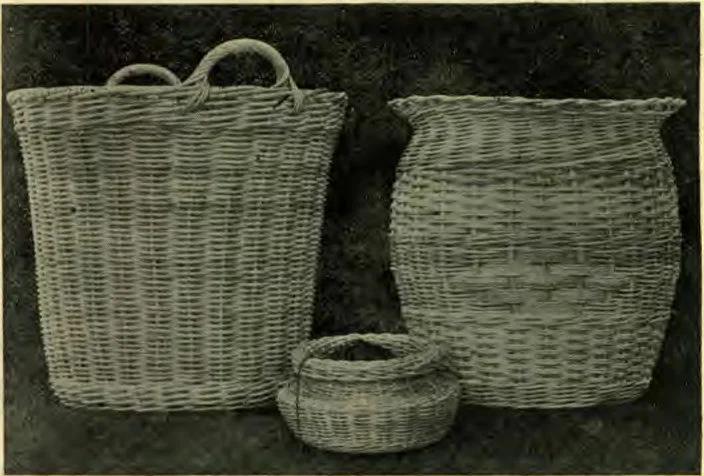
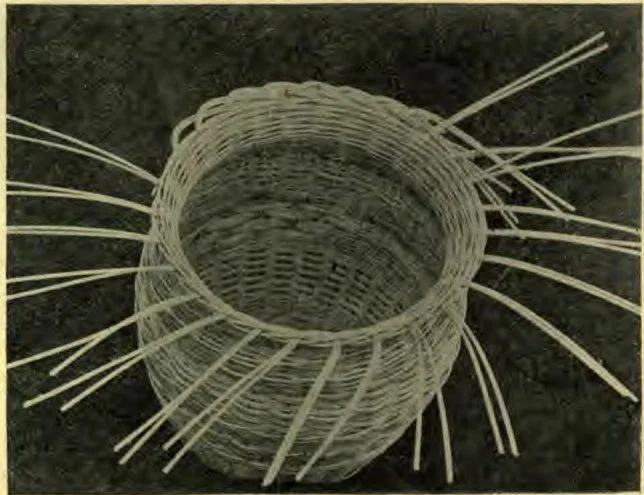
The barrel-shaped basket has a base seven inches in diameter. Twenty-seven double stakes of No. 4 reed, each twenty inches long; insert as directed for the plain basket. Pinch stakes, and bend up. Rope twist, and four rows of triple twist of No. 3 reed. Twelve rows of double weaving, two rows of triple twist, and about two and one-half inches of single weaving. This may be put in plain, or a pattern woven as shown in Fig. 1. This pattern is made by passing over each ninth stake five consecutive times. To do this the weaver must every other row be placed back of two stakes each side of the one you wish to pass over. This will become plain as it is worked out. The next five rows pass under the stake you have just passed over, and over the one at its right and left. Continue working on this plan until the pattern is complete. Follow with two rows of triple twist, twelve rows of double weaving, and twelve of waling twist. Bend the stakes to produce the shape desired. The border is made with the top of basket toward the worker. Take any stake, pass to the right back of one stake, in front of one and back of one. Leave the first one loose to allow for finishing off. Fig. 2. Work toward the right, using each stake in succession until all are used. Weave the last ones in to correspond with the rest. Cut each to rest against a stake on the under side of the rim.
The Knitting Basket
The small basket in the center is a convenient desk or machine basket for small scraps, but is especially adapted for a ball of yarn. Standing beside the one who is knitting or crocheting, the basket will not easily upset, nor can the ball escape. The base of this basket is four and one-fourth inches in diameter. Six and one-half spokes of No. 3 reed. Split three, and insert three and one half. Use No. 2 reeds for weaving, and make the base as usual. Twenty-five stakes, thirteen inches long, of No. 3 reed. Insert one each side of each spoke, except one, so as to have an odd number. Use the stakes singly in weaving. Space them evenly with the upsetting. No. 2 reed for weavers. Rope twist and three rows of triple twist. One and one-half inches of single weaving, with the stakes slanting outward. Then push stakes well toward the center, and continue single weaving one inch, then bend the stakes up to form the neck, using the same weave. For the roll bend the stakes outward and downward, keeping the weaving firm and close. No waling twist was used on this basket. To make the border, stand the basket on its side, with the top toward the worker. Take any stake, bring it forward in front of two stakes at its right, back of one, in front of one, and back of one. Treat each stake in the same way, except that the first should be left loose for the finishing, and all the others drawn down very tight. Always work toward the right. Draw the ends tight, and clip on the under side of roll. The height of the finished basket is three inches, and the inside diameter at top is four inches. By a little mental7effort one can easily make larger- or smaller-sized baskets of the shape of any of the models. It would not be wise, however, to attempt to make a change in size before having made at least one basket just like the model.
MRS. E. M. F. LONG.
A Leper in China
The following touching account of a leper in the Hiao Kan Asylum, Hankow, is taken from the July number of Without the Camp. It is written by Dr. Fowler, of the London Missionary Society. He says:—
During the past year the poison of the “lepra bacilli” has been doing its fell work in our home, and many of our poor fellows are drawing to the end of their earthly pilgrimage. In China no newspaper tells of the loneliness and sufferings of the leper. Seldom, indeed, does any earthly soul but the missionary or a fellow convert come to speak a word of hope or to minister to him as he leaves behind his misery, and passes away into the beyond. No monument marks his grave. But here we wish to place on record the life of one whom we lost last year. He came to the asylum just at the time when we first took charge, and a more unprepossessing lad was never seen; wild, disobedient, dirty, loathsome—a heathen of the heathen. There was much in the boy to repel one. His only redeeming features were his piercing black eyes. Those eyes have haunted us often. At first they seemed to express only fear, then as our real relations to one another dawned upon the lad, friendliness crept into his steady gaze. Later on a light shone there which can only be seen where the love of God has found a lodgment. He became obedient and most kindly—a Christian in very deed. As soon as the better nature began to assert itself, he began to learn characters. His progress was rapid, and he was not a little proud when he found himself able to read his verse at the daily service. At this period the disease had not touched his vocal chords, and his clear ringing voice could always be distinguished during the singing from the gruff unnatural voices of his fellows. The lad developed into a helpful, reliable, and industrious inmate. We used to call him our “Interpreter;” for when, with stammering tongue, we tried to speak to others in very uncertain bookish language, he would stand quietly by our side and turn our words into the colloquial. We regret to say that his services came to a premature and abrupt conclusion just a few weeks ago. A complication of grave kidney and heart troubles sent him to his bed, and pneumonia supervened. We never heard him complain of his maladies. During the whole of that illness he caused us some anxiety; for he no sooner heard the sound of singing at the leper services than he left his bed and stole in to join in the worship of God.
Only the last Sunday of the year, when the service was half through, our friend could be seen with panting breath making his way slowly to the back of our temporary leper chapel. Two days later, he died, believing and trusting in the leper’s Friend. Our loss is quite recent, but it will be many days before we forget our friend “The Interpreter.”
MEMORY VERSE: “Even a child is known by his doings, whether his work be pure, and whether it be right.” Prov. 20:11.
“And the child grew, and waxed strong in spirit, filled with wisdom: and the grace of God was upon him.
“Now his parents went to Jerusalem every year at the feast of the passover. And when he was twelve years old, they went up to Jerusalem after the custom of the feast. And when they had fulfilled the days, as they returned, the child Jesus tarried behind in Jerusalem; and Joseph and his mother knew not of it. But they, supposing him to have been in the company, went a day’s journey; and they sought him among their kinsfolk and acquaintance. And when they found him not, they turned back again to Jerusalem, seeking him.
“And it came to pass, that after three days they found him in the temple, sitting in the midst of the doctors, both hearing them, and asking them questions. And all that heard him were astonished at his understanding and answers.
“And when they saw him, they were amazed: and his mother said unto him, Son, why hast thou thus dealt with us? behold thy father and I have sought thee sorrowing. And he said unto them, How is it that ye sought me? wist ye not that I must be about my Father’s business? And they understood not the saying which he spake unto them.
“And he went down with them, and came to Nazareth, and was subject unto them: but his mother kept all these sayings in her heart. And Jesus increased in wisdom and stature, and in favor with God and man.”
Questions
1. In what little town was the childhood of Jesus spent? Matt. 2:23. What is said of him as he grew older? With what was he filled? What was with him?
2. Name three other boys especially mentioned as children in the Bible. See 1 Sam. 3:19; Luke 1:80; 2 Tim. 3:15. What kind of children were they? What kind of men did they become? Is there anything we can learn from this? How is every child known? See Memory Verse.
3. Where did the parents of Jesus go each year? When was the first feast of the passover held? What did the lamb eaten in this feast represent?
4. Where did Jesus go with his parents when he was twelve years old? When they started home, where did he stay? What did they suppose? Where did they look for him?
5. When they failed to find him, where did they go? After three days where did they find him? Who were with him? What was he doing? How did these learned men feel as they listened to his questions, and heard his answers?
6. How did his parents feel when they saw him? What did his mother say to him? How did Jesus answer her? Whose work had he been doing? Did Joseph and Mary understand his words? Who remembered them?
7. Where did Jesus now go with Joseph and Mary? What is it to be “subject” to one’s parents? What commandment did Jesus obey by being subject to his earthly father and mother? How do we know that obedience to parents is pleasing to the Lord? Read Eph. 6:1 and Col. 3:20.
8. In what did Jesus increase? In whose favor did he grow?
Bob's Enemy
By Adelbert F. Caldwell
Bob didn't do this, and he failed to do that!
Every day he forgot to wipe his shoes on the mat!
His cap he forgot to hang up on the hook,
He never remembered to take back a book!
When his father wished help,— it has to be said,—
Bob forgot till too late to jump out of bed!
Now one day his uncle said, “Bob, do you know
You've a terrible enemy? Ah, but it's so!
And unless you look out and get rid of him, boy,
He'll injure you always— never cease to annoy!”
“Who— who is it, uncle, that's so mean to me?”
“'Tis the boy who forgets— 'tis yourself, don't you see?”
— Adelbert F. Caldwell.
III—The Resurrection
(April 15)
MEMORY VERSE: “And they shall be mine, saith the Lord of hosts, in that day when I make up my jewels; and I will spare them, as a man spareth his own son that serveth him.” Mal. 3:17.
Questions
1. With what promise did Jesus comfort Martha at the death of Lazarus? John 11:22.
2. What reply did Martha make showing that she looked forward to the resurrection? Verse 24.
3. How certain are we that there will be a resurrection? 1 Cor. 15:13–16.
4. Without a resurrection, what is the fate of the righteous dead? Verses 17, 18.
6. How many general resurrections are spoken of in the Bible? Rev. 20:5;
7. What two classes will be raised from the dead? Acts 24:14, 15.
8. How much time will elapse between the two resurrections? Rev. 20:5.
9. At what event will the righteous dead be raised? Acts 24:14, 15.
10. With what kind of body will they come forth? 1 Cor. 15:44.
11. Whose voice will call them from the grave? John 5:28, 29.
12. What did Jesus proclaim himself to be? John 11:25.
13. Who will be sent to gather the righteous together at the coming of Christ? Matt. 24:30, 31;
14. For what purpose will Jesus come to the earth the second time? John 14:3.
15. What class will be gathered to meet Jesus in that day? Mal. 3:16, 17.
The Public Schools
OUR country is being aroused to the alarming increase of crime. The cities of Washington and Boston seem most awake to the situation. Men and women of thought are seeking for a preventive. Many are settling down to the idea that moral and religious instruction in the public schools will solve the problem. Plans are therefore being made to get Congress to enact a law requiring that religious instruction be given in all schools, and a book consisting of selections from the Old and New Testaments be used as a text-book. It is urged that a careful study of such a book will serve the “double purpose of familiarizing the pupils with the finest literature in the world, and instilling into their minds the principles of the most exalted morality, together with reverence and love for God.”
It is suggested by Catholics that if such instruction is to be given by teachers who have little or no reverence for the Bible or its Author, the effort will fail of its intended goal. The Catholics are opposed to the measure; they believe in religious instruction, but they want the privilege of having their own denominational schools, with financial support from the state.
At the Lafayette Theater, Sunday evening March 12, Professor Prescott gave a very forceful presentation of the true principles of religious liberty. He showed that while it is desirable that all children receive religious instruction, it is not the province of the state to provide it; but that the home, the church, and Christian schools are God’s ordained means for giving such instruction. He claimed that if these agencies were fully awake to their privileges and responsibilities, it would not be necessary to seek the aid of the state.
This great problem of increase of crime, together with a legion of others, could be very successfully solved if all who profess the name of Christ were truly his disciples, and went earnestly to work under his direction for the salvation of the individual and the family. “Individual Work for Individuals” should be the Christian’s motto.
Jesus Thirsts
“OUR Redeemer thirsts for recognition. He hungers for the love and sympathy of those whom he has purchased with his own blood. He longs with inexpressible desire that they should come to him and be saved.” We think it was a sad and wicked thing that when our Saviour hung upon the cross and said, “I thirst,” there was none to place to his lips a cup of cold water; but that vinegar mixed with gall was given him. It was a sad thing; but the pain caused by that insult was as nothing compared with the anguish of the Saviour when he thirsts for our recognition, and we refuse to acknowledge him as our Redeemer. Jeremiah gives a pathetic picture of the feeling of the Lord when his people Israel were indifferent to his love and mercy. The Lord is represented as saying: “Woe is me for my hurt! My wound is grievous; but I said, Truly this is a grief, and I must bear it. My tabernacle is spoiled, and all my cords are broken: my children are gone forth of me, and they are not: there is none to stretch forth my tent any more, and to set up my curtains.” Jer. 10: 19, 20.
Shall We Give the Gospel to the Jews?
By A. E. Place
The work which God has entrusted to us is to go to every nation, kindred, tongue, and people. This certainly includes the Jew. Thus far in our experience we have done comparatively little, if anything, for them. The Lord has told us definitely that work for the Jews ought to be done, and to this end a young man was raised up some thirty-five years ago, and was connected with the publishing house at Battle Creek. See “Testimonies for the Church,” Vol. III, page 206.
Not very long ago Elder F. C. Gilbert received a communication from Sister White, in which is contained the following concerning the Jewish work: “The slumbering faculties of the Jewish people are to be aroused. . . . Souls will be saved from the Jewish nation, as the doors of the New Testament are unlocked with the key of the Old Testament. . . . Many of the Jewish people will by faith receive Christ as their Redeemer.”
Elder F. C. Gilbert has recently written a tract for the Jewish people. The cut in this article illustrates the first page of it, in a reduced size. It is written in two languages, parallel pages, Jewish and English. Now will not all our people take hold and distribute this tract? The Jews are found everywhere, and many are very willing to read anything to-day bearing on the gospel. Who have anything for the Jews to-day as Seventh-day Adventists have? Every truth we hold so dear the Jews once possessed before us. Shall we not give to them the gospel message for to-day?
The tract will be sent in any quantity to all who desire to circulate it, and it is hoped that thousands of these will be distributed. The tracts are sent free, but if you desire to send a free-will offering when you send for some, it will assist the work. Send all orders to Elder F. C. Gilbert, who has the oversight of the work. Address him at South Lancaster, Massachusetts. Be sure and send for some of these tracts. Orders can also be sent to Central New England Tract Society, South Lancaster, Massachusetts. “God has not cast away his people which he foreknew.” Will you? A. E. PLACE.