The Youth’s Instructor, Vol. 30, No. 32.

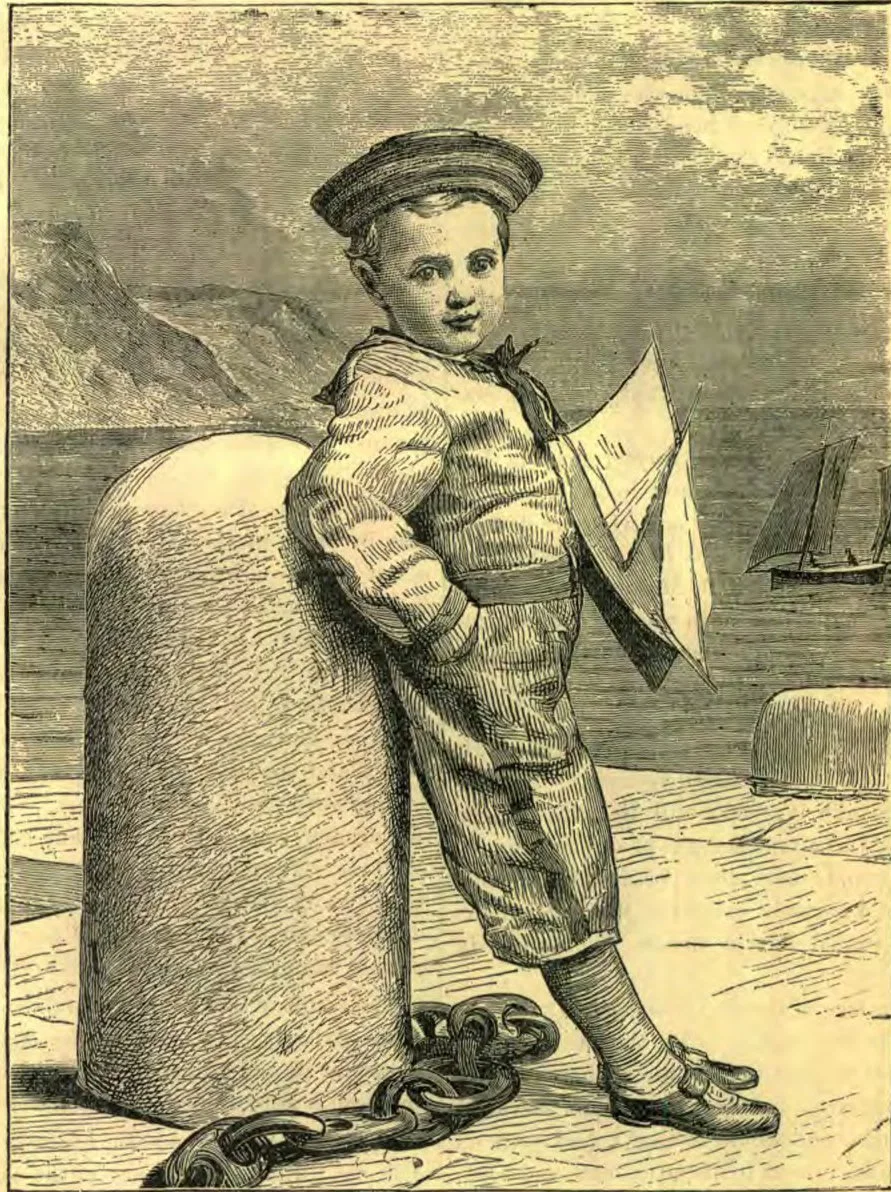
THE YOUNG SAILOR;

The Youth’s Instructor

Aug 9, 1882

S. D. A. Publishing Association · Battle Creek, Mich. · Aug 9, 1882

THE YOUNG SAILOR;

OR HOW A TRUE SERVANT BECAME A BRAVE MASTER.
[Translated from the German.]
The following, from the Independent, is an interesting incident, and true as well as interesting. It tells about a noble Holland lad, who, although in the midst of rough associates, by his adherence to principle, rose from cabin boy to naval commander, and in various ways rendered important service to his country. On one occasion he terribly chastised the Algerine Pirates, who plundered merchant ships on their voyages. He finally lost his life in an ocean battle off the Island of Sicily, in 1676. But here is the story itself:—
“In Holland, where the Rhine flows into the sea, there lived, in 1666, an admiral, who understood the sea as well as a general does the land. His name was Michael Adriaenszoon de Ruyter—a name honored by every true Hollander. He was born at Vliessinger, Zealand, in 1607. His parents were poor people, and wished to train their son to a trade; but he longed to venture upon the sea and to become a sailor.
“Accordingly, he sailed on a ship which traded with Morocco. The merchant, who followed the good maxim, ‘Your own eyes are better than another’s glasses,’ himself sailed with the ship, and soon found that the sailor, Ruyter, was very useful, and, what was more important, a true man. He, therefore, trusted him in many ways in which it is not usual to trust a ship-boy.
“Once, when the annual fair at Morocco was near, the merchant became so sick that he could not make the voyage to Africa. He resolved: ‘I will trust to no one but Ruyter the ship’s cargo, which I will send to the market of Morocco.’
“Then he summoned him to his presence, and said: ‘Michael, you see how I am situated. I cannot go to Morocco. My book-keeper is an old man. What, think you, should I do?’
“‘Send another trusty man, Mynheer,’ said Ruyter.
“‘Right!’ cried the merchant. ‘But whom shall I send?’
“‘That you must know better than I, Mynheer,’ was Ruyter’s reply.
“‘It is an important business,’ said the merchant.
“‘I know it is,’ said Ruyter.
“‘Hear!’ continued the merchant. ‘You must undertake the business. You shall be my super-cargo.’ (Thus he is called who has charge of merchandise sent by the sea.)
“So it was arranged. Ruyter received clothing and pay suited to his rank. The sailors looked surprised when their young comrade came on board as supercargo; but they thought: ‘The merchant is no fool, and he has chosen the right man.’ This was soon very evident. The ship sailed away, landed at Morocco, and Ruyter arranged in the market-place his goods, which consisted of fine woolen cloths.
“There ruled in Morocco at that time a Bey, or prince, with despotic power. The property and lives of all the subjects were at his disposal, and also of all who came into the country for the purposes of trade. There was neither right nor justice. No man’s head rested very firmly between his shoulders.
“One beautiful morning the Bey himself, with a long retinue of courtiers, came and stood before Ruyter’s booth. He examined the cloth, and a piece of superior quality pleased him greatly.
“‘What is the cost?’ asked he.
“Ruyter named the price his master had fixed.
“The Bey offers half of it.
“‘I am not a cheat,’ said Ruyter, ‘who asks half more than the thing is worth, that he can, at last, take the half of what he has asked. The price is fixed. Besides, it is not my property. I am only my master’s servant.’
“All that was lawful; but in Morocco there was no law. Everybody looked alarmed, except Ruyter, as they saw the angry face of the Bey.
“‘Do you not know,’ says the Bey, ‘that I am the master of your life?’
“‘I know that well, Herr Bey,’ said Ruyter; ‘but I know also that I have not asked over much, and that I have a duty, as servant of my master, to care for his interest, and not to think of myself. That I will do until death, and you shall have the cloth not a penny cheaper. Do what you are willing to answer for before God.’
“The merchants, when they heard these words, were full of fear. ‘Good-bye, Ruyter,’ thought they, ‘you will never see another sunrise.’
“They were mistaken. The Bey looked upon the handsome young man with angry eyes. All waited for the brief command, ‘Off with his head!’ but he said: ‘I give you until to-morrow for reflection. If you do not change your mind, make your will.’
“Then he went away. Ruyter calmly put the cloth in its place and began to wait upon his other customers.
“Now arose an uproar among the merchants. ‘For Heaven’s sake give him the cloth,’ cried they. ‘If he cuts off your head,—and he will do it, as sure as you live,—then your life and all your master’s goods, and the ship besides, are lost. And what will become of us? Give it—’tis but a trifle—and save the rest and yourself.’
“‘I am in God’s hand,’ said Ruyter. ‘He who is not true in small things, how shall he be true in great things! If my master loses through me a penny, I am not a faithful servant. I shall not yield a hair.’
“On the following morning Ruyter stood in his booth. The Bey approaches and looks grimly at Ruyter. Behind him walked one who was clothed in garments red as blood, and had a broad-sword in his hand. The people of Morocco knew him and shunned him as fire. He was the public executioner. The Bey paused before Ruyter’s booth, and, looking sternly at him, cries out: ‘Have you as yet come to a conclusion?’
“‘Yes,’ said Ruyter. ‘I shall give the cloth not a penny less than I asked yesterday. If you wish my life, take it; but I will die with a clear conscience and as a true servant of my master.’
“All the people held their breath, for the one clad in the red garment examined the edge of his sword, and smiled like a demon in his bloody work.
“Then the face of the Bey changes and suddenly becomes clear and bright. ‘By the beard of the prophet,’ cries he (and that is the highest oath of a Turk), ‘thou art a noble soul. A truer servant I have never met, and would to God I had such an one.’ Then he turned to his attendants and said: ‘Take this Christian for a model.’ To Ruyter he said: ‘Give me thy hand, Christian. Thou shalt be my friend.’ He threw a purse of gold upon the table and said: ‘It is, thou may’st believe, as much as thou hast asked. I will make of the cloth a robe of honor, as a memorial of thy fidelity.’
“Ruyter returned to Holland with large profits; but he said nothing of this occurrence to his master, who learned it first from others.
“This was the beginning of Ruyter’s great fortune. He soon became the captain of his master’s ship, and, after his master’s death, he entered into the naval service of Holland. He rose rapidly and finally attained the highest rank, that of an admiral, and won many victories over the enemies of his country.
“Thus one may learn that out of the lowest place there is a path to the highest honor, by knowledge, fidelity, honesty, and the fear of God. The way is closed to none. It stands evermore wide open. Onward! whoever will, whoever has a true heart in his breast. From on high God reaches an unseen hand to help.”

STRIFE

Prov. 20 : 3 ; 26 : 17 ; 17 : 14.
Aesop tells us that Hercules, walking one day, Found a strange looking animal in the roadway. As it raised its head, and was threat'ning him, He aimed it a blow from his club with vim, Thinking to pass on, nor be troubled more; But the creature grew larger than before. He dealt it fierce blows, but his wondering eyes Saw the monster increasing ever in size. As harder and quicker the strokes he lay, It more frightful grew, and filled all the way. Then Pallas appeared, and in gentle tone, Said, “You will do well to let that alone. If you value your peace, or even your life, Cease your blows, for the monster’s name is Strife.”
MARY MARTIN.

Faithful in Little Things.

“This,” said Deacon Hays, “is probably the last ship I shall ever build, and I intend to have her as perfect as possible.”
So he selected a beautiful model, and, knowing that the owner wanted something very superior, he spared no time or money in procuring the best timber to be had, and the best workmen to be found; and then he watched over every stick as it was hewn and fitted in its place, every plank that was spiked on the timbers, and every spar that was prepared. When they came to put the copper sheathing over the bottom of the ship, the deacon watched it very closely. At one spot he found that the head of a copper nail which fastened the sheathing was split. The deacon’s eyes were becoming rather poor, but he saw the broken head. “Jim Spiker, I see a nail broken; isn’t there a little hole by its side?” “Not a bit of it, I’m sartin. There couldn’t a drop of water get in there in a century.” So the word of Jim was accepted, the ship was finished and launched, and made two or three prosperous voyages. During one of these she lay at a wharf in Calcutta. Now, these waters swarm with that little pest, the ship-worm. They crawled all over the ship, but could not get through the copper sheathing. At length Mrs. Teredo lit upon the broken nail, found the little hole, and squeezed herself in. Then she began to eat the timber and lay her eggs in it. Soon they hatched and increased, till that timber was full of little teredoes, and then the next and the next, till every stick in the whole ship was very badly worm-eaten. Still, the ship looked sound, sailed well, and made her long voyage.
At length, when in the middle of the great ocean, a terrible storm met her. The wind howled through the rigging as if singing a funeral dirge. The waves rolled up and writhed as if in agony. Every spar was bent, and every timber and spike strained to the utmost. The cargo which filled the ship was of immense value. The crew was large and the passengers were many. Worse and worse grew the storm, till at last a huge wave struck her with all its power. The poor ship staggered, groaned once, and crumpled up like a piece of paper. She foundered at sea, in the dark night, in that awful storm. The rich cargo all went to the bottom of the ocean. The drowned men and women sank down, down, miles before they rested on the bottom. All done through the neglect of Jim Spiker, who was too unfaithful to mend the hole made by the broken nail.—My Paper.

THE IDLENESS OF GIRLS.

One great mistake that many of our girls are making, and that their mothers are either encouraging or allowing them to make, is that of spending their time out of school in idleness or in frivolous amusement, doing no work to speak of, and learning nothing about the practical duties and serious cares of life. It is not only in the wealthier families that girls are growing up indolent and unpracticed in household work; indeed, I think that more attention is paid to the industrial training of girls in the wealthier families than in the families of mechanics and people in moderate circumstances, where the mothers are compelled to work hard all the while. “Within the last week,” says one of my correspondents, “I have heard two mothers, worthy women in most respects, say, the first, that her daughter never did any sweeping. ‘Why, if she wants to say to her companions, I never swept a room in my life, and takes comfort in it, let her say it;’ and yet that mother is sorrowing over the shortcomings of that very daughter. The other said she would not let her daughter do anything in the kitchen. Poor, deluded woman! She did it herself instead.” The habits of indolence and of helplessness that are thus formed are not the greatest evils resulting from this bad practice; the selfishness that it fosters is the worst thing about it. How devoid of conscience, how lacking in a true sense of tenderness, or even of justice, a girl must be who will thus consent to devote all her time out of school to pleasuring, while her mother is bearing all the heavy burdens of the household. And the foolish way in which mothers themselves sometimes talk about this, even in the presence of their children, is mischievous in the extreme. “Oh, Hattie is so absorbed with her books, or her crayons, or her embroidery, that she takes no interest in household matters, and I do not like to call upon her.” As if the daughter belonged to a superior order of beings and must not soil her hands or ruffle her temper with necessary housework. The mother is the drudge; the daughter is a fine lady for whom she toils. No mother who suffers such a state of things as this, can preserve the respect of her daughter—and the respect of her daughter no mother can afford to lose.
The result of this is to form in the minds of many gifted girls not only a distaste for labor, but a contempt for it, and a purpose to avoid it as long as they can live by some means or other.
There is scarcely one letter I have received which does not mention this as one of the chief errors in the training of our girls at the present day. It is not universal, but it is altogether too prevalent. And I want to say to you, girls, that if you are allowing yourselves to grow up with such habits of indolence and such notions about work, you are preparing for yourselves a miserable future.—St. Nicholas.

KEEP STRAIGHT AHEAD.

PAY no attention to slanderers or gossip mongers. Keep straight on your course, and let their backbitings die the death of neglect. What is the use of laying awake of a night, brooding over the remark of some false friends, that runs through your brain like forked lightning? What is the use of getting into a worry and fret over gossip that has been set afloat to your disadvantage by some meddlesome busybody, who has more time than character? These things can't possibly injure you unless, indeed, you take notice of them, and in combating them give them character and standing. If what is said about you is true, set yourself right at once; if it is false, let it go for what it will fetch. If a bee stings you, would you go into the hive and destroy it? Would not a thousand come upon you?
It is wisdom to say little respecting the injuries you have received. We are generally losers, in the end, if we stop to refute all the backbitings and gossipings we may hear by the way. They are annoying, it is true, but not dangerous, so long as we do not expostulate and scold. Our characters are formed and sustained by ourselves, and by our own actions and purposes, not by others. Let us bear in mind that calumniators may usually be trusted to time and the slow but steady justice of public opinion.—Baptist Weekly.

Fear Nothing in the Way of Duty

FEAR nothing when you are in the way of duty.

SCENES IN THE LIFE OF CHRIST.

LESSON 21.—TWO BLIND MEN; ZACCHÆUS.

It must be remembered that immediately after our Lord raised Lazarus from the dead, the chief priests and the Pharisees held a council, and decided to put Jesus to death.
“Jesus therefore walked no more openly among the Jews, but went thence into a country near to the wilderness, into a city called Ephraim, and there continued with his disciples.” While in this place, he gave parables; spoke of his second coming; blessed little children, and said that all who enter the kingdom of heaven must become like them,—must be as pure and innocent, as trusting and submissive, as they are.
When the time of the Passover drew near, Jesus and his disciples left the city of Ephraim, and traveled slowly toward Jerusalem, going by the way of Jericho. It was on this journey that Jesus reproved James and John for wanting to be exalted above their brethren. One day when they were near Jericho, and a great multitude was with them, they passed two blind men who sat by the way-side begging. When these men heard so many people walking, one of them, whose name was Bartimeus, asked what it meant, and some one said, “Jesus of Nazareth passeth by.” When they heard this, they cried out, saying, “Have mercy on us, O Lord, thou son of David.” The multitude, fearing that these men would annoy Jesus with their cries, rebuked them, and charged them to hold their peace, but they cried out the more, saying, “Thou son of David, have mercy on us.” When Jesus heard them, he sent some of the disciples to call them to him. As the blind men came near, he said, “What will ye that I shall do unto you?” They said, “Lord, that our eyes may be opened.” And Jesus had compassion on them, and touched their eyes, telling them that their faith had made them whole. When he had done this, they immediately received their sight, and followed him; and all the people who saw it gave praise unto God. By this we may learn that our Lord will not be displeased with us for being very earnest and persistent in our prayers. Jesus can hear us as well now as he could hear those blind men when he was upon the earth. He has the same compassion for those who call on him, and the same power to help them. If we are obedient and faithful, every heart-felt prayer will be answered, either by granting what we ask, or by giving us something better.
In Jericho, or near it, there was a rich man, named Zacchæus, who was chief among the publicans. This man was very anxious to see Jesus, but could not, because he was so little of stature that he could not make his way through the crowd of people that pressed around our Lord. So he ran before and climbed up into a sycamore tree, and as Jesus passed by, he looked up, and said, “Zacchæus, make haste, and come down; for to-day I must abide at thy house.” Then Zacchæus, hastening down from the tree, received the Lord with great joy. When some of the people saw what Jesus had done, they murmured because Jesus had gone to be the guest of a man that was a sinner. “And Zacchæus stood, and said unto the Lord; Behold! Lord, the half of my goods I give to the poor; and if I have taken anything from any man by false accusation, I restore him fourfold. And Jesus said unto him, This day is salvation come to this house, forasmuch as he also is a son of Abraham. For the son of man is come to seek and to save that which was lost.”

QUESTIONS.

  1. What course did the chief priests and the Pharisees take soon after Jesus raised Lazarus from the dead? John 11.
  2. Where did Jesus then go?
  3. What did he do there?
  4. When did he leave that place?
  5. Toward what place did he travel?
  6. While on this journey, whom did Jesus reprove?
  7. For what did he reprove them?
  8. Whom did Jesus pass one day near Jericho? Matt. 20: 29, 30.
  9. Who besides his disciples were with Jesus at this time?
  10. How did the blind men find out that Jesus was passing by?
  1. What did they then do?
  2. Why did the multitude try to stop them?
  3. What effect did it have to rebuke them?
  4. What did Jesus do when he heard them?
  5. When the blind men came near, what question did Jesus ask them?
  6. How did they answer?
  7. How did Jesus feel toward them?
  8. What did he do and say?
  9. What happened as soon as he had done this?
  10. How did the people show their appreciation of this miracle?
  11. What may we learn from this parable?
  12. How well can Jesus hear our prayers now?
  13. What may be said of his compassion, and his power to help?
  14. If we are obedient and faithful, how will every heart-felt prayer be answered?
  15. What rich tax-gatherer resided in or near Jericho? Luke 19.
  16. What position did he hold among the publicans of that place?
  17. What hindered his getting a sight of Jesus?
  18. How did he get a position where he could see the Saviour?
  19. What did Jesus do when he came to the tree where Zacchæus was?
  20. How did Zacchæus respond to these words?
  21. What caused some of the Jews to murmur?
  22. How did Zacchæus show that he was truly sorry?
  23. What did Jesus say to him?
  24. For what did Jesus say he had come to this earth?

NEW-TESTAMENT HISTORY.

LESSON 94.—THE PASCHAL SUPPER.

It will be remembered that on Sunday our Lord made his triumphal entry into Jerusalem. On Monday he cleansed the temple and healed the sick. On Tuesday he taught all day in the temple, and at night, while on his way to Bethany, he stopped with his disciples on Mount Olivet, and gave them a prophetic history of the church down to the end. On Wednesday the rulers conspired to kill him, and hired Judas to betray him unto them. On Thursday, remaining still in Bethany, Jesus sent his disciples to make preparation for the passover. Near the close of the day, the paschal lamb was killed, and in the evening that immediately followed, the passover supper was eaten. “And when the hour was come, he sat down, and the twelve apostles with him. And he said unto them, With desire I have desired to eat this passover with you before I suffer; for I say unto you, I will not any more eat thereof, until it be fulfilled in the kingdom of God. And he took the cup, and gave thanks, and said, Take this, and divide it among yourselves; for I say unto you, I will not drink of the fruit of the vine, until the kingdom of God shall come.”
“And there was also a strife among them, which of them should be accounted the greatest. And he said unto them, The kings of the Gentiles exercise lordship over them; and they that exercise authority upon them are called benefactors. But ye shall not be so; but he that is greatest among you, let him be as the younger; and he that is chief, as he that doth serve. For whether is greater, he that sitteth at meat, or he that serveth? is not he that sitteth at meat? but I am among you as he that serveth. Ye are they which have continued with me in my temptations. And I appoint unto you a kingdom, as my Father hath appointed unto me; that ye may eat and drink at my table in my kingdom, and sit on thrones judging the twelve tribes of Israel.”
“Now before the feast of the passover, when Jesus knew that his hour was come that he should depart out of this world unto the Father, having loved his own which were in the world, he loved them unto the end. And supper being ended, the devil having now put into the heart of Judas Iscariot, Simon’s son, to betray him; Jesus knowing that the Father had given all things into his hands, and that he was come from God, and went to God; he ariseth from supper, and laid aside his garments, and took a towel, and girdeth himself. After that, he poureth water into a basin, and began to wash the disciples’ feet, and to wipe them with the towel wherewith he was girded. Then cometh he to Simon Peter; and Peter saith unto him, Lord, dost thou wash my feet? Jesus answered and said unto him, What I do, thou knowest not now; but thou shalt know hereafter. Peter saith unto him, Thou shalt never wash my feet. Jesus answered him, If I wash thee not, thou hast no part with me. Simon Peter saith unto him, Lord, not my feet only, but also my hands and my head. Jesus saith to him, He that is washed, needeth not save to wash his feet, but is clean every whit; and ye are clean, but not all. For he knew who should betray him; therefore said he, Ye are not all clean. So after he had washed their feet, and had taken his garments, and was set down again, he said unto them, Know ye what I have done to you? Ye call me Master and Lord; and ye say well; for so I am. If I then, your Lord and Master, have washed your feet; ye also ought to wash one another’s feet. For I have given you an example, that ye should do as I have done to you. Verily, verily, I say unto you, The servant is not greater than his lord, neither he that is sent, greater than he that sent him. If ye know these things, happy are ye if ye do them. I speak not of you all; I know whom I have chosen; but that the scripture may be fulfilled, he that eateth bread with me hath lifted up his heel against me. Now I tell you before it come, that when it is come to pass, ye may believe that I am he. Verily, verily, I say unto you, He that receiveth whomsoever I send, receiveth me; and he that receiveth me, receiveth him that sent me.”

QUESTIONS.

  1. On what day of the week did our Lord make his triumphal entry into Jerusalem?
  2. What notable acts did he perform on the next day?
  3. How was he employed on Tuesday?
  4. When, and under what circumstances did he give the prophetic history recorded in Matt. 24; Mark 13; Luke 21; etc.?
  5. What took place on Wednesday?
  6. Where is Jesus supposed to have remained on Thursday?
  7. On what errand did he send his disciples? Matt. 26: 17–19; Mark 14: 12–16; Luke 22: 7–13.
  8. When was the paschal lamb killed?
  9. When was the passover supper eaten?
  10. As they sat down to the supper, what did Jesus say of his feelings in regard to it? Luke 22: 14, 15.
  11. Why did he have such feelings with reference to this supper?
  12. What did he say as he took the cup and gave thanks?
  13. Was this cup the one that he blessed and gave to them as an emblem of his blood? See note.
  14. What strife arose among his disciples at this time? Verse 24.
  15. How did Jesus reprove and instruct them? Verses 25, 26.
  16. What lesson did he teach them from his own example?
  17. On what occasion had he previously given them similar instruction?
  18. How did he teach them that they were not to be honored in this life, and at the same time, encourage them by promises of being honored with him in the life to come? Luke 22: 28–30.
  19. As Jesus knew that he was about to depart to his Father, and again enjoy the glories of heaven, what were his feelings toward his disciples? John 13:1.
  20. To whose control had Judas now fully yielded? Verse 2.
  21. How did Jesus at this time teach his disciples a lesson of humility? Verses 3, 4.
  22. Why was Peter unwilling to have Jesus wash his feet?
  23. What conversation took place between him and his Lord? Verses 6–10.
  24. Why did Jesus say that they were not all clean?
  25. After Jesus had finished washing their feet, what question did he ask them?
  26. What explanation did he then give? Verses 13–15.
  27. What principle did he lay down for them to remember? Verse 16.
  28. What gentle admonition did he then give them? Verse 17.
  29. What did he say further with reference to Judas?
  30. Why did he make this prediction? Verse 19.
  31. What did Jesus say about the reception of the messengers whom he should send forth to do his work upon the earth? Verse 20.

NOTES.
Chronological Order.—“It is plain from the concurrent order of the other three Evangelists that St. Luke in his account of this supper, has not arranged the incidents chronologically.”—Gardner’s Harmony, p. 222. The verses omitted here will be found in another place.
And he took the cup.—“The preliminary cup taken before the Paschal meal in connection with the invocation of a blessing, and mentioned in Luke 22: 17, is not to be confounded with the cup given at the institution of the Lord’s Supper at the close of the Paschal Supper.”—Ibid.

THE LAUNCH.

BEN THOMPSON was a sailor. He spent the most of his time on the sea, sometimes not coming home for two or three years. Each time he left home, he would say to his two boys, Elmer and Robert: “Now, lads, I’m going back to the ship, and I want you to be good to your mother, and do just as she tells you, and if I live to get back, I hope to hear her say that she couldn’t get along without her boys. And if I should never get back, I hope you will grow up good men, and always care for your mother and sister.”
After he was gone, their mother would give them each certain things to do before they were to play. Robert was to drive the cow to and from the pasture, while Elmer fed the chickens and ducks. They each had their share of the corn and potatoes to hoe, and while one split the wood, the other would pile it in the shed. After these and various other things were done, the boys were allowed to do what they pleased, if they would stay near enough to the house to hear their mother if she called. Sometimes their little sister, “Tot,” was allowed to play with them, if they would be kind to her, and watch that she did not get hurt. Then, if they were good all the week, every Thursday they would all take their dinner and go to the woods. On these trips they would gather flowers, and nuts, and autumn leaves, and sometimes the boys would catch a young rabbit, or squirrel, or fox, which they would bring home and tame.
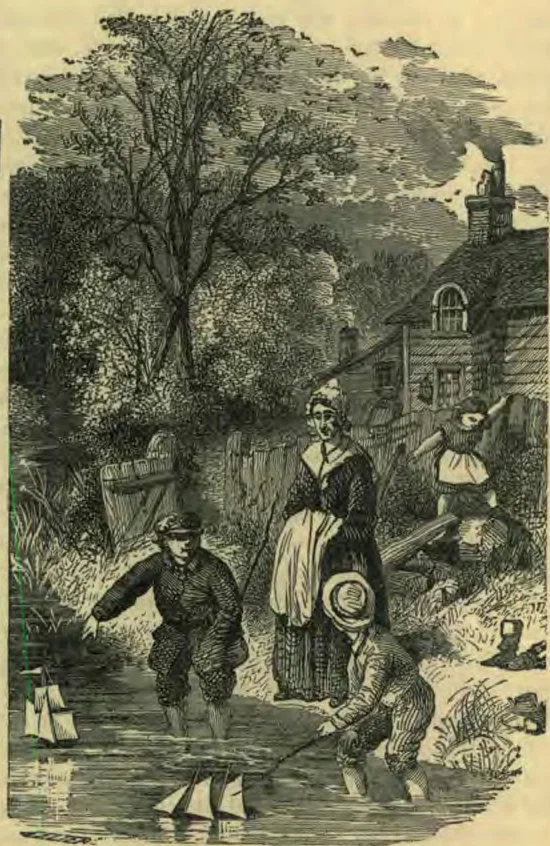
But what the boys liked most of all to do, was to build little ships, and sail them on the pond back of the house. One time when their father was home, he taught them to swim, and then told them they could build rafts, and pole or paddle them over the pond. One summer, the boys’ grandmother came to visit them, and when Robert learned that her name was Ann Eliza, he said to Elmer,—
“Let’s each build a ship; you name your ‘Ann,’ and I’ll name mine ‘Eliza.’ Then we’ll launch and christen them on Grandma’s birthday. So when the birthday came, Grandma was called down to the bank of the pond to see her namesakes launched. Robert’s boat seems to have made the best start, but perhaps by the time little ‘Tot’ gets to the water’s edge, Elmer will have his craft alongside of Robert’s.”
How much better these boys enjoy their sport after they have all their work done, and know that they have been useful to their mother, than they would if they had neglected part of it, or spent all their time in play! And when they get to be men, they will always follow the same motto that their mother taught them,—“Business first, and pleasure afterward.”

HOW MARBLES ARE MADE.

MARBLES were used as playthings by the boys of Rome two thousand years ago. Some marbles are made of potters’ clay, and baked in an oven just like earthenware is baked, but most of them are made of a hard kind of stone found in Saxony, Germany. Marbles are manufactured in great quantities, and sent to all parts of the world, and even to China, for the use of Chinese children. The stone is broken up with a hammer into little square pieces, which are then ground round in a mill. The mill has a fixed slab of stone, with its surface full of grooves or furrows. Above this a flat block of oak wood, of the same size as the stone, is made to turn rapidly around, and while turning, little streams of water run in the grooves and keep the mill from getting too hot. About one hundred of the square pieces of stone are put into the grooves at once, and in a few minutes are made round and polished by the wooden block.
China and white marble are also used to make the round rollers, which have delighted the hearts of the boys of all nations for hundreds of years. Marbles thus made are known to the boys as “chinas” or “alleys.” Real chinas are made of porcelain clay, and baked like china-ware or other pottery. Some of them have a pearly glaze, and some of them are painted in various colors that will not rub off, because they are baked in, just as the pictures on plates and other table-ware.
Glass marbles are known as “agates.” They are made of both clear and colored glass. The former are made by taking up a little melted glass upon the end of an iron rod, and making it round by dropping it into an iron mold, which shapes it, or by whirling it around the head until the glass is made into a little ball. Sometimes the figure of a dog or a squirrel or a kitten, or some other object, is placed on the end of the rod, and when it is dipped in the melted glass the glass flows all around it, and when the marble is done, the animal can be seen shut up in it. Colored glass marbles are made by holding a bunch of glass rods in the fire until they melt, then the workman twists them round into a ball or presses them into a mold, so that when done, the marble is marked with bands or ribbons of color. Real agates, which are the nicest of all marbles, are made in Germany, out of the stone called agate. The workmen chip the pieces of agate nearly round with hammers, and then grind them round and smooth on grindstones.—Selected.

THE ONLY SAFE WAY.

The pilot of a United States revenue cutter was asked if he knew all the rocks along the coast where he sailed.
He replied, “No; it is only necessary to know where there are no rocks.”
Would that all our young men and boys were as wise as this pilot. He did not attempt to know about all the rocks, and to see how near he could steer to them and not wreck his craft. He might have said, “Oh, I’m tired of going this monotonous round day by day and year by year. I believe I’ll try a new track. Some say this is the only safe way, but I’m going to see for myself.” That is what the boy says, when he wants to break away from parental restraint, or when tempted to drink the first glass or smoke the first cigar or cigarette. Total abstinence from all alcoholic liquors and tobacco is the only safe way.—Selected.

The Lasting Companionship of Books We Have Read

One cannot get away from a book that has once been read. The companionship of thought is terribly close. One's friends one may evade, one's enemies one may avoid, but the written words, the unspoken thoughts that we have once admitted to the shrine of our minds, are there forever.

LETTER BUDGET.

HERE is a letter from a grandfather, but he still has a young heart, and loves the children. He says: “I have taken the INSTRUCTOR nearly all the time for over twenty-five years, and also sent it to others. I love the paper, and always go to Sabbath-school, though I often have to walk four miles. I am sixty-five years old; and my wife rests in the grave. She left eight children, and twenty grandchildren. Several of them go with me to Sabbath-school. Dear children, let us all try to learn our lessons well, and then we can have a good Sabbath-school. And I hope we may all so live that when the Great Teacher shall come, we may be gathered into one grand Sabbath-school. Then we shall all know each other.”
FLORENCE L. GALES writes us a letter from St. Armand, Province Quebec. She says: “I am eleven years old. I like to read the INSTRUCTOR, and learn my lessons from it every week. We do not have a Sabbath-school any more, for the folks have all moved away but us, but we still keep the Sabbath. Two of my little cousins live with us. Their mother died about three years ago, and they were brought here to live with us. One is six years old, and the other is three. Emily, the oldest, learns lessons in ‘Bible Lessons for Little Ones.’ I close, with love to all the INSTRUCTOR family.”

THE GOODEST MOTHER.

EVENING was falling cold and dark, And people hurried along the way, As if they were longing soon to mark Their own home cradle’s cheering ray.
Before me toiled in the whirling wind A woman, with bundles great and small, And after her lagged, a step behind, The bundle she loved the best of all.
A dear little roly-poly boy, With rosy cheeks, and jacket blue, Laughing and chattering, full of joy; And here’s what he said—I tell you true: “You’re the goodest mother that ever was.” A voice as clear as a forest bird’s; And I’m sure the glad young heart had cause To utter the sweet of the loving words.
Perhaps the woman had worked all day, Washing or scrubbing; perhaps she sewed; I knew by the weary footfall’s ways, That life for her was an uphill road.
But here was a comfort; children dear, Think what a comfort you might give To the very best friend you can have here, The lady fair in whose house you live,
If once in awhile you’d stop and say, In task or play for a moment’s pause, And tell her in sweet and winning way, “You’re the goodest mother that ever was.”
—M. E. Sangster.

You have reached the end of this edition.

The Youth’s Instructor · Aug 9, 1882