Your ShelfYour Projects

Review and Herald, Vol. 76, No. 14.

AFTER THE CAMP-MEETING

Review and Herald

Apr 4, 1899

Seventh-day Adventist Publishing Association · Battle Creek, Mich. · Apr 4, 1899

AFTER THE CAMP-MEETING.

MRS. E. G. WHITE.
The last days of the Brisbane camp-meeting were full of interest. The attendance at the evening meetings steadily increased, and frequently men and women came long distances, saying they had just learned about the meetings. During the second Sunday, the grounds were thronged. Some had been at the meeting the first Sunday, and came again, bringing friends; many we recognized as those who had attended the evening meetings; but there were hundreds who had come to the meeting for the first time. According to appointment, our meeting was to close the following day, but it was evident that the work of the meeting was not finished. It was too busy a time for consultation; for every worker on the grounds was busy, visiting, entertaining the interested and the curious, distributing reading-matter, and holding short Bible readings with those who questioned about the doctrines taught at the meeting. Those who bore the burden of the meeting felt that an earnest effort must be made to follow up this interest, and many prayers ascended that God would direct in planning and executing the work.
In the night, light came to me, and I was deeply moved. It was represented to me that the cloud still rested over the tabernacle. The cloud had not yet lifted, and the tents must not be taken down. This was our time to seek the Lord earnestly for wisdom and strength, and to labor with all our powers to give the warning message to the people. The people were under conviction, and this camp-meeting remained a necessity. I was not able to speak at the early meeting, but sent word that according to light given to me, there ought to be nothing done unnecessarily to give the impression to the people that the meeting had closed.
Arrangements had already been made to keep the large tent standing for a week or two; but it was the plan of our people to take down the family tents as fast as possible, and let all go to their homes except the regularly appointed Bible workers. But now other plans were rapidly formed. A Bible study for workers was appointed to be held each morning; and our people were invited to remain on the grounds, and aid in the work of the following week. As many tents were left standing as possible, and the families that remained to help keep up the public interest and enjoy the Bible studies were furnished the use of tents without charge. A score or more remained on the grounds for another week, and many others would have done so if they had known beforehand of the opportunity.
The experiences of this meeting, with what has been presented to me at various times regarding the holding of camp-meetings in large cities, lead me to advise that a larger number of camp-meetings be held each year, even though some of them are small; for these meetings will be a powerful means of arresting the attention of the masses. By camp-meetings held in the cities, thousands will be called out to hear the invitation to the feast, “Come; for all things are now ready.” After arousing an interest, we must not cut these meetings short, pulling down the tents, leaving the people to think that the meeting is over, just at the time when hundreds are becoming interested. It is just then that the greatest good may be accomplished by faithful, earnest work. The meetings must be so managed that the public interest shall be maintained.
It may be difficult, sometimes, to hold the principal speakers for some weeks to develop the interest awakened by the meeting; it may be expensive to retain the grounds, and to keep standing a sufficient number of the family tents to maintain the appearance of a camp-meeting; it may be at a sacrifice that several families remain camping on the grounds, to assist the ministers and Bible workers in visiting and in holding Bible study with those who come on the grounds, and in visiting the people at their homes, telling them of the blessings received at the meetings, and inviting them to come; but the results will be worthy of the effort. It is by such earnest, energetic efforts as these that some of our camp-meetings have been instrumental in raising up strong, working churches; and it is by just such earnest work that the third angel’s message must be carried to the people of our cities.
Sometimes a large number of speakers attend a camp-meeting for a few days; and just when the interest of the people is beginning to be fully aroused, nearly all hurry away to another meeting, leaving two or three speakers behind to struggle against the depressing influence of the tearing down and removal of all the family tents. How much better it would be in many cases, if the meetings were continued for a longer time; if persons would come from each church, prepared to remain a month or longer, helping in the meetings, and learning how to labor acceptably. Then they could carry a valuable experience to their churches when they return home. How much better if some of the same speakers who arouse the interest of the people during the largest attendance at the meeting would remain to follow up the work begun, by a thoroughly organized protracted effort. To conduct meetings in this way would require that several be in progress at the same time, and this would not permit a few men to attend all the meetings; but we must remember that the work is to be accomplished “not by might, nor by power, but by my Spirit, saith the Lord of hosts.”

INSTRUCTION REGARDING LABOR.

For a few days after it was decided to continue the camp-meeting, it was quite a struggle for the workers to keep up heart, because of the distraction which attends the departure of friends, and the resettling preparatory for the summer’s work. At the Monday evening meeting the public congregation had voted a hearty request that the meetings continue, and each night the large tent was well filled. The morning Bible classes, which were attended by about thirty persons, were of unusual interest. There were about twelve workers of varied experience and gifts, to be employed in following up the interest awakened by this meeting; and as we saw the extent of the field before them, we wished there were many more.
At the beginning of the Sabbath my heart went out in prayer that God would give wisdom to these workers, and in the visions of the night many words of instruction and encouragement were spoken to us. Ministers and workers were in a meeting where Bible lessons were being given. We said, We have the Great Teacher with us to-day, and we listened with interest to his words. He said: There is a great work before you in this place. You will need to present truth in its simplicity. Bring the people to the waters of life. Speak to them the things which most concern their present and eternal good. Do not present subjects that will arouse controversy,—things that it will require a person of experience by your side to defend. In all that you say, know that you have something that is worthy of the time you take to say it, and of the time of the hearers to hear. Speak of those things which are essential, those things which will instruct, bringing light with every word.
Learn to meet the people where they are. Let not your study of the Scriptures be of a cheap or casual order. Let not your instruction be of a character to perplex the mind. Do not cause the people to worry over things that you may see, but which they do not see, unless these are of vital consequence to the saving of the soul. Do not present the Scriptures in a way to exalt self, and encourage vainglory in the one who opens the Word to others. The work for this time is to train students and workers to deal with subjects in a plain, serious and solemn manner. There must be no time uselessly employed in this great work. We must not miss the mark. Time is too short for us to undertake to reveal all that might be opened up to view. Eternity will be required that we may know all the length and breadth, the height and depth, of the Scriptures. There are some souls to whom certain truths are of more importance than other truths. Skill is needed in your education in Scriptural lines. Read and study Ps. 40:7, 8; John 1:14; 1 Tim. 3:16; Phil. 2:5-11; Col. 1:14-17; Rev. 5:11-14.
To the apostle John, on the Isle of Patmos, were revealed the things that God desired him to give to the people. Study these revelations. Here are themes worthy of our contemplation, large and comprehensive lessons, which all the angelic hosts are now seeking to communicate. Behold the life and character of Christ, and study his mediatorial work. Here are infinite wisdom, infinite love, infinite justice, infinite mercy. Here are depths and heights, lengths and breadths, for our consideration. Numberless pens have been employed in presenting to the world the life, the character, and the mediatorial work of Christ; yet every mind through whom the Holy Spirit has worked has presented these themes in a light that is fresh and new, according to the mind and spirit of the human agent.
The truth, if received into the heart, is capable of constant development and expansion. It will increase in brightness as we behold it; and as we aspire to grasp it, its height and breadth will ever increase. Thus it will elevate us to the standard of perfection, and fit us for our work by giving us faith and trust in God. We want the truth as it is in Jesus; for we desire to make the people understand what Christ is to them, and what the responsibilities are that they are called upon to accept in him. As his representatives and witnesses, we need to come to a full understanding of the saving truths attained by an experimental knowledge.
Teach the great, practical truths that must be stamped upon the soul. Teach the saving power of Jesus, “in whom we have redemption through his blood, the forgiveness of sins.” All should be made to comprehend the power of the truth to those who receive it. “In him dwelleth all the fulness of the Godhead bodily.” Men need to understand that the Deity suffered under the agonies of Calvary. The Majesty of heaven was made to suffer at the hands of wicked men,—religious zealots, who claimed to be the most enlightened people on the face of the earth. Men claiming to be the children of Abraham worked out the wrath of Satan upon the innocent Son of the infinite God. While Christ was bearing the heavy guilt incurred by man’s transgression of the law of God, while in the act of bearing our sins, of carrying our sorrows, he was mocked and reviled by the very men appointed to teach the law, and lead the people to love and obey God.
It was at the cross that mercy and truth met together, that righteousness and peace kissed each other. Let students and workers study this again and again, that they, setting forth the Lord crucified among us, may make it a fresh subject to the people. Teach that the life of Christ reveals an infinitely perfect character. Teach that “as many as received him, to them gave he power to become the sons of God, even to them that believe on his name.” Tell it over and over again, that we may become the sons of God, members of the royal family, children of the heavenly King. Let it be known that all who accept Jesus Christ, and hold the beginning of their confidence firm unto the end, will be heirs of God, and joint heirs with Christ, “to an inheritance incorruptible, and undefiled, and that fadeth not away, reserved in heaven for you, who are kept by the power of God through faith unto salvation ready to be revealed in the last time.”

THE MASTER'S FACE.

No pictured likeness of my Lord have I; He carved no record of his ministry On wood or stone. He left no sculptured tomb nor parchment dim, But trusted, for all memory of him, Men's hearts alone.
Sometimes I long to see him as of old Judea saw, and in my gaze to hold His face enshrined. Often, amid the world's tumultuous strife, Some slight memorial of his earthly life I long to find.
Who sees the face sees but in part; who reads The spirit which it hides sees all; he needs No more. Thy grace— Thy life in my life, Lord—give thou to me; And then, in truth, I may forever see My Master's face!
— Wm. Hurd Hillyer.

HOW MANY ENTERED IN?

KATHERINE A. PINCKNEY.
(South Onondaga, N. Y.)
When the twelve spies returned from searching the land of Canaan, all except two brought discouraging reports, and this curse was pronounced by God: “Your carcasses shall fall in this wilderness; and all that were numbered of you, according to your whole number, from twenty years old and upward, which have murmured against me, doubtless ye shall not come into the land, concerning which I sware to make you dwell therein, save Caleb the son of Jephunneh, and Joshua the son of Nun.” Num. 14:29, 30.
“But the Levites after the tribe of their fathers were not numbered among them.” Num. 1:47. If the tribe of Levi was “not numbered among them,” and the curse was pronounced only on those who were numbered, who shall say how many of the Levites entered the promised land? Num. 34:17 and Joshua 14:1; 17:4; 24:33 prove that at least one, Eleazar the priest, did. And if he, why not others? The thought may arise that Eleazar and Ithamar were not twenty years of age at the time of the numbering of the tribes; but it was “on the first day of the second month, in the second year after they were come out of the land of Egypt,” that the Lord commanded Moses to number the people. Num. 1:1, 2. Although the Levites were not numbered with them, Numbers 4 shows that they were set apart for their work at the age of thirty years; and at the time of the numbering, Eleazar and Ithamar were ministering in the priests’ office, being of the tribe of Levi; therefore they were at least thirty years of age. Later, the age for service varied. Num. 8:24; 1 Chron. 23:25–27. The service of the Levites was laborious; but when God had “given rest” unto his people, it might be performed by younger men.
Of the Levites it is said, “They have observed thy word, and kept thy covenant.” Deut. 33:9. Are those who observe the word of God and keep his covenant, to fail of reaching the heavenly Canaan, of which the earthly was a type? Again, “The Lord is his inheritance.” Deut. 10:9. “In whom [Christ] also we have obtained an inheritance.” Eph. 1:11. Are we ready to say that the Levites failed to enter the earthly, and we may fail to enter the heavenly, Canaan? Again, “And the Levites shall be mine.” Num. 8:14. “And they shall be mine, saith the Lord of hosts, in that day when I make up my jewels.” Mal. 3:17. Are we to say that the Lord cast off his own in the first case, therefore he may in the second, when he says he “will not cast off his people”? Ps. 94:14.
Why was the tribe of Levi so honored?—“It was found that the tribe of Levi had taken no part in the idolatrous worship” at Sinai. “The Lord honored their faithfulness by bestowing special distinction upon the tribe of Levi.”—“Patriarchs and Prophets,” page 324. The children of Israel sinned repeatedly, but it was idolatry that prevented their entering the promised land.
What is idolatry?—“Mortify therefore your members which are upon the earth; fornication, uncleanness, inordinate affection, evil concupiscence, and covetousness, which is idolatry: for which things’ sake the wrath of God cometh on the children of disobedience.” Col. 3:5, 6. “For this ye know, that no whoremonger, nor unclean person, nor covetous man, who is an idolater, hath any inheritance in the kingdom of Christ and of God.” Eph. 5:5. Then covetousness is idolatry. It originated in heaven with Satan. “Not content with his position, . . . he ventured to covet homage due alone to the Creator.”—“Patriarchs and Prophets,” page 35. Self-love is the root of covetousness, and he who is addicted to this “blesseth himself” and “abhorreth the Lord.” Ps. 10:3, margin. Let us beware lest we fall under the curse, through worship of self, as did Satan; and being idolaters, fail to “enter in.”
As the Levites were not idolaters, the “Lord God of Israel was their inheritance.” And again, as they were not idolaters, could the punishment for that sin have been visited upon them? As those who were guilty of idolatry failed to enter the earthly Canaan, so will the “covetous man, who is an idolater,” have no “inheritance in the kingdom of Christ.” But is it wise to conclude that because the eleven tribes were guilty, and fell under the curse, the Levites, not being guilty, suffered the same punishment? Are we willing to accept the analogy?
Joshua and Caleb were not of the tribe of Levi, but were among those who were numbered; therefore it was that the Lord said: “Ye shall not come into the land, . . . save Caleb . . . and Joshua.” Num. 14:30. Though “numbered” among the transgressors, they were not of them. At the time of the idolatry at Sinai, Joshua was on the mount, “awaiting the return of Moses.” See “Patriarchs and Prophets,” page 313. Of Caleb it is said, “Caleb . . . hath followed me fully.” Num. 14:24.
In the light of these words of inspiration, shall we continue to say that of all who came out of Egypt, only two entered the promised land? Who has not felt a weight of discouragement settle down on the mind when this answer has been given? But there is wonderful help and encouragement in this for us as a people: “The history of ancient Israel is a striking illustration of the past experience of the Adventist body. God led his people in the Advent movement, even as he led the children of Israel from Egypt. In the great disappointment their faith was tested, as was that of the Hebrews at the Red Sea.”—“Great Controversy,” page 457.
If the “disappointment” was the Red Sea of the Adventists, then since that time this people have been wandering in the “Wilderness of Sin,” just as surely as the forty years’ wandering followed the passage of the Red Sea. We sometimes wonder at the course taken by ancient Israel during the forty years of wandering. But how many years since 1844? Have we reached the promised land? Why not?—“If all who had labored unitedly in the work in 1844 had received the third angel’s message, and proclaimed it in the power of the Holy Spirit, the Lord would have wrought mightily with their efforts. Years ago the inhabitants of the world would have been warned, the closing work completed and Christ would have come for the redemption of his people.” When Israel crossed the Red Sea, physical Egyptian bondage ceased, but spiritually they were in Egypt. Heb. 11:24–26 shows that “Egypt” and “sin” are synonymous terms. Then the bondage of sin is spiritual Egyptian bondage.
“Out of Egypt have I called my son.” Matt. 2:15. Anywhere outside of a radius of six miles from Bethlehem, Jesus would have escaped the power of Herod, but he must go into Egypt that the word might be fulfilled. Not that Christ was in spiritual Egypt (sin), except as he was made “sin for us;” but we were, and are to-day, unless we have been called out, and have obeyed the call, as all will who are sons of God; for, “Out of Egypt have I called my son.”
As Israel could not keep God’s law while in Egypt, neither can we while in spiritual Egypt—sin. When we have been freed from bondage, we shall be able to keep all the commandments of God, not only the first, of which God’s servant says: “Man is forbidden to give to any other object the first place in his affections or his service. Whatever we cherish that tends to lessen our love for God or to interfere with the service due him, of that do we make a god,” but also the tenth, of which she says: “The tenth commandment strikes at the very root of all sins, prohibiting the selfish desire, from which springs the sinful act.”
As the “rainbow of the covenant” is a circle symbolizing God’s goodness and mercy, without beginning or end, so the tenth commandment reaches back to the first, forming a circle, one tenth part of which can not be broken and removed without breaking the whole. James 2:10. To be sure, as we stand on the earth, the rainbow appears to be but half a circle; but if we could rise above the earth, and the causes which produce the bow, we should see a circle, not a half-circle,—fit emblem of God’s mercy.
So, while we are on this earth, and of the earth, earthy, we can not see the wonderful completeness of God’s law; but when we obey the call, “Out of Egypt [sin] have I called my son,” then we see the glorious oneness of the law. And when we, not having been guilty of idolatry, reach the border of the promised land, and see that law “traced as with pen of fire” against the sky, great will be our reward if we, in our hearts, have kept the circle intact. That is where God has promised to write his law: “I will put my law in their inward parts, and write it in their hearts.” And our part is to keep what he has written.

PATIENCE

VIOLA E. SMITH.
Be patient! In the early spring The farmer sows the precious grain; But many days their flight shall wing, And moons shall wane and wax again, And storms descend, and tempests drear, Ere tiniest shoots of green appear.
Be patient! ages long ago, God made the world for ends sublime; But centuries filled with crime and woe Have deeply dyed the stream of time; Yet through the dark his mercy great Has waited calm, and still doth wait.
Be greatly patient like our God. Though hearts seem hard and cold as stone, Yet he who caused e'en Aaron's rod To bud, thy toil will ne'er disown. Sow thou the seed with purpose high: The harvest cometh by and by.

A PLEASANT WORD.

DID you give one to the last person you met? If so, and if that is your habit, you are to be congratulated, as are also all whom you meet. It is a delightful habit, and one which all can cultivate. The cost of pleasant words is little. Their value is great. Children are hungry for them. Weakness finds strength in them. Discouragement is dispelled by them. They inspire hope. They live in an atmosphere of sunniness and cheerfulness, and they beget such an atmosphere. They make old hearts young, and sad hearts glad. They wipe tears away with a touch as gentle as the hand of an angel, and with a commanding voice they bid despondency be gone.
Pleasant words are pleasant both to speak and to hear. They are neither coarse nor harsh. They do not have a metallic sound, but are rhythmic and musical. They suggest in sound the song of birds and the laughter of childhood, and in spirit the rays of sunshine and the zephyrs of nature’s choicest summer days. Their quality is balm. Their mission is to heal. Blessed, thrice blessed, pleasant words!—Selected.

Overcoming the Feeling of Being Neglected

“THE man who always feels neglected is destined to have a hard time in life. Such a feeling is compounded largely of selfishness. A good way to get rid of the neglected feeling is to hunt up some one who has been really neglected and tell him of the Saviour’s love.”

THE SABBATH QUESTION IN ICELAND.

L. JOHNSON.
(Christiania, Norway.)
David Östlund, our faithful missionary in Iceland, presented the Sabbath question from the platform last fall in Reykjavik, the capital of the island, where he has labored over a year; and the whole city was moved by the Scriptural presentation. A Lutheran priest wrote against him in his church paper; and then the editor of a political paper took it up; and as some of our brethren have expressed a desire to see in the REVIEW what this man wrote, I have translated it as correctly as I could. Some of the expressions are unusual in both the Scandinavian and the English language; but I understand they are quite common in the Icelandic. The paper containing the article was dated Oct. 15, 1898. It reads as follows:—
The author of the tract, “Hvildordagen Drottius,” shows plainly what all educated people knew before,—that the keeping of Sunday, like Christmas, is wholly heathen, and has no relation to Jesus of Nazareth or his religion. The Emperor Constantine, who appointed by law the unchristian and dog-heathen Sunday, saw clearly, like the theosophists of our time, that Christianity, which had a hundred heads, and heathenism, which had a thousand heads, were so much related that both ought to be able to agree upon letting their oxen and asses rest upon the same day.
To those who believe that the ten commandments of Moses are the revealed will of the eternal God, Mr. Östlund has no difficulty in showing that the third (fourth) commandment remains unchanged, because Constantine and other Christian men’s notions in the fourth century could not (how nice they appeared!) abolish the eternal and almighty God’s plain command. The third commandment, “Remember the Sabbath day [Saturday], to keep it holy,” was of course neither more nor less important in the time of Moses than it is to-day.
Mr. Östlund can not understand (and that is reasonable) what power can exist in the other commandments, when men can take one of them, and trample it under their feet without either God or men saying anything about it.
Pastor John Helgason has written, in Verði ljós, against this “erroneous tract,” and it is evident that he does not bury his talent in the ground; but it is almost too bad that he should have so little with which to defend himself. It is pitiful that the Scriptures, the word of God, which the Lutherans say they build upon altogether, have only bonehard commandments concerning Saturday, and not one word in favor of Sunday. In regard to this, Pastor John Helgason can of course do nothing; and it would be right for him honestly to acknowledge that Constantine and Catholicism have taken away the third commandment. It is also very pitiful that people who are used to read Verði ljós, and listen to the sermons of the priests, now shall hear Pastor Helgason make fun of the many Scripture quotations that are used by Mr. Östlund.
Still from all this, Pastor Helgason gets out tolerably well. But in one point he let “the awful heretic” fool him too much. He has no other way to get rid of the third commandment (and there does not exist any other) than to say that all the commandments are abolished in Christ, “according to the letter;” then of course the third [fourth] commandment is also abolished “according to the letter,” and he can put in another new commandment in place of it. But this is an awful road to the truth: it is a road upon which the Scripture itself would break its neck.
According to the words, Jehovah commands all to keep the rest-day of the Lord their God; that is, “according to the letter,” he commands all to keep Saturday holy. It is plain that it is just Saturday that he means, or else he would have said: “Keep thou one or another day in the week holy;” etc. “But according to the Spirit,” the commandment would read as follows: “Keep one day or another in the week holy. Thou dost not need to care anything about that the Lord says it is Saturday, if thou canst just find something to remind you of this or that which seems beautiful to you.”
But now how would it be if we did the same with the other commandments,—abolished them “according to the letter”? Let us take the first commandment. Would it not read about as follows? “Thou shalt have one or another God.” That the first commandment speaks of Jehovah as the third speaks of Saturday means nothing, because it is abolished “according to the letter.”

Roses and Pinks.

L. A. REED.
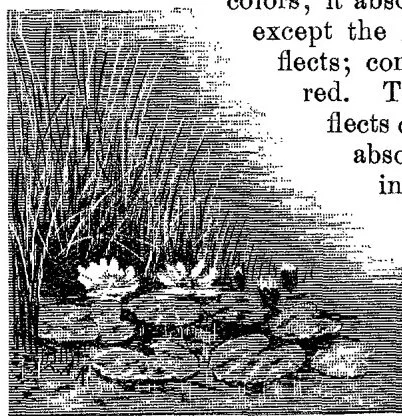
God never made two souls exactly alike; he never made two souls to present exactly the same aspects of his character. And there is something like this in nature. Dandelions are yellow, and poppies are red; if all flowers were of the same hue, we should tire of the uniformity. There is the same sun and the same sunshine for each flower, the same sky bending above them, the same rain and dew; yet how varied the colors!
This variety in the color of flowers is due in each instance to the fact that each individual reflects a different set of light-rays from that of his neighbor. The lily, like the snow, reflects all the prismatic colors, and hence is white. But the poppy does not reflect all the prismatic colors; it absorbs all of them except the red: this it reflects; consequently, it is red. The dandelion reflects only the yellow, absorbing, drinking in, the others.
Roses and Pinks.
Roses and Pinks.
It is thus with Christians. They may be placed under the same apparent circumstances and influences, yet they will present variety. Each individual is so constituted that he reflects some one or other of the rays of the Sun of Righteousness more fully than his fellows, and by this peculiarity he is distinguished.
It is the manifold grace of God that men receive; and in some, as in Moses, it appears as meekness; in another, as for instance Abraham, as faith; or, as in Paul, it is zeal; in Elijah, courage and power; in Job, patience; in John, love. The ideal type, the perfect character, is to be found in no single individual outside of Christ himself; but on the other hand, in all the saints collectively. Each is to reflect his own hue of God’s glory.
Not all can be the roses, else there would be no lilies and no pinks. If he makes you a rose, be not anxious to be some other flower in his garden,—this garden of the Lord. The Gardener has placed each flower as pleases him best; and if he prefers in your corner of the garden to have the blue or the red, or any other, be content to have it so. Know that he places each flower so it will make with the others the sweetest harmony, and add most loveliness to his garden. There are no ugly flowers; some you may like better than others, but none are ugly; each one of God’s flowers has untold beauties.
But even though you be one of the flowers not much noticed for itself, is it not enough if the garden is loved the more for your being there? His child, be glad in the thought that you are a flower of his planting. Bloom on in the sunshine, radiant in its light. You are in his garden. That is enough.
Continue reading: TO HIM THAT OVERCOMETH