Pacific Press Publishing Company · New York · Aug 1, 1895
IN THE CHAIN-GANG UNDER THE FLAG.
It was the evening of the third of July, that the eight Seventh-day Adventists, now in the chain-gang in Rhea County, Tenn., went to prison.
Court had adjourned until the following Monday, and the judge, before whom they had been tried, the attorney-general, who prosecuted them, and the jurors, who found them guilty, had all gone home to spend the Fourth—with their friends.
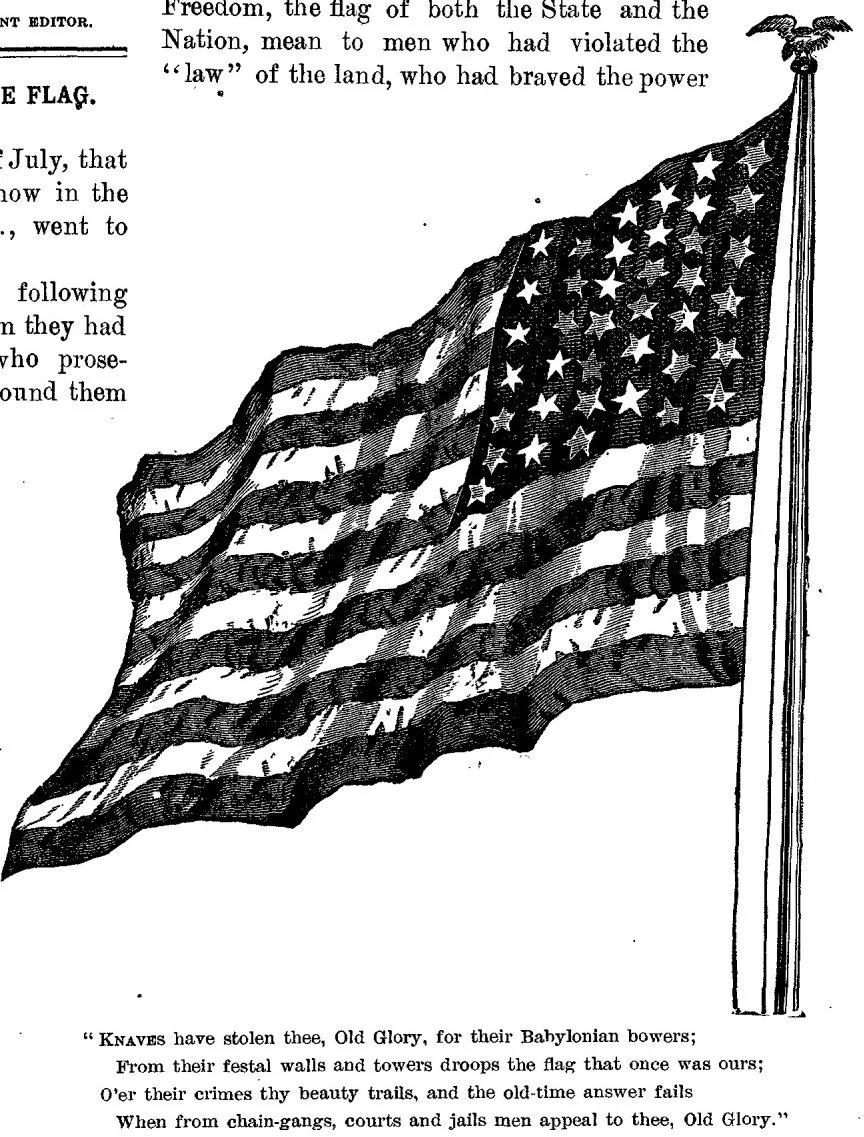
“KNAVES have stolen thee, Old Glory, for their Babylonian bowers;
From their festal walls and towers droops the flag that once was ours;
O'er their crimes thy beauty trails, and the old-time answer fails
When from chain-gangs, courts and jails men appeal to thee, Old Glory.”
But not so with the convicted Adventists. Their wives and children, a number of whom had been in court to hear the judge’s sentence, had bidden them a sorrowful good-by, and had gone to their now lonely homes. Most of their friends who had been with them through the trial had also gone home and left them—prisoners.
It was then the sheriff said, “Come on,” beckoning them to fall into line for the march to the jail, which was to be their prison until the temporary workhouse should be ready for the occupancy of—the chain-gang.
A few moments sufficed to reach the prison, and then came the registration of their names with a detailed description of each man, so that should they escape they might be easily identified. But the eight Adventists had no thought of escape. They would not resist wrong and oppression even to the extent of seeking freedom in flight.
As the sheriff registered their names, some, earnest of the patriotic demonstrations of the morrow—“the glorious Fourth”—attracted their attention and reminded them that it was the eve of the National Independence Day; and one of them said, with a smile and yet sadly, and with just a touch of irony in his tone: “Sheriff, won’t you please erect a liberty pole to-morrow where we can see it?”
Oh, what a train of thought is started by that question! What! a liberty pole and a flag for convicts? What could “Old Glory,” the “Star Spangled Banner,” the emblem of Freedom, the flag of both the State and the Nation, mean to men who had violated the “law” of the land, who had braved the power which wears the flag? What comfort could chain-gang convicts, “law” breakers, possibly derive from looking upon the banner unfurled by the power that enslaves them—that power that brands them as enemies of the State, and drives them to the stone pile with the vilest criminals, that locks them in loathsome cells or works them ten hours per day under a broiling sun, for no other offense than worshiping God according to the dictates of their own consciences? In short, What is the flag of the Union to Seventh-day Adventists to-day?
Ah! thrilling memories cluster around that flag; for while Seventh-day Adventists have no taste for war or carnage, while they as followers of the Prince of Peace are opposed to war, even as are the Quakers, they remember that it was in the providence of God that this land became an asylum for the oppressed of other lands; and they love the old flag because under its folds their forefathers found that liberty to worship, which was denied them in the Old World, and which is to-day denied Adventists in “free America;” not because of the flag nor of that for which it stands, but in flagrant violation of the principles represented by every fiber of that noble banner; principles for which patriots died in 1776, and for which in this year of our Lord, 1895, men toil in the chain-gang in Tennessee. And in the language of the poet these men can to-day look upon that flag and say—
“Thou art Freedom’s child, Old Glory,
Born of Freedom’s high desire.”
The flag had its birth in the days of Washington, and Jefferson, and Madison, and Patrick Henry; in the days when men knew the value of liberty because they had known what it was to be denied freedom of conscience; in the days when humble Quakers, patient Mennonists, noble Baptists, warm-hearted Methodists and staunch Presbyterians alike claimed as an inalienable and God-given right, freedom to worship their Creator according to the dictates of conscience, and challenged the right of any man to dictate to them in matters of religion, or in any manner to come between them and their God.
Those stars and stripes stand for the immortal Declaration of Independence and for that noble charter of liberty, the Constitution of242the United States; not as perverted by the Supreme Court decision of February 29, 1892, but as it stood when our fathers had written into it: “Congress shall make no law respecting an establishment of religion or prohibiting the free exercise thereof.” And just as men deprived of water, love to think of “purling streams and crystal fountains,” of rolling rivers and wave-swept lakes, so Christian patriots, men who, living in all good conscience, render to Cæsar the things that are Cæsar’s, and to God the things that are God’s, love to look upon the banner of civil liberty, even though that which it represents has been denied them; yea, even though their hearts bleed for the wrongs which they suffer, and for the violence done to that freedom once cherished, but now lightly esteemed by so many who know not its worth; for they know that religious rights are as lasting as the rock-ribbed hills or snow-capped mountains, yea, that they are as eternal as the Everlasting King who gave them; that such rights “are not exercised in virtue of governmental indulgence, but as rights, of which government cannot deprive any portion of citizens however small;” and that though despotic power may invade those rights, “justice still confirms them.” And they with the poet can say:—
Knaves have stolen thee, Old Glory,
For their Babylonian bowers;
From their festal walls and towers
Droops the flag that once was ours;
O’er their crimes thy beauty trails,
And the old-time answer fails
When from chain-gangs, courts and jails
Men appeal to thee, Old Glory.
The flag is not a god, but in the providence of God it stands as the high water-mark of human liberty. But alas! as the sacred name of Christ has been made the cloak of most unchristian acts, so this providential symbol of liberty, has been made the covering for most revolting crimes against the most sacred rights of men. And as Madame Roland, on her way to the guillotine, bowed before the clay statue of Liberty erected in the Place de la Revolution, exclaimed: “Liberty! Liberty! how many crimes are committed in thy name;” so Seventh-day Adventists can to-day salute the stars and stripes with these words: “O banner of liberty, what crimes are committed under thy ample folds! what wrongs are done in thy name! what injustice and oppression is practiced by those who are sworn to maintain the principles by which thou wast begotten!”
“Corrupted freemen are the worst of slaves;” and we have fallen upon evil times, when men know not what true liberty means. Some in the mad pursuit of wealth, others in the fierce struggle for existence, have forgotten that he who fails to protest against the persecution of his neighbor, thereby virtually forfeits the right to protest when he is himself persecuted. Channing has well said: “The spirit of liberty is not merely, as multitudes imagine, a jealousy of our own particular rights, but a respect for the rights of others, and an unwillingness that any man, whether high or low, should be wronged.”
It was the purpose of the founders of this Government to erect, if possible, impassable barriers against religious bigotry and intolerance. As remarked by the compiler of “American State Papers Bearing on Religious Legislation”:—
Both Jefferson and Madison were opposed to the States having anything whatever to do with regulating religious observances of any kind; and the liberal spirit supported them. But as this spirit is supplanted by self-interests, the intolerance of State Churchism again manifests itself in reviving the old religious laws, and prosecuting Sabbatarians for Sunday labor, etc. Jefferson, foreseeing this, desired to have all religious laws swept from the statute books, not willing to have them remain as a dead letter, which might at any time be revived by the partisan zealot. In his “Notes on Virginia,” query xvii, Jefferson says:—
“Besides, the spirit of the times may alter, will alter. Our rulers will become corrupt, our people careless. A single zealot may commence persecution, and better men be his victims. It can never be too often repeated, that the time for fixing every essential right on a legal basis, is while our rulers are honest, and ourselves united. From the conclusion of this war we shall be going down hill. It will not then be necessary to resort every moment to the people for support. They will be forgotten, therefore, and their rights disregarded. They will forget themselves, but in the sole faculty of making money, and will never think of uniting to effect a due respect for their rights. The shackles, therefore, which shall not be knocked off at the conclusion of this war, will remain on us long, will be made heavier and heavier, till our rights shall revive or expire in a convulsion.”
In the light of current events, Jefferson’s words seem almost prophetic. The spirit of the times have altered; our rulers have, many of them, become corrupt; and the question has been repeatedly asked of petitioners for justice, “How many are there of you? Have you political influence?” Our people have become careless, and in scores of cases a few bigots have commenced persecution and better men have been their victims. But neither the Declaration of Independence, the Constitution of the United States, nor the banner which represents them is to blame; neither is deliverance to be found in any nor in all of these. The fault lies at the door of fallen human nature, and the remedy is the power of God; for such things will be until He comes, whose right all dominion is, for his alone is a righteous rule. And the divine promise is: “At that time shall thy people be delivered; every one that shall be found written in the book.”
“INCONVENIENT CITIZENS” VERSUS UNJUST LAWS.
Among the papers that have defended persecution of Seventh-day Adventists in the South, is the Atlanta Constitution; but evidently the Constitution would like to be fair, if it only knew how. In its issue of July 18th, occurs the following:—
The Seventh-day Adventists.
Speaking of the efforts to get the Supreme Court to come to the relief of the Seventh-day Adventists in Tennessee and Georgia, who have been sent to the chain-gang for doing secular work on Sunday, the Chicago Tribune says:—
“The question of religion appears to be one of those which the framers of the Constitution deemed it best to leave entirely to the States. At the time when the Constitution was adopted Connecticut had an established church—the Congregational one—and in all the States the Sunday observance laws were infinitely more rigid than they are now. In many of them Sunday travel was forbidden, Sunday amusements of the mildest character were not tolerated, and the man who thought it wrong to work Saturday was told no one would force him to work on that day, but that if he worked on that day which the majority of the people looked on as holy, he would suffer for it.”
“It rather seems, therefore, as if those who complain of the religious laws of the States in which they live, will have to look to the State for redress and not to the National Government, which does not seem to have any more to do with the Sunday question than with the marriage and divorce question.”
This is a fair statement of the situation. But it is said that the Tennessee authorities will soon have another question to decide. The Adventists say that no punishment and no human power can force them to work on Saturday, their Sabbath. If they gain this point, the chain-gang will get only five days’ work in the week out of them.
Upon the whole, these scrupulous religionists are very inconvenient citizens to have in a community. When at liberty they want to disregard our Sunday, but in the chain-gang they will claim two rest days in the week: Saturday, as a matter of conscience, and Sunday, as a matter of law.
The cases will make trouble. It is impossible to deal with it justly and at the same time satisfactorily.
The statement quoted from the Chicago Tribune is doubtless “fair” in the sense, that the writer of it had no intention to misrepresent the case, or to do injustice to the persecuted Adventists. It is, moreover, probably true that the United States Supreme Court would take that view of the matter; but this does not necessarily follow from the facts stated by the Tribune. It is true, that as originally adopted, the National Constitution left the matter of religion entirely with the States; but it is far from an unreasonable proposition that the First and Fourteenth Amendments to the Constitution have very materially changed all this. The First Amendment provides that “Congress shall make no law respecting an establishment of religion, or prohibiting the free exercise thereof.” The Fourteenth Amendment provides that “no State shall make or enforce any law that shall abridge the privileges or immunities of citizens of the United States.”
Certainly, under the First Amendment, freedom from all legal and statutory interference in matters of religion, is one of the privileges of every citizen of the United States; and as such it is guaranteed by the Fourteenth Amendment. This being true, we ask, how in the name of law and justice can any State abridge this privilege of citizens of the United States?
But the most serious and inexcusable statement made by the Constitution is that, Adventists when at liberty, “want to disregard our Sunday; but in the chain-gang they will claim two rest days in the week: Saturday, as a matter of conscience, and Sunday, as a matter of law.”
It is very certain that no Adventist will work in the chain-gang, or anywhere else, on the Sabbath. All the tortures of the Inquisition would be powerless to compel a true Seventh-day Adventist to thus violate his conscience, either by breaking the fourth commandment or any other commandment of the Decalogue.
But it is not true that any Adventist would likewise claim the privilege of “Sunday as a matter of law.” Adventists, it is true, hold themselves under no obligation to work in the chain-gang, though thus far they have done so, when so commanded by the officers having them in charge. But they would as soon work on Sunday in the chain-gang as to work there upon any other day; and they would doubtless do so, were any State to be so inconsistent as to imprison them for doing private work on Sunday, and then require them to do public work in the chain-gang upon that day.
The Constitution says: “The cases will make trouble. It is impossible to deal with it [them], justly, and at the same time satisfactorily.”
Yes; these cases will make trouble so long as the various States insist on putting men in prison and working them in the chain-gang for exercising a constitutional, natural, God-given right; because, whether or not, it is a right guaranteed by the Constitution of the United States to work on Sunday, there is not a single State constitution but contains an even more explicit guarantee of religious liberty than does the National Constitution; and in every State this guarantee of religious liberty is violated under the operations of the so-called Sunday laws.
But why should these cases make trouble? The Sunday “law” of Georgia is violated every week in a thousand ways, and yet no trouble is made about it. The Atlanta Constitution issues a Sunday edition in flagrant violation of the statute of that State, but we243have not heard of any trouble over it. The railroads in Georgia run their locomotives and trains recklessly through the so-called law, fifty-two Sundays every year, and there is no trouble about it. The writer recently saw posted in the Union Depôt at Atlanta, the announcement of a regular Sunday excursion, with tickets on sale every Sunday at that depôt; and the same number of the Constitution, from which we have quoted, publishes a schedule of Sunday trains from the city of Atlanta, the capital of Georgia, a State that sends men to the chain-gang for ordinary farm labor on that day.
Why should railroad trains and Sunday papers make no trouble, and yet men be arrested for doing ordinary private work on Sunday? There is but one answer: It is because the so-called law, which is not law, because violative of the constitution, is made the engine of persecution and oppression against those who observe another day, and are in truth persecuted, not for Sunday work, but for Sabbath rest.
The trouble which the Constitution fears can be avoided in one of three ways: either let the legislatures of the various States repeal their iniquitous Sunday statutes; or let the various Supreme Courts declare them unconstitutional, as they most certainly are; or let the citizens of the several States, each man for himself, practice the Golden Rule and cease to invoke against their neighbors these antiquated, unjust, unconstitutional, and tyrannical statutes.
Seventh-day Adventists will make no trouble if they are left in the quiet enjoyment of their God-given rights; but God helping them, they will never cease to protest against wrong and injustice, and never consent to yield their consciences into the keeping of the individual, nor of the several States, nor of the United States.
WHAT DOES THE “SABBATH RECORDER” MEAN?
By Editor
The Sabbath Recorder is a Seventh-day Baptist paper, published at Plainfield, N. J., in which State, observers of the seventh day are permitted by statute to labor on Sunday. The Recorder is therefore at a good safe distance from feeling in its own person or in the persons of its employés the pains of religious persecution. Nor is this all; so far as we know, a score of years have intervened since any Seventh-day Baptist has been prosecuted under a Sunday statute in any State. If there have been more recent cases we have not been informed of them.
This immunity is due very largely, we think, to the fact that members of that denomination are found almost exclusively in States which, like New Jersey, have exemption clauses in favor of those who observe as a sabbath, a day other than Sunday. This still further removes the Recorder from the persecution which it does not feel even in the persons of Seventh-day Baptists. But the Recorder should understand that he who fails to protest when others are persecuted, thereby forfeits the right to protest when he himself is persecuted.
But does not the Recorder protest against the persecution of Seventh-day Adventists? Yes, in a half-hearted way which leaves the reader to doubt if after all the Adventists are suffering more than their just deserts at the hands of their outraged neighbors. For example, in its issue of July 25, the Recorder says of the enforcement of Sunday statutes against Seventh-day Adventists:— In some cases resentment is provoked and advantage taken of the possibilities of legal trial and punishment, because those who observe the seventh day are provokingly defiant of law and the practice of the majority. We confess to very grave misgivings concerning the wisdom and spirit that prompts men to court such notoriety, if any such instances exist.
That is the Recorder’s statement in all its cold-blooded cruelty and injustice. The perhaps intended-to-be saving clause, “if any such instances exist,” is nullified before it is written by the positive statement, “Resentment is provoked and advantage is taken,” etc., “because those who observe the seventh day are provokingly defiant,” etc. The Recorder has made the point-blank statement quoted. Will it prove it? If not, will it retract it?
In marked contrast with the reproach which the Recorder takes up against its neighbors, the persecuted Seventh-day Adventists, is the testimony of Judge Parks, in his letter to Governor Turney, recommending the pardon of the Adventists imprisoned at Dayton, Tenn., last spring. The letter is as follows:—
Isabella, Tenn., April 8, 1895.
To the Governor, Nashville.
At the March term of the Circuit Court of Rhea County, several Seventh-day Adventists were convicted and sent to jail for violating the Sunday laws. They are among the very best people of that county, and I can cheerfully recommend that those remaining in jail be pardoned—this for several reasons, chief of which is that there was no aggravation shown in a single case. It is true that they did some work on Sunday, but it was done in a quiet way, and without any studied effort on their part to attract public attention. In fact the proof rather tended to show that they tried to do their work in such a way as not to attract public attention.
They have been in jail nearly a month, and I think the punishment they have undergone amply sufficient.
Very respectfully,
JAS. G. PARKS,
Judge 17th Circuit.
These are the facts as proven in open court by the State’s witnesses themselves; and what is true of these cases is equally true of the scores of cases tried in the various States since the persecution of Seventh-day Adventists commenced in Arkansas ten years ago. Adventists are Bible Christians and hold the Golden Rule in equal respect with the fourth commandment. But they ask no man to violate his conscience or to prove disloyal to his God to please them; neither will they yield their consciences to the keeping either of their neighbors or of the State. These facts ought to be known to the Recorder; certainly—that paper has had ample opportunity to know them, and its unkind thrust at Seventh-day Adventists looks like a violation of the ninth commandment.
But we are persuaded that the Recorder does not represent any considerable number of Seventh-day Baptists in this matter. We prefer to think better of our Sabbath-keeping brethren of that communion, and to believe that the real sentiment of Seventh-day Baptists is voiced not by the Sabbath Recorder but by the Sabbath Outlook, which, in noble contrast with the course of the Recorder, has not hesitated to give to persecuted Adventists full and hearty Christian sympathy; and instead of stabbing them in the back, has ministered to them words of Christian cheer and courage. And so, to the Recorder, we say, Go to the Outlook, learn its ways and be wise.
We sincerely hope that it will turn out that the Recorder spoke hastily in this instance, and that this uncharitable utterance does not represent the deliberate judgment of even its author. If, after the Recorder has investigated the matter and ascertained the facts, it, like a brotherly Christian, corrects its erroneous statement, we will gladly make a note of the correction.
DEFENSE OF BYRD TERRY.
By Byrd Terry
Once Enslaved by the State; now Condemned to the Chain-Gang by the State Church, Crime—Lifting a Wheelbarrow over a Fence on Sunday.
I AM here, gentlemen of the jury, charged with working, doing malicious work, on Sunday. I deny that charge; I don’t think I work “maliciously” on any day.
I want to say to this jury that I observe the seventh-day Sabbath; and since I gained a knowledge of the true Sabbath I have thought it my God-given privilege to work on the remaining six days, though I knew that it was in violation of the law of Tennessee. But there are two sabbaths, a rival sabbath and the Sabbath of the Lord. Now, the State says that I must rest on Sunday, and God says that I must observe the seventh day. Well, now, who must I obey? Answer for yourselves. And if you gentlemen require me, as the law says, to rest on the first day of the week, and if you will answer for me before God, and be responsible for me there, then take the case into your hands and compel me to do these things.
I want to say this, gentlemen of the jury: I was born and raised a slave, and until the emancipation, of course I never enjoyed any freedom at all, but since the emancipation, I thought this was free America, and I felt that I was a free man to do just as I pleased, so long as I did not infringe on the rights of others.
I have made some advancement in divine life. In studying the Bible, I found that I was wrong, and that God did not require me to keep the first day of the week as the Sabbath; and my honest conviction was that the seventh day was the Sabbath. From that day to this I have been observing the seventh day to the best of my ability. Yet I am a law-abiding citizen until the law comes in conflict with my conscience. God says for me to observe the seventh day and the State says for me to rest on the first. I call this a parallel case to the three Hebrew worthies. No doubt it was said to them that they could bow down to the image and reverence their God too. But we cannot do this, gentlemen; it is a life and death question with me, and if I tip the hat to the rival sabbath, to the sabbath that the State has set up and says that I shall observe, if I tip the hat to that, I show that I do not reverence the God of the universe.
The Sabbath is God’s memorial of his creation, and not only that, but is a sign of his recreation; and I feel to-day, gentlemen of the jury, that a recreation has been wrought in me, and if that be so, I must reverence the laws of my God.
This is the first time that I have ever been brought before the court. I have neither cheated nor defrauded any man; I pay my just and honest debts. I owe some debts and will pay them when I get where I can. I have wronged no man; and there is not a man here under the sound of my voice that can say that I have ever stolen anything from him. I have tried to lift my own people from that degraded state into which they have fallen; and my desire is to live right and be a good citizen. I do want a home in heaven, and just as certainly as I renounce my allegiance to the God of heaven and go against my own convicted conscience, and obey a bad law that has been set up by unthinking men, then I will lose my eternal interest in the kingdom of God.
I don’t want to impeach any of the the244men who made the law, for I respect them; I have nothing against any of them. His honor that sits upon the bench is a gentleman, and I respect him as such. The Bible says to love your enemies, and them that persecute you, and I am so glad that I love the men who have had me indicted.
I call this religious persecution, though you may call it what you please. The reason why I call this religious persecution, is because I have been a citizen of this county for several years, and even lived here in Dayton and worked for the Dayton Coal and Iron Company on Sunday, since I was an Adventist; and went to and fro through the town with my working clothes on, and never was interfered with, molested, or bothered. But as soon as I left this place and moved to Graysville, and there began to exercise my God-given privilege, quietly and peaceably, why then I am charged with violation of the law. But, gentlemen of the jury, look well to the law and see whether it is a good one.
Now I leave the case with you to decide. I can only say with the apostles, “We ought to obey God rather than men.” The case is with you; do just as you will with it, but remember that you will have to meet your decision in the Judgment.