The superintendent of the House of Refuge, at St. Louis, recently forbade Roman Catholic priests to celebrate “mass” in the institution for the supposed benefit of Roman Catholic children incarcerated therein. The board of managers, at a recent meeting, decided against the superintendent, after considering numerous communications and resolutions from the parties interested. Chief among these were two statements, one from a committee of Roman Catholics and the other from a committee of Lutheran clergymen.
The Catholic presentation of the case, as published in the St. Louis Republic, of June 25, is as follows:—
To the Honorable Board of Managers of the House of Refuge—
In accordance with the suggestion of the honorable acting mayor at the last meeting of this board, on June 20, 1895, we respectfully beg leave to submit the following argument prepared by Mr. Paul Bakewell, as representing our views:—
The House of Refuge, situated in the city of St. Louis, and maintained by the city government, is an institution in which minors are confined who have committed some crime, or who, without having committed any crime whatever, are placed there for safe keeping, either because they have no parents or guardians, or because their parents or guardians are not fit to have charge of them, and, therefore, in order to protect them, and at the same time prevent their being a nuisance to the community, they are temporarily placed in this institution.
For more than fifteen years past it has been the practice of the ministers of various denominations to hold services at this institution for the benefit of the inmates. For more than fifteen years past the Catholic priest has regularly attended every Sunday morning to say mass, and it has also been the practice, for more than fifteen years past, for a Catholic priest to have an opportunity of seeing such of the inmates as are Catholics, in order to hear their confessions, this being usually done on Saturday evenings, in order that such inmates may receive holy communion, at mass, on the following Sunday morning.
The sacraments of confession and holy communion are, in accordance with the Roman Catholic faith, essential to the welfare of souls, and, under the law of the Roman Catholic Church, every Catholic is obliged to go to confession and receive holy communion at least once a year and during Easter term. Moreover, it is obligatory upon Catholics, under the law of the Roman Catholic Church, to go to mass every Sunday.
The Catholic priest, or priests, who has, or have, attended the inmates of the House of Refuge, have always done so without any expense or charge whatever to the institution, offering their services in the matter of the spiritual welfare of the inmates desiring to attend these services free of any charge whatever.
Furthermore, only those who are Catholics, or who care to attend the Catholic services of their own free will, are expected to attend these Catholic services.
This condition of things, which has existed for more than fifteen years, and is in strict harmony with the constitutional right of citizens and the spirit of the law established in this country, has been suddenly brought to an end by one named Bristol, who is now in charge of this institution, and who has, we are informed, absolutely refused to permit a Catholic priest to enter the institution to administer spiritual consolation to any of its inmates who may desire to see the priest, and absolutely refuses to allow the Catholic priests to hear the confessions of the inmates, or to celebrate mass in the institution, for the benefit of such of the inmates as may desire to attend such services of the Roman Catholic Church.
We believe that this is in violation of the constitutional right of the citizen, and is also contrary to the policy of our laws, and is nothing more than an arbitrary attempt on the part of the one in charge of this institution to deprive its inmates—or, at least, such of its inmates as are Catholics—of the moral and spiritual benefits which such inmates conscientiously believe are necessary to their moral and spiritual welfare.
[Then follow quotations regarding religious liberty from the Constitution of the United States, the constitution of the State of Missouri, “Cooley’s Constitutional Limitations,” pages 578, 579 and 580, and “Bishop on Criminal Law,” Section 499.]
If, the argument continues, it is the policy of the law, as above set forth, “to avoid with care any compulsion which infringes on the religious scruples of any, however little reason may seem to others to underlie them,” it would seem that those in authority over the keeper of the House of Refuge in carrying out the policy of the law will see at once that the action of the present keeper of the House of Refuge is, by compulsion, to infringe on the religious scruples of those in that institution who are Catholics and whose duty it is to receive the sacraments offered to them by their church and to attend upon the services offered to them by their church, when these services are offered to them as a gratuity, without any expense whatsoever to the House of Refuge or to the government maintaining it.
We respectfully submit, therefore, that the action of the present keeper of the House of Refuge cannot be permitted to stand, as it is manifestly contrary to the spirit of our laws and contrary to the constitutional guarantees, and is manifestly calculated to the demoralization of those inmates of the institution who are Catholics and who are deprived of their religious privileges, freely offered to them by the ministers of their church. Furthermore, it is a direct discrimination against the Roman Catholic religion, to the manifest moral hurt of the Roman Catholic inmates of that institution.
The position taken by the Lutheran ministers, as reported in the same paper, is as follows:—
1. We hold that the freedom of religion and the exercise thereof vouchsafed to the inhabitants of our country and the citizens of this State does not include the right of public worship in public institutions of the State, or on premises not the property of the individual or individuals, or society, exercising such public worship, and we therefore maintain that no person or society can base upon the right of religious freedom legal claims to the right of conducting divine worship in the House of Refuge or in any public institution in the city of St. Louis.
2. We hold that the First Amendment to the Constitution of the United States has no legal bearing upon the question at issue, since it merely provides that Congress shall make no law respecting an establishment of religion or prohibiting the exercise thereof, while it leaves the hands of State legislatures, city councils and boards of managers free to control the affairs to them intrusted according to the will of the people and to the laws and ordinances of the States and municipalities under which they perform their official duties.
3. We hold that, since, according to the constitution of the State of Missouri, “no preference shall be given to, nor any discrimination made against any church, sect, or creed of religion, or a form of religious faith or worship, it would be at variance with the letter and spirit of the constitution of the State if any church or religious denomination were allowed to carry on divine worship in any of our public institutions to an extent, or in a measure, not granted to all churches or denominations requesting like privileges.
4. We hold that the inmates of penal institutions are no more entitled to religious ministration from without on the plea of religious liberty than they are entitled to the enjoyment of conjugal rights and the performance of parental duties on the plea of being in conscience bound to perform such duties and vindicate such rights.
5. We hold that imprisonment for crime is not an interference with the rights of conscience, though such imprisonment precludes the exercise of religion according to the religious conviction of the prisoner, since, if it were, imprisonment would be illegal and unconstitutional, if executed upon an orthodox Jew or minister of the gospel, precluding the observance of the Mosaic law in the former and the performance of his ministerial duties in the latter.
6. We hold that it is in no wise or measure the duty of the State or of State officials to provide religious ministration by way of keeping or vacating apartments in State institutions for such purposes; and that no inmate of a penal or other State institution can claim at the hands of the State what the State has not to give, religion being, according to American institutions, an affair not of the State, but of the church.
7. We hold that, while it is not an encroachment upon the freedom of conscience to treat a prisoner as a prisoner, it is an infringement upon religious liberty to afford opportunity for the propagation of religious doctrines and practices upon the premises and among the inmates of a public institution, against the protest of taxpayers, whose conscience and religious convictions will not permit them to contribute toward the furtherance of doctrines and practices which they deem erroneous and endangering man’s temporal and eternal welfare.
8. We hold that every opportunity for religious proselyting should be most carefully guarded against in public institutions in general, and in penal institutions of minors especially.
9. We hold that in view of all the principles laid down in the preceding paragraphs the authorities in charge of public institutions should grant permission for religious exercise in such institutions only in a measure and manner conceded by the unanimous consent of the citizens within the limits of the constitution and statutes of the State and the ordinances of the municipality.
10. We hold the minister of religion may be consistently permitted to bestow religious instruction and private ministration upon such inmates of public institutions, as may be members or adherents of their respective churches or have expressed a desire for such ministration, with the exclusion, however, of exercises partaking of the character of public worship with the distinctive paraphernalia of any particular church or denomination.
Both of these statements contain good points, and the decision of the board to admit Catholic priests will be commended by unprejudiced defenders of religious liberty. Justice, in the first place, demands the maintenance of rigid equality among the several denominations asking admission to the institution; and second, that the supposed services rendered the inmates be given without charge to the taxpayers, to such as desire them. If a public service is allowed the Protestant, then a public service should be allowed the Roman Catholic, and245the fact that this public service is called “the mass,” and is said while costumed in certain paraphernalia, has nothing to do with the case. The Protestant Bible and hymn book constitute a distinct paraphernalia as certainly as does the absence of these and the presence of the Roman missal and the stole constitute a distinct paraphernalia. The decision of the board to admit Catholic priests as well as Protestant preachers will be opposed only by those whose opposition to a union of Church and State is based on passion and prejudice, and not on fundamental principles.
FROM A TENNESSEE CHAIN-GANG.
[We are permitted to print the following private letters, written by one of the Adventists now serving in the Rhea County chain-gang to a friend in Atlanta, Ga., and by him sent to us.]
Rhea County Chain-Gang,
Spring City, Tenn., July 20, 7:30 P. M.
D. W. REAVIS, Atlanta, Ga.,
Dear Brother: I have just received your two good letters of the 18th and 19th inst., with stamps. We also got Review, Signs, Sentinel, Home Missionary, and Sabbath-School Worker. I am certainly willing to keep you posted, to the best of my ability. I always read the letters to the other brethren and ask them to notice if the news given is perfectly correct. I want to get it all just as it is.
We are all well and happy in the Lord. Brother Abbott was with us to-day. He came up this morning and went back this evening.
Yesterday Mr. Merriman, a reporter from Chattanooga for the New York Recorder, and Mr. Bugler, an artist from Dayton, came up and took our photographs at work at the approaches to the Piney Bridge; also one of the workhouse, and one of our tent. The reporter took many notes and asked many questions in regard to the trials, etc. You can get the pictures from Mr. Bugler, at Dayton, if you wish them.
I got a letter from a photographer at Huntsville, Ohio, sent to the sheriff at Dayton, then to me. It had been on the way a week. The writer had heard we were in Dayton jail, and said he would like to come and take some good pictures of the jail and court house, etc., also of some of our homes, wives, children, etc. He said if we wrote to him, he would be with us over this Sabbath; so I wrote and told him to come. I mailed the letter yesterday.
Mr. Howard (a deputy sheriff) came to us this morning and said he supposed this was the day we did not work. We told him it was. He said we could not work to-morrow (Sunday) or, it would not do for us to work to-morrow. Then at noon he said that our time would not go on to-day. But every day counts in jail to everybody in workhouse or chain-gang, work or play, except to us. We heard this evening that we would have to pay for our board on the Sabbath, that is, work it out. We do not know for sure that they will do that. But they have said that our time does not go on on the Sabbath. Allen Cathey refused to work to-day and they chained him upstairs and gave him bread and water.
Our cooks are two negro women and one man, and real criminals. One cut her husband's throat and is now in for fighting; the other is in for cutting a negro man with a razor; and the negro man is also in for fighting. They are cursing and quarrelling at each other and everybody else all the time. It makes us think of, “Behold I send you forth as sheep among wolves.” We generally have cold biscuit and syrup for breakfast, and sometimes not enough of that. Sometimes we have potatoes and cabbage cooked by the above-described cooks.
They have hog meat and coffee, but we don't use either. We get enough grease in the other things. Don't think we are complaining. I am only trying to give you the facts in the case. God is helping us to stand this splendidly. We all stand the work, though in a hot place, as well as we ever stood any work in our lives.
We find that there are some people here who have been keeping the Sabbath, and others are convinced. I have more reading and writing than I can do. I am happy, and “my cup runneth over.” Pray for us continually, that we may walk right in this position that we occupy as prisoners for Christ.
I had one letter from Brother Moon and two from Brother Tait. The barrel of health foods was shipped to us about the 14th. I suppose we will soon get it.
The Dayton Republican is read by many of the best people up here, and is truly a sentinel.
Your brother in Christ,
W. S. BURCHARD.
Rhea County Chain-Gang,
Spring City, Tenn., July 22, 1895, 6 P. M.
W. D. REAVIS, Atlanta, Ga.
Dear Brother: We have just come in from work. All are well except Brother Moyers; he has not been very well since he came here, and he has not worked any yet.
I have nothing very important to write this time. The cooks have been fighting to-day. One snatched up a Winchester and snapped at another, but it did not go off. Two more of the prisoners escaped to-day, and there is $5 reward offered for them.
To-day has been cooler than usual, and we have stood the work splendidly.
We are of the best of courage in the Lord; the blessings of God are truly with us. I have heard the brethren rejoicing many times to-day in the truth. We are standing everything splendidly.
Yesterday (Sunday) was a good day with us; many visitors came to see us and talk with us about the truth. Some of the best people here are convinced of the truth and are almost ready to keep the Sabbath.
Brethren Terry, Kerr and Plumb went to the colored church last night, and they invited Brother Terry to take charge of the meeting, and he did so. Brother Terry says to tell you that the colored people here are very anxious to hear preaching.
Your brother in Christ,
W. S. BURCHARD.
SPEECH OF EX-CONGRESSMAN SNODGRASS.
As previously stated in these columns, ex-Congressman Snodgrass, at the recent trial of the Adventists, in Dayton, Tenn., addressed the jury by permission of the prosecuting attorney. We have secured a report of the speech of Mr. Snodgrass, and insert it here:—
These are cases of considerable interest, not only to the unfortunate people who persist in the constant violation of the law, but it is a matter of great moment to all the people, not only in Rhea County, but the whole State of Tennessee.
Now, so far as I am personally concerned, no man is in favor of larger liberty than I am, both religious and personal. I believe that this law under which these people are being prosecuted is bad policy, and is wrong; that is my personal notion about the law. I also believe, notwithstanding the Supreme Court of the State has passed upon the act in question and held it to be constitutional, that it is unconstitutional and an infringement of the Bill of Rights. In the Bill of Rights every American citizen is guaranteed the right to worship God according to his own conscience. No man can force him to keep up a religious denomination. No man, in my judgment, under that law, is compelled to keep any special day. Whatever his conscience dictates, my personal judgment is, under the organic law of the land, he has a right to that so far as the working upon Sunday or Saturday is concerned.
The court is not to make a law, nor to repeal a law, but to enforce a law. It is not the province of the court, nor is it the province of the jury, to say whether a law is a bad law or a good one. The only duty you have to perform when you take your seat in the jury-box, is to render a verdict according to the evidence produced in the case.
I tell you it is a bad law. My sympathies go out to all these misguided people. They are no doubt honest in their convictions, but I want to refer them to another injunction on that point—to the injunction in which they are commanded to obey the “powers that be” and be subject to the law.
The court, or some other power, ought to issue a letter of amnesty and turn all these people loose, and notify the grand jury that they should not again be prosecuted under this law.
I say this law ought to be repealed, but until it is repealed it is the duty of every Christian man—it is the duty of every law-abiding citizen that loves the law—it is his duty to abide by the law and to take such steps that will insure its repeal. That is the action that ought to be taken. Now, if your honor please, I know it is a difficult matter to enforce a law where public sentiment is against it.
If men were imprisoned, or sent to the workhouse, and allowed the ordinary privileges of a citizen; if they can go to and from the jail at will, there is in fact very little punishment inflicted. So it is not the amount of punishment, in my judgment, that forces people to respect the law and to obey it, but it is the certainty of that punishment. It is the certainty with which the judgment is carried out. Now I know that there is a great deal of sympathy for these people. Many of them believe that they are obliged to work on Sunday. It has been contended before this court that it takes all the six days to make a living.
I am not here to say that this does not work a hardship. As a matter of dollars and cents, a man had better work even five days and lose one day rather than pay the fine and penalty for a violation of the law. So there is no theory upon which this can be put, unless a man is controlled by wild fanaticism.
We are not commanded and enforced by God to work every other day, so no man need be stirred on that question. And until the law is repealed, they would only lose one day. And if they are so industrious, why not work a little later at night and a little earlier in the morning to make up the time of the odd day?
The violation of this law simply gets up a spirit of antagonism. And as long as it stands, they have a cudgel to strike you with, and the more you probe a man, the more inclined he is to show some kind of resentment. I am afraid, on both sides, this thing has been carried too far. It would have been far better if the people would have overlooked the work on Sunday, and all joined in the repeal of the law. But I want to say to this people, that I am afraid you are doing worse in violating this law; you are getting up more vexation, more spite, and it is far more injurious to you than the day that you would lose. And so far as I am concerned, they are good citizens; I am satisfied that they are good Christians—do all they can to serve God, and I honor them for it, and I would be glad, may it please your honor, if every one of these prosecutions should be dismissed.
So long as they get up here and confess that they have violated the law; that they believe that Saturday is the day, and that they must work on Sunday in order to support their families, there is nothing left for you, gentlemen of the jury, except to return a verdict of guilty. Here you are to pass upon the facts and the law, and all you can do is to convict them.
Mr. Snodgrass is evidently strongly opposed to the condition of things which makes the prosecution of Seventh-day Adventists possible, and all of these persecuted people and their friends will be pleased with the ex-congressman's sympathy for them and his complimentary words regarding their character as citizens and Christians; but they cannot follow his well-meant advice. The matter is not one of dollars and cents. It is true that it is a hardship for a poor man to be deprived of one-sixth of his time in which to make a living, but this is not the motive for violating the judicial Sunday legislation of Tennessee. The persecuted men in their defense, have sometimes mentioned the fact that they needed the six working days in which to labor for the support of their families, but this was referred246to merely as an evidence of the injustice of Sunday statutes.
The reason Seventh-day Adventists refuse to bow to Sunday statutes, was repeatedly stated by the men tried in the hearing of Mr. Snodgrass. It is because Sunday observance is the badge of the great apostasy from the Word of God, and Sunday statutes seek to compel all men to wear that badge.
The New Orleans Times-Democrat, of July 5, expresses the situation thus forcibly:—
On the one side is the express command of Jehovah to keep the seventh day holy; and opposed to it is the injunction of secular legislators to keep the first day holy. That is the difficulty in which the Seventh-day Adventists find themselves, and as we said, they obey the voice of God rather than the voice of man.
To this pointed statement of the “difficulty,” the Adventists would simply add, that behind these “secular legislators” and acting as their animating spirit, is the religious element which demands that the Adventists bow down to the opposing sabbath which men have set up. To obey the voice of God rather than the voice of man, is an evidence of Christian fortitude, not fanaticism; of a truth-directed, not a misguided mind.
A SIGNIFICANT MOVEMENT.
By GEO. B. WHEELER
There is at present a most significant movement going on in connection with the Christian Endeavor Society, as shown in their convention held in Boston recently, on the line of religion enforced by law; the results of which will be speedily felt. The convention itself was a notable one, probably one of the largest religious gatherings ever held, representing nearly all parts of the world.
The leading purpose of the organization, as expressed by its leaders and public speakers, is to unite all the denominations composing the organization into one determined effort to carry out the principles of “civic reform,” as represented by what is now known as “Christian citizenship.” Bishop Samuel Fallows, of Chicago, said:—
The Y. P. S. C. E. is one of the grandest movements in the direction of Christian unity the Church of Christ has ever known. It stands for civil service and other phases of civic reform.
Rev. A. M. Phillips, of Montreal, said:—
Mankind must be made to feel that it is absolutely wrong to divorce the sacred from the secular—to separate religion from politics. The true principle is, business is religion, politics is religion. The objective point of Christianity as taught must be changed. The consummation of Christianity is not in a happy land far, far away, but in this real old sin-cursed earth; nor is it to be looked for in the distant visionary good time coming or the sweet by and by, but in the near now and now. Denominational pride and bigotry must give way to Christian unity and coöperation.
Rev. William G. Clark, D. D., of Chicago, said:—
Practical Christianity means, among other things, a Christian politician and a Christian statesman. False to your nation and you are false to your God. Loyal to either and you are loyal to both.
Many columns like the foregoing might be quoted from the sayings at the convention. Christian citizenship, as defined by the tracts of this society, “maintains the supreme right of Jesus Christ to rule municipal and national as well as private life. The city, the State, the nation, should be governed by the principles laid down by him,—principles of righteousness, of justice, of unselfishness. Upon the application of these principles depends the final solution of every present day problem.”
Christian citizenship has taken a definite form in the Christian Citizenship League. It is proposed to have auxiliary leagues in every city, ward and town in the country. It is also proposed to watch every candidate for office and see that no one is elected except such as conform to their ideas; and also to influence legislation in whatever direction they may wish, by making a united demand for it, in such a way that legislators will not dare to refuse. When we consider the vast power that can be exercised by these Christian Endeavor societies, numbering as they already do over a million voters, which will probably be multiplied many times soon, it will not require a prophet to tell what future legislation in this country will be.
A prominent object of Christian citizenship is, their views of the Sabbath enforced upon all. Congressman Elijah A. Morse said in the convention:—
Another element of good citizenship, and conducive thereto, is a sacred, religious regard for the sabbath day, as a day of rest and surcease from toil. The command given on Sinai, “Remember the Sabbath day to keep it holy,” was given for every nation and every people; for that century, for the 19th and 20th centuries, and for the 200th century, if the world shall continue so long. And I firmly believe that the prosperity of any individual, family, State, or nation may be measured by their regard for the holy sabbath day. The command to observe it is side by side with, “Thou shalt not steal,” “Thou shalt not bear false witness.” Christian Endeavorers, love and defend the sabbath day.
Dr. Hoyt also said in the convention, as reported in the secular press:—
They should remember that Christian Endeavor is but a servant of the Church, that the meaning of Christian Endeavor was to withstand drifts, to combat corrupt politics, to keep on saying that the politics of this country, city, State, and county are to be pure. There was another drift which would have to be met also, and that was sabbath desecration. He thought that the most immoral influence of the present day, is the secular Sunday newspaper, and Christian Endeavorers ought to declare themselves on this point.
The following is from the Christian Citizen, the organ of the Christian Citizenship League:
One of the significant signs of the times is the increasing number of young men and young women, all over the country, who are identifying themselves with reform movements of various kinds, and especially with the Christian citizenship leagues of their respective localities. In this way, each local society of Christian Endeavor, or Epworth League, or Baptist Union; each Young Men’s Christian Association; and each church, is being made a nucleus of reform. The demand for Christian citizenship literature, for public meetings, for speakers on the subject, constantly increases with the increase of the numbers of those interested. Committees are being appointed by the young people’s societies, and charged with the superintendence of civic concerns. The churches, not as churches, but through their members, are readily and rapidly federating for good government, and for the conservation of distinctive and imperilled American institutions, such as the American Sunday and the free school system. Sermons and prayer meetings and worship begin to take the form of political activity. The spirit of reform, defensive and offensive, is abroad. Let it stay abroad, and strike quick and strike hard until evil is down and good is up.
The enthusiasm shown in this great convention, in this Christian citizenship movement, was very great; it was the principal line of effort that was to be made; and with the Christian Citizenship League with its machinery for work, all perfected, with enforced Sunday observance one of its main objects, it certainly will not be long before the persecutions now carried on in Tennessee against those who keep the seventh day as the Sabbath, and work the other six days according to the commandment, will be waged all over the country GEO. B. WHEELER.
MORE PRESS COMMENTS CONCERNING RELIGIOUS PERSECUTION IN TENNESSEE.
Invited to Kansas.
[From the Evening Standard, Leavenworth, Kans., July 13.]
WE advise the Adventists of the South to pull up stakes and come to Kansas where the law gives them permission to live out their religion. It would be well for this country to pluck the beam of religious persecution from its own eye before it rushes off to Constantinople to remove the mote from Turkey’s eye.
Religious Intolerance.
[From the Buffalo (N. Y.) Express, July 18.]
RHEA COUNTY, TENN., has put a lot of Seventh-day Adventists who worked on Sunday, into the chain-gang. This sort of thing savors too much of the bad old days of religious intolerance.
An Outrage.
[From the Fentress County Gazette, Jamestown, Tenn., July 11.]
THE sentencing of the Seventh-day Adventists to jail in Rhea County is simply an outrage and a disgrace to the State. These men are simply worshiping God according to the dictates of their own consciences, and should be protected therein. They are only doing from religious conviction what many of their neighbors will do whenever convenient, although they think it a sin.
[From the Nashville American.]
PERHAPS if those Seventh-day Adventists would open a gambling shop or a saloon on Sunday they would not be prosecuted by the energetic fee grabber.
“Intolerant, Bigoted and Cruel.”
[From the St. Louis Globe-Democrat, July 14.]
IT is intolerant, bigoted and cruel to persecute and prosecute a sincere, earnest, and religious body of men and women, simply because they observe a day of rest which does not please the majority of people. It is not claimed that they interfere with the liberty or comfort or worship of any of their fellow-citizens, but only that they are offending the dominant religious sense of the community. That is what it practically amounts to.
Ought Not to Be Silent.
[From the Ashland (Neb.) Gazette, July 12.]
PERSECUTION for religious opinions has not wholly ceased, even in this boasted land of liberty. Even now, in certain States, notably in Tennessee, the most sincere and devout Christians, men of the best character, suffer imprisonment for conscience’ sake. Members of the Adventist denomination, a large and respectable class of Christians, have been imprisoned within the last few years in Tennessee, Arkansas, Georgia and Maryland, under circumstances that make it perfectly clear that religious intolerance, rather than a reverent regard for the Christian sabbath, was the animus of their prosecution. When the Sunday beer garden, the gambling house and the brothel are allowed to run unmolested, and a quiet, inoffensive citizen, who conscientiously believes that the Sabbath of the Mosaic institutes is still binding in the Christian dispensation,247and whose impecunious condition would render it a great hardship to be compelled to lose his labor two days in the week, is arrested and carried off to prison for hoeing in his garden on Sunday; the case is so full of persecution that lovers of religious liberty and untrammeled conscience ought not to be silent.
Christianity Corrupted by Alliance with Power
THE whole history of the Christian religion shows that she is in far greater danger of being corrupted by the alliance of power than of being crushed by its opposition.—Macaulay.
WE WILL HELP YOU.
By Editor
“How I wish all my friends could read that SENTINEL,” is a sentiment expressed by many of our readers on receiving some special number of the SENTINEL; but as it costs one cent each to mail the SENTINEL, many have, for this reason, used but a limited number of papers in this way. Here are offers which will enable you to send a single issue of the SENTINEL to scores, yes, hundreds of your friends for the first cost of the paper, without the additional postage:—
OFFER No. 1.
Send a list of the names and addresses of your friends, plainly written, and we will send the SENTINEL you name to any number of names for one and a quarter cents each.
OFFER No. 2.
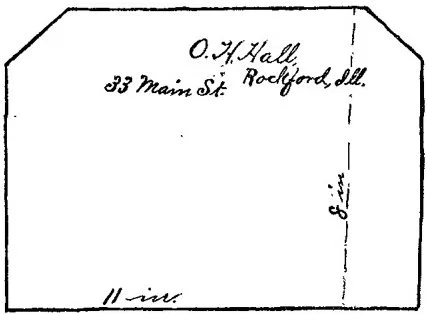
Send us wrappers, shaped and addressed similarly to the following cut, and we will send the SENTINEL you desire to one hundred names for one dollar.
Wrappers of thin manilla paper are the best. Be careful to write the names and addresses plainly, and write them about an inch or an inch and a half from the edge. The wrappers should be about eight by eleven inches; with the corners clipped, as in cut. In mailing the wrappers to us, don’t fold them but roll them.
Try one of these plans on our excellent extra of July 18. Keep these directions for future reference.
Allen Cathy's Imprisonment and the Sabbath Question in Tennessee
By Editor
An interesting question has been raised in Rhea County, Tenn., in the case of Allen Cathy, the young man convicted of cutting wood for his mother on Sunday. Mr. Cathy is a man of about twenty-two years of age. His mother is an Adventist, but he is not, and hitherto he has not been a Sabbath-keeper. But Sabbath, July 20, he refused to work and was placed in chains and restricted to a diet of bread and water. We do not know his reason for refusing to work; but it is probable that the injustice which he has suffered, has opened his eyes to the real issues involved in the Sabbath question, and that he has honestly resolved to keep the Sabbath of the Lord. His imprisonment in the first place, was an outrage against human rights scarcely second to the wrong done to the Adventists, and if the event shall prove that his refusal to work on the 20th ult., was on conscientious and constitutional grounds, the wrong will be that much greater. Tennessee is treading upon dangerous ground. It has already reached a point where, to keep within the limits prescribed by the constitution, it must know just what Allen Cathy's conscience is; just whether the seventh day of the week is set apart by his religion as a day of rest; and man has never yet devised any effectual way of ascertaining such facts—of wringing from men the secrets of their souls, except by the rack and thumbscrew. Will Tennessee adopt such methods? or will it arbitrarily decide what young Cathy's religion is, or ought to be, and so continue to ride roughshod over his rights in a more modern but not less cruel way.
Earning Their Bread.
COUNTY PRISONERS PUT TO WORK ON THE SPRING CITY BRIDGE.
[From the Dayton (Tenn.) Republican, July 19.]
MONDAY, nineteen county prisoners were taken to near Spring City and put to work on filling in the approaches to the new bridge in course of construction over Piney River.
The prisoners are under the supervision of J. A. Howard, deputy sheriff. Suitable quarters have been provided for them near the place of operation. It will take about twenty days to complete the work on the bridge and after that the prisoners will be worked on the county roads, probably first near Graysville.
Among these prisoners are eight Adventists, who are serving out fines and costs that will keep them at work between sixty and eighty days. There has been some speculation as to whether the officers would attempt to make them work on Saturday, their Sabbath. When asked as to this, Mr. Howard said: “No, we shall respect the Adventists’ position and let them observe Saturday as they see fit. They are good people and will not be treated as the balance of the prisoners. They will be given accommodations as good as we can provide apart from the other prisoners, and will only be under nominal restraint.”
And so it has come at last. Eight Christian men at work under duress of the law for following the dictates of their conscience as taught them by the Bible. We had hoped that Rhea County would be spared this odium. No, the officers need not be afraid these men will try to escape. They have the Spirit of the Carpenter of Nazareth, and will submit meekly to this maladministration of law and justice. People in whom the sense of justice is dead or never lived, may sneer and call them martyrs, but this does not alter the fact that a very arbitrary and stupid thing has been done in depriving these men of their liberty and making them work at the expense of the county for an honest, conscientious, and harmless exercise of what they consider their religious duty.