Your ShelfYour Projects

Review and Herald, Vol. 88, No. 22.

The Secret of a Happy Day
Earlier text: The Minister in the Home

The Russian Union Committee Meeting

GUY DAIL
The third annual session of the Russian Union Committee was held in Riga, March 3-8. In attendance were Brethren L. R. Conradi, J. T. Boettcher, G. Perk, H. Hartkop, J. Sprohge, K. A. Reifschneider, D. Isaak, J. F. Ginter (formerly known as Hinter), H. J. Loebsack, O. Wildgrube, T. Perk, P. Brandt, and the undersigned. Owing to the attitude of the government toward “sects,” it has been impossible for us to hold our local conferences in the various fields. Because of a series of lectures the president of the union was conducting in this city,—where about fifty have been added to our numbers by vote and baptism during 1910,—he was able to meet with only the Baltic Conference Committee for their annual audit. For these two reasons, the other conferences and mission fields referred to this session of the union committee their auditing for 1910, the granting of credentials and licenses, and the selection of officers for the current year, as well as the arrangement of such other matters as are usually considered at a local conference. These things, in addition to that which might be spoken of as strictly within the province of the union administration in such unions as deal only with organized conferences, have kept the brethren fully occupied from eight o’clock in the morning until late at night.
The reports and statistics show that God is at work for his little flock in this great empire. If one were to judge from the manner in which our opponents are bestirring themselves to give publicity to, and to cast reflections upon, the third angel’s message, he would conclude that many of them attach as great importance to our work as do we ourselves. Long articles frequently appear against us in the periodicals of the land. Three of our workers are under police surveillance; one has just been tried, and sentenced to two months’ imprisonment, or to fifty rubles’ fine, for having baptized and united in marriage a person who had not formally severed her connection with the orthodox church; and one worker is still in prison. In spite of this, 731 new members were received last year, at the close of which there were 3,952 adherents to the third angel’s message in the three conferences and six mission fields of the union, against a membership of 3,668 twelve months earlier.
There has been a good growth in tithes, the report showing a total tithe of $21,242 for 1910—$5,625 more than for 1909. The offerings were $5,417, which is an increase of $1,873 over those for the previous year. It must not be forgotten that these gains have been made, partially at least, in localities where there has been a failure in the harvests, but where the brethren have revealed their love for the work by faithfulness in giving to God his own. The Riga Publishing House, a branch of the International Tract Society in Hamburg, shows a gain of about $1,400 for the year; whereas in 1909 it had a small deficit. In eighteen days one sister sold $125 worth of publications, and found thirty persons deeply interested in the truth. She goes into a settlement, holds a meeting in which she presents the importance of getting ready to meet Jesus, and tells the people she has literature that will be helpful to them in preparing for this solemn event. She then canvasses the place.
First in the order of business was the auditing of the accounts of the workers in Russia, Siberia, and Russian Central Asia. There were only about fifty of these, as the accounts of the twelve workers of the Baltic Conference had already been audited. There was a deficit of 11,066 rubles, which was made up by appropriations from the General Conference. The Baltic Conference, which had closed with a surplus, made a donation of 1,000 rubles to the Russian Union from its tithe. We think $5,721.25 a moderate appropriation for this immense field, with its one hundred fifty-seven million people, and over sixty nationalities.
At its September session, the European Division of the General Conference Committee recommended that Asiatic Russia be separated from European Russia, the former to be called the Siberian Union Conference. The Russian Union Committee indorsed this plan; and beginning with Jan. 1, 1911, the Siberian Union Conference began its separate existence, with Elder G. Perk as superintendent. It contains the following local fields:—
1. The Volga field, composed of the Don territory, and the governments of Astrakhan, Saratof, and Simbirsk. Brother G. Perk is also in local charge of this mission, with his headquarters at Saratof. Its population is over nine million, and it has not quite three hundred members.
2. The Ural field is made up of Samara, Orenburg, Ufa, Kazan, Viatka, Perm, and that part of Uralsk lying west of the Ural River. Elder F. Ginter is superintendent, and will reside at or near Samara. There are nearly eighteen million people in this district, and over two hundred church-members. In this field, as well as in the Volga territory, there are a number of German settlements.
3. The West Siberian field includes that part of Uralsk east of the Ural River, Turgai, Akmolinsk, Semipalatinsk, Tomsk, Tobolsk, and Semirechensk. Its population is over eight million; its membership, about two hundred. Elder H. K. Loebsack is in charge of this part of the Siberian Union.
4. The Central Asiatic field is right in the heart of Asia, and it has over seven million inhabitants, many of whom are Mohammedans. Elder J. Ebel, whose family has recently had a very hard fight with the smallpox, is superintendent, and lives at Tashkent, a city that covers a space nearly as large as Paris, and the “roofs of whose houses are covered with a layer of earth laid out in flower-beds.” The territory composing this mission is made up of Ferghana, Samarkand, Syr-Daria, the Transcaspian District, Khiva, and Bokhara. We have here a membership of about one hundred.
5. The last of the Siberian Union fields is the one extending to the Pacific Ocean, the East Siberian Mission,—with about two million eight hundred thousand inhabitants. It includes Yeniseisk, Irkutsk, Transbaikalia, Yakutsk, Amur, and the coast district. Elder E. Gnaedjin, a native Russian, has been chosen to look after this territory. He has already done good work in Harbin, Manchuria, where we have a Russian church of about twenty-five members. Two of our brethren were taken off by the plague, which has recently raged in that region.
To provide greater financial strength to the Russian Union Conference, Riga has been separated from the Baltic Conference, and made a union district. This city, with its suburbs, has a population of about five hundred thousand, the most of whom are Germans; there are also a large number of Lettonians, and many Russians and Esthonians. Here we have a German church of ninety-five members, and an Esthonian church of 186 members, both of which use the same place of meeting. This they are able to do by holding their services at different hours. At best, however, our quarters are greatly crowded; for there is a good interest to hear the message in this place. It is only a question of a short time until better accommodations must be provided for our work here, and money is being gradually secured for this purpose.
There are many encouraging openings for our medical missionary nurses who have been trained at Friedensau, Germany. For the present, it seems wise to continue the education of our Russian workers at the Friedensau Industrial School, as heretofore. The dearth of laborers for these great fields is heartrending; and to be present in the Russian Union Committee, and witness the urgency with which these presidents and mission superintendents call for laborers, leaves such an impression on one’s mind that he will not forget it in many a day. These men grasp for workers as a drowning man grasps at a straw. It has become more and more important that we get Russian-born workers, owing to the attitude of the government toward foreign workers.
While there are many things that cause us a great deal of trouble in these large fields, we feel that there is much for which we should praise God, and that there are abundant reasons why our dear brethren of the Russian Union Conference should have the courage and hope and good cheer that they manifest. These workers desire that God’s people in all parts of the world will remember them at the throne of grace in a special manner, asking for continued success to crown the efforts of his children in this great land.
Hamburg.

Christ Knocks at the Door

CHRIST knocks at the door of each individual heart, but he does not force an entrance. He takes possession of the heart only to the extent that it is yielded to his divine occupancy. But if there is a complete and full surrender to the influence of the divine will, divine grace will mold the life, and fashion the character, and shape the destiny of the one so yielded. The old life of sin will be forgiven, new thoughts and purposes will fill the human soul, and the life of the disciple will be linked with the life of God. Shall we not surrender our all to him, allowing him to work in us and through us according to his good pleasure?

Good Works Speak Louder

“Good works will do more than hard speeches, as the sunbeams, without any noise, made the traveler cast off his cloak, which all the blustering of the wind could not do, but made him bind it tighter.”

Along Alaska's Seacoast

In giving a report of our work in this field I can tell only of my personal experience. I am all alone in this great northern territory, but my courage is good. The only Sabbath-school in Alaska is composed of one other person besides myself,—a Sabbath-school of two.
Though not so far away as many imagine, Alaska has been neglected. We are dealing with a floating population of all nationalities, a rough, hardy class of fishermen, miners, and trappers.
The personal statement of an old Indian chief to whom I was giving a Bible reading, while seated on the end of a block of stove-wood in his humble camp, keeps ringing in my ears: “We poor natives, we need help; we poor natives, we need help.” This has spurred me on to some definite action to give them help.
I have nearly completed a boat, a power cruiser, with sleeping accommodations for six persons, bath-room, toilet-room, medicine and emergency case, also room for two or three tons of freight, for carrying a stock of books and papers. This boat is of special design, and built to stand the roughest seas. My plan is to spend another year in southern Alaska, then work along the coast toward Nome, a distance of about three thousand miles.
A short time ago, while visiting the little shack of an old hermit, he showed me a dollar which had been lying on his table for over two years. It had been given to him by a noted checker-player, whom he had beaten. He said, “That dollar ain’t doin’ me any good layin’ there. Could I buy a Bible with it?” I assured him that he could. That Book may yet lead him to a new life.
A native to whom I had shown “Thoughts on Daniel and the Revelation,” said, with tears in his eyes: “That’s just the book I want; I have been tangled up on those things for a long time.”
In this section of the United States the people need the Word of God. Truly it is a neglected and needy field.
FRED M. TEMPLE.

China Union Training-School

We have just completed the work of the first term of school, with an average enrolment of twenty-eight students. In addition to these were the students in the elementary schools, for the boys and girls. These numbered twenty-nine, and brought the total number of boarding students up to fifty-seven, all of whom were under the same school regulations, and together attended chapel exercises. We had but five living-rooms in which to accommodate them. The largest of these rooms was about eleven feet wide and twenty long; the others were about 11 x 12 feet.
When it was decided to make a beginning with this central training-school, we canvassed the situation carefully, to see if we could secure students enough from our constituency to warrant our starting. We thought we could get eight or ten who could be put under training for evangelists and medical workers; and that if this could be done, it would be well worth the effort. The school also had for its object the training of Sabbath-keeping young men and women from all the stations where we are working in China,—those who gave promise of becoming workers, and who might return to carry forward the work of the message in the localities from which they came.
When the day for opening the school came, Oct. 7, 1910, only three of those we had numbered among the prospectives were present. We received word from the stations that the interest among inquirers was growing, so that they could not spare the men from the stations just then, but hoped at a future term to give their workers the advantages of the school. However, school had not continued a week when a houseboat arrived from Ying Shang Hsien, our mission in Anhwei, 145 miles to the east of us, with seven bright young men on board who had come to enroll as students. We placed all these boys in one room. A little later another young man arrived from the same place, and we placed him in with the rest. They had four beds, with a square study table and chairs, in a room not larger than 11 x 12 feet, besides having with them all their baggage. There was no complaint from any of being crowded.
In a few days after the arrival of these boys, another small boat arrived, having on board four men and an aged woman, the mother of one of the men. They had come from the western part of Honan, a distance of about 140 miles, and had never seen one of our ministers, having met only an evangelist whom Elder J. J. Westrup had sent into that territory some months before. They reported quite an interest in our message in that region, and had come this long journey, by wheelbarrow and boat, to learn more about our doctrine. It had been quite an expense for them, and they are poor people. When we learned of the providences of God that had accompanied their journey, we had no doubt that they were led by him. We suggested that they enter our training-school, and they at once decided to do so, and stay until they had sufficient knowledge to go forth as intelligent messengers of this truth.
The mother, although over fifty years of age, was as earnest as her son to receive a training. Although reared from childhood in ignorance, and in a home without the least order and system,—in which all Chinese homes are deficient,—she was prompt in attendance at her classes, and observed the regulations of the school as did the young pupils. We believe that she will make a valuable worker. Among Chinese women, age is a great help, as it commands respect in gaining access to homes; and for this reason the time spent in training some of these consecrated old people will be well worth the effort. They often do well in reading the Bible, and the Spirit of the Lord helps them in a special way to understand this truth as they explain it to their sisters who are in heathen darkness.
The coming of this party at the time of the opening of the school, having heard nothing of such an enterprise among us, and their demands being met in the establishment of the school, was to us an indication of the approval of God in the opening of this training-school.
We gave these young men, for their industrial work, the sale of literature. They were faithful in their task, always asking the help of the Master before going upon the street. Toward the latter part of the school term, one of the men, Brother Djang, was exhibiting the Sabbath calendars on the street when a young man, half intoxicated, thrust the calendars from his hand, tearing them; he then grasped Brother Djang by his queue, and pulled him about half a block down the street. This experience did not cause our brother’s courage to fail, and the next day found him at his work again.
H. W. MILLER, M. D.
(Concluded next week)

Teach Self-Denial

As teachers we should cherish that spirit of love which will lead us to seek frequent opportunities for social intercourse with the parents of the children. We should be willing to explain all our plans to them. If we visit them in the right spirit, they will feel bound to be courteous in return.
Parents are generally willing to listen to reason, especially when it is directed to the benefit of their children. I believe the old proverb, “He has a chance to teach his school well upon the inside, who knows how to influence the community upon the outside.” Encourage the parents frequently to visit the school. We are watched by our pupils, and it behooves us to be careful in our conversation, which should be instructive and edifying.
In our church-school at Greenville, S. C., we held our Harvest Ingathering service Dec. 18, 1910. The children took part, in recitations and singing; two mothers also read selections. Although it rained all day, the few who attended expressed great pleasure at being present. Previously I had distributed many copies of our Harvest Ingathering number of the REVIEW among the children, and called their attention especially to some of their color who do not have such privileges as they enjoy, and invited them to deny themselves candy, and give the money thus saved to help the needy.
Some were very much impressed. A few days later eleven of the children brought an offering of five cents each.
May we as teachers be so imbued with the spirit of giving that we shall improve every opportunity to teach and admonish our pupils to cultivate a self-sacrificing spirit. MRS. J. F. CRICHLOW.

Our Sanitariums in the West

“LET us go up at once, and possess it; for we are well able.”
When God commands that a thing should be done, it is not presumptuous to say, even in the face of obstacles and apparent hindrances, “We are well able.” Such a faith, however, is usually the product of past experiences in the Lord’s work. When the halting multitude said, “We be not able to go up against the people; for they are stronger than we,” they stated a partial truth. Humanly speaking, this was so. The Canaanites were stronger than the Israelites.
Among the children of Israel were men who many times had been brought into difficult places, where all they could do was to keep the eye of faith fixed upon their invisible Leader, and trust in him for deliverance. In response to their faith, deliverance came again and again. They witnessed God’s power in behalf of his people repeatedly; and as a result, when this experience came, they said: “Let us go up at once, and possess it; for we are well able.”
On my recent trip to California and other Western States in the interest of our sanitarium work, I was reminded again and again of this experience on the part of Israel. Comparatively speaking, we are not a strong nor a rich people, and the truths we are carrying to the world are not popular; yet marvelous things have been accomplished. Much more might have been accomplished, however. When in the past we have been called upon to undertake some new thing, requiring an outlay of means, we have often said: “We must act like sensible and sane men, and study the situation carefully as to whether or not we are able to accomplish this.” This attitude has frequently led to the appointment of committees; and more than once the people’s hands have been weakened as the various obstacles and difficulties in the way were dwelt upon, and, sometimes, unconsciously magnified.
Nearly every sanitarium we thus far have in our large family of institutions is a child of faith. They were born at times and under conditions which savored of the impossible.
Years ago, when the Battle Creek Sanitarium was started, it looked like an impossible task. The difficulties connected with the enterprise were great, but the greatest difficulty, the great hindrance, was the unbelief on the part of a few who said, “We are not able.” This attitude was responsible for the heavy burdens which the faithful ones had to bear. The institution could have been started, no doubt, without debt had the hearts of the people not been made faint by doubt and unbelief. This spirit closed the purses of those who could and would have given liberally.
This experience has since then been repeated in the establishment of other sanitariums. The St. Helena Sanitarium passed through a similar experience. Time was in the history of this institution when some said, “The only sensible thing to do is to close it down. We can not afford to conduct the work at a loss.” But the word came, “Let it live,” and to this it owes its preservation. Many saw little light in opening another sanitarium in California. But instruction had been given that there should be many of these institutions,—that, in fact, we should have them near every large city.
The Glendale Sanitarium was next urged on us. The shoutings of hosanna should have been heard when it was opened; but many doubted the advisability of starting it at all, and this attitude greatly retarded the work.
Then appeared a suitable building for sanitarium purposes near San Diego, now known as the Paradise Valley Sanitarium. The building and a large tract of land were offered for twenty thousand dollars; and finally, owing to drought, the property was offered at four thousand dollars. Although we were urged to secure it, so little faith did we have in the enterprise that even at this low figure we were unwilling to venture its purchase. Sister White, Sister Gotzian, and Brother E. S. Ballenger finally agreed to purchase it on their own responsibility, and to conduct it until the conference expressed a willingness to take it over. The charter was so arranged that it was impossible for the promoters ever to become enriched by the enterprise. They could draw only a six-per-cent dividend on their original investment, and money donated to the institution was turned over, dollar by dollar, in stock to the local conference. The earnings of the institution were also to be turned over in stock to the conference. Should the institution ever become a paying concern, it would in time become a conference institution, with no expense or worry to the conference. It ran behind the first few years, as nearly all institutions do, and during that time no interest was drawn by Sister White or Sister Gotzian on the money they had invested. The land in the meantime increased tenfold in value.
Next the attention of our people was called to the “Hill Beautiful,” or Loma Linda—a beautiful piece of land, with a large building already furnished and ready for occupancy. It was erected and furnished at a cost of over one hundred twenty thousand dollars. We said, “We can not undertake such a proposition, even though the entire property is offered to us for about forty thousand dollars.” The way the property was secured will be explained in the following letter from Sister White:—
“While attending the General Conference of 1905 at Washington, D. C., I received a letter from J. A. Burden, describing a property he had found about four miles from Redlands. As I read this letter, I was impressed that this was one of the places I had seen in vision, and I immediately telegraphed him to secure the property without delay. Later, when I visited the property, I recognized it as one of the places I had seen nearly two years before in vision. How thankful I am to the Lord for this place!”

A Training Center

Still later we were urged to make of Loma Linda a training center for medical missionaries,—physicians and nurses; we were told that we needed such a place for the training of future workers for the cause of God. In this school, things were to be taught that are not taught in worldly schools. The Bible was to be given its proper place as the great lesson-book in the education of students. Special instruction should be given in the “art of treating the sick without the use of poisonous drugs, and in harmony with the light God has given.” Women should be “educated by women physicians to do the best possible work in treating diseases of women,” etc. This school was to do a work which no other school in the land was doing. Some doctors did not see how this could be done. Doubt saw the giants. Finally, almost unwillingly on the part of some, the school was launched.
Has there been wisdom in all this? I feel it a duty and a privilege to relate what my eyes have seen, and the impression made upon my mind on my trip through California and other Western States where we have similar institutions.
Loma Linda was my first stopping-place. Every one who visits this place is impressed with its beauty. “Beautiful for situation,” may be said of this sanitarium. I found it more than filled with patients. It is able to accommodate comfortably about seventy-five or eighty, and it had as many as one hundred five, and twenty were at one time waiting for an opportunity to enter. Patients were willing to have beds made up in offices, and even in the dining-room, in order to be admitted. During the month of March the receipts amounted to ninety-six hundred dollars, and during the year 1910 the managers were able, in addition to ordinary sanitarium expenses, to pay their teaching force in the medical college and sanitarium, consisting of nine physicians, and to bear other running expenses, and show a balance of nearly one thousand dollars. It seemed marvelous to me. Surely this experience should forever hush the voices of those who once said, “We be not able,” and teach one and all a lesson of faith. We ought now to rally around this training center, and hold up the hands of those whom we have placed in positions of responsibility, by encouraging mature young men and women to enter this school,—those who have had a good Christian experience, and are anxious to obtain a fitness to preach the gospel and to heal the sick. We should do more: we should assist it by our prayers and with our means.
From Loma Linda I went to the Glendale Sanitarium. This was also filled, and is doing a good work.
The Paradise Valley Sanitarium was full to overflowing. I could not be accommodated within the building. The conference in which it is located is now prepared to take it over. At a joint meeting of the sanitarium board and the local conference committee, action was taken making this possible. It is no longer a losing enterprise.
During the past few years, the St. Helena Sanitarium has been able to pay off its indebtedness. It is now practically free from debt. The institution was filled when I visited it. About one hundred twenty-seven patients were accommodated.

The Lesson for Us

Suppose we had waited until every obstacle was removed before attempting to go forward in establishing these enterprises—how many of them would now exist? It seems to me as if this ought to teach us a lesson for all time, and give us faith to move forward. Sickness is increasing. There never was a time when there existed a greater demand for Christian doctors, nurses, and sanitariums than the present. This demand will increase as time advances, and plans should be laid accordingly.
D. H. K.

The River Plate (Argentina) Academy

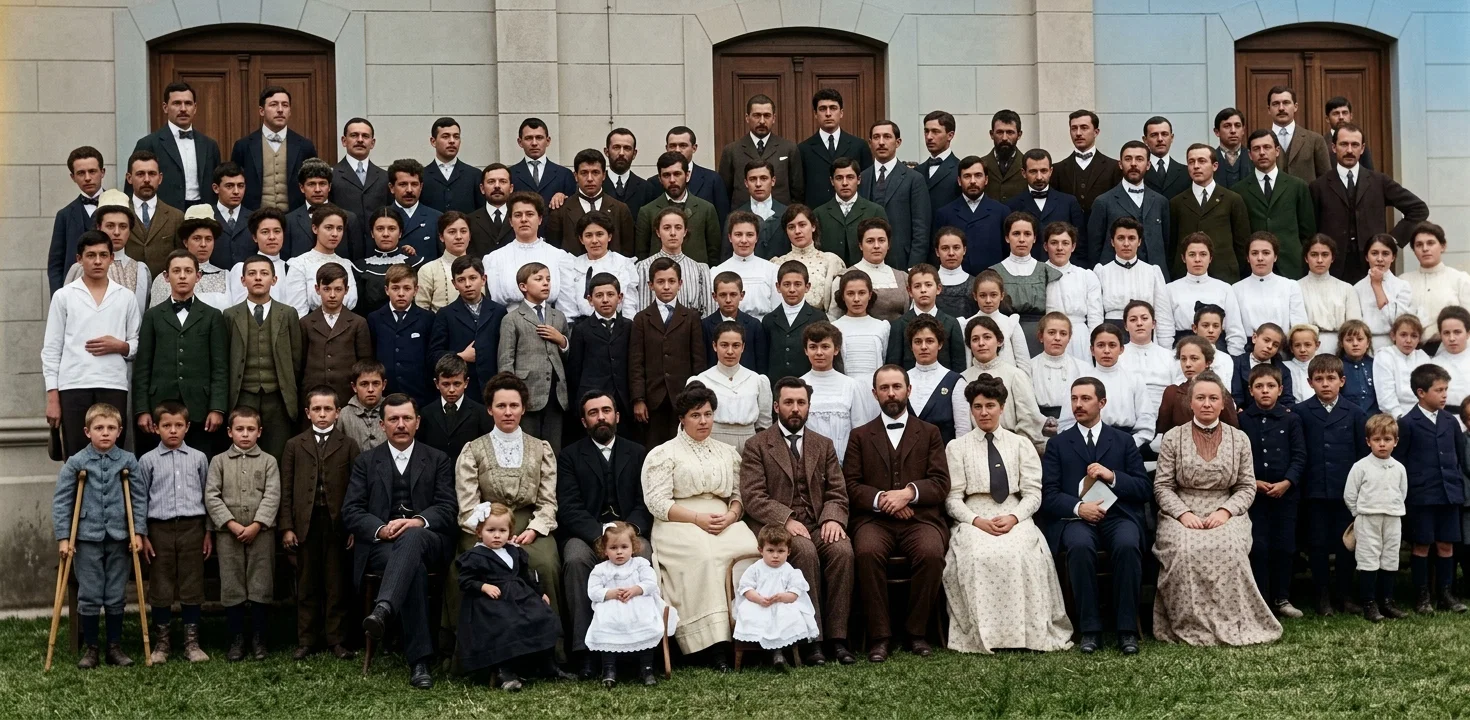
THE following interesting report, with a photograph, which is reproduced with this article, has just been received from Prof. Walton C. John:—
FACULTY AND STUDENTS, RIVER PLATE ACADEMY, ARGENTINA, SOUTH AMERICA
“Our school closed last year with the best attendance it has ever had in the regular graded classes. The enrollment was 118. In many respects the year was a good one, although we have suffered much inconvenience for lack of room in the dormitories. The way we have to crowd students in our rooms would scarcely be allowed in the United States. While our rooms are quite large, we have to put four and five in the smaller ones, and seven to nine in the larger ones. Our American students have many things in their favor, when they consider how the students live here. However, our students have borne these conditions with great patience. We are anxiously looking forward to the time when the portion of the $300,000 Fund which has been appropriated to our school shall arrive, so that our buildings may be completed.
“The spiritual condition of the school, considering the age of the pupils, has been good during the past year. As the school has grown in numbers, Satan has tried to thwart the principles of right; but we are thankful that God is powerful, and is leading us on to a higher plane of spiritual life. The Lord has opened the way for sending out students in the canvassing work this past summer. In view of the dry weather, there was no crop, so our students undertook to do what they could with ‘Patriarchs and Prophets’ and Salud y Hogar. Nearly all the boys had extraordinary success, some even selling as high as nine hundred pesos’ worth during two months. This shows to many of our young men the value of the scholarship plan, which we have adopted here.
“During the past year Elder G. Block, one of the first students of our academy over ten years ago, contributed something of interest to our school. In his labors in Concordia, Entre Rios, he brought into the church an Argentine lady who had been a Roman Catholic. During a recent visit he called on her, and found that she had become somewhat discouraged. Inquiring into the matter, he learned that she had continued bowing down to her household saint, San Antonio, who is the patron saint of that region. Elder Block soon helped to clear away the obstacle which separated her from Christ, and she then found the peace that she so much desired. She gave the god to Elder Block, who turned it over to us. This San Antonio was originally in the church of Concordia, and was reputed to have been the means of healing many sick people, securing, in consequence, large sums of money for the priests. However, the day came when the priests decided to get a better-looking image, and so they gave this one to the son of this sister, who was an assistant at the altar.
“The outlook for the school this year is not bright, owing to the two consecutive dry seasons, which have left nearly all our brethren in poor circumstances. We are fortunate this year in obtaining Elder H. S. Prener, who will bear heavy responsibilities as Bible teacher and preceptor. Prof. C. D. Lude is secretary, and Sister Lude acts as matron; this year begins their eighth year of continuous service in this school. Our other teachers are Prof. Otto Heyde, Camilo Gil, and Miss Catalina Block, who begins this year as a student-teacher. Brother Arthur Westphal is now treasurer and bookkeeper.
“It is our fervent desire that the Lord will use us as his servants in training workers to go into the great South American vineyard. We ask a special interest in your prayers that God’s work may advance rapidly in this place.”

Christian Education

Conducted by the Department of Education of the General Conference
H. R. SALISBURY 3 Secretary

Medical Missionary Department

Conducted by the Medical Department of the General Conference
D. H. KRASS, M. D.  Secretary L. A. HANSEN  Assistant Secretary

Conviction Must Become Conduct

“CONVICTION, were it ever so excellent, is worthless till it converts itself into conduct.”

At the Cross

Is it nothing to you? Behold Me and see: Pierced through and through With countless sorrows, and all is for you; For you I suffer, for you I die. Is it nothing to you, all ye that pass by?
O men and women! your deeds of shame, Your sins without reason and number and name, I bear them all on the cross on high. Is it nothing to you?
Is it nothing to you that I bow my head? And nothing to you that my blood is shed? O perishing souls! to you I cry— Is it nothing to you?
O, come unto me! O, come unto me! By the woes I have borne, By the dreadful scourge and the crown of thorn, By these I implore you to hear my cry. Is it nothing to you?
This awful price, Redemption’s tremendous sacrifice, Is paid for you, is paid for you. O, why will ye die? O, come unto me! —Sir John Stainer.

Jesus Went About Doing Good

“God anointed Jesus, . . . who went about doing good, and healing all that were oppressed of the devil.”

The Value of Perseverance

“And Jesus said unto him, No man, having put his hand to the plow, and looking back, is fit for the kingdom of God.” Luke 9:62.
Very few young people appreciate how serious it is to start in Christian service, and then give it up. The one who does this is not only putting himself out of the kingdom of service here, but is also unfitting himself for the kingdom of God hereafter.
A young woman called on me the other day, and said she was unhappy, discouraged, and wanted help. I knew that she had just left school, and I had intended to see her, and learn why she had taken this step. She had started out to build a foundation for a career of usefulness, but had been unconsciously dropping a brick here and there, leaving a weak place in the structure, until finally she discovered that the structure was not worth the building. I persuaded her to go back, gather up the lost bricks as far as possible, and finish her building. On her knees before God she promised him that with his help she would go through what she had started, and she left me with a new ambition in her soul.
If young men and women could realize the awful blot they are placing upon their characters by quitting everything they undertake, they would carry their tasks through to a successful completion, even though it took their very life-blood.
I once knew a young woman who had a habit of saying, as she dropped one task after another: “Well, that is not in my line. I was never cut out for that work.” And so she let the opportunities pass, until one day she began to wonder if there was anything left that she really could do. Then she made the discovery that perseverance was the quality that she lacked. “He that shall endure unto the end, the same shall be saved.” Mark 13:13.
Let us all follow the example of Paul the apostle: “This one thing I do, forgetting those things which are behind, and reaching forth unto those things which are before, I press toward the mark for the prize of the high calling of God in Christ Jesus.” Phil. 3:13, 14.
CAROLINE LOUISE CLOUGH.
Continue reading: Canvassers' Summary for April, 1911