The American Sentinel, Vol. 11, No. 46.

The Papacy and the Supreme Court Analogy
Earlier text: The Papacy and the Supreme Court Analogy

CHRISTIAN CITIZENSHIP. NO. 3.

BY GEORGE E. FIFIELD.
“THE powers that be are ordained of God.”—Paul.
All must admit that this refers to the civil powers, the republics, the kingdoms, the empires, of the earth, as God said of the kingdom of Babylon: “And now have I given all these lands into the hand of Nebuchadnezzar, the king of Babylon, my servant, and all nations shall serve him;” or as he said of the Persian empire under Cyrus: “Thus saith the Lord to his anointed, to Cyrus, whose right hand I have holden, to subdue nations before him. I have even called thee by name, I have surnamed thee; I have girded thee though thou hast not known me.” The immediate context is sufficient evidence of this. Let us quote the passage: “There is no power but of God; the powers that be are ordained of God. Whosoever therefore resisteth the power, resisteth the ordinance of God; and they that resist shall receive unto themselves damnation. For rulers are not a terror to good works, but to the evil. Wilt thou then not be afraid of the power? do that which is good and thou shalt have praise of the same. For he is the minister of God to thee for good. But if thou do that which is evil, be afraid; for he beareth not the sword in vain; for he is the minister of God, a revenger to execute wrath upon him that doeth evil. Wherefore ye must needs be subject, not only for wrath, but also for conscience’ sake. For this cause pay ye tribute also; for they are God’s ministers attending continually upon this very thing.”
In our last paper we saw that God is love and only love; that his law is a law of love, and that in his kingdom love is the only power. We saw that love was opposed to arbitrary force, for such force is a limitation of the liberty of love, and that, in the full realization of the divine kingdom, every one will be free to do precisely what he pleases, pleasing to do that only which love dictates. Now we see that this same God of love has ordained kingdoms and empires of arbitrary power, whose symbol of authority is the sword. He has not only ordained them, but he has declared that they bear not the sword in vain, but that they are his ministers to execute wrath upon them that do evil. Christian people must be subject to them, not only for fear of that wrath, but also for conscience’ sake, and they must pay their taxes to support them in their work, for they are God’s ministers attending continually to the divine commission granted to them, to restrain by arbitrary power, if need be, the wrong of man against his fellowmen.
The question naturally arises: How can these two things be harmonized? How can a God who is opposed, in his very nature, to all arbitrary manifestation of power, and who, when he has his way completely, will sweep from the whole universe all need, and all possible chance, for the manifestation of such power forever more,—how can such a God ordain such power now and declare that those who manifest it are his ministers? This question is not a difficult one. God is opposed to thorns and thistles and noxious weeds. In the Edenic world these did not grow, at least not spontaneously as now, to choke out the precious fruits and grains. Neither will they thus grow in the Eden restored when God has his own way fully once more, for we read: “Instead of the thorn shall come up the fir tree, and instead of the brier shall come up the myrtle tree; and it shall be to the Lord for a name, for an everlasting sign that shall not be cut off.”
But while God is thus opposed to thorns and thistles, he ordained that for the present they should grow. “Cursed is the ground for thy sake, thorns and thistles shall it bring forth to thee,” and “in the sweat of thy brow shalt thou eat bread.” “For thy sake,” that is, on thy behalf, not because I am so offended that I wish to punish thee, but for thy good. God is love, and he acts only in love. All his curses, even, are blessings in disguise. They are curses over what might have been if man had not sinned and come short of the divine ideal, but they are blessings over what would be now without them. They are the best that infinite love can do under the circumstances, since we have resisted his perfect will.
If man had remained sinless, disposed to devote his leisure to the study of God, it would have been a blessing for corn and wheat and fruit to grow spontaneously with no battle with weeds, and God meant it so to be. Now, however, both science and history prove that where the conditions of life are too easy, even as where they are too hard, a high civilization and a good moral development cannot be reached. It is an old proverb: “The devil has work for idle hands to do,” and the trouble with Sodom and Gomorrah was abundance of bread and idleness. For this reason the God who is love and who is opposed to thorns and thistles ordained that they should grow, and that the toiler should earn his bread by the sweat of his brow. That curse was a blessing; it was love working for our sake.
Again, God is the fountain of life, and as such he is opposed to death. If man had remained sinless, permitting God’s perfect ideal of love to be realized, there would have been no such thing as death and its sad partings from loved ones. When God’s perfect ideal is realized in the redeemed world, we read that “death and hades [the grave] were cast into the lake of fire,” and “there shall be no more death.”
Yet for the present God has ordained death. Death is a curse, an enemy coming by sin, and yet it is a blessing. How much better it would have been for the present happiness of man had he never sinned, and so death here had never been necessary. But how infinitely better it is that sin, which brings sorrow and grief, should finally bring release from these in death, rather than that there should be endless life in hopeless misery. Thus God, who is opposed to death, ordained from the first that death should be, if sin should make it necessary.
So of arbitrary power,—the power of physical force. God is love, and love in its very nature is opposed to such manifestation of force. Had man, instead of sinning, yielded his heart to the divine love until the law of love fully controlled his life, there would have been no need or chance for the exercise of physical force in restraining evil. Each man, without any external restraint, could and would have done just what he pleased, for he would have pleased to do only that which was in harmony with liberty and joy. How much better this would have been! How much better it will be when this is so, for, praise God, through redemption his ideal is still to be realized.
But now since man is sinful, and, left to himself, the strong would combine to oppress the weak, and the guilty to crush out the innocent, God has ordained that civil governments should exist to compel those who will not yield their hearts to his righteousness, to be civil, and respect the rights of their fellows. Those who are righteous do not need to be compelled to be civil, for they are civil already—they love all men as brothers, and have no desire to oppress them or infringe their rights. The civil power cannot compel men to be righteous, since righteousness in its very nature, must be spontaneous if at all; it is a thing of the desires and affections, and not of the outward acts merely. In righteousness the outward acts are controlled from within by the divine love; in civility merely they are controlled from without by arbitrary force.
Since external force cannot reach and change the attitude of the heart toward God, and since God desires no worship of mere form,—no worship that does not spring from the love of the heart,—God has not ordained that the civil power should legislate in religious things, or in any way seek to control the consciences of men. He has ordained the powers that be simply to compel men to be civil, and regard the rights of their fellows, that we may live together and transact business, and be free to worship him or not as we see fit. How much better it would be if this compulsion were not necessary. But, now, under the present necessity, that the civil power is a blessing, the millions whose rights and happiness have been conserved thereby can testify. What this world would be without such restraint no human heart can conceive, and therefore no pen can picture. It would be a pandemonium of evil with lust and rapine running riot on every hand. The darkest hour of earth’s history would furnish no complete illustration, for such restraint has never been fully removed.
Now, the Spirit of God, dwelling in the Christian’s heart tends to bring him into harmony with God in all things. It makes him feel that this is not his abiding city, but only the place of his pilgrimage. It makes him long, as does the Lord himself, for the time when thorns and thistles and death and arbitrary power will no longer be necessities, and so will have passed away. It causes love to dominate and control every impulse of the life, so that the exercise of arbitrary force is distasteful and contrary to his nature as it is to God’s. But while the Spirit of God brings the Christian into harmony with God in these things, it also brings him into harmony with God, in that he recognizes as does God the present necessity of the restraint of force, even as he recognizes that thorns and thistles and death are present necessities, and therefore blessings.
The Christian, therefore, not only submits to the civil government because he is afraid of its penalties, but as Paul says, for conscience’ sake. He does not pay his taxes merely because he has to, but because he knows that God has ordained that the civil power should exist, and that therefore it is the duty and privilege of the Christian to support it.
We conclude by repeating, the Spirit of God is the Spirit of love and truth, and it is given to bring us into harmony with the divine love, with the truth of God in all things, and not merely in the one point that force becomes opposed to our nature as it is to his.

NEWS AND NOTES.

WEST Virginia holds a State Christian Endeavor convention at Clarksburg, November 17, 18.
A NEW “Messiah” and “divine healer,” whose name is Schrader, has appeared in New Jersey, and is expected soon to come to New York City.
THE police of Beverly, Mass., have forbidden newsboys of that place to shout on the streets on Sunday, or to sell their papers quietly.
A MASS meeting to promote Sunday observance in Rhode Island, is announced to be held in Providence Nov. 23. A similar meeting will be held at Portland, Me., Dec. 3.
It is reported that a bill emanating from the Congregational Association of Massachusetts, forbidding the employment of laborers for seven days in the week by any corporate body, will be presented to the next legislature of that State.
“THE Endeavorers of New Castle, Pa.,” says the Golden Rule, of November 5, “have been doing a good piece of work for Christian citizenship in folding and addressing 200,000 pieces of National Reform literature, which are to be sent out over the country.”
AN attempt made recently to hold open-air Sunday concerts in a public resort near Mansfield, Ohio, was defeated by resolutions and threats by the Christian Endeavor societies of the place, directed against the street-railway company which was to furnish transportation.
A BOSTON jury decided recently that “Yankee Doodle” was not a fit tune for a Sunday concert, and now objection is made by the New England Sabbath Protective League to a Sunday performance of Rossini’s oratorio “Moses in Egypt.” So says the New York Herald, of November 10.
THE Defender, organ of the “New England Sabbath Protective League,” in its November issue, defends the recent arrest of three persons for bowling on Sunday in Somerville, Mass., on the ground that “every human being has the right of rest and the privilege of worship, one day out of seven.” Does the fact that one person is engaged in recreation at a certain time prevent another person from resting or worshiping at the same time? If so, how do seventh-day observers manage to rest and worship at all? Yet they find no difficulty in resting and worshiping on the seventh day, with worldly business, pleasure, and recreation in full blast around them.
IT appears that the Raines liquor law, which is pronounced to be one of the best measures ever devised for “regulating” the liquor traffic, does not even stop the sale of liquor on Sunday; for, as the Examiner, of October 29, states, 2,000 saloons in Brooklyn alone have been transformed since its enactment into “hotels,” which are free to dispense intoxicants any day in the year. The only effective way of dealing with the saloon is to outlaw it.
SPEAKING of the revolt against Spanish rule in the Philippine Islands, a Spanish Roman Catholic journal asserts that “the people do not care for progress and civilization,” and “are happy when they are let alone.” This it says in connection with an argument for the complete subjection of the people to the priests and the extinguishment of all liberalizing agencies, as the only method of securing peace and happiness. Rome would hardly dare to state her policy so plainly in this country.
A DES MOINES (Iowa) journal of recent date publishes a call for a “Sabbath Rescue” State convention, to be held in that city December 1-3. The call is signed by committees of the Iowa Sabbath Association, Des Moines Ministerial Association, Y. M. C. Association, Christian Endeavor societies, Iowa, W. C. T. U., partisan and non-partisan, and the Iowa Sunday-school Association. The call states that “it is desired to place the Sabbath Association on a broader and better understood basis, making it representative of all religious bodies in the State that are in sympathy with efforts to preserve the sacredness of the Christian sabbath. The association will then be the servant and central agency of this interdenominational constituency and prove such a center of organized activity as a State central committee is in a political campaign.”
A LITTLE glimpse at what is being done in the way of permeating our legislative bodies with “National Reform” sentiment, is afforded by the following item from the Chicago Times-Herald, of November 9:—
BEAVER FALLS, Pa., Nov. 8.—There was hauled today to the post-office 60,000 large envelopes containing a copy of a supplement to a Christian paper in which was printed a report of the hearing before the Judiciary Committee of the House of Representatives, Washington, March 11, 1896, and the proposed Christian amendments to the Constitution of the United States.
Also a memorial to the “Body of followers of the Saviour King on the Christian amendment now pending before Congress for the acknowledgment of God and Christ and the Bible in the Constitution of the United States.”
A blank petition to the House of Representatives and Senate of the United States is also included, asking those bodies to adopt the joint resolution which is now before them on the above-named amendment. These enclosures were addressed to individuals all over the United States, and were issued by the National Reform Association of the Covenanter Church, 107 Park-Way, Allegheny. The mass of stuff filled a two horse wagon and required two hundred tie sacks to carry it in the mails. The postage cost $1,200. The postmaster was given special instructions to mail none of it until Monday, so that it would not travel on the sabbath day to reach its destination.

IMPROVING ON GOD’S METHODS.

[The Examiner (Baptist, N. Y.), Sept 24, 1896.]
THE greatest calamities and crimes which have afflicted Christendom have grown out of efforts, no doubt well meant, of good people to improve upon the methods which God has made known in his Word. It is altogether likely that the man who first proposed to sustain religion by the arm of the State thought that he was rendering a great service to the Church, and was inaugurating a scheme which, for some inscrutable reason, the Deity had overlooked. It is hardly necessary to say that experience has justified, if justification were needed, the declaration of our Lord, “My kingdom is not of this world.” No doubt the thought of a primate among the clergy, having supremacy over all the Christian Church, seemed at the start to be a great improvement upon the loosely organized and perhaps sometimes disorderly democracy which had prevailed. Monasteries and convents, to which religious persons should retire for lifelong meditation and prayer, free from the contaminations and temptations of the world, seemed not only harmless but beautiful and edifying. Oracular confession and absolute obedience to a spiritual director were thought to be very promotive of humility and spirituality on the part of the laity. The celibacy of the clergy was devised as a means of preserving the clergy from entanglements in worldly affairs, and of putting them more at liberty to obey the commands of their spiritual superiors, in whatever directions these commands might lead. It is not at all impossible that the establishment of the Inquisition proceeded from a sincere desire on the part of its originators to repress error in thought and action. They very likely believed that they were doing God’s service. We are not disposed to deny or doubt that Loyola, in establishing the Society of Jesus, was governed by a sincere desire “for the greater glory of God.” It is hardly necessary to speak of the results which experience has brought to light as to the effects of these various extra-Scriptural institutions, in which men have endeavored to improve upon God’s plans.

WHAT THEY SAY OF IT.

AMERICAN SENTINEL: I received my Bible over two weeks ago, and am very much pleased with it. I hope others will avail themselves of this excellent opportunity to secure a nice Bible cheap. Yours truly, MRS. L. A. ROSS, Butte, Mont.
AMERICAN SENTINEL: I am delighted with the Bible. I don’t know how you sell it so cheap. Yours truly, THOMAS RACE, 349 E. 13th St., St. Paul, Minn.
“Dear Sirs:—
“I received the Bible all right and am very much pleased with it. It is all that it is claimed to be, a first class Bible.”
A lady 75 years old bears this testimony:—
“Dear Brethren:—
“I sent to the express office and received the Bible in good condition and judge of my surprise on seeing the name so nicely put on. Many thanks for the same. I am well pleased with the Bible.”

Teachers' Bible With Pronunciation Aids and Maps

With this book reading is made easy. No more stumbling over the hard words. All proper names are divided into syllables, and the accent and diacritical marks render their accurate pronunciation a simple matter. With a little study of the Key to Pronunciation to be found in every copy of this Bible, the reader loses all fear of the long, hard names of Scripture, and pronounces them with ease.
OUR PREMIUM BIBLE CLOSED.
As is indicated by the name, this is a teachers’ Bible. It contains fifteen maps and 64 pages of illustrations and diagrams, copious helps of the latest revision, Bible index, concordance, dictionary of Scripture proper names with their pronunciation and meaning, and many other excellent features.

Oxford Self-Pronouncing Reference Teachers' Bible Offer

$7.00 WORTH FOR $3.50.

We propose to make it possible for each and everyone to be the possessor of A FIRST-CLASS HIGH-GRADE BIBLE.
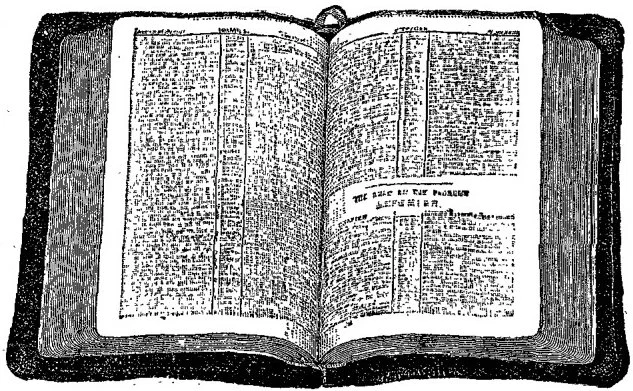
The book we offer has large clear type (see specimen page) and is what is known as the AMERICAN OXFORD SELF-PRONOUNCING REFERENCE TEACHERS’ BIBLE, Bourgois Type, Bound in Imperial Seal Leather, Divinity Circuit, Extra Linen Lined to Edge, Round Corners, Red Under Gold Edges, Silk Headband, Silk Marker, Binding of the Best Quality,

Nehemiah's Covenant and the Names of Those Who Sealed It

gavest before them, neither turned they from their wicked works.
36 Behold, we are servants this day, and for the land that thou gavest unto our fathers to eat the fruit thereof and the good thereof, behold, we are servants in it:
37 And it yieldeth much increase unto the kings whom thou hast set over us because of our sins: also they have dominion over our bodies, and over our cattle, at their pleasure, and we are in great distress.
38 And because of all this we make a sure covenant, and write it; and our princes, Levites, and priests, seal unto it.

CHAPTER X:

1 The names of them that sealed the covenant. 20 The points of the covenant.
1 Now those that sealed were, Nehemiah, the Tirshatha, the son of Hachaliah, and
25 Rehum, Hashabnah, Maaseiah,
26 And Ahijah, Hanan, Anan,
27 Malluch, Harim, Baanah.
28 ¶ And the rest of the people, the priests, the Levites, the porters, the singers, the Nethinims, and all they that had separated themselves from the people of the lands unto the law of God, their wives, their sons, and their daughters, every one having knowledge, and having understanding;
29 They clave to their brethren, their nobles, and entered into a curse, and into an oath, to walk in God's law, which was given by Moses the servant of God, and to observe and do all the commandments of the LORD our Lord, and his judgments and his statutes;
30 And that we would not give our daughters unto the people of the
OUR PREMIUM BIBLE OPEN.

Unprecedented Offer: Bible With Sentinel Subscription

It is only by special arrangement with the publishers of this Bible that we are able to make this

UNPRECEDENTED OFFER.

REMEMBER, the price of this Bible is $6.00. ANYONE, OLD OR NEW SUBSCRIBER, SENDING US $3.50 WILL RECEIVE THIS BIBLE POSTPAID, AND THE SENTINEL ONE YEAR.
Or WE WILL GIVE ONE OF THESE SUPERB BIBLES for seven new names at the regular subscription price, $7.00.
For 25 cents extra we will mark on the Bible in gold letters any name desired.
Address all orders to AMERICAN SENTINEL, 39 Bond Street, New York City.

Christian Statesman Laments Religion in the Political Campaign

THE Christian Statesman, of Nov. 7, laments that the late political campaign was not conducted on the basis of an appeal to God’s law. “National dishonesty” was not, it says, denounced as “a sin against God;” and “the triumph of ‘sound money’ is not therefore a moral victory such as could have been desired.” It was a very noticeable fact in connection with the campaign that the preachers—very many of them—entered into the campaign and tried to conduct it upon the basis of a contest between righteousness and sin, thereby creating a political side show neither edifying nor instructive to the people, and productive of great harm to the spiritual interests of many. From the spectacle they afforded one can get some idea of what would have been had the two leading political bodies divided upon religious grounds, and turned the campaign into a religious controversy.

SIGNIFICANT.

It is a very noteworthy fact that the President’s Thanksgiving proclamation, while not specifically designating the “Ruler of the Universe,” does contain what all Christians will understand to be a distinct reference to Jesus Christ, in the words: “And let us, through the mediation of Him who has taught us how to pray, implore the forgiveness of our sins and a continuation of heavenly favor.”
This departure from the precedent established by former proclamations was doubtless not accidental; nor has it escaped general observation. The National Reform party view it as the direct result of their propaganda for governmental recognition of Christ as the nation’s King; and that their view is correct there seems little reason to doubt. Their organ, the Christian Statesman, in its issue of Nov. 7, refers to it as a “Christian Proclamation,” and says: “This proclamation is the fruit of the earnest efforts of National Reform workers. Their repeated presentation of the claims of Christ upon this nation have not been in vain.”
The authors of the State Thanksgiving proclamations do not appear to have taken the cue provided them on this point in the national proclamation; but in Pennsylvania, it is said, such action was prevented only by determined opposition on the part of those who discern the evil contained in religious proclamations by the State.
It is but one step further to an open recognition of the Christian religion as being the religion of those who constitute the nation. Indeed, the words “Jesus Christ” might have been substituted for “Him who has taught us how to pray,” without doing any violence to the meaning of the paragraph. And the recognition of the Christian religion as the religion of the nation, by the government’s chief executive, is in effect a governmental declaration that those who do not profess that religion, or who may be counted as its enemies, are not really a part of the nation. Very harmless this declaration may be in a Thanksgiving proclamation; but once established by governmental sanction, it will speedily appear elsewhere in a character anything but innocuous.
Who will still say there is no significance in Thanksgiving proclamations? Is it not high time that the friends of liberty everywhere wake up, and with earnest effort prepare to meet the issues which now confront us? S.

New England Agitation Over Sunday Observance

“ALL New England is agitated for the better observance of the Lord’s day.” So says The Defender, the organ of the Sunday observance party in the New England States.

Rev. C. H. Parkhurst Renews Campaign Against Tammany

The Rev. C. H. Parkhurst has inaugurated anew his campaign against Tammany, and announces his intention of burying that organization beyond the possibility of resurrection in the next twelve months.

The Evil of Church and State Union

It cannot be too often repeated in these days that the real evil of Church and State union consists not in an unfair discrimination between the sects, but in the administration of religion through the civil power. Keep religion and the State power separate.

Christ's Kingdom Not of This World

JESUS CHRIST said, “My kingdom is not of this world,” yet he was condemned and put to death as a plotter against the Roman government. This history repeats itself to-day. Those who proclaim now that Christ’s kingdom is not of this world, are accused of carrying on a warfare against the government under which they live. This is the charge now brought against observers of the seventh day.

Difficulty of Enforcing Sunday Laws

A PROMINENT city official connected with the police department spoke at some length at a meeting of the City Vigilance League, Nov. 9, on the difficulty of procuring convictions for violations of the Sunday law. Nevertheless, they have been able in several instances to arrest and punish by fine poor people who at best can hardly supply themselves with the necessaries of life. It is because of the evident injustice of such measures that they are found difficult of enforcement.

Catholic Review on Masses for Souls in Purgatory

THE Catholic Review, of September 7, announces that “the poor souls in purgatory expect much relief from the good works that will be offered up for them by the Church on earth. They cry out from amidst the purifying flames, ‘At least you, our friends, have mercy on us!’ They will remember those who remember them and repay them a hundred-fold for their mediation in their behalf.” The “good works,” of course, will be largely such as will contribute to the revenue of the church. Thus are the echoes of Tetzel’s drum-beats heard even in the nineteenth century.

Papal Doctrine of Purgatory Misrepresents God's Character

THE above quotation sets forth the papal doctrine in a nutshell. The dead who have only committed a few sins, comparatively, are suffering in the “purifying flames” of purgatory. What they want is release from the flames, but the Lord put them there and only he can release them; and this he is not disposed to do. But man surpasses God(!) in pity, and so to man the poor spirits turn, exclaiming, “At least you, our friends, have mercy on us!” Thus appealed to, the friends in their pity do some “good works,” by which the stoicism or indifference of God is overcome, so that he is moved to release the poor unfortunates from their pains! Hardly would it be possible to more misrepresent the character of the eternal Father!

Colorado Court Weighs Constitutionality of Sunday Laws

COLORADO is the latest State to pronounce upon the constitutionality of Sunday “laws.” We have not yet seen the decision, but a Denver journal of recent date stated that a pronouncement on the validity of the Sunday closing ordinance of that city was expected Saturday, Nov. 7, from Judge Abbott, who had delayed the same for some days in order to obtain a copy of the recent Illinois Supreme Court decision touching the Barbers’ Sunday bill. It will be remembered that the latter was declared unconstitutional by the Illinois court; and it is to be hoped Judge Abbott has been guided by the principles of justice to a similar conclusion.

Baptists in Russia Face Persecution and Literature Seizures

The Baptists in Russia, says the Missionary Review, continue to suffer deep persecution, to which has now been added the confiscation of all religious literature. But in spite of the great difficulties under which they labor, the work goes on.

You have reached the end of this edition.

The American Sentinel · Nov 19, 1896