The Youth’s Instructor, Vol. 28, No. 20.

PINS AND NEEDLES

The Youth’s Instructor

May 12, 1880

S. D. A. Publishing Association · Battle Creek, Mich. · May 12, 1880

PINS AND NEEDLES.

“Once there was a girl,” said Aunt Patty, “who lived in a good home and had plenty to eat and to wear, and a good father and mother who were always doing all they could for her, but she didn’t deserve it a bit. You wouldn’t have believed it to look at her, but she was one of the most cruel girls that ever lived. I don’t mean that she tore the legs and wings from the flies, or stuck pins through bugs; she did worse than that. She carried pins and needles about with her, and stuck them into people. The strangest thing about it was that her own mother suffered most by her cruelty. Her mother wasn’t a bit well. She often took a poor spell, and was a weakly kind of woman any way; but this wicked girl didn’t have any sort of feeling for her. In went a pin here and a needle there whenever she happened to feel out of sorts.”
“Stuck pins and needles into her own mother!” said Rose.
“Yes, she did,” continued the old lady; “sometimes it was a great, coarse pin that tore her most cruelly, and sometimes it was a little, fine cambric needle, so fine you could hardly see it, that went way in deep. If she couldn’t do just what she wanted to, or go where she wanted to, or read when her mother wanted her to work, she would just fly up and stick a needle or a pin into her.”
“Mean, ugly thing,” said Rose, her black eyes flashing; “why didn’t her mother whip her or shut her up?”
“Served her right, if she had, I think myself,” said Aunt Patty with emphasis. “But she was one of that sweet, patient kind of persons, and she would often go off by herself and cry and pray over her bad girl. You have seen little silk pin and needle cushions, haven’t you, made in the shape of a heart? Well, what was strange about this was that the pins and needles went right through to this poor mother’s heart, and there it was, stuck full. Nobody could see them only just herself, and the Eye that looks down into everybody’s heart.”
Aunt Patty stopped just here, and her gray eyes looked over her spectacles at Rose, as she slowly said,
“Do you know of any other girl that carries pins and needles around with her?”
Rose’s cheeks got redder, and her eyes blacker. She grasped her sunbonnet, dashed down the steps, and away she flew around the house, down to the farthest corner of the yard, out of sight and hearing, and then flung herself down on the grass under the old pear-tree, and cried aloud,
“Oh, dear! oh, dear! Aunt Patty means me. I know she does!” she groaned. “I wish she never had come here. She’s always watching me just as sharp. I don’t stick needles and pins into mamma, and she needn’t say that I did; and she’s real cross, too, anyhow. Oh, dear! oh, dear!”
She cried loud, angry screams until she was almost worn out, then buried her face in the cool, sweet grass, and fell asleep; and she dreamed. She thought her mamma was very sick, the blinds were all closed, and the house was still, everybody whispered and went about on tiptoe, and a doctor with gray hair and long gray beard bent over her mamma. “She has heart disease,” he said, “brought on by trouble;” then he turned and looked right at Rose from under his shaggy brows, shook his finger at her and said, “This is the one who did it, the troublesome child,—she is killing her mother.”
She screamed out in her dream, and that awoke her. She sat straight up and looked round about her. She had been asleep a long time, for the sun was almost down to the top of the hill. Then it all came to her,—Aunt Patty’s story and her dream. When she recalled the words of the gray old doctor, she cried again with all her might.
It was a sorrowful little soul that sat there for the next half-hour. If naughty, cross looks, tardy obedience, as well as impertinent words, were pins and needles, how many times she had hurt her dear mother,—her fair, sweet mamma, that she was proud of. She killing her mamma, indeed! She would die for her that very minute, if it were necessary; but then the dreadful truths would come and stand before her. How she had pouted when her mamma asked her to put down her Wide Awake and set the table for dinner; how she always fretted when she couldn’t have the second piece of pie; and only yesterday she went through what she called a “real fuss” about wearing her white Swiss muslin; told her mamma, “Nobody else thought it was too cold, and it was real mean, anyhow.” Why, it seemed as if she were always wanting to do the opposite thing from what mamma wished.
“Put on your rubbers, Rose.”
“I don’t need them.”
“Yes, you do; the ground is quite damp.”
“Oh, no; it isn’t damp where I am going, besides I can walk on my heels if it is. I don’t need them, truly I don’t.”
Then she would hurry out of hearing quickly. That would oblige mamma to come to the hall door and issue a positive command for the rubbers to go on, and they always went on with a pout and a frown.
Her conscience gave her a very sharp twinge, too, when she recalled her mother’s look, and tone, and words, only a few days ago when she had spoken disrespectfully to her.
“My child, when you speak in that manner, do you know that it pains me in my heart, just as your finger does when you run a sharp needle into it?” Mamma knew about pins and needles, too, it seemed.
Yes, Aunt Patty was right. She did not feel angry with her now, nor was she crying in those loud, ugly screams; tears of real penitence rolled down her cheek. She knelt down behind the old tree, and told Jesus all about her naughtiness, and asked him to take those hateful sins right out of her heart. She made a solemn promise never to be naughty to her mamma any more; never, never to let her lips speak those sinful words again. She asked the dear Lord to keep her from breaking it. Just then she heard her mamma’s soft voice calling,
“Rose! Rose! Where is my blossom? Why, tea is all ready, and we are waiting for you. What are you hiding down here for, little one?”
“O mamma,” said Rose, in a little choked voice, springing up and hugging her mother close, “I am so glad you are not dead. I won’t be pins and needles any more, indeed I won’t. Do forgive me.”
“Pins and needles!” said mamma, looking puzzled, “what does that mean?”
“Oh, it means—it means,” sobbed Rose, “that I’m never going to be naughty any more.”—Interior.

BE IN TIME.

Be in time for every call; If you can, be first of all: Be in time.
If your teachers only find You are never once behind, But are, like the dial, true, They will always trust to you: Be in time.
Never linger ere you start; Set out with a willing heart: Be in time.
In the morning, up and on, First to work, and soonest done; This is how the goal’s attained; This is how the prize is gained: Be in time.
Those who aim at something great, Never yet were found too late: Be in time.
Life with all is but a school; We must work by plan and rule, With some noble end in view, Ever steady, earnest, true: Be in time.
Listen, then, to wisdom’s call,— Knowledge now is free to all: Be in time. Youth must daily toil and strive, Treasure for the future hive; For the work they have to do, Keep this motto still in view,— Be in time.

SCRAPS FROM HISTORY.

STATE OF THE ROMAN EMPIRE AT THE BIRTH OF OUR SAVIOUR.

The affairs of the political world, at the birth of the Saviour, were in a peculiar condition. For centuries, the nations of Europe, Asia, and Africa, had been convulsed by internal war and strife. Now, those wars had terminated. All nations had been gathered into one, and were under the influence of the powerful pagan empire of Rome. The kingdom at this time embraced the best parts of Europe, Asia, and Africa. Its revenues were immense.
The king was highly honored by the great men of all countries. The king of Parthia sent to him the spoils of the army of Crassus, and the kings of India sought his friendship. The proud Spanish nation was now, for the first time, completely subjugated, and, at last, the rebellious German tribes were quelled, and the temple of Janus, which was closed only in times of profound peace, and which had been open nearly 700 years, was now closed.
It was at this period, and under the circumstances we have just mentioned, that our Saviour was born at Bethlehem in the land of Judea, in the reign of Cæsar Augustus.
In early life, he worked with his father at the carpenter’s bench, attracting no especial attention. When about thirty years of age he began his ministry by collecting around him a few humble, devoted followers, who listened with profound reverence to that which he taught.
He was crucified in the days of Tiberius Cæsar. He arose from the dead, and just before he ascended to Heaven, he commissioned his disciples to go into all the world, visit all nations, and preach the good news of salvation to every creature.
The Jews rejected the gospel, and then it was proclaimed to the Gentiles; and in reaching them it spread all over the Roman empire. Those who embraced it were first called “Christians” at Antioch.
Paul, the great apostle to the Gentiles, preached the gospel through Asia Minor, Grecia, and at Rome, the capital of the empire. S. H. LANE.

WHERE IS THAT BOY?

SOME fifty years since, a little boy asked his father to furnish him some school-books. The father replied, “I should be glad to get you books, my son, but I am too poor.” Was the lad discouraged? No. Away he bounded to the village, perhaps two miles or more, and went from store to store, to purchase some second-hand books. Soon he found what he wanted. But how could he pay for them?
A happy thought struck him; he proposed to pay for them in butternuts, and so he did; drawing them on his hand-sled upon the snow crust to the merchant.
Now he improves his evenings by reading and studying his new treasures, “Not” said he, “by the light of your modern kerosene lamps, nor candles, but by the light of pitch-pine knots.” This boy toiled on, studied on, climbing up the mountain of hinderances in pursuit of an education.
He taught his first school for nine dollars per month, built the fires, swept the school-house, and took one-half of his pay in spruce shingles. But never mind this, he was climbing up the ladder. And where is that boy now? Well, for a term of years he has been a professor in one of the colleges in Vermont.
My young readers, what do you think of this boy? I think you will say that he had commendable perseverance. That is it. Now let me say to each one of you, Set your mark high, and aim to hit it. Start right, and persevere in the right.
But education, wealth, and fame are not to be compared with heavenly wisdom. “How much better is it to get wisdom than gold! and to get understanding rather to be chosen than silver!” Prov. 16 : 16.
“Wisdom is the principal thing; therefore get wisdom; and with all thy getting, get understanding.” Prov. 4 : 7.
A. S. HUTCHINS.

SACKCLOTH AND ASHES.

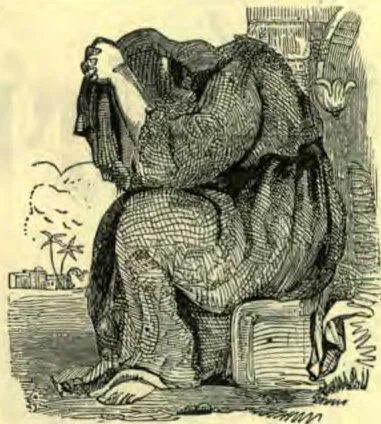
SACKCLOTH is a texture of great antiquity. In Hebrew it is called sak, a word which means both sack and sackcloth. It was generally made of the hair of goats or of camels, was of a dark color, and very coarse, rough, and thick. It was used for tents, sacks, and strainers, besides being worn as a badge of mourning. When used for mourning, it was sometimes worn next to the skin, which it must have chafed by its harshness, sometimes it was put on over the outer garments, or instead of them, and sometimes spread under one upon the ground.
The cut at the head of this article gives us some idea of a person's appearance when clothed in an outer garment of sackcloth. This garment is simply a sack with holes for the head and arms. A girdle of similar material confines its loose folds at the waist. When thus clothed, it is the custom to sprinkle ashes upon the head and face.
When Joseph's brethren brought his coat of many colors to their father, and he thought that Joseph had been devoured by wild beasts, Jacob put on sackcloth and mourned many days. Job, in his great affliction, sewed sackcloth upon his skin, and mourned and wept before God.
Sackcloth and ashes were not only used when mourning, but were used to denote humility and self-abasement. When Jonah came to the city of Nineveh with the cry, “Yet forty days and Nineveh shall be overthrown,” the king commanded that man and beast be covered with sackcloth, and cry mightily unto God.
When word came to King Ahab, through the prophet Elijah, that the Lord was displeased with his course, and that punishment would surely follow, “he rent his clothes, and put sackcloth upon his flesh, and fasted, and lay in sackcloth, and went softly.”
Joel, in speaking of the judgments of God, commands the people to gird themselves, and lament, and the ministers to “lie all night in sackcloth.” As the wearing of sackcloth denoted humility, Joel brings this custom down to our time by using it in a figurative sense, that when the Lord sends judgments upon his people, they must humble themselves, that peradventure the Lord will turn from his anger.
V. A. M.

BIBLE LESSONS FOR YOUTH.

LESSON XCVIII.—THE STORY OF ESTHER.

  1. In the book of Esther, what name is given to Artaxerxes?
  2. What was the name of his first queen?
  3. Relate the circumstances of her divorce.
  4. What steps were taken to secure another queen?
  5. Who was preferred above all others?
  6. About what time did she become queen?
  7. To what nation did Esther belong, and how had she been brought up?
  8. For what signal service was the king indebted to Mordecai?
  9. Who was greatly annoyed by Mordecai’s presence at the gate?
  10. Who was Haman?
  11. What plot was laid by this wicked man?
  12. What was his only cause for such a course?
  13. How did he accuse the Jews before the king?
  14. What decree did he induce the king to issue?
  15. How did Esther undertake to rescue her people?
  16. How was she received by the king?
  17. What request did she make of him?
  18. When at the banquet, what did the king offer to grant Esther?
  19. What did she request?
  20. Who besides the king was called to the banquet? Esther 5:4.
  21. On his leaving the banquet, what occurred to spoil all the satisfaction he had enjoyed in being so highly honored?
  22. At the suggestions of his wife, what measures did Haman take to rid himself of this annoyance?
  23. How was the king troubled that night?
  24. What question did he ask the next morning when Haman came in to ask permission to hang Mordecai?
  25. With what disappointment did Haman meet?
  26. How did the king feel when, at the banquet that day, Esther made supplication for herself and her people?
  27. How were the Jews saved from destruction?
  1. How was Haman punished?
  2. What was done with Haman’s possessions?
  3. To what rank was Mordecai raised?
  4. How did these events affect the interests of God’s people at Jerusalem?

SYNOPSIS.

In the third year of his reign, Artaxerxes Longimanus, called also Ahasuerus, made a great feast; and when he had become merry with wine, sent for Vashti, his queen, to come in, and make a display of her remarkable beauty before his drunken lords. This, Vashti resolutely refused to do, whereupon the princes decided that she should be divorced.
Search was immediately made throughout the realm for a beautiful young woman to take Vashti’s place as queen. Among many others brought to the king was Esther, a Jewish orphan, brought up by her uncle, Mordecai. Her beauty and modesty pleased the king, and she became his queen just about the time that Ezra set out for Jerusalem.
As Mordecai sat at the king’s gate, he discovered a conspiracy against the king’s life on the part of two of his chief officers. This he immediately made known, and the officers were hung.
Some time after this a wicked man by the name of Haman, having been greatly honored by the king, was much annoyed at seeing Mordecai sitting at the king’s gate, and laid a plot for the destruction of the entire Jewish nation. He told the king that the Jews, who were scattered throughout the empire, had laws diverse from all other people, and that they would not obey the laws of the king. So the king made a decree that on a certain day all the Jews in his realm should be slain. Now Haman’s only cause for such a course was that Mordecai refused to bow to him.
When Esther heard of the decree, she set to work to deliver her people. At the risk of her life she presented herself to the king, who in the providence of God received her graciously, and consented to be present at a banquet which she wished him and Haman to attend the next day. At the banquet he offered to grant any request she might make, even to half of his kingdom; but she only asked his presence the next day.
On leaving the banquet, Haman met Mordecai standing erect at the gate, and was so chagrined at the Jew’s want of deference as to lose all satisfaction in the high honors he had just enjoyed. His wife, however, suggested a very speedy remedy, and a gallows was at once erected for the execution of Mordecai.
During the night the king was much troubled in mind, and recollected that Mordecai had never been rewarded for saving him from the bloody hand of the assassin. The next morning, when Haman came to ask the king’s permission to hang Mordecai, the king, accosting him, said, “What shall be done to the man whom the king delighteth to honor?” Haman, thinking himself to be the man, proposed that he should be arrayed in the king’s apparel, and paraded through the streets on the king’s horse. The king at once caused Haman to carry out his suggestion upon Mordecai, the Jew.
On the second day of the banquet, when Esther begged the king to spare her life and the life of her people, he was so displeased at the cruelty and treachery of Haman that he had him hung on the gallows which Haman had prepared for Mordecai. The decree that had been made could not be remanded, but another was issued granting the Jews permission to defend themselves, which they did so effectually as to cost the lives of seventy-five thousand Persians.
The king then gave Haman’s palace and all his vast wealth to Esther, who in turn passed them over to Mordecai, her uncle, who was raised to the highest position in the kingdom, next to the king. With a Jewess for a wife, and a Jew for a prime minister, it does not seem strange that the king favored the restoration of Jerusalem. G. H. BELL.

LESSONS FOR CHILDREN.

LESSON LXXII.—REVIEW OF LESSONS LXIX-LXXI.

1. TELL how Elijah and Elisha went from place to place when Elijah was about to be translated, and what conversation passed between them.
2. What did the sons of the prophets say to Elisha?
3. What did Elijah do when they had come to the river Jordan?
4. Relate the conversation that passed between Elijah and Elisha when they had crossed the Jordan.
5. How were they separated?
6. How was Elijah taken from Elisha?
7. Who were watching these two holy men when these things happened?
8. How did they know that the spirit of Elijah had fallen upon Elisha?
9. Describe the healing of the waters of Jericho.
10. Tell what happened when Elisha was on his way to Bethel.
11. Tell how water was given to the famishing armies that went out against the king of Moab.
12. Tell how the Moabites were deceived.
13. How did Elisha help the poor woman to pay her debt?
14. Why was she so much troubled about this debt?
15. Tell how Elisha became acquainted with the Shunammite woman and her family.
16. Describe the death of her son.
17. Describe her journey to Mount Carmel.
18. Tell how the child was brought to life.

TRUE TEACHING.

THE true teacher should be animated by a single purpose. He should aim to teach, as God shall give strength and grace, the appointed lesson of the day, and not some other, however good. It may suit the fancy of the hour or be deemed easier to teach something else, to allow one's self to be diverted into some other train of thought, to indulge in pious harangue, or cheap exhortation on some topic suggested at the moment. But such so-called teaching is subversive of good order, of the unity of thought and purpose that should obtain in every well-ordered school, is demoralizing to the teacher, and usually sooner or later brings him into contempt with the class. No teaching is so effective as that which comes spontaneously out of the lesson or text itself, and none so likely to prove abortive as discursive talk and what seems like preaching on unfit occasions.
We are often impressed most deeply when we are least conscious of the process by which we are affected. Nathan had a solemn and direct message to David, yet he presented it most effectively by draping it in a story through which the king was made to condemn himself most emphatically and severely. The lesson came spontaneously out of the truth presented in the illustration, and thus the way was prepared for a most pointed application. “Thou art the man” came home to the king's conscience with resistless power after his self-condemnation had come spontaneously from the truth so skillfully, yet indirectly presented by the prophet.

DUTIES OF SUPERINTENDENTS.

“A SUPERINTENDENT ought to be a minute man. When school is to begin at three o’clock, don’t begin ten minutes nor one second after. It is lying if you do. Be a man of your word. Be kind to a child; if he’s troublesome, be kinder still. Superintendents ought to have good common sense. Be on hand before school; greet the pupils; inquire about their homes and friends. Be sure to have rooms clean, cheerful, well ventilated. He ought to be a man who can set others to work. He need not lead all teachers’ meetings, but should drill teachers into such labor, thus educating and encouraging activity.”

Enduring Friendships Between Teachers and Pupils

SOME of the most delightful and satisfying friendships of life are those formed between teachers and pupils. We should never look upon the bond as a slight one, meant to be transient and temporary. It should rather take hold of the most enduring part of our nature, and reach forward to the beautiful world beyond this changeful one. When the great Teacher gathers his own beside the crystal sea, there will be many little circles around him formed of those who loved him here, and taught in his name.

Religious Training Suited to a Child's Nature

It is not reasonable to expect the piety of a child to be exactly like that of a man. It must partake of the peculiarities of childhood. Teachers, therefore, who offer the child a man's religion will not be likely to succeed. Religious life in a man will be in harmony with a man's thoughts and habits; in a child it will be in harmony with the child's nature and childish thought. Those who wisely observe these peculiar characteristics will be likely to see quicker and more abundant fruit of their labors.

THE SUNBEAM PATH.

It had been raining all day. Nellie had watched it from nearly every window in the house, looking now to the east and now to the west for some sign of clearing up. But the drops fell steadily, and she could only stay indoors and watch the water forming into little pools in the worn door-stones, and dripping from the trees.
All the “Too bads!” and “Oh dears!” did not make the day a bit brighter, and indeed they seemed to make it darker to mamma, for a restless, discontented little girl is not a very pleasant companion.
At last, Nellie tired of waiting for a change of weather. “It’ll rain until it stops, I suppose,” she said, very truthfully, but rather crossly, and taking up a book, she seated herself to read.
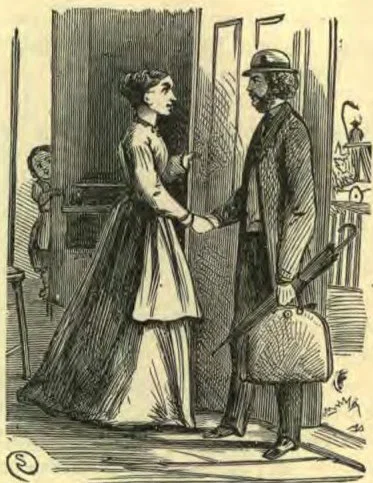
Just then, the stage drove up to the door, and a gentleman alighted, and came up to the house. Mrs. Brand went to the door; and when Nellie heard Uncle Will’s voice, she dropped her book and ran to meet him; but when she got as far as the door, she stopped, and peeped shyly at him from behind it.
Uncle Will came in, and taking Nellie upon his lap, asked her if she was glad to see him. “Oh, yes; it is so rainy and lonesome, and mamma and I have been alone all day.”
“Oh,” said Uncle Will, “that is why my little niece has such a long face.”
But mamma and Uncle Will began to talk about this and that, things that did not interest Nellie, and slipping down from Uncle Will’s lap, she moved restlessly about the room.
“Oh, dear!” said she, “this is the longest rain there ever was.”
“I guess you forget about the flood,” said Uncle Will.
Nellie meditated a minute, and decided that having all the animals in the ark must have been a great help to Noah in passing the time; and that reminded her of Carlo, and suggested his companionship as a consolation. She was not quite sure that the others would be pleased with his company, so she opened the door and gave the invitation very quietly. But Carlo knew no such caution. He had been out in the rain until he was thoroughly drenched, and he bounded into the comfortable room and gave himself a complacent shake that sent drops of muddy water over the white clothes mamma had been ironing, while his feet left tracks on the clean floor at every step.
“O Nellie!” exclaimed mamma; and the dog was hastily banished.
Then Nellie seated herself, took up her book again, and soon forgot her troubles. She did not know how long she had read, when a glow upon the page before her made her look up. The sun had broken through the clouds, and a stream of light was flooding the room.
“Oh, how pretty! Look at it on the floor there!” she exclaimed. “What does it seem like?”
“Like cheerful, sweet-tempered people,” answered mamma. “They always seem to brighten up a room more like sunshine than anything else that I can think of.”
Nellie’s face flushed. The sunlight, with mamma’s words, had shown her, as if by a flash, how selfish her day had been.
“It’s like a great golden road upward, a golden road up to God,” said Uncle Will slowly.
“I wish that I could go up on it!” exclaimed Nellie, watching the slanting beams. “But it won’t bear feet.”
“Our thoughts can travel over it,” said mamma.
Nellie did not answer, for she was thinking how seldom it was that her thoughts traveled over the “sunbeam path” up to God. She wondered, too, if a sweet, unselfish life could be like the sunbeams,—a golden road upward. Will she forget it all when the next rainy day comes?

LETTER BUDGET.

Bushnell, Mich.
Dear Editors: I am a little boy five years old. I take the weekly Instructor, and like to read the stories in the Children's Corner. I love to go to Sabbath-school. I want to be a good boy, so that I can meet all the Instructor family in Heaven. Bert Tyler.
Poy Sippi, Wis.
Dear Editors: I take the Instructor. I keep the Sabbath with my father, sister, and brother. My mother is dead. I am eleven years old. I was baptized October 6, 1879, by A. D. Olsen. I am trying to be a good girl. Laura M. Coolidge.

The Giant Sin.

DEAR CHILDREN: You have all, perhaps, heard or read about David and Goliath, have you not? You remember, then, that David was a mere child in size as well as in years, and that Goliath was a great man, as regards size only, for we cannot be truly great unless we are good, and we have no authority for saying that he was, seeing that he defied the armies of the living God.
We are told that his height was six cubits and a span, which is a little more than eleven feet, or twice as tall as an ordinary man of our day. Then he had a helmet of brass on his head, and a coat of mail to protect him while fighting.
Now David had much armor given him by King Saul, but he refused to wear it, as he had “not proved it;” but, dear children, he had his heart and soul well supplied with armor direct from God,—faith, confidence, trust in Him who is mighty to save by few as by many, by the weak as by the strong.
With and by this faith, he marched bravely onward, hazarding his life for the chosen people of God. By faith he struck the fatal blow, and thus wrought salvation in Israel from bondage; and by faith, at last, won an inheritance in the “bright beyond.”
Now let us, for a moment, draw a picture,—a comparison: You are all to-day in the same state that David was when he heard the challenge of Goliath of Gath,—in youthfulness and innocence. The giant may be likened to sin, and the city of Gath to the world.
Now, if such be the case, you should, like David, go to Jesus for strength to contend with and conquer this giant, sin, day by day; for I think he is much worse and more to be feared than Goliath. You know that Goliath’s power was limited; but there is no limit to the power or extent of sin in this world. It is found in our churches, our schools, our homes,—everywhere but in Heaven.
This giant is trying very hard to bring you into bondage,—to turn you over as slaves to his wicked father, Satan. Will you give up your freedom so easily, children? I think I hear you say, “No, no; we will, like David, go to Jesus, and ask him to make us good little warriors, so that we may fight bravely in the battle of life against our two great foes,—Satan and sin,—and then at last we will don our beautiful crowns and sing the song of victory, which only those children who love the dear Lord can sing, through all the years of eternity.”
Yes, dear children, this is true; and because it is, will you not try harder than ever to be like this youthful shepherd,—not only because he fought, but because he conquered?
Your true friend,
JENNIE B. WESTON.

You have reached the end of this edition.

The Youth’s Instructor · May 12, 1880