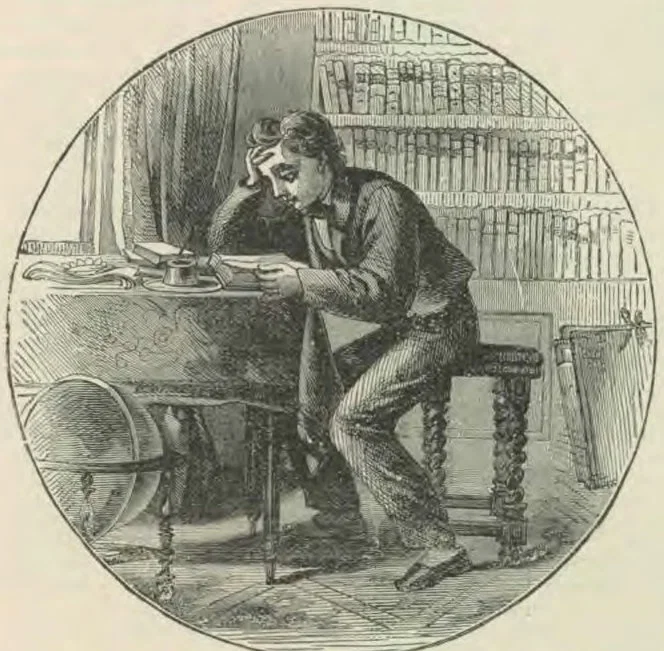
Percy had never spent so delightful a vacation. He lived in a thrifty village. It had a good school, which was held three-fourths of the year, and Percy went to it. He never missed a day, for he liked the teacher, and he also liked to study.
Among all the merry children swinging their satchels of books on that balmy June afternoon when school closed, I think Percy's face was the only one that was clouded. He was really sorry vacation-time had come.
Percy's father was a market-gardener, and raised vegetables to sell in a neighboring town. I am afraid that the thoughts of the long forenoons when he would have to hoe in the garden instead of playing or reading, had something to do with making the vacation such a dread to the young boy.
But there was a pleasant surprise for Percy when he reached home. It was a letter his mother had got from her brother only two days before, and in it was an invitation for Percy to come and spend two whole months by the sea-shore! What was better still, Percy's father and mother had decided to let him go. Can you think how delighted he was? He had never been so far away from home before.
But I did not want to tell you about Percy's long journey to the sea all by himself, which was very much like all other boys' first journeys, nor to tell you what a beautiful place he found at his journey's end, nor of the little room his uncle gave him, with its hooded window looking out over the great ocean. But I wanted to tell you of a talk Percy and his uncle had near the close of vacation time.
There was one place in the house that Percy liked better than all the rest,—better, in fact, than all the beautiful world outside; it was the library. Every minute he could get when his cousins were not teasing him to go somewhere, he would spend in this cozy place, with its walls lined with shelves of books, and with globes, and atlases, and maps.
“You seem very fond of reading,” said his uncle, as he came into the library one morning, and found Percy busily poring over a book.
“Yes, sir,” replied Percy, looking up, “I like this place the best of any in the house.”
“Well, what have you found to read that you liked?” asked his uncle, drawing a great easy-chair up to the table, and sitting down by the boy.
“Pretty much everything,” Percy replied, with a laugh. “I didn't think it would make any difference where I began, so I have read most all the books on that shelf.”
“That is quite a good many for only six weeks,” his uncle replied; “there are twenty books in that row.”
“Yes, sir,” Percy replied, with some pride, “I read a great deal, and I can read very fast for a boy of my age. I mean to be a scholar some day.”
“Ah!” said Uncle Peter, “that is a good mark for a boy to aim at. How old are you?”
“I am eleven—most twelve,” Percy replied.
“You must indeed read fast,” said his uncle; “you have read more than I could well read myself in the same time.”
Percy looked pleased; he thought his uncle meant that he was an unusually smart boy.
“Now,” asked his uncle, “how much can you remember of what you have read?”
Percy puckered up his brows and tried to think; but there was only a confused mass of new things in his mind. Stories of the Reformers, legends of the Northland, and of Greece, the Tales of the Boy Travelers, Robinson Crusoe's adventures, and many other things were hopelessly mixed.
“It is rather a hard matter to straighten out, isn't it?” said his uncle, with an amused smile.
Percy only looked uncomfortably confused, and made no reply.
“I like your desire to be a scholar, and learn all you can,” Uncle Peter replied soberly; “but I think you are making a mistake in the way you take to do it. A boy's mind must be treated in a good many respects like his body. You would not grow any taller or stronger if you should eat six meals a day instead of three comfortable ones, would you?”
“No,” said Percy, “I should expect to get sick if I ate all the time.”
“Well,” continued his uncle, “that is what you have been doing to your mind this summer. You have stuffed it so full of really good things that it cannot take care of any of them properly. You cannot remember anything you have read with certainty. How much good do you think such knowledge will do you?”
Percy looked thoughtful, but made no reply.
“Now I have been watching you for some time when you didn't know it,” said Uncle Peter, “and I have thought of a plan that I think will help you.
“When you finish a chapter, shut the book up and see how much you can remember of what you have read. Do this at the end of every chapter of all the books you read that are worth remembering, and I am sure that you will know more at the end of the next two months' reading than you do at the end of this. But remember that reading a great many books will not make you a scholar, as you suppose; it lies in reading only good books, and remembering what they contain. It is not anything to be proud of that you are a very fast reader, but it is something to be satisfied with if you can keep what you do read.”
These were all new ideas to Percy; and as he believed his Uncle Peter was a very wise man because he had so many books, he thought a great deal about what he had said, and you may be sure it helped him to grow stronger mentally when he had learned to do some thinking on his own account.
W. E. L.
“HO, FOR SLUMBERLAND!”
By Eben E. Rexford
A LITTLE song for bedtime, when, robed in gowns of white,
All sleepy little children set sail across the night
For that pleasant, pleasant country, where the pretty dreamflowers blow,
’Twixt the sunset and the sunrise,
“For the Slumber Islands, ho!”
When the little ones get drowsy, and heavy lids droop down,
To hide blue eyes and black eyes, gray eyes and eyes of brown,
A thousand boats for Dreamland are waiting in a row,
And the ferrymen are calling,
“For the Slumber Islands, ho!”
Then the sleepy little children fill the boats along the shore,
And go sailing off to Dreamland; and the dipping of the oar
In the Sea of Sleep makes music that the children only know,
When they answer to the boatman’s
“For the Slumber Islands, ho!”
Oh! take a kiss, my darlings, ere you sail away from me
In the boat of dreams that’s waiting to bear you o’er the sea.
Take a kiss and give one, and then away you go
A-sailing into Dreamland.
“For the Slumber Islands, ho!”
—Eben E. Rexford, in St. Nicholas.
SEWING-SONG
By E. H. Rockwell
BUSY little maidens, singing as we sew,
What is it we're learning? Would you like to know?
Stitch and fell and gather,—gather, stitch, and fell,—
Turn the edges neatly, ’tis not much to tell.
Stitches short and even, set so strong and fast,
Not a minute wasted, soon the time is past.
Neatness, care, and patience,—patience, neatness, care,
These are worth the learning, here and everywhere.
We will help each other, though our power is small,
As the dear Lord bids us, he who loves us all.
Kindness, love and service,—service, kindness, love,—
Make the golden stairway to the home above.
—E. H. Rockwell
Letter Budget.
ELIJAH DANFORTH writes from Los Angeles Co., Cal. He says: “I am a little boy ten years old, and study in Book No. 2. I have two brothers and three sisters. I belong to the Rivulet Missionary Society, and am trying to do what I can. We used to live on a place about seventy miles from here, where we could see a great many antelopes, deer, and all kinds of game. Sometimes there would come some 150 antelopes within a few rods of the house for water. If we kept real quiet, they would go clear up to the spring and get a drink. But the dog would scare them, and they soon got so timid they wouldn’t come any more. A doctor who is nearly gone with consumption, and a little boy ten years old, lived with us. The doctor does not belong to any church, but the little boy wants to be an Adventist. He says he will be one, and would die for the truth. His home is in Tennessee, and his folks are Roman Catholics. The doctor is very cruel to him on account of his belief. The little boy has preached several sermons, and he longs to be free, that he may help spread the third angel’s message. Pray for him and us that we may hold out faithful. This is my first letter.”
Our next letter is from COBA DAVIS, of La Porte Co., Ind. She writes: “I have one brother and one sister. We are the only Sabbath-keepers about here. We often feel lonely, not having any meeting or Sabbath-school to attend. There are some people here who believe the seventh day is the Sabbath, but they do not keep it. I hope they will sometime. I expect to attend the Warsaw camp-meeting with my mother, sister, and brother. Pa would like to go with us, but we cannot all leave for so long a time. After I have read the INSTRUCTOR, I often take it to my schoolmates, who seem glad to get them. I am in the fifth grade at day school. There are so many temptations it is not so easy to be a Christian while going to school. For my pets I have a calf, dogs, four little kittens, and two missionary hens with chickens. I am thirteen years old. I am trying to be a faithful follower of Christ, that I may have a home with him when he comes.”
The next is a letter from Polk Co., Minn. It is written by DORA E. A. VALSTAD, and reads: “I am a little girl ten years old. My papa died two years ago. We lived in Wisconsin, but now we have moved to Minnesota, and I have a step-papa. I have a sister two months old. I have a big doll. My little sister is my mamma’s doll. Mamma thinks her doll is nicer than mine. I think so too. She is the nicest baby I have seen. I go to day school and read in fourth reader. I keep the Sabbath with my parents, but we have no Sabbath-school, for we are the only Sabbath-keepers in this part of the country. I have an old hen and eight little chickens that I am going to sell and give the money to the mission. Mamma takes the INSTRUCTOR for me. I like to read it very much, but like the Budget best. I am trying to be a good girl.”
GRACE MCLAUGHLIN writes a letter from Crawford Co., Pa. She says: “I am a little girl six years old, and with my mamma and adopted brother attend Sabbath-school nearly every Sabbath. We have about twenty-three members, and also a church organized with eight members. I am nearly through with Book No. 1. I learn a text every Sabbath. My papa does not keep the Sabbath. I wish he would so that we might all be saved when Christ comes. I have a kitten. His name is Tiger; for he looks just like one. I attend day school and read in the third reader. I love to go to day school, and to Sabbath-school too.”
OLIVE M. and HARLAN A. TYLER write letters from Dupage Co., Ill. Olive is twelve years old. She writes for the first time. She says: “I live in a very small town. It has only about one hundred inhabitants. I go to Sabbath-school when it does not storm, and study in Book No. 3. I also go to day school. My sister Cora has two canary birds, and one of them is a beautiful singer. At the time I write, Eld. Rothwell is here giving lectures every evening. We take the INSTRUCTOR and like it much.”
Harlan says: “I am a little boy eight years old. I have three sisters. We all keep the Sabbath, and go to Sabbath-school almost every time. I study in Book No. 1. There is one family here who keeps the Sabbath besides ourselves. I also go to day school. We live very near the school-house.”