The Youth’s Instructor, Vol. 29, No. 38.

SUSIE'S SONG

The Youth’s Instructor

Sep 21, 1881

S. D. A. Publishing Association · Battle Creek, Mich. · Sep 21, 1881

SUSIE'S SONG.

“So you have been to meeting,” said little white-faced Susie Hubbard, who was sitting in a large cane-seat rocking chair under the apple trees in front of her home, one sultry summer afternoon, to a group of children who had paused in the shade by the door-yard fence, with pity in their young faces, to speak to “lame Susie.”
“Mamma couldn’t go to-day,” went on the little invalid, “and I was afraid I shouldn’t hear anything about it. Please tell me something that the minister said.”
“Oh, he told a real good story about a little girl who teased her papa until she got him to go to meeting with her,” said Gertie Pierce, “and he said, perhaps, if we tried hard, we could all get some one to go to meeting who did not go all the time as we did, and that would be doing work for Jesus.”
“Yes, and he said all boys and girls could be useful in some way, and if they loved God, and tried to be good, all the little deeds would prove to be for him,” put in Johnny Shaw, eagerly.
“That is nice,” said Susie, “but I can’t do anything now since my knee was hurt. I do wish I could, and I wish I had done more for mamma and for everybody when I was well.”
“We all hope you will soon be well again,” said Sarah Comins, sympathetically; “don’t you think you shall?”
“I’m afraid not,” replied Susie, sadly, “for mamma looked very sorry after the doctor was here yesterday, and I heard him saying that I ought to go to Boston to be treated by some surgeon. Mamma can’t afford that, of course, and I can’t help her a single bit in any way.”
“Our teacher inquired after you kindly,” said Emma Dimmock. “She said she missed your voice in the singing, and that she had thought of you a good deal, how she was sure you would sing when your knee ached instead of crying, you were such a brave little thing.”
“I never thought to try it,” said Susie to herself, after the children had gone away; “I don’t believe I could, but I will see to-morrow.” The next morning while Mrs. Hubbard was washing, the baby cried a good deal, and little Belle could not quiet it. “Oh, dear, what shall I do?” sighed the wee bit of a girl, who was not much more than a baby herself. “I tan’t do anysing wif him.”
“Draw him out here,” called Susie, who had been placed again in the front yard that she might breathe the pure, fresh air. “Draw him out here, and I will sing to you both.”
Belle obeyed, and before her lame sister had got half through the hymn, “I am so glad,” the hot, tired baby was soothed to sleep. Susie, now having found her voice once more, kept on singing one familiar gospel hymn after another until her mother came and looked around the corner of the small brown house, saying: “It seems good to hear your voice again, my poor child. I hung out that basketful of clothes a great deal easier from hearing you. I feel, too, as if you could not be in quite so much pain this morning.”
Susie sung very often after that. Sometimes she hummed softly to herself, and sometimes her clear, young voice rang out so loud that the words of her song could be heard away up the shady street to the great hotel among the elms and maples.
One morning a gentleman, sitting on the hotel veranda, laid down his newspaper, and said to his wife: “Did you ever hear such singing? It is a child’s wonderfully sweet, strong voice; yet there is pain in it.” “I, too, have been listening to it,” was the reply. “Let us walk down the street in the direction from which the voice comes, and may be we shall discover the singer.”
So the two walked slowly down the grassy avenue of trees, through the flecks of yellow sunshine, more and more drawn by the musical utterances as they came nearer the humble home from whence they proceeded, until the gentleman whispered: “It must be in this yard.” They both now bent forward and peered into the shrubbery through their spectacles (for they were oldish people), as one looks after a singing bird that he fears he may frighten away.
A pitiful sight indeed met their eyes. They saw a pale-faced child reclining on a sort of couch made of two old chairs and a profusion of well-worn blankets, shawls, and pillows. The little invalid was wringing her thin hands in an agony of pain, and the tears were pouring down her white cheeks, as her voice, with “a pain in it,” indeed, rang out upon the pure air. They looked upon her for some time in silence, unobserved as they were. Then the gentleman swung back the light wooden gate, and went toward the little sufferer. The song ceased with a mournful quaver, the tears were quickly wiped away, and a pathetic, wondering smile greeted the visitors.
“You see this is all the way I can help mother when I am sick,” said Susie, confidentially, in reply to the gentleman’s questions; “and if she knew how my knee really ached, it would be ever so much harder for her, so I keep singing, and then she believes I am more comfortable.”
“I am a doctor,” said the gentleman, “and I should like to see this painful limb. My wife, here, will help me remove the bandages.”
It was decided, after a thorough examination and a consultation with the village physician, that the curious ulcer, which the doctors called it, on the poor child’s knee could not be successfully treated at home; and the stranger doctor kindly offered to take her to the city with him in a few days. The hard-working young widow and Susie were both very grateful, and early the next morning the little invalid was awake and singing:—
“Precious Saviour, let me sing, only for thee! Tiny offerings I will bring, only for thee! Be my spirit’s deep desire, only for thee! May my childish mind aspire, only for thee! Only Christ who died for me, Paid the price and made me free, Now and through eternity, Only for thee!”
While she was singing, Dr. Nichols, anxious to know how his little patient had rested through the night, after the new treatment he had suggested, and the dressing he had given the painful sore with his own hands, came, again accompanied by his wife, to inquire for her.
“I never heard that hymn before,” he said, taking her thin hand.
“I changed it a little,” replied Susie, “I often do to make the hymns say just what I want them to. You don’t think it is wrong, I hope.”
“Oh, no,” said her new friend, smiling, “but do you believe all this ‘gospel song’ teaching, this ‘atonement’ talk—that Christ ‘paid the price,’ and ‘set me free,’ I mean?”
“Don’t you believe it?” asked Susie, with round eyes, and a bewildered look on her little pinched face.
“No, my poor little one, I don’t, but if you like to believe it, I won’t say a word against it. Sometime I will tell you what I do believe, and then we will see if you will not think me a good man still.”
“Oh, I am so sorry,” said Susie, “and I beg your pardon, I can’t go away with you. I supposed, of course, you were a Christian, and I thought Jesus sent you because I was doing all I could to help mother by singing; and if you are not a Christian, I can’t trust you, and I can’t go to the city; and, please, I don’t want you to doctor me any more; yet, I do thank you ever so much;” and Susie, sobbing, turned her face away.
Doctor Nichols was strangely affected. Although he was a very learned, skillful physician, justly celebrated for his worth as a man and a medical practitioner, he did not believe that Jesus Christ died to save sinners. He was kind-hearted, yet proud, and to be thus summarily dismissed as a physician by a poor little country girl grated upon his sensibilities. He left the pretty village that morning with his wife, and both the resident doctor and Mrs. Hubbard blamed Susie not a little for her plain talk “out of season” to her new friend whom, they told her, she would never see again.
In a little more than a week, however, he came back. “Susie’s song kept singing itself into my ears,” said he, “until I, too, believed, and was made free like all who receive the proffered grace of the Lord Jesus Christ and keep his commandments.”
The next morning a very happy little girl accompanied the doctor to the city where, under his own roof, and at his own skillful hands, she rapidly recovered, and is now quite well and strong again. As soon as her health permitted, she began, at the good doctor’s expense, to take music lessons, and will soon be able, she expects, to help her mother support their little family. Her teachers say she has a fortune in her voice, but Susie’s sweet, simple nature still clings to the sentiment of that favorite hymn which she so often sang during that weary, weary summer, and which she now sings with more than the old marvelous sweetness, without the pain,—
Tiny offerings I will bring, only for Thee!
This true as well as touching little story came to my ears recently, and I have written it out for the children, that they might all learn the sweet and wholesome lesson which it teaches.—Mrs. Annie A. Preston.

A SONG OF THE CORN:

When morns are freshest with early dew, And birds pipe gayly from bush and tree, When the crocus smiles ’neath skies of blue, And the violet lists for the hum of the bee; When thaw-winds blow from the sunny South, And streams swell higher from day to day, When maple, and elm, and birch are budded, And the butterfly hangs o’er the fragrant May— Oh, then is the time when we plant the corn, And the golden kernels are hidden from sight,— Hidden within the cool, damp earth, Hidden away from the searching light.
When the spring has gone, and the buttercups And daisies are dotting the meadows green, When the blue-bells are fringing the mountain-side, And the red rose blossoms, a royal queen; When fields are greenest and skies are bluest, And frolicsome breezes come and go, When Berenice shines in the southern heaven, And Spica kisses the hill-top low,— Then is the time when the corn springs up, And stands with its tassels waving high,— A splendid army in green and gold, ’Midst the bearded barley and emerald rye.
When the mountains are crowned with purple mist, And the apples glow ’mid the orchard’s green, When the grapes droop low on the clambering vine, And the morning air is frosty and keen; When the maples are blazing with scarlet flame, The gorgeous flame of the quivering leaves,— Oh, then do we gather the golden corn, And bind it close in its ample sheaves. We gather it in, our priceless hoard, Ripened and crisped by the summer’s glow, And up to Heaven we lift our thanks For this gift of grain ere the winter snow. —St. Nicholas.

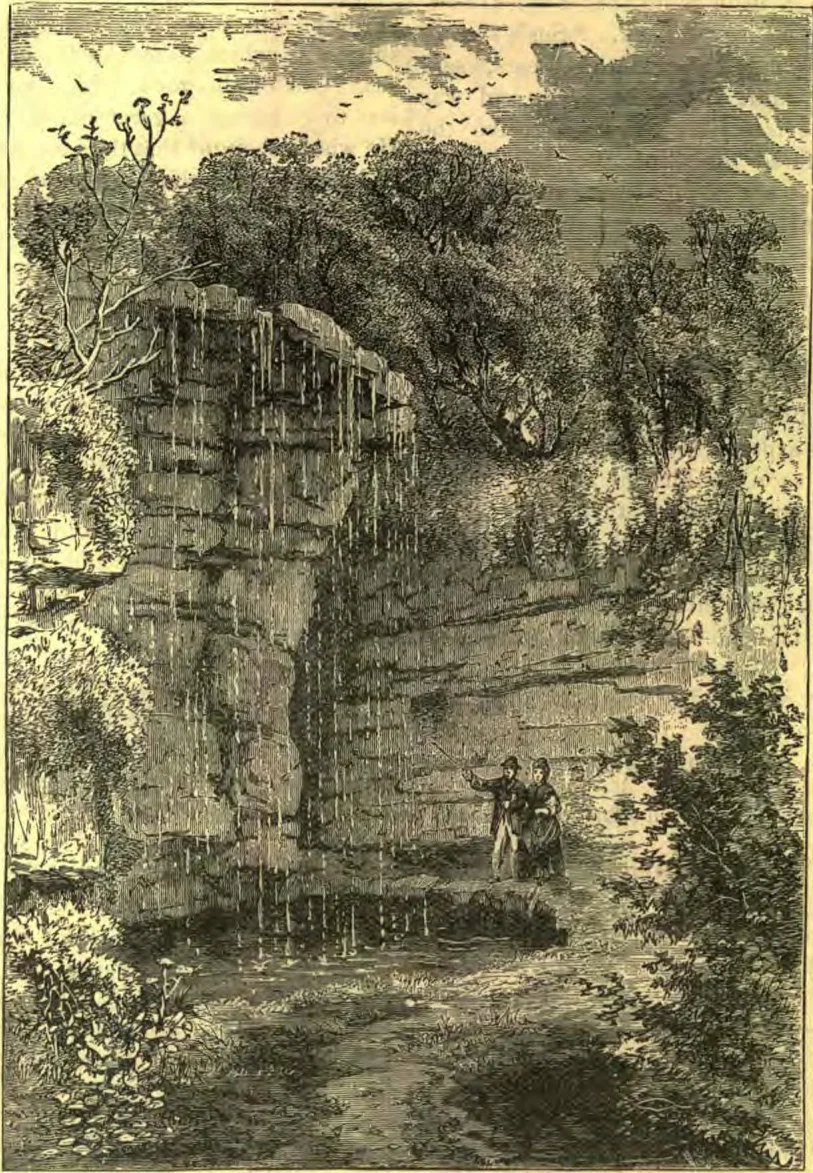
A DRIPPING WELL.

This wonder of nature is situated near the market town of Knaresborough, in Yorkshire, England. The water of the dripping well has the power of turning things into stone. We may see the same effects in any stone pit, where the quarrymen turn up curious-looking things, bedded in stone, which are called fossils. Hard as they now are, they were once soft, living creatures. They became imbedded in the sand, which hardened into stone; and in the course of ages they have become of the same nature as their stony shroud. Any material you choose to place under a dripping well will become petrified, or at least coated with stony matter. A piece of moss, a leaf, a bird's nest, a twig, an acorn, or any such thing, becomes incrusted in a little time, and presents a curious appearance.

Ancient Britain: King Alfred's Devoted Reign

ANCIENT BRITAIN.—NO. 13.

After King Alfred had overcome the Danes, and England was again at peace, he, like Athelberht, instead of seeking to increase his territory, set himself to improve the condition of society. To this end he determined to live solely for the good of his people. He is said, by English historians, to be the first instance of a Christian king, who put aside every personal aim or ambition to devote himself to the welfare of those whom he ruled. He wished, he said, “to live worthily.” With him a life of worthiness meant one of justice, temperance, and self-sacrifice.
Before his time England had no ships with which to meet a foe on the sea. One of the good things he did was to construct a great many ships. He wisely thought that the best means of keeping away the Danes and other enemies was to meet them on the sea, and fight them there, and not let them land and carry away the goods and children of the people on the sea-coast.
Besides using his ships for fighting the Danes, he sent some of them to Italy, France, and other countries, to get many useful things that the English did not then know how to make at home. He sent some of his vessels to trace the coast of Estonia, in Russia, to see what the people were like, and if they had anything in their country that it would be useful to England to buy. He himself wrote a history of one of these voyages for the instruction of his people. He remembered how he loved to read when he was young and he determined to encourage all the young people in England to love learning. He got together the few learned men of England, and sent to Rome and France for others. These he set to teaching. He built several schools in different parts, and it is said that the first school in Oxford was established by him.
Of the state of learning as it then existed, he said, “When I began to reign, I cannot remember one south of the Thames who could explain his service book in English.” King Alfred said he “desired that every free-born youth, who possessed the means, abide at his books till he could well understand English writing.” At that time, near the end of the ninth century, printing had not been invented. There were few books, and what there were were in writing, and in the Latin language, which few besides the priests understood.
Alfred resolved to throw open to his people, in their own tongue, that knowledge which previously had been only in Latin. He translated into English “‘The Consolations of Boethius,’ ‘The Pastorals of Pope Gregory,’ and ‘The Compilations of Orosius,’ which was then the only accessible book of universal history. He also translated the history of his own people by Baeda.” Before his time England had no prose writings in her own tongue. The historian says: “Simple as was the aim of Alfred, he created English literature. The mighty roll of books that now fill her libraries begins with the translations of this Alfred, and above all with the chronicles of his own reign.” Alfred may well be admired, not for great conquests and extension of kingdom, but for teaching his subjects to conquer their evil habits, and arise from their ignorance. He did all in his power to place learning within their reach. He was never idle. It was his habit to carry in his pocket a note-book in which he jotted down at once any useful thoughts for after use.
His active reign of twenty-nine years closed with a long and painful illness. He was very solicitous for the welfare of the English, and before his death gave much good advice to his son Edward, who was to succeed him on the throne. Among other things he said to him, was that saying which true English people so much love: “It is just that the English people should be as free as their own thoughts.”
J. N. Loughborough.

The Orphan's Friend.

“What do you do without a mother to tell your troubles to?” said a child who had a mother, to one whose mother was dead.
“Mother told me whom to go to before she died,” answered the little orphan. “I go to the Lord Jesus. He was mother’s Friend, and he is mine.”
The other replied, “Jesus Christ is up in the sky; he is far away, and has a great many things to attend to in Heaven. It is not likely he can stop to mind you.”
“I do not know about that,” said the orphan. “All I know is, he says he will, and that is enough for me.”
The orphan was right. God’s ear is open to the youngest of us.

THE THIEF.

There is a thief that walks the world, In the quick noon-day and starless dark, Protean-like, now ringed and curled, Ragged anon, and grim and stark; And he plies his trade with a ceaseless skill, Defiantly, warily working ill.
But I trow the charm Will keep you from harm, If scored in your memory ever: Who walks in the street of By-and-by, will stop In the house of Never.

ANGELS

Of the angels, Paul says, “Are they not all ministering spirits, sent forth to minister for them who shall be heirs of salvation?”
Angels for our companions? Yes, God gives us members of the heavenly family to protect us from dangers seen and unseen. It is said, “He shall give his angels charge over thee, to keep thee in all thy ways.”
The following beautiful words of the poet express the peace of one who had learned the presence of the holy beings:—
“I wandered through a forest lone, I met a fair young child, ‘My little one, art not afraid? The wood is drear and wild.’ She shook her sunny, waving curls, And looked and at me smiled. “‘Nay, but I am not all alone,’ Still reverent answered she. ‘An angel walketh by my side, Though him I cannot see; And he would tell of it in Heaven If ought should injure me.’ “I turned me from that trusting child Who put my doubts to shame, And to my heart these ancient words Of Holy Scripture came; ‘The angel of the Lord encamps Round those who fear his name.’”
Let me entreat you, dear young friends, to never go where these holy angels will not accompany you, for there would be positive danger. With them alone are you safe.
CHAS. L. BOYD.

Taking Less Notice of Unkindness and Injury

THE less notice we take of the unkindness and injuries that are done us, the more we consult the quiet of our own minds.

The Greatest Truths Are the Simplest

THE greatest truths are the simplest; and so are the greatest men.

SCENES IN THE LIFE OF CHRIST.

LESSON 35.—CHRIST HEALS THE CENTURION'S SERVANT, AND RAISES THE WIDOW'S SON.

A centurion was a Roman captain who had command of a hundred soldiers. Some of these centurions were noble men. One of them, who dwelt at Capernaum, had a servant who was very sick. Now the centurion loved his servant dearly, and was very anxious to save his life. Jesus had done some wonderful miracles in Capernaum, and the centurion must have heard about them. He might have been present when the demoniac was healed in the synagogue, or when the four men brought, on a litter, a man sick with the palsy, and let him down through the house-roof into the presence of Jesus. Now the centurion wanted to ask Jesus to heal his servant; but he was afraid to go himself; for the Roman soldiers were generally cruel men, and did not believe in the religion of the Jews nor in Jesus. And, besides, the Romans had conquered the Jews, and were ruling over them; so the Jews were not very friendly to the Romans, generally, and probably the centurion thought Jesus would not come for his asking. So when Jesus had finished the Sermon on the Mount, and had returned to Capernaum, the centurion got some Jews of high rank and influence to go to him and beg that he would come and heal his servant.
When these elders of the Jews came to Jesus, they told him that the centurion was a worthy man; for, said they, “He loveth our nation, and he hath built us a synagogue.”
“And Jesus went with them. And when he was now not far from the house, the centurion sent friends to him, saying unto him, Lord trouble not thyself; for I am not worthy that thou shouldest enter under my roof.” “Neither thought I myself worthy to come unto thee; but say in a word, and my servant shall be healed. For I also am a man set under authority, having under me soldiers, and I say unto one, Go, and he goeth, and to another, Come, and he cometh; and to my servant, Do this, and he doeth it.”
When Jesus heard this, he marveled, and, turning about, said to the people that followed him, “I have not found so great faith, no, not in Israel.”
When the men who had been sent to meet Jesus returned to the centurion’s house, they found the servant entirely well.
“And it came to pass the day after, that he went into a city called Nain; and many of his disciples went with him, and much people. Now when he came nigh to the gate of the city, behold there was a dead man carried out, the only son of his mother, and she was a widow; and much people of the city was with her. And when the Lord saw her, he had compassion on her, and said unto her, Weep not. And he came and touched the bier; and they that bore him stood still. And he said, Young man, I say unto thee, Arise. And he that was dead sat up, and began to speak.” Then Jesus delivered him to his mother.

QUESTIONS.

  1. To what place did Jesus go when he had finished the Sermon on the Mount? Luke 7:1.
  2. What remarkable miracles had Jesus performed in Capernaum before this time?
  3. Who sent for Jesus to come and heal his servant?
  4. Why was this man called a centurion?
  5. Why was this centurion so anxious for his servant?
  6. Whom did he send to Jesus?
  7. Why did he not go himself?
  8. What kind of men were most of the Roman soldiers?
  9. Why were the Jews unfriendly to the Romans generally?
  10. When the Jewish elders had come to Jesus, what did they say to him about the centurion?
  11. Who met Jesus before he reached the centurion’s house?
  12. What word did they bring from the centurion?
  13. Why did he feel unwilling to trouble the Master any further?
  14. What did he think would be sufficient?
  15. Did the centurion have to go in person when he wished to have anything done?
  16. What did he say about his authority over the soldiers and servants that were under him?
  17. What did Jesus say when he heard the centurion talk in this way?
  18. When the men who had been sent to meet Jesus returned to the centurion’s house, in what condition did they find the man who had been sick?
  19. Into what city did Jesus go the next day?
  20. Who went with him?
  21. Who was carried out of the city just as Jesus and his company came near the gate?
  22. Who was with the widow?
  23. How did Jesus feel when he saw the poor woman weeping?
  24. What did he say to her?
  25. What did he do?
  26. When the men who were carrying the dead man stood still, what did Jesus say to him?
  27. What was the effect of the Master’s words?

NEW-TESTAMENT HISTORY.

LESSON 48.—THE TRANSFIGURATION.

“And it came to pass about an eight days after these sayings, he took Peter and John and James, and went up into a mountain to pray. And as he prayed, the fashion of his countenance was altered, and his raiment was white and glistering. And, behold, there talked with him two men, which were Moses and Elias; who appeared in glory, and spake of his decease which he should accomplish at Jerusalem. But Peter and they that were with him were heavy with sleep; and when they were awake, they saw his glory, and the two men that stood with him. And it came to pass, as they departed from him, Peter said unto Jesus, Master, it is good for us to be here; and let us make three tabernacles, one for thee, and one for Moses, and one for Elias; not knowing what he said. While he thus spake, there came a cloud, and overshadowed them: and they feared as they entered into the cloud. And there came a voice out of the cloud, saying, This is my beloved Son; hear him.” “And when the disciples heard it, they fell on their face, and were sore afraid. And Jesus came and touched them, and said, Arise, and be not afraid. And when they had lifted up their eyes, they saw no man save Jesus only. And as they came down from the mountain, Jesus charged them, saying, Tell the vision to no man, until the Son of man be risen again from the dead.” “And they kept that saying with themselves, questioning one with another what the rising from the dead should mean.”
“And his disciples asked him, saying, Why then say the scribes that Elias must first come? And Jesus answered and said unto them, Elias shall truly first come, and restore all things. But I say unto you, That Elias is come already, and they know him not, but have done unto him whatsoever they listed. Likewise shall also the Son of man suffer of them. Then the disciples understood that he spake unto them of John the Baptist.”
On the next day after the transfiguration, Jesus, with Peter, James, and John, came down from the hill where the kingdom had been shown them in miniature; and when they came to the other disciples, they saw a great multitude gathered about them, and the scribes questioning with them: “And straightway all the people, when they beheld him, were greatly amazed, and running to him, saluted him. And he asked the scribes, What question ye with them? And one of the multitude answered and said, Master, I have brought unto thee my son, which hath a dumb spirit; and wheresoever he taketh him, he teareth him; and he foameth, and gnasheth with his teeth, and pineth away; and I spake to thy disciples that they should cast him out; and they could not. He answered him and said, O faithless generation, how long shall I be with you? how long shall I suffer you? bring him unto me. And they brought him unto him: and when he saw him, straightway the spirit tare him; and he fell on the ground, and wallowed foaming. And he asked his father, How long is it ago since this came unto him? And he said, Of a child. And ofttimes it hath cast him into the fire, and into the waters, to destroy him; but if thou canst do anything, have compassion on us, and help us. Jesus said unto him, If thou canst believe; all things are possible to him that believeth. And straightway the father of the child cried out, and said with tears, Lord, I believe, help thou mine unbelief. When Jesus saw that the people came running together, he rebuked the foul spirit, saying unto him, Thou dumb and deaf spirit, I charge thee, come out of him, and enter no more into him. And the spirit cried, and rent him sore; and came out of him; and he was as one dead; insomuch that many said, He is dead. But Jesus took him by the hand; and lifted him up; and he arose. And when he was come into the house, his disciples asked him privately, Why could not we cast him out? And he said unto them, This kind can come forth by nothing, but by prayer and fasting.”

QUESTIONS.

  1. Describe the transfiguration of Jesus. Luke 9: 29; Matt. 17: 2; Mark 9: 3.
  2. Who appeared in glory, and talked with him?
  3. On what subject did they converse?
  4. Whom did Elijah represent?—The saints that will be translated at the second appearing of Christ.
  5. Whom did Moses represent?—The saints that will be raised from the dead, when the last trump shall sound.
  6. Who did Jesus represent?—The King of Glory, as he will appear when he comes for his saints.
  7. What promise was thus fulfilled? Matt. 16: 28; Mark 9: 1; Luke 9: 27.
  8. How were Peter, James, and John affected by what they saw?
  9. What did Peter say, just as Moses and Elijah were departing?
  10. What took place as he was speaking?
  11. What was heard from the cloud?
  12. What did Jesus do to them?
  13. How were the disciples affected by the awful solemnity of the voice?
  14. What charge did Jesus give them in regard to telling the vision?
  15. On what did they question among themselves?
  16. What question did they ask their Master?
  17. How did he answer them?
  18. What did they understand from his answer?
  19. When Jesus, on coming down from the mount of transfiguration, drew nigh to his disciples, what did he see? Mark 9: 14.
  20. Describe the actions of the people when they saw Jesus.
  21. What question did Jesus ask the scribes?
  22. What did one of the multitude say in regard to the cause of the commotion?
  23. Repeat the man’s account of his son’s affliction.
  24. What did Jesus say when he learned that his disciples had not been able to cast out this evil spirit?
  25. What violence did the wicked spirit do to the young man as soon as he saw Jesus?
  26. What brief history did the father give of his child?
  27. What earnest petition did he put forth?
  28. What did Jesus say to him?
  29. What reply did the agonized father make?
  30. What did Jesus do when he saw the people come running together?
  31. What was the effect of his words?
  32. How was the young man completely restored?
  33. What did Jesus say to his disciples when they asked him privately why they could not cast out the evil spirit?

Leftover Instructor Papers Offered to Readers

During the past year there have been, almost every week, quite a number of INSTRUCTORS left over in the Battle Creek Sabbath-school. Now if there are any of the readers of the INSTRUCTOR who could make use of these back numbers of the paper, we would gladly supply them; for we would like to have these papers doing some good. Perhaps there may be children who cannot take the INSTRUCTOR, who would like these to read. Now let those who want them, or know of any one else who does, write to the secretary of the B. C. Sabbath-school, S. N. Curtiss, Battle Creek, Mich., telling how many papers you want, and inclosing one or two stamps for postage.

NOTES

And after six days. Matt. 17:1. That is, six days from the conversation [at Cæsarea Philippi] recorded in the last chapter. Luke says, “about an eight days after.” Matthew mentions the six days that intervened between the day of the conversation and the transfiguration. Luke includes both these days, and thus reckons eight. Besides, Luke does not pretend to fix the precise time. In the Greek it is “about eight days after.” Thus there is no contradiction in the statements of the two evangelists.—Barnes’ Notes.

THE MOUNT OF TRANSFIGURATION.

Tabor is the traditional “mount of transfiguration,” but there seems to be much doubt in the minds of travelers about its being the true scene of this wonderful occurrence, although the tradition dates as early as the fourth century. Says one, “If we might choose a place which we would deem peculiarly fitting for so sublime a transaction, there is certainly none which would so entirely satisfy our feelings in this respect as the majestic, beautiful Tabor; but this theory seems highly improbable from the fact that just a little before this glorious event Jesus was far away from Tabor, near Cæsarea Philippi. Moreover, the summit of Tabor was at that time occupied by a fortified town.” Some think it very probable that the event may have occurred on one of the spurs or recesses of Mount Hermon. This view seems at least reasonable, for there is no proof that the disciples and their Master had left the neighborhood of Cæsarea Philippi, which was itself situated on a spur of Hermon. A few, however, still stoutly contend that Mount Tabor is the probable site of the transfiguration, claiming that the fortified city did not cover the whole mountain, and thus there must have been plenty of retired spots where the sublime scene might have occurred. From its comparative isolation from other mountains, they think it best answers to the account of Matthew, “a high mountain apart.”

NOTE

Nain, meaning beauty, or pleasantness, is the name of a little village situated on the north-western slope of “Little Hermon,” a clump of hills near the eastern end of the great plain of Esdraelon. The village is about two miles from the foot of Mount Tabor. In the days of Christ, the little town doubtless deserved its name, the beautiful; but though the site is still a pleasant one, the village, now called Nain, is but a small, poor hamlet of about twenty houses, or huts. Around the town are quite extensive ruins, the most interesting of which are the tombs hewn in the rock, a short distance east of the village.

WHAT WILLIE LEARNED.

WILLIE HARDING sat in a big arm chair before the open grate where a bright wood-fire was burning. Everything in the room seemed pleasant and cheery, but Willie was not happy, and his face showed it plainly enough, as he sat leaning his curly head on his hand and looking steadily into the fire.
The fact was, Willie thought he had a pretty hard time of it. Two weeks before, as he was at play on the ice, he had sprained his ankle, and since then he had had to stay in the house, and have his foot and ankle bandaged. He could not even walk without the help of a crutch. His mother spent all the time she could spare in reading to him, and trying to amuse him in various ways. But Willie was not very patient, and this afternoon he felt out of sorts. The boys were all going coasting over to Bald Eagle Hill, and he had so much wanted to go; but now he must sit in that “poky old house” all the afternoon while the boys were having a good time. So instead of making the best of what could not be helped, Willie seemed trying to make himself and everybody else as unhappy as he could. He felt angry with his mother and little sister, and angry with himself, and even the poor cat purring so quietly by the fire shared his spite. Altogether, he had made up his mind that he was the worst abused boy in the world.
Just then Willie was started from his pouting by a knock at the hall door; and in a moment Mrs. Harding came into the sitting-room, bringing with her the strangest looking little body, but whether a boy or a girl Willie could not at first tell; for the child was wrapped in an old tattered shawl, and had on its head the queerest looking thing, half cap and half bonnet. Mrs. Harding unpinned the faded bit of a shawl, and leading the child to the fire, bade it sit down, and warm the red toes which were peeping from the old ragged shoes. When the shawl was taken off, Willie saw that the child was a little cripple boy. He was hunch-backed, and his poor hands and feet were badly out of shape. From his neck hung a basket, in which were a few bunches of matches.
So far, the little fellow had been silent, but soon he found words to say: “And please ma’am, wouldn’t you like to buy some matches? My mother is sick at home, and she and my little sister have nothing to eat. I tried to sell the matches to get them bread, and I got so cold—;” and there he burst out crying. But all at once he stopped, and straightening up his crooked little body as best he could, said, “I must go now; mother will worry about me.”
But kind Mrs. Harding would not let him go until he had eaten a lunch, and she had dressed him in a pair of boots and a warm coat and cap of Willie’s. She bought all his matches, and filled the basket with food for his mother and sister at home; and Willie begged so hard to give some of the pennies from his bank that his mother let him do so. So the match-boy went away much more comfortable and happy than he came.
When the door had closed upon the poor little dwarf, Willie sat very quiet, and looked into the fire a long time; at last he said, “Mother, I don’t believe I shall ever be cross and unhappy, and think I have a hard time, again; I did not know before how many things I had to make me happy.”
And Willie did learn a good lesson from what he saw that afternoon; and this summer when I was visiting his mother, he told me about it, adding: “And now, when you go home, if you want to write out the story of how bad I was, you may, so other little boys and girls may learn from it what I did.” E. B.
Continue reading: IRENE