Signs of the Times, Vol. 57, No. 44.

Do You Follow Magic or Science?
Earlier text: Destructive <page-break/> Science Preparing for a SUPERWAR

THE GREAT PHYSICIAN

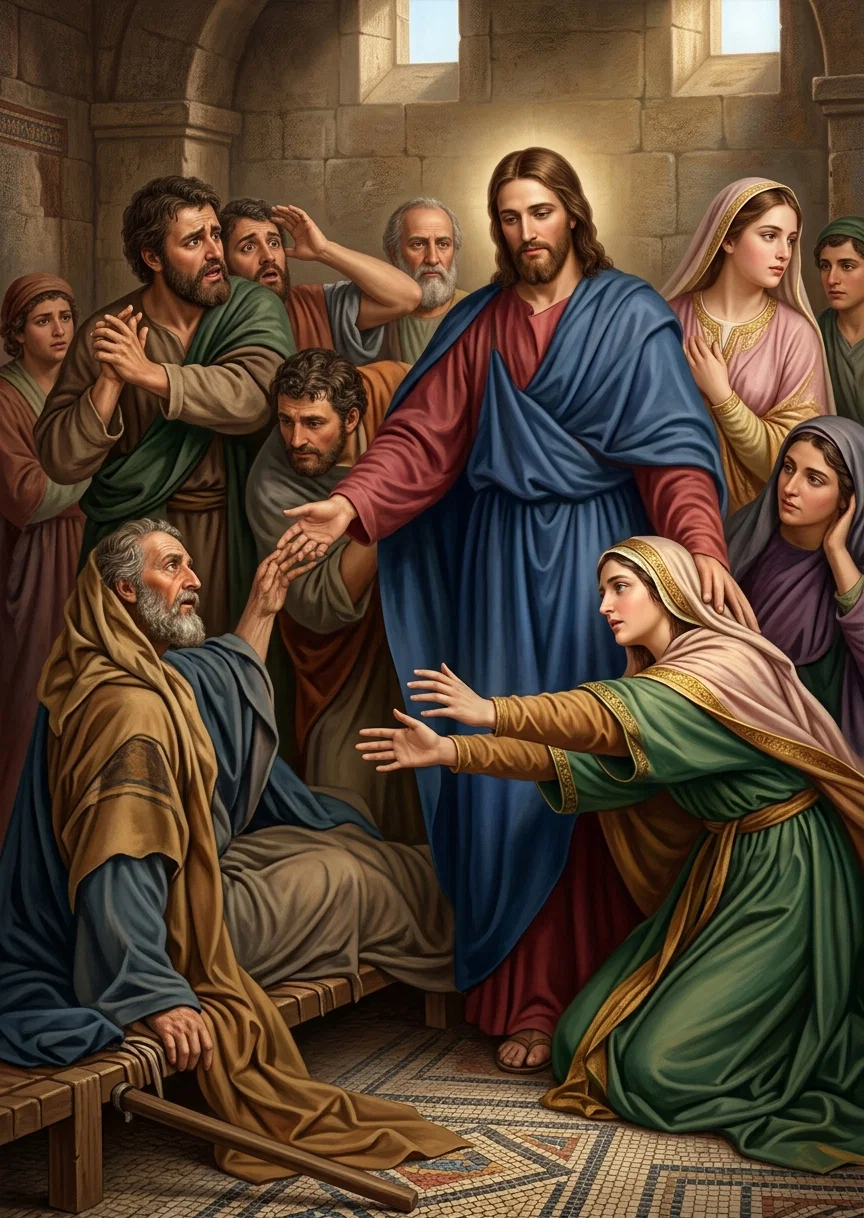
The miracle-working Christ
NINA M. MUNSON
Her sweetheart died in the World War. She was heartbroken. No one could seem to break the spell of sadness that had so changed Elsie's usually happy life into one of seemingly unbroken heaviness of heart and disinterest in life itself. It was so unlike Elsie that all her friends and neighbors were greatly concerned. They made many visits and spoke only cheerful and cheering words to her. But when they began to talk to her, each time she only dropped her head and wept as if her heart would break.

A CHANGE

One day the neighbors saw the old family doctor stop at Elsie's door and disappear inside her home. No one was at home except Elsie. Some shook their heads as they remembered their own experiences on such visits, and watched to catch his expression when he should come out. All afternoon he remained with Elsie. Finally he came out, and drove away.
The next day Elsie was seen out in her garden picking flowers. Her whole being seemed changed—even a song was upon her lips. And so she continued from that time on, seeming suddenly to have been brought out from her gloom into the sunlight once more. All those who saw marveled at the change, but no one was able to find out just what the old doctor had done to bring it about.
Finally, one day about a year later, some one visiting with the old doctor asked what he had done that had wrought so great a change in Elsie. The old doctor looked very thoughtful, then said that he had entered the house and found Elsie—as all her friends always found her—sad and quiet. He began to talk to her; yes, he talked a long time to her. “But,” asked the visitor, “didn't she begin to cry?”
“Yes,” the physician answered, “she did. But I kept on talking. You see, I told her about losing Mary. We had been married only about two months when Mary died.”
He hesitated a moment, then continued: “Elsie was sobbing bitterly by the time I had finished telling her about Mary, and I just put my head down on the table and wept with her.”

SYMPATHY

It was not pills that Elsie needed,—the doctor's pill bag had remained in the corner the entire time of his visit,—nor cheering words, but sympathy. And that was what the physician gave her,—sympathy. He, too, had passed through a similar experience, and could understand her mental suffering. He was a great physician.
But there is a Great Physician who sympathizes with each one of us. He knows our burdens and heartaches and temptations, for He met all these when here on earth. So He puts His hand on ours, bows His head and weeps with us; and we know we have met One who really sympathizes and understands.

Justification by Faith

JUSTIFICATION by faith is not a doctrine, it is an act. It rests entirely upon belief; not belief in a historical statement about Christ, but in the personality of Christ, in Jesus Christ as the Second Person of the Trinity, in Jesus Christ the Second Person of God, in whom the power of the godhead rests. That is the reason salvation rests exclusively upon belief, not upon works, not upon baptism, but upon belief in Jesus Christ, the living, throbbing, pulsating Son of God, the personality of God manifested in Christ, who is God, the embodiment of the personality of the godhead.”—Mark A. Matthews.

To Parents of Children

I WILL venture, as a parent of six, to make these simple suggestions, with apologies for their dogmatic form, to any fellow parents or others in charge of children, who may read these lines.
1. Make friends with your children, finding out, by careful experiment, how to be both leader and comrade. As they grow up, your relationship with them should include the element of happy, trustful, confiding friendship.
2. Help them to think for themselves, and try to train them to be self-reliant and resourceful. Don't be too eager to do things for them that they had much better learn to do for themselves. Whether it is putting their clothes tidy, keeping their lesson books in order, doing their little bit of garden, feeding the chickens, mending a toy boat or a bicycle tire,—whatever it is, suggest to them it ought to be done, encourage them to do it, show them how, but don't do it for them!
3. You cannot begin too early to tell them about God and Christ and the world and themselves. The most valuable thing that Christian fathers and Christian mothers can give their children, by wise methods and in suitable ways, is what they themselves have of Jesus Christ. From their earliest days teach them how to seek and to find God in prayer, in the Bible, in nature, and in the men and women all around them. What they become in later years depends, to an almost terrifying degree, on what you write on the white pages of their receptive child minds.
4. Nevertheless, what gets written on that page depends, in the long run, less on what you say to them than on what you are and what you do. If they see you, their father and mother, make a point of telling God about everything, they will want to do the same. If they see any Christlike unselfishness in you, they will copy it, unconsciously and instinctively. If they see you subordinating money and comfort and ease to the claims of the poor and needy in body and soul, that will be for them a beacon light in finding their vocations and shaping their careers. And the consciousness that they watch you thus will prove a very powerful motive to make each of you a better Christian. Indeed, you can hardly meet their eyes if you get slack.—A Father.

A NEW BOOK FOR THE CHILDREN

The MALLARDS and their NEIGHBORS

by NEIL WAYNE NORTHEY
This is volume two in a series of four new books for the children, called “Old Homestead Tales.” Each book is a complete story in itself, covering a certain phase of wild life found on the Old Homestead.
In this book is told the story of the Little Wild Creatures that prefer to live near water. It is the story of the Mallards, who lived at the Duck Pond on the Old Homestead, and of the Feathered Friends and Furry Friends who were their neighbors at the Duck Pond and along Little River. While flying northward, Mr. Mallard was shot in the wing, and that was why the Mallards stopped on the Old Homestead. Mrs. Mallard discovered a Sheltered Little Cove at the Duck Pond, and decided to start housekeeping. In a little while Redwing the Blackbird, Longlegs the Heron, Shoveler the Spoonbill, and many other Feathered Friends moved in. Everything would have been peaceful at the Duck Pond if Lutra the Otter, Trailer the Mink, Billy Coon, Snoop the Weasel, and other Furry Enemies had stayed away. And there was Sharptoes the Duck Hawk, who tried to catch the Fluffy Ducklets. What do you suppose Bud Smith, who lived in the Grand Old House on the Old Homestead, did to the Fluffy Ducklets before they left for the Sunny Southland?
“The Mallards” has 180 pages divided into thirty chapters of most interesting stories. It is very fully illustrated with pen drawings, and there are four full-color plates, showing the Little Wild Folk in their natural colors. This book follows “The Bluebirds and Their Neighbors”—the only two of the set of four that are ready at the present time. Order these two new books, and watch for the announcement of the other two numbers.
Order from our nearest representative or
PACIFIC PRESS PUBLISHING ASSOCIATION Mountain View California
Price $1.25 Postpaid
In Canada, $1.50

THE MOVIES IN THEIR TRUE LIGHT

A VERY remarkable document on the movies has recently been issued by the Christian Century. This material first appeared as a series of five articles in that journal from the pen of Fred Eastman. They are now reprinted in a separate brochure. We wish that every home in the land had a copy of this document. Surely every Christian worker should have one, and many parents too. It is entitled “The Menace of the Movies,” and can be obtained from the Christian Century, 440 South Dearborn Street, Chicago, at ten cents a copy or $7.50 a hundred.
Dr. Eastman, who is Professor of Religious Literature and Drama in the Chicago Theological Seminary, and a trained sociologist, has made an exhaustive study of the effect of the movies on conduct and character, especially among the children and youth. Although a liberal religionist, and writing in the chief organ of liberal religion in the United States, yet his indictment of the movies is a more drastic one by far than has ever appeared on these pages. He makes the movies out a menace of major importance not only to the mental and moral life of America, but also to America’s influence throughout the wide world where the films from Hollywood and elsewhere are exhibited.
In the first place, Mr. Eastman has polled a wide variety of opinion in the United States as to whether or not the movies have improved in their moral tone during the last ten years, since Will Hays became “the czar of the movies.” The unanimous opinion is that they have been gradually getting worse.
“The testimony, therefore, seems overwhelming to the effect that the movies have not been cleaned up. Their character is shady. Their morals are a mess. Their pull is downward. . . . But, worst of all, they are educating millions of young people daily in false standards of taste and conduct, false conceptions of human relationships.”
His indictment of the movies is:
“The movies are so occupied with crime and sex stuff and are so saturating the minds of children the world over with social sewage that they have become a menace to the mental and moral life of the coming generation.”
An analysis of what our modern motion pictures are made up of is most enlightening:
“The Child Welfare Committee of the League of Nations analyzed 250 films in 1926 and found in them ‘97 murders, 51 cases of adultery, 19 seductions, 22 abductions, and 45 suicides. Among the principal characters in these 250 pictures were 176 thieves, 25 prostitutes, 35 drunkards, etc.’”
“The Chicago Censorship Board in 1924 is said to have made the following eliminations from 788 pictures: 1,811 scenes of assault with guns, with                 intent to kill 175 scenes of assault with knives, with                 intent to kill 129 scenes of assault with other weap-                 ons 231 scenes of hanging 173 scenes of horror (as clawing out                 eyes, biting off ears, etc.) 757 scenes of attacks on women for im-                 moral purposes 929 scenes of nudity and seminudity 31 scenes of jail breaking”
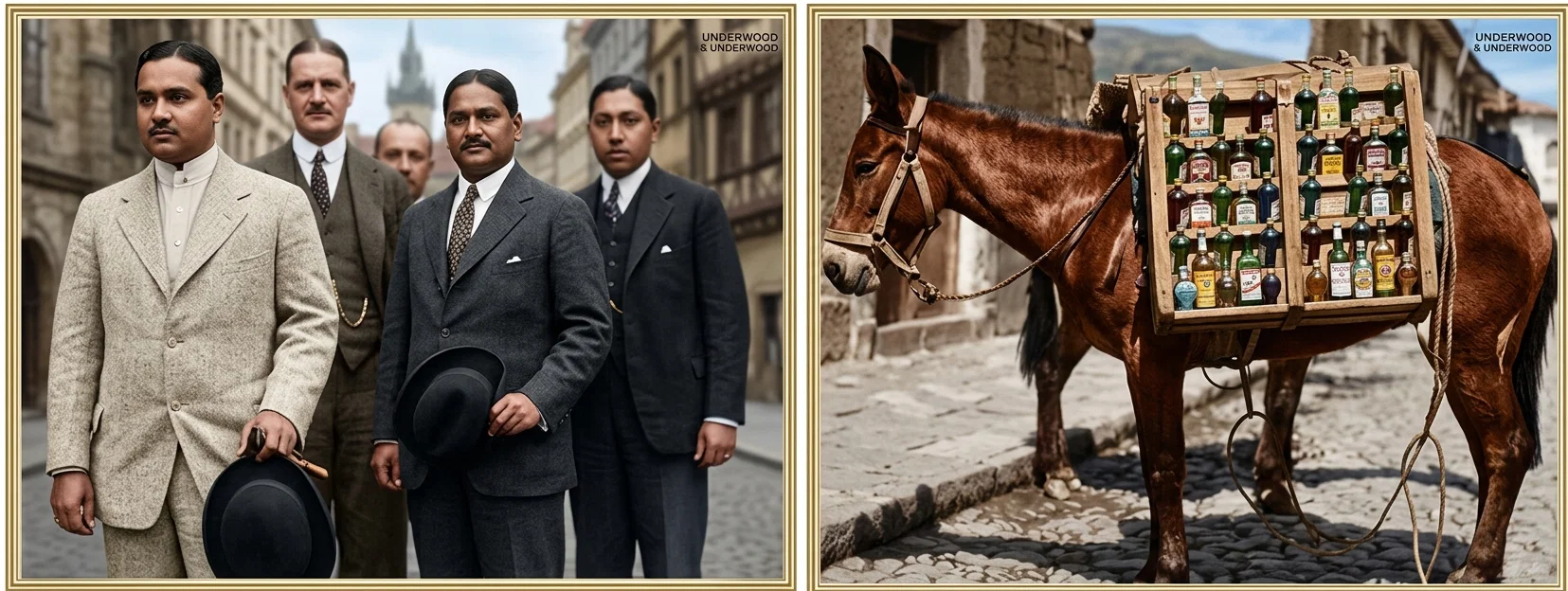
The Maharajah Manikya Behadur of Tripur, who is reputed to have a fortune in excess of $900,000,000, with members of his suite as they arrived in Prague, Czecho-Slovakia, on their tour of Europe. The maharajah is the man at the left, in the light suit. Unsettled conditions in Bolivia do not interfere with the delivery of alcoholic drinks. This picture shows how Bolivian merchants use pack mules and burros to make their deliveries in towns whose streets are so hilly that all other methods are unsuccessful.
When one takes into consideration the fact that thousands of communities, outside the few large cities that have boards of censors, see all these movies with nothing eliminated, one can easily appreciate the incitement toward crime and immorality the movies constitute. They are the chief debaucher of our present-day civilization.
Dr. Eastman interrogated scores of young boys and girls as to their impression of the movies. Here are two characteristic replies:
“A sixteen-year-old-girl: ‘Those pictures with hot love-making in them, they make girls and boys sitting together to get up and walk out, go off somewhere, you know.’”
“A young delinquent: ‘Movies make most anything seem all right. Things that look bad on the outside don’t seem to be bad at all in the movies.’”
That is perhaps the greatest single allegation that could be made against the movies,—they make bad seem good. In other words, they dull the moral perceptions. They blur the distinction between right and wrong. They obscure the line of demarcation between righteousness and iniquity. They so educate the young that they do not differentiate between honesty and dishonesty, purity and impurity, uprightness and degradation, integrity and moral obliqueness. They make sin and sinning attractive, and point the finger of scorn at the high standards of morality and religion.
We are thankful for Dr. Eastman’s exposure of the movies. We hope it will make some impression upon the several scores of millions who are constant attendants, and most of all, upon the parents who take or allow their children to go to the movies.
B.

You have reached the end of this edition.

Signs of the Times · Nov 11, 1930