The Youth’s Instructor, Vol. 67, No. 14.

Brief News Items From Around the World

The Youth’s Instructor

Apr 8, 1919

Review and Herald Publishing Assn. · Takoma Park Station, Washington, D. C. · Apr 8, 1919

Brief News Items From Around the World

Secretary of the Navy Daniells is in Europe on official business.
Two hundred girls from the Orient are students in American schools and colleges.
Within a month America will be ready to start several airplanes on a transatlantic flight.
Dr. A. F. Schauffler, the indefatigable Sunday school worker and writer, died on February 18, aged seventy-three years.
Ralph De Palma, the intrepid Italian driver, recently covered one mile in his automobile racer at Daytona, Florida, in 24.92 seconds.
Damage estimated at $5,000,000 was done to the tomato crop on the eastern coast of Florida by recent heavy rains. Practically the entire crop was ruined.
The former German kaiser finds the climate of Holland disagreeable to him, so he desires to locate in Egypt or in some other equally salubrious country.
The first monument dedicated to the memory of George Washington is said to be the quaint stone tower at Boonsboro, Maryland. It was dedicated on July 4, 1827.
Queen Marie of Rumania expects soon to visit the United States. Whether the trip will be made before or after the conclusion of the Peace Conference has not been decided.
Twenty cities have now enrolled in the nation-wide “own-your-own-home” campaign, inaugurated by the Department of Labor to stimulate building during the readjustment period.
Socialists accused of violating the espionage act in the Chicago District have been sentenced to serve a total of 968 years in prison, or an average of five years for each person convicted.
Authentic reports state that starvation prevails throughout Bolshevist Russia, and the population is dying by thousands. Undertakers are unable to cope with the situation, since there is not wood enough for coffins.
The Du Pont Powder Company supplied forty per cent of all the explosives made for the Allied nations during the war, or 1,466,761,219 pounds during four years. This industry brought into their treasury more than $1,000,000,000.
Germany will surrender approximately 3,500,000 tons of merchant shipping under the terms of the armistice. The ships will be divided between France, Great Britain, and the United States. The United States will receive eight first-class transatlantic liners.
Mr. Roy A. Conger has purchased the entire equipment of the Canadian Royal Air force of 350 planes and 1,000 engines, purposing the commercial development of “the flying business” in Canada. He will conduct a regular air-express and passenger service across the continent.
Norman Hapgood, who has been appointed by President Wilson to succeed Dr. Eagan as United States minister to Denmark, was the president and one of the founders of the League of Free Nations, an organization which has done much to make available information concerning an international league.
On Memorial Day this year the few survivors of the Grand Army will take over for the first time the duty of decorating the graves of American soldiers who have fallen in this war and whose remains have been brought back to this country. It will be a touching service.
Dr. Mary E. Walker, the woman who made herself notorious by the wearing of male attire, is dead. She spent four years as a surgeon during the Civil War, and by special authorization of Congress discarded at this time the dress of her sex for that of her brother.
The French Government has started an offensive against profiteering by opening fifteen large public eating houses for the sale of government controlled provisions. It is estimated that the cost of living in Paris will thus be lowered at least forty per cent.
Tibet has at last opened its doors to the gospel missionary, according to a recent statement issued by Roderick A. McLeod. For years this country was closed to all outside influence, since China demanded that it hold intercourse with her alone.
Amelia E. Barr, the authoress, died on March 10 at her home in Richmond Hill, New York City. Mrs. Barr, who was within a few days of being eighty-eight years old, suffered a sunstroke last July and never completely rallied from its effects.
A bronze lapel button somewhat like that worn by the G. A. R. veterans will be the “honorable discharge” emblem issued by the United States War Department to veterans of the Great War, whether they served overseas or not.
A report from the Treasury Department shows that the loans of this Government to the Allied nations now total $8,841,657,000, leaving about $1,158,000,000 of the original $10,000,000,000 authorization which may yet be loaned.

Recent Touring in Fiji Towns

J. E. FULTON
THERE are many things to interest one as he labors among the people in the Fijian villages, even though there are privations and inconveniences to be met. The people are uniformly kind, and do their best to please their visitors.
Sometimes when it has been announced that visitors are coming, as in the case of our recent tour through the mountains, flowers are gathered and placed in vases in the house to be occupied by the visitors. Often on our trips the houses we occupied had an arbor of flowers and greenery at the entrance.
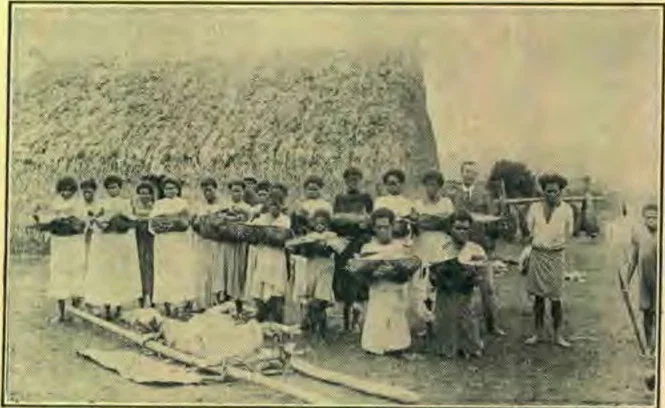
Bringing in the feast on the arrival of the missionary party. The meat dish is a baked or roasted calf. The baskets contain steamed and baked taro, yams, and sweet potatoes.
Food was brought to us in great abundance. It is always customary to have a feast to greet visitors. Sometimes a good deal of expense was incurred by their slaying the “fatted calf” and buying what they thought we might like. With this would be great quantities of vegetables and sometimes fruit. Then follow the customary speeches in presenting the food, and the replies from the visitors,—the first telling how little and poor the gift is, and the other telling how much and how good it is. After the food is prepared, it is brought in and laid on large, fresh leaves which are placed on a special mat laid on the floor. Fijians never use an elevated table, but sit Turkish fashion, with the food on the special mat spread on the ordinary floor mats, with which every Fijian house is covered. Many foreigners have difficulty to maintain this attitude long; but as ordinarily there are no tables and chairs in a Fijian home, one must accustom himself to sit so and to have both hands free; it seems the only way.
Generally speaking, the natives are clean in their habits, bathe frequently, and have ideas of cleanliness in respect to the preparation of food. Yet there are some things they do which severely try those long accustomed to better ways. It is bad Fijian etiquette to pass behind any one. In olden days such an offense was punishable by death. So the boys who wait upon the table must walk upon the mat upon which the food is spread. No forks are used in placing the food before one, so the hands are freely used by those preparing the meal and in handling the food.
The houses are rather dark inside, there being, as a rule, but few doors or windows. In the evening a single small kerosene lamp or lantern provides all the light furnished. With this it is quite impossible to distinguish the dark figures sitting here and there, gazing upon the visitor who has the light shining full on his body. Sometimes there is no kerosene in the home, and stores are often far away. The host may then go to his neighbors to borrow a little oil. If successful, he is likely to come back with the kerosene in the most unheard-of kind of oil receptacle. You look for a bottle or a tin or a cup, but he seems to have nothing. Then he takes the lamp or lantern, and ejects the great mouthful of kerosene he has borrowed, and it dawns upon you that the Fijian mouth is used as a combined suction pump and kerosene container.
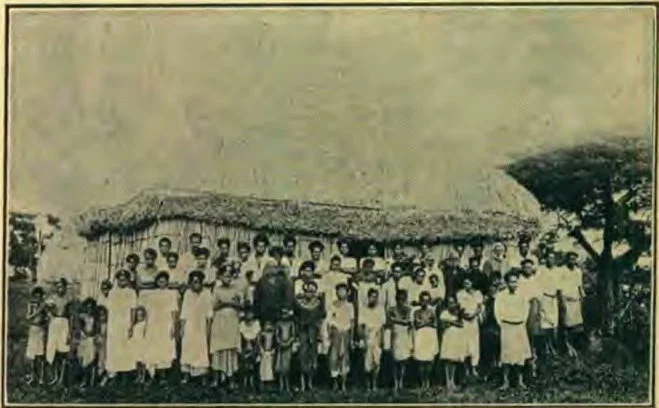
The village church and congregation at Nabutatau. These believers are descendants of cannibals. The town is a short distance from the spot where Mr. Baker, a Wesleyan missionary, was killed in 1867.
At a number of places, on arriving at the boat’s landing we were met by our brethren with singing. At one place an arbor was built down to the water’s edge, and under this we walked while the brethren sang. Then with singing they accompanied us to the house we were to occupy. It was very good of them, but the writer felt they made altogether too much of the occasion.
On our tour there were two or three sermons a day, besides baptisms and many visits, picture taking, and then at night, after all our work, and perhaps a long journey through the day; anxious questioners would perhaps keep us busy till midnight expounding Scripture. But all was interesting and thoroughly enjoyable.
On our trip we saw the descendants of those who took part in the killing of Mr. Baker, a Wesleyan missionary. We visited the town of Nabutatau, where this took place, and found nearly one hundred Sabbath keepers. The grandson of the old chief who was responsible for the death of Mr. Baker, is now the reigning chief and a fine man, a zealous Bible student, and an ardent advocate of the message. We also saw two old men who had part in that terrible cannibal feast. These men also are nominal Adventists. Many here who have recently accepted the Sabbath truth need much instruction, but wonderful opportunities are presented to teach them the full message.

My Hidden Task

E. F. COLLIER
Father, help me to do my part Before the night's dark shadows fall; Before the clouds, the storms, the tempest, Shall close thick doors about us all.
Father, I do not know the work Thou hast for me to do below; But when thou say'st, “Go, and hasten! Do this for me!” my God, I go.
Nothing care I if the vain world Ignore the station that I fill; If I may find God's way and purpose For me, it shall be pleasure still.
To act a quiet, lowly part, Though treated by the friends I love As Judas treated Christ,—this blessing Is more to me than thrones above.
And when I have fulfilled thy will, —No matter how, without a grudge, To go or stay—I am contented; To live or die — thou art my judge.
O God, to do for thee my part And do it right, is all I ask; Unloved, unsung, it shall be sweeter When done for thee—my hidden task.

An Interesting Trip

O. B. KUHN
We were to leave Changsha for the end of the railroad three hundred li to the east, on the morning train from Yoh Djou. We went to the station early, hoping to secure a seat; but as the train rolled in, still going at a good rate, three or four hundred soldiers dived, sprawled, and tumbled through the windows, and took all the seats and available room. Several score of passengers had to ride in open freight cars in the rain. A big soldier grudgingly gave up a corner of a seat to me at the request of the evangelist who accompanied me.
Along the road every farmhouse swarmed with soldiers who make the men and boys slave for them, and the women and girls wait upon them. The officers have possession of the railroad stations and use them for living quarters. Passengers not aware of this, seeking to leave the trains by the usual exits through the stations, are slapped, cuffed, and kicked by the corporal's guard stationed there. When a person is wise enough by observation to escape the trap, the corporal and his men seem disappointed and look wistfully after him.
As we neared a large military center, the passengers were scrutinized by officers who looked through the open windows. It was shaded where I was sitting, and as the weather was cold I had my coat collar turned up and my hat pulled down. My eyes and a strip of face were all that could be seen. Three officers looked at me and asked each other whether or not I was a Chinese. From the depths of my collar I jokingly replied that I was a Hunanese by adoption and was on my way to Yuen Djou Fu in Kiang-si. The officers said to each other that my kou-yin (mouth word) was not shih-fen dui-liao, meaning that my speech was not ten parts correct. Looking more closely at me, they laughingly said that I was an Englishman. We conversed pleasantly for a few minutes and then they passed on.
Arriving at the end of the line in the evening we stayed overnight at a Chinese inn. The horses in my father's barn had a cleaner, brighter, and warmer place to stay in than that inn, but we were thankful even for that place of protection from the wintry, rainy weather without.
Early the next morning we started on a two days' journey up the valley to Yuen Djou Fu. Our baggage had been weighed, and the contract made with the chair carriers and baggage carriers, the innkeeper acting as middleman. We advanced half the money and received the innkeeper's receipt. We instructed the men to carry my chair first, then the baggage, and last the evangelist's chair. This arrangement was for the protection of the baggage, and for my convenience should any trouble arise with the men, who think that foreign missionaries roll in wealth, and always try to force them to pay more money. The evangelist being in the rear would be in easy reach to help handle the situation.
The men hurriedly maneuvered and put the evangelist ahead and me last. My men walked slowly, and when I asked them to keep up with the others they replied that I was heavier than the evangelist, which is not the truth. After going a li or two, while still in the city, the two carriers set the chair down in the middle of the street, and telling me that they would not carry me farther, deserted both me and the chair. I called a soldier and told him that I had a passport from the governor-general, and explained the case. He sent for the innkeeper and got hold of the two chair carriers. The innkeeper sent for the president of the business men's association, and the carriers called the secretary of the labor union. After discussing the matter I was told that the hotel runner had deceived the men as to the actual weight of the baggage, and that he had withheld a larger commission from them than was allowed. The judgment in the case was that the runner should give up the money in excess of the regular commission, and that I should hire another man to help with the baggage. Also as we had already paid half the money in advance, thus binding the first contract, that the innkeeper should pay one third of the hire of the additional baggage carrier. The court trial was held in the middle of the street with a crowd of spectators. It was immensely amusing to me. After all was settled, we bowed gracefully all around, and with many apologies from every one we separated. In the meanwhile the evangelist had stopped on the bridge after passing through the city gate, wondering where I was all the time. He returned to the place of the trial in time to hear the arguments and receive the judgment.
As this is the rainy season, the roads were in very bad condition. In many places the mud and water was halfway up to the carriers' knees. The second day we had to leave the chairs and walk long distances at a stretch, as the men could not get through the mud with our weight. At times they could hardly pull their feet out to make another step.
Along the way we bought delicious mandarin oranges for three coppers a gin. On that road it required one hundred thirty-seven coppers to make a silver dollar. At the present rate of exchange a Chinese silver dollar is worth about eighty-eight cents American money. A gin weighs about a pound and a third. Thirteen coppers purchased ten large, fresh hen eggs. We paid two coppers a bowl for good boiled rice. This section produces white, yellow, and pink rice. The pink rice is very pretty. It all tastes about the same regardless of color. The Chinese eat the unpolished rice which is more tasty and more wholesome than the fine grade of rice purchased in American stores. A good meal of rice, vegetables, eggs, and oranges cost us from six to ten coppers. Our room at the inns at night cost five coppers for each person. Should one be without his own bedding, he may hire quilts for five coppers each. At one place it cost twelve coppers for each meal and no charge for the room.
These inns are one-storied, and have tamped earthen floors. The walls are of mud and straw brick. One is very fortunate if he gets a room with a window. In most places the only light from the sun comes through a piece of glass in the roof, about five by ten inches in size. There are from four to a dozen beds in a room according to the size of the room. The light and air are insufficient, to state it mildly. Little tin cups of oil with a cotton wick are the only lamps furnished. These cost a copper each for one filling of oil, which is enough to burn an hour or two. These produce more smoke than light, but they are better than nothing. The beds are nothing but boards with woven rice straw upon them. These straw mats are usually inhabited. It is well for one to pack a folding cot. Some persons carry oiled paper or cloth with a strong odor which is first placed upon the beds.
The Chinese get their most commonly used cooking oil from a fruit nut. This oil is called cha-yu. The pulp that remains after the oil has been forced out is mixed with straw and pressed into cakes about one inch thick and fourteen inches in diameter. These cakes are used for fuel and make a fairly good fire. After it is thoroughly lighted it stops smoking, and the glowing coals remain for hours. If these coals are covered with ashes they will throw off a gentle heat sufficient to keep one's hands or feet warm. If left uncovered, there is much heat. These coals are carried around in bamboo baskets of various sizes with a clay vessel inside. This fuel is superior to charcoal and does not throw off such poisonous gas. We bought these cakes at from two to four coppers each. One place we paid six coppers. One cake would keep our basket stoves going all day, and one would heat up our room in the evening, and dry our clothes wet with the rain.
Yuen Djou Fu proved to be a very interesting city, and one of the most beautifully located places that I have seen. On all sides there are hundreds of hills of a great variety of shapes, sizes, positions, and appearances. There are many kinds of large evergreen trees. The palms and vines are especially pretty. Nearly every family has an orange grove. A gently flowing stream of clear water, bridged by a seven-arched structure entirely of stone, divides the city. The banks of the river are walled up like ancient Babylon. The city walls inclose an area about four li wide and five li long. The walls are in good condition, and possess a grandeur of appearance above any other that I have seen. In many places pretty evergreen vines hang over the tops and run down halfway to the ground. The walls are twenty to thirty feet high and are surrounded by a moat. As we viewed the beautiful sight from a hill in the center of the city, I was reminded of the West Indies and of Washington Irving's description of ancient Spain.
The present city was built about six hundred years ago in the Ming dynasty by a famous general named Dju, who was at that time governor-general of Kiang-si Province. Some time before this the western part of Kiang-si had been captured by the Hunanese. General Dju conceived a great hatred for the Hunanese, and determined to recover the lost territory. With a large army he invaded Hunan Province, and it is said that he killed every man, woman, and child. Later the province was repopulated by persons from Kiang-si whom the general sent. However wicked the general may have been, he chose a beautiful place for his capital and built a grand city.
As Yuen Djou Fu is situated far away from the large commercial centers and more modern cities, and is not easy of access, it has not been appreciably influenced by modern civilization. The people still adhere to the ancient customs and time-honored practices of the Chinese. The people are artistic, refined, and courteous. It seems that I had made a trip to the ancient, flowery kingdom of the Hans.
Here we accidentally met the leaders and believers of the Higher Doctrine Society. This people, numbering about fifteen thousand, are descendants of Chinese who in the early centuries received the Scriptures from missionaries from Palestine passing through India. Believers of this faith do not worship idols. Through the centuries they have been persecuted by idolaters who have tried to force them to worship graven images of wood and stone, but they have faithfully held out against idolatry. Their property has been confiscated, their sacred writings burned, and they have suffered death at times, only a few escaping with their lives.
The members of this society believe we are living in the last days and that the Creator is soon coming. They said that the Creator gave man six commandments. The first is that man shall worship the Creator and shall not worship idols, and that he shall keep the Creator's worship day. The other five commandments correspond to the last five of the decalogue. The Chinese do not have a weekly cycle; but twice a month, according to the moon, these persons cease work and assemble for worship. We were walking along the street one day and noticed a sign hung on the closed door of a large store. The sign read, “Cin-tien Li-bai,” meaning, today is worship day. Upon inquiry we found their place of meeting, and became acquainted with an interesting people who still preserve some precious truths. Their second commandment, which is against killing, they observe very literally. They do not eat meat, not even chicken or fish, for this would be taking life. We hope that our Chinese workers at Yuen Djou Fu, consisting of an evangelist and his wife and a common Bible worker, may lead the honest ones into the full light of truth.
At this city we baptized sixteen persons and organized a church. The ages of the candidates ranged from seventeen to seventy-one. One man was seventy-one and his wife sixty-three. Another man was sixty-eight and his wife sixty-two. These persons were baptized on Sabbath, Dec. 21, 1918. The water in the river was very cold, but these old people did not show signs of discomfort or dread. Later I overheard some women asking these aged sisters whether or not they were cold in the water and if they feared to enter. They replied that they were not cold, and had no fear because God “bao-hu liao,” meaning that God protected them. From this place two young men accompanied us on the return trip. They were on their way to our school at Hankow, to prepare for the Lord's service.
The next morning we left Yuen Djou Fu in a hard rainstorm, which soon turned into snow. The wind blew with such force that the chair carriers made only forty li up to four o'clock in the afternoon. As it was necessary to cover at least fifty li the first day in order to make the end of the railroad in three days, allowing them an extra day because of the bad roads and weather, we urged the men to travel another ten li before dark. It was only after promising them more money that they again started out.
The second morning snow covered the trees and the roofs of the houses. It was bitterly cold, a strong northwest wind blowing up the valley. The evangelist's feet were so numb that he did not know that the hot coals at his feet had burned through his heavy shoes and blistered the skin. The baggage men at the rear called his attention to the odor from the burning shoes. Fortunately the burn was not severe. Walking to keep warm was out of the question because of the depth of the mud and water.
On the afternoon of the third day we arrived at Ping-hsiang at the end of the railroad. We purchased tickets the next morning, the evangelist and I going to our station at Li-ling ninety li distant, and the students going on to Changsha where they were to take ship for Hankow. Our tickets to Li-ling, third class, cost us thirty cents, and the students' tickets cost one dollar thirty-five cents each. The distance to Changsha is about three hundred li. It requires three li to make a mile, so you see traveling in China is not expensive. Only third-class cars are running on this line, because the soldiers recognize no distinctions, so the second-class and first-class cars have been taken off.
We arrived at Li-ling, still in the storm, the hills in the distance looking very pretty in their covering of white. We were indeed glad to find ourselves inside our chapel, protected from the storm after our hard journey, and to meet again with the little company here whom we baptized a year and a half ago. They, with the other inhabitants, have suffered much from the soldiers the past year, and tell many interesting stories of their narrow escapes from death. Although all have lost their homes by loot and fire, they are still happy in the Lord and rejoice in his love and care. We shall remain here a few days and then visit other stations.

The Call of Spring

O TREES, you look so pale and gaunt, Your slumber robes thrown down; For it is time for you to want To don your new green gown! You've stretched your long arms toward the sky The cold bleak winter through, As though you would all things defy That worked their will with you.
With leaden skies now overcast You look so sad and bare; Surrounded by a dreary, vast, Bleak outlook everywhere. We long to see a tiny leaf Upon your boughs unfold; To know that springtime, sweet and brief, Returns, as knights of old,
To take away your cold, white robe For lovely dress of green, And clothe once more the rolling globe For springtime's brightest scene. Dear trees, we wait until the birds Shall call you to awake; All nature at their song is stirred King Winter to forsake.
MRS. J. L. VAUGHAN.

Prayer was Answered

THE six-year-old daughter of an attorney has been taught from infancy to have implicit faith in prayer. So strongly has this been impressed on her mind that practically all her desires and childish wishes sooner or later find expression in the prayerful appeal.
The child is a motor enthusiast, and on the first warm day after the severe winter weather she asked her father to take her out for a ride. He explained that their machine was put away for the winter, and that it could not be used at that time. The child then sought her mother, and asked her to pray for somebody to come around and take them out for a ride. The mother tried to explain that such a prayer would be unavailing, but, undaunted in her firm belief, the child went to her room and prayed that she might have an automobile ride. An hour or so passed, and the little girl waited expectantly and anxiously for the car to arrive.
The shriek of an automobile horn was heard outside. The child rushed to the door, and to the amazement of the mother, a neighbor asked the girl whether she desired to take a ride.
“Will you have room for mother, too?” the girl asked.
“No, we have room for just one little girl,” replied the man at the wheel.
The child hurriedly put on her coat and cap, and as she left the doorway she turned to her mother and said:
“See, mother, if you had prayed with me, you could have gone, too.”—Selected.

Where the Waters Blend Their Music

FAR in the mystery of a wood A springing fountain flows, Born with a will to endless good From God's untainted snows. There thirsting creatures come to drink; There stars reflected shine; And the waters blend their music With the singing of the pine.
The peace of God is on the hills, His healing in the stream, And beauty that old forest fills As pure as childhood's dream. There's cleansing from the dusty way, There's rest and strength divine, Where the waters blend their music With the singing of the pine.
That happy stream in forest old, How blest its waters are Their joyful course unstained to hold, Reflecting sun and star! May God the Father keep as pure And glad this life of mine As the stream that blends its music With the singing of the pine.
EUGENE ROWELL.

Character Building

DURING the Revolutionary War, Richard Jackson was accused of the intention to join the British Army, and admitted the truth of the charge. He was sent to the rude county jail, from which he could have escaped easily; but he considered himself held by due process of law, and his sense of duty forbade flight under such circumstances. He asked leave of the sheriff to go out and work by day, promising to return each night. Consent was readily given, as his character for simple honesty was well known. And for eight months he went out each morning and returned at evening.
At length, the sheriff prepared to take him to Springfield to be tried for high treason. Jackson said this would be needless trouble and expense, for he could go just as well alone. Again his word was taken, and he set off alone. On the way, he was overtaken by Mr. Edwards of the council of Massachusetts, who asked where he was going. “To Springfield, sir,” was the reply, “to be tried for my life.”
The proof was against him, and Jackson was condemned to death. When the president of the council asked if a pardon should be granted, member after member opposed, until Edwards told of his meeting with Jackson. By common consent, a pardon was at once made out. The childlike simplicity and integrity of the man had saved his life. Character is power.
“A noble, all-round character is not inherited. It does not come to us by accident. A noble character is earned by individual effort through the merits and grace of Christ. God gives the talents, the powers of the mind; we form the character. It is formed by hard, stern battles with self. Conflict after conflict must be waged against hereditary tendencies. We shall have to criticize ourselves closely, and allow not one unfavorable trait to remain uncorrected.
“Let no one say, I cannot remedy my defects of character. If you come to this decision, you will certainly fail of obtaining everlasting life. The impossibility lies in your own will. If you will not, then you cannot overcome. . . . Remember that you will never reach a higher standard than you yourself set. . . . Do not disappoint Him who so loved you that he gave his own life to cancel your sins. He says, ‘Without me ye can do nothing.’ . . .
“A character formed according to the divine likeness is the only treasure that we can take from this world to the next.” How important, then, is the work given us to do! MILDRED BOYNTON.

Wastebasket It

THE useful things in this world are the working things. If your day isn't clear and clean, if details clutter it, concentrate for a brief period. One by one decide on the essentials and get them into their proper places. But just the minute you reach a useless detail that you can find no place for — wastebasket it.
Either do the thing that faces you — or wastebasket it.
Wastebaskets were invented to take care of the useless. Learn to look a duty or proposition or written problem squarely in the face, and decide its relative value immediately. If it is worth while, care for it without fuss or fume; if it looks useless, do not tabulate or file it away — wastebasket it.
Either do the thing that faces you — or wastebasket it.
If you have a mind that is free from the consideration of “unfinished business,” you have a mind powerful and quick working — a veritable fortress, back of which you may safely go and lodge, assured that there you will find ammunition sufficient to win the fiercest battle. So, mind this, that you —
Either do the thing that faces you — or wastebasket it.—“Take It.”

A Book for You to Read

SOME time ago I recommended to you one of John Muir’s charming books, “The Story of My Boyhood and Youth,” and now I have for you another, equally excellent, “My First Summer in the Sierras.” It is full of the freshness of clear mountain weather and breathes gladness and cheer on every page. The master lover of California’s mountains tells, as only he can, of glorious days spent on a journey with a flock of sheep to the head waters of the Merced and Tuolumne Rivers. The trees and wild animals are vividly described, the majestic music of the waterfalls is interpreted for you, the peace of all outdoors is brought to your soul. Watch with Mr. Muir the daybreaks and sunrises, climb the rugged steeps, and pluck the flowers in wild mountain meadows.
EDMUND C. JAEGER.

Russia’s New Treasure Port

THE Murman Coast has come into prominence of late, more particularly because of the fact that thousands of American soldiers have been and are likely to remain in that remote region for some time to come — at least until Bolshevism is eradicated from Russia, and order has been restored in that chaos-stricken land. The Murman Coast is situated in Russian Lapland, far in the arctic and east of northern Norway.
The strange thing about this coast is that Russia has been scheming and fighting for three hundred years to get an ocean port which was free from ice the year round, and all that time she had it and did not know it — at Murmansk.
The port of Murmansk is situated upon the bay of Kola, which is free from ice, although it is far in the arctic. It is the northern terminus of the Petrograd-Murmansk Railroad which the Allies recently completed as a war measure, but which, after peace is declared, will be one of the busiest and most prosperous lines of road in the world. The shipping already is beginning to crowd the harbor. Laborers are working day and night building more docks.
The region is rich in copper and iron ore, while the bay and the waters in the vicinity are fairly alive with herring. Murmansk will soon be one of the world’s great ports, and will export more herring than any other city. Already England and her allies have laid out a great town there; and a weekly newspaper, printed in Russian, English, and French, a club house, and a moving picture theater help to make the long nights livable.— A. L. Trude.

Brighten the Corner Where You Are

“Do not wait until some deed of greatness you may do, Do not wait to shed your light afar; To the many duties ever near you now be true, Brighten the corner where you are.”

On How Readers Shape a Book's Meaning

“A BOOK, though mainly as the writer makes it, Is also largely as the reader takes it.”
Continue reading: The Beauty of Truthfulness