The Youth’s Instructor, Vol. 67, No. 14.

Brief News Items From Around the World
Earlier text: Summary of the Missionary Volunteer Work in North America for Quarter Ending September 30, 1918

Young People's Lesson

[For some time there has been a call for lessons for our young people. In response to this call the General Conference Sabbath School Department has provided a set of lessons which we feel assured our young people will greatly enjoy. It has been remarked that these lessons are more difficult than the senior lessons; but this will only challenge our young people to earnest study. We trust the Sabbath schools will quickly readjust their organization, so that these lessons will be used by all schools.]

III — Conversion (Faith)

(April 19)
GOLDEN TEXT: From the following, choose and memorize the one you like best: Rom. 4: 20, 21; 1 Peter 1: 5; 2 Peter 1: 4; Isa. 26: 3.
STUDY HELPS: “Steps to Christ,” chapters “Consecration” and “Faith and Acceptance.”

Questions

1. Besides repentance toward God, what else is necessary in true conversion? Acts 20: 21.
2. How does Paul define faith? Heb. 11: 1. Note .
3. Can the “substance” of faith be seen? How? James 2: 14-17; Gal. 5: 6.
4. If we have saving faith in Christ, what will be our relation to God’s law? Rom. 3: 31; 2 Cor. 3: 3. Note .
5. What relationship will true faith establish between us and Christ? Col. 1: 27.
6. How will true faith lead us to regard God’s promises? Rom. 4: 20, 21.
7. How will true faith enable us to deal with those who may wrong us? Luke 16: 3-5. Note .
8. What effect will faith have on our talents? Matt. 25: 28, 29.
9. How will faith affect our prayers? Luke 17: 5.
10. What is the relation of justification and faith? Rom. 5: 1, first part.
11. What experience does justification by faith bring? Rom. 5: 1, last part.
12. In what condition will faith keep the believer? Isa. 26: 3.
13. What other experience does faith give? 1 Peter 1: 5.
14. What precious relation is thus established between the human and the divine nature? 2 Peter 1: 4.
15. What will faith enable us to do for the unconverted? 2 Tim. 2: 24, 25.
16. What will be the final fruit of faith? Col. 1: 28.
17. At what time will faith be most needed? Luke 18: 8; Heb. 10: 37, 38.
18. How may such wonderful faith be obtained? Rom. 10: 17.
19. What will be a leading characteristic of the remnant church? Rev. 14: 12.

Questions for Students Who Think

Have you taken all the steps in conversion?
Are you enjoying all the fruit of conversion?
Now, “the just shall live by faith.”

Notes

III — Saul Chosen King

(April 19)
LESSON SCRIPTURE: 1 Sam. 9: 25-27; 10: 11.
MEMORY VERSE: “Turn not aside from following the Lord, but serve the Lord with all your heart.” 1 Sam. 12: 20.
STUDY HELPS: “Patriarchs and Prophets,” pp. 610-615; “Bible Lessons,” McKibbin, Book Two, pp. 55, 56.
“Were I so tall to reach the pole Or grasp the heavens with a span, I must be measured by my soul; The mind’s the standard of the man.”
—Isaac Watts, written when a boy.

Questions

1. After the feast, when Samuel entertained Saul, where did they go for further conversation? 1 Sam. 9: 25.
2. What did Samuel do early the next morning? As they were coming to the outskirts of Ramah, what request did Samuel make? Verses 26, 27.
3. When the servant had passed on, what ceremony did Samuel perform? 1 Sam. 10: 1.
4. What three signs did Samuel give to strengthen Saul’s faith? Verses 2-5.
5. What change was to take place in Saul himself? Of what might he feel sure when these things should come to pass? Verses 6, 7.
6. What instruction did the Lord give Saul concerning where he should go and what he should do? How soon were the signs fulfilled? Verses 8, 9.
7. When Saul met the company of prophets, what came upon him? What did the people say? Verses 10-13.
8. To what place did Saul evidently return? Of what did he not speak? Verses 14-16.
9. To what place did Samuel call the people to assemble? What was the purpose of the meeting? Verses 17-19.
10. How was the choice of a king made public? When Saul was brought before them, what did the people shout? Verses 20-24.
11. What did Samuel then tell the people? Where did he send them? Where did Saul go? What did the children of Belial say? What did Saul wisely do? Verses 25-27.
12. What trouble came to the Israelites living in Jabesh-gilead? What request did they make of the king of the Ammonites? 1 Sam. 11: 1-3.
13. To whom were messengers sent? What came upon Saul? How did Saul secure the help of the people? Verses 4-7.
14. How large an army did Saul gather? What word did he send to the men of Jabesh-gilead? Verses 8-10.
15. How did Saul arrange his army? What was the result of the battle with the Ammonites? Verse 11.
16. After the battle, what did the people say to Samuel? What was Saul’s decision? How was Saul’s right to reign as king now fully confirmed? Verses 12-15.

A Map Exercise

Draw a map of the land of Canaan showing the Sea of Galilee, the river Jordan, and the Dead Sea.
Locate Jerusalem with Ramah and Gibeah a few miles north.
Locate the tribe of Gad on the east side of the river and Jabesh-gilead halfway between the river Jabbok and the Sea of Galilee.
Write the word “Ammonites” eastward on the map, bordering the desert.

Notes

Birds

THEY wake in the midst of the rain, and sing, But not a note of sorrowing. Dark though the east as ruled by Night, They feel the coming light.
The very breath of springtime stirs In these exultant choristers Who, knowing naught of hate or wrong, Fill the sad world with song.
Far from the sound of shot and shell That change earth’s Eden to a hell, Remote from war’s red sacrifice, They make a paradise!
O beauty! good without alloy! While there are birds, there will be joy, Joy that shall lift the heart above, Where pain is lost in love!
— Florence Earle Coates.

Reconstructing France

THIS is not a child's task. Fifteen thousand square miles lie in ruins, where once were populous villages, towns, and cities. There were on an average twenty-two bridges to every ten miles, and mines and canals and railroads filled the country. These all were made the target of the enemy's ruthless work. To gain some idea of the vastness of the reconstruction work, we are bidden to “imagine the great grape-producing country of California, the textile mills of New England, the steel works of Pennsylvania, the coal mines of West Virginia, and the iron fields of Minnesota, the commerce of New York, the chemical works of Delaware, and the farm lands of Wisconsin dumped into this little strip. Imagine, too, that mixed in with this are more miles of navigable canals than in the whole United States. Imagine everything within this radius dynamited and burned! Now you have a picture of the job before us in the reconstructing of northern France.
“Two great armies might rage and tear over a territory of fifteen thousand square miles in any one of a number of our States, and then present a problem of reconstruction that would be comparatively simple. But in northern France, where the towns and cities lie within five or ten miles of one another, where villages are only two or three miles apart, where agriculture, industry, and commerce blend together in a single township, war has developed desperate complications.
“The French transportation system was left by the enemy in an indescribable state. To reconstruct it will cost about $2,500,000,000, according to a British estimate, and will require the work of from two hundred to two hundred fifty thousand men for more than two years; that is, if the canals, rivers, highways, and railroads are to be rebuilt according to European standards. Our engineers, however, claimed that that is a European figure, based on the cost of European labor—and is too conservative. About twice that would be their guess.
“Building a right of way through this desolate waste is a considerable job in itself, even in peace times.
“If there is one thing northern France is rich in it is No Man's Land. There are more than four thousand square miles which at some time or another comprised this shell-racked area of ghastly and twisted ruins, where forests have been blasted to splinters, where towns and villages are burned piles of crumbling stone and brick, and where the ground itself has been churned by a gigantic dump of scrap, disease, and bombs.
“How many thousand unexploded shells, grenades, and aerial bombs are buried in a square mile of No Man's Land no one is prepared to say. How many mines, containing hundreds and thousands of pounds of high explosives each and ready to go off through accidental contact, await those who reclaim in No Man's Land, no one knows. Without having even a slight idea of their total, I am prepared to say that it is no paradise for the pick slinger.
“Pulling barbed wire is another part of reclaiming No Man's Land that I have never classed as a pastime. There are over fifty thousand miles of barbed-wire entanglements strung through the heart of northern France today, and attached to this wire are some thousands or hundreds of thousands of individual mines designed to discourage our barbed-wire cutters and night raiders. Those mines are still very much alive, and make the work of cleaning up barbed wire extremely dangerous. Scores of our men have been maimed or killed by these mines.
“Now that we are no longer harassed by the enemy, we are able to employ safety devices for this work, such as using grappling irons attached to long ropes. But even this has not entirely removed the element of danger, as giant underground mine systems have been set off by the explosions of the barbed-wire mines.
“It is almost impossible to realize the tremendous amount of explosives, especially dynamite, that is used by these wreckers in their reconstruction work.
“I venture the estimate that for purposes of clearing the way for canals, highways, and railways the United States Army is using over a thousand tons of dynamite a day, and if we undertake to reconstruct northern France in a big way it will require close to ten times that amount.”

Work of the Last Congress

THE Sixty-fifth Congress, which came to an end through Constitutional limitation on March 4, was the only Congress in the history of our country which made two declarations of war. It also—
“Passed greatest tax law in parliamentary history, levying $10,000,000,000 in taxes in two years.
“Authorized issuance of $22,000,000,000 in bonds, the greatest bond issues attempted by any nation.
“Passed army appropriation bill of approximately $12,000,000,000, the largest appropriation bill ever passed by any country.
“Passed selective service law and raised by draft greatest American army.
“Was addressed by President Wilson nine times, more than any other Congress.
“Authorized expenditure of $2,884,000,000 to create an American merchant marine, to be the greatest in the world.
“Appropriated $100,000,000 for housing war workers.
“Made appropriations creating an American air service and authorized airplane mail service.
“Authorized Government control of railroads and communication agencies.
“Created Federal control of food and fuel.
“Created War Finance Corporation to aid war industries.
“Appropriated approximately $57,000,000,000.
“Passed almost 300 public laws.
“Enacted 48 public resolutions.
“Conducted twenty-six Congressional investigations.”

An Explanation

A POEM, “The Best That I Can,” is referred to in the April Gazette as appearing in this issue of the INSTRUCTOR. By mistake it was printed in the INSTRUCTOR of March 11, page seven.

Do Good With That Thou Hast

Do good with that thou hast, or it will do thee no good.— William Penn.
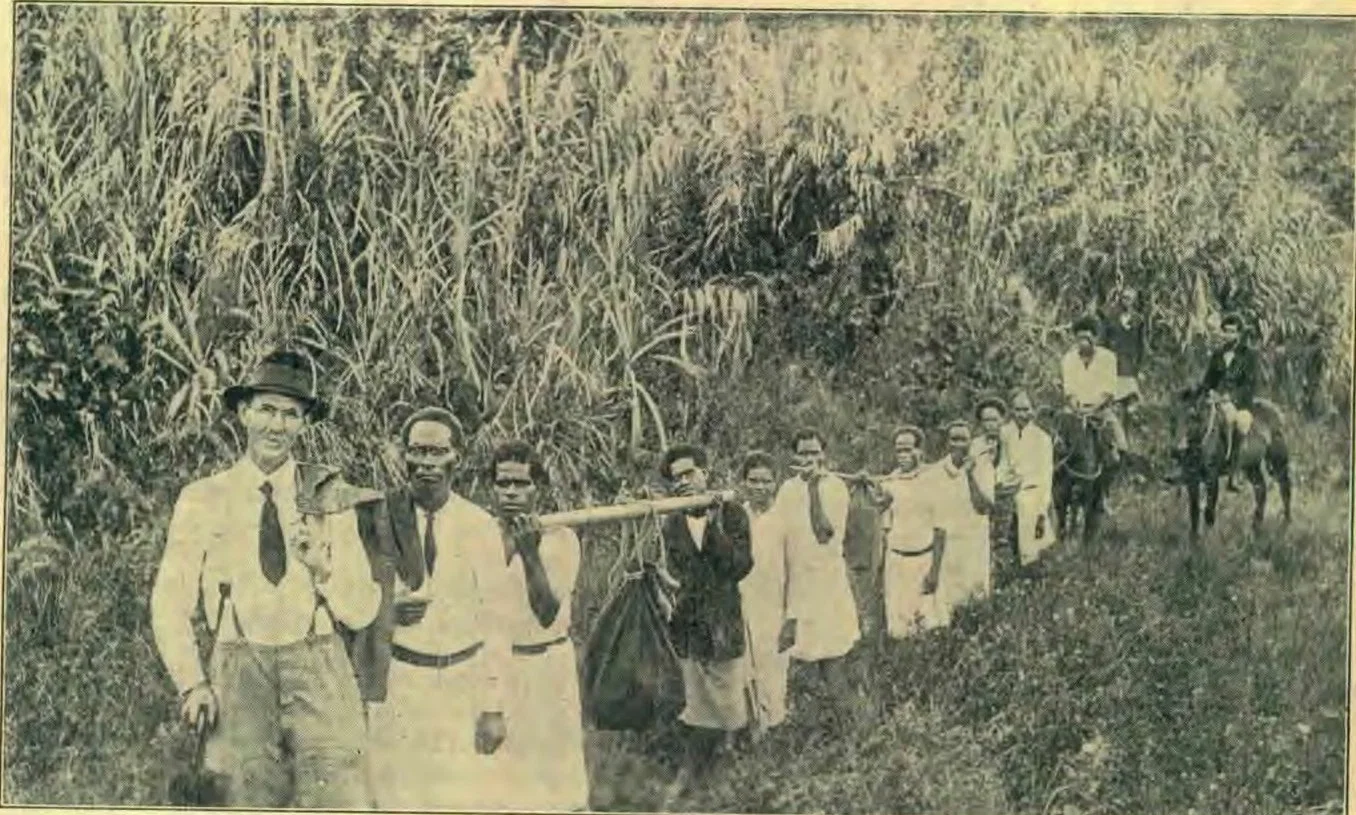
Touring in the Fiji. Pastor Parker in Foreground, Pastor Fulton Taking Photograph.
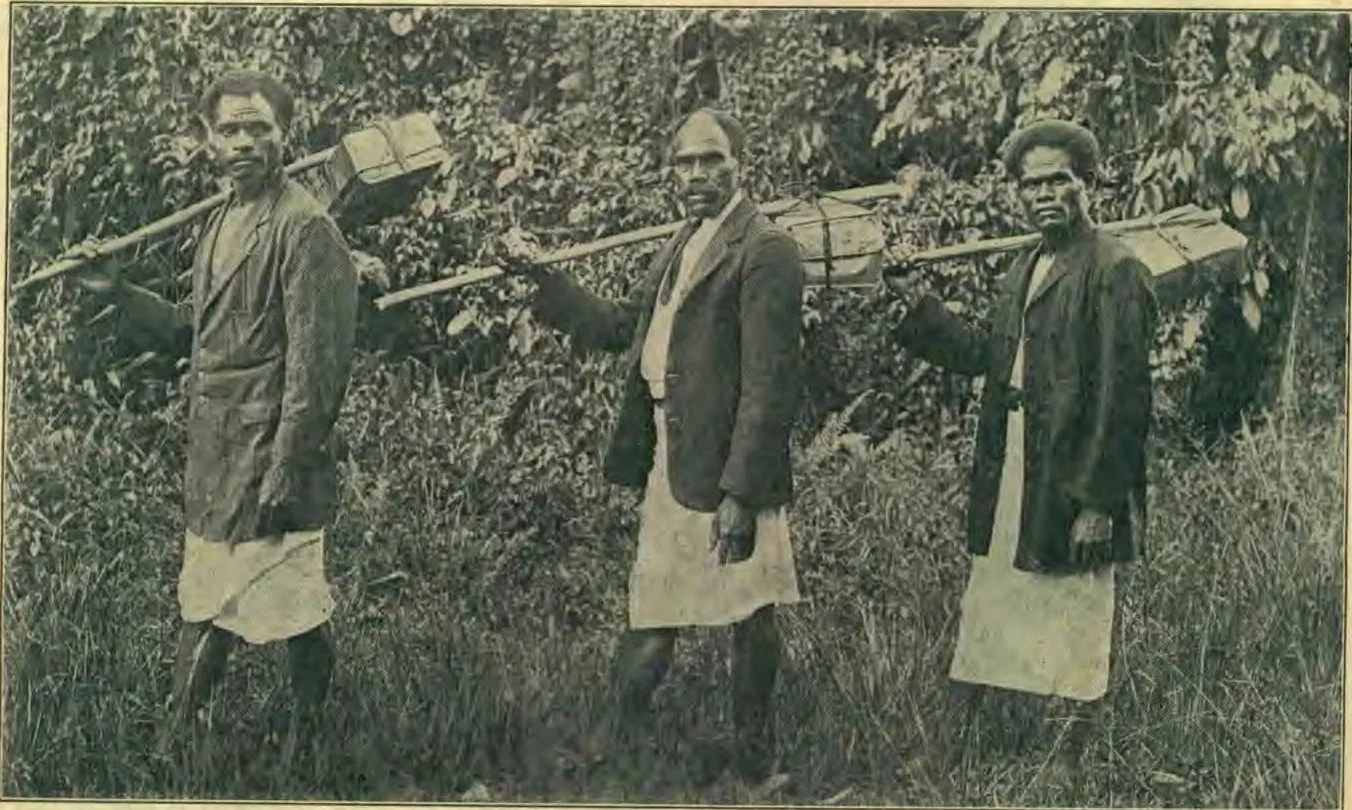
Three of our native evangelists ready for a preaching tour. Their “suit cases” are made of kerosene tins, in which they carry their Bible, hymn book, a clean clothing outfit, comb, and towel. Thus equipped they can travel among the villages for several weeks.

You have reached the end of this edition.

The Youth’s Instructor · Apr 8, 1919