REVIEW QUESTIONS.— Without turning to back lessons, supply proof texts to the following questions:—
1. How long a time was occupied in the round of service in the earthly sanctuary?
2. In which apartment did it begin?
3. In which apartment and on what day did it close?
4. What was the service on that day called?
5. From what was the sanctuary cleansed?
6. In what did this service consist?
7. What was the nature of the work? (See note .)
SUGGESTIONS FOR STUDY.— We will begin directly with the questions this time, noticing as we proceed the following points: 1. The review questions lead us to consider the great day of atonement. 2. The first eight questions of the advance lesson are designed to show that the day of atonement is a type of the judgment; also to show the nature of the judgment, and the means for carrying it on. 3. The remaining questions treat of the blotting out of the sins of God's people, and of Satan's bearing them to the land not inhabited. 4. Notice how clearly the types of the Lord's goat and the scapegoat are fulfilled in the work of Christ and the experience of Satan.
1. WHAT is necessary in cleansing the heavenly temple? Heb. 9: 11, 12, 23.
2. From what must it be cleansed? (See note .)
3. Considering the type, what must be the nature of this work?
20. What resurrection is this called? Rev. 20: 4-6.
21. What is done with Satan at that time? Verses 1-3. (See note .)
UNSISTERLY WORDS.
“Let the words of my mouth, and the meditation of my heart, be acceptable in thy sight, O Lord, my strength and my redeemer.” This was the prayer of the sweet singer, David. Do you not think it is a good prayer for us all? It reminds me of what James the apostle says in the New Testament: “Let every man be swift to hear, slow to speak, slow to wrath.” You know Jesus is our example, and it is said of him: “All . . . wondered at the gracious words which proceeded out of his mouth.”
A hasty word or an unkind act may be the work of a moment, but all future time can never undo it; but who can tell the value of a kind word? It is so easily spoken, and may never be forgotten.
Dear children, be careful. If brother or sister or playmate does not please you in all things, do not speak cross or angry words. And if you find an evil temper in your heart, do not speak or cry, but silently pray to Jesus to take it all away.
Two little sisters who were very fond of each other, and generally quite happy together, were playing “keep house and go visiting.” The elder sister was the housekeeper, and she bustled merrily about, spreading the table and arranging her little tea-set upon it, meanwhile chatting with little Anna, who, for the time, was “a very fine lady from the city.”
Just as the preparations were completed, and she was about to summon her guest to the miniature repast, Anna quietly climbed into a large easy chair, and rocking slowly back and forth, she said:—
“I don’t want to play any more.”
Not noticing the sudden pallor of the sweet little face, the sister angrily retorted:—
“I’ll never play with you again as long as I live!”
And she never did. She went to her little bed alone that night, and lay with a heavy, aching heart, longing for the morning to come, that she might put her arms around her little sister’s neck, and tell her she was sorry. The morning came, but Anna was dangerously ill. Her parents had watched over her through the weary night, and were alarmed for her safety. The sister was allowed just to see her, but she must not speak. The poor child grew worse and worse, and in a few days she died.
The last words she ever heard from that loving but petulant sister, was that bitter, angry sentence. O, how she wished she could call back those words, or that she might at least have said, “I’m sorry,” and receive one forgiving kiss. But no such opportunity was given her; and through all the many years since little Anna died, she has carried the “sorry” in her heart. And many times when angry thoughts and feelings have risen within her, the remembrance of that last sad speech has helped her to keep back the angry words which crowded themselves on her tongue.— Selected.
THE MISSION OF A PINE-TREE.
By Philip E. Howard
Long years ago I was a little seed, dwelling just on the edge of a granite cliff, high up on the mountain. My brother and sister seedlings had, not cared to choose such a high, wind-swept place; and they all laughed a little at me because I was so foolish as to love the rugged cliff more than the gentle slope of the mountain-side.
“Oho!” they cried. “What a place for a pine-tree to grow! Whew! how the winds from the gorges will hurry and roar out there! Let him go, if he wishes. We are not such fools.” And down they sank into the soft loam, and among the flowering undergrowth.
I was sorry that they thought me foolish; but I said good-by, and the very next breeze that came my way kindly bore me out to my dwelling-place. That is how I came to be there.
When I had grown to be quite a tall tree, and could look far down the valley and over the blue hills, a party of men came stumbling up the mountain one day, bearing on their shoulders keen axes and heavy chains. I heard them talking of a new town in the valley, of houses that must be built; and best of all, they spoke of a church which was to stand in that village. O, how I longed to be a part of that building, if I must be taken away from my mountain dwelling! But the men passed me by; and I heard them shout for joy when they saw what fine trees my brothers and sisters were.
Said one strong-faced, earnest man, “All this clump shall go into the church building. They are nearest heaven.”
“Shall we not take that big one yonder on the cliff?” asked another.
“No,” answered the first; “he stands where we could not work with safety.”
Weeks and months passed by, and down in the valley the little church grew very fast. Finally I saw the men shape a beautiful pulpit from the willing body of my fairest brother, and then I could not keep from groaning aloud.
“AN’ WATERED THEM RIGHT SMART.”
Before my brothers and sisters had gone away to be of the house of God, I had taken keen delight in breasting the mighty storms which seemed to shake my very roots, and yet never could tear them away from the rock beneath. In the misty nights, when the owl would croon and shiver in my arms, I loved to pillow my head on the soft, white down of the fog-bank, and sleep until the mischievous morning breezes snatched my pillow away. Then I thought that some day I might have a noble mission in the great world. But what could I do now? To be sure, I had sheltered a wandering man from a smothering slide of snow one night, and I had cast a cooling shade upon many a tiny flower in the summer weather. But all this was not like being a part of the house of the Father whose loving hand had made me a straight tree, in spite of the winter storms.
It was wrong, my children, to question his tender care, and to wonder that he had not taken me to be built into his house. I know the reason now.
One morning I saw the lake in the valley all white with leaping waves, and I felt the ground beneath me shake within the very grasp of my roots. Wildly I battled with the storm-clouds as they surged around me, and yet more fiercely the relentless wind tugged and strained at my branches. Suddenly, with a great cry, I fell headlong over the cliff; and then I knew no more for a long time.
When I awoke, rough men were working over me with saws and axes; and before that day was over, I had learned that I was to be sent to a distant city, but for what purpose I did not know. It was moonlight when I was hurried along past the still, white church, and out over the rough roads on my journey. O, could it be that the good Father knew what I was suffering?
All night I was borne through forests and over the sleeping hills until the sun began to climb up through the haze overhanging the city, which I could see was just beyond us. O how different it was from the glorious mornings on the cliff, when I would wake from sleep only to smile back at the sun through the clear air, and to reach up my branches to him for the first morning kiss!
The low hum of the city grew louder and louder as we came nearer; and soon I was drawn along the streets and into a noisy building, where I was thrown upon the ground among other broken trees. I had hardly time to glance about me before I was caught up into a trough, where sharp knives were whirling, and I was so mangled by them that I cannot tell what happened next. I only know that for hours I was nothing more than a soft, pulpy mass, driven about in cruel machines, through long pipes, and under jets of water, until, after passing between many glistening rollers, I found myself in a clean, still room,—a roll of white paper.
I was in that room for many days. Sometimes little groups of men would gather around me, and I learned from what they said that many other trees of my kind were made into paper just as I had been. When I heard this, I indeed felt less lonely, but I was by no means contented. A roll of blank paper was so useless! That is what I thought then.
One bright day when the sunbeams were playing in high glee over the floor, a gentleman entered the room and came directly toward me.
He stopped by my side, and, after looking at me very closely, he smiled, and nodded his head.
“H’m!” he murmured, “that is very good paper. It is just what I want.”
He went out again; and before the day was over, I was taken away to another building, right in the heart of the city. If I could have had my own way, I would never have gone into that building. It was noisy and black in there, not at all like the room I had just left. But the good Father knew best, as I soon learned. By and by black characters were pressed into my surface. Keen knives cut away my useless portions, and after many hours spent among strange machines, I was at last made into what I have heard you call a Bible!
My children, you learn rare lessons from me now, as you sit in that little church in the valley. And my brother, the pulpit, bears me up in the light of the Sabbath mornings, and the strong young preacher rests his hands tenderly upon me, while he tells to you the meaning of the marks I bear. Surely it was wise for me to choose the wind-swept cliff and the wider outlook. Surely the good Father did not forget me; and I am glad each day that he has given me a nobler mission than I had longed for, when I was only an ambitious sapling on the mountain-side.—Philip E. Howard, in Sunday-School Times.
BABY'S SOLILOQUY.
By MRS. M. A. LOPER.
This is the greatest, biggest world!
From morning until night
Folks has so awful much to do,
I helps wif all my might.
They calls me busybody now
In other men's affairs.
I don't know what they means by that—
I des I'll go up-stairs.
I's just been helping mama work;
I made my fingers whirl,
An' mixed her bread dough all up nice—
She smiled, "You roguish girl."
I put some water on the floor,
An' tried to scrub a bit.
I des she thought I must be tired;
She said I better quit.
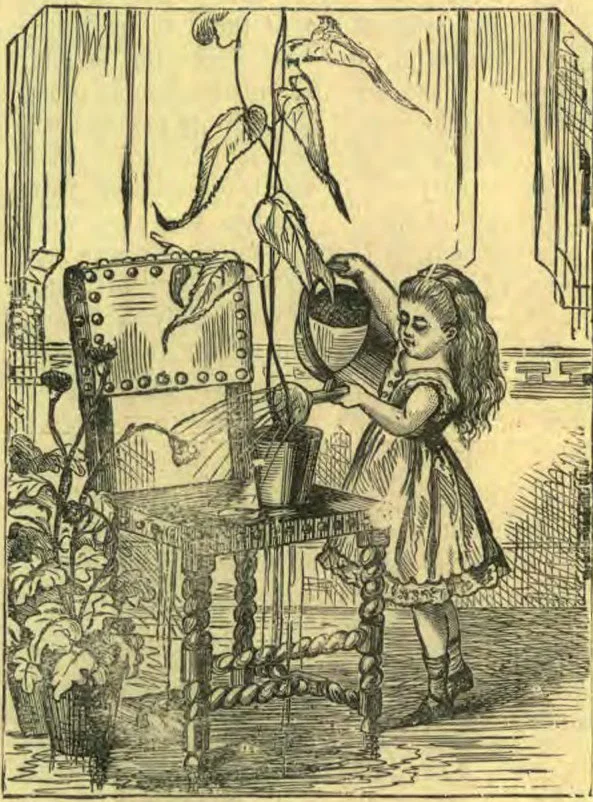
An' then I dug around her plants,
Just like I've seen her do,
An' watered them right smart until
She told me that would do.
I helps her do so many things,
She says I just beats all.
When I's a few more big years old,
I des I'll do it all.
MRS. M. A. LOPER.
THE QUEEN'S DRILL.
THE gentler sex (boys, why do we let them beat us in gentleness?) are usually very much afraid of fire. Her Majesty of England is no exception, it seems:—
Queen Victoria has a great horror of fire, and has arranged quite a complete fire brigade among her servants, so that it is at hand whenever she is in residence. They had a very successful “false alarm” the other day at Osborne, and every one was at his post according to order, as if on board ship. Prince Henry, among his other useful domestic rôles, is chief of the little brigade. The queen has taken the greatest interest in the whole affair.
—Selected.
Living Epistles: The Influence of Godly Lives
Books on the “Evidences of Christianity” are read by comparatively few, but the lives of godly Christians are “living epistles known and read of all men.”
The Ant.
By F. P. Fisher
Four little things spoken of in God's word are the ants, the conies, the locusts, and the spiders. Prov. 30:24–28.
Some very valuable lessons are taught us by all four, but just now we will try to learn something from the ant.
Who made these tiny things? Was it not our heavenly Father, the Creator of heaven and earth? And does he not in his holy word call our attention to them, though they are so small? They are very important little people; so much so that we are told to consider their ways and be wise.
We may learn wisdom from them because the Lord tells us that “they are exceeding wise.” It does not look as though such small heads could contain such great wisdom, but we cannot tell how much they know by their looks.
They are exceeding wise because they use the wisdom which God gave them, which is more than many people do. We are told, “The ants are a people not strong, yet they prepare their meat [food] in the summer,” laying up a store for the winter, when they cannot work. How wise!
It is very interesting to watch these tiny things on a summer day, so busy gathering in their store. If you look closely, you will notice that they work very orderly, not getting in each other’s way, but keeping in rank or line, going out briskly and coming in with a tiny crumb of bread or a wee grain of seed, each one bringing something to store up. So they go backward and forward, working away with all the strength and wisdom they have.
Now, dear children, it is your privilege to lay up a store of knowledge in your summer days,—the days of your youth. Do you remember what we are told about little Timothy,—how he knew the Holy Scriptures from a child? He must have taken pains to learn. We are told, too, that it made him wise unto salvation. 2 Tim. 3:15. His grandmother and his mother loved the Old Testament scriptures; and as they taught little Timothy, he too loved them, and received the gift of faith. You may be wise like him if you choose. “Better is a poor and a wise child, than an old and foolish king.”
What are you exhorted to do in the days of your youth? Is it not to remember your Creator in your summer days (Eccl. 12:1), before the wintry days of age come, spoken of in the next few verses? Let the word of Christ dwell richly in you, so laying up treasures in heaven.
We are taught another lesson by the little ant—to make best use of the early morning. The Lord tells the sluggard and the slothful to go to the ant, and “consider her ways, and be wise.” The ant is up in the early mornings, and at work. There is a sad picture given of the slothful man’s garden. “It was all grown over with thorns, and nettles had covered the face thereof, and the stone wall thereof was broken down.” Prov. 24:30, 31. It gives us no pleasure to walk in such a garden. The trouble was that the man said, “Yet a little sleep, a little slumber, a little folding of the hands to sleep,” and while he idled away the morning hours, the thorns and nettles grew.
Well, then, let us take care that our hearts and lives are not like that garden. Shall we not rather let the good seed of the word of God be sown in our hearts, that the fruits of righteousness may spring up? We cannot avoid something appearing, can we? Thorns and nettles come through neglect in the garden. So in our lives, fruits of righteousness, right doing, or the ugly fruits of wrong doing, called fruits of unrighteousness, will appear; and in our early days we are to be diligently sowing the good seed by reading good words and thinking good thoughts—the words and thoughts of God, as he has written them for us in our Bibles.
From the ant, then, we may learn to be diligent in storing up that which we need to give us life. Jesus tells us that the words which he speaks are life, and that the Scriptures are words of life to those who believe what he says. They are full of wisdom, and wisdom, we are told, is better than rubies and precious stones. David said that the words of God were to him sweeter than honey. Let us then now, in the morning hours of life, store these words in our hearts, and then we shall find that in them is life eternal.—F. P. Fisher, in Present Truth.
THE ALPINE HORN.
The Alpine horn is employed in the mountain districts of Switzerland, not only to sound the cow-call, but for another purpose, solemn and religious. As soon as the sun has disappeared in the vales, and its last rays are just glimmering on the snowy summits of the mountains, the herdman who dwells on the loftiest peak takes his horn and trumpets forth, “Praise God the Lord!” All the herdmen in the neighborhood take their horns and repeat the words. This often continues a quarter of an hour, while on all sides the mountains echo the name of God. A solemn stillness follows; every individual offers his secret prayer on bended knee and with uncovered head. By this time it is quite dark. “Good night!” trumpets forth the herdman on the loftiest summit. “Good night!” is repeated on all the mountains, from the horns of the herdmen and the clefts of the rocks.—Selected.
A WOMAN'S NAME.
It is said that the practice of the wife's assuming the husband's name at marriage originated from a Roman custom, and became common after the Roman occupation. Thus Julia and Octavia, married to Pompey and Cicero, were called by the Romans Julia of Pompey and Octavia of Cicero, and in later times married women in most European countries signed their names in the same manner, but omitted the “of.”
Again this view may be mentioned that during the sixteenth, and even the beginning of the seventeenth, century, the usage seems doubtful, since we see Catherine Parr so signing herself after she had been twice married, and we always hear of Lady Jane Grey (not Dudley) and Arabella Stewart (not Seymour). Some persons think that the custom originated from the scriptural teaching that husband and wife are one. It was decided in the case of Bon vs. Smith, in the reign of Elizabeth, that a woman by marriage loses her former name, and legally receives that of her husband.—Dublin Times.
Constant Need of God's Care and Praise
We need God’s constant care, by night as well as by day, hence we ought to thank him and praise him at all times.
THE PROMISE FULFILLED.
It had been an unusually dull day for Ned Jackson, the little street-sweeper. There was plenty of work to do; but it was very cold, and people hurried along, not noticing the cold little figure who was so faithfully working for them.
He was an attractive boy, with his bright face, cheery whistle, and pleasant ways, and many pennies came to him; but for a week he had met with poor success. He tried to whistle to-day; but his eyes would fill with tears, and his lips would tremble at every attempt, so that he finally gave it up.
“They say it is darkest just before it is light, and I guess it is dark enough now for it to begin to be light pretty soon,” thought Ned.
“I thought those mission folks were right when they said that God cared for those who loved him, and did right. They also said something about his feeding the birds, and that he cared more for me and other people than he did for the birds. I don’t see that he is caring for me and feeding me; for I couldn’t be much more hungry than I am now.
“I’ve tried to do right and love him. I’ll stick to it, too; for I’ve been happier and felt more comfortable, even if nothing more comes from it. I’ll keep attending the meetings, and listening to what the people say. I don’t understand about this, but perhaps they can tell me. I’ll ask them, anyway.
“Mr. Nixon, the superintendent, told us that God puts it into the hearts of people to do things, and he uses them to work for him. Perhaps there are no people for him to put it into their hearts to help me, or else they will not let him, or will not do it when he tells them. They would not even give me the pennies that I have earned. I could get a good square meal if I had them.
“What’s that? I thought I heard my name called. There it is again. Now I see a little girl in the window across the street, and she is beckoning to me.”
When he was near enough, the little girl said,—
“Come up to our door, and I’ll come down and speak to you.”
When they met at the door, the little girl said,—
“I didn’t hear you whistle when you came along to-day, and you look sad; are you sick?”
“No, not exactly; but I’m not in very good trim for whistling, as I’ve had only two apples and two slices of bread for two days,” said Ned.
“Why, Neddie Jackson! isn’t that dreadful? I get so hungry that I can hardly wait for dinner, and I have a good breakfast, too. You stay here, and I’ll ask mama if Betty mayn’t give you something,” said the little girl.
After he had eaten, he thanked Betty, and told her that he would like to see the little girl again. When she came, he thanked her, also, and said,—
“God put it in your heart to give me a good meal, and he used you to work for him. Now I know that he is caring for me, and I shall love him all the more, and try harder to do right.”
“Why, I couldn’t help giving you something to eat, when I knew you were so hungry; but I am glad that God was using me, and I want to do more things for him,” said the little girl.
As Ned walked to his poor little home,—now whistling merrily—he thought,—
“I understand better now, and I shall tell them all about it at the mission.”—Selected.
CARRIER PIGEONS IN WAR.
SINCE the success of the carrier pigeon service during the siege of Paris in 1870-71, European governments have given considerable attention to the rearing and training of pigeons. In France, according to Lieutenant-Colonel De Rochas, most of the fortresses now contain dove-cotes, and forty-seven departments have private societies for pigeons in the country, being about one hundred thousand, Paris alone having eight thousand trained and ten thousand untrained.
In Germany there are about twenty military pigeon stations, and in 1888 there were seventy-eight private societies, with fifty-two thousand two hundred and forty carrier pigeons. In Italy there are dove-cotes at twenty-three military stations. Spain has a very complete system of pigeon service, dove-cotes having been established at eighteen stations, the greatest distance between any two designed to communicate directly being from Madrid to Malaga, two hundred and forty miles.
In Portugal there are fourteen stations; in Russia, five stations, that at Brest-Litowsk having one thousand pigeons; in Switzerland, four stations; in Austria, two stations, and several projected ones, considerable government encouragement being given also to private trainers. Sweden has one station; Denmark, a private society in twelve sections; Belgium, many private trainers, with an estimated total of more than six hundred thousand pigeons. Holland has a regular pigeon postal service between Java and Sumatra, and England a number of cotes in garrisoned cities.—The Graphic.
WINTER
By Mrs. P. Alderman
The winter king sits on his throne of snow,
And watches the storm clouds come and go,
And whistles and moans in the tree-tops bare,
As if he enjoyed the crispy air.
He sings and groans through the dismal night,
And repeats the dirge in the morning light.
Then he covers the earth with a snow-white pall,
As if to hide it away from all.
And the old earth sleeps 'neath its blanket white,
While she holds in her bosom her treasures tight.
The crocus, and tulip, and lily fair
Are sleeping sweetly, without a care.
Then let the storm king rave and blow;
When April comes, he'll be sure to go.
And the breeze will be gentle, and soft, and warm;
For the spring will hush all the winter's storm.
MRS. P. ALDERMAN.
Douly Gray's First Series on Yosemite Valley
By Editor
With this number we begin a series of articles on the Yosemite Valley, written by our youngest contributor, Douly Gray, of Armona, Cal., a lad of fifteen summers. He tells us, “This is my first attempt.” I am sure all the readers of the INSTRUCTOR will be pleased with his efforts, and we trust that the younger members of the INSTRUCTOR family will be stimulated to try to see what they can do at that age. They may not all be gifted to write, but surely they have each some talent they might use to better advantage then they did heretofore. And now let each one for himself or herself find out what that talent is, and then make the very best possible use of it.
THE PRESS IN THE ARCTIC REGIONS.
THERE exist at present several “journals” that make their appearance but once a year, says a writer in a leading scientific paper. Literally, of course, they are not journals,—dailies,—but annuals. They are published within the confines of the north polar circle. The Eskimo Bulletin, for example, is edited near Cape Prince of Wales, on Behring Strait.
Here, in a village inhabited by Eskimos, the English missionaries have established a school, and as but one steamer lands at this place, and that but once a year, the news that it brings is consigned to a sheet of paper printed with the hektograph. Its size is eight by twelve inches. The paper is very thick, and but one surface is used.
This Eskimo Bulletin, in a sub-head, claims to be the “only yearly paper.” This, however, is an error, for there is an annual sheet published at Godthaab, in Greenland, where a small printing office was established in 1862, whence about two hundred and eighty sheets and many lithographic prints have been issued. The journal in question is entitled: “Atuagagdliutit, nalinginarmik tusaruminasassumik;” that is, “Something for reading; accounts of all sorts of entertaining subjects.”
The language is that of Greenland, a dialect of the Eskimo. There is still another periodical published in Greenland, under the name of “Kaladlit.”—Youth’s Companion.
PETRIFIED FORESTS.
The arid regions of the central and the southwest abound in marvels. There are remains of old cities in the midst of the desert, and the evidence of a low type of civilization covering the hills and plains. Another evidence of a change in the physical conditions of the country is found in the petrified forests still existing in several localities. One of the most interesting papers read before the late Forestry Association was that of Dr. Horace C. Hovey, of Newburyport, Mass., on the petrified forests of the southwest, particularly in Arizona. He claimed that there was a time when the atmosphere of the arid region was sufficiently humid to produce a great variety of vegetable products. The plains and hills were covered with immense forests—pines and cedars two hundred feet high. As evidence of this fact, he exhibited a photograph of a cedar still standing, though turned to solid stone.
In most of these stone forests the trees either lie prostrate on the surface or are partially buried in the soil. It is supposed the petrifaction was completed while the trees were standing, and then by some convulsion in nature, presumably an earthquake, they were overthrown. There are evidences that the trunks, limbs, and twigs were broken after petrifaction. The cause of this transformation of whole forests we can only imagine. Perhaps the best conjecture is that the forests were submerged and affected by a flood of siliceous waters from the geysers. After prostration the trees were covered by showers of volcanic ashes, now changed to a soft sandstone.
The best known of these forests is one discovered by Dr. Hovey twenty years ago near the Southern Pacific Railway in Arizona. Until recently it has not been accessible to the general public, but now whoever will take the trouble may see these acres of stone timber prostrated as with the bosom of destruction. He visited the spot about two years ago, and found that a company had been organized to pulverize the stone trees for purposes of commerce. We quite agree with the essayist that the general government, so careful of other forests on the national domain, ought to protect this marvel of the ages.—Zion’s Herald.
A BRIDGE OF AGATE.
WONDERFUL stories are told of the West, with its mammoth geysers, petrified trees, brilliantly-colored rocks, springs of mineral paint, and gems to be picked up by the chance traveler. A miner who has been prospecting in Arizona claims to have found a natural bridge which surpasses the famous one in Virginia. It is nothing less than a bridge of agate crossing a canyon forty-five feet in width. The agate bridge seems once to have been a tree trunk, which hardened to such a degree that when even the sandstone that afterward surrounded it was finally washed away by the little stream that scooped out the canyon, the tree remained — an agate bridge over the chasm.—Harper’s Young People.
FOR THE JAPAN MISSION FUND.
By Editor
Received since Jan. 10, 1895.
SUSAN HARWOOD, $ .50
Eaton Rapids, Mich.
GERALDINE AND ETHEL MC KYEs, 1.00
Flushing, L. I.
MRS. A. S. ATTERBERRY, .50
Keenville, Ill.
DAISY PRESCOTT, 1.75
North Berwick, Me.
RALPH, CHESTER, AND JIMIE LIBBY, 1.25
Silver, Okonogan Co., Wash.
ADELE DROEL, .50
Eau Claire, Wis.
MRS. M. R. VANDERGRIFT, 1.00
Lewis Run, Mc Kean Co., Pa.
CHARLIE AND KATIE HASKILL, .40
Bowling Green, Fla.
MRS. PHEBE HAMP, 3.00
Fontenelle, Uinta Co., Wyo.
G. H., PERLEY, AND MABEL WOOD, 1.00
Roscoe, Ill.
Total, $10.90
Giving a grand total to date, of $344.64.
Our books are still open for further gifts to this noble and needy cause, and we trust the five hundred dollars will be fully made up before we open the next missionary garden in the spring, so that this year’s yield may be applied wholly to some other part of the Master’s great harvest-field.