The Youth’s Instructor, Vol. 33, No. 41.

OCTOBER

The Youth’s Instructor

Oct 28, 1885

S. D. A. Publishing Association · Battle Creek, Mich. · Oct 28, 1885

OCTOBER

A CHARMED moment poised between perfection and decay; The aftermath of yellowing green is touched with specks of gray.
The maple’s gold and scarlet leaf hangs quivering in the sun, As though it felt a throb of grief that summer days are done.
Along the way the tangled briers gleam with a ruddy glow; October lights her festal fires ’neath treasures bending low;
And like a gorgeous, conquering queen, in some triumphal hour, She scatters with a gracious mien the riches of her dower.
She hangs upon the clambering vine a robe of purest dyes, And bursting berries, red with wine, ripened ’neath golden skies.
In tawny reds and russet-browns the forest trees are dressed, And on their blazing crimson crowns she stamps her royal crest.
Where’er she goes, at her command, strange beauties burst to sight, A waiting hush hangs o’er the land, rich with mellow light;
Till far upon the mountains steep she spreads a mystic haze, As if behind its veil to weep for her last perfect days.
—Continued.

THE WARBLER FAMILY.

THERE is, among the feathered tribe, a very large family known as Warblers (Sylviadæ), a class of birds in which, it is said, “the genera, when taken together, number more members than do those of any other family.” The most attractive of the group are the Song Warblers (Sylviæ), whose many subfamilies are each named from some trait or mark peculiar to itself; as, Spectacled Warbler, from a white ring around its eyes; Fire-eyed Warbler, from its bare and brightly colored eyelids; etc., etc.
The song warblers are all small, with soft, silky plumage of a light gray color, variously intermixed with different shades of red and brown. They live mostly in wooded tracts of country, preferring low trees and shrubs to large forests; but they avoid the mountains, even when covered with their favorite shrubs. Their diet consists of insects, worms, and larvæ; but in the fall of the year, their principal food is berries and fruits.
Most of the Song-Warbler family are good songsters, but one of the most gifted of them is the Capirote, or Black Cap, so called from the black tuft on the head of the male. The female has a tuft on its head also, but it is dark brown instead of black. The general appearance and habits of the Capirote are very like those of the other song warblers; but in song, Mr. Mudie says “it has the mildest and most witching notes of all our warblers.” He says also, “It is true it has not the volume and variety of the nightingale, neither the ineffably sweet chant of the garden warbler; but its notes take one by surprise, and the changes and trills are finer than those of any other bird. The song, when the bird is at rest, appears to be like the songs of several birds; but it transposes them into a lower or rather a minor key, and finishes off with variations of its own.”
Bolle mentions a tame Capirote “kept by a lady in Cindal de los Palmas, the chief town of the Canaries, that was the wonder and admiration of the whole neighborhood, on account of the extraordinary clearness with which it had learned to repeat the words mi nino chiceritito (my darling little pet), a phrase daily employed by its mistress as she gave her favorite its food. Large sums were offered by several persons in the hope of obtaining so great a curiosity as a singing bird which could speak; but his owner was not inclined to part with her treasure. After several years, however, this lady had the misfortune to lose her pet by poison, administered, it is supposed, by some one whose offers had been refused.”
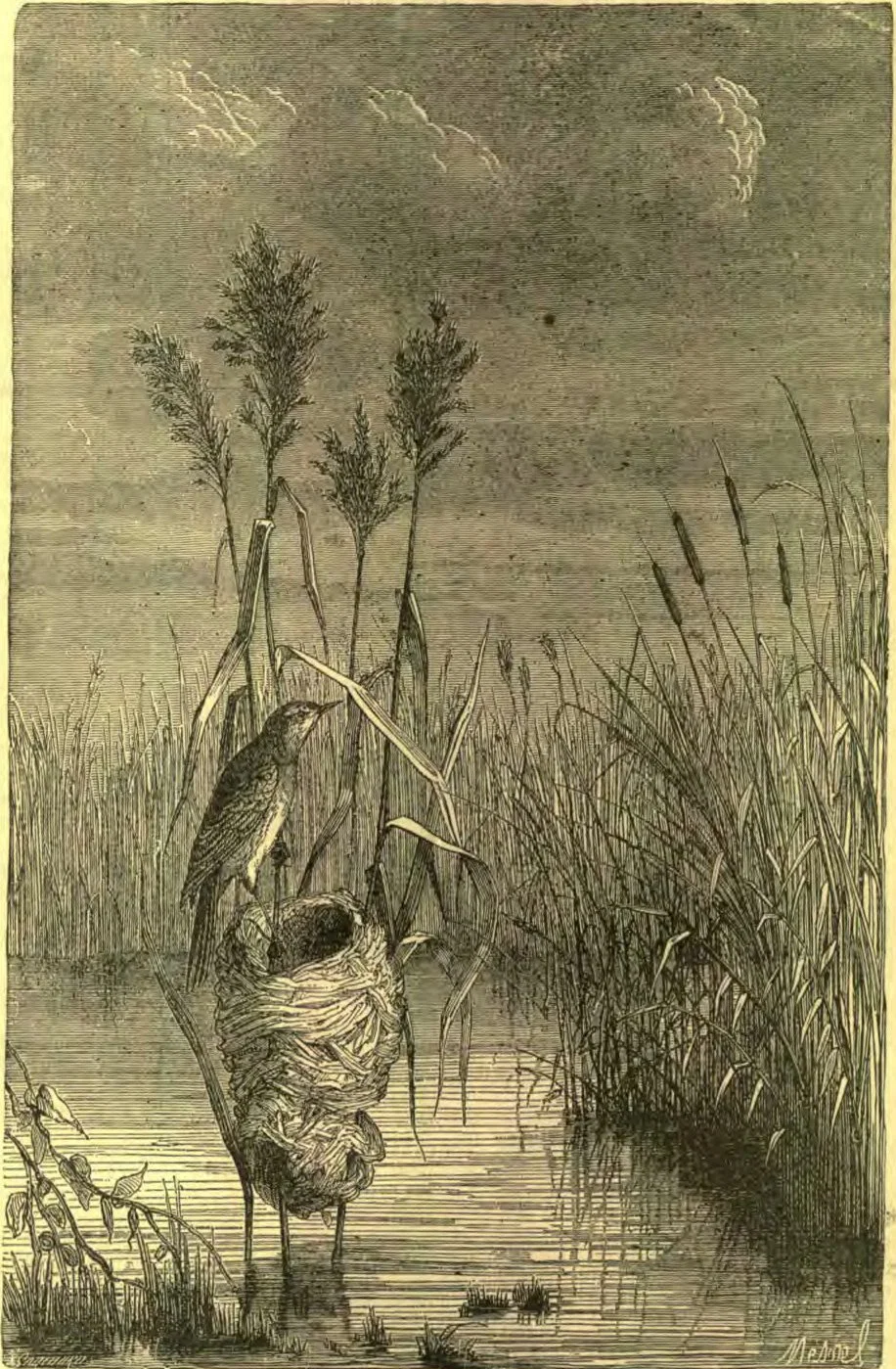
In the great warbler family are many groups besides the song warblers,—the tree warbler, garden, marsh, reed, sedge, grasshopper, etc., nearly every group having its subfamily. Our picture is a representation of the Reed Warbler, so called because it lives among the reeds, in marshy places. It is never seen in the mountains or woods, nor even upon trees that grow near its favorite dwelling place.
The true Reed Warbler is about eight inches long; the wing measures three and one-half inches, and the tail four inches and a quarter. It is yellowish gray on the upper side, and reddish white on the under side, shaded with gray upon its throat.
These birds may be found most all over Europe; and in Northern and Southern Africa are species very nearly similar. They begin to migrate in September, and wander as far as Central Africa, but they never linger in any but marshy places. After their return in the spring, their loud, echoing voices may be heard, not only all day, but frequently all through the night. In Cassell’s description of birds it is said that “their song is a strange combination of a great variety of harsh, quavering notes, more nearly resembling the croaking of the frogs whose domain they share, than the notes of any of the feathered creation.” Also, “while singing, the males usually perch upon a reed, with drooping wing, outspread tail, inflated throat, and open beak, and go through their noisy performance with an energetic desire to rival every bird around them; such is the evident satisfaction they exhibit at the result of their efforts, as to make the listener overlook the want of vocal talent, in his amusement at the concert of the self-complacent songsters.”
They begin their nests in June. As you see in the picture, they are long in shape, turned inward at the top, to prevent their young from falling, or being blown out. They are made of stalks, grasses, fibers, etc., lined with some soft materials. Their nests are fastened securely to the reeds by drawing four or five together and interweaving the building material among them. They lay about four or five eggs, which they hatch in two weeks. They are very attentive to their young, until they are fully fledged.
Dr. Bennett says, “One species of the Reed Warbler (Acrocephalus Australis) is very numerous about the sedgy localities of the Nepean River, Australia; and although it has been denied that any of the Australian birds are endowed with a musical voice, this bird has a very loud, pleasing song, enlivening the places it frequents.”
There is also a large Reed Warbler in India, similar to the European species.
M. J. C.

THE WHITE HORSE OF SAXONY.

EVERY boy and girl who knows anything of history has heard of the great Charlemagne, whose empire extended over nearly all Western Europe. In Italy, Spain, and Southern Germany he was alike victorious over his enemies.
The Saxons, however, who held the country which is now Prussia, refused to submit to his rule. They were a brave, barbarous people, who believed in the old heathen gods, and hated most bitterly the Christianity which Charlemagne proposed.
Long and desperate was the war. For thirty-two years it raged with few intermissions. Sometimes Charlemagne would be victorious, and the Saxons would seem conquered; but no sooner was Charlemagne engaged in war elsewhere, than they would gather under their native chiefs, and renew the struggle. The greatest cruelty was shown to the Saxons; they were carried away into foreign lands, their country was laid waste, and at one time, as a punishment for rebellion, 4,500, who had been taken prisoners, were put to death.
All this barbarity, however, only made the Saxons more determined in their resistance. Their leader, the brave Wittekind, was once obliged to seek protection in Denmark; but he soon returned to lead his people against their conqueror.
Two bloody battles were fought, in the last of which the Saxons were defeated. Soon after this, they submitted. Wittekind and his wife Gera were baptized, Charlemagne being sponsor. From this time Saxony became tranquil under the rule of Charlemagne, and Christianity was accepted as its religion. Historians tell us that the leaders became convinced that heaven was on the side of Charlemagne, and so yielded. German tradition explains more fully this sudden change on the part of the Saxons.
A thunder-storm at evening, so runs the legend, had followed a warm summer day. The thunder rolled; the wind swept through the tops of the ancient oaks. The waters of the Weser foamed and dashed against a little hut which stood upon its banks, as if they would dash it away. In the door of the hut, a Saxon of powerful frame stood looking out upon the raging storm; suddenly he saw, making his way through the underbrush, the figure of a man. The new-comer was of gigantic stature, but his torn clothing and bewildered glance showed him to be one who had lost his way. So soon as he spied the hut, his countenance lighted with a smile.
“Can I find here a shelter? Will you lodge me?” he cried, coming toward the hut.
The man in the door looked distrustful as he asked, “You are lost in the woods? You are a stranger in this region?”
“Since morning I have wandered among the mountains, not knowing how to find my way out. Now I desire a lodging where I can await the morning, which, God will, shall bring me again to my own people.”
The expression of distrust did not leave the face of the Saxon, and the duty which hospitality laid upon him was evidently a distasteful one.
“Be welcome,” he said, slowly advancing toward the stranger; “come under the shelter of my hut.”
The guest seemed to find but little more pleasure in accepting the invitation than the Saxon had in extending it. He glanced with evident disquiet around the apartment, whose walls were adorned with images of the heathen divinities and the stone weapons of the Saxons. Soon, however, his countenance cleared, and after partaking of a repast which his host placed before him, he threw himself on the bear-skin bed, and was soon asleep.
Long after his guest slept, the Saxon sat brooding by the fire. Suddenly seizing his stone knife, he started from his seat, but with a glance at the image of his god, he dropped back again.
“No, no. Woden commands that the rights of hospitality be honored. It must not be.”
So speaking, he cast himself upon his bear-skin, and was soon asleep.
All signs of the tempest had vanished when the bright rays of the morning sun awakened the two sleepers. Hastily springing up, they put in order their dress, and ate together their simple breakfast.
“God reward you for the shelter and food you have given me!” said the guest. “Permit me now to take my departure.”
“I will accompany you,” said the Saxon; “I know every outlet of this country.”
As they journeyed, the stranger saw gamboling on the green meadow a beautiful white horse. “See,” he cried, “this fine horse. Let us catch and tame him.”
“He will not easily be caught or tamed,” replied the Saxon.
“Why not?” said the stranger. “Give me a cord; he shall soon know me as master.”
“You can try it,” was the answer, “but you will soon find that your trouble is vain. This wild horse will never yield to power; but if you show kindness, he will come of his own free will.” So saying, he motioned with his hand.
The beautiful beast raised his head, then began slowly to approach them. The Saxon patted his slender neck, and stroking lovingly his silver white mane, “In this horse,” he said, “you see a symbol of the free, unconquered Saxon people; they will never yield to power. Before we allow ourselves to be compelled to honor the Christ-god whom you Franks are striving to bring into our land with fire and sword, we will die to the last man.”
“But if I try love, if I use gentleness?” said the stranger, half to himself, as he watched the horse rubbing his head against the Saxon’s shoulder.
“The Franks know only how to use rough power,” replied the Saxon gloomily.
“But it shall be otherwise,” cried the other; “the war shall end, and peace shall unite both peoples. My word that it shall be done,” he continued, raising with regal mien his hand to the heavens, “my imperial word as a pledge; for know I am Charles, Emperor of Germany!”
“Do you think that I have not known you? This majestic form, these golden locks, these sparkling blue eyes, would betray you among a thousand. When last night you stood before my threshold, I knew that it was the deadly enemy of my people who begged shelter.”
“You knew me,” said the emperor, “and still received me with hospitality?”
“Although I would gladly have buried my knife in your breast, I harmed no hair of your head, for Woden commands, ‘Your guest shall be holy to you.’”
“I, too, soon knew that I was under the roof of an enemy,” said the emperor; “but I believed myself unknown, and trusted to my strength for protection. But who art thou? Thy clothing, thy imperious look, thy noble bearing, show thee no common man.”
“I am Wittekind,” replied the Saxon, “Wittekind, the leader of my people.”
“Blessed be the hour which brought us together, and blessed be the white horse that has given me this example of the power of mildness!” cried the emperor, seizing the hand of the Saxon prince. “In peace shall Frank and Saxon dwell together, and no more through the power of the sword, but through persuasion, through love, will I seek to spread Christianity among you.”
“And I,” replied Wittekind, conquered by the friendly words of the emperor, “I promise allegiance for myself and my people. We will hear the message of the Christ-god whom you could never have forced us to obey.”
The pledges of Charlemagne and Wittekind were fulfilled. There was peace between the two peoples, and gradually the Saxons accepted the religion of gentleness and love, and became Christians. Wittekind remained a true vassal of the emperor, and bore on his shield an image of the white horse that had wrought this change to his people.
Centuries have passed; no one knows where stood the hut in which the Saxon king entertained the Frankish emperor. The Saxons bear another name, and have in customs and manners become another people; but to-day the white horse, the emblem of early Saxon freedom, is the device on the crest of Brunswick and Hanover.—Christian Weekly.

FROM SAMOA TO AUCKLAND.

Our next stopping place after leaving the Samoan Islands, was Auckland, New Zealand. But before reaching the latter place, all were again obliged to lay off their light clothing for that which would protect against the increasing cold of the winter toward which we were speeding. Each day the shadows grew longer at noon-day, and the weather became colder accordingly as we sailed away from the sun, which was at that time carrying spring and summer to our friends in the northern hemisphere.
Thursday evening, May 28, we arrived at the 180th meridian, sometimes called the day-line. In sailing westward, this is the place where navigators drop a day from their calendar, in order to be in harmony with the count of the days west of that point. In other words, this is the spot where one day ends, and another begins; so here our ship sailed out of one day into another. Consequently, that evening became to us Friday evening, and Friday itself was dropped out of our count of days. That, of course, gave us one week with only six days in it; but should we return the same way, we would then have to add a day to our reckoning, which would give us eight days in one week. Such changes would never be necessary if we always remained on one side of the globe; but when we sail westward in the same direction that the sun moves, of course we keep the sun in sight longer each day than if we had remained in one place. By doing this each day we went west, we not only had the sun a little longer each day than did those who remained in one place, but each night was also a certain number of minutes longer to us than to those who were motionless, according to the number of miles we sailed during each night. But while having this, we must also get the sun-rising a proportionate number of minutes later each morning than do those who remained where we were the evening previous. Now it is quite plain that to do this day after day, from the point where the day begins, to the same place again, that the day must have been gradually moved forward fully twenty-four hours. Then upon arriving at the day-line, it is evident that the time thus apparently gained must be dropped, and harmony is in this way preserved.
On the sixth day after leaving Samoa, there was seen in the western horizon that which appeared to be a heavy fog-bank, lying upon the bosom of the ocean. As we came nearer, however, it gradually changed in appearance until it became to the eye what it really was,—tall, rocky islands of various shapes and sizes. These stately sentinels were safely passed, and our good ship was speeding her way through the Hauraki Gulf, toward Waitemata Inlet, in which is situated the city of Auckland.
It was quite a relief to many of the passengers, when the ship rounded the promontory at the mouth of Auckland harbor, to find themselves again in smooth water. It was surely a contrast to the stormy ocean upon which we had been tossed for the two preceding days. As we moved up the harbor, the city presented a very pretty appearance. Along the water front lay the shipping of several nations, while in their rear the city rose, street upon street, and building upon building, far up the gently ascending hillside, against a background of beautiful suburban villas quietly nestling in the groves upon the heights beyond.
We arrived in Auckland the first day of June, which some of the inhabitants told us was the coldest day known in that part of the country for a long time. This no doubt seems quite strange to dwellers in northern regions whose coldest weather is from December to March. But the winter in New Zealand, as in all Australasia, covers the months of June, July, and August. This is the rainy season. Spring commences in September, and strawberries ripen from November to January; cherries, peaches, pears, plums, and apples, in January and February. Melons and grapes ripen in March, which is the first month of autumn.
Auckland has a population of 26,000, and is the center of numerous native settlements. Its public gardens are finely laid out, and lines of street cars run from one end of the city to the other. The country for some distance south and east of the city is covered with orchards and vineyards, and dotted here and there with pretty villas. Farther on, however, there are numerous isolated hills of volcanic formation. A few of these lift their heads far above those of their neighbors, some rising precipitously in terraces, and others putting out large spurs which sweep downward to the plain. The slopes of these hills, as well as the plains at their base, are marked with homesteads, which, in the distance, look in the clear sunlight like bright tints in a beautiful landscape painting. Looking eastward from the city, one may see in the far distance, mingling with the horizon, the dim outline of the mountain ranges of Cape Colville. These have an elevation of 3,000 feet, which in the flashing sunlight of a clear morning present a most beautiful and attractive scene. J. O. Corliss.

WHY IDLY DREAM.

WHY should we sit and idly dream Our lives away? Why plan such wondrous work to do Some other day?
Why stand and gaze away, away, Beyond the hills, While close at hand, so much there is Our pathway fills?
So many hungry, tired souls— Alas! alas! Who, while we grasp at things afar, Unnoticed pass!
Who cry and cower in the dust Of misery, While we their want and sore distress Ne’er feel nor see! —Well-Spring.

A SWEARER SILENCED.

WHEN the Boston train came steaming into the depot, the crowd rushed for seats. As a band of recruits mounted the platform, they shouted back to their friends who had accompanied them to the train the various slang phrases they could command, interspersed with an oath now and then. As the train moved on, they pushed each other into the car where many ladies were seated, including Mrs. B. and her two boys.
Then the oaths came out thick and fast, each one trying to outdo the other in profanity. Mrs. B. shuddered for herself and her boys, for she could not bear to have their young minds contaminated with such language. If the train had not been so crowded, she would have looked for seats elsewhere; but under the circumstances, she was compelled to remain where she was.
Finally, after the coarse jesting had continued nearly an hour, a little girl, who with her mother sat in front of the party, stepped out timidly from her seat, and going up to the ring-leader of the group, a young man whose countenance indicated considerable intelligence, she presented him with a small Bible.
She was a little, delicate-looking creature, only seven or eight years old; and as she laid the book in his hands, she raised her eyes appealingly to his, but without a word went back to her seat.
The party could not have been more completely hushed if an angel had silenced them. Not another oath was heard, and scarcely a word was spoken by any of them during the rest of the journey.
The young man who had received the book seemed particularly impressed. He got out of the car at the next station, and purchased a paper of candy for his little friend, which he presented to her. He then stooped down and kissed her, and said he would always keep the little Bible for her sake.
The little girl's mother afterward told Mrs. B. that her child had been so troubled by the wickedness of those young men that she could not rest until she had given her little Bible, which she valued so highly herself.—Christian Instructor.

THE PURPOSE OF READING.

EVERY reader should know the purpose for which he reads. Usually this purpose is either rest, amusement, or improvement. A boy or girl, tired by work in the shop or house, takes up Hawthorne's “Wonder-Book,”—that is reading for rest. Fretted by low marks at school, one becomes absorbed in “Swiss Family Robinson,”—that is reading for amusement. Eager to instruct the mind, you read Bancroft's “History of the United States,”—that is reading for improvement.
Of these purposes, that of improving the mind and heart is most important. In all reading whose immediate aim is either recreation or pleasure, the remote aim should be the formation of a noble character. No one should read a book without resolving to be benefited by it in every right endeavor.
The purpose for which one reads determines the choice of the book. If you are in doubt what to read, form a clear idea of the reason of your reading, and the selection of a proper book is made easy.—Selected.

IMPORTANT BIBLE SUBJECTS.

LESSON 8.—REVIEW.
[NOTE TO THE STUDENT.—Do not consider the lesson learned until you can give at least the substance of every text, with the correct reference for each. The references in black letters indicate those texts that should be committed to memory. A little diligent application each day will enable you to learn them, although this need not be considered a test of scholarship.]
1. How does God make known to man the events that will come upon the earth? Num. 12:6; Amos 3:7.
2. What does Peter say of the importance of prophecy? 2 Pet. 1:19.
3. What does Paul say of the importance of a knowledge of God’s word? 2 Tim. 3:15–17.
4. To what portion of the Bible did Timothy have access, as mentioned in verse 15? (See note.)
5. What lesson may we learn from this?
6. To what are the books of Daniel and the Revelation especially devoted?
7. What noted captives are mentioned in Daniel 1:6?
8. What especial gift did God bestow upon Daniel? Verse 17.
9. What remarkable dream was given to King Nebuchadnezzar in the second year of his reign? Dan. 2:31–35.
10. Give the interpretation.
11. What vision was given to Daniel in the first year of Belshazzar? Dan. 7:1, 2, 3.
12. Describe the four beasts that came up from the sea. Verses 4–7.
13. What did these four beasts represent? Verse 17.
14. Was Daniel fully satisfied with the interpretation he received? Verse 28.
15. After two years, what symbols were shown to Daniel, as mentioned in chapter 8? Verses 3, 5, 9.
16. What did the first beast denote? Verse 20.
17. What did the rough goat represent? Verse 21.
18. By what was the fourth universal kingdom represented? Verse 9.
19. What are the names of the first three universal empires?
20. By what symbols is Babylon represented in chapters 2 and 7?
21. By what is Medo-Persia symbolized in chapters 2, 7, and 8?
22. How is Grecia represented in these chapters?
23. How is the fourth empire represented?

NOTES.

From a child.—This epistle to Timothy was written by Paul during the Christian dispensation; and yet the only scriptures to which Timothy could have had access “from a child” were the prophecies and histories of the Old Testament. Yet these, Paul states, are “able to make thee wise unto salvation,” with this addition, “through faith which is in Christ Jesus.” This would teach us that “all scripture is given by inspiration of God, and is profitable for doctrine, for reproof, for correction, for instruction in righteousness; that the man of God may be perfect, thoroughly furnished unto all good works.” 2 Tim. 3:15–17. This will teach us that none can reject any portion of God’s revealed word with impunity.
The books of Daniel and the Revelation.—These books are specially devoted to prophecies relating to the history of this world as connected with the people of God, clear through to the consummation of all earthly scenes, the setting up of God’s everlasting kingdom, and the final redemption and reward of his faithful people.

PROGRESS

AND prophets, and heroes, and seers arise: “Their words and deeds like the thunder go; Can ye still their voices? They answer, “No!” It is God who speaks in their words of might! It is God who acts in their deeds of right!
—Anon.

WORTH ONE THOUSAND DOLLARS.

Our Dumb Animals estimates that the following paragraphs contain information which, if remembered, may be worth a thousand dollars to a person. If that is the price at which one values his life, this might be so; but we should consider as invaluable any information which would enable us to escape death. With experience of the buoyant power of water, so that presence of mind could be maintained in case of accident, no doubt many lives might be saved. The paragraphs read:—
“The human body weighs a pound in the water, and a chair will carry two persons—that is, it will keep the head above water, which is all that is necessary when it is a matter of life or death. One finger placed upon a stool or chair or a small box or a piece of board will easily keep the head above water, while the two feet and the other hand may be used as paddles to propel toward the shore.”
“It is not necessary to know how to be able to swim to keep from drowning. A little experience of the buoyant power of water, and faith in it, is all that is required. We have seen a small boy who could not swim a stroke propel himself back and forth across a deep, wide pond by means of a board that would not sustain five pounds' weight. Children and all others should have practice in the sustaining power of water. In nine cases out of ten, the knowledge that what will sustain a pound-weight is all that is necessary to keep one's head above the water, will serve better in emergencies than the greatest expertness as a swimmer.”
“A person unfamiliar with the buoyant power will naturally try to climb on top of the floating object on which he tries to save himself. If it is large enough, that is all right. But it is generally not large enough to keep all entirely above water. This often happens when pleasure boats capsize. All immediately want to get out of the water on top of the overturned or half-filled boat, and all are drowned except those whom the wretched craft will wholly bear up.”
“If they simply trust the water to sustain 99-100 of the weight of their bodies, and the disabled boat the other 1-100, they all might be saved under most circumstances. An overturned or half-filled wooden boat will sustain more people than it will carry. It would keep the heads above water of as many people as could get their hands on the gunwale. These are simple facts, easily learned, and may some day save your life.”

SOMETHING ABOUT BUOYS.

THE buoys, or floats, which are often used to mark entrances to harbors, to point out the position of objects under the water, as anchors, shoals, rocks, etc., are colored differently, as some of you may have had opportunity to notice. There is a reason for this, which is given in Treasure Trove as follows:—
“As sailors traverse the whole world, of course some uniform system has to be adopted—one that will mean the same thing everywhere. And so, in any harbor in the world where the channel is marked by buoys, you will find that those on your right as you pass in are painted red, and those on your left, black. If you should see one painted in red and black horizontal bands, the ship should run as close to it as possible, because that indicates the center of a narrow channel. Buoys with red and black vertical stripes always mark the ends of spits, and the outer and inner ends of extensive reefs, where there is a channel on each side. When red and black checkers are painted on a buoy, it marks either a rock in the open sea, or an obstruction in the harbor, of small extent, with a channel all around. If there are two such obstructions, and a channel between them, the buoy on the right of you will have red and white checkers, and the one on your left will have black and white checkers. When a wreck obstructs the channel, a green buoy will be placed on the sea side of the wreck with the word ‘wreck’ plainly printed on it in white letters, provided there is a clear channel all around it; otherwise, an even number will be painted in white above the word ‘wreck’ when the buoy is on the right side of the channel, and an odd number if the buoy is on the left.”

INTERNAL REVENUE PAPER.

Internal revenue paper is used for making internal revenue stamps. The young readers of the INSTRUCTOR may not all know the use of these stamps, and so may like a few words of explanation. Revenue is the yearly income which a State or nation collects, and receives into its treasury, from taxes, duties, rents, etc., for public use. Until the war of the rebellion, our government relied wholly on taxes, or duties, on imports, for funds to carry on the government; but so much money was needed to carry on the war, that it was found necessary to add to this source of income by taxing various domestic or home manufactures. Internal revenue, therefore, is a tax, or duty, on certain home productions. During the war, taxes were imposed on the capital and circulation of banks; on beer, ale, wines, whisky, cigars, tobacco, patent medicines, etc.; on matches, wax tapers, cigar lights, etc. The tax has since been taken off from some of these.
Internal revenue stamps are of different denominations. Some of them resemble our postage stamps. The government employs agents throughout the country to furnish them as they are needed; and they are affixed to the boxes, barrels, or whatever contains the articles taxed, increasing the cost of the goods by the amount of the cost of the revenue stamps affixed.
The Philadelphia Record says that parties at the paper mill at Richmond and Tioga Streets, of that city, have contracted with the United States Government to manufacture its yearly supply of paper (450,000 lbs.) for internal revenue stamps, and the work of manufacturing it is already in progress. The Record gives some interesting particulars of the work, as follows:—
“This is the first time that such work has been attempted in this city, and every effort has been made to give satisfaction. After the mill had been in operation for a short time, it was found that the paper was being rolled off in a satisfactory manner, and the work of preparing it for shipment began. The paper used does not differ in quality from ordinary fine paper. It is made from fine pulp, chiefly of cotton stock with a sufficient proportion of linen stock to give proper strength, clay or any other adulterant being excluded. Entire freedom from thread knots, grit, or other foreign substance is required, and the paper is calendered sufficiently to admit of wetting down for plate printing, and of subsequent writing upon it with pen and ink. With all these conditions, it is required that the paper shall possess no greater strength than will insure its printing and necessary handling. The quality of paper is, therefore, necessarily of a high order. That which, apart from the familiar light-green tint of revenue stamps, distinguishes this paper from all other paper materials is the letters U. S. I. R. water-marked upon it so thickly that every square inch must contain some portion of the sign. This marking is done by means of a ‘dandy roller’ placed among the series of rollers through which the paper is passed on its road from the pulp-top to the receiving rollers. The paper passes over this roller while in a wet, pulpy condition, and the impression is then made. This roller is furnished by the government, and was sent on under charge of watchmen. It is never out of sight of some of the officials, and will be returned to Washington as soon as the contract is completed. The whole operation is under the supervision of the government officials, who keep an eye on the paper from the time it receives its water-marking, which makes it revenue paper, until the perfected sheets are packed and shipped, or the waste pieces are returned to the pulp. No one is admitted except under their care. This precaution is taken to prevent the government from being defrauded through engravers’ securing paper upon which stamps of high denominations could be printed. To have even a small piece of this paper in one’s possession will subject him to a criminal prosecution.”

A NARROW ESCAPE.

M. BOUTIBOUSE, the French savant, served in Napoleon's army, and was present at many engagements. At the battle of Wagram, in 1809, he was in the heat of the fray; the ranks around him had been terribly thinned by shot, and at sunset he was nearly isolated. While reloading his musket, he was shot down by a cannon-ball. His impression was that the ball had passed through his legs below his knees, completely severing them, for he suddenly sank down, shortened, as he believed, to the extent of about a foot in measurement. The trunk of the body fell backward on to the ground, and the man's senses were paralyzed by the shock. Thus he lay, motionless, among the wounded and dead all night, not daring to move, when consciousness partially returned, lest the loss of blood should be fatally increased. That he felt no pain he attributed to the stunning effect of the shock on his nervous system, and he was still mentally too numbed to be able to reason as to why he had not bled to death. At early dawn he was aroused by one of the medical staff, who came round to help the wounded.
“What’s the matter with you, my good fellow?” said the surgeon.
“Ah, touch me tenderly, doctor,” replied M. Boutibouse; “a cannon-ball has carried off my legs!”
The surgeon examined the limbs referred to, and then, giving him a good shake, said, with a loud laugh, “Get up with you; there’s nothing the matter with your legs!”
M. Boutibouse sprang up in utter astonishment, and stood firmly on the legs which he had thought lost forever. “I felt more thankful,” said he, “than I had ever felt in the whole course of my life before. I had not a wound about me. I had, indeed, been shot down by an immense cannon-ball; but, instead of passing through my legs, as I firmly believed it had, the ball had passed under my feet, and had plowed a hole in the earth beneath at least a foot in depth, into which my feet suddenly sank, giving me the idea that I had been thus shortened by the loss of my legs.”—S. S. Glassmate.

FOR LACK OF KNOWLEDGE SOME ARE DESTROYED.

A little scientific knowledge of familiar things sometimes saves one considerable alarm, to say the least. If the Connecticut school-boy had been familiar with the chemical action produced by bringing water in contact with unslaked lime, he would have withheld either the lime or the wet sponge from his pocket. Golden Days is responsible for the following amusing incident:—
“A school-boy at Norwich, Connecticut, picked up a lump of unslaked lime, one day, a few weeks ago, and put it into the place where a thousand-and-one other objects are thrust,—the jacket pocket. At school, the same boy jammed a wet sponge into the same pocket. In another moment a cloud of steam began to unroll itself out of that part of the garment, and the boy’s classmates were soon in an uproar. As for the boy himself, he did not know what else to do than to hop around and scream, while the teacher, thinking his jacket was on fire, and fearing lest he should be burned to death, was quite beside himself. It did not take long, however, to find out just what was the matter, and to get the lime out of the pocket and into the yard.”
Continue reading: CURIOUS COMBATS