The Youth’s Instructor, Vol. 30, No. 9.

SHE WAS A STRANGER

The Youth’s Instructor

Mar 1, 1882

S. D. A. Publishing Association · Battle Creek, Mich. · Mar 1, 1882

“SHE WAS A STRANGER.”

A MISSIONARY was requested to go out to a new settlement to address a Sabbath-school. He had preached in the morning, and was wearied and felt quite unfitted for the task, but reluctantly consented to go. When he found himself at the spot, he looked round on the assembly with great misgivings, not knowing what to say to them. He noticed a little girl, shabbily dressed and barefooted, shrinking in a corner, her little sunburnt face buried in her hands, the tears trickling between her small brown fingers, and she sobbing as if her heart would break. Soon, however, another little girl, about eleven years old, got up and went to her, led her toward a brook, then seated her on a log; and kneeling beside her, she took off her ragged sun-bonnet, and dipping her hand in the water, bathed her hot eyes and tear-stained face, and smoothed the tangled hair, talking in a cheery manner all the while. The little one brightened up; the tears all went away, and smiles came creeping around the rosy mouth.
The missionary stepped forward and said, “Is that your little sister, my dear?”
“No, sir,” answered the child, with tender, earnest eyes. “I have no sister, sir.”
“Oh, one of the neighbors’ children!” replied the missionary. “A little school-mate, perhaps!”
“No, sir; she is a stranger. I do not know where she came from. I never saw her before.”
“Then how came you to take her out, and have such a care for her, if you do not know her?”
“Because she was a stranger, sir, and seemed all alone, and needed somebody to be kind to her.”
“Ah!” said the missionary to himself, “here is a text for me to preach from: ‘Because she was a stranger, and seemed to be all alone, and needed some one to be kind to her.’ These words came to him: ‘Inasmuch as ye have done it unto one of the least of these my brethren, ye have done it unto me.’ So, taking the little girl by the hand, he went back to the school-room, and told the people the simple story; then spoke of the great love that all should bear to one another, even as our Saviour sought out those who were humble and of low estate, making them his peculiar care. The missionary forgot his weariness, and felt that God had put a good word into his mouth.—Selected.

WESTMINSTER ABBEY

ONE of the oldest churches in the world is Westminster Abbey, in London. It is thought to have been commenced sometime in the seventh century, but has been repaired and added to, at many different times since. It is built in the form of a Greek cross. Our picture shows the northern side of this magnificent structure, but gives only a poor idea of its vast size. The two towers seen to the right of the picture mark the front of the building, which faces toward the west. The height of these towers is two hundred and twenty-five feet. The length of the building is between four and five hundred feet, and its extreme width about two hundred feet.
At either end of the building and in various portions of the sides, are immense windows of stained glass, adorned with painted figures of marvelous brilliancy and beauty. Perhaps the most interesting of these is the great south window, which contains full-length representations of Abraham, Isaac, Jacob, Moses, Aaron, and others of the patriarchs. The “rose window,” in the north side, and the “marigold,” in the south side, also give Scriptural incidents.
As the visitor enters the Abbey, he is struck with the immensity of the place. It appears larger than it really is, owing to the dim light which enters through the stained glass windows. A grand view stretches away amid wonderful aisles, arches, and forests of columns, almost as far as the eye can reach. Everywhere—along both sides of the length of the building, in chapels and under the marble floor—are the tombs, tablets, statues, monuments, and inscriptions of the illustrious dead. Among these are the British poets, artists, and worthies, from Shakespeare’s time to the present. The English sovereigns, from Edward the Confessor to Queen Victoria, have been crowned here, and here many of them have been buried, some with and others without monuments. As the guide conducts you through the various chapels, he points out to you the numerous sarcophagi [stone coffins] of the former kings and queens of England who here lie in dust.
Religious services are held daily in the Abbey, and on Sunday they are numerously attended, though the audience-room is so large that the voice of the preacher can be heard by only a part of the people present. One who has been to London during the past year thus speaks of his visit to this world-renowned place of worship:—
“On the first Sunday in July we attended divine service in Westminster Abbey, and heard Canon Farrar preach an earnest and very appropriate sermon. It was, however, with peculiar feelings that we listened, surrounded as we were by the tombs of a host of Britain’s distinguished dead,—kings and queens, warriors, heroes, and poets, almost without number,—all silent in the dust, yet proclaiming the brevity of human life, and the vanity of human honor and glory and fame. But blessed be the assurance that the righteous shall be held in everlasting remembrance, and that their names shall never perish!”
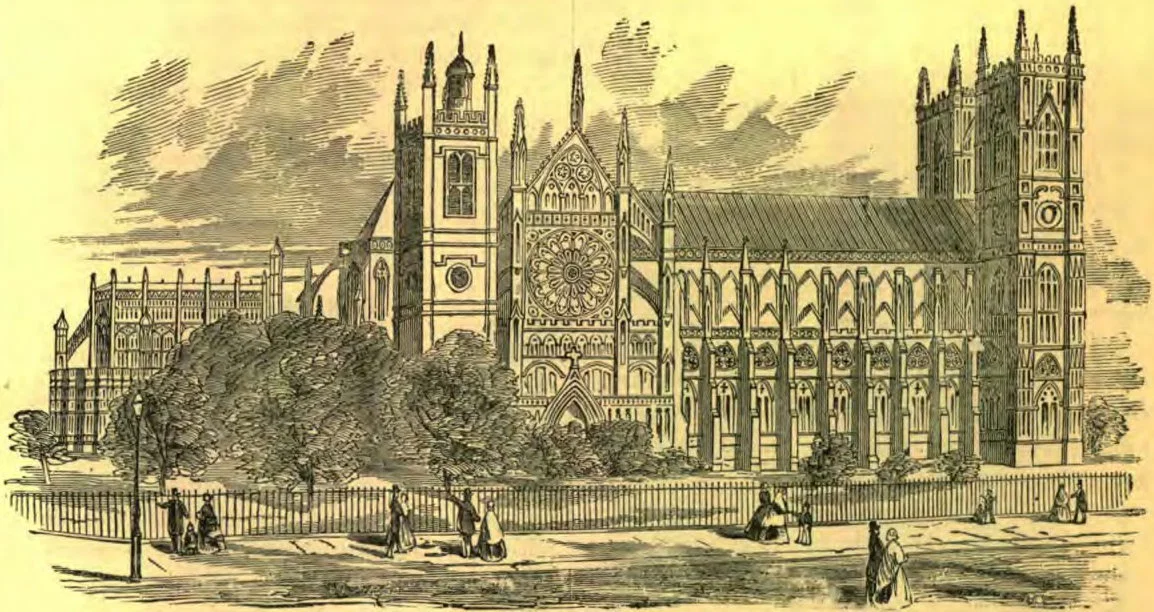
During the last summer, Dr. Arthur Stanley, long the loved and honored Dean of Westminster, and widely known for his eloquence of both tongue and pen, died very suddenly, and was laid to rest in the old Abbey through whose aisles his voice had so often echoed. Canon Farrar, mentioned in the extract above, was his friend and fellow-worker, and often preached from his pulpit.
E. B.

GOD’S CARE.

I SAT in the door at eventide; My heart was full of fears, And I saw the landscape before me lie Through mists of burning tears. I thought to myself, the world is dark, No light nor joy I see; Nothing but toil and want is mine, And no one cares for me.
A sparrow was twittering at my feet, With its beautiful auburn head, And looked at me with dark, mild eyes As it picked up crumbs of bread; And said to me, in words as plain As the words of a bird could be, I’m only a sparrow, a worthless bird, But the dear Lord cares for me.
A lily was growing beside the hedge, Beautiful, tall, and white, And it shone through the glossy leaves of green, Like an angel clothed in light; And it said to me, as it waved its head, On the breezes soft and free, I’m only a lily, a useless flower, But the Master cares for me.
Then it seemed that the hand of the loving Lord Over my head was laid, And he said to me, O faithless child, Wherefore art thou dismayed? I clothe the lilies, I feed the birds, I see the sparrows fall; Nothing escapes my watchful eye, My kindness is over all.
—M. C. Edwards.

HOW THE STORY GREW.

As Kitty Coleman and Maggie Weir were going to school one morning, Kitty said:—
“I was over at Uncle Fred’s last Saturday, and came near staying too late. We had such fun that I did not notice how near the sun was to setting, and I was very much afraid that I might meet a tramp.”
“Did you meet one?” inquired Maggie.
“No one but Johnnie Gates; he was coming down the hill whistling, with a great big watermelon under his arm; I was scared at first, but when I saw who it was, I got over it.”
At recess Maggie said to Mary Ford:—
“Kittie told me that she saw Johnnie Gates carrying a great big watermelon home Saturday evening. Wonder where he got it, and what he is going to do with it?”
Before school Mary whispered to Sallie Bates: “Johnnie Gates was seen carrying a great big watermelon Saturday evening. I wonder if he got it honestly?”
“Mr. Hart’s melon patch was robbed about that time; maybe that’s where it came from,” answered Sallie.
At noon, Sarah told Susan and Jennie.
“I know something, and I’ll tell you if you won’t breathe it to a soul.”
“Oh, no, we won’t,” cried both girls in one breath; “what is it?”
“Why, Johnnie Gates robbed Mr. Hart’s melon patch last week.”
“Oh dear, isn’t that awful?” exclaimed Susie.
“I always thought that Johnnie was not so much better than the rest of us, for all he made believe he was so honest,” said Jennie.
“He couldn’t have done it alone,” Sallie said.
Whereupon Jennie hastened to a group of school girls who were in the house, and said to them, “Johnnie Gates and a lot of other boys robbed Mr. Hart’s melon patch, and destroyed all they could not carry away.”
Just at that moment Johnnie himself came in whistling, and looking like anything but a thief.
“O girls! get together quick; I’ve got something for you, and it’s ’most school time.”
The girls looked at each other, and with little movements of disgust turned away.
“Why, what’s the matter with you all? Hurry up, or the bell will ring,” cried Johnnie.
“We know what you’ve got, Johnnie Gates,” spoke up Sallie; “and we don’t want any of your stolen melon, and I think you should be ashamed of yourself.”
“Who says I stole a melon?” cried Johnnie in an excited tone: “I guess he’d better not tell me so. I was over at Uncle Henry’s Saturday night, and he gave me a splendid one, and I saved it on purpose to give you all some; but if that is the way you are talking about me, you may do without.”
“Well,” said one of the girls, “that is what I heard, anyway.”
“Who told you, I’d like to know?”
Then they all began to talk at once, and became so excited that they did not notice that their teacher was in the room, until she spoke to Johnnie, asking him to explain the cause of the confusion. Then she carefully examined into the matter, until she found that it all came from Kitty Coleman’s saying that she had met Johnnie with a melon.
The children that had taken part in the story felt somewhat ashamed of themselves, when they saw how much the story had grown in their hands.
The teacher said, “I hope every one of you will learn a lesson from this incident, and just now, before the habit becomes fixed, resolve that you will tell nothing but what you know to be true, and that what you do tell, you will tell exactly as you heard it; and not tell anything to injure another, even if it is true. I hope Johnnie will forgive you, and that you will never forget the lesson you have learned to-day.”
I am glad to say that Johnnie did forgive them, and gave them a piece of the melon all around; and I hope that neither they nor any of my young readers will grow up to be tattling, gossiping men and women.—Morning Star.

I CAN AND I WILL.

How many boys there are who can, but never do, because they have no will power, or, if they have, do not use it! Before undertaking to perform any task, you must carefully consider whether you can do it, and once convinced that you are able to accomplish it, then say, “I will do it,” with a determination that you will never give up till it is done; and you will be successful. The difference between “Give up” and “I can’t,” and “I can and will,” is just the difference between victory and defeat in all the great conflicts of life.
Boys, adopt for your motto, “If I can, I will,” and victory will be yours in all life’s battles. “I can and I will,” nerves the arm of the world’s heroes to-day, in whatever department of labor they are engaged. “I can and I will,” has fought and won all the great battles of life and of the world.
I know of a boy who was preparing to enter the Junior Class of the New York University. He was studying trigonometry, and I gave him three examples for his next lesson. The following day he came to my room to demonstrate his problems. Two of them he understood, but the third—a very difficult one—he had not performed. I said to him,—
“Shall I help you?”
“No, sir, I can and I will do it, if you will give me time.”
I said, “I will give you all the time you wish.”
The next day he came into my room to recite another lesson in the same study.
“Well, Simon, have you worked that example?”
“No, sir,” he answered, “but I can and I will do it, if you will give me a little more time.”
“Certainly: you shall have all the time you desire.”
I always like these boys who are determined to do their work, for they make our best scholars, and men too. The third morning you should have seen Simon enter my room. I knew he had it, for his whole face told the story of his success. Yes, he had it, notwithstanding it cost him many hours of the severest mental labor. Not only had he solved the problem, but, what was of infinitely greater importance to him, he had begun to develop mathematical powers which, under the inspiration of “I can and I will,” he has continued to cultivate, until to-day he is professor of mathematics in one of our largest colleges, and is one of the ablest mathematicians of his years in our country.
My young friends, let your motto ever be: “If I can, I will.”—Golden Days.

MARCH

How stern is March, with blasts that warm or chill; Now like some peevish grandame, fuming, sputtering; Now fierce to whirl the wandering dust-clouds wide; Now bright with sunny gleams through discords muttering! Yet spirits of leaves, that in bare boughs abide, Mysterious happiness are mutely uttering, And under many a streamlet's barren side The violet's hidden hearts are softly fluttering! —Wide Awake.

BIMEBY

I HAVE a little friend whom we call “Bimeby,” because he always says “By-and-by” when he is asked to do anything. He will get up by-and-by; he will learn his lesson by-and-by; he will bring in wood for his mother, or go to the store for her groceries, by-and-by. A great many troubles come to him and to his friends from this bad habit of putting off his duties, and not long ago it was the cause of a serious misfortune.
One morning, when the ground was covered with ice, little “Bimeby’s” mother said,—
“Fred, I want you to sprinkle some ashes on that icy place by the back door.”
“All right,” said Fred, “I’ll do it by-and-by.”
“But you must do it right off,” said Mrs. Harris; “somebody will fall there, if it is neglected.”
“Yes, mother,” and “Bimeby” started off to get his sled that he had lent to the boy next door, thinking that five minutes’ delay could make no difference.
Just about this time, Mamie, Fred’s four-year-old sister, begged to go out and play in the yard.
“It is so shiny out,” she said, “I guess it’s most like summer. And mebbe I shall find a flower peeping up somewhere.”
So her mamma put on her little rubber boots, her warm cloak and hood and mittens, and let her go out with her tiny sled. Poor Mamie! She clambered down the steps, laughing and cooing to herself, and talking about the “flowers.” But all at once she uttered a loud cry of fright and pain. She had slipped upon “Bimeby’s” ice, and broken her arm.
Then came the surgeon to torture the soft, fair arm, and long days of weariness followed, days of great care and anxiety for the household, and all because one careless boy put off obeying his mother for a few minutes.—Selected.

HOW TO SAY “NO.”

The great thing is to meet a temptation boldly, frankly, and at once, with a “No” which has a meaning in it. Some boys will say “No,” but it is in such a half-hearted way that the tempter knows that it means a half “Yes.” This simply gives an invitation for a repetition of the solicitation, and makes almost certain, too, the yielding. But a “No” that is enforced by tone and look that tell that the word has its own true meaning, generally settles the matter, or if it does not settle it, makes it certain that if the temptation comes again, it will be weaker, and he will be stronger. The first “No” is a great thing.—Christian Weekly.

Honor Flees From Those Who Pursue It

HONOR is like a shadow, which, as it flees from those that follow it, so it follows those that flee from it.

NEW-TESTAMENT HISTORY.

LESSON 71.—ALL THINGS MUST BE GIVEN UP FOR CHRIST.

“And when one of them that sat at meat with him heard these things, he said unto him, Blessed is he that shall eat bread in the kingdom of God. Then said he unto him, A certain man made a great supper, and bade many; and sent his servant at supper time to say to them that were bidden, Come; for all things are now ready. And they all with one consent began to make excuse. The first said unto him, I have bought a piece of ground, and I must needs go and see it; I pray thee have me excused. And another said, I have bought five yoke of oxen, and I go to prove them; I pray thee have me excused. And another said, I have married a wife, and therefore I cannot come. So that servant came, and showed his lord these things. Then the master of the house, being angry, said to his servant, Go out quickly into the streets and lanes of the city, and bring in hither the poor, and the maimed, and the halt, and the blind. And the servant said, Lord, it is done as thou hast commanded, and yet there is room. And the lord said unto the servant, Go out into the highways and hedges, and compel them to come in, that my house may be filled. For I say unto you, that none of those men which were bidden shall taste of my supper.”
“He that loveth father or mother more than me is not worthy of me; and he that loveth son or daughter more than me is not worthy of me. And he that taketh not his cross, and followeth after me, is not worthy of me. He that findeth his life shall lose it; and he that loseth his life for my sake shall find it.”
“For which of you, intending to build a tower, sitteth not down first, and counteth the cost, whether he have sufficient to finish it? lest haply, after he hath laid the foundation, and is not able to finish it, all that behold it begin to mock him, saying, This man began to build, and was not able to finish. Or what king, going to make war against another king, sitteth not down first, and counteth whether he be able with ten thousand to meet him that cometh against him with twenty thousand? Or else, while the other is yet a great way off, he sendeth an embassage, and desireth conditions of peace. So likewise, whosoever he be of you that forsaketh not all that he hath, he cannot be my disciple.
“Salt is good; but if the salt have lost his savour, wherewith shall it be seasoned? It is neither fit for the land, nor yet for the dunghill; but men cast it out. He that hath ears to hear, let him hear.”
“Then drew near unto him all the publicans and sinners for to hear him. And the Pharisees and scribes murmured, saying, This man receiveth sinners, and eateth with them.”
“And he spake this parable unto them, saying, What man of you, having a hundred sheep, if he lose one of them, doth not leave the ninety and nine in the wilderness, and go after that which is lost, until he find it? And when he hath found it, he layeth it on his shoulders, rejoicing. And when he cometh home, he calleth together his friends and neighbors, saying unto them, Rejoice with me; for I have found my sheep which was lost. I say unto you, that likewise joy shall be in heaven over one sinner that repenteth, more than over ninety and nine just persons, which need no repentance.”
“Either what woman having ten pieces of silver, if she lose one piece, doth not light a candle, and sweep the house, and seek diligently till she find it? And when she hath found it, she calleth her friends and her neighbors together, saying, Rejoice with me; for I have found the piece which I had lost. Likewise, I say unto you, there is joy in the presence of the angels of God over one sinner that repenteth.”

QUESTIONS.

1. What did one who had been sitting at meat with Jesus, and listening to his discourse, say to him? Luke 14:15.
2. On what subject had our Lord just been speaking?
3. What parable did Jesus then employ for the purpose of bringing out further truth?
4. When the feast was ready, how were the guests notified?
5. How did they respond to the call?
6. What excuses did they make?
7. When the servant reported these things, what did his master tell him to do?
8. After obeying his lord’s command, what did the servant report?
9. What did his master then say to him? Verses 23, 24.
10. How did Jesus warn his disciples against being misled by unconsecrated friends? Matt. 10:37.
11. Will the love of Jesus take anything away from the true love we bear to any one else?
12. How did Jesus show that his servants must practice self-denial, and endure reproaches? Verse 38.
13. How does he encourage his followers to endure persecution for his sake, even unto death? Verse 39.
14. What question did Jesus ask about building a tower? Luke 14:28–30.
15. What question did he ask about a king who should go out to war? Verses 31, 32.
16. What lesson did he draw from these two figures? Verse 33.
17. By what figure does our Saviour show the importance of maintaining faith, love, and good works,—the vital principles of godliness,—as well as the outward forms of religion? Verses 34, 35.
18. Who drew near to hear Jesus? Luke 15:1.
19. What fault was found with this by the scribes and Pharisees?
20. What course did Jesus say a man would pursue who should lose one sheep from his flock of a hundred?
21. What would he do after having found it?
22. What would he do on coming home?
23. How did Jesus apply this parable? Verse 7.
24. What course will a woman pursue who loses one of ten pieces of silver?
25. What will she do on finding it?
26. How was this parable applied?

SCENES IN THE LIFE OF CHRIST.

LESSON 58.—REVIEW.

  1. GIVE a brief account of the leading events from the feeding of the five thousand to the transfiguration.
  2. Who was with Jesus when he was transfigured?
  3. Where were they?
  4. For what purpose had they gone there?
  5. What wonderful change came over the Saviour?
  6. What was he doing when this change took place?
  7. How were the disciples affected?
  8. What did they hear?
  9. What did they see when their eyes were opened?
  10. Which of them spoke?
  11. What did he say?
  12. How were the disciples again overcome?
  13. What supernatural words did they hear?
  14. How were they encouraged to look up again?
  15. Who alone was then with them?
  16. What was this whole scene meant to represent?
  17. What words of Jesus were fulfilled by it?
  18. What classes of persons did Moses and Elias represent?
  19. How long were the disciples to keep the events of the transfiguration a secret?
  20. What difficulty did these disciples meet in believing that Jesus was the Christ?
  21. How did Jesus explain this matter?
  22. Could the disciples understand what he meant by his rising from the dead?
  23. What strange sight did Jesus and his disciples meet when they came down from the mountain the next day?
  24. Who came forward to speak with Jesus?
  25. What was the man's errand to this place?
  26. What was the condition of his son?
  27. What had caused the commotion among the people?
  28. How did the evil spirit manifest his power when the young man was brought before Jesus?
  29. What words passed between Jesus and the father of the demoniac?
  30. Tell how the young man was healed.
  31. When the disciples wanted to know why they could not cast out this evil spirit, what did Jesus say to them?
  32. Where did our Lord and his disciples next travel?
  33. How did he journey?
  34. Of what sad event did he talk to them?
  35. Tell how Peter obtained tribute money for the temple service.
  36. What did the disciples contend about as they were journeying?
  37. How did their Lord rebuke them?
  38. What kind of spirit must all have before they can enter the kingdom of heaven?
  39. Who will be greatest there?
  40. How may we receive Jesus?
  41. Why did the disciples forbid a man whom they saw casting out devils?
  42. Who told Jesus how bold this man had been?
  43. What reply did Jesus make?
  44. What did he say about little acts of kindness?
  45. What did he say about offenses?
  46. By what figure did he show that we ought to give up the dearest things, if they keep us from doing right?
  47. By what parable did he teach that we should not despise the weak, but that we should rather go out of our way to help them?
  48. How should we treat our friends if we see any of them going wrong?
  49. What would be a bad course in such a case?
  50. How does the Lord encourage us to unite in asking his blessing?

Salt Has Lost Its Savour

Salt has lost its savour.—That is, if it has become tasteless, or lost its preserving quality. The salt used in this country is a chemical compound, and does not lose its savour, or saltness. In Palestine, and other Eastern countries, however, the salt used is mingled with vegetable substances, and when exposed to the sun and rain, loses its saltness entirely. It is then good for nothing except to be placed in paths, or walks, as we use gravel.

THE THREE CALLS TO THE LORD'S SUPPER.

In Luke 14 : 15-24 the Saviour gives a prophetic parable, which evidently applies to the last days. One had spoken of the blessedness of eating bread in the kingdom of God, referring to the time when the marriage supper of the Lamb should take place. Luke 12 : 36-37; Rev. 19 : 9. This occurs when the saints of God have been caught up to the New Jerusalem at Christ's second coming. The parable brings to view three calls to this supper. In Rev. 14 : 6-14, Christ's coming is also referred to, and three important messages of warning are represented as going to the world to prepare a people for that great event. The first contains the solemn announcement of the Judgment. The second presents the terrible consequences of rejecting the first warning,—a moral fall. The third presents a terrible threatening, and sets before us the great platform of divine truth upon which God's people will stand when they are prepared for his coming,—the commandments of God and the faith of Jesus. Then Christ appears. Then the supper will be partaken of in the kingdom of God.
So in this parable three corresponding calls are made. They come at “supper time,” i. e., at the close of the day. A call was made at the beginning of the Christian dispensation,—at the time of “dinner.” Matt. 22 : 4. The destruction of Jerusalem is evidently referred to. Verse 7. This cannot be the same as the call at “supper time.” In the first of these, Luke 14 : 18, those invited presented various worldly objections. Their hearts were set on earthly things. These evidently include worldly professors of religion, who had no interest in Christ's coming and the marriage supper. The second call, verse 21, is given in the streets and lanes of the city, to the poor and the unfortunate, not to the worldly, proud professor. Those were rejected for not accepting the first message. The third call, verse 23, is proclaimed in the “highways and hedges. It “compels” them to come in. This evidently is the very last call, and extends especially to those places not reached by the other two. There is a convincing power that goes with this message, which no honest soul can resist. This fitly represents the beautiful, harmonious, consistent truth of God, contained in the commandments of God and the faith of Jesus. It has “compelled” thousands of souls, much against their will, to dissolve their church connections and former associations, and become unpopular for its sake. How important that we accept these calls, for none of those who do not shall “taste of the Lord's supper!”
G. I. BUTLER.

LITTLE BY LITTLE.

When Charlie woke up one morning and looked from the window, he saw that the ground was deeply covered with snow. The wind had blown it in great drifts against the fence and the trees. Charlie's little sister Rosey said it looked like hills and valleys. On the side of the house nearest the kitchen the snow was piled higher than Charlie's head. Mamma said she did not know how black Aunt Patsey could get through it to bring in the breakfast.
“There must be a path cleared through this snow,” said papa. “I would do it myself, if I had time. But I must be at my office early this morning.” Then he looked at Charlie. “Do you think you could do it, my son?”
“I, papa! Why, it is higher than my head! How could a little boy like me eat a path through that deep snow?”
“How! Why, by doing it little by little. Suppose you try; and if I find a nice path cleared when I come home to dinner, you shall have the sled you wished for.”
So Charlie got his wooden snow-shovel and set to work. He threw up first one shovelful, then another; but it was slow work. “I don't think I can do it, mamma,” he said. “A shovelful is so little, and there is such a heap of snow to be cleared away!”
“Little by little, Charlie,” said his mamma. “That snow fell in tiny bits, flake by flake, but you see what a great pile it has made.”
“Yes, mamma; and if I throw it away shovelful by shovelful, it will all be gone at last. So I will keep on trying.”
Charlie soon had a space cleared from the snow, and as he worked on, the path grew longer. By-and-by it reached quite up to the kitchen door. It looked like a little street between snow-white walls. When papa came home to dinner, he was pleased to see what his little boy had done. Next day he gave Charlie a fine blue sled, and on it was painted its name, in yellow letters, “Little by Little.”
The boys all wanted to know how it came to have such a name. And when they learned about it, I think it was a lesson to them as well as to Charlie.—Our Little Ones.

A TRUE BEAR STORY.

Many years ago, in the western part of the State of New York, a little orphan boy lived with his aunt, whom he dearly loved. That part of the country was then quite new, and the older settlers used to have some startling stories to tell about wild cats, panthers, and bears. Children are usually rather timid; and this little boy, whose name was George, because of the many stories he heard, got to be quite a coward; in fact, many persons much older than himself were troubled in the same way.
When “little George,” as he was generally called, was five or six years old, he had an adventure which he will probably never forget. His Aunt Lottie, with whom he lived, was going to spend the night at a neighbor’s, who lived two miles away, if you went round the road, but by going “cross lots” and through a piece of woods, the way might be made much shorter.
It was in the autumn, and well toward night, when Aunt Lottie and little George started across the fields. They sped along as fast as possible, talking briskly all the time, so it would not seem so lonely. They had gone most of the way there, and were nearly through the “big woods,” when it began to grow dark. With timid steps they hurried on, hoping to get into the clearing before it was really dark. They had nearly reached the edge of the woods, and were beginning to breathe easier, when lo! right by the side of the path, near the fence which they must climb, what did little George see but a great black bear.
Now they were in a terrible fright indeed. Little George began to cry, and wanted to go home, but his aunt told him that would not do, for the bear would run and catch them before they got a quarter of the way through the woods. She then took the little boy by the hand, and started to go round the bear, but the old fellow seemed to turn his head, and eye them so sharply that she did not dare to go any farther. So she began to call out, “Shoo! shoo!” as farmers talk to sheep, but the bear did not stir. She began to feel that the case was getting serious, as it grew darker all the time; and seizing a large stick, she moved a few steps toward the beast, striking the ground, and calling out as before; but there the bear staid, doing nothing but move his dark ears. Then little George got a stick too, and he and his aunt both charged upon the enemy, but still he did not stir. Finally they went up closer, striking the ground with their sticks, hoping thus to make him run; when lo! as they came near enough to see, their bear turned out to be a big black elm stump.
A recent fire in the woods had blackened the outside of the stump, and certain little projections made the nose and ears; the rest of the picture their imagination had formed. And that was all there was to little George’s black bear.
But he learned a lesson from the adventure, and so may the children who read this story. Do not allow yourselves to be afraid to go up stairs, or down cellar, or anywhere else you are sent, lest you meet some frightful object; for nine times out of ten your “bear” will turn out like little George’s big black stump. E. N. N.

WHAT THE SNOW-FLAKES SAY.

BRIGHT, beautiful snow crystals, Filling the air, Why do you come dancing, From homes so fair, To fall and be trodden on everywhere!
“We hurry, we scurry down, From regions bright, To clothe the murky old town, And bare hills, bleak and brown, In garments white.
“And when we are trod on and black, Our sweet task o’er, We joyously hasten back, Dance o’er the homeward track, More glad than before.”
— M. J. T.

Never Go to Sleep Without Prayer

NEVER go to sleep without prayer, as it may be the last chance you will have.
Continue reading: LETTER BUDGET