The Youth’s Instructor, Vol. 33, No. 7.

THE CITY OF THE CALIPHS

The Youth’s Instructor

Mar 4, 1885

S. D. A. Publishing Association · Battle Creek, Mich. · Mar 4, 1885

THE CITY OF THE CALIPHS.

ON the banks of the Tigris stands an old, old town. For over a thousand years the hot sun has shone down on its glittering domes and tall minarets. Generations have trod its narrow streets, and trafficked in its thoroughfares; and having lived their allotted time, they have in turn given place to those who came after them.
Powerful monarchies have crumbled into dust, and new ones have risen, since the foundation walls of this old city were laid. Great caravans have passed, and still do pass, through this place, laden with the spices and balms of the orient. All the wealth and luxury of the east combined to make the city one of the most magnificent of its day.
Through the midst of the city flows the great Tigris River, spanned by a bridge of boats. Above the bridge, on the left side of the river, stands the palace of the Pasha, a building more noted for its great size than for its magnificence.
The old Mahometans seem to have built their houses wherever their fancy led, and then to have laid out their streets afterward; for there is not the slightest regard to regularity. The streets are unpaved, and so narrow that two horsemen can with difficulty pass each other.
Like a truly oriental town, the houses of Bagdad have but few windows facing the public thoroughfares and the doors are small and low; so that from the street only gloomy walls are seen. But the space between the houses is turned into beautiful gardens of pomegranates, figs, olives, grapes, and date palms, and at a distance the town looks as if it rose from the midst of trees.
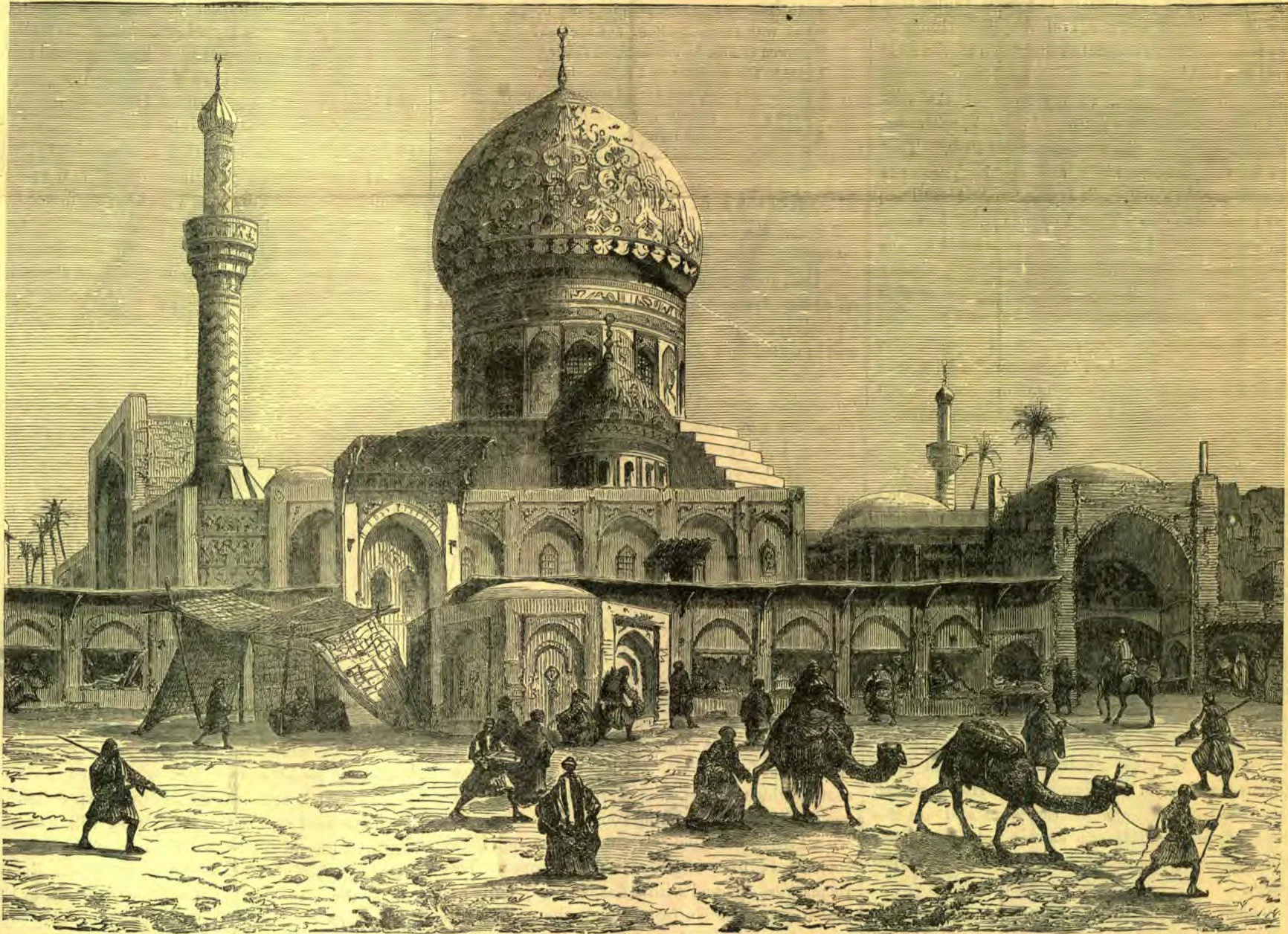
In our picture is given a view of the market place. Here in their stalls the merchant-men sit among their goods, smoking their long pipes, and driving hard bargains with their customers.
Five times a day, from the tall minarets of the mosques, the muzein calls the faithful to their devotions. The close bargaining is suddenly interrupted, although no more than half completed at the sound of that call, and all true believers, wherever they may be, offer up their petitions. The scene is very impressive.
The city is inclosed with strong walls, shutting it in from the great desert lying all around. Three gates open into it, one on the southeast, one on the northeast, and one on the northwest. All around the outside of the wall is a deep, dry ditch.
Perhaps one of the most interesting portions of the town is the old burying-ground. The most prominent object in this old cemetery is the tomb of Zobeide, the favorite wife of Haroun el Raschid, who was one of the greatest and wisest of caliphs. The tomb is a high, octagonal building, surmounted by a lofty, cone-shaped structure. This burying-ground extends over a large portion of the land once occupied by city streets. So does death ever tread on the footsteps of life. In such a place one is forcibly reminded that the numbers of the dead are much greater than those of the living.
W. E. L.

ETHEL'S BOOK OF REMEMBRANCE.

When Ethel was about twelve years old, she used to run into our house very often, and tell us about her school-mates. But somehow she got to telling the unpleasant things, which they would not like to have repeated; and we began to hear who had missed, who had been punished, or who had been cross, stupid, mean, and hateful, until I said at last, “Suppose you turn to the next chapter, and tell me just as many good things about these boys and girls.”
“I don’t remember those half so well,” she answered quickly.
“If that is the case,” I replied, “you have a very poor memory; and the next time I go to Boston, I’ll buy you a new one.”
A day or two after that conversation, I bought at Ward and Gay’s a blank book, with red covers, on the outside of which I got somebody to print in gilt letters, “Ethel’s Book of Remembrance;” and this, together with two bottles of ink, I gave to the young girl. “There’s your new memory,” said I. “Fill it up with stories about your classmates, if you wish.”
“But what’s the use of two bottles of ink?”
“Oh, I want you to write the good things that they do or say in red ink, and the other things in blue ink; and be as careful to put down all the good as all the bad.”
She promised; and, to my surprise, the new book came back in the course of a week, with simply these words on the wrapper, “All Full.” That was harvest concert night, and the book was put away in my desk, where it lay untouched until the next Christmas eve. Then I opened it, while Ethel was with me, and found about two-thirds of the pages filled with red ink items, showing how many good things she had recorded—a long list of kind words and generous deeds, which I read aloud as she sat quietly on a cricket by the open fire. “That’s the end of the red passages,” said I, as I finished; “and now for the blue ones, which will tell me how stupid and hateful those same children can be!”
“No, no! Don’t read those,” she cried. “I am ashamed to have you see them, and I wish I hadn’t written them down. Give me the book, please, without reading the rest.”
So I handed it to her, with a smile, and watched her great astonishment at finding one-third of the book blank; for the blue ink, which recorded the unpleasant items, had entirely faded out, and left the pages almost as white as they were when I bought the book.
“Why!” she exclaimed, “what does it mean?”
“Only that I had the blue ink made expressly for you. It is called Faultfinder’s Ink, and fades out in a few days. If you must write down all those unpleasant items, be very sure and use this kind of ink; and if you cannot get your bottle filled up again, use water, and it will answer every purpose.”
“Soon after that Christmas, Ethel moved to another town, and I did not see her until I went West last year. She showed me the little red book, and said she really did get a new memory when she received that present. And I think she did; for when I asked her about the high school girls, she told me how pretty this one was, and how smart that one, and a third so good, and a fourth so obliging, until I finally inquired if they were all perfect and had not a single fault. That brought the old time back, and she blushed a great deal, as she replied:— “The blue ink you gave me faded out so quickly that I did not think it paid to write the faults down on my memory at all. So I looked for everybody’s best things, and wrote only those in my new book of remembrance.”—Selected.

MEXICAN RELICS IN CALIFORNIA.

DURING the month of November, while traveling by carriage from San Pasquil Valley, San Diego Co., Cal., to Norwalk, Los Angeles Co., a distance of ninety-five miles, I passed by two of the old Catholic missions. The first was in San Diego Co., and is called San Louis Rey. The second was in the southwest part of Los Angeles Co., and is called San Juan Capistrano. Although services are not now conducted in these mission houses, and the buildings are fast crumbling to ruins, yet by viewing them, a person can get quite an idea of their former greatness, and the mode of conducting worship in them. The two mission buildings were constructed on a similar plan, except that the former was much larger than the latter, and is now in a better state of preservation.
I will only describe those of the San Louis Rey Mission. The church building itself is about thirty by sixty feet. Directly at the left of the church building, and even with its front, is an inclosure five hundred feet square, surrounded by a wall fifteen feet in height. Within the first twenty feet of this space, and across the entire front, are inclosed rooms, which I was told were used for cooking rooms, festive halls, dining rooms, wine rooms; and withal there was a huge oven, large enough for the cooking of five whole bullocks at once. These rooms were covered with a flat, strongly-built roof, which extended six feet without the walls, and as many feet within the court; and was supported on either side by a beautiful colonnade, thus forming a porch without the walls, and within the court. At either edge of this roof there was a balustrade, or breastwork, some three or four feet in height, constructed of open tiles. Upon this roof, hundreds could stand and see the sports conducted in the court.
You may think strange that in this place of amusement connected with a mission church, one of the chiefest was a regular Spanish bull-fight. This portion of California, as you may all be aware, was once a part of Mexico. The inhabitants, in the days when these missions flourished, were either Spanish, or Indians taught in the Spanish language, habits, and customs. In past times, bull-fighting was one of the choice sports of the Spaniards. Of the Indian, it has been often said that his natural habit is to go from his devotions to dissipation. Perhaps the priests counted on this natural inclination of the people, and so arranged matters as to draw the whole surrounding country together on their gala days.
I was told that when the people were thus occasionally called together, religious services were first held. The people so disposed, confessed their sins to the priests, for which they, of course, took the people's gold and silver. This was followed by a grand barbecue, and the entertainment closed up with a bull-fight.
Opposite the mission buildings was a field of ten or fifteen acres, surrounded by a wall some five feet high. Within this inclosure the beasts were kept, and from it they were brought into the court to fight. From the flat roof before mentioned, the spectators could behold the animals caught in the field, led into the court, and then the battle, until the animal was slain.
As I looked upon those grounds, and meditated upon the purpose for which they had been so often used in the past, strange thoughts passed through my mind. In the church, the priests professedly taught the people the gospel of Jesus of Nazareth. That gospel is full of gentleness, kindness, and self-denial. Had it really been taught by the priests in this mission, it would have been a strange departure to engage at once in feasting and wine-drinking to excess, and then a cruel bull-fight; but with a religion of “soulless forms,” and “pampered sense,” I do not know as we should expect any thing different. The Revelator described this apostate church as “feasting on the abundance of her delicacies,” and not as one pursuing the path of self-denial taught and exemplified in the life of the Saviour. J. N. LOUGHBOROUGH.

MUSIC

MUSIC is to the ear what beauty is to the eye. One is heard, the other seen; both may be enjoyed. It is difficult for us to say when music was first heard, but as far back as when the world was first made, “the morning stars sang together, and all the sons of God shouted for joy.”
As men began to multiply on the earth, there began a multiplication of pursuits and inventions, and among the early inventors there might be seen father Jubal, charming the listening crowd with wonder and delight, while he swept the new-made harp with a master hand, and taught the enraptured children to pour forth melody from the first instrument that was ever played.
Ever since his day, people have loved the melody of sweet sounds, and when they can hear no other, they will set themselves down delighted with the wild music of nature; they will listen to the warbling of the birds, the hum of the bee, the buzzing minstrelsy of the insect tribes, the cooing of the dove, the dash of the waters, the sigh of the zephyr, or the rush of the storm; and they will settle into silence as the loud thunders peal along the darkened heavens, “and shake the world with awe.”
But nature’s music was not enough for man. The Creator designed that he should make music for himself, and that it should be an art among men—a pleasant and healthful exercise—a science to be studied and improved upon—something to arouse and elevate the feelings, to warm and gladden the heart, and to thrill the soul with rapture and delight.
We doubt whether the Creator ever made a world in which no music could be heard, or living creatures capable of thought who cannot be moved by melody, or thrilled by its hallowing power.
Why, when the skillful variations of well-regulated sounds rise and float along the air, as the strains become sweeter and the tones more clear, the wild beast of the forest is subdued into submission, the hyena quits its prey, the lion crouches down, the fierce tiger is tamed into silence, and, as in the case of Saul, Satanic madness drops its scowl and retires.
Moses introduced it in the Jewish church, and taught the children of Israel to sing that immortal song of victory, when horse and rider, chariot and charioteer, shield and buckler, Pharaoh and all his host, were swept into the sea; and as the notes of that song* rang on the morning air, the hearts of the aged must have bounded with youthful courage; and then it was, as we read in the Book of wisdom, that “God opened the mouth of the dumb and made the tongues of infants eloquent.”
All along in after years, during Israel’s prosperity, hymns of praise were sung in the religious services, and the sweet singer of Israel melodized gratitude and thanksgiving into the loftiest praise that was ever sung on earth.
At the dedication of Solomon’s Temple, as the long ranges of musicians stood at the east end of the altar, the “trumpeters and singers were as one, to make one sound in praising and thanking the Lord;” then the house was filled with the glory of the Lord.
Like many other blessings, music has been perverted, used for evil purposes, yet this is no argument against its proper use.
Satan and wicked men know very well its power over the human heart, and have successfully used it in the cause of sin. Shall the children of light be so blind as not to see its worth in the cause of Christ?—Selected.

WINTER

WINTER’S wild birth-night! In the fretful East The uneasy wind moans with its sense of cold, And sends its sighs through gloomy mountain gorge, Along the valley, up the whitening hill, To tease the sighing spirits of the pines, And waste in dismal woods their chilly life. The sky is dark, and on the huddled leaves— The restless, rustling leaves—sifts down its sleet, Till the sharp crystals pin them to the earth, And they grow still beneath the rising storm. The roofless bullock hugs the sheltering stack, With cringing head and closely gathered feet, And waits with dumb endurance for the morn. Deep in a gusty cavern of the barn The witless calf stands blatant at his chain; While the brute mother, pent within her stall, With the wild stress of instinct goes distraught, And frets her horns, and bellows through the night.
The stream runs black; and the far waterfall That sang so sweetly through the summer eves, And swelled and swayed to Zephyr’s softest breath, Leaps with a sullen roar the dark abyss, And howls its hoarse responses to the wind.
Yet lower bows the storm. The leafless trees Lash their lithe limbs, and, with majestic voice, Call to each other through the deepening gloom; And slender trunks that lean on burly bough, Shriek with sharp abrasion; and the oak, Mellowed in fibre by unnumbered frosts, Yields to the shoulder of the Titan blast, Forsakes its poise, and with a booming crash, Sweeps a fierce passage to the smothered rocks, And lies a shattered ruin. —J. G. Holland.

IMPORTANT BIBLE SUBJECTS.

LESSON 24.—THE INHERITANCE OF THE SAINTS.

[NOTE TO THE STUDENT.—Do not consider the lesson learned until you can give at least the substance of every text, with the correct reference for each. The references in black letters indicate those texts that should be committed to memory. A little diligent application each day will enable you to do this.]
1. WHAT is the meaning of the word “meek”?
2. Mention two individuals who possessed this grace in a remarkable degree. Num. 12:3; 1 Peter 2:21-23.
3. How was the meekness of Christ manifested? 1 Peter 2:23.
4. In thus meekly suffering injury, what did he leave us? 1 Peter 2:21.
5. What should we do? Ib.
6. What will be done by all who abide in Christ, or, in other words, by all Christians? 1 John 2:6.
7. Then what grace must characterize all Christians?
8. What is promised to the meek? Matt. 5:5.
9. By what other term are the meek referred to in this chapter? Verse 3.
10. What is promised to the poor in spirit?
11. What testimony does the apostle James bear on this point? James 2:5.
12. What is an heir?
13. Then if the meek are “heirs,” what can you say as to the time of their inheritance?
14. What must the heirs pass through before they can receive the promised inheritance? Acts 14:22.
15. What class of people in this world are in the best condition? Ps. 73:3-7.
16. On further consideration, what did David see would be the end of such? Verses 17-19.
17. How complete will be their destruction? Ps. 37:10.
18. What will then take place? Verse 11.
19. Then what must take place before the fulfillment of the promise in Matt. 5:5?

NOTES.

MEEK: “1. Mild of temper; not easily provoked or irritated; given to forbearance under injuries; soft, gentle, yielding. 2. Specifically, submissive to the divine will; patient and gentle from moral and religious motives.”—Webster.
An heir is one who is entitled, either by birth, adoption, or special promise, to succeed to the possession of any property. Ordinarily, the heir comes into possession at the death of the proprietor. When we hear that a man is heir to a certain estate, we know that the time when he shall possess it is still in the future.

“CHEERFUL WORKERS.”

“CHEERFUL WORKERS” is the name we have given to our society. By “we” I mean some of the young folks at Bernardo, Cal.
We had been growing careless about trying to live real Christian lives; and at last we concluded that we must do something about it before we became, too worldly to care to improve. This is the plan we have taken:—
Sabbath afternoon, we met at the school-house, where we hold our Sabbath-school. Most of us are between the ages of twelve and twenty.
We talked the matter over, and decided to have a society with the following rules:—
Each member is to have a plot of ground of a certain size. On this ground he is to plant corn, beans, potatoes, or anything he pleases. He is to take good care of the crop, and harvest and sell it.
All the money obtained in this way is to be paid into the hands of a treasurer elected by the society. The money is to be used as the society shall decide; but it is to be for some good purpose, and not any of it for ourselves.
Each member must also send off one copy of the Signs each week. Our parents take a club of Signs, so we shall use papers from it until the time for which they subscribed has expired; then we may send for a club of our own. But each one is to earn money enough to pay the postage on his papers.
We are to meet the evening after the Sabbath, report the condition of our crops, read any letters we may have received from missionary work, and talk over our experiences of the past week.
At each meeting we are to select some good verse, try to remember it, and act by it through the week. Our motto for this week is, “The Lord loveth a cheerful giver.” We are to try to remember that everything we do is either for God or for Satan. When we are kind, patient, and helpful, we are giving cheerful service to God; when we are cross, lazy, or selfish, we are serving Satan.
By this plan, we hope to get up such an interest in the work of spreading the truth that each member of the society will feel connected with the work, and be active, cheerful workers in the great harvest field of God.
All who were present at the meeting joined the society. We then elected a president, secretary, and treasurer.
At some future time the “Cheerful Workers” may send another letter to the INSTRUCTOR, telling the results of their plans.
Could not the younger members of other churches start such a Society, too? If all cannot have plots of ground, they may be able to find some other way of earning the money. They may, in this way, do much good for the Master.
L. JUDSON.

A CURE FOR TATTLERS.

MISS HANNAH MORE, a celebrated writer who died about fifty years ago, had a good way of managing tale-bearers. It is said that whenever she was told anything bad about another, her reply always was, “Come, we will go and ask if it be true.” The effect was sometimes ludicrously painful. The tale-bearer was taken aback, and begged that no notice might be taken of the statement. But the good lady was firm; off she took the scandal-monger to the scandalized, to make inquiry and compare accounts. It is not likely that anybody ever a second time ventured to repeat a gossipy story to Hannah More. One would think her method of treatment would be a sure cure for scandal.

TRYING TO DO RIGHT.

Do not, after one mistake, give up trying to be good. Begin anew every morning, and see how much better you can do each day. A tree never grew to be a tree in a single night; first it was a seed, then a tender sprout, then a weak sapling, and at last a strong tree. So you will grow, if you keep trying to do right; from a fearful, helpless disciple of Jesus, you will go on till you become a brave and successful soldier in his cause. And yet he loves the little ones who try to serve him, just as well as the valiant bearer of the cross who gains great victories for him; for in each case he sees the love in the heart which prompted the action. Remember how he watches your movements. Never give up.—Selected.

THE BRIGHT SIDE.

Nature will always take the color of the spectacles we wear. They who choose to wear yellow ones are likely to die of the jaundice; those who prefer rose-color make life a gladness and a blessing, and generally walk on the sunny side of the way. A poor widow, not having bed-clothes to shelter her boy from the snow which blew through the cracks of her hovel, used to cover him with boards. “Mother,” said the boy, “what do poor folks do this cold weather who have no boards to put upon their children?” There are people who are never contented with their lot. Clouds and darkness are over their heads, whether in rain or shine.—Selected.

THE “S. S. WORKER.”

We trust that all our Sabbath-school officers and teachers have provided themselves with a copy of the S. S. Worker. If any have failed to do so, let them subscribe at once, for they can illy afford to lose the instruction contained in it.
The Worker is a sixteen-page magazine, devoted to the interests of the officer, the teacher, the scholar, and the home, and contains articles from all our leading S. S. workers. The Question Box is a department of no small interest to our schools; also the department headed “Our Reports,” in which is given every quarter the reports of the individual schools. Each number will contain a page of new music for the use of the Sabbath-school.
This valuable paper ought to visit every home. Send twenty-five cents to the S. S. Worker, Battle Creek, Mich., and thus secure this quarterly for one year. No live, active Sabbath-school worker can do without it.

A Life for Christ: Love, Usefulness, Faithfulness

A LIFE for Christ must always be a life of love, of usefulness, and of faithfulness. It is just living for God, day by day, hour by hour. It is nothing strained and unnatural; beginning in the heart, in a true devotion to Christ, it is lived out in simple obedience and quiet faithfulness in whatever sphere our lot may be cast.

Think Truly, Speak Truly, Live Truly

THINK truly, and thy thoughts Shall the world's famine feed; Speak truly, and each word of thine Shall be a fruitful seed; Live truly, and thy life shall be A grand and noble creed.—Bonar.

I AM NOT MY OWN.

“WISH I had some money to give to God,” said Susy; “but I haven’t any.” “God does not expect you to give him what you have not,” said her papa, “but you have other things besides money. When we get home, I will read something to you, which will make you see plainly what you may give to God.”
So after dinner they went to the library, and Susy’s papa took down a large book, and made Susy read aloud: “I have this day been before God, and have given myself—all that I am and have—to God; so that I am in no respect my own. I have no right to this body, or any of its members; no right to this tongue, these hands, these feet, these eyes, these ears. I have given myself clean away.”
“These are the words of a great and good man, who is now dead. Now you see what you have to give to God, Susy.”
Susy looked at her hands, and at her feet, and was silent. At last she said in a low voice, half to herself: “I don’t believe God wants them.”
Her papa heard her. “He does want them, and he is looking at you now to see whether you will give them to him, or keep them for yourself. If you give them to him, you will be careful never to let them do anything naughty, and will teach them to do every good thing they can. If you keep them for yourself, they will be likely to do wrong and to get into mischief.”
“Have you given yours to him, papa?”
“Yes, indeed, long ago.”
“Are you glad?”
“Yes, very glad.”
Susy was still silent; she did not quite understand what it all meant.
“If you give your tongue to God,” said her papa, “you will not allow it to speak unkind, angry words, or tell tales, or speak an untruth, or anything that would grieve God’s Holy Spirit.”
“I think I’ll give him my tongue,” said Susy.
“And if you give God your hands, you will watch them, and keep them from touching things that do not belong to them. You will not let them be idle, but will keep them busy about something.”
“Well, then, I’ll give him my hands.”
“And if you give him your feet, you never will let them carry you where you ought not to go; and if you give him your eyes, you will never, never let them look at anything you know he would not like to look at, if he were by your side.”
Then they knelt down together, and Susy’s papa prayed to God to bless all they had been saying, and to accept all Susy had now promised to give him, and to keep her from ever forgetting her promise, but to make it her rule in all she said, and all she did, all she saw, and all she heard, to remember—“I am not my own.”—The Sunlight.

A GREAT PAPER.

Many pieces of old paper are worth their weight in gold. I will tell you of one that you could not buy for even so high a price as that. It is now in the British Museum in London. It is old and worn, and is more than 666 years old.
It is not so easy to realize how old that is. Kings have been born and died, nations have grown up and have wasted away during that long time. There was no America (so far as the people who lived at that time knew) when this old paper was written upon. America was not discovered for nearly three hundred years after it. A king wrote his name on this old paper; and although he had written his name on many other pieces of paper, and they are lost, this was very carefully kept from harm, though once it fell into the hands of a tailor, who was about to cut it up for patterns, and at another time it was almost destroyed by fire.
Visitors go to look at it with great interest. They find it a shriveled piece of paper, with the king’s name and the great seal of England on it; but they know that it stands for English liberty, and means that “Britons never shall be slaves.” It is called the “Magna Charta,” which means simply the “Great Paper.” There have been other great papers, and other papers that have been called “charters,” but this is the one known the world over as the “Great Paper.”—Selected.

RED RIDING-HOOD.

On the wide lawn the snow lay deep, Ridged o'er with many a drifted heap; The wind that through the pine trees sung The naked elm-boughs tossed and swung; While, through the window, frosty-starred, Against the sunset purple barred, We saw the somber crow flap by, The hawk's gray neck along the sky, The crested blue-jay flitting swift, The squirrel poising on the drift, Erect, alert, his thick gray tail Set to the north wind like a sail.
It came to pass, our little lass, With flattened face against the glass, And eyes in which the tender dew Of pity shone, stood gazing through The narrow space her rosy lips Had melted from the frost's eclipse: “Oh see,” she cried, “the poor blue-jays! What is that the black crow says? The squirrel lifts his little legs, Because he has no hands, and begs; He's asking for my nuts, I know; May I not feed them on the snow?”
Half lost within her boots, her head Warm sheltered in a hood of red, Her plaid skirts close about her drawn, She floundered down the wintry lawn; Now struggling through the misty veil, Blown round her by the shrieking gale; Now sinking in a drift so low Her scarlet hood could scarcely show Its dash of color on the snow.
She dropped for beast and bird forlorn Her little store of nuts and corn, And thus her timid guests bespoke: “Come, squirrel, from your hollow oak— Come, black old crow—come, poor blue-jay, Before your supper's blown away! Don't be afraid; we all are good; And I'm mamma's Red Riding-Hood!”
O Thou, whose care is over all, Who heedest e'en the sparrow's fall, Keep in the little maiden's breast The pity which is now its guest! Let not her cultured years make less The childhood charm of tenderness, But let her feel as well as know, Nor harder with her polish grow! Unmoved by sentiments of grief That wails along some printed leaf, But, prompt with kindly word and deed To own the claims of all who need, Let the grown woman's self make good The promise of Red Riding-Hood!
—J. G. Whittier, in St. Nicholas.

LOOK OUT FOR THE VOICE.

You often hear boys and girls say words when they are vexed that sound as if made up of a snarl, a whine, and a bark. Such a voice often expresses more than the heart feels. Often even in mirth one gets a voice or tone that is sharp, and it sticks to him through life. Such persons get a sharp voice for home use, and keep their best voice for those they meet elsewhere. I would say to all boys and girls, “Use your guest-voice at home.” Watch it day by day as a pearl of great price, for it will be worth more to you than the best pearl in the sea. A kind voice is a lark’s song to a heart and home. Train it to sweet tones now, and it will keep in tune through life.—Child’s Guide.

Sincere Repentance and Late Repentance

SINCERE repentance is never too late; but late repentance is often insincere.

Letter Budget.

If our little friends could see the pile of letters waiting a bit of a corner of the Budget, they would know why their own have had to wait so long. We shall need to make them all short as possible, putting in such things as will be most interesting to all. First, we have a letter from Minnesota.
Carrie Hopkins writes from Fillmore Co., Minn. She says: “I have taken the INSTRUCTOR six years, from the time I was four years old until now. We think we could not do without it. I have two brothers and two sisters. We go to Sabbath-school and meeting in the summer, and my little brothers and pa and I go sometimes in the winter; but it is ten miles from home. I love to go to Sabbath-school. My brothers and I go one mile and a half to day school. Pa takes us every morning. We like our teacher very well. We have twelve scholars. Elds. Tenney and Grant held some good meetings at Pleasant Grove, but they have gone away now. Mamma is going to send some selections for the INSTRUCTOR. I hope they will be printed, because they are so nice. We are going to have a Home Missionary Club. Mamma is going to be treasurer. We have to pay two cents a month, and as much more as we can get, out of our own earnings. We thank you for your good paper, and hope you will long continue to publish it. Our love to the dear INSTRUCTOR family.”
Please thank your mamma for the selections. One of them had been used, and they were all good. Think you will see some of them again soon. How we would all like to meet with your club sometime! It is a move in a good direction.
We give you the whole of a letter from a little girl in Wisconsin. She says: “My name is AGGIE MARSHALL. I live in Door Co. I am seven years old. I take the INSTRUCTOR, and I think it is a very nice, good paper. My little brothers and sisters all like it. We can all read it, and would not get along without it. Our pa and ma keep a teacher all the time for us. She takes the INSTRUCTOR too, and likes it. She gives us lessons out of it in our home school. I read in the second reader; but in a few days I shall begin in the third reader. I have never been to school. This is a new country, and there is no church any nearer than eight miles; and then the churches are either German or Swedish, and papa and mamma do not understand the people. My pa and ma came from Scotland to this place seventeen years ago. Baby is crying, and mamma wants me to take care of him; so kind love to all the readers of the INSTRUCTOR family. I will write again.”
We shall all be glad to hear from Aggie again. We can’t think the baby will cry long when his sister goes so cheerfully to him. Cheerful obedience imparts sunshine in the household. You who do not know, just try for your own satisfaction.

You have reached the end of this edition.

The Youth’s Instructor · Mar 4, 1885