WACO is a beautiful city of perhaps twenty thousand inhabitants, admirably located on the Brazos River, near the centre of the State and surrounded by rich agricultural lands, from which immense crops of cotton, corn, wheat, and oats are gathered every year, but it is greatly handicapped by mossbackism, and religion of the sour-godliness type. It has more fine churches and high salaried preachers than any other city of its size in the State, though, morally it is no better than the worst of them.
Lately some enterprising citizens have arranged for a cotton palace exposition, which is to be open during the month of November, and from what we can learn it will be a credit to the city, but no one will be allowed to see it on Sunday.
The board of directors passed a resolution to open it on Sunday, but the preachers who have always had a monopoly of that day for transacting their business set up such a howl that the board, like good little Sunday-school boys, made hot haste to rescind their action and now it is to be kept closed so tight on the “Lord’s day” that a mouse could not get in.
It is said there are about twenty churches in the city with seating capacity for possibly six thousand people, which leaves fourteen thousand which could not get into them if all should take a notion to go to church at once. Now we think the majority who could not be accommodated in the churches should have the privilege of attending the cotton palace if they want to, but this dog-in-the-manger spirit of the preachers will not permit them to do so.
To open the cotton palace on Sunday need not close the churches provided anybody wants to go to church. To extend to the public the privilege of attending the cotton palace on Sunday would not hinder anybody from going to church who wants to go, and if there are people here who would prefer the cotton palace to the church, we think in all fairness they should be allowed to go there, since every one who wants to go to church is perfectly free to do so.
There is no reasonable excuse for such narrow-minded bigotry, and that, too, in deference to a minority of our citizens, for we feel perfectly certain that if this Sunday question could be left to a vote of the people, the cotton palace would be opened on Sundays just as it will be on other days.
We would not be in favor of denying the churches any privilege that rightfully belongs to them, nor do we want to see them interfered with in their right to spend the Sunday just as they please, but they have no right to prevent other people from doing the same. A majority of our people are not likely to attend the churches during the time the cotton palace will be open, and if they should, there is nothing to prevent their doing so except that the churches are not large enough to hold them.
It is plain enough to any observing person that all this fuss about desecrating the Sabbath is business with the preachers. They know well and good that if the cotton palace is kept open on Sundays it will knock down church attendance, and that will be money out of their pockets. They are not willing to put their preaching in competition with the cotton palace, for if they should we doubt if half their own members would go to church a single Sunday during the exposition period.
There are many people here who cannot attend the cotton palace on a week day without losing a day’s work in addition to the gate fees, and many will be here over Sunday, on expenses that will be a dead loss to them.
We are not astonished at the turn this thing has taken, for Waco is a priest-ridden city. It has its full share of saloons and other sinks of corruption that are patronized day and night with frequent robberies and murders, but the line is drawn at desecrating the “holy Sabbath.”
We hope to see many readers of the Pulpit here during the opening of the cotton palace, but they are advised to come early in the week so as to return home before Sunday. — Independent Pulpit, Waco, Texas.
Enforcement of Sunday Laws in Switzerland.
By W. H. McKee
BY W. H. MCKEE, BASEL, SWITZERLAND.
The appealed case of Elder H. P. Holser, manager of the publishing house of the Seventh-day Adventists, at Basel, Switzerland, has been heard by the Federal Tribunal,—the supreme court of the federated cantons,—at Lausanne, and the decision of the lower courts affirmed. The costs of the appeal, however, were ordered paid by the State.
This case was brought under Article 14 of the factory law, which reads thus:—
Labor on Sunday is prohibited, cases of necessity excepted, and with the exception of such establishments as by their nature require an uninterrupted continuance and have for this obtained the permission of the Federal Council (Bundesrath), in accordance with the previous Article 13. In an institution of this kind also the second Sunday must remain free for each workman.
The cantonal legislature is at liberty to appoint farther holidays on which factory work may be prohibited as on Sunday. These holidays may, however, not exceed the number of eight during the year.
Such festival days can be declared binding by the cantonal legislature only for those professing that creed.
Those who will not labor on other church festival days shall not be fined because of refusal to work.
This law applies to every establishment employing five or more workmen; every such institution being adjudged to be a factory under the terms of the law. It has always been the custom, in every institution belonging to the Seventh-day Adventists, in all parts of the world, to perform ordinary labor on Sunday. Mr. Holser, as manager, and therefore responsible, was arrested for the work done on Sunday in the Basel publishing house, convicted, and condemned to both fine and imprisonment. The case was carried from the city police court of Basel to the court of appeals, where it was decided against Mr. Holser, and he addressed the following appeal to the Federal Council,—the court of last resort:—
To the Swiss Bundesgericht at Lausanne,
HONORABLE PRESIDENT AND JUDGES:—
Gentlemen: The undersigned is a member of the Seventh-day Adventist denomination, which has thirteen churches in French and German Switzerland, and a large publishing house in Basel, in which from twenty-five to thirty hands are employed. Our first object is to serve God, in whose name the Federal Constitution is proclaimed. We recognize God’s law of ten commandments as supreme, the fourth of which enjoins rest on the seventh day. This unchanged law we observe, just as it is written in the Bible, and accordingly rest on Saturday and work the other six days, including Sunday.
Our highest object being the observance of the ten commandments, our people have gained a good reputation for being quiet, orderly and industrious. (The truthfulness of this statement may be attested by reference to the citizens of Basel, where we have a church of a hundred members.) During the first years of its existence, our publishing house was not interfered with by the police authorities; but during the last two years we have been fined eight times for Sunday work. These fines, amounting to 320 francs, we could not conscientiously pay, because they were imposed in consequence of our keeping the ten commandments, and therefore were unjust. Hence the authorities seized my private household goods, and sold them at public auction.
August 16, I was again sentenced to three weeks in prison, and 200 francs fines, or forty days in prison, for having worked Sunday August 12, and in addition was threatened with the closing of our business entirely. An appeal to the Court of Appeals, Basel-Stadt, resulted in a confirmation of the decision of the police court; hence I appeal to the Federal Council, and base my appeal on the following:—
1. As Protestant, I acknowledge the Word of God as my only rule of faith and practice. To me, the Bible is the revealed will of God. Chief among the expressions of the divine will are the ten commandments, the fourth of which says, “Remember the Sabbath day to keep it holy. Six days shalt thou labor, . . . but the seventh day is the Sabbath of the Lord thy God. In it thou shalt not do any work.” This command enjoins labor on the six days as well as rest on the seventh. It is God’s express command to me, and my hope for eternal life depends on explicit obedience to this as well as all other commands of Jehovah. Human laws are enforced to the letter, not even a word being allowed to be changed. How much less ought we to change the law of the Supreme! Referring thus, it is impossible for me to obey the law forbidding me to work on Sunday, a day on which God commands me to work. My inability to obey this Sunday law does not arise from a fanatical fancy of my own, or of some sectarian leader, but from allegiance to the ten commandments which Christians have in all ages acknowledged.
2. According to God’s word, Sunday is for us a rival institution to God’s Sabbath. It stands as the sign of authority of a church which we as true Protestants cannot accept. It has been argued that the Sunday law does not oblige us to accept the day as a religious institution, but simply to lay aside our secular work on that day. But as Sunday observance in Switzerland consists simply in not working, when we cease to carry on our regular work, we keep the day to all intents and purposes. The only way to show that we do not keep the day is for us to work on it. Therefore, by forcing us to lay aside our secular work on this day, Sunday laws oblige us to accept an institution directly opposed to our faith.
3. The object of Article 14 of the factory law, under which I am condemned, is to protect the laboring class against the avarice of the capitalist, by securing him a day of rest each week. Our house does not allow work, under any circumstances, on the seventh day, so each employé is absolutely sure of a weekly rest-day, and thus we certainly meet the object of the law. With scarce an exception, our employés observe the seventh day as a matter of conscience. When compelled to lay down their work on the first day also, they suffer under this law which, according to its chief promoters, is philanthropic, not oppressive.350Hence, by enforcing Sunday observance on our house, the object of Article 14 of the factory law is defeated. The Federal Factory inspector acknowledged this in 1886, and ordered that in consequence we be not molested on account of Sunday work.
4. The enforcement of Sunday laws on Seventh-day Adventists is a violation of Article 49 of the Federal Constitution, which says: “Religious liberty and freedom of conscience are inviolable.”
“No one may be compelled to take part in a religious organization, or in religious instruction, or to undertake a religious act, or suffer the infliction of punishment of any sort whatsoever on account of religious views.”
“The exercise of civil rights may be restricted by no sort of precepts or conditions of an ecclesiastical nature.”
“Religious views do not release from the fulfillment of civil duties.”
It is our natural and inalienable right to serve God according to the dictates of our own consciences. The State cannot give us this right; we have it direct from God, by virtue of being human beings; and the State can only protect us in the exercise of this right. Should we attempt to exercise it in a way to invade our neighbor’s rights, then the State must interfere, not because we are exercising our right, but to protect the rights of our neighbor. But while we keep the ten commandments, it cannot be made to appear that we invade the rights of our neighbor. Further, under Article 49, we read: “Religious views do not release from the fulfillment of civil duties.” But it being our natural right to work, and only a religious but never a civil duty to rest from labor one day every week, it cannot be claimed that it is a duty which we owe to the State to rest on Sunday. Again, under the same article we read: “No one may be subjected to fines [or punishment] of any kind whatsoever because of his religious views.” The sole and only reason why I am fined under the Sunday law is because of my religious belief that I must keep Saturday.
5. I appeal from the decision of the police court, not from a motive to resist the civil government, but because I must obey God rather than man. The civil government being ordained of God, is under and not above him. Now, if the State makes laws hindering me from keeping the commandments of God, who is above the State, it thereby elevates itself above God, and we cannot obey it in this presumption.
Paul, who was inspired to write, that we should be subject to the powers that be, lived under a heathen government, which commanded men to honor the gods of Rome and forbade as treason the introduction of another god; but he did introduce another God, who overthrew all the gods of Rome. This proves that the command to be subject to the powers that be cannot have reference to religion.
In Romans 13:3–4, we read: “Whosoever therefore resisteth the power, resisteth the ordinance of God; and they that resist shall receive to themselves damnation. For rulers are not a terror to good works, but to the evil. Wilt thou then not be afraid of the power? do that which is good and thou shalt have praise of the same. For he is the minister of God to thee for good. But if thou do that which is evil, be afraid; for he beareth not the sword in vain; for he is the minister of God, a revenger to execute wrath upon him that doeth evil.” Thus it is plain that God’s order in ordaining the State is for the punishment of evil-doers and the praise of them that do well; and when the State pronounces this evil and punishes me for it, the State is acting against God’s order.
6. The province of the State is to protect the individual in the exercise of his natural rights; and not to protect majorities only, and even aid the majority in depriving the minority of some of their natural rights. One of the natural rights of man is to perform honest labor. When the State obliges me to rest or cease labor on Sunday, it deprives me of this right. If the majority has the right to deprive me of one natural right, it may deprive me of all, and thus reduce me to the condition of slavery.
After observing the seventh day in obedience to our conscience instructed by the Bible, we have the same right to work six days as those who keep the first day. If first-day observers have a right to use the State to force us to keep the first day after we have rested the seventh, we have the same right to use the State to force them to rest the seventh day in addition to the first. We acknowledge the right of the State to protect us in our right to rest; but we protest against the State forcing us to lay aside our regular work on a day on which our conscience tells us to labor.
7. In forcing Sunday observance on me and Seventh-day Adventists whom I represent, the State deprives us of one-sixth of our income. It is declared that the Sunday law does not hinder our keeping the Sabbath; but it does rob us of one-sixth of our living. What right has the majority to impose a tax of 16⅔ per cent. on the minority for the privilege of exercising freedom of conscience? The Constitution grants freedom of conscience to every citizen; hence a law which imposes a tax of 16⅔ per cent. on the minority for this privilege is openly against the Constitution. As Christians, it is our duty to provide for our families. “But if any provide not for his own, and especially for those of his own house, he hath denied the faith, and is worse than an infidel.” 1 Tim. 5:8. Under the present conditions it is impossible to maintain a family with but five days work per week; hence by prohibiting our working on Sunday, the State brings us into a condition which the Bible calls heathen; and so these Sunday laws would force us to deny the faith.
The State’s attorney argued that the Sunday law prohibited our work in the factory only, and that we could work at home. But here we would be restricted by other Sunday laws; and very few factory hands have work at home that would be remunerative. Because we keep the Sabbath, it is almost impossible to find work among Sunday-keepers; so we must have factories of our own; and if we are not allowed to work on Sunday, we are certainly oppressed by the State because of our religion.
8. It is also argued that Sunday laws are civil, not religious, and so cannot interfere with religious liberty. But they do interfere with our religious liberty. Wherever such laws are enforced, there is liberty of conscience only for those that accept Sunday and those that are indifferent about the day. But it is our duty to work six days, and Sunday being one of these six work days I must work on it in order to keep the commandment.
Again, Sunday laws are a violation of Article 49 of the Constitution, which says: “The exercise of civil or political rights cannot be restricted by any kind of regulations or conditions of a religious or ecclesiastical nature.” Sunday is a church institution. It was established by the church, and has ever been promoted by the church. It is to be found only where professing Christians are found. The week is not a natural division of time, but is purely a Bible institution, given by inspiration, and Sunday is to occupy the place of the Sabbath in the week. Only those nations that have the Bible have the week. When the French Revolution rejected the Bible, it rejected the week, and also Sunday as a part of it. Another evidence that Sunday is religious is that its chief promoters are the ministers. This is true in all parts of the world. Societies formed for the promotion of Sunday observance are organized by ministers and religious people; and with few exceptions, the officers of such societies are ministers.
Furthermore, Sunday law advocates do not want a secular Sunday. That is the very thing they don’t want. The chief agitators for Sunday laws want a religious day. The religious part is the essential part. The proceedings of the international congresses for Sunday Rest show this with sufficient plainness.
(Conclusion next week.)
Significant Paragraphs.
[We publish under this heading paragraphs more or less significant, without either approval or dissent, and without comment. The careful observer of the signs of the times will readily discern the pertinent facts and opinions, and will know how to turn them to account in the great controversy between truth and error.]
United Presbyterians Favor Church Taxation.
PITTSBURG, Oct. 29.—Should church property be exempt from taxation was vigorously discussed and answered in the negative here to-day by the United Presbyterian Ministers' Association. The Rev. John A. Wilson, D.D., of the United Presbyterian Theological Seminary presented an able paper upon the subject. Incidental to the subject there was considerable discussion of the proneness of some ministers to ask reductions in the bills of their grocers, bakers, butchers, tailors, and others with whom they deal, out of respect to the cloth. This practice was bitterly denounced by all who spoke on the subject.—New York Sun, Oct. 30.
The Pope’s Views on the Union of the Eastern and Western Churches.
ROME, Oct. 29.—The text of the pope’s speech to the conference held to consider the union of the Eastern and Western churches has just been made public, although the speech was delivered on the 24th. After praising all who had helped bring about the conference, he said:—“We wish that all governments alike had embraced this grand ideal, inasmuch as the work, if achieved, will be for the interest and benefit of the entire world; but political views and, still more, we regret to say, the unreasonable jealousies of some of the governments, which show in what condition the papacy is placed, have prevented these reunions from having the large and solid results rightly expected from them. “Above all, we must lament the absence of the patriarch of the Armenians. We shall not on this account, however, recede from our purpose, and, even if we can count only within certain limits on political union, nothing will prevent us from solving the grand problem from the religious side while awaiting more propitious times for the rest of the work.”—New York Sun, Oct. 30.
A Means of Education.
IF the tendency to adopt “Romish ceremonial” does not ultimately bring about the reunion of all Christians in one true faith, it will yet have some good effect. Formerly it was a severe task to get prospective converts to understand and accept the ceremonies of the church. The Protestant sects, in adopting them and using them in their churches, are doing a great deal of educational work which formerly came upon the shoulders of the Catholic priests. Protestants, in thus becoming acquainted with Catholic ceremonies, render themselves easy converts to the faith.—Boston Republic.
In America and in Europe.
The Catholic Review does not as a rule take part in politics. On the contrary it carefully avoids it. The exception happens when faith, morals, or Catholic rights are in jeopardy. In that case, it speaks out without fear or favor, without partisan bias or prejudice, having no entangling alliance with any party or organization. In this election it is forced in self-defense to say: Vote against the A. P. A.; against any and every candidate and any and every party that affiliates with, truckles to, secretly encourages or openly favors political proscription for reasons of conscience. Religious liberty is of more worth than tariff taxes or any other minor issue. Vote against the A. P. A.!—Catholic Review, New York, Oct. 28, 1894.
The debate in the Hungarian House of Magnates on the bill for extending religious freedom in Hungary commenced on Wednesday, Oct. 4th. The principal point of difference is in reference to a clause which has been in force in Cisleithania for the past twenty-six years, permitting people when describing themselves to declare that they belong to no recognized faith, or that they are confessionless (which is not identical with professing no religion). Cardinal Bishop Schlauch, however, declared the clause to be religious anarchism, and said that it could only promote social revolution, atheism, and irreligion, and prepare the way for political anarchism, just as the bill in reference to the Jews permitting, among other things, Christians to be converted to Judaism would contribute to undermine the moral basis of the Hungarian people.—From London Tablet, Roman Catholic, reprinted in Catholic Review of October 28, 1894.
The Power of the Saloons.
THE churches are bodily against Tammany, and this is a formidable power, but with 9,000 saloons as a reserve at their back the Tammany leaders think they can set the churches, of which there are less than 1,000 in this city, at defiance. Tammany does not like to believe that the liquor dealers are in open revolt against the blackmailers.
“Each one of these saloons,” said a Tammany leader the other day, “absolutely controls not less than six votes. There are 54,000 votes in all we are sure of. The regular organization has in addition not351less than 90,000 votes, and with these as a fighting force and the saloons as a reserve, the preachers may howl and the papers may denounce, but we can afford to laugh.”
The claim of 90,000 members for the regular Tammany organization is, without doubt, a fiction, but the strength of the saloons has not been exaggerated by this man. The saloons may be said to hold the balance of power when the party lines are closely drawn. In the destruction of Tammany it will be an error to count the victory as won till the power of the saloons is weakened, or better still—destroyed.—Commercial Advertiser, Oct. 29.
BOOKS FOR THE CHILDREN.
We offer the following three books as the best of their kind we have been able to find. They are profusely illustrated, and the stories are told in a very simple yet highly entertaining manner. The books cannot fail to be exceedingly helpful to children in an educational way, and should be found in every home:—
LITTLE FOLKS’ BIBLE GALLERY
Has nearly 100 pages, and contains 43 Bible stories, each illustrated with a full-page picture. Size, 7x9 inches, bound in board lithograph covers. Price, by mail, post-paid, $1.00
BIBLE PICTURES AND STORIES
Has 45 full-page illustrations and an equal number of well-told Bible stories. Same style and size as “LITTLE FOLKS’ BIBLE GALLERY,” and is really a companion volume to it. Price, post-paid, $1.00
A mother, than whom none can be more careful and particular as to what her children have to read and study, speaking of these two little books, says: “Really it is a pity that any little child should not have the privilege of seeing these beautiful full-page pictures and hearing the well-told stories.”
Both “LITTLE FOLKS’ BIBLE GALLERY” and “BIBLE PICTURES AND STORIES” will be sent to one address, post-paid, for $1.75
The Good Shepherd:
The Life of the Saviour for Children.
Beautifully Illuminated Covers!
Fifty-three Illustrations!
Interesting Reading!
Ninety-six pages,
Large print,
Good paper,
Strong binding.
This book, which is 8x10½ inches and ½ inch in thickness, tells the story of the life of Christ in a way that cannot fail to interest the little folks. It is exceptionally free from doctrinal errors, and should be in every family where there are children to be taught a Saviour’s love. The illustrations add very much to its educational value. Price, only 50 cents.
—ADDRESS—
PACIFIC PRESS PUBLISHING COMPANY,
43 BOND STREET, NEW YORK CITY.
“Before He Is Twenty,” —OR— “Five Perplexing Phases of the Boy Question.”
IS A VERY HELPFUL BOOK FOR PARENTS.
It is divided into five chapters, by as many different writers, each treating of a particular phase of a boy’s life.
The first chapter, “THE BOY AND HIS FATHER,” by Robert J. Burdette, is alone worth many times the price of the book to any father of a young boy.
The other chapters, “WHEN HE DECIDES,” “THE BOY IN THE OFFICE,” “HIS EVENINGS AND AMUSEMENTS,” and “LOOKING TOWARD A WIFE,” are all important and helpful.
104 pages, bound in cloth, embossed in jet and gold, price, 75 cents.
PACIFIC PRESS, 43 BOND STREET, New York City.
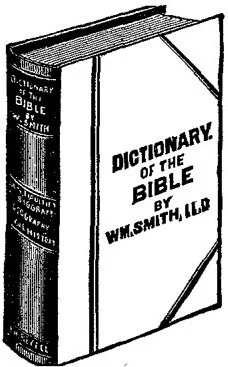
SMITH'S DICTIONARY of the BIBLE.
EDITED BY WM. SMITH, L.L.D.
COMPRISING ITS ANTIQUITIES, BIOGRAPHY, GEOGRAPHY, AND NATURAL HISTORY.
PRICE, $2.00.
This work contains every name in the Bible respecting which anything can be said; over 400 engravings, and is a complete guide to the pronunciation and signification of scriptural names; the solution of difficulties of interpretation, authority, and harmony; also a history and description of Biblical customs, manners, events, places, persons, animals, plants, minerals, etc., and comprises a most complete encyclopedia of Biblical information.
PACIFIC PRESS, 43 Bond Street, New York City.
YOUNG PEOPLE'S LIBRARY SERIES 1.
Every volume in this library contains choice, wholesome, instructive reading, and, while designed for the young, it will be equally interesting to every member of the family. Each volume has 160 pages, is fully illustrated and substantially bound in fine colored cloth, handsomely embossed in jet and gold.
Series 1 contains six volumes, which are as follows:—
FIJI AND SAMOA.—JOTTINGS FROM THE PACIFIC, No. 1.
JACK THE CONQUEROR.
SAVONAROLA, THE FLORENTINE MARTYR.
THE TONGA ISLANDS AND OTHER GROUPS.—JOTTINGS FROM THE PACIFIC, No. 2.
LETTERS FROM THE HOLY LAND.
AMONG THE NORTHERN ICEBERGS.
The set, in cloth, in a box, sent post-paid, for $3.60; single volumes, 60 cents each; paper, 25 cents.
CRUDEN'S CONCORDANCE,
A DICTIONARY, And Alphabetical Index TO THE BIBLE.
CLOTH, $1.25. SHEEP $2.50.
ADDRESS, PACIFIC PRESS, 43 BOND STREET, NEW YORK CITY. Kansas City, Mo. Oakland, Cal.
PRISON LIGHT
Edited by one sending the Third Angel's Message to the perishing in prisons all over the land. Agents wanted, 50 per cent. commission. Trial year 20 cents. Terms and sample copy 2 cent stamp. Indexed by the SENTINEL.
PRISON LIGHT, 40 Green Street, Brattleboro, Vt.
A CRITICAL HARMONY of the GOSPELS.
By James P. Cadman
BY JAMES P. CADMAN, A. M.
One of the best helps to Bible Study ever published.
THIS Book gives, in the words of the Evangelists themselves, the gospel narrative, giving every word from each of the four Gospels, and indicating by the figures 1, 2, 3, 4, representing Matthew, Mark, Luke, and John, which of the four, or if more than one, how many of them use the words given, so that the reader has under his eye all the words of the Evangelists on any given subject, without turning from gospel to gospel to find them, and this is a connected narrative.
The text used is that of the Revised Version, making the book specially valuable for use in connection with the King James' Version.
Long primer type, 380 pages, well bound in cloth, price, $1.50.
—ADDRESS—
P A C I F I C P R E S S,
43 Bond St., New York City.
IS THE PAPACY IN PROPHECY?
By Thomas W. Haskins
BY THE **Rev. Thomas W. Haskins, M. A.,
Rector Christ Church, Los Angeles, Cal.
The above is the title of a treatise written by the author, at the request of the Ministerial Union of Los Angeles, California. It grew out of a discussion upon the present aspect and aims of The Roman Catholic Church in the United States, the author taking the ground that the rise, progress, present and future condition of the temporal power known as the Papacy, or Vaticanism, Is Outlined in the Prophecies of Holy Scriptures, with sufficient accuracy to determine what the “Papacy” is, and what is to be its future development and ultimate end.
Paper Covers, - - - 25 Cents.
Cloth Covers, - - - - 60 Cents.
Mailed, post-paid, on receipt of price.
YOU CAN BIND
By H. H. Ballard
One sheet, or three hundred sheets, in ten seconds. The Klip binds loose sheets, pamphlets, or magazines.
If you want covers also, you had better send for a Klip price-list—that’s free. If you will try the Klip, I will mail a sample dozen, six sizes, and a pair of Klip-Keys to put them on with for seventy-five cents.