The Youth's Instructor, Vol. LI, No. 23

The World’s Metropolis—II

The Youth's Instructor

June 11, 1903

Review and Herald Publishing Company · Battle Creek, Michigan · June 11, 1903

The World’s Metropolis—II

London Tower

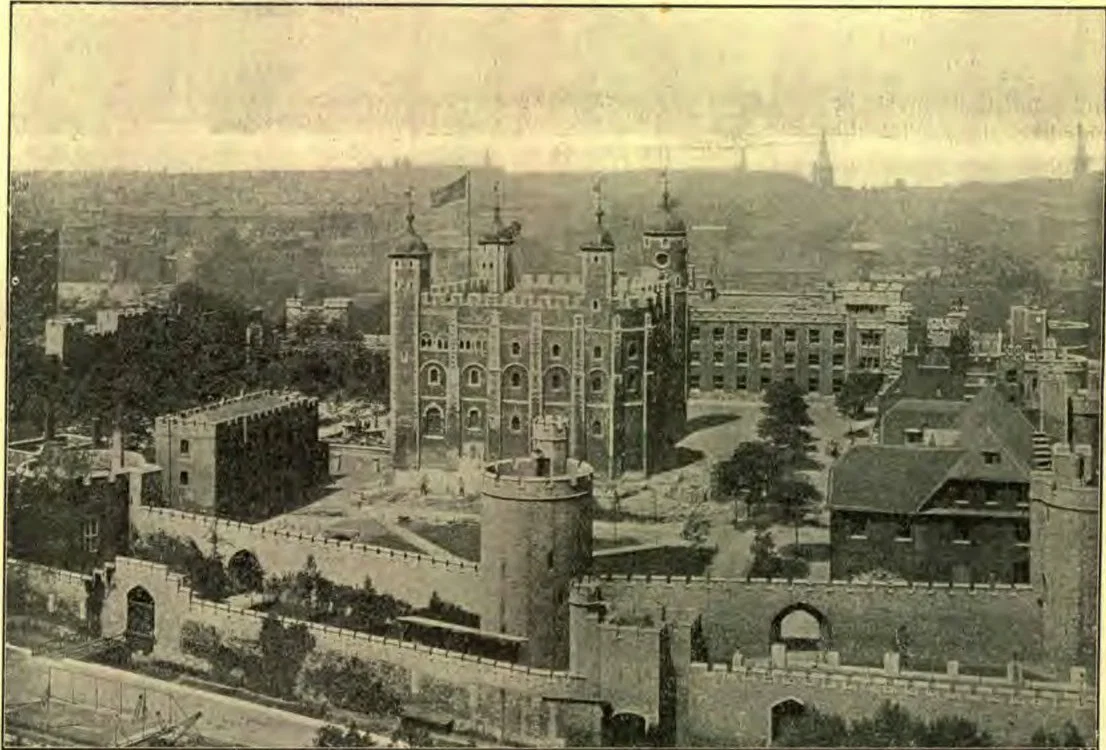
No other institution in England exceeds in historical interest the Tower of London. It is said to be of Roman origin. The accompanying illustration represents a portion of the Tower very accurately.
The buildings and courts cover about eighteen acres. In the center is the celebrated White Tower, built by William the Conqueror. At one time this was the royal residence of England. Beneath this Tower are the famous dungeons where Sir Walter Raleigh, Guy Fawkes, and many other celebrated prisoners were kept. Adjoining them is the Torture Chamber, where many such prisoners were tortured at midnight to force confessions and the revelation of plots. The walls of these dungeons are solid granite, sixteen feet in thickness. When the cells were used as prisons, there were no windows nor ventilators of any kind.
In the upper part of this building is the Armory, where many relics are preserved; such as armor-clad knights on horseback, the rack used for the torture of victims, the ax and block for executions, etc.
Beauchamp (pronounced Bē’cham) Tower, at the left of the White Tower, was the prison where many victims were imprisoned during the persecutions of the sixteenth century. Among these were Sir Thomas Moore, Bishop Fisher, Anna Boleyn, Catharine Howard, Lady Jane Grey and her husband, and many others. Several of these were executed on the block in the Tower Yard. The place is distinctly marked by a memorial plate in the pavement. In two places in Beauchamp Tower we find the name Jane cut in the solid rock. It was probably engraved by some prisoner who was confined here with the unfortunate Lady Jane Grey.
The Crown Jewels are exhibited in Wakefield Tower, among which is the crown of St. Edward, which has been used at the coronation of all the kings and queens of England since the time of Charles the Second.
The most interesting entrance to the Tower is the Traitor’s Gate, which opens from the River Thames. Royal and princely prisoners were always brought into the Tower by boat through this gate. The Tower is cared for by the Yeomen of the Guard, commonly known as “the king’s beef-eaters.”

The Tower Bridge

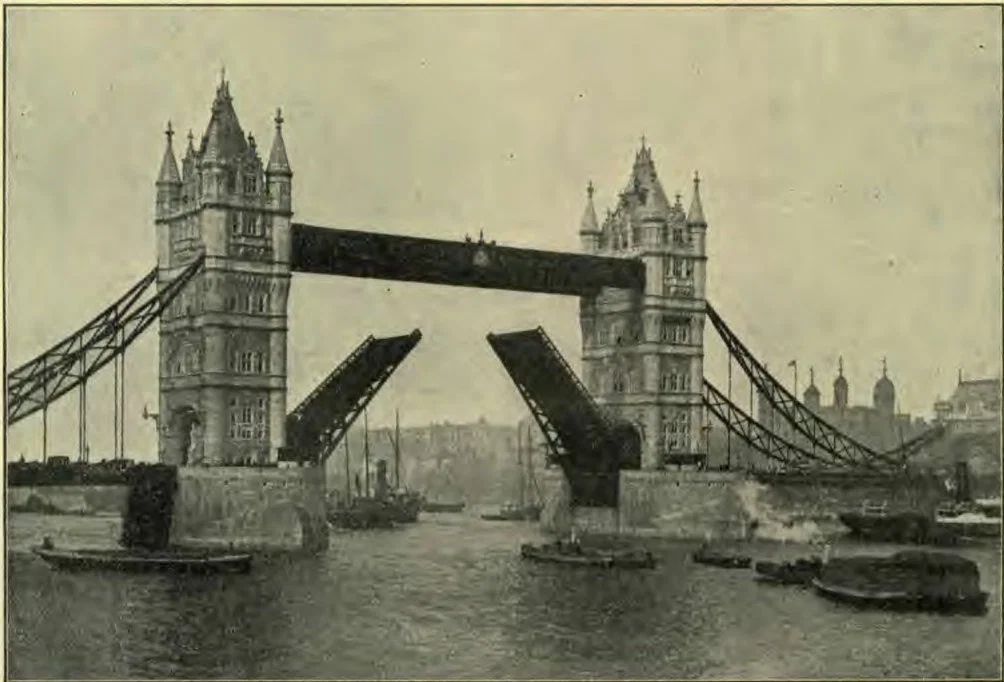
The Tower Bridge crosses the Thames just below the Tower of London, and is one of the finest pieces of architecture in the city. It was built in 1871 by Sir Horace Jones, who was the first to conceive the idea of opening the central span by lifting it in two parts, as shown in the picture on the next page. The mechanism is quite perfect. The great span of two hundred feet can be opened for the passage of vessels in two minutes. The total length of the bridge is nine hundred and forty feet; and the distance from high water to the upper span is one hundred and thirty-nine feet six inches; in other words, when the span is open, a ship having masts one hundred and thirty-nine feet six inches high above the water can pass beneath the bridge. Traffic is not hindered when the span is open; for the people are taken up to the higher bridge by elevators, and lowered in the same way on the other side.

London Bridge

Not far above the Tower Bridge is London Bridge. The traffic across this bridge is enormous. This is probably the busiest point in London, with the possible exception of the street in front of the Bank of England. London Bridge is built of granite, and was completed in 1831 at a cost of ten million dollars.
LONDON TOWER, WITH THE WHITE TOWER PROMINENT IN THE CENTER

Smithfield

Smithfield is a familiar name to our young people who have read the History of the Reformation in Great Britain. In ancient times it was a large open space in front of the ancient little church of St. Bartholomew, commonly known as St. Bartholomew the Grand. It was on this open space, and directly in front of St. Bartholomew’s Chapel, that over two hundred prisoners, among whom was John Rogers, were burned at the stake for their faith. These executions were largely during the reign of Queen Mary. It was here, also, that Walworth, mayor of London, slew Watt Tyler, the leader of a rebellion. The Scottish patriot, William Wallace, is also said to have been beheaded here. For many years this open space was used as a cattle market; but the Smithfield of then was not the Smithfield of to-day. Great markets of brick and stone, paved streets, and long rows of shops and residences have obliterated the Smithfield of history. All that is left is a small square paved with stone where the marketmen feed their horses. Even the churchyard and cemetery of St. Bartholomew have been trespassed upon; for within the quaint old entrance-gate of the churchyard are small shops, liquor saloons, and other public buildings, which seem cruelly desecrating to the visitor.

St. Bartholomew the Grand

St. Bartholomew’s Chapel is the oldest church in London. It was founded in 1102, nearly four hundred years before Columbus sailed across the Atlantic. Services are still held two or three times a week in this venerable old pile, the columns of which are more than half eaten in two by the action of time. We had the good fortune to visit the chapel when the Sunday morning service was about to begin, and one of the ush- ers kindly explained to us many items of interest. As we stood beneath the crumbling arches of one of the old cloisters, and listened to the quaint service and the deep tones of the organ echoing along the time-worn roof, a strange solemnity came over us; for it was in this very building, and before this altar, that scores of noble men deliberately and fearlessly made the decision to lay down their lives by the ordeal of fire rather than prove untrue to the God whose light had shone into their hearts.
Such men are needed to carry the cause of truth to the world to-day.

Bunhill Fields

On the city road in Finsburg is a little plat of four acres of ground which is interesting to every traveler. This was used as a burying-place during the “great plague” of 1665, when over a thousand cart-loads of human bodies were deposited here from the charnel-house of St. Paul’s. It is said that over one hundred and thirty thousand persons were buried in this cemetery during the century preceding 1852. Here, in the midst of this great gathering of the bodies of the dead, rest the remains of John Bunyan, author of Pilgrim’s Progress; Daniel De Foe, author of Robinson Crusoe; George Fox, the founder of the sect of Quakers; Dr. Isaac Watt, the author of so many beautiful hymns; Susannah Wesley, the mother of John and Charles Wesley; three of the grandsons of Oliver Cromwell; and many other noted personages.

John Wesley’s Church

Across the street from Bunhill Fields is the little old church where John Wesley preached the grand and soul-stirring doctrine of sanctification and justification by faith. The caretaker permitted us to go through the church, and sit in the chair and in the pulpit once used by this devoted man. It seemed almost like sacrilege to sit in his pulpit simply from curiosity; for the memory of the great work accomplished under the blessing of God by this man leaves an atmosphere of awe and reverence about these historic relics.
In the yard behind the church are the graves of John Wesley and Dr. Adam Clarke. In front there is a fine statue of Wesley, on which are his memorable words, “The world is my parish.”
E. R. PALMER.

Who Will Go to the Jews?

HERE is a neglected but promising field,—an especially promising field to those of the Advent faith,—and one that must be occupied erelong, if the approval of Jesus is to be won.
The Jews are the brethren of Jesus. To these he would have the cup of cold water given. These he would have fed and clothed, and to these, in the dark prison of ignorance and sin, our visits of mercy should be paid. They are thirsting for the water of life, starving for want of the Bread that came down from heaven, perishing for lack of the garment of righteousness that only Christ can give. They are “sick” and “in prison;” have we ministered unto them? “Inasmuch as ye did it not to one of the least of these, ye did it not to me.”
Who among Adventists will start a mission to the Jews? We have heard no hint of such a thing; no interest has been shown in this direction. And yet the fields are white for harvest.
“Where are the reapers? O who will come, And gather the sheaves for the harvest home?”
Frye was among the first of the Jewish converts in the last century, and his autobiography was what first drew our hearts in loving sympathy toward the Jews. The work among this people has steadily progressed from that time to the present.
The London Society for promoting Christianity among the Jews was formed in 1808; and much has been done in Protestant, papal, and Mohammedan countries toward giving them a knowledge of Christ as their Messiah. Many are ready to accept Christ.
“Sick unto death for a deeper saintliness,” they propose in London to “supplement the Jewish worship” with “lessons from the New Testament.” “Drawn by the simple gospel of Jesus,” the Jewish mission hall in New York City “is filled to its utmost capacity.” New York is to have a Jewish theological seminary, where the old doctrines of the law will be taught, and the mystical interpretations of the Talmud will be ruled out.
“The momentous conflict in sight between the Jewish believers in the Old Testament and those represented by Rabbi Hirsch, who deny the books of Moses and the divine illumination and leading of the Hebrew race,” shows that the Jew is to be tested as well as the Gentile, and that he must take his stand either on “the good or evil side.”
The younger class of Jews in our country are turning away from Judaism. What is the meaning of this? What does it portend in the providence of God?—Just this, that if we grasp our opportunity, we can lead them to him “who taketh away the sin of the world.” Shall we do it?
A recent letter to me, from a Jewish missionary in New York City, says there are six hundred thousand Jews in that city, hungry for the word of God. He also says: “Some Christians are inclined to think that the Jews know their Bible and also the New Testament Scriptures, and that they willingly and wilfully reject their Messiah and Saviour, Jesus Christ; but this is not so. All that the Jew knows about his God is in the traditional teachings of the Old Testament. All that he is allowed to read is the five books of Moses, and even these he must not read without the help of tradition and Talmudic explanation. Few of them have ever read the New Testament. They are entirely ignorant of the love of God and of his glorious gospel. O what a pity! It is heart-rending to think that the people through whom God gave to the world the Bible and a Saviour are without both!”
THE NEW TOWER BRIDGE
“What a memorial would be built if two thousand Old Testaments and ten thousand New Testaments could be distributed to the Jews, who flock to this great city from all corners of the world in search of a resting-place far from their persecuting enemies, and if, in finding this place of refuge, they could also find here their long-waited-for Saviour, our dear and precious Lord.”
Who will help give them these Bibles and Testaments? Who will start an Advent mission to the Jews?
ROXANA WINCE.

A Nature Lesson

The lessons were hard, our minds were dull, and our teacher seemed sorry for us (surely we were sorry for him!), when one day he said, “To-morrow we will walk into the country, and you shall recite your lesson under a tree; and as we walk by the way, we will converse in Spanish of the things we see.”
According to this arrangement, we were awakened in the morning at five o’clock by the peon who was to carry our breakfast out for us, and started on our journey while it was yet dark; but at this early hour on the principal street leading out from the city, we met scores of ox-teams hauling two-wheeled carts heavily loaded with sugar to make up the cargo of the boats in the harbor. These had been traveling all night, they told us, without rest or food.
We were entertained along the way by the interesting observations of our teacher, who was quite a naturalist. Among other things he called our attention to some trees, with here and there a branch so different from the other branches that we looked to see if some vine had not so completely covered the natural branch as to make it appear like another species. No vine stalk was to be seen, however, and our teacher explained that this was a method which nature has of grafting, and that the seed of the strange branch was carried into the tree by the birds, and grew there, becoming a real part of it.
The coffee plants were white with blossoms, and their perfume filled the air, but I was not allowed to pluck even one of them, because of their value to the owner. In our walk of three miles we crossed two pretty streams, and on each side saw women doing their washings by means of a paddle with which they beat the clothes, alternately beating and rinsing till the desired whiteness was attained.
As we reached our destination, and sat down to eat our breakfast, just as the sun was peeping over the mountains, the sight that met our eyes was one long to be remembered. The hills clad in everlasting green, the valleys flooded with the light which formed rainbows from the dewdrops, the songs of the birds, and the peace and quiet of the place, caused us to bow our heads in gratitude to God, and in our hearts there rose a prayer that as the shining of the sun had dispensed the darkness, and caused light and gladness to spring forth, so might the rays from the Sun of righteousness shine into the darkened hearts about us, and cause light to shine which should bring forth fruit unto eternal life. Never had a lesson seemed so interesting, and best of all, it closed with a talk concerning Him who created the heavens and the earth, and we went home believing that our instructor received a lesson and a blessing from the word of God.
LILLIAN S. CONNERLY.

Let the Morrow Rest

LET the morrow rest In his beloved hand; His good is better than our best As we shall understand,— If, trusting him who faileth never, We rest on him, to-day, forever! —Francis Ridley Havergal.

Gift and Giver

Not the gift the gift doth measure, Be the boon how rich or rare; But the giver’s self we measure— ’Tis his love we long to share.
No mere dole from purse or basket Ever yet true alms did make; That is but the empty casket, Little worth for its own sake.
More than money, men are needed In this world that needs so much; Men whose bounty is exceeded By their hands’ fraternal touch.
— Philip B. Strong.

“There Is Sorrow on the Sea.” Jer. 49:23

HEAR the moaning, groaning, crying, sobbing; Listen to the voices weeping bitterly. Every wave with unknown grief is throbbing: There is always sorrow, sorrow on the sea.
O'er the sea in wailing accents sighing, Mothers' prayers flit hither, thither, eagerly Seeking unknown graves in ocean lying. O, there's untold sorrow on the restless sea!
Love and hope launch out in early morning, Blest with happy thoughts of morrow soon to be; But that night has for them no new dawning; Thence their memory broods in sorrow on the sea.
Many, many tales of anguish sadden The dark, roaming, hissing billows free; But the words of promise sweetly gladden Every wail of sorrow on the sea.
By the unwritten tombstone cliffs are standing Angel guards, who know where all love's treasures be, And the sea will yield its dead at their commanding. There'll be no more sorrow, there'll be no more sea.
G. C. TENNEY.
Pacific Ocean, April 25, 1903.

J. A. CORLISS

Corn

CORN, or maize, is so common a production throughout the world nowadays that it seems superfluous to speak of it; yet the origin of common things is not always understood by the casual reader. However, many know that as far back as when the ships of Columbus plowed the deep blue sea in quest of new discoveries in 1492, when he landed on Cuban soil, he found the people there subsisting largely on “mahis,” as it was called, and among the many things he took back to his native country as trophies of his voyage were a few ears of corn. To the eyes of King Ferdinand and Queen Isabella these were of little value, as compared with the great mass of rich plunder in gold, and gems, and copper-skinned captives, which was presented to them; but in the centuries that have followed, those golden ears have yielded far more treasure to the world than all that has been gathered into men’s coffers from that island domain.
Gradually at first the people became acquainted with the merits of the beautiful grain, till sufficient seed was produced, and then very rapidly its use spread all over Europe, Asia, and Africa. But many years before this it had been the main support of the natives of Mexico and the American Indians.
It is a beautiful plant. Who does not admire the broad fields of this thrifty grain, growing by day and by night so fast that one can almost “hear it grow”? See its broad leaves waving to each passing breeze, and its feathery, tasseled head bowing to every passer-by! Is it not majestic in its rapid growth? There is no grain that equals it in beauty of form in its perfect state. But how many recognize its nativity? True, the world has become its dwelling-place, and it has adapted itself to almost every clime, though in some places, it has become but a pigmy of its former self. Compare it with other plants of a succulent nature. Do not the broad, clinging leaf, and the tall, luxuriant growth proclaim it a child of the tropics? Its home is found in the table-lands of Mexico or Peru, where it delights in the “growing” days and the cool, moist nights of that equable climate.

J. A. CORLISS

Leicester, England.

Roses and Raphael

THE salesman paused, and looked from the roll of wall-paper he had just thrown over the show-rack to the boy who was watching him.
“Like that?” he asked.
“First-rate. At least I think my sister would. Don’t girls always like pink and white?”
“They’re likely to,” said the man.
Jim Brainard’s eyes sparkled with appreciation. He stood gazing admiringly at the roll of paper. Pink and white it was, certainly,—pink roses as big as coffee-cups, with equally large green leaves, on a white ground. The salesman brought the border; more roses, as large as tea-plates, and a shine of gilt on the edge.
“Look here,” Jim said, confidentially, “I’m doing this to surprise my sister. She’s coming home next month. She’s been away four years, except in summer. She’s pretty sure to like those roses, don’t you think?”
“Yes. It’s one of our handsomest patterns, and only thirty cents a roll.”
“I’ll take it. Do up enough for a room twelve by—” Jim consulted a rumpled piece of paper—“twelve by sixteen, eight feet high, two windows and two doors out. Put the bundle in the back of my wagon there. That’s the one—with the gray horses. I’m going to a carpet-store next.”
In the carpet-store Jim had a bad quarter of an hour. His idea was a cream-colored carpet with pink roses. He had a notion that girls—and his sister Frances especially—liked to have things match. But he could find no carpet of such description among the ingrains. He felt obliged to confine himself to ingrains, because, although he had twenty-five dollars to spend on that room,—twenty-five dollars which he had been four months in saving from the wages his father paid him for his work on the farm,—that sum would not allow extravagance in any one item.
“I’ve got to buy some furniture,” mused Jim, sitting on a roll of linoleum, “so I can’t go in very heavy on the floor.”
“Why not get matting?” suggested the clerk.
“Matting!” repeated Jim, contemptuously. “It’s got matting on now—plain, dust-colored matting, three-quarters worn out. My sister had to change it all around and patch it to death when she was home last summer. No, sir, it’s going to be something better than matting, if I have to go without a new winter suit.”
“You might use a rug for the middle of the floor, and paint the edge, or stain it,” said the clerk, with interest. “We have a remnant of about ten yards here you could have cheap. It has the roses in, too.”
“Fetch it out,” commanded Jim.
It was a piece of “tapestry Brussels,” of a vivid pattern; red roses on a mixed ground of green, tan, brown, and gray. Jim eyed it doubtfully.
“I don’t think the roses are exactly the same color as the paper I picked out,” he considered.
“Oh, well, you don’t want the wall and the floor exactly alike,” said his ready adviser. “Are the roses in the paper pink?”
“Yes.”
“Then they’ll go all right with this carpet. These roses are just a deeper pink. That’s all right. This piece of carpet’s a bargain. Worth a dollar a yard. I’ll let you have the remnant at seventy-five cents. And it’ll please your sister. It’s a handsome thing.”
So the carpet went into the back of the farm wagon, and Jim departed, well pleased, to the larger of the two furniture stores in the village. Although only seventeen years old, he was used to being sent by his father for the purchase of farm implements, and even of sheep and cows, and he had acquired excellent discernment in such matters. He went at his present buying with precisely the same decision of manner.
“Got any pink bedroom sets?” he inquired.
“What—er—pink? Well, not exactly. We have a bedstead in pink enamel, with brass trimmings.”
“Let me see it,” said Jim.
The bedstead took his eye. It was very gay. It cost six dollars and a half. Jim bought it on the instant.
“It’s prettier than anything else they’ve got,” he reflected. “It’s so pretty she won’t mind using the old bureau and wash-stand. Or I could—I could paint ’em this same color—and—yes—I could paint the woodwork in her room pink, too. Then it would all match. I’ll do it—yes, sir, I’ll do it!”
He paid for his latest purchase with enthusiasm, and was rushing from the store when he caught sight of a row of framed pictures hanging on the wall above a collection of dining-tables. One was a bright-hued representation of a smiling girl dressed in a trailing pink gown, with an enormous bunch of lilies in her arms. The frame was wide and very gilt. Jim paused thoughtfully.
“Those are a bargain, sir,” said the alert salesman. “We’re making a special sale of them at cost. You can have your choice at a dollar ninety-eight. If you’re thinking of furnishing a lady’s room, you couldn’t find a neater thing to put on the wall than”—with a glance at the direction of Jim’s eyes—“that girl in pink, say.”
“Guess I’ll take it,” said Jim, feeling reckless. That picture certainly would add the finishing touch. And thinking of finishing touches, he found that he had spent all but ten cents of his money.
“I could get some lace curtains for part of that,” he considered. He went into three of the four village dry-goods stores, however, before his critical taste was satisfied. He wanted those curtains to have a pattern of roses.
“Guess a girl couldn’t have done it any better!” he chuckled, as he gave the rein to the gray horses and drove home at a spanking trot through the May twilight. “Why, everything matches! Roses—and roses; all pink and white—except that carpet; and I expect it’s better, as the man said, not to have too much of a sameness everywhere.”
There was nobody at home to interfere with Jim’s plans. He and his father, their housekeeper and a small maid servant, lived there alone. It was a pleasant old farmhouse from which the one daughter had gone away to school and college. When Jim had announced that he meant to refurnish Frances’ room out of his own savings, his father had no objection.
“I’d like to fix that room so she would sort of want to stay in it,” Jim had explained, with a certain shyness, when he broached the subject. “Girls think a lot of having their rooms look pretty. I’ve got about the idea.”
“Yes, fix it up, fix it up, if you think you can do it to suit her,” agreed his father. “I suppose it does look plain and shabby to her when she comes home, and now that she’s coming to stay, it would be a good idea to furnish things up a bit. Go ahead, Jimmy. She’ll be pleased to think you care enough about her to do it.”
“I guess I care!” murmured Jim; and he went out without delay to harness the grays, and to drive the two miles to the village, where he could do his purchasing.
On the first rainy day, which came soon, Jim went to work. He bribed Betty, the small maid of all work, to help him, and the two made a great clearing out of Frances’ room. Before they began, Jim stood in the doorway and surveyed the place. “Plain and ugly as mud!” he said, with supreme contempt.
The room was in the perfect, shut-away order in which Frances had left it; but it was plain, certainly, and even shabby, yet not quite ugly, although the boy did not know that. Curtains made of thin old embroidered muslin, carefully mended, hung at the windows; ruffled covers of the same material lay on the bureau and wash-stand; a big rocking-chair clad in dull-blue denim stood by one of the windows—the one which looked out on the river and the mountains beyond. The bed was covered with an old hand-made blue-and-white spread, of a fashion which in Jim’s eyes was beneath contempt. On the wall hung two pictures, tastefully framed, although only in passe-partout. One was a photograph of Raphael’s “Madonna of the Chair,” the other a little print of Michelangelo’s “David.” Jim looked especially at these, and grinned at their obvious lack of value.
“May as well leave those things out,” he thought. “They’ll look pretty small beside the picture I’ve bought. No use in keeping truck.”
Then the work began in earnest. Jim never did things by halves. When the room was empty, and while Betty cleaned it after his directions, he went down to the barn with his pails of paint and a roll of wall-paper, and mixed the color for the woodwork. This he made of a vigorous tint, as nearly like that of the enamel bed as possible. As the bed had not been delivered, he had to trust to his eye for color, but Jim’s eye was accurate. If there was any failure to match the enamel perfectly, it was not on the side of paleness.
It rained all that May week, and Jim worked unceasingly. He got the village paper-hanger to come and work for him, because he could not risk an amateurish job; but he did everything else himself. When it came to painting the floor, he found that he had spent all but ten cents of his money.
“I don’t suppose the floor really ought to be pink,” he mused. “Seems as if that would look nice, though, and match.” He was possessed with the idea of “matching.” “But maybe that would be carrying it a bit too far. I’ve got just about enough pink paint left. I wonder what putting in a little black paint would do. There’s some out at the barn.”
The black made the pink paint into a purplish drab, and Jim felt that it would do. The floor was not of so much consequence, anyway. Who would look at the edge of it, with that beautiful rose-strewn rug in the middle?
But he did commit one extravagance. The furniture when painted—it was solid old mahogany, and it took several coats to cover it—did not approach the pink-enamel bed in finish. So Jim borrowed a dollar of his father on his next week’s wages,—he would accept no help in any other way,—and bought several cans of bath-tub enamel of a salmon hue. When this was on, the rejuvenated pieces shone forth with a polish which satisfied him completely. There was no doubt that they had ceased to look old.
It was all done in time, with a day to spare. Before Jim drove away to the train to meet his sister, he stood looking in for a long time at the door of her room. In fact, he had hardly been able to keep away from that door for two consecutive hours since the room had been finally finished.
Probably no happier boy of seventeen ever surveyed the work of his hands. His father had expressed his hearty approbation of the changes Jim had made, and little Betty had said again and again that it was the loveliest room that ever was, and would not Miss Frances be that pleased? Jim could ask nothing more except Frances’ own approval, and of that he was confident. Could a room all pink and white—mostly pink, too—fail to please a girl?
It did not fail. Frances, just home from college, fresh from four years of association with all that is best in science and literature and art, stood in the doorway of her old room, Jim’s eager, happy face looking down at her, and did not flinch. She took in everything at a glance—the pink-enamel bed, the rose-patterned lace curtains, the gilt-framed picture of the girl with the lilies, the new rug with its gay red roses on the purplish-drab floor—Frances took all this in with one sweeping glance, and comprehended instantly that it was the devoted work of a big, loving, blundering boy, whose affection she would make any sacrifice to retain.
For an instant she found it difficult to speak, for various antagonistic reasons. Then she turned, put up both arms, and clasped them round her brother’s neck,—Jim gladly bent low on purpose,—and said, with all the warmth of delight he had hoped for, “Why, you dear, dear boy! Why, Jim! Did you do all this—yourself—for me?”
“You’re right, I did!” declared Jim, returning the embrace with interest. “Do you think I could have a sister like you coming home to such an old frizzle of a room as this was, when I could fix it up for you? How do you like the furniture? Isn’t that enamel paint great?”
“It is, indeed,” murmured Frances.
“I was pretty sure you’d like the roses,” Jim went on, enthusiastically. “Look at that border! Don’t you think it’s immense?”
“It certainly is, Jim, dear.” It was—she could agree to that truthfully. It was two feet wide—and the room was but eight feet high. “And it all looks so—so—clean and—fresh, Jim. And to think you did it! That’s what pleases me so.”
But when the boy had gone, radiant with satisfaction, to do the evening “chores,” Frances went over and sank down in a little heap, with her head on the window-sill. She looked out through Jim’s lace curtains at the old, lovely view of the river and the mountains. Then she said aloud, very softly, “O Jimmy, boy!” and laughed. Then she said, “O Jimmy, Jimmy!” and cried. Then she laughed again, and then she cried again. “He’s even taken away my little ‘David’ and the ‘Madonna,’” she said, and turned her wet eyes from the girl with the lilies.
She had been thinking about that room all the way home. It had been shabby, but it was very dear to her, because she had grown up in it. She had had a dozen plans concerning it, plans for simple changes which, instead of touching the old mahogany furniture, should give it an environment befitting its fine simplicity. She sat staring out at the mountains for a long time; but when she turned to the room again, it was with a radiant face.
That evening, on the porch, she said, “Jim, do you know what I’ve been planning? I’ve thought of it all this year, and now this surprise of yours makes me settled in it. You must go to college, Jim. Yes, dear, you must. I’ve talked it over with father, and he’s willing—if you want to go. You do want to go, don’t you, Jim?”
“Me?” Jim was astounded.
“Yes, you. I can tutor you in one year so you can enter the next. We’ll study in that room. I’m not going to have everything. You’re just as bright as I was—far brighter, I’m sure, Jim, dear, and we can manage it. You simply must go! Yes, Jim, and I’m going to send you.”
He went. The year of his sister’s tutoring enabled him to pass his entrance examinations. Frances sent him half across the continent, that he might have that additional and most valuable education which would come from life among conditions as different as possible from the old ones. She wanted him to find out what was amiss with the pink-and-white room. He did not come back for four years; and when he came back, he knew.
But he found the room unchanged. Next door to it his sister had arranged one for Jim’s own use whenever he might be at home. When he had looked at it, with an eye appreciative of its beauties,—beauties which he would not have recognized four years ago,—he said, with some curiosity:—
“I’ve often thought, Frances, of that gorgeous horror of a room I fixed up for you so long ago. Of course when I got away, you made it over into what it ought to be. You took the shock like an angel. I remember that—poor girl!”
“Come, and see,” Frances returned, smiling, and opened the door.
Jim—the new Jim—looked in over her shoulder.
“Why, you dear girl!” he said, and stood still in surprise, while something closely resembling moisture crept into his bright eyes, and the laughter on his lips gave way to a touched gravity.
“I’ve lived mostly in the room I’ve furnished for you,” Frances explained, with her arm in her brother’s. “But I couldn’t bear to touch this one until you came home. It meant too much to me. It meant that I had ‘gained my brother,’ dear, and you don’t know how I came home four years ago hoping I might be able to do that.”
“You’ve kept him, too,” he answered, soberly. “Frances, if it hadn’t been for your letters—But I’ve four straight, clean years to offer you, whatever else I’ve done or failed to do, and perhaps you know that means a good deal.”
She knew it, and was thankful in her inmost soul. But she let him begin at once to tell her how he meant to help her furnish that room now, because that was easier to talk of.
“Frances, that room is going to have two things in it, anyway,” said Jim, happily. “I brought them home in my trunk. They are two of the best copies I could find of Michelangelo’s ‘David’ and Raphael’s ‘Madonna of the Chair.’”
—Grace S. Richmond, in the Youth’s Companion.

At the Setting of the Sun

As I watch the sun sinking from view below the western horizon, I ask myself, What have I accomplished to-day? Have I overcome that evil trait in my character? Have I spoken a word in season to some one who is weary with the toils of life? Have I repressed the hasty word, the unkind criticism, the evil thought? Have I, by beholding his lovely character, become more like the meek and lowly Jesus?
If nothing of good has been accomplished, no help given to those about me, no progress made in character building, the work of the day has been a failure. Let us take to heart the lessons that each sunset should bring, and strive for constant progress, for greater usefulness, for a higher plane of thought and action.
Though our hearts are often made sad because of neglected opportunities and misspent moments, we are encouraged by the thought that it may be God will grant us another day. But the time will come, we know not how soon, when the sun will set upon all the opportunities and possibilities of this life, never to rise again; and when it comes, our eternal destiny will have been decided.
Shall we drift thoughtlessly onward, heeding not the angel voices of each passing moment, making no effort to rise above the trifling, fleeting pleasures of earth, “killing time” by listless inaction, or by amusements that are worse than useless, and at last find ourselves but cumberers of the ground, fit only for eternal destruction with the tares and thorns and rubbish of earth, and with all the hosts of evil? Or shall we, on the other hand, with divine help, so improve the precious moments of probation, so fill each day with acts of kindness, with words of holy comfort and cheer, and with victories over our besetting sins, that it may be our privilege to hear that sweetest of all voices saying to us, Come, thou faithful child; enter into the joy that I have prepared for you?
To-day — now — is the deciding time.
B. E. CRAWFORD.
Continue reading: The Curious Clock