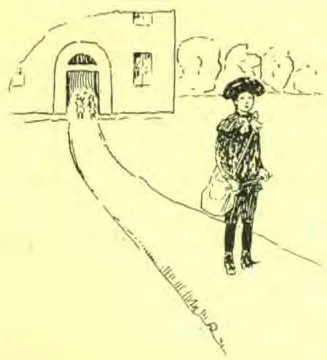
I know a curious little clock,
Which goes about its work
As if some hours were full of joy,
And some 'twould gladly shirk.
Each morning just at half-past six
It hangs both hands straight down,
And yawns, because 'tis rising time
For little Billy Brown.
But when 'tis twelve, it shouts in glee,
"'Tis dinner time, my boy,"
And smiles, and throws both hands straight up,
In its excessive joy.
Nine in the morning! O, that clock!
It wears a dreadful frown,
For that's the time that school begins
For little Billy Brown.
At four P.M. that funny clock
Displays a grin of glee,
Because from school and lesson books
Its master then is free.
But, O, dear me! at nine at night
It dons a doleful frown,
And sadly tolls the sleepy time
Of little Billy Brown.
The Real Young People’s Work
UNDER this heading, Brother W. S. Sadler writes a stirring article in the Pacific Union Recorder. We reprint it for the benefit of those who have not read it:—
The real young people’s work is the work which the young people ought to be doing for others, and not the work which others are trying to do for the young people. The less our youth work for the salvation of lost souls, the more some one will have to work for them; on the other hand, the more earnestly our young people engage in sincere effort really to help those who know not the Lord Jesus, the less the effort that will have to be put forth to keep them near the Lord.
Life-saving effort is the greatest and grandest work young men and young women can engage in. What a barren experience to look forward to a life of money-making, fame-seeking, or selfish ease and gratification! Souls for whom Christ died are perishing in darkness all about us. Has the Spirit of God touched your heart, and spoken to your conscience? Have you heard the voice of heaven calling to you, asking, “Why stand ye here all the day idle? Go work in my vineyard to-day”? There is a work for the young to do that can not be done by the older members of the church. We may secure counsel and help from those of larger experience, and then, in humility and by the grace of God, let us go forth in the name of the Lord of hosts to fight the good fight of faith.
Do you want to get into the Lord’s work? If you do, then go to work for your fellow men to-day, right now, right where you are. Don’t wait for anything. Do what your hand finds to do, with all your might.
The salvation of your own soul is the credentials of heaven that you have been called to carry the glad tidings of salvation to others; the fact that your sins are forgiven is a commission for you to proclaim forgiveness and remission of sins to others in the name of the Lord Jesus.
If you are planning to attend school, all well and good. If you are desirous of preparing yourself for medical missionary work or any other branch of the organized work of the third angel’s message, all well; but I beseech you not to overlook your opportunity and privilege of working for God to-day.
If you are daily neglecting to perform the work Heaven sends you to do right where you are to-day, have you any assurance that you would not neglect your sacred responsibilities if you were a minister, an editor, a doctor, or a nurse?
May the Lord help us to be earnest and faithful even in the smallest details of our daily life.
I truly believe there is a work for every Seventh-day Adventist youth to do, and I earnestly desire to help one and all in every way I possibly can to find their work, and make a complete and glorious success of it.
The Work in the Upper Columbia Conference
REPORTS have been received from four Societies in the Upper Columbia Conference.
The number of members at Natchez, Washington, is not reported, but the Society meets weekly, and the INSTRUCTOR studies form a part of the program of each meeting. The leader, Miss Lydia Kime, writes: “Last Sabbath we had the field study, and after the meeting some of the visitors came to me, and said, ‘You have such a nice young people’s meeting. I wish we could attend all the time.’”
The largest Society in the Conference is that of College Place, which reports a membership of one hundred and seventy. These members are especially interested in the raising of means for the support of missionaries in foreign fields. Mrs. J. L. Kay, the State secretary, writes thus of the work of the young people there: “The Young People’s Society is composed largely of students. These same students have an organized missionary society, holding weekly meetings. They take a club of Signs, and are also doing tract work, and several of them have been out canvassing for ‘Christ’s Object Lessons.’ The present leader of the Young People’s Society is the librarian of the church, and is not only a student, but also an active worker in the church missionary society. Two other of the young men have taken such an active part in the meetings of the Walla Walla church during the past year that at the last election one was chosen as elder and the other as deacon of that church. They with several helpers spend the entire day Sabbath conducting the regular Sabbath meetings with the church in the forenoon and cottage meetings in the city in the afternoon. They frequently go in again on Sunday, and continue the work.”
At Boise City, Idaho, there are twenty members holding weekly meetings. The secretary says: “The interest is very good, better than at the beginning. I think all the young people are having a better experience.”
THE WEEKLY STUDY
By William A. Spicer
The Working of Spiritualism
(June 14-20)
SHALL we not make South Africa the prayer topic at the opening of our meeting this week? All know more or less of the great work our brethren there have on hand, and the great country open for the message, now that war times are over. The brethren in Matabeleland report danger of a famine and much suffering among the natives. Lack of means, it seems evident, will make it necessary to defer opening a mission in Barotseland, planned for this year, in response to the call of the king of that country. Pray that the way may remain open till God gives us the burden that shall cause the means to flow in. The workers are ready to go.
Now to the study for the week. The light that showed the early pioneers the special part this country was to act in warring against the law of God, forewarned them also of the agency of Spiritualism. The Spirit of prophecy was quick to point out the tremendous issue enfolded in those first manifestations in Rochester, at which the world merely smiled. We can see how every word has been fulfilled, save only the final manifestations.
Let some members tell of the rise and early development of this evil agency, as outlined in “Rise and Progress,” pages 144-146, and pages 173-175; also “Early Writings,” pages 49, and 124, 125. Four paragraphs from the last two pages cited would make a good selection to read.
Let another give a Bible reading on the subject. Material for it will be found in chapters XXXIII and XXXIV of “Great Controversy.”
This must necessarily be a short study, but a very short reading will often accomplish more in bringing the truth before people than a long one, with many texts. In all our exercises, we are but learning how to teach the truth to others. We must study to make our Bible readings or talks concise and clear, so that one who did not know the truth might get a definite outline of it if listening. The danger in these meetings is that the leader of a study will think that he need not be very precise and definite in presenting a subject because he takes it for granted that all the members of the Society understand it as well as himself. But he as well as others will learn more about the subject, the more carefully he studies to present it just as he would wish to do if dealing with an audience to whom it was altogether new.
Spiritualism is not restricted to the question of man’s nature and state in death. See in “Early Writings,” pages 66, 67, how the new-thought ideas about God and his person, that are sweeping over the world and into the church, are but the product of Spiritualism. This agency stands for all that would obscure the definite message that God has for this day. Our hearts must be clean, and our minds illuminated by the Spirit of light, if we would be kept in the pathway to the holy city in these times when the evil one has come down to deceive, if possible, even the very elect.
W. A. S.
From a Far Country
We have often wondered what the young people of our denomination in other lands are doing, and if they are organizing bands of workers as we are doing here in the United States. In a recent number of the Australasian Signs of the Times, Brother W. W. Fletcher writes of the work of the young people of North Fitzroy. Speaking of the work of distributing the Signs, he says:—
“Our Signs worker is devoting the whole of her time to a district that is being systematically worked with tracts by the young people of our company. About four hundred tracts are loaned in this district every week, and we trust that this work, combined with the efforts of our Signs worker, will result in bringing many souls to a knowledge of the truth.”
We would be very glad of reports or interesting items concerning the work in other lands. So if those who read the INSTRUCTOR know of work being done, will they not please send us a report? So far Australia, India, and Japan are the only places that have reported of which we have any knowledge.
Bauer, Michigan
FROM the West Michigan Herald we quote the following good report, written by Sister Mildred Wilson, of the work of the Bauer young people:—
May 31, 1902, a Society was organized, the members ranging in age from eight to twenty-three years. One of the older sisters was chosen as the vice-president. We now have twenty-one members, who are willing to do all they can to help carry on the work of the Society. It has ever been our object to keep before the minds of the members that we should be a working Society,—one that will benefit both ourselves and those around us.
The distribution of literature has constituted a large part of our aggressive labor. Since June 1, 1902, we have circulated over five thousand pages of books and papers. Each week we take a collection, which is used to pay postage on papers and other matter sent through the mails. Two donations have been forwarded to Chicago to aid in the work among the poor children of that city. We also send the Little Friend and the INSTRUCTOR to Chicago for use in the mission Sunday-school.
Those who read the December Life Boat will recall the story of little “Tommy.” The members of our Society became much interested in him, and we felt very sad when we learned of his death. Some of our money went to assist his poor family, and that is probably one reason that we became so much interested in him. Those who have never tried helping the worthy poor will find, if they will make the experiment, that “it is more blessed to give than to receive.”
We pray that God will bless our work, and that we may see souls in the kingdom as the result of our efforts.
Question Hints
(To be given to different members, and answered in the meeting)
WHEN were the first deceptive workings of Spiritualism manifested in the world? Outline the story briefly.
What doctrine and what method is Satan using to-day to accomplish man’s destruction?
What theory forms the foundation of Spiritualism? Give some of the plain statements of Scripture on this point.
In the absence of a prophet among God’s people, what prominent king of Israel called upon a Spiritualist medium to bring up before him the so-called spirit of a dead man to give advice to Israel? What was the result of seeking to familiar spirits? Cite promises from God’s word showing that he is always willing to guide his children in judgment, and to give wisdom in time of perplexity.
Luther Warren Appointed to Sabbath-school Committee
By Editor
At the recent meetings of the General Conference Committee held in Battle Creek, a resolution was passed to the effect that Elder Luther Warren be made a member of the Sabbath-school Department Committee, to give special attention to the Young People's work. We are pleased to say that Brother Warren has closed up his work in the East, and recently passed through this city on his way to some of the Western camp-meetings, which he is attending in the interests of the Young People's work.
MEMORY VERSE: “He that putteth his trust in me shall possess the land, and shall inherit my holy mountain.” Isa. 57:13.
Israel was still encamped in the Vale of Shittim. Moses was dead, but God’s people were not left without a leader, for Joshua had been divinely appointed to succeed Moses and lead the people into the promised land.
Now the word of the Lord came to Joshua: “Arise, go over this Jordan, thou, and all this people, unto the land which I do give to them.”
The river at this season of the year was swollen, and overflowed its banks. From a human point of view, it would seem impossible to cross it with the great multitude. But Joshua was strong in faith, and courageous; and, feeling his own weakness, but trusting in the strong arm of the Lord, he was ready to obey.
To reassure him, the word came, “As I was with Moses, so I will be with thee: I will not fail thee, nor forsake thee. . . . Unto this people shalt thou divide for an inheritance the land, which I sware unto their fathers to give them.” The admonition was given, “Only be thou strong and very courageous, that thou mayest observe to do according to all the law, which Moses my servant commanded thee: turn not from it to the right hand or to the left, that thou mayest prosper whithersoever thou goest.”
Orders were given that food for three days be prepared, and that they prepare for battle. They were about to enter Canaan, but they themselves were to have a part in conquering the wicked inhabitants. Two men were also sent to Jericho, to “view the land,” and the report they brought back gave fresh courage; for they said that the inhabitants of the land were terrified, on account of the wondrous things which the Lord had done for Israel.
After arriving at the River Jordan, messengers were sent throughout the camp to tell the people to put away their sins, for the Lord would the next day “do wonders” among them. When they should see the ark of the covenant borne by the Levites, they were to follow, at a distance of about half a mile.
Again the Lord spoke to Joshua, who imparted his words to the people. As a sign that he would be with them when they entered Canaan, and would drive out the wicked inhabitants from before them, the waters of Jordan would separate as soon as the soles of the priests’ feet touched the river.
The next day, at the command of the leader, the priests took up the ark. As soon as their feet touched the river’s brim, “the waters which came down from above stood and rose up upon an heap,” and the waters below flowed on toward the Salt Sea, leaving a dry channel.
The bearers of the ark stood on the dry ground in the midst of the Jordan, until all the people passed over. Then, according to the command of the Lord, Joshua bade the twelve men previously chosen by the people—one from each tribe—to take each a stone from the channel, and carry it over to their next encampment. He also took twelve stones, and set them up in the place where the priests stood.
When the priests had passed over, the waters returned to their place, as before.
At Gilgal the twelve stones were set up as a memorial. When future generations should ask, “What mean ye by these stones?” the story of how God had so miraculously opened the way for them through the Jordan was to be told, that all the earth might know of the mighty God, and that they themselves might fear the Lord forever.
Questions
1. Where was Israel still encamped?
2. What command did Joshua here receive from God? How did he realize that he would be enabled to obey? From what source will the strength come to us to do God’s bidding?
3. To whom was the promise of the inheritance of Canaan first made? Gen. 15:18-21. Name some others to whom it was afterward repeated. Gen. 26:3; 35:12; Ex. 3:7, 8. Why did these men not receive the inheritance? Gen. 15:13-16. Why had not the promise been fulfilled to the children of Israel years before this time?
4. How did the people prepare for the onward march?
5. What report gave the people further courage to go forward?
6. At the Jordan, what message was sent to the people by the Lord?
7. What sign was given as an assurance that the Lord would be with the Israelites in Canaan?
8. How and when was this sign fulfilled?
9. Tell how the people passed over the river. Had they ever had a similar experience?
10. What did Joshua set up in the midst of Jordan?
11. How many stones were carried up out of the river-bed? Where were these set up? Of what use would they be in future generations?
MEMORY VERSE: “But the Lord is faithful, who shall stablish you, and keep you from evil.” 2 Thess. 3:3.
But we are bound to give thanks to God always for you, brethren beloved of the Lord, for that God chose you from the beginning unto salvation in sanctification of the Spirit and belief of the truth: whereunto he called you through our gospel, to the obtaining of the glory of our Lord Jesus Christ. So then, brethren, stand fast, and hold the traditions which ye were taught, whether by word, or by epistle of ours. Now our Lord Jesus Christ himself, and God our Father, who loved us and gave us eternal comfort and good hope through grace, comfort your hearts and establish them in every good work and word. Finally, brethren, pray for us, that the word of the Lord may run and be glorified, even as also it is with you; and that we may be delivered from unreasonable and evil men; for all have not faith. But the Lord is faithful, who shall establish you, and guard you from the evil one. And we have confidence in the Lord touching you, that ye both do and will do the things which we command. And the Lord direct your hearts into the love of God, and into the patience of Christ.—American Standard Revised Version.
Questions
1. Why did the apostles feel bound to give thanks for the Thessalonian brethren? What course on their part had brought this blessing to them?
2. What part had Paul borne in bringing them to a belief of the truth? What blessing had this gospel brought to them? Verse 14.
3. What is every one who has received the truth admonished to do?
4. What prayer is offered for us? How have God, our Father, and our Lord Jesus Christ, shown their love for us?
5. What have they given us? Through what?
6. In what will they establish us?
7. What is one of the final admonitions of the apostle? Why did he desire their prayers?
8. From whom did they wish to be delivered? Why? How are those who have no faith described in our last Sabbath’s lesson?
9. What testimony does the apostle bear to the faithfulness of the Lord? What will he do for his people?
10. Through whom did the apostle have confidence in the Thessalonians? What did he expect of them?
11. What prayer did he offer for them?
12. What will be one of the characteristics of those who wait for their Lord? Heb. 10:36, 37.
Notes
1. “Stand fast and hold.” Stand fast for service; hold faithful to the orders. The word “tradition” does not mean a body of laws or instructions handed down from generation to generation, with no other authority behind it than age and what men have said. The word is used in its literal meaning, “delivery; handing over; what is transmitted; intrusted to.” By word or epistle, Paul committed, or intrusted, to the Thessalonians the word of the gospel. It was their duty to hold it to the end.—S. S. Lesson Quarterly.
2. “Pray” not simply for ourselves, but for the servants of God; “pray” that God’s word may go freely, swiftly, mightily, and be glorified by fruit; “pray” that other souls may be searched out and saved, even as it searched you out. Thus does God speak to all his children. Thus will his Spirit lead us to do.—Id.
MRS. P. ALDERMAN
By Mrs. P. Alderman
My Father, when the cares
Press hard upon my weary heart and soul,
When all is dark below, bid me look up,
And with delight drink all my bitter cup.
O help me then to think of thee
Who drank the bitter cup of gall for me.
When earthly friends grow cold, forsake,
And cast a glance of scorn or hate,
Then let me hide in thee. Thy smile
Will comfort and protect,
And make me more like thee.
MRS. P. ALDERMAN
Gentlemanliness, Manliness, and True Virtue
By Atkins
One of the most remarkable characteristics of gentlemanliness lies in the fact that it is not so very far removed from womanliness. It has a sacred modesty, a tender regard and respect for weakness and loneliness and inferiority, a deep and genuine reverence for the innocence and purity of womanhood. But, you say, how about manliness? I reply by asking another question, Do you know what manliness means?—It signifies virtue. When Garfield said, “I shall try and become a man; if I do not succeed in that, I shall be good for nothing,” he did not mean that his ambition was to be merely big and boisterous and robust; he desired to become gentle and strong and good. Vice is no mark of cleverness or manliness. It is a shameful, devilish thing that scars the soul, wounds the heart, rends the whole life asunder, and turns the future into darkness.—Atkins.