The Youth’s Instructor, Vol. 33, No. 4.

THE WINTER DAY THAT ANDY WRESTLED

The Youth’s Instructor

Feb 11, 1885

S. D. A. Publishing Association · Battle Creek, Mich. · Feb 11, 1885

THE WINTER DAY THAT ANDY WRESTLED.
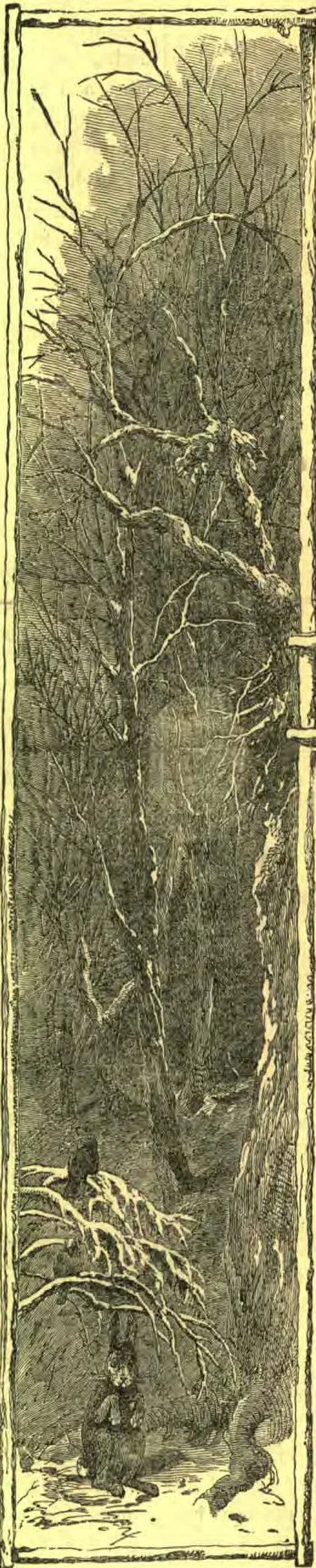
“Snow, snow, snow! Snow in the yard, snow on the house-roofs, snow in all the wide, misty space above. It kept indoors grandma, who was up-stairs, and Andy, who was down-stairs. Other folks might go out, but grandma was old, and Andy could only limp, and he limped in pain.”
“Pretty hard to stay in,” thought Andy. Poor Andy! Let me tell you what made him lame. He was climbing over a pile of boards one day, when down they fell, and one of Andy’s legs was underneath.
“Dear me!” said old Dr. Brown. “He has twisted his thigh out of joint, and broken his leg. I will mend him the best I can.”
When Andy had been “mended,” blundering Bill Holmes pushed him one day, and over went Andy, his thigh out of joint again. He was now improving, but the limp was still there; and whenever it stormed, somehow the storm shot an arrow at the weak place, and Andy felt it.
“I s’pose Tom Jones is glad,” murmured Andy, “and Sam Smith, and Bill Holmes—I hate him. I might have been out if he hadn’t pushed me when I was getting well.”
The more Andy thought about Billy, the more clouded and scowling was the white boy-face at the window. He had had ugly feelings every day, and how they troubled him when he prayed!
How can any one pass through Christmas, and not think of the Saviour; and how can they cross the line of the New Year, and not crave a new life!
“I suppose I ought to be a Christian, if I only knew how. Well, I can pray,” reasoned Andy.
Prayer, though, did not seem to help him. He would pray awhile, and make beautiful prayers, when into his thought would come Bill Holmes, and he would suddenly stop. Unseen, secretly, had Bill Holmes stepped before him, and given him another push.
“I hate him,” Andy would say. Could he find peace when that feeling was in his heart!
Andy’s grandma had now entered the room.
“Andy, there is a boy outside, and he looks as if he wanted to come in. He has something under his arm,” said grandma. Out in the tornado of snowflakes, driving, whirling everywhere, was a boy bearing a big package.
“Bill Holmes—and—and—he’s a coming here. I don’t want to see him, grandma. He pushed me over.”
“I’ll go to the door, Andy.”
Grandma went to the door.
“I thought—thought—Andy couldn’t go out, and this book is full of pictures,” said Billy,—a brown-eyed, light-haired, clumsy boy, who was sorry for the unfortunate push he gave Andy.
At first Andy would not look at the book. Then he took a peep, and then a second and a bigger peep, a third still bigger peep, until the book was wide open before him. It was the Holmes’s family Bible. The cover was gone, the title-page in front, and the index behind. The edges were turned and torn. Still it was the Bible, and so crowded with pictures! There was Jonah going head-first into the sea; and there was Daniel going feet-first into the lion’s den. There were so many pictures!
“What’s this?” asked Andy. “A man has got hold of an angel, and he is trying to throw him; or else the angel is trying to throw the man—or—I see—I know.”
Here Andy rested his cheek on his hand, and his hand on his knee, and his blue eyes drank in eagerly every feature of that strange, shadowy scene where Jacob wrestles with the angel.
“I wonder who’s a-going to beat! Oh, I know! I’ll just read about it,” thought Andy, and the blue eyes were now fastened on the story.
“Thigh out of joint!” murmured Andy. “Guess Jacob felt pretty bad, if his leg felt like mine.”
Andy caught a gentle foot-fall behind him, and grandma, looking over his shoulder, said, “That is a beautiful picture of prayer, Andy.”
“Yes, and his thigh got out of joint, like mine.”
“People sometimes must pray down some trouble, and it may be hard like that wrestling.”
Andy thought of Bill Holmes, but was silent.
“However, Andy, we are to hold on, hold on to God with all our might, and keep praying.”
“Yes, I s’pose so, grandma.”
How Andy did watch that picture, looking and looking again, but in silence. At last there seemed to be a change in the picture. It was no longer Jacob, but Andy himself wrestling with the angel.
“Why, it’s me!” thought Andy. “Yes, he looks just as I do in the glass.”
It was, indeed, the same Andy, the same dark brown hair, the same blue eyes, the same jacket and pants; but there was a change of size, or, if it were the same small Andy, then it was a small angel. How it did excite the spectator of all this, to be Andy, and yet see an Andy struggling with the angel.
“Oh, I do hope I shall beat!” thought Andy. But, alas! there was the Bill Holmes affair, and then somebody or something, at this very thought, seemed to touch Andy, and oh, what a poor, miserable, limp being was now struggling with the angel!
“Don’t mind Bill Holmes. Let that go,” exclaimed Andy. “Hold on to the angel, Andy.”
It did seem so strange to be calling to himself; but Andy felt it all, felt now what he said in a forgiving spirit about Bill Holmes, and it encouraged him to see that the other part of him was really, tenaciously holding on to the angel, and what was his other part saying? “I will not let thee go, except thou bless me.”
“O grandma!” he could not help shouting; “I’m a-goin’ to beat!”
At this there was a change. Andy’s other part disappeared, and the angel vanished also. He saw—grandma, and she was saying, “Poor little boy; you’re tired. You go right up to my room, and on the lounge there you finish out your nap. You can be all alone there.”
Andy slowly limped to his grandma’s room. He did not care, though, to lie down. His dream was all real to him. He looked out of the window. The snow was still dropping, dropping everywhere.
“I don’t care now,” he thought, “if I didn’t go out. Perhaps that is why God shuts folks in the house, because he has something to tell them. No, I don’t feel like going out now, and I don’t care to lie down.”
He felt like praying; and when he knelt, a petition dropped at the feet of God softly as a snowflake. He told God that he did not have hard feelings now toward Bill Holmes. He was sorry that he had had any. He would hold on to prayer too. “I will not let thee go except thou bless me,” was the thought in his heart. Andy was crying now, crying for joy. The Angel of Blessing had laid his soft hands on a little fellow’s head, and granted his prayer. Was that strange? Children, praying children, longing to be Christ’s, if you cast wrong feelings out of your heart, and hold on to prayer, will not God surely bless you? Cast them out now. Hold on ever.—S. S. Times.

SNOW

Brave winter and I shall ever agree, Though a stern and frowning gaffer is he. I like to hear him, with hail and rain, Come tapping against the window-pane; I like to see him come marching forth, Begirt with the icicle gems of the north; But I like him best when he comes bedight In his velvet robes of stainless white.
A cheer for the snow—the drifting snow, Smoother and purer than beauty’s brow; The creature of thought scarce likes to tread On the delicate carpet so richly spread. With feathery wreaths, the forest is bound, And the hills are with glittering diadems crowned: ’T is the fairest scene we can have below. Sing welcome, then, to the drifting snow.
The urchins gaze with eloquent eye, To see the flakes go dancing by. In the thick of the storm how happy are they To welcome the first, deep snowy day. Shouting and pelting, what bliss to fall Half-smothered beneath a well-aimed ball! Men of fourscore, did ye ever know Such sport as ye had in the drifting snow?
I’m true to my theme, for I love it well. When the gossiping nurse would sit and tell The tale of the geese, though hardly believed, I doubted and questioned the words that deceived. I rejoice in it still, and love to see The ermine mantle on tower and tree; ’Tis the fairest scene we can have below. Hurrah! then, hurrah! for the drifting snow!
—Eliza Cook.

THE FREYBURG ORGAN.

The city of Freyburg, Switzerland, has the largest organ in the world. When in full play, it pours forth a tempest of sound, through a forest of pipes seven thousand eight hundred in number, shaking the very foundation of the old St. Nicholas Church. All the bands in Boston, New York, and Philadelphia combined, would not equal in power this mighty instrument. And it is all the work of one man, named Mozer. He was poor, and never thought a great master in his art. He never received much reward for his labor. Without any help from others, he designed this organ, which travelers from every land should turn aside to hear. And so poor Mozer began his life work, and persevered for years in the face of poverty and ridicule, until his task and life were finished together. It stands now, among all similar works, like Mont Blanc among the mountains of his native land, peerless and alone.
When skillful fingers touch the keys, the mighty instrument responds with myriad voices, ranging through infinite variations in sweetness, compass, and power. Now it pours forth the heart-breaking notes of the Miserere with a voice so human that it would seem as though a lost soul were wailing in its wilderness of pipes. And now it rolls up the jubilant thunders of some glorious chorus in such mighty volumes that the listener forgets the earthly temple, and the work of human hands, and imagines himself surrounded by the trumpets and voices from heaven, in numbers without number. Now it sounds the war note, wild and high, mingled with the tramp of hosts, and the battle hymn of men that march as they sing. And now it warbles “Sweet Home” with a silvery chorus from singing birds and murmuring brooks and rustling foliage around the cottage door. Now it chants the strains of cloistered monks, interwoven with echoes that sweep along corridors of stone, and climb the sepulchral arches of the Cathedral’s long aisle. Then it sings the evening hymn of shepherds on the mountains, while hills are glad with the tinkling bells of home-bound flocks, and the vesper chimes are ringing in the village church below. Then it bursts forth with such force as shakes the hills when storms are among the Alps, and thunders leap from cloud to cloud.
And all the mighty flood, this deep, resounding sea of instrumental harmony, came from the hand and brain of one poor man, who made its creation the task of his life, and who thought of nothing else, that he might do this well. And it shows that any man may make himself a king in nobleness of aim and completeness of execution, simply by fixing it in his mind what he can do best, and then permitting nothing to draw him off.
Choose, dear little friends, a career, which for time and eternity seems the best and highest.
Make the noblest use of every faculty, and take the Bible for your guide in determining what is the highest. Study the one perfect Character before you. Goodness gives greatness to character; truth makes the perfect man. Devotion to duty is the secret of happiness. Scatter blessings all around you. Increase the value of every possession by giving more than you receive. Never sit down to your feast of happiness alone.—Selected.

OUR WOOD LOT AND ITS INHABITANTS.

On one corner of a pleasant little Michigan farm, once all moist in wild-wood shade, half a dozen acres of the primeval forest still remain. It is not, we are sorry to say, an illustration of Nature’s unmolested work; for many years ago, as several great moss-grown stumps record, somebody cut the finest trees for rails, or staves, or perchance to catch some luckless “coon.” Even in more recent times, hickories have been felled by stealth for ax-helves or cross-bows, it may be.
But for several years the sound of ax and saw has given place to the chattering of the squirrels, the drumming of the partridge, or the notes of wild-birds. On the leprous body of a beech some rustic has carved the words, “Please do not hunt in these woods.” Supposing that it refers only to the use of traps and fire-arms, we will have such a hunt as naturalists love, among forest trees, little and great, with their clinging and twining vines; among ferns and wild flowers growing without restraint from the over-careful hand of Art.
Here we often come to visit Nature, always finding her the same genial companion, ever working as quietly, and as well, as though her domain still extended from lake to lake.
In these early November days, she has been weaving her tattered curtains of leaves into a carpet of brown, and yellow, and red, marked here and there with the green figure of a Christmas fern.
Our visit to-day was greeted by the music of red-winged starlings, a species of black-bird, assembling in noisy throngs upon the tree-tops. At every approach they all stopped short; but on alighting again near by, they began, one at a time, each quite as mindless of where he left off, as he was oblivious to what all the rest were singing. Each flock, obedient to Mother Nature’s southern sea-side errand, moved onward, giving place to others.
The greater part of those that we observed moved toward the south. And so we conclude that their migrations do not consist in continuous, fatiguing flight, but that they move leisurely from tree to tree, and from grove to grove, in advance of the approaching cold. Stragglers are sometimes left behind as late as December.
Catching a sound of falling nuts farther on, we moved cautiously toward the locality of some tall, beautiful hickories. From our many previous visits, the squirrels have learned to stop work long enough for courtesy only, just to see the callers seated; though a fatherly old fox-squirrel, whom we saw here to-day for the first time, seemed a little shy. On our approach he left the neighborhood of the hickories, and betook himself to a monster elm. Circling round and round as he went up, he at last stopped at a dizzy height, under the shadow of his great bushy tail. There, with head downward, he gazed in mute reflection for a long time, apparently half afraid, and half ashamed of his suspicions. Thus scrutinized, we in turn watched the movements of a faded, old black squirrel, who had been dropping shell-barks for himself and a trio of predatory chipmunks. On seeing us quiet, he thrust his bear-like nose over a great fallen tree-trunk, used as his highway to head-quarters. Convinced of our good will, he bounded away, sniffing now and then at objects passed, and, after disappearing a moment, came to view among the boughs overhead.
Soon the clatter of falling nuts seemed to say, “Look out down there! these are to lay up for future use.” A faint little rustle down below, a brief silence, and then a cantering among Tip Chipmunk and his friends seemed to say, “Yes, we’ll look out.”
No more nuts were dropped then, but the squirrel came deliberately down to save the too-willing chipmunks any further trouble. After a few mysterious movements among the leaves, he was off to the distance of a hundred feet or more, then aloft again, and we lost sight of him.
Suddenly, like the sound of an alarm clock, came a chattering explosion from the limb of another tree not twenty feet away, and a saucy red-squirrel descended to the lowest branch. Even then he seemed to wish a nearer view of us; and descending head foremost, he passed around the trunk again and again, uttering to himself an occasional cooing chuckle, and striking his hind feet with a quivering motion against the bark. At last he reached the ground; nor did he stop even then, but came straight toward us till we could plainly see his long whiskers, his white palpitating breast, and the glow of his inquiring black eyes. Indeed, he came so close that we had to laugh outright at his prying curiosity; when off he scampered, leaving us to think of a cruel board on which “we boys” used to tally the number of squirrels killed.
GEO. R. AVERY.

A LESSON.

The birds in the greenwood, All the day long, For home-nest and sunshine Pour out their song.
Shall birds be God's preachers, The still woods his teachers, And we, whom he loves more, Deny him our heart's store?
The queenly fair roses Smile for his sake; The violets lowly Sweet offerings make; And e'en the field daisies Show forth our Lord's praises. Shall we, whom he loves more, Deny him our heart's store?
He gave us our dear life, Sweet home, and love; This beautiful world, and Heaven above. Could e'en our best treasure His benefits measure? Oh, take, Lord, our heart's store, And teach us to love more.
—Selected.

IMPORTANT BIBLE SUBJECTS.

LESSON 31.—PUNISHMENT OF THE WICKED.

CONTINUED.

[NOTE: TO THE STUDENT.—Do not consider the lesson learned until you can give at least the substance of every text, with the correct reference for each. The references in black letters indicate those texts that should be committed to memory. A little diligent application each day, will enable you to do this.]
1. GIVE a scriptural explanation of Rev. 14:9-11; 20:10.
2. When the wicked have been simply tormented with fire and brimstone, have they received their reward? Rom. 6:23.
3. Then what must the fire do in order that the wicked may receive their deserts? Mal. 4:1.
4. What is appointed unto all men? Heb. 9:27.
5. Can this death, to which all men are appointed, be the death which is the wages of sin?
6. What is promised to all men, regardless of their character? 1 Cor. 15:22; Acts 24:15.
7. Are the wicked now suffering punishment? 2 Peter 2:9.
8. When will every man be rewarded according to his works? Matt. 16:27.
9. Then for what purpose will the wicked come forth from their graves? Job 21:29, 30.
10. Give further proof that the death which is common to all men is not the wages of sin. Eze. 18:26.
11. What is it that causes the death which is the wages of sin? Rev. 20:9.
12. What is this death by fire called? Rev. 21:8.
13. How long will it be after the resurrection of the righteous before the wicked will be “brought forth” to destruction? Rev. 20:4, 5.
14. Who will escape the second death? Rev. 2:11; 20:6.

NOTE.

WHEN the apostle says that “in Adam all die,” and that “it is appointed unto men once to die,” it is evident that he cannot refer to the death which is the wages of sin, because both righteous and wicked die. The death which men die in Adam is the natural consequence of their being descendants of Adam, inheriting his mortal nature; the death which is the wages of sin, is the penalty for individual acts of transgression.

THE STORY OF THE SHOES.

EVERYBODY in the world was barefooted. There were no new shoes in the stores, no old ones in the attics. There were none at all in the whole wide world, and probably no stores nor attics either. In those good old times, when all feet were bare, a man could step on his neighbor’s toe without bringing on spasms of agony. “Stubbed toes” were common, but on land or sea not a single corn existed.
Finally, somebody—whether man or woman nobody knows—made a pair of shoes. Not of calfskin, with high heels, foxed toes, and polished uppers; but flat, rough “foot-mats” of woven reeds. These, when tied on with leathern thongs, kept the feet from the burning sands.
More and more people wore these queer “foot-mats,” till there were hundreds, and thousands, and hundreds of thousands of pairs in use. For every-day use they were light and strong. Some were gayly colored, and bound with fancy thongs; and those of the soldiers were iron-bound, with strong nails in the heels, and often whole soles of copper. In the days when all the shoes were new, and before people had begun to pinch their feet, shoes were used for queer purposes. If a man purchased a piece of land, he threw a shoe over it as a sign of ownership; if he entered a house, he removed his shoes as a sign of respect.
There is an old story of a shoemaker of Rome, long years ago, who thought he must become a preacher. Taking his son, he started out to tell the heathen of France and Britain about Christ. They were very poor, so they paid their way by making shoes. Very nice ones they made, and found plenty of custom. For a long time they followed these two trades, till at last, in savage Britain they were martyred. And to this day, the twenty-fifth of October, the day upon which Crispin was killed, is called St. Crispin’s day, and every shoemaker in the world is called a son of St. Crispin.
For hundreds and thousands of years, people had been wearing shoes of all kinds,—of leather, wood, and reeds; brass-bound, iron-bound, gold-bound; with wide, blunt toes, with narrow, pointed toes a foot long; but the right shoe and left shoe were exactly the same in shape. About the year 1800, a man invented “rights and lefts,” which was a step in the right direction. Eighteen years later, a man named Joseph Walker invented the shoepeg. Before this, all the shoes had been sewed by hand, a long, slow process; but now they were pegged. So popular did shoe-pegs become, that thirty great manufactories were devoted to making them, in Massachusetts alone; and so many were made, that some speculators bought up many bushels, and tried to sell them for oats.
Inventors now began to construct all kinds of curious machines for making shoes. Great buildings were erected, machinery put in, and thousands of pairs turned out every day, millions every year. If one had sharp enough ears, and could listen, and hear the clatter of the millions of wooden shoes in China, Japan, France, and Holland, the softer thud of the leather shoes in our country, in England and other parts of Europe, the click of the sandals in the sleepy lands of the East, the swish of the snow-shoe over the Canada snow-crust, or the ring of the fourteen-foot shoe of the Jemtland winter hunter, what would these sounds tell? Would the foot-falls say to the listener, “These busy feet are all bound on errands of mercy?—over the hill, through the valley, in steep and dangerous places, these shoes do not slip or falter, or tarry to do wrong! they belong to earth’s warriors, who are shod with the preparation of the Gospel of Peace!” Would this be the answer for them all? Alas, no! In the broad way are many, many feet hurrying on to death. Clogged and heavy, weary with sin, they stumble on, blind, reckless, lost.
Little shoes, strong, willing, eager to do right, beware the first step out of the narrow way. There are mountains to climb, deserts to cross, rivers to ford; but little shoes, little feet, if you listen to the gentle voice that said, “Follow me,” you may one day tread the streets of gold in the heavenly city.—Little Christian.

SAYING AMEN TO JESUS.

“LIONEL, get your Bible and lesson card, and read your Scripture portion,” called his mother, as she drew her work-table closer to her side, and turned up the lamp.
“All right, mother,” said Lionel, although he was deep in an interesting book; and taking his Bible and seating himself by his mother’s side, he commenced reading aloud to her. Then they had one of their pleasant talks together—talks which seemed to Lionel to bring God and Christ and heaven so very close to him, and to help him to understand how it was his mother’s face looked always calm and sweet and beautiful.
By and by they talked about faith, and Lionel’s mother asked him what faith was. Lionel thought gravely, for a time, and then said:—
“Of course, mother, it is the same as ‘believing’ and ‘trusting.’ I wish you would put it plainer, though; for sometimes I get puzzled over the words, and think—and think—until I hardly know whether I do or don’t believe in Jesus.”
“A little child once defined faith as ‘just saying “amen” to Jesus,’ Lionel,” answered his mother, “and I think that is a very plain way of putting it. When Jesus hung on the cross for our sins, he said, ‘It is finished.’ You and I, who believe that he died there for our sins, say ‘amen’ to that. God raised him from the dead, and tells us he is well pleased with all who look to his dear Son for salvation. Let us say ‘amen’ to that. It does not matter whether he bids us take up the cross, or share his joy. We believe and say ‘amen’ to whatever he says to us. It seems to me that our lives ought to be one long ‘amen’ to all God’s promises.”
“It is easy to say ‘amen’ to all God’s love, but not so easy to say ‘amen’ to all God’s will, I think,” said Lionel.
“You are right, my boy; and now run off to bed.”
“Oh, wait, mother. It’s only nine, and I am not a bit tired,” urged he.
“God’s will for you is obedience to your mother’s wishes,” she said, with a smile. “I know you don’t always find it easy to say ‘amen’ to them, but try to do so cheerfully and willingly.”
“Mother, you’ve caught me,” cried Lionel, as he threw his arms around her neck for a good-night kiss, “but I’ll really try.”
Young reader, have you heard the voice of Jesus saying, “Come unto me”? and have you said, “Lord I come”? If you have come to him, is your life saying ‘amen’ to his will, however that will crosses your pleasures and plans and wishes?—Selected.

The Blessing of a Tender Conscience

ONE of the greatest blessings you can enjoy is a tender, honest, and enlightened conscience.

GET THE CORK OUT.

To you I want to tell a secret. You can’t fill a bottle with the cork in. Let the fountain be ever so abundant, and the pump be plied with ever so much vigor and persistence, it is all in vain. Do you know what I mean? The philosopher puts it on this wise: “Curiosity is the parent of knowledge.” Your first business, then, is to awaken a desire to know. It is what, a few years ago, we used to hear lectured about so much, under the phrase, “waking up mind.” A large part of the failure among Sabbath-school teachers comes from the neglect of this principle. They know something to teach; they actually say excellent things; but their pupils don’t care a fig for the wares they are asked to buy.
Now, my friend, you may go on in this way till you teach your class to death. You may pour your stream of knowledge upon them till you drown them, or till they run away, and never get a drop of it into them, because their mouths are shut. You see the point, do you? Oh, yes! I hear you ask, “How can I open their mouths? How can I get the cork out?” That’s the rub, I confess. It is just here that the teacher “shines out.” Anybody can teach those who want to learn. The genius for teaching shows itself in teaching those who don’t want to learn; in begetting a desire to know, where such a desire does not exist.—Prof. E. Olney.

Punctuality at the Sabbath School Bell

TEACHERS and scholars, among the many good resolutions you make for 1885, resolve that you will be punctually in your place every Sabbath morning, ready to respond to the first tap of the superintendent’s bell.

Walking Cheerfully Through Life's Difficult Path

Tis well to walk with a cheerful heart Whenever our fortunes call, With a friendly glance and an open hand, And a pleasant smile for all. Since life is a thorny and difficult path, Where toil is the portion of man, We should all endeavor, while passing along, To make it as smooth as we can.

SOMETHING FOR CHILDREN TO DO.

There is something on earth for children to do; For each child should be striving to be Like the One who once murmured in accents of love, “Let the little ones come unto Me.”
There are sweet, winning words to the weary and sad By their kind, loving lips to be said; There are hearts that are waiting, by some little hand, To Jesus, the Lord, to be led.
There are lessons to learn, both at home and at school; There are efforts to make for the right; There's a watch to be kept over temper and tongue, And God's help to be asked day and night.
There are smiles to be given, kind deeds to be done, Gentle words to be breathed by the way; For the child who is seeking to follow the Lord, There is something to do every day.
If thus we are faithful to cherish each day The spirit that Christ will approve, He soon will receive us, forever to dwell With himself in the mansions above.

GREAT CRESTED GREBE.

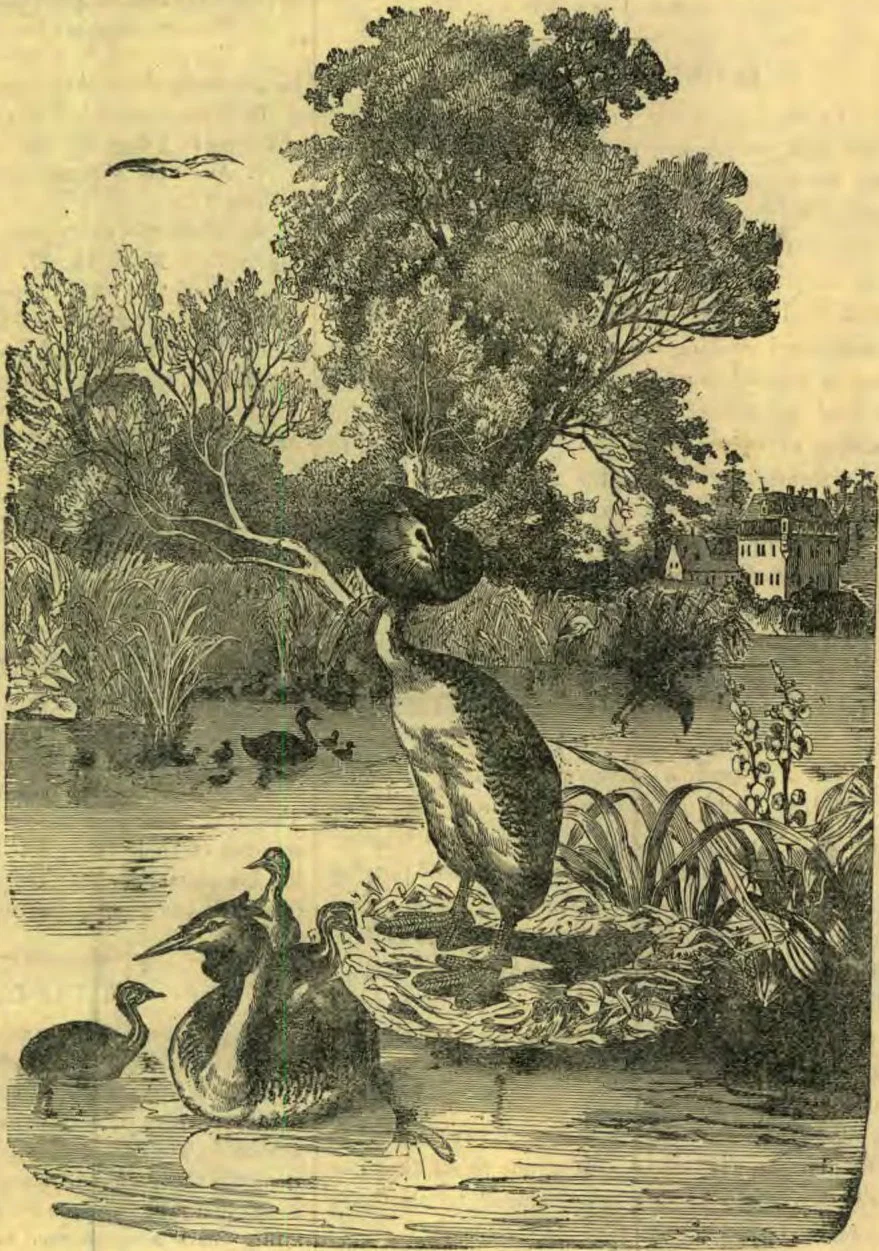
Here we have the picture of a pretty lake, with a marshy border of reeds and fens, and some of the birds that live among them. Most any of you can point out the ducks and cranes; but the group of strange-looking birds in the forefront of the picture, you may not know so well.
The three smallest of the group look like ducks, only that their bills are so sharp-pointed. But a look at the parent birds, more particularly the male bird, or the one which stands upon the edge of the nest, will satisfy you that they are not ducks.
What gives the parent birds such an odd look, is the ruffle of feathers about the neck, and the large crest, or comb, upon the head; and from this crest the bird is named the grebe, the word meaning crest, or comb.
There are more than twenty species of the grebe in the northern parts of Europe and America. They all have long necks, small heads, and long, sharp bills; and their eyes are close to their bills. Most of the species have short wings and legs; and their legs grow out of their bodies so far back that it makes it difficult for them to walk, so they do not try to walk very often. When they come on land, they have to stand upright, or they would lose their balance, and topple over.
Do you notice what queer-looking feet they have? Each foot has three divisions, or lobes, united by a web, or thin skin, just before joining the leg. The lobes are flat, and are covered with scales. The whole foot looks something like a horse-chestnut leaf with three lobes. You can examine a leaf sometime, and see for yourselves.
Being a water bird, the grebe makes its home on the borders of fresh-water lakes and rivers, and the sea-shore. There it can swim and dive to get its food, which consists of fish and such animals and plants as it can find in the water and among the reeds.
It builds its nest of weeds and roots, lining it with down, and fastens it to the fens, or leaves it to float upon the water. And although it builds so close to the water that its nest is nearly always wet, it does not seem to suffer any harm from its damp bed.
The grebe flies very rapidly, but only at short distances, save when he goes to a warmer climate; then he flies high, and a long time without rest. He is an excellent swimmer and diver, and dives to great depths; and if at any time he becomes frightened, he will dive quickly under the water, leaving only his bill above, until the danger is over.
The crested grebe is the largest of the American species. The upper part of its head and body are a blackish brown, with a reddish brown ruff, tipped with black. The forepart and sides of the neck are reddish brown, and the remainder of the body is silvery white.
The horned grebe has been known to carry its young upon its back, and even to dive with them when it was frightened.
The smallest and most active of the grebe family is the little grebe, or dab-chick. Its home is in Europe. This lively little bird will sometimes sink into the water as suddenly as though jerked by something under it; and it will as quickly rise to the surface. It has been seen to thus dive and pop out of the water, until it was really amusing.
Their flesh is not pleasant for food; but because the bird is so active, both on and under the water, grebe-shooting from boats is a favorite amusement upon Lake Geneva, in Switzerland. Besides boats and guns, telescopes are used by the hunters; but they have to understand the habits of the birds, and know their direction after diving, to outdo them.
Don't you suppose that He who notices the sparrow's fall notices also the destruction of these innocent birds by the hand of the cruel hunter? Are you all kind to the birds? M. J. C.

Better Budget.

Myrtle M. Van Syoc, of Warren Co., Iowa, writes: “I have never written for the INSTRUCTOR, although I have often thought I would. I am eight years old. Until we moved into the country, I have always lived where I could attend Sabbath-school. The Sabbath days seem long when I cannot attend; but I hope soon to get the INSTRUCTOR, so that I can study and read it at home, and by its teachings learn how to be a good girl. I want to meet my dear sisters who are laid away in the cold ground, in the morning of the resurrection; and with the INSTRUCTOR family be saved when Jesus comes. Much love to all.”
Shall we not all remember Myrtle in her loneliness?
Florence L. Galer writes from St. Armand, Canada. She says: “We take the INSTRUCTOR, and my sister and I learn the lessons from it every week, and a verse from the Bible. As there are no Sabbath-keepers here we do not have any Sabbath-school. I would like very much to live where I could go to Sabbath-school. I am fourteen years old to-day, and I want you all to pray that my life may be such that I may be accounted worthy to have a place with you in the kingdom of heaven.”
None of us will be saved for any worthiness of our own, Florence; but if all our actions are done for Jesus’ sake, his worthiness will avail for us. We will pray that your life may be as nearly as possible like the perfect Pattern, and your trust fully in him.
Ollie Grimstead, of Barren Co., Ky., writes: “I like the INSTRUCTOR very much. I try to keep the Sabbath with my mamma. I study Bible Lessons No. 1. I hope reading the INSTRUCTOR and going to Sabbath-school will make me a better girl. I am twelve years old. My papa is a blacksmith. He says he believes the seventh day is the Sabbath, but he thinks he has n’t time to keep it. I want to overcome all my evil ways, so that I may meet the INSTRUCTOR family in heaven. This is the first letter I have tried to write.”
Ollie may be greatly benefited by reading the INSTRUCTOR and going to Sabbath-school if she, from the heart, tries to become like the dear Saviour.
Don P. Rust, of Dallas Co., Texas, writes: “I have taken the INSTRUCTOR more than a year, and like it much; and I am going to have it continued another year. After I get through reading the papers, I take them to school and distribute them among my schoolmates. They are all glad to get them, and they wish me to bring more. I keep the Sabbath with my parents. We are trying to serve God, so as to have a home in heaven, where I hope to meet the INSTRUCTOR family.”
You are doing good work when you distribute your INSTRUCTORS, Don; but can you not get some of your mates to take it as their own?

You have reached the end of this edition.

The Youth’s Instructor · Feb 11, 1885