The Youth’s Instructor, Vol. 35, No. 31.

STUDY THE SCRIPTURES

The Youth’s Instructor

Aug 3, 1887

S. D. A. Publishing Association · Battle Creek, Mich. · Aug 3, 1887

STUDY THE SCRIPTURES.

“Thy word have I hid in mine heart, that I might not sin against thee.” Ps. 119:11.
We know the dangers and temptations that beset the youth at the present time are not few, nor small; and we understand that every means that can be employed to repress sin and to encourage righteousness should be entered into most earnestly by the youth themselves. We live in an age when to resist evil calls for constant watchfulness and prayer. God’s precious word is the standard for youth who would be loyal to the King of heaven. Let them study the Scriptures. Let them commit text after text to memory, and acquire a knowledge of what the Lord has said; and then let his word be strictly obeyed. When tested, and in trial, let the youth spread out the word of God before them, and with humble hearts, and in faith, seek the Lord for wisdom to find out his way, and for strength to walk in it. The Lord loves his children, and with a devotion stronger than that of a mother for her child; for in response to the question, “Can a woman forget her child?” the Lord, by his prophet, says, She “may forget, yet will I not forget.”
Yesterday, in company with Mrs. M. K. White and her two children, I rode from Basel, Switzerland, into a portion of Germany. During the ride, we witnessed a painful scene, which I could not get out of my mind, even in the night season. It was a woman running after her five-year-old child, which, when she reached it, she struck several severe blows upon the head. Afterward she grasped her little one by the hair of its head, twitched it back and forth repeatedly, at the same time continuing to strike it; and finally, seizing the little girl again by her hair, she shook her violently; and lifting her from her feet, threw her with great force into the house. All this time the child was screaming at the top of its voice. The thought that here was a woman, a mother, in a hurricane of passion, having the control of children, was painful in the extreme. What will be the effect upon children brought up in such an atmosphere? It was the first exhibition of the kind we had witnessed since coming to Europe.
But though the woman may forget, the Lord assures us he will not. Isaiah 49:15, 16 reads: “Can a woman forget her sucking child, that she should not have compassion on him?” “Yea, they may forget, yet will I not forget thee. Behold, I have graven thee upon the palms of my hands.”
Christ bears the cruel prints of the nails into heaven, and can he forget the purchase of his blood? Will he leave the children and youth a prey to the temptations of the enemy? No, he has made ample provision for every youth, that when they call upon him in perplexity and trial, he will listen to their prayer, and will, with every temptation, make a way for their escape.
The Lord never corrects except in love and compassion. Jesus was himself a child, and knows the temptations and trials of childhood. He was himself a youth, and he understands the perplexities and disappointments of youth. He pities and sympathizes with the erring. He received the cruel wounds on the cross of Calvary, that left the marks in his hands, that he might bless and save the children and youth. He knows your conflicts; he knows, too, the desires of the enemy. He knows your heart sorrows for sins and your purposes to be right and do right, and he stands ready always to give you needed help when you shall call upon him.
You may have pure, noble characters, a rich experience in the service of Jesus Christ. But you must, like Joseph, set your hearts resolutely to resist the first insinuation from the tempter to do evil. Your only safety is in making the word of God your study. If you will hide his word in the heart, you will not mistake the path of duty and of safety. That blessed book will teach you to be honest, temperate in all things, frugal, industrious, truthful, and upright. Its counsels heeded will make you a faithful companion of youth, giving you an influence that will ever lead upward, to purity of character; an influence that will lead away from sin, into paths of righteousness.
Will such a life be without enjoyment? Ah, no! It will be full of comfort, full of satisfaction, because you are bringing heaven into your life, peace into your soul, and leaving a testimony that “the law of the Lord is perfect, converting the soul.” “The entrance of thy word giveth light; it giveth understanding to the simple.”
I would that all the young could understand how precious is the offering of a youthful heart to God. How lovingly the angels guard the steps of God-fearing, God-loving youth. Jesus knows them by name, and their example is helping other youth to do right. The youth who has hidden within the heart and mind a store of God’s words of caution and encouragement, of his precious pearls of promise, from which he can draw at any time, will be a living channel of light. He has connection with the Source of all light. The Sun of Righteousness sends its light and healing beams into his soul, irradiating rays of light to all around him.
I counsel the youth not to devote to the reading of story books or fictitious tales the precious moments now given them in which to make preparation for eternity. Such reading will surely unfit the mind for the enjoyment of solid reading, which strengthens the intellect and improves the morals. Story-book reading creates an appetite for exciting stories, leads the mind away from the Scriptures, and disqualifies for duty; it makes the precious words of God, which should be of the highest value, dry and uninteresting. The mind must be fed with pure food if the heart be pure. The moral taste is perverted by fictitious reading.
Let our young men institute a warfare against every habit that has the least danger of leading the soul from duty and devotion. Let them have stated seasons for prayer, never neglecting them if it can possibly be avoided. If they go out to battle with their vicious habits indulged as before they professed fellowship with Christ, they will soon fall an easy prey to Satan’s devices. But armed with the word of God, having it treasured in heart and mind, they will come forth unharmed by all the assaults of the foes of God or man.
I appeal to our youth never to be found without the spiritual armor, wherewith they will be able to quench all the fiery darts of the adversary. In the name of God, lift your banner for truth and righteousness,—the commandments of God and the faith of Jesus. You need the perfect armor of truth now, the sword of the Spirit, whose edge will never be blunted, but will cut its way through sin and unrighteousness. I repeat, The Bible is the standard for the young who would be loyal to the King of heaven. “Thy word have I hid in mine heart, that I might not sin against thee.” Mrs. E. G. White.

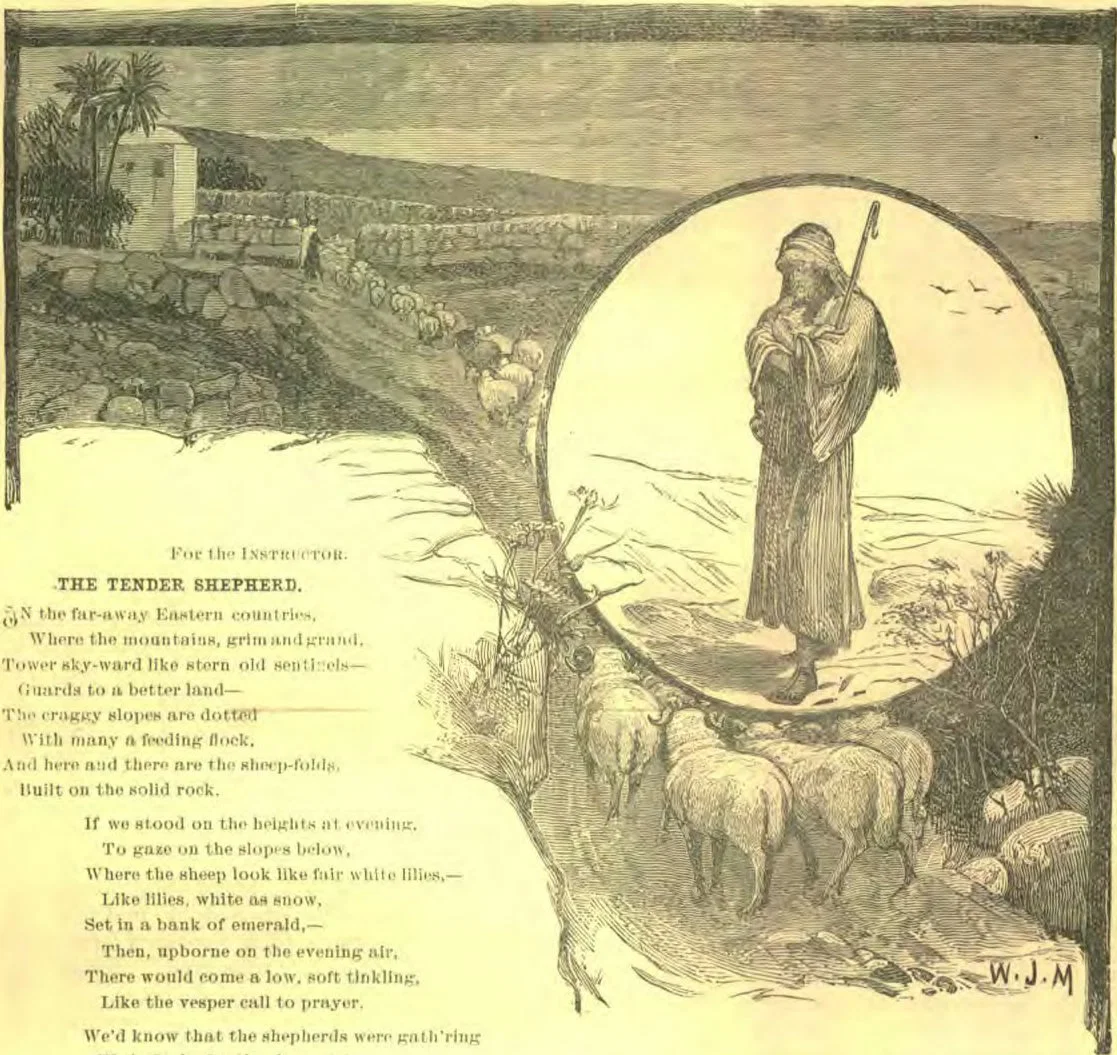
THE TENDER SHEPHERD.

On the far-away Eastern countries, Where the mountains, grim and grand, Tower sky-ward like stern old sentinels— Guards to a better land— The craggy slopes are dotted With many a feeding flock, And here and there are the sheep-folds, Built on the solid rock.
THE TENDER SHEPHERD.
If we stood on the heights at evening, To gaze on the slopes below, Where the sheep look like fair white lilies,— Like lilies, white as snow, Set in a bank of emerald,— Then, upborne on the evening air, There would come a low, soft tinkling, Like the vesper call to prayer.
We’d know that the shepherds were gathering Their flocks for the close of day, And with them watch the narrow, stony path, As they toiled on their upward way. Oh! could we then help but wonder At its kin to the paths we tread? And whether our Shepherd will call us home When the days of time are fled?
As we gazed on these lowly shepherds, ’T would gladden our hearts to see That the weary and faint and weak ones Were borne with so tenderly; That the young lambs were laid in their bosoms: And we’d think, as our eyes grew dim,— If the lambs are so dear to these shepherds, How much dearer are children to Him!
S. ISADORE MINER.

NED'S TRUST.

“Boy wanted.”
“That was the neatly written sign that had hung so long in the window of Mr. Drake's grocery store that people wondered why it was that it seemed to be so difficult for him to secure a boy, when the place was such a good one, with chances for promotion. But Mr. Drake could have told them that there were plenty of boys anxious and ready for the position, but that it was hard for him to find one with all the necessary qualifications.
In the first place, Mr. Drake required unexceptional references, and in addition to that, good security for the boy's honesty; and though most of the applicants for the position could bring references, none of them were able to furnish the necessary security.
Ned Brown's face lighted up with hope one morning when he saw the notice on his way down town. Here was just the very chance he had been looking for, and he determined to apply for the vacancy at once.
“Mr. Drake, I want a place very much,” he said, as the merchant looked up from the newspaper he was reading when the boy entered the store.
“And I want a boy very much,” Mr. Drake answered. “So perhaps we can make a bargain. Can you give me any references and security?”
“I can bring you references, sir,” Ned answered, his hope beginning to diminish at the mention of security.
“That is good, but I have resolved never to take a boy unless some one has confidence enough in his honesty to be willing to go his security.”
“I am afraid I couldn't furnish any security, sir,” Ned answered sadly, as he realized that he had no friend from whom he would like to ask such a favor.
“Then I am afraid we can't make any bargain,” and Mr. Drake took up his paper again, as if the matter was conclusively settled.
Ned walked slowly out of the store, thinking regretfully of the position he would have been so glad to obtain, and wondering whether in any way it would be possible to get the needed security.
He had almost forgotten about the matter two weeks later, when he went into a confectioner's store with a school-mate who wanted to buy some candy.
It was a warm day, and the boys were heated with their walk. Presently Ned's companion exclaimed,—
“Wouldn't this be a good time to get some ice-cream? Let's get some. I haven't enough money myself, but can't you lend me some?” Ned shook his head.
“I only have the club money in my pocket, and of course I couldn't use that.”
“Why not?” Harry asked. “It wouldn't be any harm just to use it for a little while, and you could put it back again afterwards. You're the treasurer, so it wouldn't matter if you did use it, as long as you put it back again. Come on, like a good fellow, and stand treat. Some ice-cream would cool us off nicely,” and he made a move toward the door of the ice-cream saloon that was at the end of the store, shut off by lace curtains.
But Ned shook his head resolutely.
“No, I can't use it,” he answered firmly. “I don't want to be disobliging, Harry, but it wouldn't be right for me to touch a cent of this money. I'm sorry, for I would like some ice-cream as well as you, but indeed I can't.”
“I think you're altogether too particular about a few cents,” grumbled Harry. “Any one would think I was asking you to steal it to hear you talk. You can replace it as soon as you go home if you like, so what can possibly be the harm, I would like to know?”
“Well, you see it's a trust fund,” Ned answered. “It's money that has been put in my care, and I must be worthy of the trust. Mother says that's just the way people begin that end up in stealing large sums. They take just a little at first, and think they will only borrow it and then put it back; and so they keep on taking a little more every time, until at last they take so much that they can't replace it, and then they are disgraced. Now, if I don't ever take the first step, I shall not go on to anything worse; and so though I could replace this money long before it will be wanted by the club, yet I would not touch a penny of it for anything. I'll keep my trust.”
“I suppose I've got to go without the cream then, since you're so mighty particular,” Harry answered rather ill-humoredly. “But you'll find out that you won't gain anything by being so much more honest than other people.”
A gentleman who had been sitting in the ice-cream saloon, hidden from the boys by the lace curtains, looked after them as they passed out of the store, while a satisfied look rested on his face.
The next day, when Ned was passing Mr. Drake's store, he was surprised at being called in, while Mr. Drake inquired,—
“Well, my boy, do you still want to work for me?”
“Yes, sir, indeed I do,” Ned answered eagerly. “But I can't furnish any security.”
“Well, I have determined not to wait any longer for the right boy to make his appearance, and I have made up my mind to give you a trial, and see how you suit me. I have reason to feel satisfied as to your honesty since I overheard your conversation with a friend in the confectioner's yesterday. A boy who will not violate his trust in the smallest particular, may be trusted without any other security than his own word.”
“Don't you think it pays to be honest, now?” Ned asked Harry when he saw him a few hours later, and told him that Mr. Drake had engaged him.
“Well, may be it did this time,” Harry grudgingly admitted, “but it won't always.”
He had to confess his mistake, as he found that Ned was soon promoted to a position of responsibility, because his employer learned that he always kept his trust, and could be relied upon.
I think all boys may learn a lesson from Ned. Remember that a trust fund should always be held sacred, and never appropriated to any other uses. If this lesson was only deeply implanted in the hearts of all our boys, we would not hear so much about the dishonesty of those who hold positions of trust.—Youth's Evangelist.

REVENGE AND RELIGION

TCHOUNG-KOUO.—NO. 10.

REVENGE AND RELIGION.

A Chinese will commit suicide upon the slightest provocation. The favorite methods adopted are by hanging, or by jumping into a well. In China, when a man has a grudge against another, he does not attempt to kill his enemy, but, after making it apparent to the public that the accused is his enemy, he kills himself. The reason is this, that the law throws the responsibility for the suicide upon the one supposed to have occasioned it. The result is certain torture and ruin, if not loss of life. If the enemy has property, the family of the suicide often obtains a portion or all of it. For this reason people often commit suicide in the houses of the rich, that their families may be benefited.
Suicide is looked upon by the Chinese as honorable, and when one commits suicide to avenge himself on an enemy he cannot otherwise punish, he becomes a hero to his descendants. The owner of any land upon which a dead body is found is responsible in the law for the death of the individual. If he can compromise with the relatives so that they undertake the funeral, he becomes free, otherwise he must stand a lawsuit, which means ruin, and perhaps loss of life. For this reason the sick, poor, or unfortunate are driven from every dwelling, and even out of the ditch in front of the house, being compelled to lie down and die in the highway, that being the property of the government.
There are but two pursuits which have any fascination for the Chinese,—the obtaining of money or wealth, and material enjoyments. An overruling Deity and a future life are two facts that they are too indulgent to believe in. To them religion is simply a fancy to be followed by those who like to indulge in it, never to be looked upon as a serious matter. They refuse to listen to doctrines, and will not argue, caring nothing whether they be true or false. Away back about the year 1998 B. C., we have a record of the supposed first king of China, Shin-nong, whom many presume to have been the Shem of the Bible. From his time nearly to that of Confucius, who was born in the province of Lan-sin, six centuries before the Christian era, the Chinese seem to have had a pure religion, free from idolatry, kept so simply because they were too indifferent to adopt any innovations. During the time of Confucius, two distinct religious sects arose, and several different sects of philosophy, all teaching contradictory doctrines. Since then a third form of religion, Buddhism, has been introduced. All of these systems have their priests and regular services, and the Chinese perform outward acts of worship, connected with them, yet none have any belief in the efficacy of what they do, or care to investigate, simply doing all in obedience to the universal law that makes it compulsory to act as their ancestors did before them.
W. S. C.

AUGUST

AUGUST, month when Summer lies Sleeping under sapphire skies: Open all the windows wide, Drink the orchard's fragrant tide,— Breath of grass at morning mown Through the leafy vistas blown,— Hear the clinking of the scythe Sound mellifluent and blithe. August, month when everywhere Music floats upon the air From the harps of minstrel gales Playing down the hills and dales: August, month when sleepy cows Seek the shade of spreading boughs Where the robin quirks his head, Contemplating cherries red: August, month of twilights, when Day half goes, and comes again: August days are guards who keep Watch while Summer lies asleep. —Frank Dempster Sherman, in St. Nicholas.

THE COST OF A BLUE RIBBON.

“Doth Job serve God for naught?” was the devil’s question; and the devil’s children are continually asking similar questions concerning the people of God. Judging other folks by themselves, they have no idea of doing things simply because it is right to do them; and they believe that men who do right usually do it with some selfish end or aim in view. Now and then one of these questioners gets his answer.
“How much do you get for wearing that?” said a young gentleman in an omnibus to one on whose coat was displayed the total abstainer’s badge of blue ribbon.
“Really, I can’t say exactly,” replied the wearer of the ribbon, “but I think it costs me about twenty thousand pounds a year,” was the prompt and unexpected reply of Mr. Carrington.
And his statement was literally true. He was the son of a great brewer, whose name stands on the public houses all over the kingdom. When he died, he designed his brewery for his oldest son, Frederick, if he were willing to carry on the business; if not, the brewery was to go to his youngest son, and Frederick was to receive a smaller property instead of it. The elder son had not long before consecrated himself to the service of God, and had begun to work among the poor, and sinful, and degraded in the east of London. In trying to turn them from their evil ways, and rescue them from their terrible condition, he speedily became acquainted with the fact that the great obstacle in the way of gospel work was drink, and that the Carrington brewery was doing ten times more harm than his mission was likely to do good. Accordingly he quit the brewery business, sacrificing an income of nearly one hundred thousand dollars a year, and went to work to undo so far as he could the mischief that was being done by drink.—The Christian.

“AVENGE NOT YOURSELVES.”

An Eastern story tells of the haughty favorite of an oriental monarch who, as he was passing, threw a stone at a poor dervish or priest. The dervish did not dare to throw it back at the man who had assaulted him, for he knew the favorite was very powerful. So he picked up the stone and put it carefully in his pocket, saying to himself: “The time for revenge will come by and by, and then I will repay him for it.” Not long afterward this same dervish, in walking through the city, saw a great crowd coming toward him. He hastened to see what was the matter, and found, to his astonishment, that his enemy, the favorite, who had fallen into disgrace with the king, was being paraded through the principal streets on a camel, exposed to the jests and insults of the populace. The dervish, seeing all this, hastily grasped at the stone which he carried in his pocket, saying to himself: “The time for my revenge has now come, and I will repay him for his insulting conduct.” But, after considering a moment, he threw the stone away, saying: “The time for revenge never comes; for if our enemy is powerful, revenge is dangerous as well as foolish; and if he is weak and wretched, then revenge is worse than foolish, it is mean and cruel. And in all cases it is forbidden and wicked.”—Selected.

Remembering the Poor in Thanksgiving

In the midst of our thanksgiving let us remember the poor and needy with cheerful gifts and alms, so that our services may, by deeds of charity, be made acceptable in the sight of God.

TO S. S. TEACHERS.

“For Ezra had prepared his heart to seek the law of the Lord, and to do it, and to teach in Israel statutes and judgments.” Ezra 7:10. Ezra was a very successful teacher in Israel. He labored hard to teach the people the law of God, their duty to him and to one another. His instructions were greatly blessed of God, and resulted in much lasting good. Now would it not be well for our Sabbath-school teachers to study the character of this great teacher, and learn from him how to become good and successful teachers of God’s holy word?
In the first place we find that Ezra “prepared his heart.” That was, in his judgment, the first and necessary step for him to take, in order to become an acceptable teacher of the word of God. Now if preparation of the heart was then the first and essential step to become an acceptable teacher before God, it is equally necessary now. No person whose heart is not right in the sight of God is qualified to teach the word of God and the way of life to others. The heart must be right with God before the teacher can expect God to bless his efforts in trying to teach others their duty to God. The teacher ought to be converted and have some experience in the true religion of the Bible. He ought to have a burden for souls, and feel that there is a work for him to do in trying to help and encourage such as are Christians already, and in laboring wisely and earnestly for the conversion of the unconverted. This may be done in different ways; first, by making a practical application of important truths or duties contained in the lessons. Second, by praying and laboring individually for these members of the class. To do this acceptably before God, a teacher needs much wisdom and much of the Spirit of God, all of which an instructor may obtain by careful study, and praying God for the needed help to perform these important and solemn duties.
The next thing that Ezra did was “to seek the law of the Lord.” By the law of the Lord in this case we may understand all that God had thus far revealed to man; for we find Ezra afterward teaching Israel all that had been written in the book of the law. Neh. 8:1-8. His seeking the law must mean something more than simply seeking or hunting for the book containing the law. In this case it must mean that he had carefully searched and studied it; for we find it said of him that he was a “ready scribe in the law of Moses.” Ezra 7:6. By carefully reading the books of Ezra and Nehemiah it will be seen that Ezra had a thorough knowledge of the law he was teaching, and that knowledge he obtained by seeking for it. So should our Sabbath-school teachers now study their lessons and seek for knowledge that they may be acceptable teachers before God.
No teacher is qualified to teach who does not carefully study his lessons and diligently seek for knowledge to impart to his pupils. No district would employ a person to teach a school unless he had previously prepared himself for teaching, and then he would have to pass through a rigid examination to see whether or not he was qualified to instruct youth and children before he would be allowed to teach. Now can it be that it is less important to teach eternal truths, than the common sciences of the day? Can the knowledge that is needed to make us wise unto salvation be less important than the knowledge relating to worldly business? Can it be that the training and instruction needed to make men, youth, and children fit to associate with sinless beings and holy angels in the better world, is of less importance than the training and instruction given in our common schools? What think you, Sabbath-school teachers and workers? What will you say in the last day when the great God will examine your work? May God help you to do faithful work now so that he may then say to you, “Well done;” but this he will never say unless you have done well.
The next thing that Ezra did after he had prepared his heart and had sought or studied the law, was “to do it.” He not only learned God’s will, but he did it. He faithfully obeyed God; he lived a godly life. His life was in harmony with his profession; his conduct was in perfect harmony with his teaching, and this gave force and power to his instruction.
So now every teacher in our Sabbath-schools ought to be an earnest, faithful Christian. If he tries to do right, and asks God for help, it will not be withheld from him. Every teacher should live so near to God that the Spirit could be with him from day to day; then when he comes before a class, he will realize that the Comforter is with him to aid in teaching and impressing the lesson of the day.
What we need in our Sabbath-schools is earnest, faithful Christians that have the salvation of souls at heart, persons who will work hard to advance the Sabbath-school intellectually and spiritually. May God help our Sabbath-school teachers to wake up and do earnest work for time and eternity.
There is another trait of Ezra’s character that we should not forget, and it is this: he labored and prayed earnestly for the conversion and spiritual good of Israel. He mourned and wept for the sins of Israel, and plead with God to be merciful to them and forgive them. This is something that teachers ought to do now,—labor for the conversion of the unconverted. Pray for them. Plead with God for them. Also find suitable opportunities to talk to them alone, and try to help them become Christians. If such work is done in a tender spirit by a teacher who has a love for souls it will certainly accomplish much good. There is something more for a Sabbath-school teacher to do, than merely to ask the questions of the lesson. There is work to do outside of the class recitation, and a faithful, earnest teacher will find opportunities to labor for the spiritual good of the pupils outside of the Sabbath-school hour.
May God bless and help our Sabbath-school workers to do more thorough work for the Master; and may they see fruits of their labors here and hereafter in the kingdom of God.
O. A. JOHNSON.

THE REGULAR AND CONTINUED ATTENDANCE OF SABBATH-SCHOOL PUPILS.

One of the important things in starting a Sabbath-school is to secure the pupils; and when they are once in the school, it is of no less importance to secure their regular and continued attendance. The tardiness or frequent absence of pupils is discouraging to teachers and officers, making their labors more difficult, and preventing the desired standard of success from being reached. Not only is this true, but the tardy pupils themselves suffer an irreparable loss. The last statement is based on the supposition that the Sabbath-school is conducted in such a manner as to secure substantial benefits to its members. But where there is a great amount of unnecessary irregularity in the attendance of pupils, it is suggestive that something is wrong in the school itself, and hence emphasizes the demand for remedies to be sought and applied. On the principle that prevention is better than cure, it is equally important to have in constant practice such methods and details as will render unnecessary the application of “remedies.”
In the popular Sunday-school work of the day, resort is had to many methods and expedients that S. D. Adventists regard as questionable. There are concerts, amateur theatricals, sociables, excursions, oyster suppers, lawn parties, ice-cream festivals, Christmas celebrations, etc., etc., too numerous to mention, all arranged with a view of presenting inducements to pupils to become members, regular in attendance, of the Sunday-schools furnishing such entertaining features. Then there is the system of reward of merit cards, prizes, etc., which is also questionable. We were much gratified to hear a very earnest Sunday-school worker, at a recent Sunday-school convention, unqualifiedly condemn as pernicious, all such “drawing” features as we have mentioned. It is gratifying to know that among the more conscientious and discriminating classes, this sentiment is gaining ground, and S. D. Adventists may congratulate themselves that they have not fallen into the use of the pernicious methods before mentioned.
It is true that the first and foremost reason why pupils should be desirous of attending Sabbath-school, is that they have a love for the study of Bible lessons, and that they heartily believe they will be materially benefited by learning and reciting those lessons. But this plant of love for Bible study and faith in the value of the same, does not seem to be indigenous in the human heart. It must needs be planted, and receive constant and careful cultivation and watering thereafter, in order that it may thrive and bear a desirable supply of fruit. But how is this plant to be cultivated?
It will be granted that one very important consideration in the matter of retaining the membership and regular attendance of pupils, is to have the school so conducted, and the detail work so performed that members will not only approve the same, but feel to speak commendatory of it. This is, of course, an exceedingly difficult problem to solve; and it must not be expected that it can always be completely and satisfactorily solved; there will always be some exceptions—some chronic grumblers who cannot be suited. But there are some features of such universal application that no person of fair reasoning capacity and an ordinarily comfortable disposition will criticise or condemn. We will endeavor to mention a few of them.
The opportunity afforded before the opening of the school session is an invaluable one. Officers, teachers, and pupils may then greet each other, shake hands, make inquiries after each other’s health and prosperity (we mean Sabbath-school prosperity), speak a word or two regarding the work of the day, inquire after members of the school who have not yet arrived, and thus in many ways make those few moments so precious and really valuable that none can afford to miss them. Instead of coming in one by one, silently, and with long-drawn faces, and dropping quietly into seats, there to remain and make the silence more oppressive, all should exert themselves to cultivate a spirit of cheerfulness and cordiality; a love for the place, the occasion, and each other. It is evident that officers and teachers must take the initiative in this work, and give suitable examples for the pupils to follow. If one sets his wits to work, he will find a great variety of features that may appropriately be employed in the manner indicated. Where teachers, officers, or pupils do not come in until the last minute, or are actually tardy, they thereby lay themselves liable to the suspicion that they do not care to spend any longer time at the Sabbath-school than they feel obliged to. When new members come to join the school, the best time to introduce them to others is before the session begins, and thus they will be made to feel at home, and be prepared to enjoy and receive benefit from the exercises of the day.
With the interest of all awakened, their spirits raised, and a general sentiment of warmth and cordiality pervading the entire school, as will most surely result from the practice of the suggestions made above, it is easy to see that when the school is opened with singing, the chances are greatly increased for all to join heartily, and thus a most favorable opening of the school will be secured. This is of great importance, for it is as true in Sabbath-school work as in anything else, that a work well begun is half done. It may occur that a pupil comes to Sabbath-school not in the most desirable frame of mind; he may have had some petty vexations during the morning (and who does not?), and is feeling a little out of humor,—just in the right mood to find fault. A cheerful greeting from his teacher and others, and a few words of pleasant conversation, will help wonderfully in dispelling the cloud that may be over him, and he be better fitted to receive benefit from the school session. While it is incumbent upon all the general officers of the school to constantly exhibit this spirit of cordiality, it must devolve upon the teacher to be sure that each and every member of his or her class is given proper attention in this respect. None should be slighted.
The sociability we have in mind, does not border on lightness or frivolity; it is simply an exemplification of true Christian courtesy and cordiality; it is the practice of good manners, and the mark of a gentleman or a lady. The continued and proper exercise of this feature, cannot result otherwise than to cause all who are concerned to be more in love with the Sabbath-school, and more anxious that others should attend.
The responsibility resting upon the individual teachers is apt to be greatly underestimated. It matters not how complete and efficient the general management of the school may be, the personal contact and detail work is within the teacher’s sphere; and it is this that has the most telling effect in molding the character of the school. The permanent loss of pupils from the class, or their irregular attendance, can but cause the true teacher trial and discouragement. His interest for their own good will cause him to be so affected; furthermore, the suggestion must inevitably arise that perhaps such loss or irregularity is partly the result of his own inefficiency or neglect. The consciousness that such may be the case, cannot be otherwise than a source of bitter regret. For the most part, the teacher has this matter in his own hands. He should be a close student of human nature, and study with care the disposition of his pupils; he should study their likes and dislikes, and adapt his teaching and dealings to the needs of each. He should never lose an opportunity to show his love for and an interest in his pupils. God arranges opportunities for us, and then waits to see how we improve them. If we neglect to improve them, however trivial they may seem, we have no right to expect others of a more important nature to be arranged for us, nor will we be as apt to comprehend them when they are arranged. Every neglect to improve an opportunity blunts our sensibilities in the direction of discovering others. In the class recitation, the utmost impartiality should prevail. Teachers should not have pets, nor should they allow one or two, or any portion of the class, to monopolize the entire time by talking, or by insisting on answering more than their legitimate share of the questions. If any one has failed to learn his lesson properly, be careful not to be so severe as to discourage or exasperate him. It is a pretty risky experiment to treat a pupil who is defective in his lesson in such a manner before the entire class that he will feel chagrined. A few words of private counsel and encouragement, given in a kindly manner, with such pupils as are habitually defective in their lessons, will be more effectual in bringing about a reform than anything else that we know of. Of all the work that is done in the Sabbath-school, there is scarcely anything more important than that of the teacher as he stands before his class to conduct a recitation. His work is fraught with momentous consequences, and he needs a large measure of aid from the Holy Spirit to properly discharge the responsibility that rests upon him. He can drive his pupils from the school, or retain them; he can cause them to like, or dislike the school; to speak ill, or well of it; to interest themselves in behalf of the school, or the contrary; to speak in terms of criticism, or commendation of his own work. He can, if he will, arouse a spirit of loyalty for the school as a whole, that will cause his pupils to be its champions under all circumstances.
It should be the constant aim of the teacher to touch chords in the mental and moral natures of his pupils that will respond with a wholesome vibration, rather than with a discordant jar. Make such application of some feature of the lesson, or some feature that can be legitimately brought into the lesson, as will touch the desired chords. While it should be the rule to touch upon all the points designed by the author of the lesson to be brought out, a special effort should be made to cause the pupils to realize that there is something in the lessons that each can take home with him, and make a part of himself and his everyday life. If pupils return to their homes with a sense of dissatisfaction because of not having received the material benefit and light they had anticipated, the conditions are unfavorable for their continued attendance upon Sabbath-school. It may as well be considered that pupils all have certain anticipations when they go to the school, and unless those anticipations are met, dissatisfaction is sure to arise. If the teacher can be thorough and work for the best interests of his pupils, and at the same time not disappoint them in their own expectations, it is very fortunate.
Much may be accomplished in holding the continued interest of pupils by way of suggestions relative to the succeeding lesson. Teachers should always be familiar with the succeeding lesson, and at each recitation have something to say relative to it that will awaken an interest in the pupil, and cause him to begin the study of it at the earliest possible occasion. If it can be intimated that such and such features pertaining to the next lesson, and which are important and somewhat obscure, will be given special consideration, the result will be to make the inducements stronger for a full and early attendance.
G. W. MORSE.
Continue reading: BE COMPANIONABLE