—A missionary is a man who has a mission; and if a man has no mission, and is neither sent nor called, he runs without tidings, and often runs in vain and labors in vain. It is well for every man to consider for himself just what he can do. He should do something which needs to be done; and he should learn to do something which others cannot do, or which he can do better than most others. He should make his life not only useful, but needful to the world. There are a multitude of men standing idle and seeking occupation, willing to do everything, but not knowing how to do anything. There are rough stones which may sometime be built in with others into a wall, but they are not fitted to any particular place, and are astonished to find there is no place awaiting them. Let every man fit himself to do some useful, needful thing, and do it thoroughly and well. If he speak, let him have a message which the world needs to hear; if he work, let him produce something which the world needs to have. Let him find out what he can do and do it, and be not a listless idler. The man who has no business in the world has little excuse for occupying space in it.—Sel.
Life Insurance Plan for Melbourne Church Debt
—An extraordinary plan for liquidating a church debt has been adopted in Melbourne, Australia. The debt in full is divided among the members of the committee. Then each one insures his life for the amount that falls to his share. The policies are transferred to the church, and the annual payments on them are made out of the collections. Then as the members of the committee depart this life, the sums insured on their lives, fall into the church treasury, and later, when the only survivor dies, the last installment of the church debt is paid.
What next? This beats church fairs, raffles, and kindred iniquities. In fact, it almost seems like making a “covenant with death,” and an “agreement with hell.”
“MEXICO’S GREAT CALAMITY.”
By Chicago News
If it were only a failure of crops with which our neighboring republic of Mexico had to deal, the abundant harvest of the United States would quickly relieve that country. But Mexico suffers with something a great deal worse than a poor crop, although it needed the latter to show the terrible effect of the constitutional evil the Mexican republic is afflicted with. Her peculiar disease, which more than any other cause is responsible for the slow development of her institutions, and for the lack of stability which has characterized her political life, is a practical alien ownership of the soil, to which is added the exemption of all lands from the burden of taxation. When Mexico was taken possession of by the Spanish invaders, the native inhabitants knew no such thing as individual ownership in land. The soil was held in common, temporary title to its possession being based on the fact that it was being tilled. No one could hold land without working it, either himself or with the aid of hired help. Land-ownership was then much in the same condition as the ownership of mineral mines is in Mexico up to this day. After the conquest was made, the conquerors parceled the land and its inhabitants out among themselves and the few Indian chiefs who had aided them in enslaving their country and their people. They forever exempted these lands from direct taxation. Against this system of land-holding—which divided the people of Mexico into an aristocratic minority numbering about 10,000 families, owning all the land and a vast majority of disfranchised tillers of the soil—the first Mexican revolution, led by the intrepid Hidalgo, was directed. It failed when the clergy sided with the landed aristocracy, but the latter very soon after resumed the struggle for Mexican independence and by their success saddled the old land system upon the new government. The owners of Mexican lands reside in large numbers away from the estates, which, on account of their immense size and great variety of crops, yield enormous incomes without taxing the owner’s enterprise. The raising of food crops has been neglected because they cannot stand the heavy cost of transportation, and only a few neighborhoods pretend to raise grains for other than home consumption. The tenant farmers, who are practically no more than serfs, have to pay for their holdings in labor, and therefore cannot raise anything for export, if they raise food crops at all, for which the abundance of natural food to be found in most sections furnishes but little encouragement. It is easy to see how, under these circumstances, the real population is entirely at the mercy of nature, and compelled to live from hand to mouth. There are no means for the distribution of food products to speak of. The owners of the lands have always been able to make all they wanted out of them and did not care how the people living upon them fared. They have, as a rule, accumulated large fortunes, which make a failure of crops a small matter for them, even if they have no mines to fall back upon. This will make the suffering of the people all the more terrible and may prompt them to make a new attempt to obtain permanent relief. They are not quite so ignorant as they have been, and they have, to a considerable extent, the sympathy of the ruling party, which would like to see the sovereignty of the land-holder overthrown in order to be able to impose taxes on lands and abolish the heavy burdens now placed upon the consumption of the people. This year’s bad crops may result in a crisis in Mexican affairs which should open a new chapter in the history of this so richly endowed and yet so unhappy country.—Chicago News.
IMPORTANT YEARS.
By B. F. Jacobs
We are nearing the close of the nineteenth century. “Thoughtful men are convinced that the closing years of the nineteenth century constitute a momentous crisis in the history of the nation” and of the world. A great preacher recently took for his theme, “The fragments of the century;” and now no more than one decade remains. For many years, men of different views have united in their estimate of the awful importance of these few years. If we are permitted to watch the hour-glass of the century till the few sands drop into the lower bulb, we shall witness great things. The century that has produced so many wonders, under the daily increasing pressure put upon these last years, must have more and more, and perhaps greater wonders in reserve. The great preacher said in substance, “There are Christians enough, there is time enough, there is money enough to carry the gospel to every person on earth before the century closes.” He might have added, it is possible, but it will not and cannot be done unless a great change occurs. Are we gaining? “Are church-members more faithful? Is the family altar more prayerfully maintained? Does the number faithfully attending the church services increase? Is there less infidelity, or Sabbath-breaking, or dishonesty, or intemperance?” Thank God, there is a bright side to this dark picture. In many places there is an increasing feeling of personal responsibility, and this is true of many Sunday-school workers. We have the best part of the field to cultivate; we have the most impressible and hopeful class to teach; we have the most fruitful and precious seed to sow; and we have an ever-living and ever-loving Saviour to offer, and the ever-present and all-powerful Holy Spirit to guide and bless us.
In this day of skepticism and worldliness, God has given us his infallible and eternal word to teach. What dignity and authority is conferred upon us! What high privilege is ours! What confidence it gives to the teacher and missionary to know that he has said, “Heaven and earth shall pass away, but my words shall not pass away.” It is written, “He that hath my word, let him speak my word faithfully,” and “Plainness is the beauty of teaching. What good doth a golden key that opens not?” Let us teach plainly. “Teaching them to observe all things whatsoever I have commanded you.” “His word the substance of our teaching. His Spirit our helper, and Himself our guide.” If our Lord tarry, ten years remain for work, ere the sun of this century sinks below the horizon. What possibilities are enfolded in these ten years! Wonders have not ceased. Protestant churches are being erected in Jerusalem. Converted Mohammedans are preaching the gospel in India, and 200 churches and 270 schools are reported on the west coast of Africa. The McAll mission has 134 stations, in Paris and France; and in nine German universities a movement has started for mission work among the Jews, and 130 students have enrolled their names among those who are to be trained for this purpose. Ten years of Sunday-school work! Will the men of sixty, who have ten years to live, give these years to Christ and his service? Will the men of forty, in the greatness of their strength, give these years and their strength to him? Will the young men, stepping forward to begin their Christian life, push the work, in his name? No matter for past failures.
“Men may rise on stepping-stones
Of their dead selves to higher things.”
All things are possible with God, and all things are possible to the believer. This is a day of decision. “The Holy Spirit gives awfulness to these services. We are in his tremendous presence, under his omniscient eye, in the grasp of his infinite power, in the gracious sphere of his healing love.” Let us here decide if the Lord tarries and we live, the coming year shall witness that our gathering in this convention was of him and for him. And if, during this year, Jesus shall come, blessed will that servant be who is found waiting, and watching, and working for his Lord. Brethren, “Let us rise and go to our work; to-morrow we shall rise and go to our reward.”—B. F. Jacobs, Report to Sunday-school Convention.
THE SECOND ADVENT.
The Daily Democrat, Springfield, Mo., of Aug. 9, 1891, publishes an article under this heading, from which we present the following paragraphs. They are interesting as showing how the minds of the people are being agitated on this important subject:—
It must be conceded by all observers and readers that there is a greater interest at the present time in this subject than for many years. The question of the Second Coming of Christ, which would seem to be one that the church and its clergy and writers should first endeavor to elucidate and settle satisfactorily to popular inquiry, has been taken up outside their domain, and whether they relish the prospect or not, they will be compelled to give it a place in their pulpit work and in the columns of their publications. . . .
But if the preachers and church papers maintain an unaccountable quiet with regard to the Second Advent, the secular press of this country and England does not. On the contrary, the interest is on the increase, and in a study of the Bible for light, the layman reasons along lines that the Church overlooks, stripping the Bible of the mysterious and supernatural and drawing conclusions as to its meaning by the application of rules that render their deductions comprehensible to the practical mind. . . .
Then, again, all Europe seems to be an armed camp, and the proofs that a terrible and decisive war is close at hand, are not wanting. If it be “Armageddon,” then it will be as Bismarck said, “The next war will be the last of the world’s history. With our improved munitions of war, it will be the most terrible one of all history, and the victim will bleed white.”
Verily, we live in stirring times. The interest taken by the secular press in not only the Second Advent, but in religious matters generally—a gradual development of the past few years—possesses marked significance. There are no subjects that now more thoroughly entertain audiences, either in the pulpit or the press.
Christian Union on Moody and Sober Second Adventism
—The Christian Union, in speaking of the closing discourse of Mr. Moody at the Northfield Conference, has these wise and discriminating words to say concerning the difference between sensational Second Adventism and that patient waiting for Christ which the New Testament so constantly urges upon us:—
The Second Adventism which cries, “Lo here” and “Lo there,” and which insists that the kingdom of God comes with observation, and against which Christ warned his followers, is not that represented in the sober faith and serious expectancy of such preachers as Spurgeon and Moody, or such scholars and exegetes as Alford and Meyer. A faith which inspires such enthusiasm and fidelity on the one hand, and is based on so patient and painstaking a study of the Scriptures on the other, cannot be airily dismissed as the sensuous visions of the Millerites, as a fanaticism undeserving serious consideration. If it is an illusive hope, its illusiveness should be exposed. If, on the contrary, it is a well-grounded hope, if the Church has set its face too much toward the past, and too little toward the future, if it has ceased to watch, if it says cavalierly, “Where is the promise of His coming, for . . . all things continue as they were from the beginning of the creation?” if it has substituted a pathetic love for a defeated and dead Lord in place of an enthusiastic faith in a Lord who is living and victorious, the ministry has a duty of re-awakening, first its own hope, and then the hope, and so the watchful expectancy of the now drowsy and indifferent, if not despairing Church.
Jerusalem's Languages and Sectarian Rivalries Under Turkish Rule
—It is stated upon good authority that in Jerusalem over forty different languages are spoken. The various “Christian” sects are full of bitterness and hate toward each other, and are kept in peace only by Turkish force. The Church of the Holy Sepulcher is divided off into several sections, and these are parcelled out among the Copts, Greeks, etc.
Al-Azhar University in Cairo: The World's Largest
—The largest university in the world is that of the Great Mosque of El Azar, in Cairo, Egypt. It is attended by 10,000 Moslem students, not only from Egypt and Turkey, but from Algeria and Morocco, the Soudan, Darfoor and Zanzibar, Arabia, Persia, Turkestan, India and Malaya. Nothing is taught except the Koran and the literature relating to it.
DEDICATION OF UNION COLLEGE.
Leaving Battle Creek, Tuesday, Sept. 22, at eleven A. M., we reached Lincoln, Nebr., the 23d at noon. Brethren Olsen and Prescott were kindly waiting at the depot, and stepping aboard the electric car marked “Capitol and Union College,” we were soon at College View, where the College buildings and quite a settlement of our people are located. The terminus of the car line is in front of brother Nicola’s store, and brother W. C. Sisley, whose pleasant and comfortable home stands a few steps north, opened his hospitable doors for a home for us during our stay.
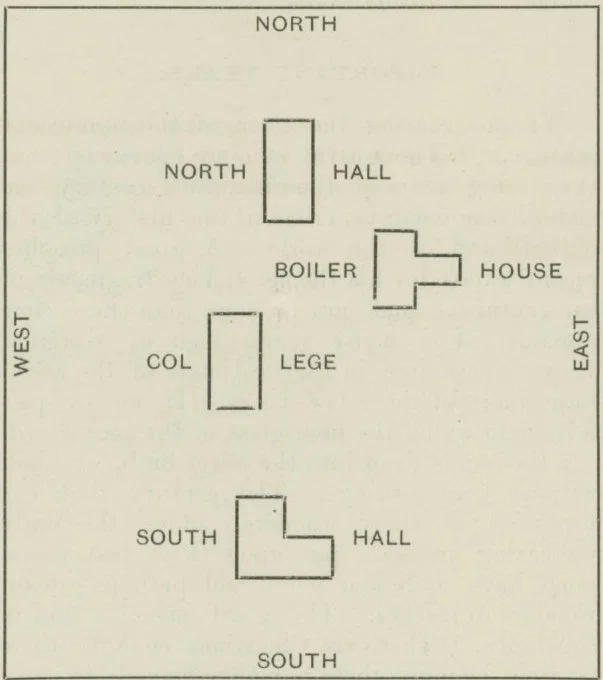
Of the college building and dormitories, it will not be necessary to speak particularly, after what has already appeared in the Review concerning them. The location surpasses in natural advantages any other in the vicinity of Lincoln. The ground is high, sloping away in all directions, that in front gradually taking the shape of a shallow ravine, called in this country “a draw” and descending to a depth of some forty or fifty feet from the level of the college basement. The buildings stand on a line north and south, facing the west, as illustrated in the diagram on this page.
The North Hall is the dormitory for the Germans and Scandinavians, and is the largest of the three main buildings. Its front is on a line with the rear of the College; and the South Hall, or ladies’ dormitory, is set back one half this distance, thus leaving the College in the center, in advance of the other buildings, and bringing them all into the most advantageous perspective, as viewed from the direction of the city, which lies to the north-west. In the rear between the North Hall and the College stands the building which will contain the boilers and engine, ice room, cold storage, laundry, bakery, and electric light plant. From this building a tunnel, high enough for one to pass through easily, runs to all the other buildings, furnishing a passage way for steam and water pipes, and rendering them readily accessible in case of needed repairs, without disturbing any of the surroundings. The utmost care has been bestowed upon the plumbing, heating, ventilation, and all sanitary considerations, to make all the rooms convenient, comfortable, light, airy, and cheerful; and it would be difficult to see where any improvement could be made in these respects.
The North Hall and boiler building are not yet completed; but other departments were so far advanced, as to make it possible to open the school in the English division, Sept. 30, 1891. When all is fully completed that is now under way, it will have cost about $138,000; and nearly $100,000 has been raised from the real estate donated by the citizens of Lincoln toward the enterprise. All bills so far have been promptly paid; there is no existing contract unfulfilled; and the enterprise to this point is free from embarrassment. This is a showing that any educational institution, in the stage of advancement which this has reached, might well be proud to make—a showing which very many have not been able to make. It reflects great credit upon those who have had charge of the enterprise, and under whose management the work has gone forward.
LOCATION OF BUILDINGS AT COLLEGE VIEW.
Thursday, Sept. 24, was the day appointed on which to set apart the buildings to the noble purpose for which they are to be used. As the hour of 3 P. M. approached, our own people, resident at College View and many who had come in from other parts of the State, and other States, with a good representation of the citizens of Lincoln, came pressing in till the large chapel was filled to its utmost capacity. Other citizens from the city would have been present had it not so happened that the Republican State Convention was held in the city the same day; and the Methodist Conference was also in session. Ladies from the city very thoughtfully and kindly furnished flowers for the rostrum, by which it was handsomely decorated. Representatives of all the other institutions of learning in the city were invited to be present and take part in the exercises; and most of them willingly responded; but some were prevented by other engagements. The following was the program of exercises:—
1. Music—Marche Militaire (Schubert); 2. Reading of Scripture (Prov. 4:13–18; Job 28:12–28), by Prof. Wm. P. Aylsworth, Cotner University (Christian); 3. Prayer, by Chancellor C. F. Creighton, Wesleyan University (Methodist); 4. Music—Flower Song (Lange); 5. Presentation of College Keys to Board of Managers, by Wm. C. Sisley, Architect; 6. Response by A. R. Henry, President of Board of Managers; 7. Address on Christian Education, by President W. W. Prescott, Union College; 8. Music—Serenade (Haydn); 9. Brief addresses by Chancellor Jas. H. Canfield, State University, and other invited guests; 10. Dedicatory Prayer by U. Smith, Battle Creek College; 11. Music—Andante and Allegro (Mozart); 12. Benediction by Rev. John Hewitt, Episcopal School for Boys.
This program was carried out as arranged, with only two exceptions: Chancellor Creighton being detained by duties at the Methodist Conference, Elder O. A. Olsen in appropriate and fitting terms offered the opening prayer; and Mr. Hewitt, being for some reason absent, the benediction was pronounced by Elder W. B. White, President of the Nebraska Conference. The four pieces of music were finely rendered by the String Quartette of the Conservatory of Music of Lincoln.
Brother Sisley in turning over the keys to the Board of Managers, gave a brief history of the origin and progress of the enterprise to the present time. He referred to the action of the General Conference in the fall of 1889, to establish a college somewhere between the Mississippi and the Rocky Mountains, for the benefit of the States lying in that portion of our country. A locating committee was appointed, which, having examined various localities, at a meeting in Knoxville, Iowa, Jan. 28, 1890, decided that Lincoln, Nebr., was the preferable point, in view of its location, and the generous efforts of the people to bring it to that place. The location having been decided upon, ground was first broken April 10, 1890, and May 10 the first stone was laid. He took occasion to express his thanks to the citizens of Lincoln, especially the business firms with which they have had occasion to deal, for the kindly feeling and the courtesies they have manifested toward the enterprise. And especially was gratitude due to God for his care and blessing, no serious accident having occurred in the progress of the work thus far. He expressed his pleasure in being able to lay off the responsibilities of the work under circumstances so favorable.
Brother Henry, in responding in behalf of the Board, accepted the work as in every way satisfactory and gratifying to them. He could heartily indorse, and desired to add to, the words already spoken in acknowledgment of the friendly attitude of the people of Lincoln toward the enterprise, and the satisfactory manner in which they had been able to deal with them. He said it had been the design as far as possible to deal with Lincoln people both in the matter of labor and material, and that about ninety-five per cent. of the means invested had been spent in that city. He spoke in the highest terms of the constant care, and the painstaking and untiring labors of the architect, assisted by other faithful laborers, in the erection of the convenient, thoroughly constructed, and substantial buildings they had before them; and in behalf of those whom he represented, he cordially accepted the work which was tendered them.
The address of Prof. Prescott was upon the broad subject of “Christian Education,” a most appropriate theme for the occasion. To impart such an education, the highest and only true education which men can receive here below, Union College has been founded; and to this work it is dedicated. Christ as the creator and the redeemer of the world, under God, is the one upon whom all depends, and his work should be the great study of mankind. All lines of education should tend to, and center in, him. To know him aright is everlasting life; and that which is of true value in this world, is that which tends to close up the gap which transgression has made between the sinner and God. So Christian education may be defined as the knowledge of God as revealed in Jesus Christ. It is to learn how, through Christ, to recognize and acknowledge God in everything and everything in God; to know him as a God near at hand and not afar off.
It would not be practicable in this report to attempt even a synopsis of the able address. The theme was considered with reference to three lines of study on which a Christian education should be sought: 1. The study of God’s word, which is a revelation of his eternal purpose in Christ; 2. The study of his works, which are a revelation of his power manifested through Christ; 3. The study of history, which is a revelation of his providence in his dealings through Christ with men and nations.
In elaborating the subject on these lines, many impressive and telling truths were brought out. The word of God in its purity and sacredness was magnified against the looseness and skepticism of modern ideas in regard to the Bible; the works of God were set forth as a visible evidence of his eternal power and godhead; and the fulfillments of his word, as manifest in the events of history all along the stream of time, show how he is working out his purposes to a definite and glorious conclusion. The address was well received and held the audience in the closest attention during the forty-five minutes of its delivery.
Chancellor Canfield, of the State university, followed with brief remarks in a very happy vein. He illustrated the situation, by supposing a family to be living by the side of a vacant lot, upon which by and by there appears evidence that a new-comer is about to locate. They watch the excavation and erection of the building, tender all sorts of advice, and, however busy they may be, scan every piece of furniture that goes in, wonder if it is not a little out of date, if the woman isn’t a trifle older than her husband, if her hair is not a shade too auburn to denote the best style of temper, if the children will be the proper kind to slide down with their boys on their cellar door, etc., etc. At length the new-comer turns the key and moves in, and the time comes for the resident family to call upon him; and then,615forgetting all their comments, their criticisms, and surmisings, they go in, and, extending the hand of friendship and the voice of greeting, say, “God bless you, my neighbor, come and welcome, and be our friend.”
Then turning to the Board, and making the application, he said that he, as a representative of the State university, as grand, expansive and progressive an institution of its kind as can be found in any State, could welcome Union College to their locality, and bid it Godspeed in its mission. They could work side by side, and co-operate in every good and noble purpose.
After the exercises, many availed themselves of the privilege of looking through the buildings. Favorable comments respecting the architectural appearance of the buildings, and especially concerning the convenience and perfection of the internal arrangements and furnishings, were heard on every hand. The weather was pleasant, and the occasion seemed to be a satisfactory one to all present. A thorn locust hedge of many years’ growth, being trimmed out, makes quite a good showing of trees, for that country, across the front and south sides of the twenty-acre campus; and when others are put in, and the grading is completed, and flower beds arranged, the grounds can be made very fine.
From the College tower a magnificent view is obtained in every direction. To the northwest, about four and a half miles away, lies the city of Lincoln, the many electric lights of which sparkling along the horizon in the evening, afford a novel and pleasing sight. On all other sides a wide expanse of rolling prairie, diversified with grove and field, is spread out before the eye. The College buildings are conspicuous objects for many miles from all directions.
The Board of Managers consists of the following persons: A. R. Henry, President; W. C. Sisley, Secretary; W. B. White, J. P. Gardiner, J. H. Morrison, A. J. Breed, W. W. Prescott.
The following names are enrolled as the Faculty: W. W. Prescott, President; J. A. Loughhead, Principal; C. C. Lewis, Higher English and Hebrew; E. L. Stewart, Mathematics; J. A. Hobbs, Biblical History and Literature; C. Walter Irwin, Greek and Latin Languages; Geo. A. Droll, Natural Sciences; Joel C. Rogers, General History; Ida E. Rankin, Preceptress; Mrs. Cora M. Loughhead, Assistant in English Language; Mrs. Lydia M. Droll, Assistant in Latin; Mrs. Angelia Hobbs, Assistant in Mathematics; Effie M. Rankin, Superintendent of Domestic Department; Alma J. Warren, Physical Culture; Lars Nelson, Steward.
Thus another important enterprise is well begun. And while its promoters have reason thus far to thank God, and take courage, it should be remembered continually that much yet remains to be done. There is at the present moment an urgent need of no small amount of means to make the College and its surroundings what it should be. The institution needs a library, apparatus, bell, clock, and electric light plant. A church, with a seating capacity of some fifteen hundred, should be built immediately. And it cannot be expected that the patronage of the school will at present pay its running expenses. So the question now is, will all who should do so, now avail themselves of the facilities provided for their benefit, by attending Union College? and will all its friends take hold to work in its behalf constantly and vigorously, as if the real work had just begun, which is indeed the case?
Do any ask if it will pay? What is that which pays? or which will pay in the end? Is it treasure hoarded for selfish ends, to be consumed at last? or is it treasure laid up on high? Union College a success, means good accomplished among men, and souls saved in the kingdom of God; and hence Union College supported, means treasure laid up in heaven. Consider what our other institutions have already done; and this is in a condition now where, if sustained, its work will soon begin to show. With a body of God-fearing men and women in charge of the instruction, and a company of earnest students fitting themselves within its walls for more efficient work for the Master, Union College will become a power in the cause, and aid in bringing many souls at last unto glory. So may it be.
THE UNSTABLE EARTH.
By L. A. S.
THE inhabitants of several Western and Southern States were last week surprised and startled by an unaccustomed sensation. The solid ground beneath them suddenly moved, the buildings upon its surface shook and trembled, and they realized that they were in the presence of one of those terrestrial convulsions which have played so frequent and disastrous a part in the history of our globe. Fortunately, the disturbance was too slight to cause any great damage in the territory which it visited.
It is very natural, however, in considering such an occurrence, to reflect upon the possibility that the disturbing tremors might have come in a severer form than they did. The limitless, mighty forces lurking beneath the earth’s crust might, for all that is known to the contrary, have caused a much more violent shaking in the towns and cities of the Mississippi Valley, there being no known limit to their power, nor any possibility of knowing how much of it will be felt at the awful moment when they manifest their presence to the outer regions of earth. And then what would have been the result? The mind can only vaguely picture the scene of ruin and death that would almost in a moment have marked the habitations of man throughout that vast region. It is enough to reflect that such a disaster, while not an alarming probability, is at least a possible occurrence.
It is no doubt fitting that the careless heart of man should be at times reminded of the unstable character of all things earthly, as well as of his own insignificance in the play of the mighty forces which surround him; and to this end the earthquake is peculiarly adapted. There is, in its severer forms, a sensation attending it which no other disturbance of nature can give. In the convulsions of sea and air, the solid earth is a final place of refuge. The storm-imperiled mariner, tossed upon ocean waves, thinks of the security of terra firma; upon the wind-swept prairies of the West, the farmer thinks of his cyclone cellar as a safe retreat from the fury of the elements above him; but when the earth itself is moved, when the very foundation of all gives way and becomes like the unstable surface of the sea, the startled mind seeks in vain for any refuge, and contemplates with strange feelings of terror its helplessness before the impending peril. It is well that men should be admonished, if so they will be, of the approach of that dread prophetic day, when the great earth-quake shall shake into the dust the cities of the nations, and the horrors of New York’s Park Place will be repeated by every lofty structure in the land. Then will be revealed the only sure foundation,—the word of God,—which alone will stand unshaken through the upheaval and dissolution of terrestrial things.
L. A. S.
FIRST-DAY OFFERINGS AND THE FOREIGN MISSIONARY WORK.
By Stephen N. Haskell
(Continued.)
22. But after every two years the second tithe was kept at home for the poor “within thy gates” (their own gates at home), after giving the Levites a portion. Deut. 26 : 12–15 ; 14 : 28, 29.
NOTE.—“Whatsoever things were written aforetime were written for our learning, that we through patience and comfort of the Scriptures might have hope.” Rom. 15 : 4.
23. This arrangement in the law, for the support of those ministering at the altar, was designed to teach the support of the ministry in the gospel dispensation. 1 Cor. 9 : 8–14.
24. The apostle Paul was among the foremost to establish systematic giving in all the churches for the support of the gospel ministry and for the poor; yet he did not receive his support from this system, for he labored with his hands for his own support, though he did receive donations which might have gone into these funds, but did not properly belong to them. 1 Cor. 9 : 15, 12, 18, 19 ; Acts 20 : 33–35 ; 18 : 3 ; Phil. 4 : 15–18 ; 2 Cor. 11 : 8–10.
NOTE.—If the donations the apostle received came from the treasury, or from the money belonging to it, then he received from a fund, and could not say that he robbed other churches. His donations must have come from outside the regular system, coming from no treasury, but from the church direct.
25. The conclusion from the above is:—
(1.) The Lord has two regular systems of giving, both in the law and in the gospel. In the law, it was by tithes and regular offerings, while there were also other voluntary offerings,—one by the tithe (Matt. 23 : 23 ; Luke 11 : 42 ; Hebrews 7) ; the other by the first-day offerings (1 Cor. 16 : 1–3) and also voluntary offerings. Luke 19 : 1–9 ; 21 : 1–4. The same principle existing in the gospel was taught and indorsed by the Saviour.
(2.) The first-day offerings are properly used for the foreign missionary work, as it was intimately connected with it in the days of the apostle, although when they were first raised, there was no system adopted by which this work was to be done.
(3.) It is evident that in the beginning, the early616disciples had no definite idea of the foreign work, or of any plan, or system, of sending the gospel to the heathen. They sold their property because they were impressed by the Spirit of God to do so, and they felt they would not need it, for according to their ideas, the kingdom was about to be established. But as the fund accumulated, they used it for the poor.
(4.) Each minister, whether he takes his support from the regular system or not, should instruct the converts in these systems of giving.
(5.) If he fails to do this, he makes a mistake in his duty.
“When the ministers neglect to teach the people their obligations to God in tithes and offerings, they neglect one important part of their work which the Master has left them to do, and ‘unfaithful servant’ is written against their names in heaven.”—Testimony 32, p. 12.
(6.) Although each minister who does this is entitled to his support from the gospel, yet it is his privilege to live independent of this, and to receive donations not strictly belonging to either of these methods.
(7.) If he receives his support from this system established by the gospel, he should report donations received.
NOTE.—Some have objected to Matt. 23 : 23 and Luke 11 : 42, as applying to none but the Jews. But by comparing Mark 16 : 15 with Matt. 28 : 20, it will be seen that the expression, “the gospel” is the same as “whatsoever I have commanded you.” As nothing can be taken from a man’s testament or will, after his death, neither can any change be made in Christ’s will, testament, or covenant, after his death (Gal. 3 : 15), for it is sealed by his precious blood. Heb. 9 : 15–17. We therefore conclude with the apostle, “We ought to give the more earnest heed to the things which we have heard, lest at any time we should let them slip. For if the word spoken by angels was steadfast, and every transgression and disobedience received a just recompense of reward; how shall we escape, if we neglect so great salvation, which at the first began to be spoken by the Lord, and was confirmed unto us by them that heard him.” Heb. 2 : 1–3. The command concerning the tithe is also found in the New Testament. Christ also taught the importance of offerings as plainly as that of the tithe. Matt. 8 : 1–4. To be afflicted with leprosy was considered the result of sin and an especial mark of God’s displeasure. The offerings brought when one was healed contained a trespass or sin-offering, and a wave or thank-offering, and a special consecration of himself and all of his faculties to God. (See Lev. 14 : 1–32.)
26. It is also evident that a second tithe existed in the Mosaic economy, and each two successive years it was taken to Jerusalem at their annual feasts when “none were to appear before the Lord empty,” and used by all the poor, including the Levites, at those feasts. Each third year was called “a year of tithing” when it was retained at home for the poor, after a portion was given to the Levites. The second tithe and offering were independent of the first tithe and certain specified offerings which went directly and exclusively to the priests. (Compare Num. 18 : 8–24 ; Neh. 10 : 35–39 with Deut. 15 : 19, 20.) The second tithe, after a portion was given to the priests, was appropriated for the poor who assembled at Jerusalem during the two years, and the third year at home. This was besides other regular yearly provisions, for the poor at home. Deut. 23 : 24 ; Lev. 19 : 9, 10 ; 23 : 22 ; Deut. 24 : 19–21 ; Ruth 2 : 15–17. Also every seven years (Ex. 23 : 10, 11 ; Lev. 25 : 4–6) the laborer was to be promptly paid. Deut. 24 : 14, 15. They were to receive no usury from him. Lev. 25 : 35–37.
27. While we do not have these annual feasts the Jews had, and the ceremonies connected therewith, neither are we all husbandmen as they usually were; yet the principle of making offerings to God is the same, and is recognized and taught by Christ in the gospels. Luke 5 : 12–14 ; Matt. 8 : 1–4 ; Mark 12 : 41–44 ; Matt. 17 : 24–27 ; Mark 14 : 3–9.