The American Sentinel, Vol. 5, No. 35.

Freedom of Thought and Religious Liberty
Earlier text: Freedom of Thought and Religious Liberty

The Beginning of the Campaign in California.

The American Sabbath Union must feel of California, as Cardinal Manning once expressed himself of England:—
If ever there was a land in which work was to be done, it is here. I shall not say too much if I say that we have to subjugate and subdue, to conquer and rule, an imperial race. . . . Were heresy conquered in England, it would be conquered throughout the world. All its lines meet here, and therefore in England the church of God [Roman Catholic] must be gathered in its strength.
Substitute California for England, and American Sabbath Union for the Roman Catholic Church, and the above quotation is befitting language for Sunday-law advocates just now. Prior to 1883, California had a dead-letter Sunday law which was then repealed. Since then Sunday-law advocates have continually mourned and threatened, because California “is the only State without a Sunday law.” The American Sabbath Union, last year, sent its best man, Rev. Wilbur F. Crafts. He organized numerous auxiliary societies and departed. He has again visited the State—a few months ago. Mrs. J. C. Bateham, Dr. W. W. Atterbury, of New York Sabbath fame, and Bishop Newman, are also on the Coast, but Sabbath laws are not yet.
Mrs. Bateham has given two lectures, recently, in Oakland, which were very slimly attended. She presented nothing new, and the old arguments were put in a remarkably weak form. An instance, and as telling an argument as she used, was that based on the stability of the Republic. Its foundation, she contended, was the Sabbath. Of course, concrete arguments are worth more than abstract, so the lady presented before us the two republics of France and the United States. The former sabbathless, the latter founded on the Sabbath; the former unstable, the latter stable. This would all have been good if her premise had been true, that a Sabbath-keeping nation was the only stable nation. But in the first place the United States has not been a Sabbath-keeping nation, and in the second place, the illustration as regards France, is of no worth in the light of opposite facts. Rome existed as a sabbathless republic, for five hundred years before Christ, and as a sabbathless imperialism more than two hundred years after. As a sabbathless republic she conquered the world. Under the last of her mighty emperors she became infected with that malignant plague—a Sunday law. According to Mrs. Bateham, right there, Rome’s greatness and stability ought to have begun, but the facts are that the Sunday law of Constantine, was but a prelude to Rome’s instability and destruction as a nation of unity and strength.
Another point, perhaps worthy of notice, was concerning the District of Columbia, another poor spot of earth without a Sunday law. The surprising fact, in connection with the matter, however, is this: That for years and years the District was without a Sunday law, and those dear people knew nothing about it till they searched the records. Yet the District of Columbia, during all that time, was one of the civilized spots of earth; it had grown apace; its people had lived, had worshiped, had died, many of them in hope. They had kept their Sabbath as good as in all other cities, except, perhaps, when the Federal Congress was there convened from the several Sunday-law States. And yet, the good people of Washington knew not they were so “disgraced” till our zealous Sunday-law agitators began their hunt. Poor Washington!
Another convention, of the American Sabbath Union, was held at the Young Men’s Christian Association rooms in San Francisco, August 16 and 18, under the direction of the District Secretary of the Pacific Coast, Rev. Edward Thompson, LL. D. It was a poorly managed affair. It was announced two weeks previous, but the place was not given, and then nothing more was heard of it till the first day had passed. Even the officers of the association, Dr. Abbott, Rev. N. R. Johnson, and Mrs. J. C. Bateham knew nothing of the meeting. Mrs. Bateham was not present at all. It was a union meeting in only one respect, all wanted a Sunday law of some kind. The spirit of the gathering was well illustrated in Acts 19:32 “Some cried one thing and some another: for the assembly was confused; and the more part knew not wherefore they were come together.” Yet all could cry as regards some kind of a Sunday law, “Great is Diana of the Ephesians.”
“The Sabbath in the Home,” was discussed by Rev. M. M. Gibson (United Presbyterian), and he said some very good things. “If the Sabbath is in the home,” he declared, “it will be in the church and in the State.” He stated most truly that there was no more religion in the church than there was in the home; and that if the Sabbath were in the home, it would pervade society and the State. And this contains the whole thing in a nutshell. If the Sabbath were in the homes of the people, there would be no need of Sabbath laws. On this point Dr. Gibson is sound, and the argument makes of none effect the Sabbath laws which he pleaded for in a half-hearted manner; again making of none effect his plea for law by returning to his original argument. The law he claimed would go no farther in restricting power, than the influence of home gave it that power.
Akin to the above topic was another: “Keep the Sabbath yourself.” It was argued by Dr. Stewart that it was absolutely impossible to enact or enforce Sabbath laws while professed Christians were so apathetic. The real trouble exists with church members.
“Sunday laws not Oppressive,” was discussed by Rev. J. A. Q. Henry (Baptist). He argued, from the following reasons, that they were not oppressive: 1. The Sabbath was a physical necessity. 2. The Sabbath was a necessity from an economic standpoint. 3. It was a necessity from an ethical standpoint. 4. It was a religious necessity. Ergo by a fourfold necessity, Sabbath laws were not oppressive. But Government has no right to enjoin a religious observance of the day, but to protect its citizens in their right to worship. Mr. Henry’s conclusion no more followed from his premises, than figs could be expected from thistles. Every argument he adduced in favor of his position could be urged in favor of a law to regulate sleep. A proper amount of sleep is a physical and economical, an ethical, and a religious (civil) necessity; therefore, laws to regulate sleep, and we may also say, food and dress, are not oppressive. It is difficult to say whether pity for the man, or contempt for his so-called arguments, is the predominating emotion in listening to such puerilities. One man asked would it oppress the Jews?—No. Provision was always made for them and Sabbatarians, with the exception of laws of one State, Kansas, he believed. This is an indication of the ignorance of many able men upon this subject. A few facts, like the persecutions in Pennsylvania, Arkansas, and Tennessee, are worth a thousand such arguments. Sunday laws are not oppressive when they are allowed to become dead letters, as they are in most of our States, but when in operation and enforced they are always oppressive, as has been demonstrated times without number.
Dr. Atterbury, of New York, urged the convention to confine the question to the civil, secular Sabbath alone, and drop every other issue. Dr. Abbott made a very vigorous speech on the same line. He said the California Legislature, he thought, would entertain a purely secular Sabbath bill, but it would do no good to ask for any other. If men were afraid of losing their religion in asking for such a bill, they had better keep away from Sacramento.
Dr. John Thompson (general Bible agent for the Pacific Coast), described the quiet Sabbath he spent in Virginia City, Nevada. Five saloons were running, but there were no places of business open. He returned to California sick at heart, because we in California had no Christian Sabbath, and this he repeated several times. Your correspondent, in conversation with him afterward, expressed surprise at the statement, and asked Mr. Thompson if he did not keep what he believed to be the “Christian Sabbath?” “Why, certainly,” was the reply. “How is it then,” was asked, “you have no Christian Sabbath here in California?” The Legislature, he said, had not given them one. “Then,” it was asked, “do you receive your religion and religious institutions, and matters of faith, from the Legislature?” It is to such pitiable shifts that the logic of their madness drives them.
In the evening, a mass-meeting was addressed by Miss Corabel Tarr, of Chicago, Dr. Edward Thompson (District Secretary), and Bishop John P. Newman, of New York. Bishop Newman urged that the issue be made on a non-secular day, a day of rest. Dr. Thompson gave a glowing account of what had been accomplished in Southern California in the closing of saloons on Sunday. Miss Tarr spoke of women’s work in the Sunday movement.
The strength of the Sunday cause is not to be estimated by these illy-managed meetings. While there is much division in the ranks in many respects, to all, great is the desideratum of some kind of a Sunday law. It will require some effort to convert California, but as Mrs. Bateham said, “the leaven is working,” the baleful, poisonous, corrupting influence of religious legislation. M. C. WILCOX.

NATIONAL RELIGIOUS LIBERTY ASSOCIATION.

DECLARATION of PRINCIPLES.

We believe in the religion taught by Jesus Christ.
We believe in temperance, and regard the liquor traffic as a curse to society.
We believe in supporting the civil government, and submitting to its authority.
We deny the right of any civil government to legislate on religious questions.
We believe it is the right, and should be the privilege, of every man to worship according to the dictates of his own conscience.
We also believe it to be our duty to use every lawful and honorable means to prevent religious legislation by the civil government; that we and our fellow-citizens may enjoy the inestimable blessings of both religious and civil liberty.

OFFICES.

43 Bond Street, New York City; 225 A St., N. E. Washington; 28 College Place, Chicago.
C. Eldridge, — President.
W. H. McKee, — Secretary.

Divorce Between State and Church Should Be Absolute

The Loyal American well says that “the divorce between State and Church should be absolute,” and that “to complete the divorce, all churches and other religious property should be taxed.”

TEN LECTURES ON NASAL CATARRH

Its Nature, Causes, Prevention, and Cure, and Diseases of the Throat, Eye, and Ear, due to Nasal Catarrh; with a chapter of

CHOICE PRESCRIPTIONS

BY J. H. KELLOGG, M. D.,
Medical Superintendent of the Largest Medical and Surgical Sanitarium in the World.
The work consists of 120 pages, and is embellished with a colored frontispiece and SIX BEAUTIFULLY COLORED PLATES, besides many illustrative cuts of the throat and nasal cavity in health and disease. This little work costs only 30 cents, and is in great demand.
PACIFIC PRESS PUBLISHING CO., 48 BOND STREET, NEW YORK. Or OAKLAND, CAL.

GOOD FOR ALL TIME!

THE NATIONAL SUNDAY LAW

This pamphlet contains the arguments in behalf of the rights of American citizens, and in opposition to the Blair Sunday-Rest Bill, which Mr. Jones presented before the Senate Committee on Education and Labor, December 13, 1888.
Mr. Crafts has pronounced the report as published
“MIGHTY INTERESTING READING.”
And Mr. Jones’ comments make it more so. His argument is enlarged to what it would have been without Senator Blair’s interruptions, objections, and counter-arguments, and is accompanied with answers to all of his objections and counter-arguments. As the Sunday question is now a living issue, this treatise will be interesting to all classes, especially Legislators, lawyers, judges, and other public men. The argument is based on Scripture and history, constitution and law, showing the limits of the civil power, the unconstitutionality of the Sunday bill, an analysis of the Sunday laws and other religious legislation of the different States, the
Sunday-Law Movement of the Fourth Century,
AND THE
Sunday-Law Movement of the Nineteenth Century.
The Methods Used in Securing Indorsements to the Petition for the Blair Bill, and the Workings of Such Sunday Laws as are Proposed for the United States.
The Work Contains 192 Pages and will be Sent Post-paid on Receipt of 25c
Send for it! Read it! Send it to Your Friends!
Address all Orders to
PACIFIC PRESS PUBLISHING CO.,
43 Bond Street, New York.
Or Oakland, Cal.

NEW EDITIONS

CIVIL GOVERNMENT AND RELIGION

IN ENGLISH AND GERMAN

By A. T. JONES,
One of the Editors of the American Sentinel.

Scriptural, Logical, Plain, and Forcible.

THIS IMPORTANT WORK SHOWS CLEARLY THE RELATION THAT SHOULD EXIST BETWEEN CHURCH AND STATE AT THE PRESENT TIME, AS PROVEN BY THE BIBLE AND HISTORY OF THE PAST TWENTY-FIVE CENTURIES.
Chap. I outlines vividly the relation that existed between “Christianity and the Roman Empire.”
Chap. II distinguishes between “What is due to God and what to Caesar.”
Chap. III shows for what purpose the “Powers that Be” are ordained.
Chap. IV ably discusses “The Religious Attack upon the United States Constitution, and Those Who Are Making it.”
Chap. V unmasks “Religious Legislation,” calling special attention to the Blair Sunday Bill now pending in Congress.
Chap. VI is devoted to the “Sunday-Law Movement in the Fourth Century, and its Parallel in the Nineteenth.”
Chap. VII shows the workings of Sunday Laws when they are enforced.
These chapters, with the Declaration of Independence and the Constitution of the United States which are printed in Appendices C and D, make this treatise INDISPENSABLE TO EVERY LOVER OF CIVIL AND RELIGIOUS LIBERTY.

CIVIL GOVERNMENT AND RELIGION

Is a Pamphlet of 182 Large Octavo Pages, in English, Price 25 Cents; and in German, 228 Pages, Price, 35 Cents.

MILLIONS OF COPIES

Should be Placed in the Hands of Thinking People at once. It Clearly Defines what Position American Citizens should Sustain Toward the Effort now on Foot to Secure Religious Legislation. Address.
PACIFIC PRESS PUBLISHING CO., 48 BOND STREET, NEW YORK, OR OAKLAND, CAL.

HEALTH FOOD CRACKERS

Health produces wealth; and good health can not be made of poor material. The agitation of this health question for some years in the past has created a demand for

HEALTHFUL FOODS,

in the manufacture of which we have for the past ten years been engaged. The demand having constantly increased, we have found it necessary to greatly increase our facilities by the addition of new and the latest improved machinery, etc. We are now well equipped, and prepared to fill all orders, and to extend our business into new fields.
Our Foods and Crackers are made from the choicest grains and are strictly pure, justly entitling them to the name above given.

SAMPLE PACKAGES

Of assorted Health Food Crackers sent post-paid on receipt of fifty cents. Write for descriptive circular and price list to
Battle Creek Bakery Co.,
163 WEST MAIN ST.,
Battle Creek, Mich.
NOTE—This change of address is made at the request of another firm, in the same line of business.

THE BEST DUPLICATING INKS

FOR USE WITH
“CYCLOSTYLE,” “MIMEOGRAPH,” “COPYGRAPH.”
Or any Duplicating Process in which a Stencil is used, are the

Celebrated “Redding Inks.”

They Dry Fast, will not Blur nor Clog the stencil, Dry or Harden on Roller or Pallet, and are in every way

A SUPERIOR ARTICLE.

Send for Price Lists and Samples of Work Done with these Inks.
REDDING INK CO.,
43 BOND STREET, NEW YORK.

SAFETY PENCIL POCKET

Neat, cheap, serviceable. They perfectly secure pen or pencil in the pocket, so that it cannot fall out when stooping. Can be easily and safely attached to any part of the clothing. A small investment will prevent the loss of a valuable pen or pencil.

PRICES.

No. Description Price
No. 1 Russia leather, for 2 pens 10c.
No. 2 " " 3 " 15c.
No. 3 " metal back, 2 pens, 15c.
No. 4 " " 3 " 20c.
No. 5 Sealskin, for 2 pens, 15c.
No. 6 " 3 " 25c.
No. 7 Russia leather, for 4 pens 25c.
No. 8 Sealskin, " 4 " 40c.
Sent by mail on receipt of price. We guarantee these pockets superior in every particular to similar styles formerly sold and still offered at much higher prices. Address,
PACIFIC PRESS PUBLISHING CO., 43 BOND STREET, NEW YORK. Or OAKLAND, CAL.

PEERLESS. HYGIENIC.

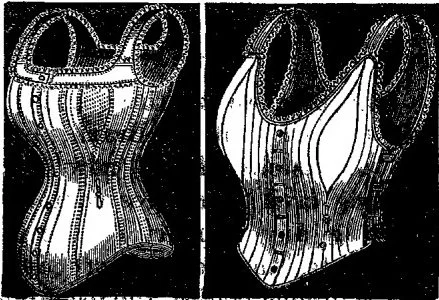
Freedom and grace of motion cannot be obtained by those wearing a stiff corset. Thousands of sensible women have laid aside their corsets and now wear our perfect substitute, “Madame Salisbury’s peerless corset waist,” or the hygienic bodice, perfect fitting, graceful, yet healthful.

LADY CANVASSERS

Make $5, to $8 per day selling our corsets, shoulder braces, skirt supporting bustles, etc., send two cent stamp for illustrated pamphlet “How to Dress Healthfully.”
LADIES’ ARTISTIC DRESS IMPR. CO., 27 Barbour St., BATTLE CREEK, MICH.

Joseph Cook on Sunday Rest and the Constitution

JOSEPH COOK says: “I hold that the Sabbath is recognized in the Constitution of the United States, for the President is required to sign bills within so many days Sundays excepted. Every one of us is entitled to the same day’s rest that he is. Still, so far as the State is concerned, I do not believe in enforcing the religious observance of the Sabbath, but only as a day of rest and quiet.”
But there is no law to prevent the President from signing bills upon Sunday if he desires to do so. There is, whether Mr. Cook acknowledges the fact or not, a vast difference between forbidding a man to do work on Sunday, and providing that he shall not be required to do any. California recognizes Sunday more fully than does the Constitution of the United States, and yet, Mr. Crafts and Mr. Cook, as well as a host of lesser Sunday-law lights constantly complain that that State has no Sunday law. They would not be satisfied with a statute declaring Sunday dies non.

Religious Liberty Association Versus the American Secular Union

In a recent appeal in behalf of that society, Ida C. Craddock, Corresponding Secretary of the American Secular Union, says: “How mistaken is your action in refusing to join the army of the American Secular Union, which is waging the only organized warfare against these would-be uniters of Church and State!”
Has the Secretary never heard of the work of the National Religious Liberty Association? With all due deference to the Secular Union, we must say that in the single year of its existence, the Religious Liberty Association has done more effective work against the “would-be uniters of Church and State,” in this country, than the Secular Union has ever done in twice the time, or ever can do; and this, for the simple reason that too much of the work of the Union takes the form of opposition to religion; while the Religious Liberty Association bases its opposition to Church and State union, upon the inalienable right of every man to profess any religion or no religion as he may elect, and that, absolutely free from any sort of State interference.

Wisconsin Republicans Renominate Hoard, Reaffirm Bennett Law

GOVERNOR HOARD has been renominated and the Bennett law re-affirmed by the Wisconsin Republicans. The Democrats have nominated Geo. W. Peck, and declared against the Bennett law. The action of the Republicans in indorsing the Bennett law is to be deplored, for it is certainly unworthy of the support of either of the great parties.

Brazil's New Constitution Secularizes the Government

THE purpose to thoroughly secularize the Government of Brazil, is shown in the provisions of the new Constitution, making civil marriages compulsory, prohibiting any support of the Church by the State, the control of cemeteries by any religious bodies, the teaching of religion in the public schools, the residence of Jesuits in the country, and the founding of new monastic orders. It will now be in order for National Reformers and Roman Catholics to unite in denouncing Brazil as “atheistic,” and her statesmen as the “enemies of all religion.”

Sunday Laws Based on Feeling, Not Logic

THE Christian at Work says: “Our Sunday laws are undoubtedly based upon feeling rather than laid along logical lines.” Yet in the same connection it attempts to justify the enforcement of such laws! Referring to this fact, a Western paper says: “Logic is reason; therefore to say that Sunday laws are not laid along logical lines, is to say that there is no reason in them. And in this age of boasted enlightenment, people will plead for rigid laws, against reason. The pitiful part of the matter is that while the laws themselves are based upon feeling, they are usually enforced with a total lack of feeling.”

Sentimentality and Legislation by Clamor Against Capital Punishment

REFERRING to those who demand the abolition of capital punishment, because of the scenes accompanying the first electrical execution, in this State, the Christian Advocate says: “They may succeed, for this is an age of sentimentality and ‘legislation by hurricane.’” This agrees exactly with the utterance of the Christian at Work concerning Sunday laws, namely, that such laws “are undoubtedly based upon feeling, rather than laid along logical lines.” This is true; we have legislation by clamor, and trial by clamor, and too often the only thing back of the clamor is a sickly sentimentalism as utterly foreign to sound reason as ice is to equatorial Africa.

Catholic Clergy Petition Los Angeles for Sunday Saloon Closing

THE Pearl of Days says that, “the Catholic clergy of Los Angeles, California, have joined with other citizens in the following petition:”—
To the Los Angeles City Council:
The undersigned earnestly petition your honorable body so to amend or enlarge our city ordinance that the saloons shall be closed not only on election days, but also on Sundays. In this movement, for the moral benefit of the people, we wish the public to understand that we are influenced by no political partisanship. FRANCIS MORA, Bishop. J. ADAM, Vicar-General, and all the other Roman Catholic clergymen of this city.
This is not to be wondered at, since the Baltimore Council declared in favor of high license and Sunday closing. The two measures are cut from the same web, namely, compromise with the saloon. They alike delay the final abolition of the evil.

Father Denied Guardianship Over Injured Child

A FEW weeks ago, a five-year-old boy was run over, in the streets of this city, and had both his legs crushed. Subsequently his father made application to one of the courts, to be appointed guardian for his own child, for the purpose of bringing a suit for damages, in behalf of the injured boy. The father’s application was denied, on the ground that he was not worth fifty dollars. It was shown that this father was a sober, industrious man, but that made not the slightest difference; he lacked the necessary property qualification, and could not, under the law as interpreted by the court, be permitted to enter suit in behalf of his minor child. Comment upon such a law is unnecessary. Every lover of justice and liberty will be able to characterize such a law himself, better than we could possibly do it. To say that it belongs with the most objectionable kind of class legislation, and that it is monstrously unjust is to put it very mildly.

Catholic Priest Indicted Over Ohio School Reporting Law

“THE school question,” says the Catholic Review, “is breeding difficulties with every hour. Following the troubles in Massachusetts, and Wisconsin, comes the news from Ohio, that a Catholic pastor in Toledo, has been indicted by the Grand Jury, ‘for misdemeanor, or for neglecting to report pupils to the Board of Education.’ There is an Ohio law, a meddlesome, impertinent law, of the same stamp as the Wisconsin Bennett law, conceived in the same spirit of malice, envy, and hatred, which requires all schools, public and private, to make a regular report to Boards of Education in each district, of the names of the pupils, ages, and so on. Acting under legal advice, the Toledo priest refused to make such returns from his private school, and his consequent arrest will test the constitutionality of the law, and make trouble for Ohio fanatics. These irritating questions are going to multiply.”

You have reached the end of this edition.

The American Sentinel · Sep 4, 1890