The Youth’s Instructor, Vol. 28, No. 42.

LOOKING FOR PAPA

The Youth’s Instructor

Oct 13, 1880

S. D. A. Publishing Association · Battle Creek, Mich. · Oct 13, 1880

LOOKING FOR PAPA.
Not long since, in traveling through the State of Iowa, I was obliged to go by stage from Elmwood to Niceville. All ready! shouted the driver, springing to his seat, and away we went, up hill and down, the driver cracking his whip, while the horses sprang forward, willing to do their best.
The scenery was pretty and varied, yet after a time I became tired of looking from the window so steadily, and commenced to scan the faces of my fellow-passengers . There was one who attracted and held my attention. He had a manly, noble face, kind and true. He sat in one corner with an expectant look, watching from the stage window as we rode along. I knew that he must be going to meet loved ones, and I followed the direction of his gaze, wondering if I should catch a glimpse of his treasures.
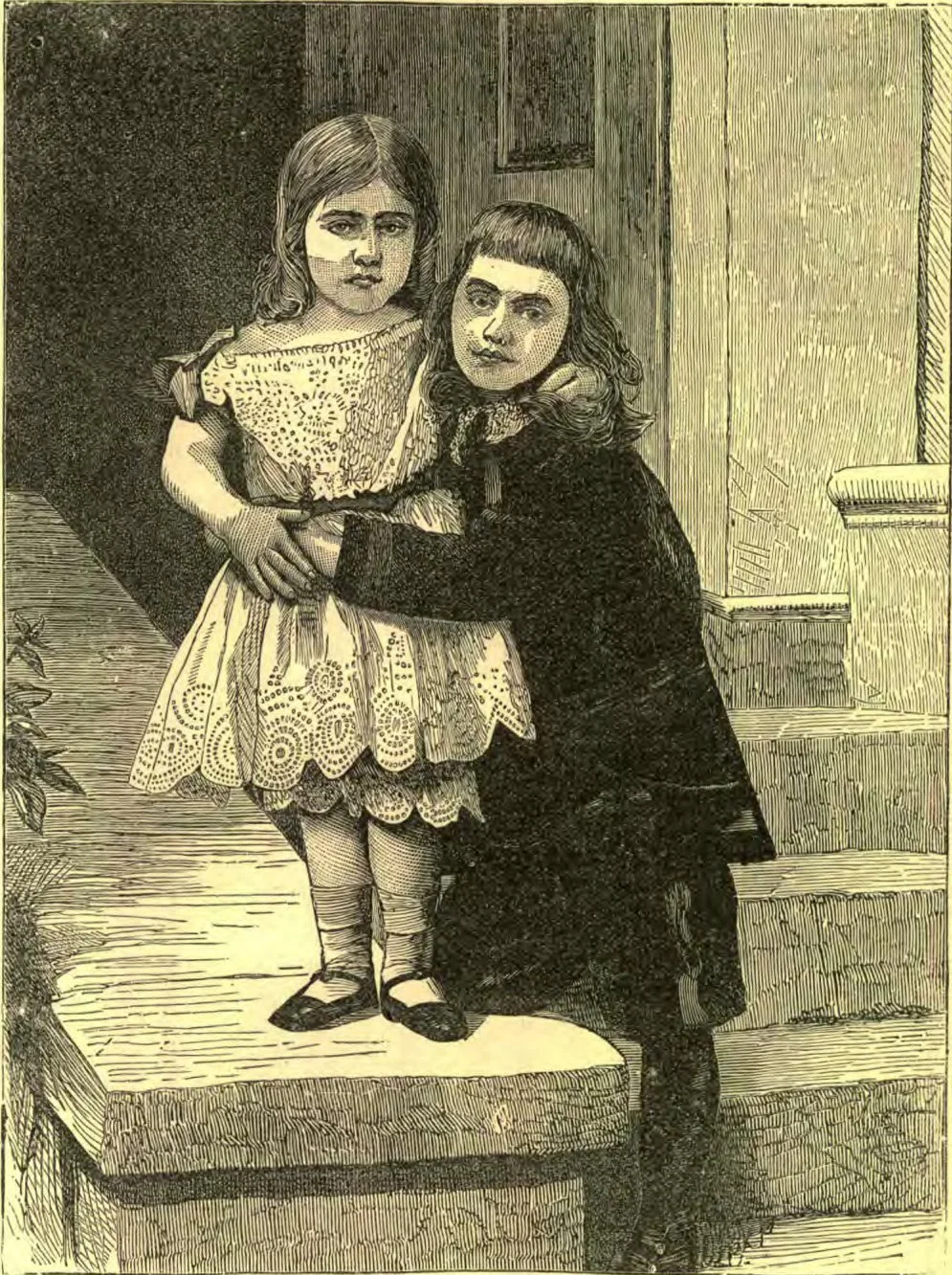
Slowly sank the sun, lower and lower, and the day was almost done. “Ah!” finally broke from his lips, as we came into the suburbs of Niceville, “there they are!” I looked, and there was indeed a picture to gladden the eyes of any parent. A tiny girl, in white dress, and with long golden curls, stood on the broad stone step, while a boy some years older stood with his arms around her, both eagerly looking for papa. “Papa has come! papa has come!” they shouted as he alighted from the stage; and with bounding feet they came to meet him .
It was hard to tell who had the greater joy, the children who were waiting for the father, or the father who came home to meet his children.
As we rode on through the quiet streets of the village, I thought of the pleasant scene that I had just witnessed, and how delightful it was to wait the coming of those we love! I thought of the many dear children who once watched for father, as these now do, but they can do it no more. Death has come to the house, and never again will they see their father’s face, or hear his welcome voice. Dear readers, you who have parents should be very thankful to God for them, and be kind and obedient to them. Y. A. M.

APPLES

One for you, and one for me, Ripe, and red as a rose can be; With a spicy breath like the airs that play On the blossoming gardens of fair Cathay.
This is the side where all day long Lingered the sunshine, clear and strong; Down to the very core, I know, Still is hoarded the summer glow.
I can tell you where they grew, By the orchard wall, where the brook comes thro', Crystal clear in the frost and rime, Lost in the grass in summer time.
This is the place where first in May Pale blue violets hide away, Half ashamed of their faces fair, When blossoms whiten the branches bare.
Gnarled and twisted the tree has grown, Leaning south as the wind has blown; Here and there are the scars that show Terrible winters of ice and snow.
Yet to the topmost bough in spring, Fair and tender the blossoms cling; Year by year, in its shelter wide, Callow nestlings the robins hide.
Year by year, when the summer days Melt and mellow in golden haze, Bright as jewels the apples shine, Swelling with autumn's odorous wine.
Leaning over the orchard wall, One by one, you may hear them fall; One by one, from the dear old tree That fed their sweetness for you and me. —Emily Huntington Miller.

MARTYRDOM BY HEROD.

Some years ago, there lived in the land of Judea a wicked king. His was a pleasant country, and peace and plenty had smiled upon it. But the day of which I write was a dark day, although Nature smiled as the sun’s first rays touched the fair hills of Judea. No dark, angry clouds disturbed the mild beauty of the fair blue sky. Gently glided the little brooks as they gracefully wound among the trees, whose bending branches were reflected upon the glassy surface. Sweetly caroled the birds of the forest, and everything united in speaking of the beauties of the day.
Many were the happy ones, who, scattered o’er Judea’s plains, welcomed this bright morn. No sad forebodings filled their hearts. Alas! they dreamed not of the dreadful scenes that this day’s sun would witness. In sweet and peaceful slumber they passed the night, all unconscious that from the kingly halls of Herod had gone forth the bloody mandate that was to spread terror, desolation, and death, throughout all the land of Judea.
The prophet had foretold, years before, that about this time, in the land of Judea, there would be a child born who should be king. When Herod learned that the time had come, and that this child was born, he sent forth and slew all the children in Bethlehem under two years of age. The soldiers were not slow in executing the commands of this wicked king. Throughout Bethlehem and all the coasts thereof, these unfeeling soldiers went, marking their footsteps with the blood of spotless infancy. Not gently does the silver cord of life loose its hold, but rashly, cruelly it is rent asunder. No more is the innocent prattle of Bethlehem’s children heard; it has been changed to the wild cry of the mothers. “In Rama was there a voice heard, lamentation, and weeping, and great mourning; Rachel weeping for her children, and would not be comforted, because they are not.”
From every turf, drenched with the blood of earth’s innocent ones, there comes a voice calling in loud tones for vengeance upon one of the darkest crimes that stain the pages of history. Many are the lords and tyrants who have dyed their hands and satiated their thirsty spirits with human blood; but none, save this wicked king, ever waged merciless war against innocent babes.
But far from these scenes of death the infant King is borne. Egypt receives the Lord and King of Heaven and earth; and while many babes “sleep the sleep that knows no waking,” the Saviour is safely cradled in his mother’s arms, secure from the power of the haughty tyrant, who would that not only every creature, but the Creator also, should bow to his will.
MARY L. WILLIAMS.

KEEPING HIS WORD.

“Come, Ned, let’s go nutting. It’s just the best day,” cried Joe Richards to his chum, Ned Hartz, one beautiful October day.
“All right,” replied Ned, “just wait till I go in and tell mother where I’m going.”
He was just rushing out of the door, basket in hand, when his little brother Frank came round the corner of the house.
“O Neddie, let me go!” he cried; “I’ll be good; do, please!”
Ned gave a look at Joe.
“Yes, let him come; but we must hurry, for we’ve got to meet the Ford boys down street.”
“Now, Ned, promise me you will keep Frankie with you all the time,” said Mrs. Hartz anxiously, “or I shall worry about him.”
“Yes, mother, I promise,” he said.
Mrs. Hartz looked fondly after them. “Dear Ned,” she said to herself, “he is always to be trusted.”
The boys had gone but a short distance when they overtook the Ford boys, who were to be their companions on the expedition. It was about three miles to the woods, but by the time they had gone two, Frank began to complain of how tired he was.
“O Neddie, my feet ache so I can’t go any farther,” he said at last, throwing himself down on the ground.
“But we’ll be there before long; can’t you keep up one more mile?” Ned asked him kindly.
“No, I want to go home to my mother,” sobbed the child.
Ned looked sober. “Well, boys,” he said, “I don’t see but that I shall have to go home. I ought to have thought that Frank was too small to walk so far.”
“Can’t we carry him a little way?” Joe asked. “I’ll help.”
“No,” said Ned, “he’d have to walk all the way back, for our baskets will be full then.”
“Yes, that’s so,” assented Joe.
“Oh, come on!” said Tom Ford. “Let the little chap go home alone. It’s a straight road, and he couldn’t lose his way.”
“No, I promised mother to keep him with me,” said Ned stoutly; “and besides, he wouldn’t dare go back alone. There is no need of my keeping you waiting any longer, for I must go, there’s no question about it.”
So saying, he took Frank’s hand, and turned homeward.
“Well, I think you’re foolish,” said Sam Ford. “I wouldn’t do it, but there’s no changing your mind when once you’ve made it up.”
“Not when he’s in the right,” said Joe, standing up for his friend.
Frank said so much about being tired that Ned made him get on his back and ride most of the way; and as the little fellow was pretty heavy, he was glad to reach home at last.
“Why, boys!” said their mother as they came in, “aren’t you home early?”
“We didn’t go,” cried Frank, “and Neddie bringed me home on his back;” and then out came the whole story. When it was through, Mrs. Hartz kissed Ned warmly, saying, “I always knew I could trust you, Ned, but now I have an additional proof of it. I am proud of you, my boy.”
And Ned was much happier for keeping his word, I think, don’t you?—M. E. H., in Young Pilgrim.

THE SWEET-BRIER.

OUR sweet autumnal western-scented wind Robs of its odors none so sweet a flower, In all the blooming waste it left behind, As that the sweet-brier yields it; and the shower Wets not a rose that buds in beauty’s bower One-half so lovely; yet it grows along The poor girl’s pathway, by the poor man’s door,— Such are the simple folks it dwells among; And humble as the bud, so humble be the song.
I love it, for it takes its untouched stand Not in the vase that sculptors decorate; Its sweetness all is of my native land; And e’en its fragrant leaf has not its mate Among the perfumes which the rich and great Buy from the odors of the spicy East. You love your flowers and plants, and will you slight The little four-leaved rose that I love best, That freshest will awake, and sweetest go to rest? —Brainard.

CHURCH MANNERS.

BE ON TIME. No one has a right to disturb a congregation or a preacher by being tardy.
Never look around to see who is coming in when the door opens. It diverts your own and others’ attention from the exercises, and is discourteous to the leader.
Never talk or whisper in church, especially after the exercises are opened.
Never pull out your watch to see what time it is when the text is announced, or during the sermon. Better to feed on a sermon than to time it.
Never lean your head on the pew rail before you, as though indifferent to the preacher.
Conform, if possible in conscience, to the usages of the church in which you worship,—kneel, stand, bow, accordingly.
Never manifest your disapprobation of what is being said by unpleasant sounds, or signs, or by hastily leaving.
Do not fidget, as though the service were a weariness. Be quiet and decorous to the very end.
Do not put on your overcoat or adjust your wrappings till after the benediction.
No gentleman ever defiles a place of worship with tobacco.
Never be one of a staring crowd about the door or in the vestibule, before or after service.
Do nothing out of keeping with the time, place, and purpose of a religious assembly.—Tomlinson’s Handy-book.

LESSONS FOR CHILDREN.

LESSON XCIV.—DANIEL'S VISIONS.

In the first year of the reign of King Belshazzar, Daniel had a vision. In this vision he saw four beasts come up out of the sea. The first was like a lion, with the wings of an eagle. This beast was meant to represent the Babylonian kingdom.
The second beast was like a bear, and was meant to represent the Medo-Persian kingdom; that is, the kingdom of the Medes and the kingdom of the Persians united.
The third beast represented the Grecian kingdom. It was like a leopard, with four heads and four wings.
The fourth beast was not like any beast known. It had ten horns, great iron teeth, and nails of brass. The prophet says it was “dreadful and terrible and strong exceedingly.” This beast represented the Roman kingdom, which was so warlike, and conquered so many nations of the earth.
Then Daniel had a view of the Judgment. He saw the great God, here called the Ancient of Days, sitting on a throne so glorious that it looked like flaming fire. A countless multitude of angels stood before him; and Daniel says, “The Judgment was set, and the books were opened.” These books contain the record of men’s lives, and out of them we shall all be judged, according to the deeds done in the body. He was also shown that the wicked are to be destroyed by fire; and that finally Jesus Christ—the same who was born in Bethlehem, baptized in Jordan, and crucified on Calvary; who preached in Palestine, causing the lame to walk and the blind to see, and who ascended to heaven in the sight of his disciples,—that this same loving Saviour is to take the kingdom, and rule over it forever and ever.
In the third year of Belshazzar, Daniel had another vision. In this vision the Medo-Persian kingdom was represented by a ram. Daniel saw a goat with a great horn between his eyes come against the ram, and destroy him. The goat represented the Grecian kingdom; and the horn between his eyes represented Alexander the Great, who, more than two hundred years after Daniel saw the vision, marched with an army into the Persian country, conquered the Persian king, and took the kingdom to himself. But this notable horn was broken, and in its place came up four. This was meant to represent Alexander’s death, and the division of his empire into four parts. But there was still another change; for out of one of these came forth a little horn, which “waxed exceeding great.” This denoted Rome, which finally became the strongest kingdom that there has ever been upon the earth. In this same vision, Daniel was told something about the cleansing of the heavenly sanctuary, but he did not understand it very well; for before the angel came to the explanation of this part of the vision, Daniel fainted.

QUESTIONS.

  1. When did Daniel have his first vision? Dan. 7:1.
  2. What did he see in this first vision?
  3. What was the first beast like?
  4. What was it meant to represent?
  5. What was the second beast?
  6. What did it represent?
  7. What did the third beast represent?
  8. What was it like?
  9. Had Daniel ever seen anything like the fourth beast?
  10. Describe its horns, teeth, and nails.
  11. What does the prophet say of it?
  1. What did this beast represent?
  2. For what was the Roman kingdom noted?
  3. Of what did Daniel then have a view?
  4. Who sat as judge?
  5. How glorious was his throne?
  6. Who stood before him?
  7. What more does Daniel say of it?
  8. What do these books contain?
  9. How are we concerned in the record contained in these books?
  10. What was Daniel shown in regard to the wicked?
  11. What was he shown in regard to Jesus Christ, our loving Saviour?
  12. Had our Lord been upon the earth when Daniel had this vision?
  13. How long was it before Jesus was born at Bethlehem?—A little more than five hundred and fifty years.
  14. When did Daniel have another vision?
  15. How was the Medo-Persian kingdom represented in this vision?
  16. What did the prophet see coming against the ram?
  17. What did this goat do to the ram?
  18. What did the goat represent?
  19. What was denoted by the horn between his eyes?
  20. What was done by Alexander the Great?
  21. How long was this after Daniel saw the vision?
  22. What change was seen to take place in this horn?
  23. What was this meant to represent?
  24. What further change was finally noticed?
  25. What was represented by this little horn which waxed so great?
  26. How strong did the Roman kingdom become?
  27. What else was told to Daniel in this vision?
  28. Did he understand this very well?
  29. Why not?

BIBLE LESSONS FOR YOUTH.

LESSON CXX.—REVIEW OF LESSONS CXVII-CXIX.

1. Who were the parents of John the Baptist?
2. In what part of Palestine did they reside?
3. How was his birth announced?
4. By what miracle were the angel's words confirmed?
5. Where was Christ born?
6. How was the news of his birth spread abroad?
7. How did the shepherds learn of his birth?
8. When he was presented at the temple, what testimony was borne in regard to his being the Messiah?
9. What caused Joseph and Mary to flee with him to Egypt?
10. How did they know when to return?
11. Why did they go to Nazareth to dwell?
12. By what incident were Christ's wonderful powers made manifest when he was about twelve years of age?
13. What record have we to show his observance of the fifth commandment?
14. How and when did the reign of Archelaus terminate?
15. How was the prophecy of Genesis 49: 10 fulfilled?
16. Since Christ was baptized at the beginning of A. D. 27, and Augustus Cæsar died A. D. 14, how do you harmonize the statement made by Luke that John began to preach in the fifteenth year of Tiberius Cæsar?
17. What was the burden of John's preaching?
18. What did he claim to be?
19. How did he reprove the Pharisees and Sadducees that came to his baptism?
20. What practical instruction did he give to different classes of people?
21. What testimony did he bear in regard to Christ?
22. Describe the baptism of our Saviour.
23. What evidences of his Messiahship were given on this occasion?
24. Describe the temptations of Christ in the wilderness.
25. What important lessons may we learn from this account?
26. Describe the calling of the first disciples.
27. Give an account of Christ's first miracle.
28. Where did Christ immediately after this take up his abode for a short time?
29. What great national feast did Christ now attend?
30. Tell how he purified the temple at this passover.
31. What did the Jews demand of him?
32. What sign did he give them?
33. What did the Jews say?
34. To what event did he refer?
35. When was this all made plain to his disciples?

NOTES ON BIBLE LANDS.

SOURCES OF THE JORDAN.

The Holy Land is almost as remarkable in its physical features as in its history. From the eastern arm of the Red Sea, called the Gulf of Akaba, a deep, narrow valley extends northward for more than five hundred miles, terminating near Antioch, which is not far from the north-eastern angle of the Mediterranean Sea. The southern part of this valley extends through that “great and terrible wilderness” where the Israelites wandered for nearly forty years. The middle and deepest portion extends through Palestine from north to south, separating it into two divisions, one lying on the east and the other on the west. Through this part of the valley the Jordan River flows to the Dead Sea, which lies thirteen hundred feet below the level of the ocean. This stream is said to be without a parallel, whether physically or historically considered.
The northern part of the valley lies between the two mountain ranges called Lebanon and Anti-Lebanon. It is drained by two streams,—the Orontes, flowing northward, and the Leontes, flowing southward. Both these streams, turning abruptly to the west, break through the mountains, and discharge their waters into the Mediterranean Sea, the Leontes passing through a chasm of frightful depth. As this stream turns to the westward, it leaves, to the east and south-east, a mountainous ridge. The drainage from the eastern slope of this ridge, and the western slope of Anti-Lebanon, forms, in the wet season, a dashing stream, called the Hasbany. This is by far the longest branch of the Jordan, although it furnishes the least water, for at some seasons it is for twenty or thirty miles nothing but a dry torrent-bed. Mr. J. Macgregor, who explored this stream in 1869, says:—
“Young Jordan is like the prettiest tiny stream in Scotland, with white hollowed rocks and weird caverns; but the gravel is prettier here than in my own land, pebbles of yellow and bright blue, banked in by fruitful loam of a deep, rich red, and all so silent and unaffected. So it winds until steeper rocks gird the water, narrowing where wild beasts’ paws have marked the sand. Farther down, a bold cliff dips into a pool of deepest green. . . . Just opposite the cliff, and a few yards away, is a three-cornered island of sand and small gravel, with many low bushes on it, and luxuriant spotted clover, and under and from out these there bubbles, gurgles, and ascends the first undoubted subterranean source of the Jordan. There are about twenty of these curious fountains on this islet, and the water runs from them in all directions. . . . The island and the rocks near it are formed into a weir, for the terribly practical purpose of supplying a mill. Perish all the mills and millstones that spoil the birthplace of such a stream!”
Of the same stream a little farther down, he says, “The river bends below the bridge with all the waywardness of a trout stream in the Highlands. Thick trees hang over its clear surging waters, and reeds, twenty feet high, fill the bays; while rocks, and a thousand hanging, straggling creepers on them, tangle together over silent pools.”
About a mile and a half from the south-west corner of Mt. Hermon, is a cup-shaped hill, thickly covered with shrubs, and bearing the modern name of Tell-el-Kady, Hill of the Judge. It stands on the northern border of a rich plain, which falls off gently southward to the marshes above Lake Huleh. This hill was the site of ancient Dan, where Jeroboam set up one of his golden calves.
This mound gives birth to the most copious source of the Jordan. From its top and western side bursts forth “an immense stream of the most limpid water,”—a river which “drives two mills, and furnishes water-power enough for any number.” This is said to be the largest water source in the world. The waters first gather into a circular basin a hundred feet wide, whence they break, a turbulent river, which goes foaming and dashing away to the plain, mostly hidden from view by the dense thickets that enshroud it. This stream is called the Leddan.
But the most beautiful source of the Jordan remains yet to be described. It issues from a wide and lofty cavern three or four miles east of Tell-el-Kady, and just at the foot of Mt. Hermon. Immediately above the cave rises a “steep-faced cliff, about eighty feet high, much scathed by weather and cut about by man.” Near by are the ruins of the ancient city of Cæsarea Philippi. One says that “from the midst of these ruins”—which choke the mouth of the cave—“and from numerous chinks in the surrounding rocks, the waters of the great fountain gush forth. They collect a short distance below, and form a rapid torrent, which leaps in sheets of foam down a rocky bed.”
Josephus, in describing this cave, says: “It is a very beautiful cave in the mountain, and under it a chasm of the earth and a steep abyss of enormous depth, full of standing water. Above impends a huge mountain, and below the cave spring forth the fountains of the river Jordan.” Here Herod built a temple, which he consecrated to Cæsar. The place is now called Banias, and the stream flowing from it the Baniasy. The Baniasy and the Leddan soon unite; and about a mile below the junction, the Hasbany contributes its sparkling waters. Thus the river Jordan is formed; and flows on through marshy lands to Lake Huleh, and thence by a rapid descent to the Sea of Galilee.
G. H. BELL.

MADGE’S PARTY.

’Twas a cloudy autumn day, And Madge by the window stood; She could not go out to play, And must be real quiet and good; For the baby was fast asleep, And mamma was “busy,” she said, So Madge stood watching the falling leaves From the tree-boughs overhead.
“How pretty they look!” thought Madge As the bright leaves floated down In red, and yellow, and green, And many a shade of brown; “They come in groups and pairs, Like girls to a party,” said she. “I know those two that are just alike,— They’re Bessie and Annie Lee.”
“That girl in brown and red Is Anna Matilda Low, That big brown leaf is cousin Fred, And the little brown one is Joe. That’s I in my red dress,” As a bright leaf floated down, “I wore that dress to a party once,— Brother Ned’s suit was brown.”
LITTLE MADGE.
LITTLE MADGE.
“Here come two yellow ones And a large one in spotted green, I know them all; there’s Jennie Mills, And Clara and Katie Dean. There’s one that stays alone Though the others keep passing by; That’s Edith Maclay,—we think she’s proud, But mother thinks she’s shy.”
The light leaves move with the wind, Now retreat, and again advance. “How pretty they look!” cried Madge, “As though they were having a dance, Or playing some game in a ring Where they move to the sound of a song, And every one joins merrily in.” And still the wind blows them along.
More sudden and strong it blows On the frolicsome leaves at play, Till only the coping of stone Keeps them from blowing away. From side to side they rush, And merrily frisk about; “That’s blindman’s buff,” said Madge to herself, As she watched the rush and rout.
Down dropped the autumn rain And soon the leaves were laid; “Now they’ve sat down to eat,” said she, “And all their games are played.” But deeper grew the gloom Of the rain-clouds overhead, And darker and darker all around The evening shadows spread.
“I guess the party is gone. I cannot see them,” said she, “No; not a single one. It is getting so late, you see, That the visitors are not there, Their papas have taken them home. Well, now, is not this very queer! Here’s my papa just come!”
And “How is my Madge?” he cries; What makes her look so gay? How merry her sparkling eyes On this dismal autumn day! The wind, and the falling leaves, And the chilly rain at night,— It cannot be that any of these Have made her look so bright!”
“Why, the leaves had a party, papa, And I watched them. It was such fun To see them coming by twos and threes, And sometimes one by one! And I was there, and Ned, And lots of the girls from school; They all played games and danced; Oh! wasn’t it beautiful! They all went home in the dark After they had their tea; And it happened so funny, you know, That you’ve just come for me.”
As he kissed the dimpled cheek And the forehead smooth and fair, There came a thought to the father’s heart,— A thought that turned to a prayer: “A cheerful spirit can still impart Light to the darkest day; She has brightened life with a happy heart, God grant she always may.”—Sel.

AN ENCOURAGING EXPERIENCE.

We commenced our Sabbath-school one year ago last March with only three children. We have only four children now that have Sabbath-keeping parents; the rest of our children come in from the outside, and their parents never attend. We have been slowly but steadily increasing until we have reached our present number, twenty-one, and now our Sabbath-school is very interesting. We have no church here; there are four churches in the town, Methodist, Congregational, Baptist, and Catholic. We are an organized class under the care of the Conference, but have heard only one sermon on present truth since last fall. We feel quite lonely sometimes, but are sure that the Lord is in the work here; for we know that without his help we should not have prospered as we have. We feel to trust in the Lord, who is strong and willing to help. Pray for us that we may succeed in building up the cause in S——, that the Lord will take hold of the work here, and that a people may be gathered out of the churches who will be ready when the Lord comes.
V—— H——.

System and Power in Sabbath-School Teaching

System in Sabbath-school teaching is a great deal, though not everything. Properly applied, it is doubtless the teacher's power over the class, and insures ultimate success in whatever is undertaken.

LETTER BUDGET.

May L. Parker, of Loyal, Wisconsin, sends a nice letter to the “Budget,” in which she says that she took the monthly INSTRUCTOR two years, but now she takes the weekly. She attends Sabbath-school, and learns the Lessons for Children. She is twelve years old, and has a brother seven years old.
Johnnie Bandy, of San Pasquall, California, writes us of his schools. He attends day-school and Sabbath-school. He likes to read all of the INSTRUCTOR, but the letters the best.
Mary M. Boise, of Loyal, Wisconsin, writes: “I am thirteen years old. I have to go six miles to Sabbath-school. I take the weekly INSTRUCTOR. I have no brothers nor sisters. Pray for me.”
Ida E. Potter, of West Hallock, Illinois, writes: “I like to read your little paper very much. I have written for the ‘Budget’ once before, but did not see my letter in the paper. I am eleven years of age. I am keeping the Sabbath with my parents. I had two little brothers who liked to attend Sabbath-school with me, but now they are dead. I am trying to live a Christian life.” We hope, dear Ida, that you will grow up to be a noble Christian woman. We know that we can wish nothing better for you.

You have reached the end of this edition.

The Youth’s Instructor · Oct 13, 1880